Introduction to
Problem Solving
andCritical
Thinking
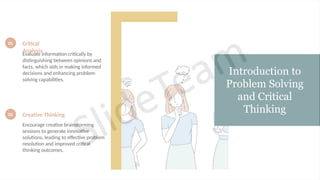
01 Critical
Analysis
Evaluate information critically by
distinguishing between opinions and
facts, which aids in making informed
decisions and enhancing problem-
solving capabilities.
02 Creative Thinking
Encourage creative brainstorming
sessions to generate innovative
solutions, leading to effective problem
resolution and improved critical
thinking outcomes.
3.
Importance of ProblemSolving Skills
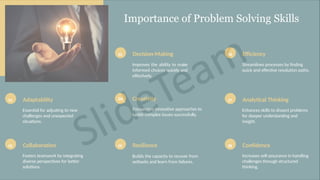
01 Adaptability
Essential for adjusting to new
challenges and unexpected
situations.
02 Collaboration
Fosters teamwork by integrating
diverse perspectives for better
solutions.
03 Decision-Making
Improves the ability to make
informed choices quickly and
effectively.
04 Creativity
Encourages innovative approaches to
tackle complex issues successfully.
05 Resilience
Builds the capacity to recover from
setbacks and learn from failures.
06 Efficiency
Streamlines processes by finding
quick and effective resolution paths.
07 Analytical Thinking
Enhances skills to dissect problems
for deeper understanding and
insight.
08 Confidence
Increases self-assurance in handling
challenges through structured
thinking.
4.
Understanding Critical ThinkingFramework
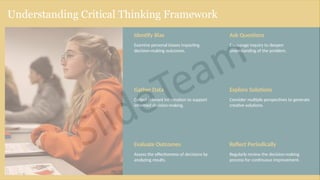
Identify Bias
Examine personal biases impacting
decision-making outcomes.
Ask Questions
Encourage inquiry to deepen
understanding of the problem.
Gather Data
Collect relevant information to support
informed decision-making.
Explore Solutions
Consider multiple perspectives to generate
creative solutions.
Evaluate Outcomes
Assess the effectiveness of decisions by
analyzing results.
Reflect Periodically
Regularly review the decision-making
process for continuous improvement.
5.
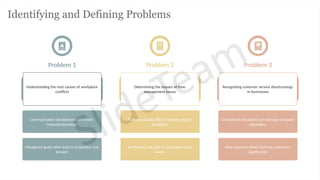
Problem 1 Problem2
Identifying and Defining Problems
Problem 3
Understanding the root causes of workplace
conflicts
Communication breakdowns can create
misunderstandings
Misaligned goals often lead to frustration and
tension
Determining the impact of time
management issues
Poor scheduling affects meeting project
deadlines
Inefficiency can lead to increased stress
levels
Recognizing customer service shortcomings
in businesses
Unresolved complaints can damage company
reputation
Slow response times frustrate customers
significantly
6.
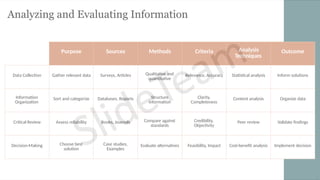
Analyzing and EvaluatingInformation
Purpose Sources Methods Criteria Analysis
Techniques
Outcome
Data Collection Gather relevant data Surveys, Articles Qualitative and
quantitative
Relevance, Accuracy Statistical analysis Inform solutions
Information
Organization
Sort and categorize Databases, Reports Structure
information
Clarity,
Completeness
Content analysis Organize data
Critical Review Assess reliability Books, Journals Compare against
standards
Credibility,
Objectivity
Peer review Validate findings
Decision-Making Choose best
solution
Case studies,
Examples
Evaluate alternatives Feasibility, Impact Cost-benefit analysis Implement decision
7.
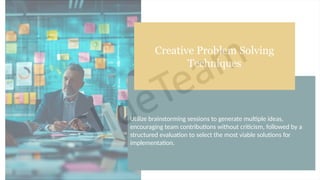
Creative Problem Solving
Techniques
Utilizebrainstorming sessions to generate multiple ideas,
encouraging team contributions without criticism, followed by a
structured evaluation to select the most viable solutions for
implementation.
8.
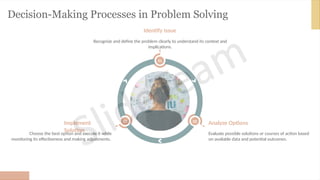
Decision-Making Processes inProblem Solving
01
Identify Issue
Recognize and define the problem clearly to understand its context and
implications.
02
Analyze Options
Evaluate possible solutions or courses of action based
on available data and potential outcomes.
03
Implement
Solution
Choose the best option and execute it while
monitoring its effectiveness and making adjustments.
9.
Common Challenges in
ProblemSolving
01 Limited Perspective
A narrow viewpoint can hinder exploring alternative
solutions, limiting overall problem-solving effectiveness.
02 Information Overload
Excessive data can create confusion, leading to indecision
and difficulty in identifying key issues.
03 Fear of Failure
Anxiety about making mistakes can prevent taking
necessary risks, stifling innovation and creative solutions.
10.
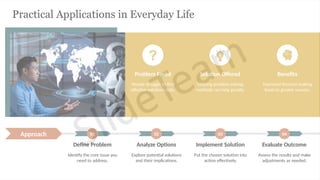
Practical Applications inEveryday Life
Problem Faced
People struggle to find
effective solutions daily.
Solution Offered
Utilizing problem solving
methods can help greatly.
Benefits
Improved decision making
leads to greater success.
Approach 01
Define Problem
Identify the core issue you
need to address.
02
Analyze Options
Explore potential solutions
and their implications.
03
Implement Solution
Put the chosen solution into
action effectively.
04
Evaluate Outcome
Assess the results and make
adjustments as needed.
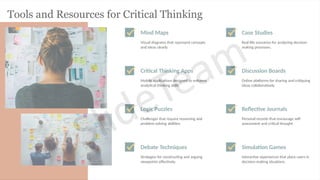
Tools and Resourcesfor Critical Thinking
Mind Maps
Visual diagrams that represent concepts
and ideas clearly.
Critical Thinking Apps
Mobile applications designed to enhance
analytical thinking skills.
Logic Puzzles
Challenges that require reasoning and
problem-solving abilities.
Debate Techniques
Strategies for constructing and arguing
viewpoints effectively.
Case Studies
Real-life scenarios for analyzing decision-
making processes.
Discussion Boards
Online platforms for sharing and critiquing
ideas collaboratively.
Reflective Journals
Personal records that encourage self-
assessment and critical thought.
Simulation Games
Interactive experiences that place users in
decision-making situations.
13.
Case Studies:
Successful Problem
Solving
ProblemFaced
The company faced declining sales for two quarters.
Solution Offered
Implemented a revamped marketing strategy targeting
new demographics.
Benefits
Increased sales by 25% within three months.
Best Practices forEnhancing Skills
01 Practice
Regularly engage in problem-
solving exercises daily to
sharpen your skills.
02 Reflect
Analyze past problems to
identify what worked and
what didn’t.
03 Collaborate
Work with others to gain
different perspectives on
problem-solving techniques.
04 Stay Curious
Constantly ask questions to
stimulate critical thinking and
creativity.
16.
Interactive Exercises andRole Playing
What strategies do you use for problem solving?
01
How do you approach critical thinking in teams?
02
Can you describe a time you solved a problem?
03
04 What challenges do you face in critical thinking?
05
How can role playing enhance your problem
solving?
17.
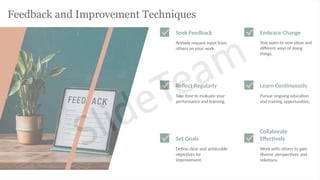
Feedback and ImprovementTechniques
Seek Feedback
Actively request input from
others on your work.
Reflect Regularly
Take time to evaluate your
performance and learning.
Set Goals
Define clear and achievable
objectives for
improvement.
Embrace Change
Stay open to new ideas and
different ways of doing
things.
Learn Continuously
Pursue ongoing education
and training opportunities.
Collaborate
Effectively
Work with others to gain
diverse perspectives and
solutions.
18.
Concluding Thoughts onProblem Solving
Effective Strategies
Utilize a variety of strategies to tackle
different problems effectively.
Collaborative Efforts
Engage in team discussions to enhance
problem solving through diverse
perspectives.
Iterative Process
Recognize that problem solving is often
an iterative and ongoing process.
Critical Thinking
Develop critical thinking skills to analyze
and evaluate information systematically.
Learning Mindset
Adopt a growth mindset to learn from
mistakes and improve future problem
solving.
Practical Application
Apply problem solving skills in real-world
scenarios for effective outcomes.
19.
Address
123 Problem St,Critical City,
CA
Email Address
contact@problemsolving.co
m
Contact Number
(555) 123-4567
Thank You
20.
Instructions to ChangeColor of
Shapes
Some shapes in this deck need to be ungrouped
to change colors
Step 1:
Select the shape,
and right click on
it
Step 2:
Select Group -
> Ungroup.
Step 3:
Once ungrouped,
you will be able
to change colors
using the “Format
Shape” option