TRAINER BRIEF
Tapajit Ghosh
Executive-HR& Admin
Prime Group of
Industries.
Experience: 4. 7 Years experience in HR field.
Academic Achievement:
▪ MBA: Major-HRM, Stamford University Bangladesh
▪ BBA: Major-HRM & Minor-Finance), UITS
▪ PGD: Risk and Compliance-Edu Pro-UK, ABP
Professional Training Achievement:
• CODP-Running.
• PcHRO -Running.
• PcOD]-WARD,
• Training of Trainer (TOT)-Minds Work
• Lean Practioner 1-Minds Work
• HR Accounting-HACS
• Labor Law-Advocacy
• Compensation & Benefits-Advocacy
3.
Training Topics WillCover Following Areas.
►Phase 1: Problem Solving.
►Phase 2: Problem Solving Strategies.
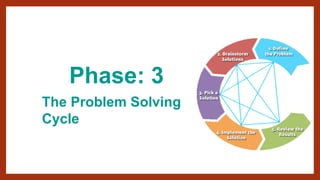
►Phase 3: The Problem Solving Cycle.
►Phase 4: Applying Critical Thinking To Everyday Problems.
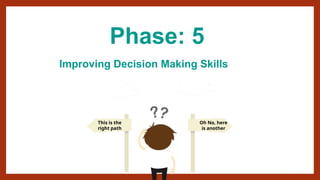
►Phase 5: Improving Decision Making Skills.
►Phase 6: Benefits of Improving Decision Making Skills.
►Phase 7: Discussion, Group/Team Work.
►Phase 8: Case Study.
►Phase 9: Game or Role Playing.
4.
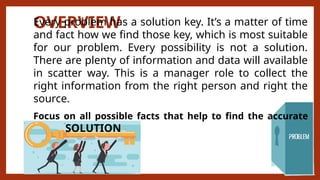
OVERVIEW
Every problem hasa solution key. It’s a matter of time
and fact how we find those key, which is most suitable
for our problem. Every possibility is not a solution.
There are plenty of information and data will available
in scatter way. This is a manager role to collect the
right information from the right person and right the
source.
Focus on all possible facts that help to find the accurate
solution.
SOLUTION
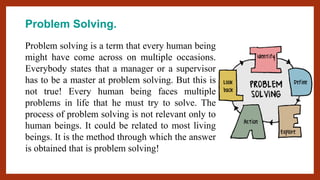
Problem Solving.
Problem solvingis a term that every human being
might have come across on multiple occasions.
Everybody states that a manager or a supervisor
has to be a master at problem solving. But this is
not true! Every human being faces multiple
problems in life that he must try to solve. The
process of problem solving is not relevant only to
human beings. It could be related to most living
beings. It is the method through which the answer
is obtained that is problem solving!
7.
What is problemsolving?
Problem solving is that term that has found its place in most fields. However, each of these fields has a
different perspective on what problem solving exactly is.
For example, in psychology problem solving would be defined as finding a solution to any mental
issues or processes where as in statistics it would be defined as a method to obtaining a solution for a
certain issue on how many fish are there in a lake.
Categories of problem solving.
1. Well defined problems. (solutions can be found easily)
These problems have well defined goals which make it easier to estimate the magnitude of the problem
and also identify feasible solutions to the same. We might also be able to plan in advance if we identify
such a problem.
2. ill – defined problems. (do not have a clear cut goal)
It makes it difficult to come up with solutions to such problems. You might not be able to identify an
expected solution. Well defined problems on the other hand are those problems to which
8.
Cont.
Problem Solving………… Psychology
Itrefers to the state where we desire to reach a goal for a present
condition that is close to the problem itself or near it or relatively far
off from the goal. We might use complex logic to understand the
condition and fill in the gaps if any in order to move closer to
achieving the goal.
However, problem solving is part of a big whole. We will first need to
find and understand the problem and then try to give the problem a
clear shape. Only then do we move into problem solving. Many
expertise, believed that human beings use self – introspection,
behaviorism and experimentation to find solutions of a problem.
9.
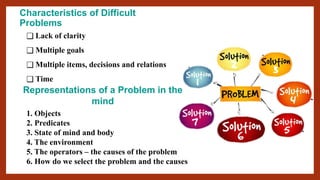
Characteristics of Difficult
Problems
❑Lack of clarity
❑ Multiple goals
❑ Multiple items, decisions and relations
❑ Time
Representations of a Problem in the
mind
1. Objects
2. Predicates
3. State of mind and body
4. The environment
5. The operators – the causes of the problem
6. How do we select the problem and the causes
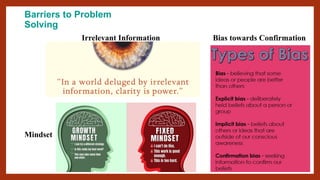
We have coveredthe different barriers that a person might face
when trying to solve a problem. We discuss few methods which is
most common strategies that have been used in the process.
Problem solving strategies are those steps that are used to identify
the problems that one faces while trying to achieve a goal. Here
are few problem solving strategies to discuss.
Problem Solving Strategies
1. Abstraction,
2. Brainstorming,
3. Hypothesis,
4. Testing,
5. Lateral Thinking,
6. Means End Analysis,
7. Analogy,
8. Proof,
9. Reduction &
10.Trial and Error
13.
Cont.
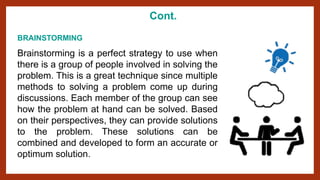
BRAINSTORMING
Brainstorming is aperfect strategy to use when
there is a group of people involved in solving the
problem. This is a great technique since multiple
methods to solving a problem come up during
discussions. Each member of the group can see
how the problem at hand can be solved. Based
on their perspectives, they can provide solutions
to the problem. These solutions can be
combined and developed to form an accurate or
optimum solution.
14.
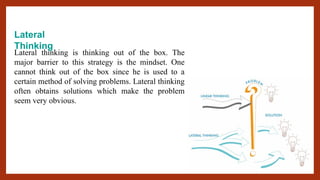
Lateral
Thinking
Lateral thinking isthinking out of the box. The
major barrier to this strategy is the mindset. One
cannot think out of the box since he is used to a
certain method of solving problems. Lateral thinking
often obtains solutions which make the problem
seem very obvious.
15.
Cont.
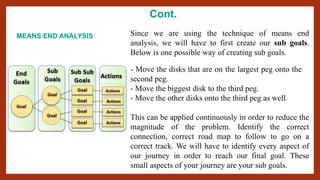
MEANS END ANALYSIS
Inmeans end analysis you create sub goals in order to reach the final goal. You try to
bridge the gap between the initial state and the final goal state. There are many
examples to this method of problem solving that are very popular. One of the best
examples is the ‘Towers of Hanoi’. While using this strategy you have to identify the
initial state and also your final goal.
The rules to this problem are:
- You can only do this by moving one disk at a time.
- You can only move a disk that is on top of the stack
- You cannot put a bigger disk on top of a smaller disk.
16.
Cont.
MEANS END ANALYSISSince we are using the technique of means end
analysis, we will have to first create our sub goals.
Below is one possible way of creating sub goals.
- Move the disks that are on the largest peg onto the
second peg.
- Move the biggest disk to the third peg.
- Move the other disks onto the third peg as well.
This can be applied continuously in order to reduce the
magnitude of the problem. Identify the correct
connection, correct road map to follow to go on a
correct track. We will have to identify every aspect of
our journey in order to reach our final goal. These
small aspects of your journey are your sub goals.
17.
Trial &
Error
Trial anderror is one of the most common
strategies that are used to solve problems.
However, this is very tedious and might take
a lot of time. You might not find the accurate
solution in the first go. The barrier, mindset,
might actually prove helpful in this situation.
You can use all the solutions that you are used
to in order to solve the problem at hand.
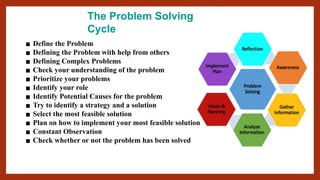
The Problem Solving
Cycle
▪Define the Problem
▪ Defining the Problem with help from others
▪ Defining Complex Problems
▪ Check your understanding of the problem
▪ Prioritize your problems
▪ Identify your role
▪ Identify Potential Causes for the problem
▪ Try to identify a strategy and a solution
▪ Select the most feasible solution
▪ Plan on how to implement your most feasible solution
▪ Constant Observation
▪ Check whether or not the problem has been solved
20.
Problem solving isusually looked at from two perspectives.
1. One solution to the problem that is at hand. (Mathematical problems are example)
This type of a perception is grounded by psychometric intelligence.
2. Solutions that constantly change. (socioemotional problems)
For example, your favorite color is a problem since it changes almost every day and it
might sometimes depend on your mood.
We might not know what we want or we might want so many things making it hard for us
to decide.
21.
The Problem Solving
Cycle
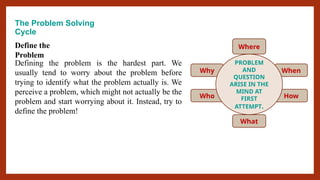
Definethe
Problem
Defining the problem is the hardest part. We
usually tend to worry about the problem before
trying to identify what the problem actually is. We
perceive a problem, which might not actually be the
problem and start worrying about it. Instead, try to
define the problem!
How
Why
Who
When
What
Where
PROBLEM
AND
QUESTION
ARISE IN THE
MIND AT
FIRST
ATTEMPT.
22.
Defining the Problemwith help from others
When you are trying to define the problem, you must ask yourself and others involved in
the problem the following questions.
a. What are the causes to the problem?
Might not identify the main causes as such but it is a start. Keep in mind that we are not
blaming somebody as a cause to the problem right at the beginning.
b. Where is the problem actually occurring?
c. How is the problem occurring?
d. At what times specifically is the problem occurring?
e. Who is the problem happening with?
f. Why is the problem arising?
Jot down the exact details as to why the problem is occurring. Finally, need a sheet of
paper and summarize the above answers. You could begin with “The following is not
happening because of “_______________”.
23.
Defining Complex Problems
Ifthe problem is overwhelming, we will have to break it down and make it simpler.
Since we are working with other people in identifying the problem, we will find it easy to
verify whether our understanding of the problem is the same as our colleagues/team mates.
Check your understanding of the problem
Prioritize your problems
We usually confuse important problems with urgent problems. We might have to deal with
multiple problems. But we cannot work on all the problems simultaneously since we
would not be doing justice to either problem at hand. What we could do is segregate these
problems into the categories of ‘Important’ and ‘Urgent’.
24.
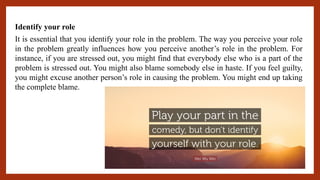
Identify your role
Itis essential that you identify your role in the problem. The way you perceive your role
in the problem greatly influences how you perceive another’s role in the problem. For
instance, if you are stressed out, you might find that everybody else who is a part of the
problem is stressed out. You might also blame somebody else in haste. If you feel guilty,
you might excuse another person’s role in causing the problem. You might end up taking
the complete blame.
25.
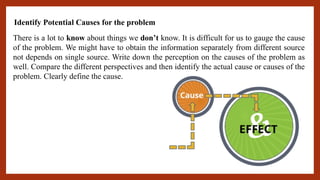
Identify Potential Causesfor the problem
There is a lot to know about things we don’t know. It is difficult for us to gauge the cause
of the problem. We might have to obtain the information separately from different source
not depends on single source. Write down the perception on the causes of the problem as
well. Compare the different perspectives and then identify the actual cause or causes of the
problem. Clearly define the cause.
26.
Try to identifya strategy and a solution
Need to defined the problem and also identified the causes to the problem. Focus on
identifying the solutions. If this is a problem we are facing, then use the strategy of
brainstorming or other methods to identify solutions that will help to solve the problem
with ease. We don’t use the same strategy if problem is different.
Cause one medicine can’t cure all diseases. At such a time, apply strategy that feel most
comfortable and most appropriate with.
27.
Select the mostfeasible
solution
We would have identified a lot of solutions to the specific problems through the step.
Now select the best approach to solving the problem. Consider the following when
identifying the best solution for the problem.
a. Which solution will solve the problem for the short term as well as the long term?
b. Are there any risks associated with the solutions?
c. Is it a realistic goal to use the solution to solve the problem?
d. Is it financially viable?
e. Do we have the time to solve the problem through this method?
28.
Plan on howto implement most feasible solution
The following section helps to plan on how to use the most feasible solution to solving a
problem.
a. Remember that there are two sides to a coin. In the same way there might be two sides
to a solution that is used to solve a problem. The solution could either create a good
effect or a bad effect. We will have to carefully consider the consequences – good or
bad – to the solution.
b. What steps should be taken to use this solution?
c. Are there any changes that might need to make in the systems?
d. Need to verify whether or not the steps in the solution are being addressed. This is a
check point..
e. Do you need any extra resources?
f. Need to schedule the entire approach. Must identify the time that will take to solve the
problem. Schedule must time box all your activities right from the start of the activity to
the end of the activity.
29.
g. Identify theperson who is responsible for ensuring that, plan takes perfect shape.
h. Create a separate plan in order to reach (Backup Plan)
This is the Plan of Action and will need to follow it word for word. The most important
thing to remember is that we must observe this plan continuously. We must be open to
taking feedback as well. If they identify that there is a certain aspect to the plan, give
feedback and make the necessary changes. You must also be open to taking feedback –
negative or positive. If Plan is not working then change the plan, not the Goal. That
way you will be able to come up with a fool proof plan!
30.
Constant Observation
We willhave to monitor the implementation of the solution closely. Create indicators at
every step in plan to identify the successes. We can frame these questions at every stage
to check whether achieved minor goals.
a. Are you happy with what you are receiving as an indicator? (Predict your chance of
wining)
b. You will have to see whether your plan is going according to the schedule. (Timing)
c. There might be times when the plan might not be working according to your
satisfaction. May we have to change or focus on SMART goals.
31.
We can alsouse the concept of SMART goals to create the perfect plan. This acronym
helps you create goals with ease. The words speak for themselves and do not require too
much of an explanation. You can use this as an alternative to create an easy and accurate
plan!
32.
Check whether ornot the problem has been solved
This is the final step to the problem solving cycle! This one step gives all the joy in the
world since it bears the fruit of the hard work. One of the best ways to check whether the
problem has been resolved is to revert back to the regular flow in the organization.
Although the problem has been solved, there are some aspects to consider:
a. What can be done to avoid similar problems like the one faced in the future?
Do changes have to be made to existing policies, technologies, and work ethics?
b. Identify the learning from the entire process.
Mat we identified solutions for problems that have not taken shape yet. We must keep a
tab on all the learning in order to safeguard your organization.
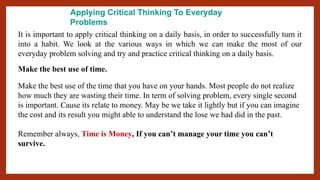
Applying Critical ThinkingTo Everyday
Problems
It is important to apply critical thinking on a daily basis, in order to successfully turn it
into a habit. We look at the various ways in which we can make the most of our
everyday problem solving and try and practice critical thinking on a daily basis.
Make the best use of time.
Make the best use of the time that you have on your hands. Most people do not realize
how much they are wasting their time. In term of solving problem, every single second
is important. Cause its relate to money. May be we take it lightly but if you can imagine
the cost and its result you might able to understand the lose we had did in the past.
Remember always, Time is Money, If you can’t manage your time you can’t
survive.
35.
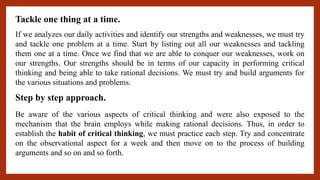
Tackle one thingat a time.
If we analyzes our daily activities and identify our strengths and weaknesses, we must try
and tackle one problem at a time. Start by listing out all our weaknesses and tackling
them one at a time. Once we find that we are able to conquer our weaknesses, work on
our strengths. Our strengths should be in terms of our capacity in performing critical
thinking and being able to take rational decisions. We must try and build arguments for
the various situations and problems.
Step by step approach.
Be aware of the various aspects of critical thinking and were also exposed to the
mechanism that the brain employs while making rational decisions. Thus, in order to
establish the habit of critical thinking, we must practice each step. Try and concentrate
on the observational aspect for a week and then move on to the process of building
arguments and so on and so forth.
36.
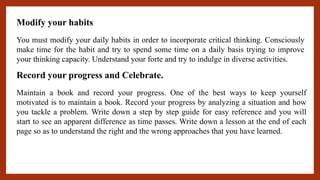
Record your progressand Celebrate.
Maintain a book and record your progress. One of the best ways to keep yourself
motivated is to maintain a book. Record your progress by analyzing a situation and how
you tackle a problem. Write down a step by step guide for easy reference and you will
start to see an apparent difference as time passes. Write down a lesson at the end of each
page so as to understand the right and the wrong approaches that you have learned.
Modify your habits
You must modify your daily habits in order to incorporate critical thinking. Consciously
make time for the habit and try to spend some time on a daily basis trying to improve
your thinking capacity. Understand your forte and try to indulge in diverse activities.
37.
Tackle your autopilotmode.
We must learn to tackle the auto pilot mode and try to stop taking unconscious decisions.
Before we arrive at a solution and implement it, spend some time to evaluate whether, we
are subconsciously taking the decision. If we are, then analyze the situation again and
apply critical thinking. We have to try and have a control over our mind to the highest
possible level in order to think critically, every single time.
Change perspective.
We must change our perspective every now and then. When faced with a problem that
involves another person, try and think of it from their point of view as well. That will
allow you to arrive at a decision at a faster pace.
For example, Every coin has two side, so if we able learn how think others point of view
may it will benefits us. That way, we will derive dual benefits. Not only will we save
time but we will also be able to increase our critical thinking skills.
38.
Be reasonable/ practical.
Inall of our critical thinking practice, we have to be reasonable and practical to the
farthest extent. Although it is advised for all to make a list of all abstract solutions as
well, just to build a counter argument to your feasible solutions, it is recommended that
we all be as reasonable as possible. If you assume that by thinking in extremes, you will
be able to devise quick solutions that will not fail you then you might be thinking
wrongly. Although critical thinking does encourage creativity, it does not do it to an
extent that allows you to be vague. You have to work within acceptable limits and be able
to find contradictions, which will help you deduce the right solution.
Have a partner.
When we take up something new, it is advisable that we must keep a partner to assist us.
Not only for remain motivated but also have the opportunity to enact the various
problems and help to find feasible solutions. And if we can do it with someone that we
trust or who believe in us as leader or best friend, then we will help each other to
develop mental sharpness.
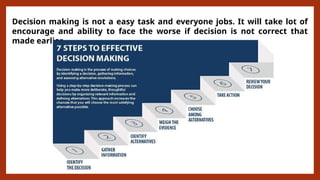
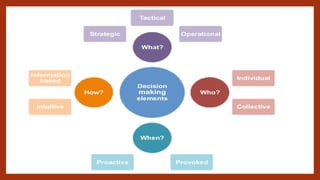
Decision making isnot a easy task and everyone jobs. It will take lot of
encourage and ability to face the worse if decision is not correct that
made earlier.
42.
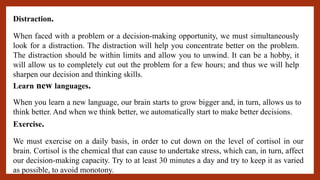
Distraction.
When faced witha problem or a decision-making opportunity, we must simultaneously
look for a distraction. The distraction will help you concentrate better on the problem.
The distraction should be within limits and allow you to unwind. It can be a hobby, it
will allow us to completely cut out the problem for a few hours; and thus we will help
sharpen our decision and thinking skills.
Learn new languages.
When you learn a new language, our brain starts to grow bigger and, in turn, allows us to
think better. And when we think better, we automatically start to make better decisions.
Exercise.
We must exercise on a daily basis, in order to cut down on the level of cortisol in our
brain. Cortisol is the chemical that can cause to undertake stress, which can, in turn, affect
our decision-making capacity. Try to at least 30 minutes a day and try to keep it as varied
as possible, to avoid monotony.
43.
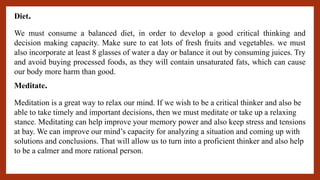
Diet.
We must consumea balanced diet, in order to develop a good critical thinking and
decision making capacity. Make sure to eat lots of fresh fruits and vegetables. we must
also incorporate at least 8 glasses of water a day or balance it out by consuming juices. Try
and avoid buying processed foods, as they will contain unsaturated fats, which can cause
our body more harm than good.
Meditate.
Meditation is a great way to relax our mind. If we wish to be a critical thinker and also be
able to take timely and important decisions, then we must meditate or take up a relaxing
stance. Meditating can help improve your memory power and also keep stress and tensions
at bay. We can improve our mind’s capacity for analyzing a situation and coming up with
solutions and conclusions. That will allow us to turn into a proficient thinker and also help
to be a calmer and more rational person.
44.
Social life.
In orderto have increased mental development, we have to have an extensive social life.
We have to have a big friend circle and also try and have friends of all ages. When we
interact with such a wide group of people, we develop the tendency of thinking at all
levels. We will be capable of understanding and analyzing a situation from the various
lenses and be able to set a large argument base. We can indulge in small talk with
strangers, in order to expand our social circle.
Read.
To be very honest, this is one of the most ideal ways to expand our mental capacity. We
have to read on a daily basis, in order to understand the various ways in which we can
increase our potential. We must read the newspaper daily and be up to date with all the
latest news. You must also read books of all types.
45.
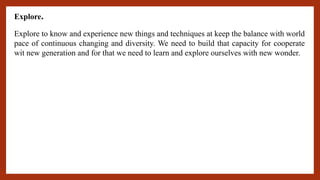
Explore.
Explore to knowand experience new things and techniques at keep the balance with world
pace of continuous changing and diversity. We need to build that capacity for cooperate
wit new generation and for that we need to learn and explore ourselves with new wonder.
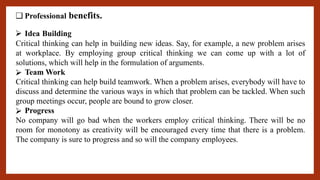
❑ Professional benefits.
⮚Idea Building
Critical thinking can help in building new ideas. Say, for example, a new problem arises
at workplace. By employing group critical thinking we can come up with a lot of
solutions, which will help in the formulation of arguments.
⮚ Team Work
Critical thinking can help build teamwork. When a problem arises, everybody will have to
discuss and determine the various ways in which that problem can be tackled. When such
group meetings occur, people are bound to grow closer.
⮚ Progress
No company will go bad when the workers employ critical thinking. There will be no
room for monotony as creativity will be encouraged every time that there is a problem.
The company is sure to progress and so will the company employees.
48.
⮚ Client Building
Byproviding meaningful and feasible solutions to clients, we will increase our customer
base. And by doing so, we will increase our profits and allow our business to grow. Our
customers and clients will be appreciative of your lateral and “out of the box” thinking
methods in providing them with quick solutions and, through word of mouth, our business
will grow.
49.
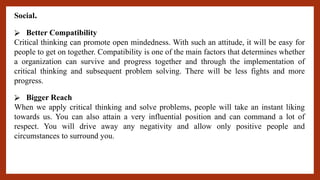
Social.
⮚ Better Compatibility
Criticalthinking can promote open mindedness. With such an attitude, it will be easy for
people to get on together. Compatibility is one of the main factors that determines whether
a organization can survive and progress together and through the implementation of
critical thinking and subsequent problem solving. There will be less fights and more
progress.
⮚ Bigger Reach
When we apply critical thinking and solve problems, people will take an instant liking
towards us. You can also attain a very influential position and can command a lot of
respect. You will drive away any negativity and allow only positive people and
circumstances to surround you.
50.
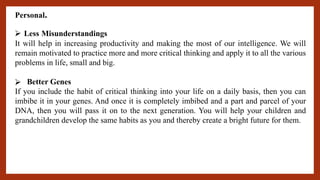
Personal.
⮚ Less Misunderstandings
Itwill help in increasing productivity and making the most of our intelligence. We will
remain motivated to practice more and more critical thinking and apply it to all the various
problems in life, small and big.
⮚ Better Genes
If you include the habit of critical thinking into your life on a daily basis, then you can
imbibe it in your genes. And once it is completely imbibed and a part and parcel of your
DNA, then you will pass it on to the next generation. You will help your children and
grandchildren develop the same habits as you and thereby create a bright future for them.


![TRAINER BRIEF
Tapajit Ghosh
Executive-HR & Admin
Prime Group of
Industries.
Experience: 4. 7 Years experience in HR field.
Academic Achievement:
▪ MBA: Major-HRM, Stamford University Bangladesh
▪ BBA: Major-HRM & Minor-Finance), UITS
▪ PGD: Risk and Compliance-Edu Pro-UK, ABP
Professional Training Achievement:
• CODP-Running.
• PcHRO -Running.
• PcOD]-WARD,
• Training of Trainer (TOT)-Minds Work
• Lean Practioner 1-Minds Work
• HR Accounting-HACS
• Labor Law-Advocacy
• Compensation & Benefits-Advocacy](https://image.slidesharecdn.com/problemsolvingdecisionmakingtraining-250227095247-f24d1b56/85/Problem-Solving-Decision-Making-Training-pptx-2-320.jpg)