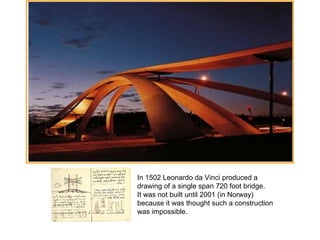

In 1502 Leonardo da Vinci produced a
drawing of a single span 720 foot bridge.
It was not built until 2001 (in Norway)
because it was thought such a construction
was impossible.
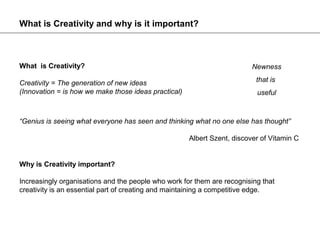
What is Creativity and why is it important?


What is Creativity?                                                       Newness

Creativity = The generation of new ideas                                   that is
(Innovation = is how we make those ideas practical)                        useful


“Genius is seeing what everyone has seen and thinking what no one else has thought”

                                                      Albert Szent, discover of Vitamin C


Why is Creativity important?

Increasingly organisations and the people who work for them are recognising that
creativity is an essential part of creating and maintaining a competitive edge.
tive
 Cre
   a


Behaviour
Agenda


• Share proven Creativity techniques that are used within our organisation


• Provide some real life Creativity success stories


• Share with you some skills, knowledge and techniques to help you become more
  creative


Objective

• Provide you with some creative thinking techniques and advise how to use these so
  you can become more creative in your BA role.
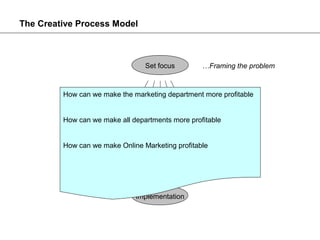
The Creative Process Model


                                 Set focus        …Framing the problem


         How can we make the marketing department more profitable
                             Idea Generation

         How can we make all departments more profitable
                                Ideas Pool
         How can we make Online Marketing profitable
                                Evaluation


                              Implementation
The Creativity Process – The Rules


Running a Creative thinking session:


1.   Be prepared - Juggling balls, Stop clock / timer & ….


2.   Set a clear Focus statement


3.   Choose the creativity tool to use


4.   Run the session
          All ideas have value, defer judgment!

5.   Evaluate the most popular idea(s) and decide which ones to take forward
     (Dr Edward De Bono’s Six Thinking Hats)
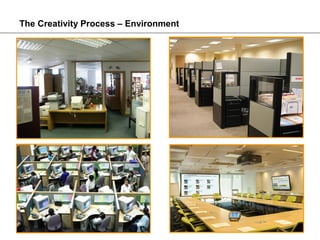
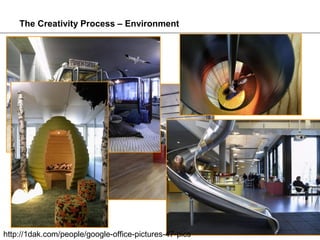
The Creativity Process – Environment


http://1dak.com/people/google-office-pictures-47-pics
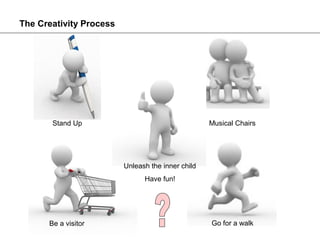
The Creativity Process


       Stand Up                                    Musical Chairs


                         Unleash the inner child
                               Have fun!


      Be a visitor                                 Go for a walk
S it u a ti o n /
                           S o lu t io n
                            R ev er s a l


              TECHNIQUE
CREATIVITIY


              one
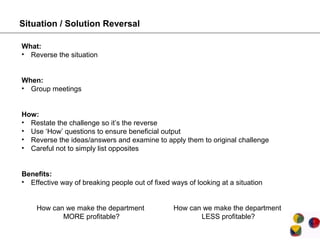
Situation / Solution Reversal

What:
• Reverse the situation


When:
• Group meetings


How:
• Restate the challenge so it’s the reverse
• Use ‘How’ questions to ensure beneficial output
• Reverse the ideas/answers and examine to apply them to original challenge
• Careful not to simply list opposites


Benefits:
• Effective way of breaking people out of fixed ways of looking at a situation


    How can we make the department               How can we make the department
           MORE profitable?                             LESS profitable?
SCAMMPERR


              TECHNIQUE
CREATIVITIY


              two
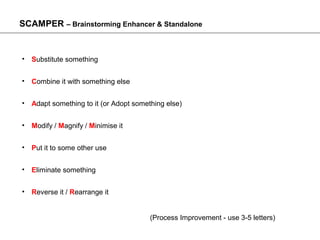
SCAMPER – Brainstorming Enhancer & Standalone


• Substitute something


• Combine it with something else


• Adapt something to it (or Adopt something else)


• Modify / Magnify / Minimise it


• Put it to some other use


• Eliminate something


• Reverse it / Rearrange it


                                       (Process Improvement - use 3-5 letters)
A n a lo g ie s a n d
                             M et a p h o rs


              TECHNIQUE
CREATIVITIY


              three
Metaphors – (AKA Force Fitting) – Brainstorming Enhancer & Standalone


What:
• Metaphors can help develop new insights into problem = create better understanding and
  possibilities of solutions
• Compare problem to metaphor

How:
• Choose a current problem/issue
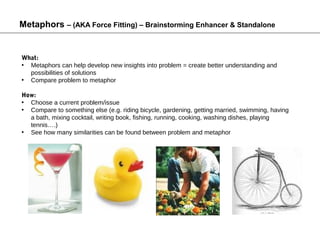
• Compare to something else (e.g. riding bicycle, gardening, getting married, swimming, having
  a bath, mixing cocktail, writing book, fishing, running, cooking, washing dishes, playing
  tennis….)
• See how many similarities can be found between problem and metaphor
Analogies


What:
• Look at problem completely differently – ask group to compare to totally different situation

How:
• “It’s a bit like…”
• Or group leader impose situation (e.g fairy tale, historic event…)
• Ask group to compare problem at hand to analogy and come up with suggested actions
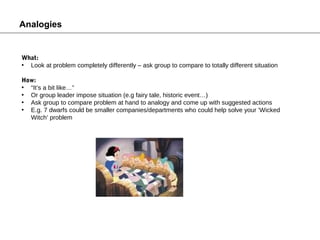
• E.g. 7 dwarfs could be smaller companies/departments who could help solve your ‘Wicked
  Witch’ problem
/
                          B ra in s to rm in g
                           B ra in W ri ti n g


              TECHNIQUE
CREATIVITIY


              four
Brainstorming
THE SEVEN RULES OF BRAINSTORMING (FROM IDEO)

1) Defer judgment
Don’t dismiss any ideas.
Any idea is a good idea, no matter how crazy.
Nothing can kill the spirit of a brainstorm quicker than judging ideas before they have a chance to
gain legs.

2) Encourage wild ideas
Embrace the most out-of-the-box notions because they can be the key to solutions.
The whole point of brainstorming is coming up with new and creative ideas.

3) Build on the ideas of others
No “buts”, only “ands.”
Sometimes people say crazy and bizarre things, like “make it on Mars”, but there is some element
of truth in it. When you build on the ideas of others, you might bring those crazy ideas back down
to earth and make them real innovations.

4) Stay focused on the topic
Always keep the discussion on target.
Otherwise you can diverge beyond the scope of what you’re trying to design for.

5) One conversation at a time
No interrupting, no dismissing, no disrespect, no rudeness.
Let people have their say.

6) Be visual
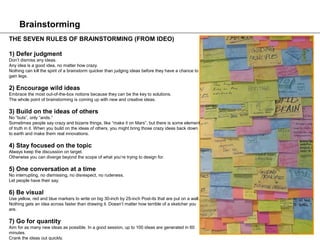
Use yellow, red and blue markers to write on big 30-inch by 25-inch Post-its that are put on a wall.
Nothing gets an idea across faster than drawing it. Doesn’t matter how terrible of a sketcher you
are.

7) Go for quantity
Aim for as many new ideas as possible. In a good session, up to 100 ideas are generated in 60
minutes.
Crank the ideas out quickly.
M in d M a p p in g


              TECHNIQUE
CREATIVITIY


              five
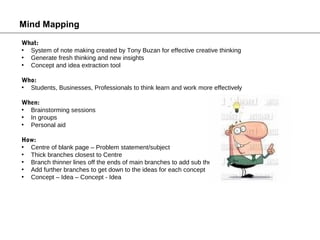
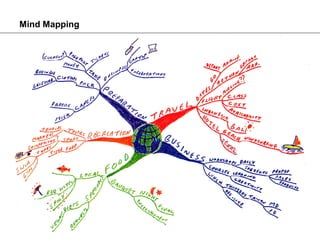
Mind Mapping
What:
• System of note making created by Tony Buzan for effective creative thinking
• Generate fresh thinking and new insights
• Concept and idea extraction tool

Who:
• Students, Businesses, Professionals to think learn and work more effectively

When:
• Brainstorming sessions
• In groups
• Personal aid

How:
• Centre of blank page – Problem statement/subject
• Thick branches closest to Centre
• Branch thinner lines off the ends of main branches to add sub themes
• Add further branches to get down to the ideas for each concept
• Concept – Idea – Concept - Idea
Mind Mapping
o ’s
                        E d w a rd D e B o n
                                              ts
                        6 T h in k in g H a


         TECHNIQUE
EVALUATION
         De Bono’s 6
        Thinking Hats
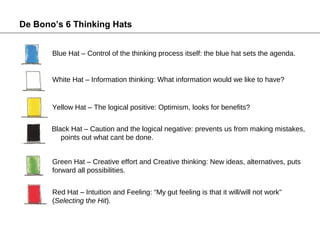
De Bono’s 6 Thinking Hats


       Blue Hat – Control of the thinking process itself: the blue hat sets the agenda.


       White Hat – Information thinking: What information would we like to have?


       Yellow Hat – The logical positive: Optimism, looks for benefits?


       Black Hat – Caution and the logical negative: prevents us from making mistakes,
          points out what cant be done.


       Green Hat – Creative effort and Creative thinking: New ideas, alternatives, puts
       forward all possibilities.


       Red Hat – Intuition and Feeling: “My gut feeling is that it will/will not work”
       (Selecting the Hit).
Creativity


      People who are crazy enough to think they can change the world…
                            are the ones that do!
                                                               …Apple

Creative Behaviour - BA2011

  • 2.
    In 1502 Leonardoda Vinci produced a drawing of a single span 720 foot bridge. It was not built until 2001 (in Norway) because it was thought such a construction was impossible.
  • 3.
    What is Creativityand why is it important? What is Creativity? Newness Creativity = The generation of new ideas that is (Innovation = is how we make those ideas practical) useful “Genius is seeing what everyone has seen and thinking what no one else has thought” Albert Szent, discover of Vitamin C Why is Creativity important? Increasingly organisations and the people who work for them are recognising that creativity is an essential part of creating and maintaining a competitive edge.
  • 4.
    tive Cre a Behaviour
  • 5.
    Agenda • Share provenCreativity techniques that are used within our organisation • Provide some real life Creativity success stories • Share with you some skills, knowledge and techniques to help you become more creative Objective • Provide you with some creative thinking techniques and advise how to use these so you can become more creative in your BA role.
  • 6.
    The Creative ProcessModel Set focus …Framing the problem How can we make the marketing department more profitable Idea Generation How can we make all departments more profitable Ideas Pool How can we make Online Marketing profitable Evaluation Implementation
  • 7.
    The Creativity Process– The Rules Running a Creative thinking session: 1. Be prepared - Juggling balls, Stop clock / timer & …. 2. Set a clear Focus statement 3. Choose the creativity tool to use 4. Run the session All ideas have value, defer judgment! 5. Evaluate the most popular idea(s) and decide which ones to take forward (Dr Edward De Bono’s Six Thinking Hats)
  • 8.
    The Creativity Process– Environment
  • 9.
    The Creativity Process– Environment http://1dak.com/people/google-office-pictures-47-pics
  • 10.
    The Creativity Process Stand Up Musical Chairs Unleash the inner child Have fun! Be a visitor Go for a walk
  • 11.
    S it ua ti o n / S o lu t io n R ev er s a l TECHNIQUE CREATIVITIY one
  • 12.
    Situation / SolutionReversal What: • Reverse the situation When: • Group meetings How: • Restate the challenge so it’s the reverse • Use ‘How’ questions to ensure beneficial output • Reverse the ideas/answers and examine to apply them to original challenge • Careful not to simply list opposites Benefits: • Effective way of breaking people out of fixed ways of looking at a situation How can we make the department How can we make the department MORE profitable? LESS profitable?
  • 13.
    SCAMMPERR TECHNIQUE CREATIVITIY two
  • 14.
    SCAMPER – BrainstormingEnhancer & Standalone • Substitute something • Combine it with something else • Adapt something to it (or Adopt something else) • Modify / Magnify / Minimise it • Put it to some other use • Eliminate something • Reverse it / Rearrange it (Process Improvement - use 3-5 letters)
  • 15.
    A n alo g ie s a n d M et a p h o rs TECHNIQUE CREATIVITIY three
  • 16.
    Metaphors – (AKAForce Fitting) – Brainstorming Enhancer & Standalone What: • Metaphors can help develop new insights into problem = create better understanding and possibilities of solutions • Compare problem to metaphor How: • Choose a current problem/issue • Compare to something else (e.g. riding bicycle, gardening, getting married, swimming, having a bath, mixing cocktail, writing book, fishing, running, cooking, washing dishes, playing tennis….) • See how many similarities can be found between problem and metaphor
  • 17.
    Analogies What: • Look atproblem completely differently – ask group to compare to totally different situation How: • “It’s a bit like…” • Or group leader impose situation (e.g fairy tale, historic event…) • Ask group to compare problem at hand to analogy and come up with suggested actions • E.g. 7 dwarfs could be smaller companies/departments who could help solve your ‘Wicked Witch’ problem
  • 18.
    / B ra in s to rm in g B ra in W ri ti n g TECHNIQUE CREATIVITIY four
  • 19.
    Brainstorming THE SEVEN RULESOF BRAINSTORMING (FROM IDEO) 1) Defer judgment Don’t dismiss any ideas. Any idea is a good idea, no matter how crazy. Nothing can kill the spirit of a brainstorm quicker than judging ideas before they have a chance to gain legs. 2) Encourage wild ideas Embrace the most out-of-the-box notions because they can be the key to solutions. The whole point of brainstorming is coming up with new and creative ideas. 3) Build on the ideas of others No “buts”, only “ands.” Sometimes people say crazy and bizarre things, like “make it on Mars”, but there is some element of truth in it. When you build on the ideas of others, you might bring those crazy ideas back down to earth and make them real innovations. 4) Stay focused on the topic Always keep the discussion on target. Otherwise you can diverge beyond the scope of what you’re trying to design for. 5) One conversation at a time No interrupting, no dismissing, no disrespect, no rudeness. Let people have their say. 6) Be visual Use yellow, red and blue markers to write on big 30-inch by 25-inch Post-its that are put on a wall. Nothing gets an idea across faster than drawing it. Doesn’t matter how terrible of a sketcher you are. 7) Go for quantity Aim for as many new ideas as possible. In a good session, up to 100 ideas are generated in 60 minutes. Crank the ideas out quickly.
  • 20.
    M in dM a p p in g TECHNIQUE CREATIVITIY five
  • 21.
    Mind Mapping What: • Systemof note making created by Tony Buzan for effective creative thinking • Generate fresh thinking and new insights • Concept and idea extraction tool Who: • Students, Businesses, Professionals to think learn and work more effectively When: • Brainstorming sessions • In groups • Personal aid How: • Centre of blank page – Problem statement/subject • Thick branches closest to Centre • Branch thinner lines off the ends of main branches to add sub themes • Add further branches to get down to the ideas for each concept • Concept – Idea – Concept - Idea
  • 22.
  • 23.
    o ’s E d w a rd D e B o n ts 6 T h in k in g H a TECHNIQUE EVALUATION De Bono’s 6 Thinking Hats
  • 24.
    De Bono’s 6Thinking Hats Blue Hat – Control of the thinking process itself: the blue hat sets the agenda. White Hat – Information thinking: What information would we like to have? Yellow Hat – The logical positive: Optimism, looks for benefits? Black Hat – Caution and the logical negative: prevents us from making mistakes, points out what cant be done. Green Hat – Creative effort and Creative thinking: New ideas, alternatives, puts forward all possibilities. Red Hat – Intuition and Feeling: “My gut feeling is that it will/will not work” (Selecting the Hit).
  • 25.
    Creativity People who are crazy enough to think they can change the world… are the ones that do! …Apple