The Creative and
Innovative Analyst
27th March, 2014
Ian Richards, CBAP, Dip. BA
Senior Business Architect
Serco Global Technology Delivery
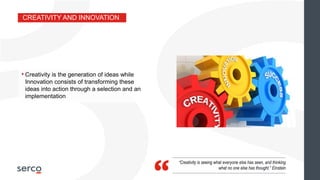
• Creativity is the generation of ideas while
Innovation consists of transforming these
ideas into action through a selection and an
implementation
“Creativity is seeing what everyone else has seen, and thinking
what no one else has thought.” Einstein
CREATIVITY AND INNOVATION
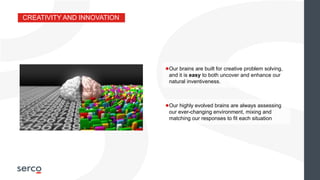
●Our brains are built for creative problem solving,
and it is easy to both uncover and enhance our
natural inventiveness.
CREATIVITY AND INNOVATION
●Our highly evolved brains are always assessing
our ever-changing environment, mixing and
matching our responses to fit each situation
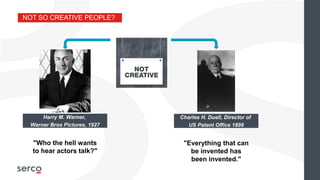
NOT SO CREATIVE PEOPLE?
Harry M. Warner,
Warner Bros Pictures, 1927
"Who the hell wants
to hear actors talk?"
Charles H. Duell, Director of
US Patent Office 1899
"Everything that can
be invented has
been invented."
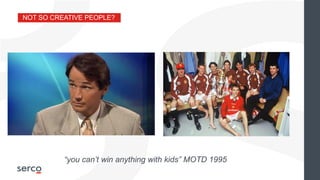
NOT SO CREATIVE PEOPLE?
“you can’t win anything with kids” MOTD 1995
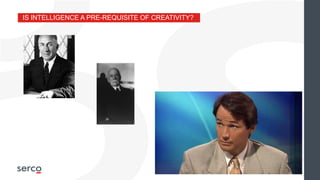
IS INTELLIGENCE A PRE-REQUISITE OF CREATIVITY?
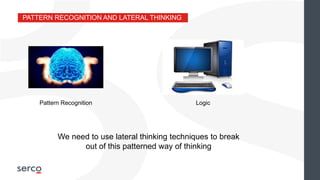
PATTERN RECOGNITION AND LATERAL THINKING
We need to use lateral thinking techniques to break
out of this patterned way of thinking
Pattern Recognition Logic
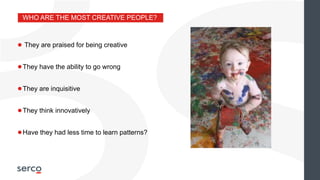
WHO ARE THE MOST CREATIVE PEOPLE?
●They have the ability to go wrong
●They are inquisitive
●They think innovatively
● They are praised for being creative
●Have they had less time to learn patterns?
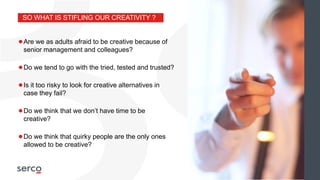
SO WHAT IS STIFLING OUR CREATIVITY ?
●Are we as adults afraid to be creative because of
senior management and colleagues?
●Do we tend to go with the tried, tested and trusted?
●Is it too risky to look for creative alternatives in
case they fail?
●Do we think that we don’t have time to be
creative?
●Do we think that quirky people are the only ones
allowed to be creative?
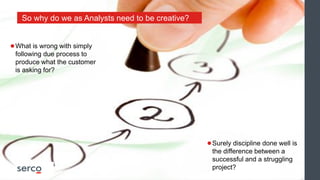
●What is wrong with simply
following due process to
produce what the customer
is asking for?
●Surely discipline done well is
the difference between a
successful and a struggling
project?
So why do we as Analysts need to be creative?
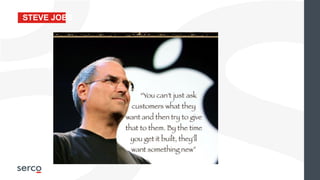
STEVE JOBS
So why bother being creative ?
Ability to stay ahead of a changing marketplace and the competition.
Creative and Innovative organizations don't copy what others do........they use
innovative ideas from others to come up with a unique application, product, or
service for themselves
More creative companies tend to distance themselves from the competition rather
than compete with them.
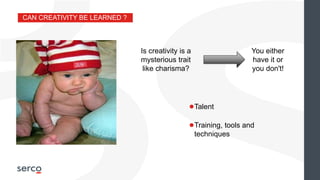
CAN CREATIVITY BE LEARNED ?
●Talent
●Training, tools and
techniques
Is creativity is a
mysterious trait
like charisma?
You either
have it or
you don't!
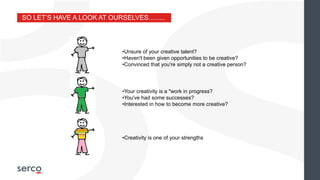
SO LET’S HAVE A LOOK AT OURSELVES.........
•Unsure of your creative talent?
•Haven't been given opportunities to be creative?
•Convinced that you're simply not a creative person?
•Your creativity is a "work in progress?
•You've had some successes?
•Interested in how to become more creative?
•Creativity is one of your strengths
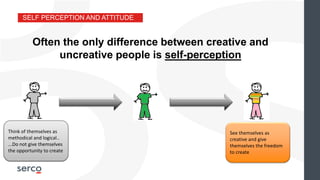
SELF PERCEPTION AND ATTITUDE
Often the only difference between creative and
uncreative people is self-perception
Think of themselves as
methodical and logical..
...Do not give themselves
the opportunity to create
See themselves as
creative and give
themselves the freedom
to create
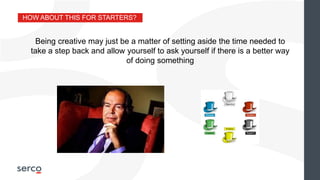
HOW ABOUT THIS FOR STARTERS?
Being creative may just be a matter of setting aside the time needed to
take a step back and allow yourself to ask yourself if there is a better way
of doing something
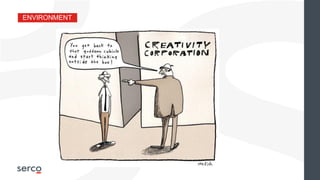
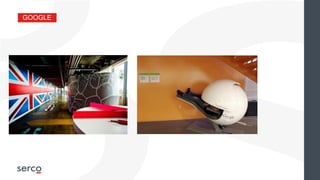
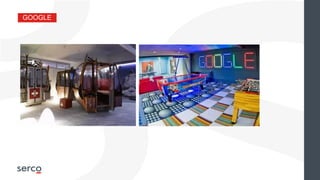
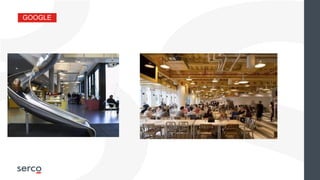
ENVIRONMENT
GOOGLE
GOOGLE
GOOGLE
SO, HOW DO I GO ABOUT STARTING A CREATIVITY SESSION?
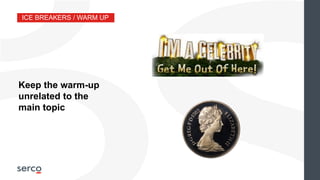
ICE BREAKERS / WARM UP
Keep the warm-up
unrelated to the
main topic
CREATIVITY WARM UP
A big, old, hungry dog
appeared at our door every
morning
CREATIVITY WARM UP
A big, old, hungry dog
appeared at our door every
morning
CREATIVITY WARM UP
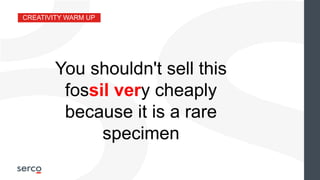
You shouldn't sell this
fossil very cheaply
because it is a rare
specimen
CREATIVITY WARM UP
You shouldn't sell this
fossil very cheaply
because it is a rare
specimen
CREATIVITY WARM UP
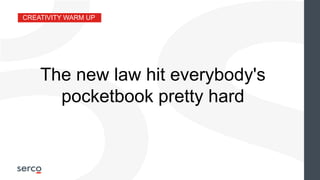
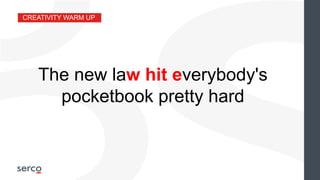
The new law hit everybody's
pocketbook pretty hard
CREATIVITY WARM UP
The new law hit everybody's
pocketbook pretty hard
CREATIVITY WARM UP
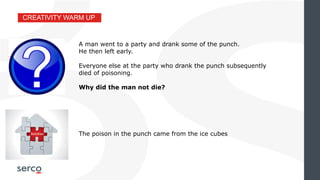
A man went to a party and drank some of the punch.
He then left early.
Everyone else at the party who drank the punch subsequently
died of poisoning.
Why did the man not die?
The poison in the punch came from the ice cubes
CREATIVITY WARM UP
They were two of a set of triplets (or quadruplets etc.)
A woman had two sons who were born on the same hour of
the same day of the same year.
But they were not twins, and they were not adopted.
How could this be so?
DUNKER’S CANDLE
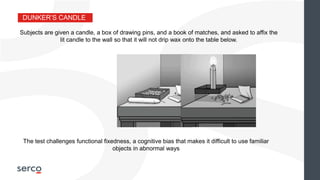
Subjects are given a candle, a box of drawing pins, and a book of matches, and asked to affix the
lit candle to the wall so that it will not drip wax onto the table below.
The test challenges functional fixedness, a cognitive bias that makes it difficult to use familiar
objects in abnormal ways
THE SUBJECT MATTER
State and scope the
Opportunity that needs solving
Get the right people in the
room
Appoint a skilled facilitator
SCOPING THE OPPORTUNITY
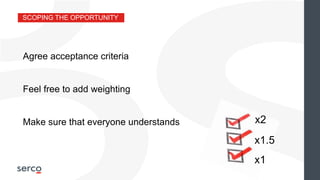
x2
x1.5
x1
Agree acceptance criteria
Feel free to add weighting
Make sure that everyone understands
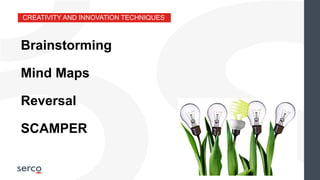
CREATIVITY AND INNOVATION TECHNIQUES
Mind Maps
Reversal
SCAMPER
Brainstorming
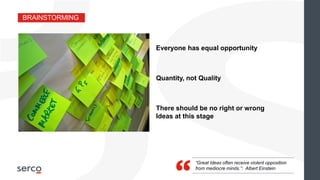
BRAINSTORMING
There should be no right or wrong
Ideas at this stage
Quantity, not Quality
Everyone has equal opportunity
“Great Ideas often receive violent opposition
from mediocre minds.”: Albert Einstein
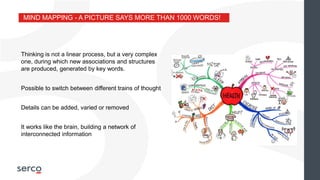
MIND MAPPING - A PICTURE SAYS MORE THAN 1000 WORDS!
It works like the brain, building a network of
interconnected information
Thinking is not a linear process, but a very complex
one, during which new associations and structures
are produced, generated by key words.
Possible to switch between different trains of thought
Details can be added, varied or removed
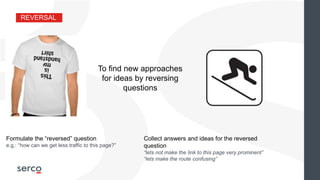
REVERSAL
To find new approaches
for ideas by reversing
questions
Collect answers and ideas for the reversed
question
“lets not make the link to this page very prominent”
“lets make the route confusing”
Formulate the “reversed” question
e.g.: “how can we get less traffic to this page?”
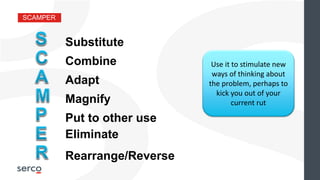
SCAMPER
Substitute
Combine
Adapt
Magnify
Put to other use
Eliminate
Rearrange/Reverse
Use it to stimulate new
ways of thinking about
the problem, perhaps to
kick you out of your
current rut
SCAMPER
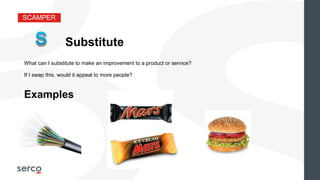
Substitute
What can I substitute to make an improvement to a product or service?
Examples
If I swap this, would it appeal to more people?
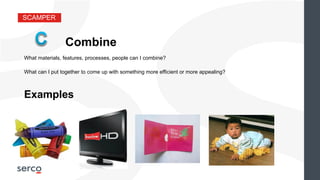
SCAMPER
Combine
What materials, features, processes, people can I combine?
Examples
What can I put together to come up with something more efficient or more appealing?
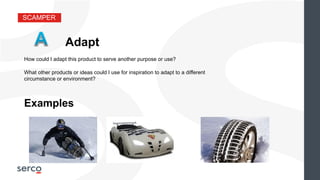
SCAMPER
Adapt
What other products or ideas could I use for inspiration to adapt to a different
circumstance or environment?
Examples
How could I adapt this product to serve another purpose or use?
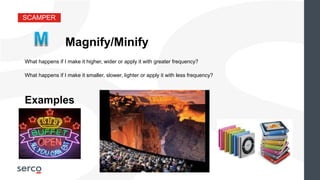
SCAMPER
Magnify/Minify
What happens if I make it higher, wider or apply it with greater frequency?
Examples
What happens if I make it smaller, slower, lighter or apply it with less frequency?
SCAMPER
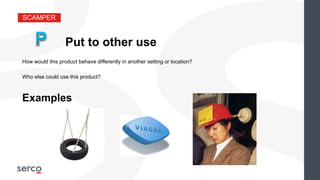
Put to other use
How would this product behave differently in another setting or location?
Examples
Who else could use this product?
SCAMPER
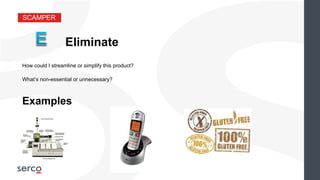
Eliminate
What’s non-essential or unnecessary?
Examples
How could I streamline or simplify this product?
SCAMPER
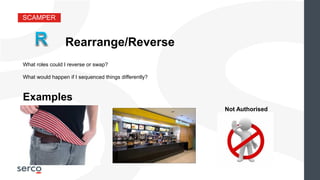
Rearrange/Reverse
What would happen if I sequenced things differently?
Examples
What roles could I reverse or swap?
Not Authorised
SO, WE NOW HAVE PLENTY OF IDEAS TO ANALYSE......
All ideas should be clear for all participants
There shouldn’t be any lack of clarity concerning an individual idea
Any idea can be improved; any idea is open to interpretation
Be open to different perspectives on your ideas
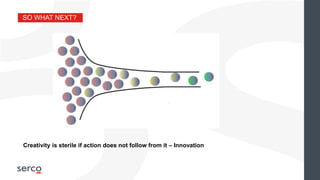
SO WHAT NEXT?
Creativity is sterile if action does not follow from it – Innovation
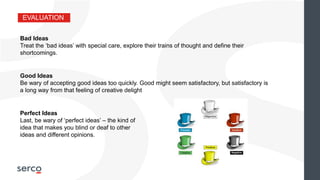
EVALUATION
Bad Ideas
Treat the ‘bad ideas’ with special care, explore their trains of thought and define their
shortcomings.
Good Ideas
Be wary of accepting good ideas too quickly. Good might seem satisfactory, but satisfactory is
a long way from that feeling of creative delight
Perfect Ideas
Last, be wary of ‘perfect ideas’ – the kind of
idea that makes you blind or deaf to other
ideas and different opinions.
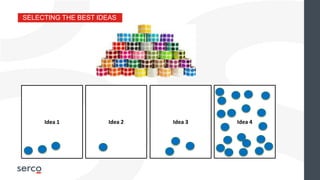
SELECTING THE BEST IDEAS
Idea 1 Idea 2 Idea 3 Idea 4
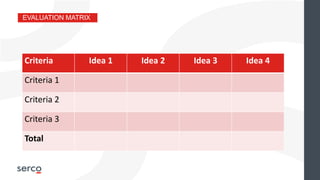
EVALUATION MATRIX
Criteria Idea 1 Idea 2 Idea 3 Idea 4
Criteria 1
Criteria 2
Criteria 3
Total
EVALUATION MATRIX
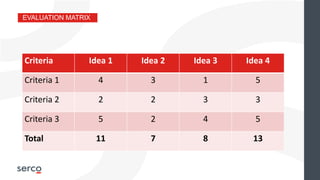
Criteria Idea 1 Idea 2 Idea 3 Idea 4
Criteria 1 4 3 1 5
Criteria 2 2 2 3 3
Criteria 3 5 2 4 5
Total 11 7 8 13
EVALUATION MATRIX
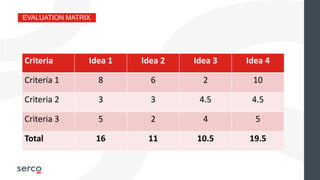
Criteria Idea 1 Idea 2 Idea 3 Idea 4
Criteria 1 8 6 2 10
Criteria 2 3 3 4.5 4.5
Criteria 3 5 2 4 5
Total 16 11 10.5 19.5
EVALUATION MATRIX
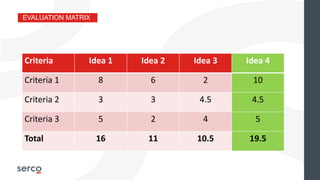
Criteria Idea 1 Idea 2 Idea 3 Idea 4
Criteria 1 8 6 2 10
Criteria 2 3 3 4.5 4.5
Criteria 3 5 2 4 5
Total 16 11 10.5 19.5
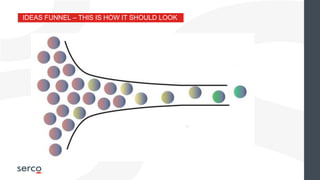
IDEAS FUNNEL – THIS IS HOW IT SHOULD LOOK
HOWEVER, ISN’T THIS OFTEN THE REALITY?
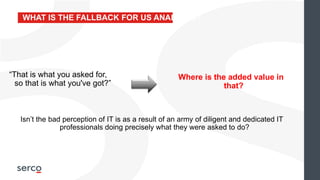
“That is what you asked for,
so that is what you've got?”
Where is the added value in
that?
WHAT IS THE FALLBACK FOR US ANALYSTS?
Isn’t the bad perception of IT is as a result of an army of diligent and dedicated IT
professionals doing precisely what they were asked to do?
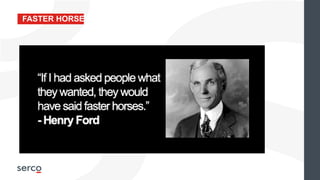
FASTER HORSES?
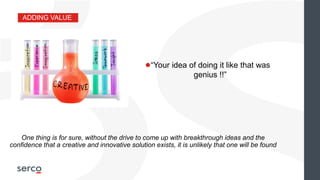
●“Your idea of doing it like that was
genius !!”
One thing is for sure, without the drive to come up with breakthrough ideas and the
confidence that a creative and innovative solution exists, it is unlikely that one will be found
ADDING VALUE
SO WHAT NOW?
Not only with the products that you have contributed to but with the culture you
have developed within your teams
Some of you will
identify a need for a
slight amendment in
attitude, approach
Some of you have
the right attitude and
just haven’t known
how to apply it
Take a moment to reflect on the legacy of creativity and innovation that you have
left in your wake personally
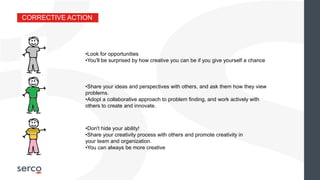
CORRECTIVE ACTION
•Look for opportunities
•You'll be surprised by how creative you can be if you give yourself a chance
•Share your ideas and perspectives with others, and ask them how they view
problems.
•Adopt a collaborative approach to problem finding, and work actively with
others to create and innovate.
•Don't hide your ability!
•Share your creativity process with others and promote creativity in
your team and organization.
•You can always be more creative
QUESTIONS?

The creative and innovative analyst

  • 1.
    The Creative and InnovativeAnalyst 27th March, 2014 Ian Richards, CBAP, Dip. BA Senior Business Architect Serco Global Technology Delivery
  • 2.
    • Creativity isthe generation of ideas while Innovation consists of transforming these ideas into action through a selection and an implementation “Creativity is seeing what everyone else has seen, and thinking what no one else has thought.” Einstein CREATIVITY AND INNOVATION
  • 3.
    ●Our brains arebuilt for creative problem solving, and it is easy to both uncover and enhance our natural inventiveness. CREATIVITY AND INNOVATION ●Our highly evolved brains are always assessing our ever-changing environment, mixing and matching our responses to fit each situation
  • 4.
    NOT SO CREATIVEPEOPLE? Harry M. Warner, Warner Bros Pictures, 1927 "Who the hell wants to hear actors talk?" Charles H. Duell, Director of US Patent Office 1899 "Everything that can be invented has been invented."
  • 5.
    NOT SO CREATIVEPEOPLE? “you can’t win anything with kids” MOTD 1995
  • 6.
    IS INTELLIGENCE APRE-REQUISITE OF CREATIVITY?
  • 7.
    PATTERN RECOGNITION ANDLATERAL THINKING We need to use lateral thinking techniques to break out of this patterned way of thinking Pattern Recognition Logic
  • 8.
    WHO ARE THEMOST CREATIVE PEOPLE? ●They have the ability to go wrong ●They are inquisitive ●They think innovatively ● They are praised for being creative ●Have they had less time to learn patterns?
  • 9.
    SO WHAT ISSTIFLING OUR CREATIVITY ? ●Are we as adults afraid to be creative because of senior management and colleagues? ●Do we tend to go with the tried, tested and trusted? ●Is it too risky to look for creative alternatives in case they fail? ●Do we think that we don’t have time to be creative? ●Do we think that quirky people are the only ones allowed to be creative?
  • 10.
    ●What is wrongwith simply following due process to produce what the customer is asking for? ●Surely discipline done well is the difference between a successful and a struggling project? So why do we as Analysts need to be creative?
  • 11.
  • 12.
    So why botherbeing creative ? Ability to stay ahead of a changing marketplace and the competition. Creative and Innovative organizations don't copy what others do........they use innovative ideas from others to come up with a unique application, product, or service for themselves More creative companies tend to distance themselves from the competition rather than compete with them.
  • 13.
    CAN CREATIVITY BELEARNED ? ●Talent ●Training, tools and techniques Is creativity is a mysterious trait like charisma? You either have it or you don't!
  • 14.
    SO LET’S HAVEA LOOK AT OURSELVES......... •Unsure of your creative talent? •Haven't been given opportunities to be creative? •Convinced that you're simply not a creative person? •Your creativity is a "work in progress? •You've had some successes? •Interested in how to become more creative? •Creativity is one of your strengths
  • 15.
    SELF PERCEPTION ANDATTITUDE Often the only difference between creative and uncreative people is self-perception Think of themselves as methodical and logical.. ...Do not give themselves the opportunity to create See themselves as creative and give themselves the freedom to create
  • 16.
    HOW ABOUT THISFOR STARTERS? Being creative may just be a matter of setting aside the time needed to take a step back and allow yourself to ask yourself if there is a better way of doing something
  • 17.
  • 18.
  • 19.
  • 20.
  • 21.
    SO, HOW DOI GO ABOUT STARTING A CREATIVITY SESSION?
  • 22.
    ICE BREAKERS /WARM UP Keep the warm-up unrelated to the main topic
  • 23.
    CREATIVITY WARM UP Abig, old, hungry dog appeared at our door every morning
  • 24.
    CREATIVITY WARM UP Abig, old, hungry dog appeared at our door every morning
  • 25.
    CREATIVITY WARM UP Youshouldn't sell this fossil very cheaply because it is a rare specimen
  • 26.
    CREATIVITY WARM UP Youshouldn't sell this fossil very cheaply because it is a rare specimen
  • 27.
    CREATIVITY WARM UP Thenew law hit everybody's pocketbook pretty hard
  • 28.
    CREATIVITY WARM UP Thenew law hit everybody's pocketbook pretty hard
  • 29.
    CREATIVITY WARM UP Aman went to a party and drank some of the punch. He then left early. Everyone else at the party who drank the punch subsequently died of poisoning. Why did the man not die? The poison in the punch came from the ice cubes
  • 30.
    CREATIVITY WARM UP Theywere two of a set of triplets (or quadruplets etc.) A woman had two sons who were born on the same hour of the same day of the same year. But they were not twins, and they were not adopted. How could this be so?
  • 31.
    DUNKER’S CANDLE Subjects aregiven a candle, a box of drawing pins, and a book of matches, and asked to affix the lit candle to the wall so that it will not drip wax onto the table below. The test challenges functional fixedness, a cognitive bias that makes it difficult to use familiar objects in abnormal ways
  • 32.
    THE SUBJECT MATTER Stateand scope the Opportunity that needs solving Get the right people in the room Appoint a skilled facilitator
  • 33.
    SCOPING THE OPPORTUNITY x2 x1.5 x1 Agreeacceptance criteria Feel free to add weighting Make sure that everyone understands
  • 34.
    CREATIVITY AND INNOVATIONTECHNIQUES Mind Maps Reversal SCAMPER Brainstorming
  • 35.
    BRAINSTORMING There should beno right or wrong Ideas at this stage Quantity, not Quality Everyone has equal opportunity “Great Ideas often receive violent opposition from mediocre minds.”: Albert Einstein
  • 36.
    MIND MAPPING -A PICTURE SAYS MORE THAN 1000 WORDS! It works like the brain, building a network of interconnected information Thinking is not a linear process, but a very complex one, during which new associations and structures are produced, generated by key words. Possible to switch between different trains of thought Details can be added, varied or removed
  • 37.
    REVERSAL To find newapproaches for ideas by reversing questions Collect answers and ideas for the reversed question “lets not make the link to this page very prominent” “lets make the route confusing” Formulate the “reversed” question e.g.: “how can we get less traffic to this page?”
  • 38.
    SCAMPER Substitute Combine Adapt Magnify Put to otheruse Eliminate Rearrange/Reverse Use it to stimulate new ways of thinking about the problem, perhaps to kick you out of your current rut
  • 39.
    SCAMPER Substitute What can Isubstitute to make an improvement to a product or service? Examples If I swap this, would it appeal to more people?
  • 40.
    SCAMPER Combine What materials, features,processes, people can I combine? Examples What can I put together to come up with something more efficient or more appealing?
  • 41.
    SCAMPER Adapt What other productsor ideas could I use for inspiration to adapt to a different circumstance or environment? Examples How could I adapt this product to serve another purpose or use?
  • 42.
    SCAMPER Magnify/Minify What happens ifI make it higher, wider or apply it with greater frequency? Examples What happens if I make it smaller, slower, lighter or apply it with less frequency?
  • 43.
    SCAMPER Put to otheruse How would this product behave differently in another setting or location? Examples Who else could use this product?
  • 44.
    SCAMPER Eliminate What’s non-essential orunnecessary? Examples How could I streamline or simplify this product?
  • 45.
    SCAMPER Rearrange/Reverse What would happenif I sequenced things differently? Examples What roles could I reverse or swap? Not Authorised
  • 46.
    SO, WE NOWHAVE PLENTY OF IDEAS TO ANALYSE...... All ideas should be clear for all participants There shouldn’t be any lack of clarity concerning an individual idea Any idea can be improved; any idea is open to interpretation Be open to different perspectives on your ideas
  • 47.
    SO WHAT NEXT? Creativityis sterile if action does not follow from it – Innovation
  • 48.
    EVALUATION Bad Ideas Treat the‘bad ideas’ with special care, explore their trains of thought and define their shortcomings. Good Ideas Be wary of accepting good ideas too quickly. Good might seem satisfactory, but satisfactory is a long way from that feeling of creative delight Perfect Ideas Last, be wary of ‘perfect ideas’ – the kind of idea that makes you blind or deaf to other ideas and different opinions.
  • 49.
    SELECTING THE BESTIDEAS Idea 1 Idea 2 Idea 3 Idea 4
  • 50.
    EVALUATION MATRIX Criteria Idea1 Idea 2 Idea 3 Idea 4 Criteria 1 Criteria 2 Criteria 3 Total
  • 51.
    EVALUATION MATRIX Criteria Idea1 Idea 2 Idea 3 Idea 4 Criteria 1 4 3 1 5 Criteria 2 2 2 3 3 Criteria 3 5 2 4 5 Total 11 7 8 13
  • 52.
    EVALUATION MATRIX Criteria Idea1 Idea 2 Idea 3 Idea 4 Criteria 1 8 6 2 10 Criteria 2 3 3 4.5 4.5 Criteria 3 5 2 4 5 Total 16 11 10.5 19.5
  • 53.
    EVALUATION MATRIX Criteria Idea1 Idea 2 Idea 3 Idea 4 Criteria 1 8 6 2 10 Criteria 2 3 3 4.5 4.5 Criteria 3 5 2 4 5 Total 16 11 10.5 19.5
  • 54.
    IDEAS FUNNEL –THIS IS HOW IT SHOULD LOOK
  • 55.
    HOWEVER, ISN’T THISOFTEN THE REALITY?
  • 56.
    “That is whatyou asked for, so that is what you've got?” Where is the added value in that? WHAT IS THE FALLBACK FOR US ANALYSTS? Isn’t the bad perception of IT is as a result of an army of diligent and dedicated IT professionals doing precisely what they were asked to do?
  • 57.
  • 58.
    ●“Your idea ofdoing it like that was genius !!” One thing is for sure, without the drive to come up with breakthrough ideas and the confidence that a creative and innovative solution exists, it is unlikely that one will be found ADDING VALUE
  • 59.
    SO WHAT NOW? Notonly with the products that you have contributed to but with the culture you have developed within your teams Some of you will identify a need for a slight amendment in attitude, approach Some of you have the right attitude and just haven’t known how to apply it Take a moment to reflect on the legacy of creativity and innovation that you have left in your wake personally
  • 60.
    CORRECTIVE ACTION •Look foropportunities •You'll be surprised by how creative you can be if you give yourself a chance •Share your ideas and perspectives with others, and ask them how they view problems. •Adopt a collaborative approach to problem finding, and work actively with others to create and innovate. •Don't hide your ability! •Share your creativity process with others and promote creativity in your team and organization. •You can always be more creative
  • 61.