ENT/ETR300 – FUNDAMENTALS OF ENTREPRENEURSHIP
                    CREATIVITY & INNOVATION


CREATIVITY AND
INNOVATION(saling b’kait)
Mohd Ali Bahari Abdul Kadir
Datin Assoc. Prof. Norela Nuruddin


                                                            1
WHAT IS CREATIVITY
• (Lotherington,2008) - the merging(kewujudan) of
  ideas which have not been merged(wujud) before.
  New ideas are formed by developing current ones
  within our minds.
• (Dorf and Byers, 2005) - the ability to use the
  imagination to develop new ideas, new things or
  new solutions
• (Matherly & Goldsmith, 1985) – the generation of
  ideas that result in improved efficiency or
  effectiveness of a system.
• (May, 1975) – the process of bringing something
  new into being.
                                                     2
WHAT IS INNOVATION
• (Howell & Higgins, 1990) – the process by which
  entrepreneurs convert opportunities into marketable
  ideas.
• (Drucker, 1985) - the specific instrument of entrepreneurs,
  the means by which they exploit change as an opportunity
  for a different business or a different service.
• Luecke and Katz (2003) - "Innovation….is generally
  understood as the successful introduction of a new thing
  or method . . . Innovation is the embodiment,
  combination, or synthesis of knowledge in original,
  relevant, valued new products, processes, or services.

                                                           3
CREATIVITY, INNOVATION &
      ENTREPRENEURSHIP
• Davila et al (2006) - "Often, in common parlance, the words
  creativity and innovation are used interchangeably. They
  shouldn't be, because while creativity implies coming up with
  ideas, it's the "bringing ideas to life“……that makes innovation
  the distinct undertaking it is.“
• (Lotherington, 2003) - Creativity enables people to connect
  unconnected things and from that meeting, new ideas spring
  forth, whether they are new ideas for doing things or new
  ideas for using things.
• Amabile et al (1996) – “All innovation begins with creative
  ideas…..We define innovation as the successful
  implementation of creative ideas within an organization. In this
  view, creativity by individuals and teams is a starting point for
  innovation; the first is necessary but not sufficient condition for
  the second"

                                                                    4
CREATIVITY, INNOVATION &
      ENTREPRENEURSHIP
• Creativity is the process of generating unique and useful
  ideas.
• Innovation will take place when there is a creative idea
  generation.
• Innovation is about taking the creative/unique new idea
  and turning it into something of value
• Innovation requires discipline and action to evaluate the
  ideas, test them, modify them and then apply them. It is
  through there disciplined and actions that turn an idea
  into something of value.


                                                              5
CREATIVITY, INNOVATION &
       ENTREPRENEURSHIP
•   Creative entrepreneurs observed people’s problem, and see
    opportunities. These entrepreneurs then innovate by applying
    creative solutions to people’s problems to better enhance
    people’s quality of life.
•   Entrepreneurship is the commercialization of creativity.
•   Entrepreneurship occurs when an individual or organization:
     a. Sees the potential in an idea that can be developed for the
        marketplace or user groups
     b. Is prepared to take the necessary risks to stir things up
        and get things out of their neat or comfortable spaces
     c. Has the skills (or access to them), confidence,
        determination, and the funds (or access to them) to carry
        out the innovation that is required to turn the idea into
        reality.

                                                                  6
CREATIVE PROCESS
• Edward De Bono, 1992 – creativity is a process that
  can be developed and improved.
• Everyone possessed a certain degree of creativity,
  some of us are more creative, and some are a little
  less.
• Creative process involves looking with different
  perspectives on unique relationships of the
  surroundings.


                                                        7
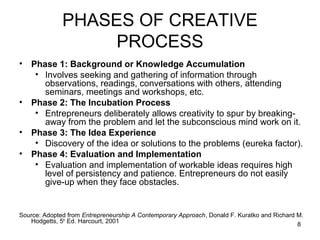
PHASES OF CREATIVE
                   PROCESS
•   Phase 1: Background or Knowledge Accumulation
     • Involves seeking and gathering of information through
       observations, readings, conversations with others, attending
       seminars, meetings and workshops, etc.
•   Phase 2: The Incubation Process
     • Entrepreneurs deliberately allows creativity to spur by breaking-
       away from the problem and let the subconscious mind work on it.
•   Phase 3: The Idea Experience
     • Discovery of the idea or solutions to the problems (eureka factor).
•   Phase 4: Evaluation and Implementation
     • Evaluation and implementation of workable ideas requires high
       level of persistency and patience. Entrepreneurs do not easily
       give-up when they face obstacles.


Source: Adopted from Entrepreneurship A Contemporary Approach, Donald F. Kuratko and Richard M.
   Hodgetts, 5th Ed. Harcourt, 2001
                                                                                             8
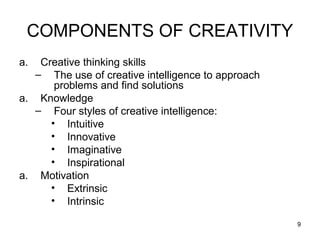
COMPONENTS OF CREATIVITY
a.  Creative thinking skills
   – The use of creative intelligence to approach
       problems and find solutions
a. Knowledge
   – Four styles of creative intelligence:
      • Intuitive
      • Innovative
      • Imaginative
      • Inspirational
a. Motivation
      • Extrinsic
      • Intrinsic

                                                    9
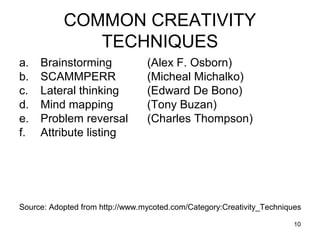
COMMON CREATIVITY
              TECHNIQUES
a.   Brainstorming               (Alex F. Osborn)
b.   SCAMMPERR                   (Micheal Michalko)
c.   Lateral thinking            (Edward De Bono)
d.   Mind mapping                (Tony Buzan)
e.   Problem reversal            (Charles Thompson)
f.   Attribute listing


Source: Adopted from http://www.mycoted.com/Category:Creativity_Techniques

                                                                        10
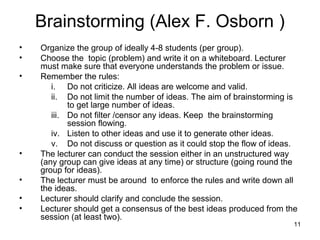
Brainstorming (Alex F. Osborn )
•   Organize the group of ideally 4-8 students (per group).
•   Choose the topic (problem) and write it on a whiteboard. Lecturer
    must make sure that everyone understands the problem or issue.
•   Remember the rules:
       i. Do not criticize. All ideas are welcome and valid.
       ii. Do not limit the number of ideas. The aim of brainstorming is
            to get large number of ideas.
       iii. Do not filter /censor any ideas. Keep the brainstorming
            session flowing.
       iv. Listen to other ideas and use it to generate other ideas.
       v. Do not discuss or question as it could stop the flow of ideas.
•   The lecturer can conduct the session either in an unstructured way
    (any group can give ideas at any time) or structure (going round the
    group for ideas).
•   The lecturer must be around to enforce the rules and write down all
    the ideas.
•   Lecturer should clarify and conclude the session.
•   Lecturer should get a consensus of the best ideas produced from the
    session (at least two).
                                                                       11
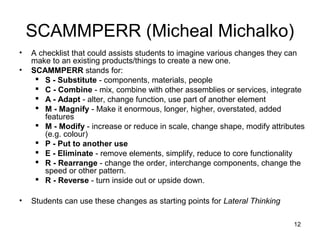
SCAMMPERR (Micheal Michalko)
•   A checklist that could assists students to imagine various changes they can
    make to an existing products/things to create a new one.
•   SCAMMPERR stands for:
      S - Substitute - components, materials, people
      C - Combine - mix, combine with other assemblies or services, integrate
      A - Adapt - alter, change function, use part of another element
      M - Magnify - Make it enormous, longer, higher, overstated, added
        features
      M - Modify - increase or reduce in scale, change shape, modify attributes
        (e.g. colour)
      P - Put to another use
      E - Eliminate - remove elements, simplify, reduce to core functionality
      R - Rearrange - change the order, interchange components, change the
        speed or other pattern.
      R - Reverse - turn inside out or upside down.

•   Students can use these changes as starting points for Lateral Thinking

                                                                             12
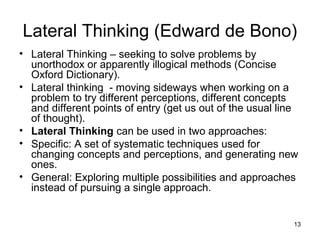
Lateral Thinking (Edward de Bono)
• Lateral Thinking – seeking to solve problems by
  unorthodox or apparently illogical methods (Concise
  Oxford Dictionary).
• Lateral thinking - moving sideways when working on a
  problem to try different perceptions, different concepts
  and different points of entry (get us out of the usual line
  of thought).
• Lateral Thinking can be used in two approaches:
• Specific: A set of systematic techniques used for
  changing concepts and perceptions, and generating new
  ones.
• General: Exploring multiple possibilities and approaches
  instead of pursuing a single approach.


                                                            13
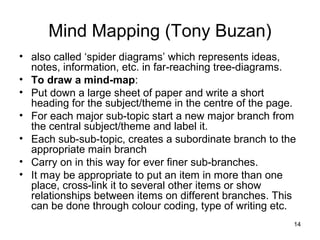
Mind Mapping (Tony Buzan)
• also called ‘spider diagrams’ which represents ideas,
  notes, information, etc. in far-reaching tree-diagrams.
• To draw a mind-map:
• Put down a large sheet of paper and write a short
  heading for the subject/theme in the centre of the page.
• For each major sub-topic start a new major branch from
  the central subject/theme and label it.
• Each sub-sub-topic, creates a subordinate branch to the
  appropriate main branch
• Carry on in this way for ever finer sub-branches.
• It may be appropriate to put an item in more than one
  place, cross-link it to several other items or show
  relationships between items on different branches. This
  can be done through colour coding, type of writing etc.
                                                         14
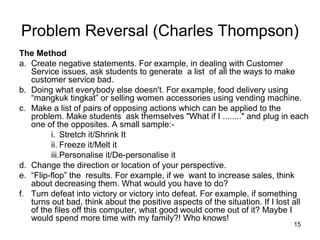
Problem Reversal (Charles Thompson)
The Method
a. Create negative statements. For example, in dealing with Customer
   Service issues, ask students to generate a list of all the ways to make
   customer service bad.
b. Doing what everybody else doesn't. For example, food delivery using
   “mangkuk tingkat” or selling women accessories using vending machine.
c. Make a list of pairs of opposing actions which can be applied to the
   problem. Make students ask themselves "What if I ........" and plug in each
   one of the opposites. A small sample:-
         i. Stretch it/Shrink It
         ii. Freeze it/Melt it
         iii.Personalise it/De-personalise it
d. Change the direction or location of your perspective.
e. “Flip-flop” the results. For example, if we want to increase sales, think
   about decreasing them. What would you have to do?
f. Turn defeat into victory or victory into defeat. For example, if something
   turns out bad, think about the positive aspects of the situation. If I lost all
   of the files off this computer, what good would come out of it? Maybe I
   would spend more time with my family?! Who knows!
                                                                             15
Attribute Listing
Steps:
a. Identify the product or process you are dissatisfied with or wish to
   improve.
b. List its attributes. For a simple physical object like a pen, this might
   include: material, shape, target market, colours, textures, etc.
c. Choose, say, 7-8 of these attributes that seem particularly
   interesting or important.
d. Identify alternative ways to achieve each attribute (e.g. different
   shapes: cylindrical cubic, multi-faceted….), either by conventional
   enquiry, or via any idea-generating technique.
e. Combine one or more of these alternative ways of achieving the
   required attributes, and see if you can come up with a new
   approach to the product or process you were working on.


                                                                          16
BLOCKS TO CREATIVITY
•  Blockages to creativity need to be recognized and
   eliminated so that it will smooth the way to
   creativity.
CLASSIFICATION OF BLOCKS ARE :
a. Perceptual
b. Emotional
c. Cultural
d. Environmental
e. Intellectual/Conceptual

                                                       17
Perceptual Blocks
• Prevent problem recognition, limiting the problem.
• Inability to see problems from different perspectives
• Stereotyping, missing the connections or
  associations
• Not thinking outside the box
• Literal thinking


                                                      18
Emotional Blocks
• Fear of failure can paralyse us if we think what we
  are doing won’t be good enough. Will lead to
  procrastination and project abandonment.
• Most blockages are attitudinal or psychological.
  Inability to incubate can lead to other fears such as:
  fear of problem, fear of work, fear of fun, fear of
  exploring and fear of abandonment.


                                                       19
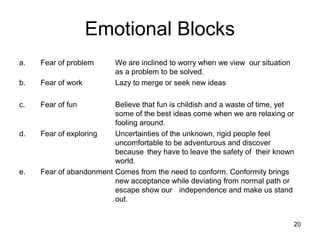
Emotional Blocks
a.   Fear of problem      We are inclined to worry when we view our situation
                          as a problem to be solved.
b.   Fear of work         Lazy to merge or seek new ideas

c.   Fear of fun         Believe that fun is childish and a waste of time, yet
                         some of the best ideas come when we are relaxing or
                         fooling around.
d.   Fear of exploring   Uncertainties of the unknown, rigid people feel
                         uncomfortable to be adventurous and discover
                         because they have to leave the safety of their known
                         world.
e.   Fear of abandonment Comes from the need to conform. Conformity brings
                         new acceptance while deviating from normal path or
                         escape show our independence and make us stand
                         out.


                                                                                20
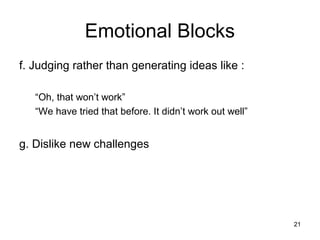
Emotional Blocks
f. Judging rather than generating ideas like :

   “Oh, that won’t work”
   “We have tried that before. It didn’t work out well”


g. Dislike new challenges


                                                          21
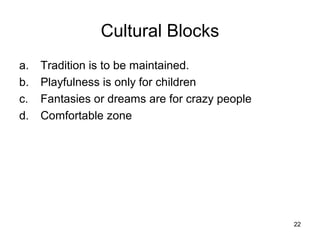
Cultural Blocks
a.   Tradition is to be maintained.
b.   Playfulness is only for children
c.   Fantasies or dreams are for crazy people
d.   Comfortable zone


                                                22
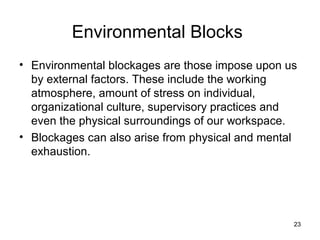
Environmental Blocks
• Environmental blockages are those impose upon us
  by external factors. These include the working
  atmosphere, amount of stress on individual,
  organizational culture, supervisory practices and
  even the physical surroundings of our workspace.
• Blockages can also arise from physical and mental
  exhaustion.


                                                  23
Environmental Blocks
a.   Lack of corporation and trust among colleagues
     (lack esprit de corp)
b.   Bosses who practice autocratic(xnk dgr ckp org )
     management
c.   Too many distractions
d.   Lack of financial and top management support to
     bring ideas to implementation


                                                        24
Intellectual/ Conceptual Blocks
a.   Failure to understand and acknowledge problems
     that need to be solved.
b.   “I don’t know; “Don’t’ ask me”
c.   “Try asking someone else”
d.   Many creative solutions are hidden by mistaken
     assumptions. Therefore, people need to be more
     open minded and receptive.


                                                  25
TYPES OF INNOVATION
•  There are 3 types of innovation :
a. Technological Innovation
b. Operational Innovation
c. Organizational Innovation


                                       26
Technological Innovation
• These are breakthrough inventions that have wide-
  reaching impact and influence which benefit society
  and business.
• Major breakthroughs can be radical and disruptive
  for people, society, businesses and countries or the
  whole world. Example; the internet.
• They can change the way people live their lives, the
  way companies do business and the way countries
  govern and behave


                                                     27
Technological Innovation
• Example of major technological breakthroughs are : the
  wheel, the printing press, steam power, electricity,
  wireless technology, the computer, the internet, high
  performance materials like plastic, fiber board, nuclear
  power and so on.
• Smaller technological inventions have less impact but
  still have significant benefit to certain users.
• Example of small technological inventions are: the paper
  cup, the ball-point pen, the electric toothbrush, the
  electric razor, hair dryers, the garden hose, electric toys,
  remote control toys, computer games, electric pencil
  sharpener and so on.

                                                             28
Operational Innovation
• Operational Innovation is smaller, more process-
  oriented Innovation
• Tends to be incremental in nature
• Doesn’t necessarily change products or services or
  how they are used and most of it goes unnoticed by
  the public, but often it is the means to improved
  products and lower operating costs.


                                                   29
Operational Innovation
• This type of Innovation happens by the very act of
  people doing their work… “Hmm, what if we try
  doing it this way instead?”
• Have much smaller impact, per invention, compared
  with breakthrough technological innovation, but
  cumulatively their effect can be enormous. Their
  effect builds and grows over time.


                                                   30
Operational Innovation includes:
a.   New systems or refinements to existing ones. For
     example, internal systems and methods for many
     aspects of work such as staff administration,
     purchasing, distribution and sales.
b.   Small improvements in operations or processes.
     For example, changes to make equipment run
     more effectively.
c.   Minor improvements or developments that will
     enhance it to a technological product.
d.   Innovative new business practices. For example,
     new ways for thinking strategically.
                                                        31
Organizational Innovation
• Organizational Innovation is where a company or
  organization itself is innovative
• In an innovative company or organization everyone
  knows his or her specific role in innovation
• It can be purposely built through putting
  organizational culture as the operational style or
  mode to get things done.
• Innovative companies don’t just produce innovative
  goods and services. They use innovative methods
  in everything they do.

                                                       32
How To Instill Organizational
              Innovation
a.   Developing and instituting an innovative work
     culture among the people within the company or
     organization.
b.   By enforcing work culture, company or
     organization able to:
         a.   Change the way the staff work
         b.   Change their attitudes and mindsets
         c.   Improve their skills
         d.   Improve the methods they use to carry out their work


                                                                     33
Examples of Organizational
              Innovation
1.   A CEO who accepts the challenge to be innovative and
     encourages risk-taking (a spur to innovation) and
     rewards good ideas as well as the successful
     completion of projects (the results of innovation)
2.   An organization where everyone understands the
     many benefits of innovation. Even those who are not
     directly involved in innovative work, such as production
     people, recognize they have a part to play in identifying
     better ways of doing things. They notice what’s going
     on around them and they find opportunities or way for
     improvement.


                                                            34
SOURCES OF INNOVATION
•    Within the company or industry
    a. Unexpected occurrence (viagra, penicillin)
    b. Incongruities (Federal Express)
    c. Process needs (enzyme for cataract operation, sugar free
        products)
    d. Industry and market changes (advances in technology, healthcare
        industry)

•    Within the social environment
    a. Demographic changes (change in consumer preference)
    b. Perceptual changes (fitness craze)
    c. New knowledge (video industry, robotics)


    Source: Adopted from Entrepreneurship A Contemporary Approach, Donald F. Kuratko and Richard
          M. Hodgetts, 5th Ed. Harcourt, 2001
                                                                                          35
COMMON CHARACTERISTICS OF
       CREATIVE ENTREPRENEURS
•   Sensitive to problems
•   Broad perspectives
•   Flexible and adaptable
•   Original thinker and stick-to-own opinion
•   Risk-taker
•   Motivated and dedicated
•   Curious


                                                36
END OF MODULE 3


                  37

Ent300 module03

  • 1.
    ENT/ETR300 – FUNDAMENTALSOF ENTREPRENEURSHIP CREATIVITY & INNOVATION CREATIVITY AND INNOVATION(saling b’kait) Mohd Ali Bahari Abdul Kadir Datin Assoc. Prof. Norela Nuruddin 1
  • 2.
    WHAT IS CREATIVITY •(Lotherington,2008) - the merging(kewujudan) of ideas which have not been merged(wujud) before. New ideas are formed by developing current ones within our minds. • (Dorf and Byers, 2005) - the ability to use the imagination to develop new ideas, new things or new solutions • (Matherly & Goldsmith, 1985) – the generation of ideas that result in improved efficiency or effectiveness of a system. • (May, 1975) – the process of bringing something new into being. 2
  • 3.
    WHAT IS INNOVATION •(Howell & Higgins, 1990) – the process by which entrepreneurs convert opportunities into marketable ideas. • (Drucker, 1985) - the specific instrument of entrepreneurs, the means by which they exploit change as an opportunity for a different business or a different service. • Luecke and Katz (2003) - "Innovation….is generally understood as the successful introduction of a new thing or method . . . Innovation is the embodiment, combination, or synthesis of knowledge in original, relevant, valued new products, processes, or services. 3
  • 4.
    CREATIVITY, INNOVATION & ENTREPRENEURSHIP • Davila et al (2006) - "Often, in common parlance, the words creativity and innovation are used interchangeably. They shouldn't be, because while creativity implies coming up with ideas, it's the "bringing ideas to life“……that makes innovation the distinct undertaking it is.“ • (Lotherington, 2003) - Creativity enables people to connect unconnected things and from that meeting, new ideas spring forth, whether they are new ideas for doing things or new ideas for using things. • Amabile et al (1996) – “All innovation begins with creative ideas…..We define innovation as the successful implementation of creative ideas within an organization. In this view, creativity by individuals and teams is a starting point for innovation; the first is necessary but not sufficient condition for the second" 4
  • 5.
    CREATIVITY, INNOVATION & ENTREPRENEURSHIP • Creativity is the process of generating unique and useful ideas. • Innovation will take place when there is a creative idea generation. • Innovation is about taking the creative/unique new idea and turning it into something of value • Innovation requires discipline and action to evaluate the ideas, test them, modify them and then apply them. It is through there disciplined and actions that turn an idea into something of value. 5
  • 6.
    CREATIVITY, INNOVATION & ENTREPRENEURSHIP • Creative entrepreneurs observed people’s problem, and see opportunities. These entrepreneurs then innovate by applying creative solutions to people’s problems to better enhance people’s quality of life. • Entrepreneurship is the commercialization of creativity. • Entrepreneurship occurs when an individual or organization: a. Sees the potential in an idea that can be developed for the marketplace or user groups b. Is prepared to take the necessary risks to stir things up and get things out of their neat or comfortable spaces c. Has the skills (or access to them), confidence, determination, and the funds (or access to them) to carry out the innovation that is required to turn the idea into reality. 6
  • 7.
    CREATIVE PROCESS • EdwardDe Bono, 1992 – creativity is a process that can be developed and improved. • Everyone possessed a certain degree of creativity, some of us are more creative, and some are a little less. • Creative process involves looking with different perspectives on unique relationships of the surroundings. 7
  • 8.
    PHASES OF CREATIVE PROCESS • Phase 1: Background or Knowledge Accumulation • Involves seeking and gathering of information through observations, readings, conversations with others, attending seminars, meetings and workshops, etc. • Phase 2: The Incubation Process • Entrepreneurs deliberately allows creativity to spur by breaking- away from the problem and let the subconscious mind work on it. • Phase 3: The Idea Experience • Discovery of the idea or solutions to the problems (eureka factor). • Phase 4: Evaluation and Implementation • Evaluation and implementation of workable ideas requires high level of persistency and patience. Entrepreneurs do not easily give-up when they face obstacles. Source: Adopted from Entrepreneurship A Contemporary Approach, Donald F. Kuratko and Richard M. Hodgetts, 5th Ed. Harcourt, 2001 8
  • 9.
    COMPONENTS OF CREATIVITY a. Creative thinking skills – The use of creative intelligence to approach problems and find solutions a. Knowledge – Four styles of creative intelligence: • Intuitive • Innovative • Imaginative • Inspirational a. Motivation • Extrinsic • Intrinsic 9
  • 10.
    COMMON CREATIVITY TECHNIQUES a. Brainstorming (Alex F. Osborn) b. SCAMMPERR (Micheal Michalko) c. Lateral thinking (Edward De Bono) d. Mind mapping (Tony Buzan) e. Problem reversal (Charles Thompson) f. Attribute listing Source: Adopted from http://www.mycoted.com/Category:Creativity_Techniques 10
  • 11.
    Brainstorming (Alex F.Osborn ) • Organize the group of ideally 4-8 students (per group). • Choose the topic (problem) and write it on a whiteboard. Lecturer must make sure that everyone understands the problem or issue. • Remember the rules: i. Do not criticize. All ideas are welcome and valid. ii. Do not limit the number of ideas. The aim of brainstorming is to get large number of ideas. iii. Do not filter /censor any ideas. Keep the brainstorming session flowing. iv. Listen to other ideas and use it to generate other ideas. v. Do not discuss or question as it could stop the flow of ideas. • The lecturer can conduct the session either in an unstructured way (any group can give ideas at any time) or structure (going round the group for ideas). • The lecturer must be around to enforce the rules and write down all the ideas. • Lecturer should clarify and conclude the session. • Lecturer should get a consensus of the best ideas produced from the session (at least two). 11
  • 12.
    SCAMMPERR (Micheal Michalko) • A checklist that could assists students to imagine various changes they can make to an existing products/things to create a new one. • SCAMMPERR stands for:  S - Substitute - components, materials, people  C - Combine - mix, combine with other assemblies or services, integrate  A - Adapt - alter, change function, use part of another element  M - Magnify - Make it enormous, longer, higher, overstated, added features  M - Modify - increase or reduce in scale, change shape, modify attributes (e.g. colour)  P - Put to another use  E - Eliminate - remove elements, simplify, reduce to core functionality  R - Rearrange - change the order, interchange components, change the speed or other pattern.  R - Reverse - turn inside out or upside down. • Students can use these changes as starting points for Lateral Thinking 12
  • 13.
    Lateral Thinking (Edwardde Bono) • Lateral Thinking – seeking to solve problems by unorthodox or apparently illogical methods (Concise Oxford Dictionary). • Lateral thinking - moving sideways when working on a problem to try different perceptions, different concepts and different points of entry (get us out of the usual line of thought). • Lateral Thinking can be used in two approaches: • Specific: A set of systematic techniques used for changing concepts and perceptions, and generating new ones. • General: Exploring multiple possibilities and approaches instead of pursuing a single approach. 13
  • 14.
    Mind Mapping (TonyBuzan) • also called ‘spider diagrams’ which represents ideas, notes, information, etc. in far-reaching tree-diagrams. • To draw a mind-map: • Put down a large sheet of paper and write a short heading for the subject/theme in the centre of the page. • For each major sub-topic start a new major branch from the central subject/theme and label it. • Each sub-sub-topic, creates a subordinate branch to the appropriate main branch • Carry on in this way for ever finer sub-branches. • It may be appropriate to put an item in more than one place, cross-link it to several other items or show relationships between items on different branches. This can be done through colour coding, type of writing etc. 14
  • 15.
    Problem Reversal (CharlesThompson) The Method a. Create negative statements. For example, in dealing with Customer Service issues, ask students to generate a list of all the ways to make customer service bad. b. Doing what everybody else doesn't. For example, food delivery using “mangkuk tingkat” or selling women accessories using vending machine. c. Make a list of pairs of opposing actions which can be applied to the problem. Make students ask themselves "What if I ........" and plug in each one of the opposites. A small sample:- i. Stretch it/Shrink It ii. Freeze it/Melt it iii.Personalise it/De-personalise it d. Change the direction or location of your perspective. e. “Flip-flop” the results. For example, if we want to increase sales, think about decreasing them. What would you have to do? f. Turn defeat into victory or victory into defeat. For example, if something turns out bad, think about the positive aspects of the situation. If I lost all of the files off this computer, what good would come out of it? Maybe I would spend more time with my family?! Who knows! 15
  • 16.
    Attribute Listing Steps: a. Identifythe product or process you are dissatisfied with or wish to improve. b. List its attributes. For a simple physical object like a pen, this might include: material, shape, target market, colours, textures, etc. c. Choose, say, 7-8 of these attributes that seem particularly interesting or important. d. Identify alternative ways to achieve each attribute (e.g. different shapes: cylindrical cubic, multi-faceted….), either by conventional enquiry, or via any idea-generating technique. e. Combine one or more of these alternative ways of achieving the required attributes, and see if you can come up with a new approach to the product or process you were working on. 16
  • 17.
    BLOCKS TO CREATIVITY • Blockages to creativity need to be recognized and eliminated so that it will smooth the way to creativity. CLASSIFICATION OF BLOCKS ARE : a. Perceptual b. Emotional c. Cultural d. Environmental e. Intellectual/Conceptual 17
  • 18.
    Perceptual Blocks • Preventproblem recognition, limiting the problem. • Inability to see problems from different perspectives • Stereotyping, missing the connections or associations • Not thinking outside the box • Literal thinking 18
  • 19.
    Emotional Blocks • Fearof failure can paralyse us if we think what we are doing won’t be good enough. Will lead to procrastination and project abandonment. • Most blockages are attitudinal or psychological. Inability to incubate can lead to other fears such as: fear of problem, fear of work, fear of fun, fear of exploring and fear of abandonment. 19
  • 20.
    Emotional Blocks a. Fear of problem We are inclined to worry when we view our situation as a problem to be solved. b. Fear of work Lazy to merge or seek new ideas c. Fear of fun Believe that fun is childish and a waste of time, yet some of the best ideas come when we are relaxing or fooling around. d. Fear of exploring Uncertainties of the unknown, rigid people feel uncomfortable to be adventurous and discover because they have to leave the safety of their known world. e. Fear of abandonment Comes from the need to conform. Conformity brings new acceptance while deviating from normal path or escape show our independence and make us stand out. 20
  • 21.
    Emotional Blocks f. Judgingrather than generating ideas like : “Oh, that won’t work” “We have tried that before. It didn’t work out well” g. Dislike new challenges 21
  • 22.
    Cultural Blocks a. Tradition is to be maintained. b. Playfulness is only for children c. Fantasies or dreams are for crazy people d. Comfortable zone 22
  • 23.
    Environmental Blocks • Environmentalblockages are those impose upon us by external factors. These include the working atmosphere, amount of stress on individual, organizational culture, supervisory practices and even the physical surroundings of our workspace. • Blockages can also arise from physical and mental exhaustion. 23
  • 24.
    Environmental Blocks a. Lack of corporation and trust among colleagues (lack esprit de corp) b. Bosses who practice autocratic(xnk dgr ckp org ) management c. Too many distractions d. Lack of financial and top management support to bring ideas to implementation 24
  • 25.
    Intellectual/ Conceptual Blocks a. Failure to understand and acknowledge problems that need to be solved. b. “I don’t know; “Don’t’ ask me” c. “Try asking someone else” d. Many creative solutions are hidden by mistaken assumptions. Therefore, people need to be more open minded and receptive. 25
  • 26.
    TYPES OF INNOVATION • There are 3 types of innovation : a. Technological Innovation b. Operational Innovation c. Organizational Innovation 26
  • 27.
    Technological Innovation • Theseare breakthrough inventions that have wide- reaching impact and influence which benefit society and business. • Major breakthroughs can be radical and disruptive for people, society, businesses and countries or the whole world. Example; the internet. • They can change the way people live their lives, the way companies do business and the way countries govern and behave 27
  • 28.
    Technological Innovation • Exampleof major technological breakthroughs are : the wheel, the printing press, steam power, electricity, wireless technology, the computer, the internet, high performance materials like plastic, fiber board, nuclear power and so on. • Smaller technological inventions have less impact but still have significant benefit to certain users. • Example of small technological inventions are: the paper cup, the ball-point pen, the electric toothbrush, the electric razor, hair dryers, the garden hose, electric toys, remote control toys, computer games, electric pencil sharpener and so on. 28
  • 29.
    Operational Innovation • OperationalInnovation is smaller, more process- oriented Innovation • Tends to be incremental in nature • Doesn’t necessarily change products or services or how they are used and most of it goes unnoticed by the public, but often it is the means to improved products and lower operating costs. 29
  • 30.
    Operational Innovation • Thistype of Innovation happens by the very act of people doing their work… “Hmm, what if we try doing it this way instead?” • Have much smaller impact, per invention, compared with breakthrough technological innovation, but cumulatively their effect can be enormous. Their effect builds and grows over time. 30
  • 31.
    Operational Innovation includes: a. New systems or refinements to existing ones. For example, internal systems and methods for many aspects of work such as staff administration, purchasing, distribution and sales. b. Small improvements in operations or processes. For example, changes to make equipment run more effectively. c. Minor improvements or developments that will enhance it to a technological product. d. Innovative new business practices. For example, new ways for thinking strategically. 31
  • 32.
    Organizational Innovation • OrganizationalInnovation is where a company or organization itself is innovative • In an innovative company or organization everyone knows his or her specific role in innovation • It can be purposely built through putting organizational culture as the operational style or mode to get things done. • Innovative companies don’t just produce innovative goods and services. They use innovative methods in everything they do. 32
  • 33.
    How To InstillOrganizational Innovation a. Developing and instituting an innovative work culture among the people within the company or organization. b. By enforcing work culture, company or organization able to: a. Change the way the staff work b. Change their attitudes and mindsets c. Improve their skills d. Improve the methods they use to carry out their work 33
  • 34.
    Examples of Organizational Innovation 1. A CEO who accepts the challenge to be innovative and encourages risk-taking (a spur to innovation) and rewards good ideas as well as the successful completion of projects (the results of innovation) 2. An organization where everyone understands the many benefits of innovation. Even those who are not directly involved in innovative work, such as production people, recognize they have a part to play in identifying better ways of doing things. They notice what’s going on around them and they find opportunities or way for improvement. 34
  • 35.
    SOURCES OF INNOVATION • Within the company or industry a. Unexpected occurrence (viagra, penicillin) b. Incongruities (Federal Express) c. Process needs (enzyme for cataract operation, sugar free products) d. Industry and market changes (advances in technology, healthcare industry) • Within the social environment a. Demographic changes (change in consumer preference) b. Perceptual changes (fitness craze) c. New knowledge (video industry, robotics) Source: Adopted from Entrepreneurship A Contemporary Approach, Donald F. Kuratko and Richard M. Hodgetts, 5th Ed. Harcourt, 2001 35
  • 36.
    COMMON CHARACTERISTICS OF CREATIVE ENTREPRENEURS • Sensitive to problems • Broad perspectives • Flexible and adaptable • Original thinker and stick-to-own opinion • Risk-taker • Motivated and dedicated • Curious 36
  • 37.