© Capita Business Services Limited 2012
25 July 2013
Creativity and Innovation
for TMP
Linda Harris
Exceptional people delivering exceptional results
Selling your creative talents
Ian Richards
Innovation consists of
transforming these ideas
into action through a
selection and an
implementation
“Creativity is seeing what everyone else has seen, and thinking
what no one else has thought.” - Einstein
Creativity is the generation of
ideas while….
So what is Creativity and Innovation
2
So why is
Creativity
and Innovation
Important?
Why
3
Our brains are built for creative problem solving, and it is easy to
both uncover and enhance our natural inventiveness
Our brains
4
Definitions
5
Harry M. Warner,
Warner Bros Pictures, 1927
"Who the hell wants to hear
actors talk?"
Charles H. Duell, Director of
US Patent Office 1899
"Everything that can be
invented has been invented."
Definitions
6
“you can’t win anything with kids” MOTD 1995
Definitions
7
We need to use lateral thinking techniques to break
out of this patterned way of thinking
Pattern Recognition Logic
Definitions
8
► They have the ability to go wrong
► They are inquisitive
► They think innovatively
► They are praised for being creative
► Have they had less time to learn patterns?
“Every Child is an artist. The problem is staying an
artist when you grow up - Pablo Picasso
Who are the most creative people?
9
► Talent
► Training, tools and techniques
Is creativity is a
mysterious trait like
charisma?
You either have
it or you don't!
Can creativity be learned?
10
Intelligence?
► Do we tend to go with the tried, tested and trusted?
► Is it too risky to look for creative alternatives in case
they fail? Are we too afraid of failure?
► Do we think that we don’t have time to be creative?
► Do we think that quirky people are the only ones
allowed to be creative?
So what is stifling our creativity?
11
Tools Templates
Methodologies Governance
In an effort to standardise our work, have we lost focus
of the importance of Creativity and Innovation?
The trend towards standardisation…….
12
“
?
“
“
“
The Beautiful Game
13
The Creative Arts
14
► Unsure of your creative talent?
► Haven't been given opportunities to be creative?
► Convinced that you're simply not a creative person?
► Your creativity is a "work in progress?
► You've had some success
► Interested in how to become more creative?
► Creativity is one of your strengths
Lets take a little look at ourselves…..
15
Lets take a little look at ourselves…..
16
Often the only difference between creative and uncreative people is self-perception
What makes the perfect creative environment?
17
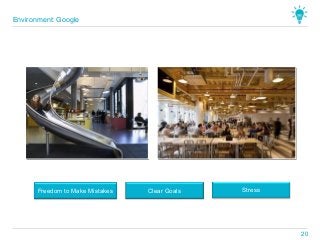
Environment: Google
18
Environment: Google
19
Freedom to Make Mistakes Clear Goals Stress
Environment: Google
20
So how do I go about starting a creativity session?
21
Keep the warm-up unrelated to the main topic
Ice breakers
22
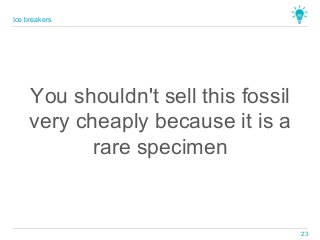
You shouldn't sell this fossil
very cheaply because it is a
rare specimen
Ice breakers
23
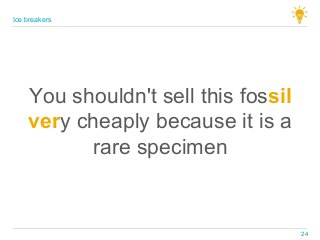
You shouldn't sell this fossil
very cheaply because it is a
rare specimen
Ice breakers
24
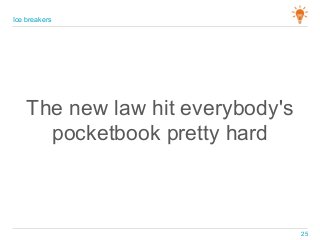
The new law hit everybody's
pocketbook pretty hard
Ice breakers
25
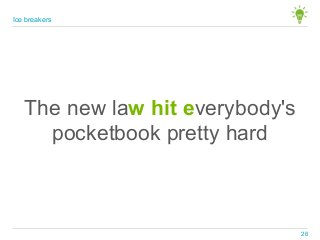
The new law hit everybody's
pocketbook pretty hard
Ice breakers
26
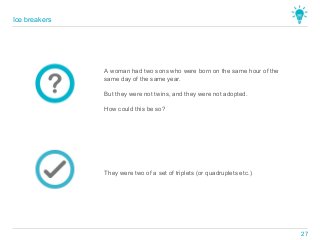
They were two of a set of triplets (or quadruplets etc.)
A woman had two sons who were born on the same hour of the
same day of the same year.
But they were not twins, and they were not adopted.
How could this be so?
Ice breakers
27
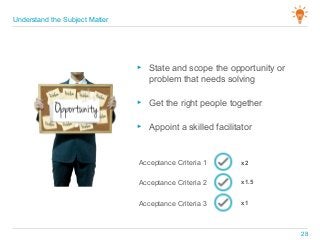
► State and scope the opportunity or
problem that needs solving
► Get the right people together
► Appoint a skilled facilitator
x2
x1.5
x1
Acceptance Criteria 1
Acceptance Criteria 2
Acceptance Criteria 3
Understand the Subject Matter
28
Boardstorming
SCAMPER
Reversal
When you're being creative, nothing is
wrong - John Cleese
Creative Pause
Traditional Creativity Techniques
29
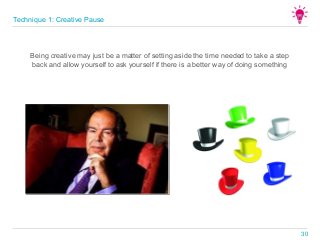
Being creative may just be a matter of setting aside the time needed to take a step
back and allow yourself to ask yourself if there is a better way of doing something
Technique 1: Creative Pause
30
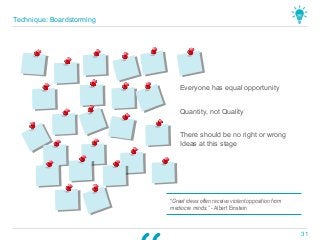
There should be no right or wrong
Ideas at this stage
Quantity, not Quality
Everyone has equal opportunity
“Great ideas often receive violent opposition from
mediocre minds.” - Albert Einstein
Technique: Boardstorming
31
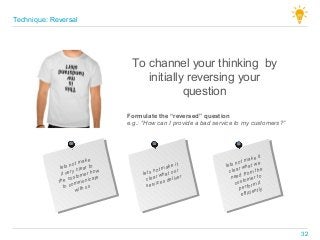
To channel your thinking by
initially reversing your
question
lets not make
it very clear to
the customer how
to communicate
with us
lets not make it
clear what our
services deliver
lets not make it
clear what we
need from the
customer to
perform it
efficiently
Formulate the “reversed” question
e.g.: “How can I provide a bad service to my customers?”
Technique: Reversal
32
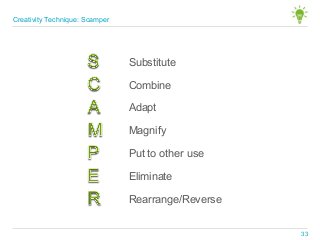
Substitute
Combine
Adapt
Magnify
Put to other use
Eliminate
Rearrange/Reverse
Creativity Technique: Scamper
33
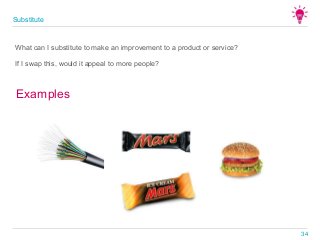
What can I substitute to make an improvement to a product or service?
Examples
If I swap this, would it appeal to more people?
Substitute
34
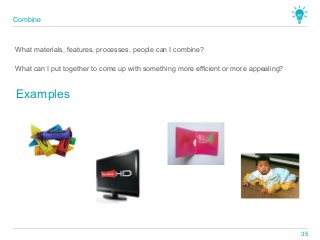
What materials, features, processes, people can I combine?
Examples
What can I put together to come up with something more efficient or more appealing?
Combine
35
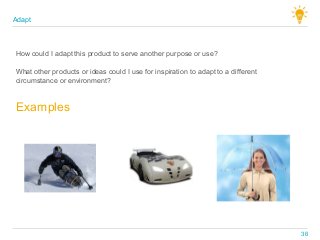
What other products or ideas could I use for inspiration to adapt to a different
circumstance or environment?
Examples
How could I adapt this product to serve another purpose or use?
Adapt
36
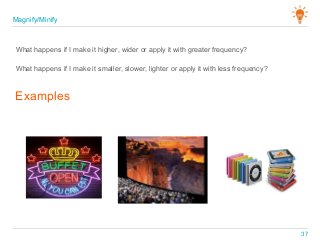
What happens if I make it higher, wider or apply it with greater frequency?
Examples
What happens if I make it smaller, slower, lighter or apply it with less frequency?
Magnify/Minify
37
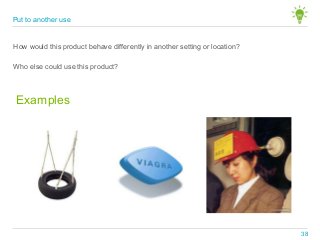
How would this product behave differently in another setting or location?
Examples
Who else could use this product?
Put to another use
38
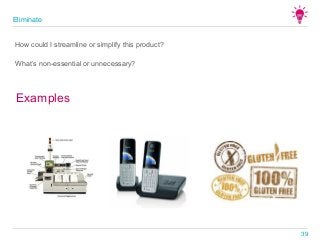
What’s non-essential or unnecessary?
Examples
How could I streamline or simplify this product?
Eliminate
39
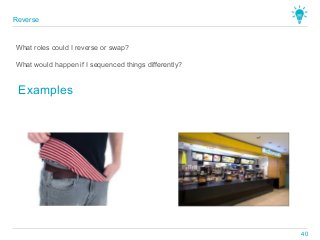
What would happen if I sequenced things differently?
Examples
What roles could I reverse or swap?
Reverse
40
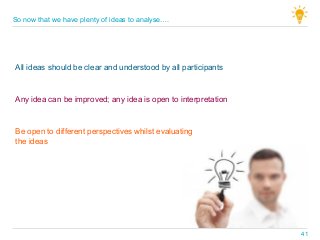
All ideas should be clear and understood by all participants
Any idea can be improved; any idea is open to interpretation
Be open to different perspectives whilst evaluating
the ideas
So now that we have plenty of ideas to analyse….
41
Creativity is sterile if action does not follow from it
Innovation – Making ideas a reality
42
How do we martial our thoughts and ideas?
What ideas make the most sense?
How do we make ideas a practical and commercial reality?
De Bono’s Thinking
Hats
Evaluation Matrix
Dotoscopy
Traditional Innovation Techniques
43
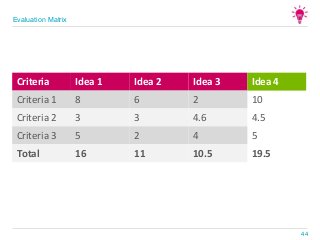
Evaluation Matrix
44
Criteria Idea 1 Idea 2 Idea 3 Idea 4
Criteria 1 8 6 2 10
Criteria 2 3 3 4.6 4.5
Criteria 3 5 2 4 5
Total 16 11 10.5 19.5
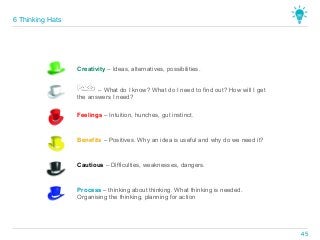
Process – thinking about thinking. What thinking is needed.
Organising the thinking, planning for action
– What do I know? What do I need to find out? How will I get
the answers I need?
Feelings – Intuition, hunches, gut instinct.
Creativity – Ideas, alternatives, possibilities.
Cautious – Difficulties, weaknesses, dangers.
Benefits – Positives. Why an idea is useful and why do we need it?
6 Thinking Hats
45
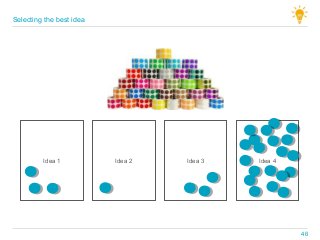
Idea 1 Idea 2 Idea 3 Idea 4
Selecting the best idea
46
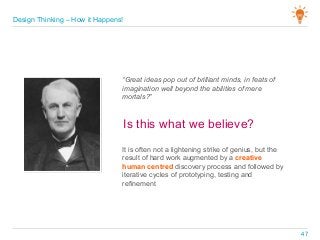
“Great ideas pop out of brilliant minds, in feats of
imagination well beyond the abilities of mere
mortals?”
It is often not a lightening strike of genius, but the
result of hard work augmented by a creative
human centred discovery process and followed by
iterative cycles of prototyping, testing and
refinement
Is this what we believe?
Design Thinking – How it Happens!
47
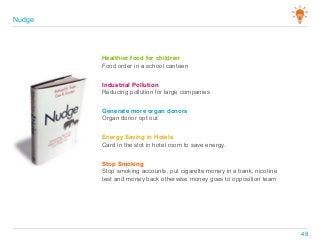
Healthier food for children
Food order in a school canteen
Industrial Pollution
Reducing pollution for large companies
Generate more organ donors
Organ donor opt out
Energy Saving in Hotels
Card in the slot in hotel room to save energy.
Stop Smoking
Stop smoking accounts, put cigarette money in a bank, nicotine
test and money back otherwise money goes to opposition team
Nudge
48
Human Centred Thinking
49
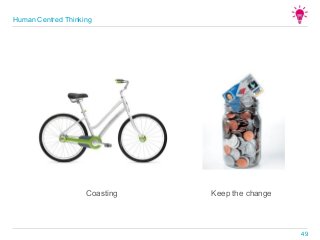
Coasting Keep the change
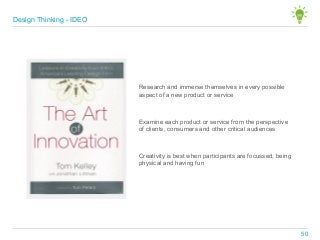
Creativity is best when participants are focussed, being
physical and having fun
Research and immerse themselves in every possible
aspect of a new product or service
Examine each product or service from the perspective
of clients, consumers and other critical audiences
Design Thinking - IDEO
50
Co-Design
51
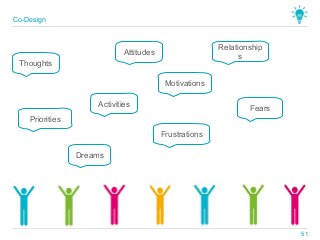
Thoughts
Activities
Attitudes
Motivations
Dreams
Fears
Frustrations
Relationship
s
Priorities
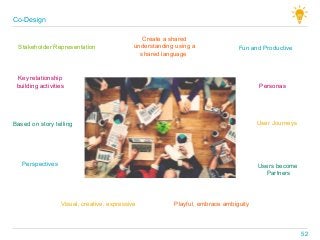
Stakeholder Representation
Perspectives
Personas
User Journeys
Users become
Partners
Visual, creative, expressive
Based on story telling
Playful, embrace ambiguity
Key relationship
building activities
Fun and Productive
Create a shared
understanding using a
shared language
Co-Design
52
Lunch and learn Session 1
Take some of my slides and deliver over a lunch and learn session
Lunch and learn Session 2
Take a fun topic and create some fun sessions using the techniques
1. The Wheel has become illegal, what do we do next?
2. Money no longer exists, what do we do next?
Lunch and learn Session 3
Ask the senior leadership team for a business problem that they have that could do
with an injection of creativity and innovation
1. Run through the techniques to solve the business problem
2. Present back to the senior leadership team and ask for feedback
Lunch & Learn Sessions
53
Reminder: This is how the funnel should look
54
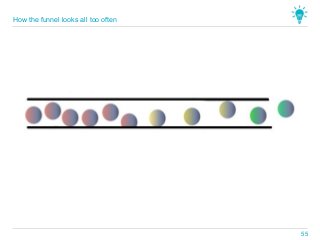
How the funnel looks all too often
55
“That is what you asked for, so
that is what you've got?” Where is the added value in that?
Isn’t the bad perception of Business Analysis as a result of an army of diligent and
dedicated BAs doing precisely what they were asked to do?
So what is the fallback?
56
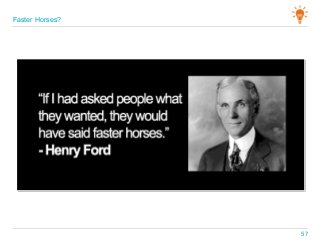
Faster Horses?
57
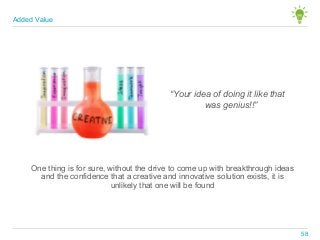
“Your idea of doing it like that
was genius!!”
One thing is for sure, without the drive to come up with breakthrough ideas
and the confidence that a creative and innovative solution exists, it is
unlikely that one will be found
Added Value
58
► Look for opportunities
► You'll be surprised by how creative you can be if you give yourself a
chance
► Share your ideas and perspectives with others, and ask them how
they view problems.
► Adopt a collaborative approach to problem finding, and work
actively with others to create and innovate.
► Don't hide your ability!
► Share your creativity process with others and promote creativity in your team
and organisation.
► You can always be more creative
Corrective Action
59
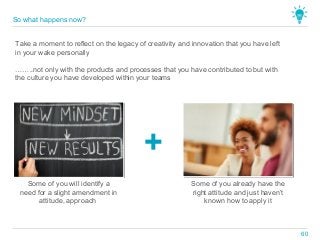
Some of you will identify a
need for a slight amendment in
attitude, approach
Take a moment to reflect on the legacy of creativity and innovation that you have left
in your wake personally
……..not only with the products and processes that you have contributed to but with
the culture you have developed within your teams
So what happens now?
60
+
Some of you already have the
right attitude and just haven’t
known how to apply it
25 July 2013
Creativity and Innovation for
TMP
Linda Harris
Exceptional people delivering exceptional results
Selling your creative talents
Ian Richards

How to Sell Your Creative Talents

  • 1.
    © Capita BusinessServices Limited 2012 25 July 2013 Creativity and Innovation for TMP Linda Harris Exceptional people delivering exceptional results Selling your creative talents Ian Richards
  • 2.
    Innovation consists of transformingthese ideas into action through a selection and an implementation “Creativity is seeing what everyone else has seen, and thinking what no one else has thought.” - Einstein Creativity is the generation of ideas while…. So what is Creativity and Innovation 2
  • 3.
    So why is Creativity andInnovation Important? Why 3
  • 4.
    Our brains arebuilt for creative problem solving, and it is easy to both uncover and enhance our natural inventiveness Our brains 4
  • 5.
  • 6.
    Harry M. Warner, WarnerBros Pictures, 1927 "Who the hell wants to hear actors talk?" Charles H. Duell, Director of US Patent Office 1899 "Everything that can be invented has been invented." Definitions 6
  • 7.
    “you can’t winanything with kids” MOTD 1995 Definitions 7
  • 8.
    We need touse lateral thinking techniques to break out of this patterned way of thinking Pattern Recognition Logic Definitions 8
  • 9.
    ► They havethe ability to go wrong ► They are inquisitive ► They think innovatively ► They are praised for being creative ► Have they had less time to learn patterns? “Every Child is an artist. The problem is staying an artist when you grow up - Pablo Picasso Who are the most creative people? 9
  • 10.
    ► Talent ► Training,tools and techniques Is creativity is a mysterious trait like charisma? You either have it or you don't! Can creativity be learned? 10 Intelligence?
  • 11.
    ► Do wetend to go with the tried, tested and trusted? ► Is it too risky to look for creative alternatives in case they fail? Are we too afraid of failure? ► Do we think that we don’t have time to be creative? ► Do we think that quirky people are the only ones allowed to be creative? So what is stifling our creativity? 11
  • 12.
    Tools Templates Methodologies Governance Inan effort to standardise our work, have we lost focus of the importance of Creativity and Innovation? The trend towards standardisation……. 12 “ ? “ “ “
  • 13.
  • 14.
  • 15.
    ► Unsure ofyour creative talent? ► Haven't been given opportunities to be creative? ► Convinced that you're simply not a creative person? ► Your creativity is a "work in progress? ► You've had some success ► Interested in how to become more creative? ► Creativity is one of your strengths Lets take a little look at ourselves….. 15
  • 16.
    Lets take alittle look at ourselves….. 16 Often the only difference between creative and uncreative people is self-perception
  • 17.
    What makes theperfect creative environment? 17
  • 18.
  • 19.
  • 20.
    Freedom to MakeMistakes Clear Goals Stress Environment: Google 20
  • 21.
    So how doI go about starting a creativity session? 21
  • 22.
    Keep the warm-upunrelated to the main topic Ice breakers 22
  • 23.
    You shouldn't sellthis fossil very cheaply because it is a rare specimen Ice breakers 23
  • 24.
    You shouldn't sellthis fossil very cheaply because it is a rare specimen Ice breakers 24
  • 25.
    The new lawhit everybody's pocketbook pretty hard Ice breakers 25
  • 26.
    The new lawhit everybody's pocketbook pretty hard Ice breakers 26
  • 27.
    They were twoof a set of triplets (or quadruplets etc.) A woman had two sons who were born on the same hour of the same day of the same year. But they were not twins, and they were not adopted. How could this be so? Ice breakers 27
  • 28.
    ► State andscope the opportunity or problem that needs solving ► Get the right people together ► Appoint a skilled facilitator x2 x1.5 x1 Acceptance Criteria 1 Acceptance Criteria 2 Acceptance Criteria 3 Understand the Subject Matter 28
  • 29.
    Boardstorming SCAMPER Reversal When you're beingcreative, nothing is wrong - John Cleese Creative Pause Traditional Creativity Techniques 29
  • 30.
    Being creative mayjust be a matter of setting aside the time needed to take a step back and allow yourself to ask yourself if there is a better way of doing something Technique 1: Creative Pause 30
  • 31.
    There should beno right or wrong Ideas at this stage Quantity, not Quality Everyone has equal opportunity “Great ideas often receive violent opposition from mediocre minds.” - Albert Einstein Technique: Boardstorming 31
  • 32.
    To channel yourthinking by initially reversing your question lets not make it very clear to the customer how to communicate with us lets not make it clear what our services deliver lets not make it clear what we need from the customer to perform it efficiently Formulate the “reversed” question e.g.: “How can I provide a bad service to my customers?” Technique: Reversal 32
  • 33.
    Substitute Combine Adapt Magnify Put to otheruse Eliminate Rearrange/Reverse Creativity Technique: Scamper 33
  • 34.
    What can Isubstitute to make an improvement to a product or service? Examples If I swap this, would it appeal to more people? Substitute 34
  • 35.
    What materials, features,processes, people can I combine? Examples What can I put together to come up with something more efficient or more appealing? Combine 35
  • 36.
    What other productsor ideas could I use for inspiration to adapt to a different circumstance or environment? Examples How could I adapt this product to serve another purpose or use? Adapt 36
  • 37.
    What happens ifI make it higher, wider or apply it with greater frequency? Examples What happens if I make it smaller, slower, lighter or apply it with less frequency? Magnify/Minify 37
  • 38.
    How would thisproduct behave differently in another setting or location? Examples Who else could use this product? Put to another use 38
  • 39.
    What’s non-essential orunnecessary? Examples How could I streamline or simplify this product? Eliminate 39
  • 40.
    What would happenif I sequenced things differently? Examples What roles could I reverse or swap? Reverse 40
  • 41.
    All ideas shouldbe clear and understood by all participants Any idea can be improved; any idea is open to interpretation Be open to different perspectives whilst evaluating the ideas So now that we have plenty of ideas to analyse…. 41
  • 42.
    Creativity is sterileif action does not follow from it Innovation – Making ideas a reality 42 How do we martial our thoughts and ideas? What ideas make the most sense? How do we make ideas a practical and commercial reality?
  • 43.
    De Bono’s Thinking Hats EvaluationMatrix Dotoscopy Traditional Innovation Techniques 43
  • 44.
    Evaluation Matrix 44 Criteria Idea1 Idea 2 Idea 3 Idea 4 Criteria 1 8 6 2 10 Criteria 2 3 3 4.6 4.5 Criteria 3 5 2 4 5 Total 16 11 10.5 19.5
  • 45.
    Process – thinkingabout thinking. What thinking is needed. Organising the thinking, planning for action – What do I know? What do I need to find out? How will I get the answers I need? Feelings – Intuition, hunches, gut instinct. Creativity – Ideas, alternatives, possibilities. Cautious – Difficulties, weaknesses, dangers. Benefits – Positives. Why an idea is useful and why do we need it? 6 Thinking Hats 45
  • 46.
    Idea 1 Idea2 Idea 3 Idea 4 Selecting the best idea 46
  • 47.
    “Great ideas popout of brilliant minds, in feats of imagination well beyond the abilities of mere mortals?” It is often not a lightening strike of genius, but the result of hard work augmented by a creative human centred discovery process and followed by iterative cycles of prototyping, testing and refinement Is this what we believe? Design Thinking – How it Happens! 47
  • 48.
    Healthier food forchildren Food order in a school canteen Industrial Pollution Reducing pollution for large companies Generate more organ donors Organ donor opt out Energy Saving in Hotels Card in the slot in hotel room to save energy. Stop Smoking Stop smoking accounts, put cigarette money in a bank, nicotine test and money back otherwise money goes to opposition team Nudge 48
  • 49.
  • 50.
    Creativity is bestwhen participants are focussed, being physical and having fun Research and immerse themselves in every possible aspect of a new product or service Examine each product or service from the perspective of clients, consumers and other critical audiences Design Thinking - IDEO 50
  • 51.
  • 52.
    Stakeholder Representation Perspectives Personas User Journeys Usersbecome Partners Visual, creative, expressive Based on story telling Playful, embrace ambiguity Key relationship building activities Fun and Productive Create a shared understanding using a shared language Co-Design 52
  • 53.
    Lunch and learnSession 1 Take some of my slides and deliver over a lunch and learn session Lunch and learn Session 2 Take a fun topic and create some fun sessions using the techniques 1. The Wheel has become illegal, what do we do next? 2. Money no longer exists, what do we do next? Lunch and learn Session 3 Ask the senior leadership team for a business problem that they have that could do with an injection of creativity and innovation 1. Run through the techniques to solve the business problem 2. Present back to the senior leadership team and ask for feedback Lunch & Learn Sessions 53
  • 54.
    Reminder: This ishow the funnel should look 54
  • 55.
    How the funnellooks all too often 55
  • 56.
    “That is whatyou asked for, so that is what you've got?” Where is the added value in that? Isn’t the bad perception of Business Analysis as a result of an army of diligent and dedicated BAs doing precisely what they were asked to do? So what is the fallback? 56
  • 57.
  • 58.
    “Your idea ofdoing it like that was genius!!” One thing is for sure, without the drive to come up with breakthrough ideas and the confidence that a creative and innovative solution exists, it is unlikely that one will be found Added Value 58
  • 59.
    ► Look foropportunities ► You'll be surprised by how creative you can be if you give yourself a chance ► Share your ideas and perspectives with others, and ask them how they view problems. ► Adopt a collaborative approach to problem finding, and work actively with others to create and innovate. ► Don't hide your ability! ► Share your creativity process with others and promote creativity in your team and organisation. ► You can always be more creative Corrective Action 59
  • 60.
    Some of youwill identify a need for a slight amendment in attitude, approach Take a moment to reflect on the legacy of creativity and innovation that you have left in your wake personally ……..not only with the products and processes that you have contributed to but with the culture you have developed within your teams So what happens now? 60 + Some of you already have the right attitude and just haven’t known how to apply it
  • 61.
    25 July 2013 Creativityand Innovation for TMP Linda Harris Exceptional people delivering exceptional results Selling your creative talents Ian Richards

Editor's Notes

  • #3 Why should we be creative and innovative?
  • #4 Why should we be creative and innovative?
  • #5 Left – Logical It is easy to uncover it but also easy to forget.
  • #22 We go from meetings to meetings with the same mindset
  • #42 Don’t be precious abut your own idea
  • #43 We all know people who have these great ideas but never implement them.
  • #47 This could also be internet voting or questionnaire based
  • #48 Lets not kid ourselves, it is hard work being creative! Thomas Edison's teachers said he was "too stupid to learn anything." He was fired from his first two jobs for being "non-productive." As an inventor, Edison made 1,000 unsuccessful attempts at inventing the light bulb. When a reporter asked, "How did it feel to fail 1,000 times?" Edison replied, "I didn’t fail 1,000 times. The light bulb was an invention with 1,000 steps.“ He had an army of helpers also! Design thinking can seem chaotic for those experiencing it for the first time.
  • #49 Nudge, understanding human behaviour Change architects & Libertarian paternalism !!!
  • #50 Coasting (Chill, Explore, Dawdle, the first one there is a rotton egg!) Keep the change – Getting an emotional payoff –Bank of America – Helped identify a human behaviour that many people will recognise. Built this jar behaviour into the a debit card. Total rounded up to the nearest dollar then the difference is held separately in their savings account. The Bank of America sweetened the deal y matching that saved in the fist three months & 5% of annual savings thereafter. There are now 5 Million using this with £500M Savings – IDEO helped with this.
  • #51 IDEO – Tom Kelley partner is a partner at the renowned design and innovation consultancy IDEO
  • #52 people are tired and the activities too serious, people will lose interest. Co-design sessions should be fun and enjoyable as well as ‘productive’. (They are also key relationship building activities). They generate rich visual, subjective and tangible material to work with We are limited in what we can express, people can only talk in the language that they know Many of our experiences and knowledge is tacit or embedded in the everyday. Our habits, rituals, dreams and attitudes are not (necessarily) things that we have on tap to describe to design researchers, we may not even be aware of them ourselves
  • #53 people are tired and the activities too serious, people will lose interest. Co-design sessions should be fun and enjoyable as well as ‘productive’. (They are also key relationship building activities). They generate rich visual, subjective and tangible material to work with We are limited in what we can express, people can only talk in the language that they know Many of our experiences and knowledge is tacit or embedded in the everyday. Our habits, rituals, dreams and attitudes are not (necessarily) things that we have on tap to describe to design researchers, we may not even be aware of them ourselves Take photos of the sessions, put it in a journal or a newsletter
  • #54 Of course you can just adopt these techniques…..however this may be a more covert way…. Who often works though their lunch hour? This could be good for appraisals, showing initiative and promoting Business Analysis within the organisation. Use it as a facilitation development sessions for those who want it. Build your reputation as a C&I champion. See if there is an internal reward scheme that is worth perusing Creativity Data Nights