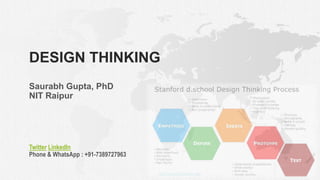
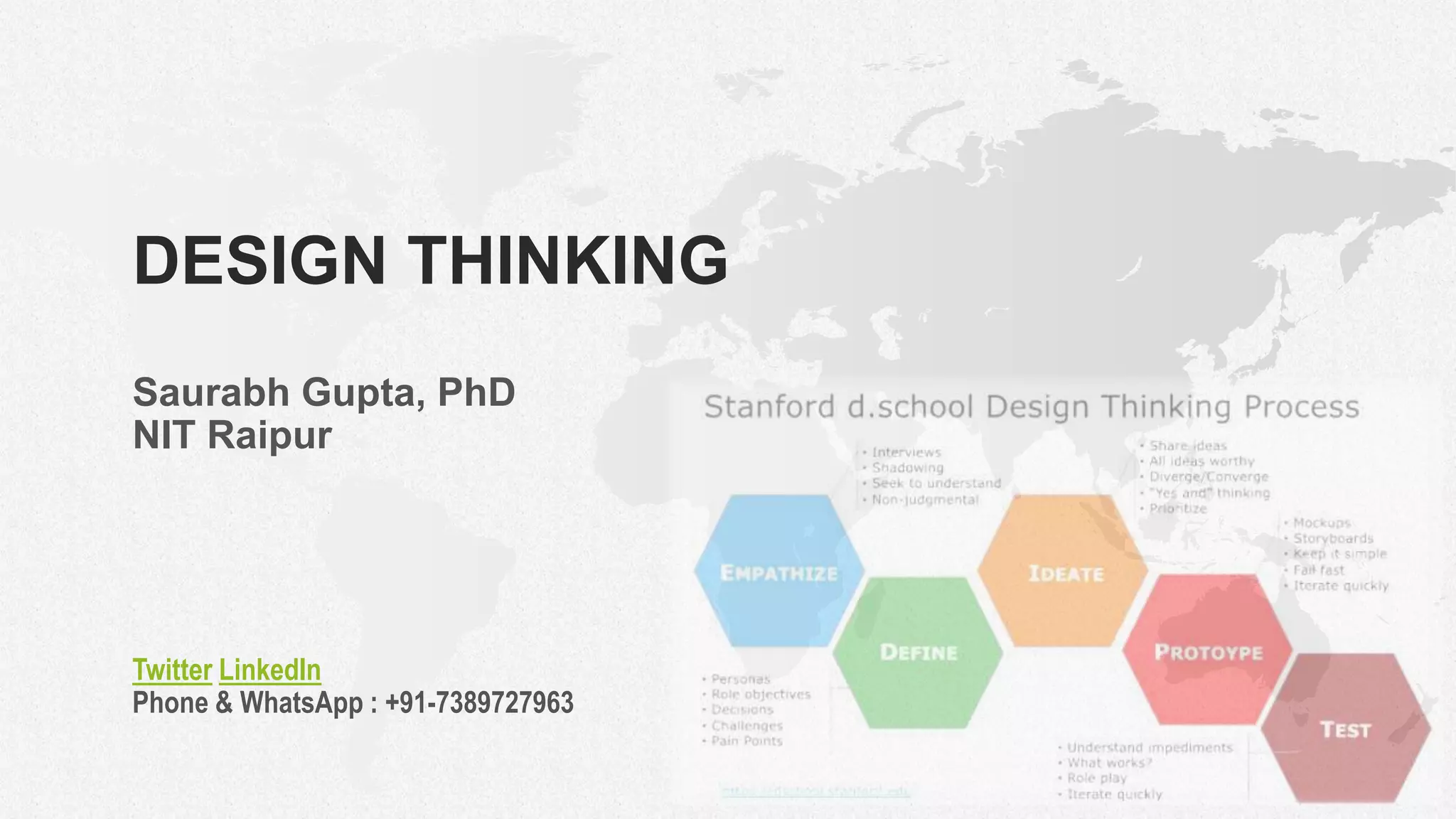

DESIGN THINKING
Saurabh Gupta, PhD
NIT Raipur
Twitter LinkedIn
Phone & WhatsApp : +91-7389727963
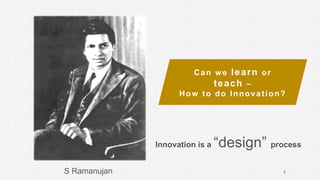
S Ramanujan
Can we learn or
teach –
How to do Innovation?
2
Innovation is a “design” process
• Jugaad Man: Uddhab Bharali
• The Non-stop inventor Two important statements
- Nobody can make you
a innovator
- You have to “feel” it
3
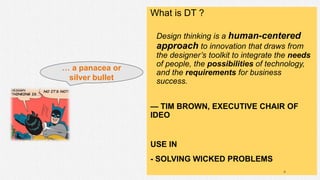
What is DT ?
Design thinking is a human-centered
approach to innovation that draws from
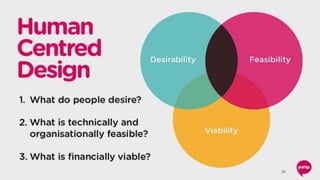
the designer’s toolkit to integrate the needs
of people, the possibilities of technology,
and the requirements for business
success.
— TIM BROWN, EXECUTIVE CHAIR OF
IDEO
USE IN
- SOLVING WICKED PROBLEMS
… a panacea or
silver bullet
4
5
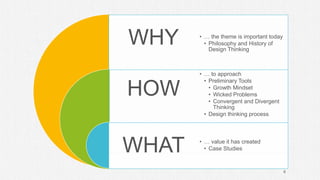
WHY
HOW
WHAT
• … the theme is important today
• Philosophy and History of
Design Thinking
• … to approach
• Preliminary Tools
• Growth Mindset
• Wicked Problems
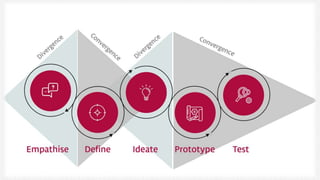
• Convergent and Divergent
Thinking
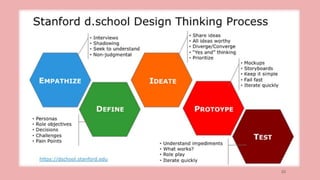
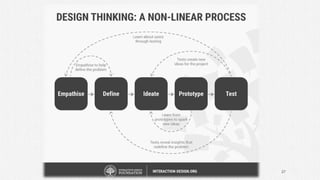
• Design thinking process
• … value it has created
• Case Studies
6
WHY – … THE THEME IS
IMPORTANT TODAY
7
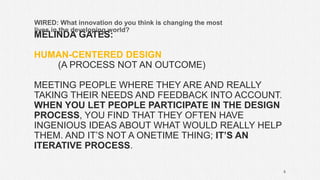
MELINDA GATES:
HUMAN-CENTERED DESIGN
(A PROCESS NOT AN OUTCOME)
MEETING PEOPLE WHERE THEY ARE AND REALLY
TAKING THEIR NEEDS AND FEEDBACK INTO ACCOUNT.
WHEN YOU LET PEOPLE PARTICIPATE IN THE DESIGN
PROCESS, YOU FIND THAT THEY OFTEN HAVE
INGENIOUS IDEAS ABOUT WHAT WOULD REALLY HELP
THEM. AND IT’S NOT A ONETIME THING; IT’S AN
ITERATIVE PROCESS.
WIRED: What innovation do you think is changing the most
lives in the developing world?
8
HOW DOES THAT WORK IN PRACTICE?
PAUL FARMER
IN HAITI I WOULD SEE PEOPLE SLEEPING OUTSIDE
THE HOSPITAL WITH THEIR DONKEY SADDLE UNDER
THEIR NECK — THEY’D BEEN WAITING THERE FOR
DAYS. AND NO ONE WAS ASKING THEM, “WHAT ARE
YOU EATING WHILE YOU’RE WAITING? WHAT IS YOUR
FAMILY EATING WHILE YOU’RE GONE?” WE HAVE TO
DESIGN A HEALTH DELIVERY SYSTEM BY ACTUALLY
TALKING TO PEOPLE AND ASKING, “WHAT WOULD
MAKE THIS SERVICE BETTER FOR YOU?” AS SOON AS
YOU START ASKING, YOU GET A FLOOD OF ANSWERS.
9
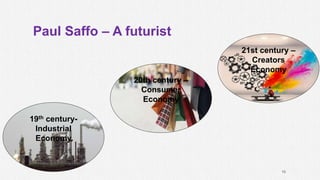
Paul Saffo – A futurist
19th century-
Industrial
Economy
20th century –
Consumer
Economy
21st century –
Creators
Economy
10
If “Design Thinking” is a solution today,
then what would have been the
“need” or “pain point” it addressed years
before
That very first thought
(DT as the case study itself)
11
12
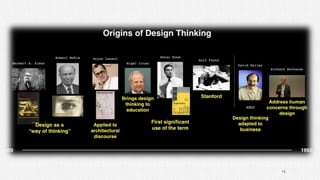
Design -> Design Thinking
Focusing just on design is very incremental and
don’t have much impact
Emerged in later half of 20th century as
design became a tool for consumerism
It makes products amusing, desirable but “not
important”
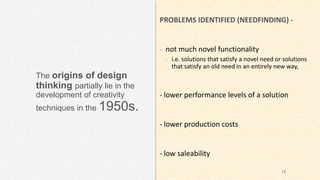
The origins of design
thinking partially lie in the
development of creativity
techniques in the 1950s.
PROBLEMS IDENTIFIED (NEEDFINDING) -
- not much novel functionality
- i.e. solutions that satisfy a novel need or solutions
that satisfy an old need in an entirely new way,
- lower performance levels of a solution
- lower production costs
- low saleability
13
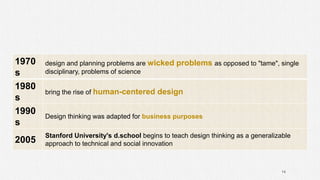
1970
s
design and planning problems are wicked problems as opposed to "tame", single
disciplinary, problems of science
1980
s
bring the rise of human-centered design
1990
s
Design thinking was adapted for business purposes
2005
Stanford University's d.school begins to teach design thinking as a generalizable
approach to technical and social innovation
14
15
16
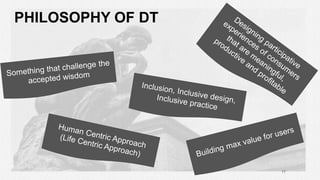
PHILOSOPHY OF DT
17
HOW – … TO APPROACH THE
CONCEPT
18
Preliminary
Tools
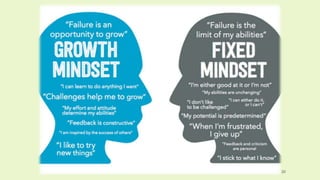
- Growth Mindset
- Wicked Problems
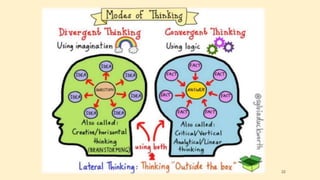
- Convergent and Divergent Thinking
19
20
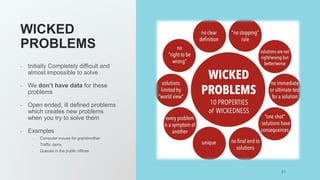
WICKED
PROBLEMS
- Initially Completely difficult and
almost impossible to solve
- We don’t have data for these
problems
- Open ended, ill defined problems
which creates new problems
when you try to solve them
- Examples
- Computer mouse for grandmother
- Traffic Jams
- Queues in the public offices
21
22
23
START WITH
PEOPLE AND
CULTURE
24
25
26
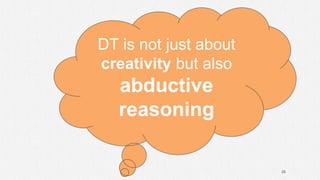
DT is not just about
creativity but also
abductive
reasoning
27
28
29
Isambard Kingdom Brunel was an English civil
engineer who is considered "one of the most ingenious and
prolific figures in engineering history,” "one of the 19th-century
engineering giants,” and "one of the greatest figures of the Industrial
Revolution, [who] changed the face of the English landscape with his
groundbreaking designs and ingenious constructions."
I want to give the
Experience of
“floating” to
passengers along the
countryside - flattest
gradient, longest tunnels
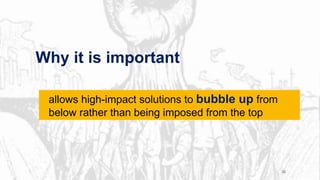
Why it is important
30
allows high-impact solutions to bubble up from
below rather than being imposed from the top
31
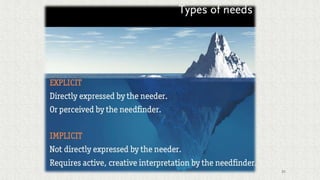
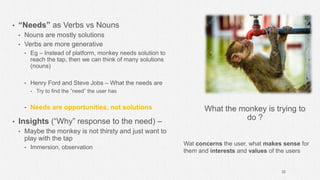
• “Needs” as Verbs vs Nouns
• Nouns are mostly solutions
• Verbs are more generative
• Eg – Instead of platform, monkey needs solution to
reach the tap, then we can think of many solutions
(nouns)
• Henry Ford and Steve Jobs – What the needs are
• Try to find the ”need” the user has
• Needs are opportunities, not solutions
• Insights (“Why” response to the need) –
• Maybe the monkey is not thirsty and just want to
play with the tap
• Immersion, observation
32
What the monkey is trying to
do ?
Wat concerns the user, what makes sense for
them and interests and values of the users
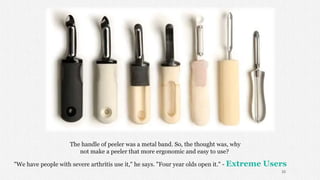
The handle of peeler was a metal band. So, the thought was, why
not make a peeler that more ergonomic and easy to use?
"We have people with severe arthritis use it," he says. "Four year olds open it." - Extreme Users
33
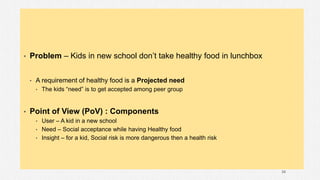
• Problem – Kids in new school don’t take healthy food in lunchbox
• A requirement of healthy food is a Projected need
• The kids “need” is to get accepted among peer group
• Point of View (PoV) : Components
• User – A kid in a new school
• Need – Social acceptance while having Healthy food
• Insight – for a kid, Social risk is more dangerous then a health risk
34
PULSE
• NEWS APP
• We did develop products before, but we didn’t think about things like gaining
empathy for our users or developing prototypes at that time. That was
missing.”
• - Founders of PULSE
• They met at cafés in Palo Alto where they also encountered their future users.
It was often the little insights that shaped their idea further:
• We started observing people reading news in cafés in Palo Alto.
• We basically stayed all day in a café for user tests.
• We then realized that other users felt the same way. They were also
dissatisfied with how news was read on mobile phones at that time.
• Newsreaders back then required you to put in RSS feeds and were tedious to set up.
• We focused on visuals so that users could discover a lot of content really
quickly.” 35
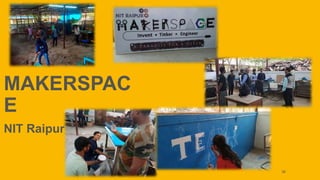
MAKERSPAC
E
NIT Raipur
36
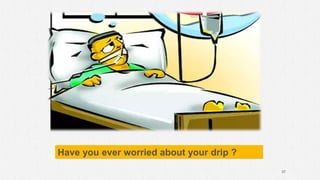
Have you ever worried about your drip ?
37
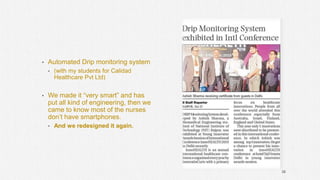
• Automated Drip monitoring system
• (with my students for Calidad
Healthcare Pvt Ltd)
• We made it “very smart” and has
put all kind of engineering, then we
came to know most of the nurses
don’t have smartphones.
• And we redesigned it again.
38
Methods
• Observations
• as at times it is difficult for the users to
communicate the “need”
• Baby products, people who has
accepted the “problem” and started
living with that
39
• Interviews (Focus group,
individual)
• Make your customer feel comfortable.
• Ask some introductory questions to collect basic
demographics that you believe will drive how you
segment and qualify your initial customer.
• Outline the problem that you have identified as
worth solving with some context.
• Ask your prospect how critical is this problem – is it
a must-have, good-to-have, or don’t need?
• Explore Customer’s Worldview - Ask the prospect
how he/she addresses this problem currently.
• Wrapping Up - seek permission to follow-up for the
Problem/Solution interview
• Document Results
40
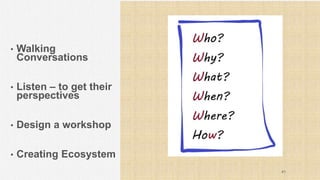
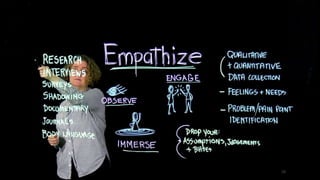
• Walking
Conversations
• Listen – to get their
perspectives
• Design a workshop
• Creating Ecosystem
41
Designers
Approach to
Empathy
- Without judgement
- With a beginners eyes
- With curiosity
- Optimistically
- Respectfully
42
best practices
on how to run
problem
interviews
- Prefer face-to-face interviews
- Pick a neutral location
- Ask for sufficient time
- Avoid recording the interviewee
43
44
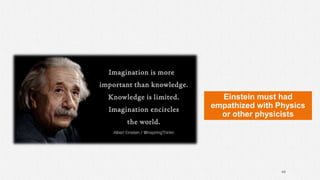
Einstein must had
empathized with Physics
or other physicists
45
Why it is important
46
Better understanding of the problem with
thorough understanding of the users
context and to go into the direction “problem
worth solving”
Methods
• follow 5 WHYs to get the “problem worth
solving”)
• NGO working with girls to train them for
“Beautician course”
• What is the job to be done?
• Workshop with stakeholders - Present
“problem statement” to other stakeholders
in the ecosystem to refine it.
47
Methods
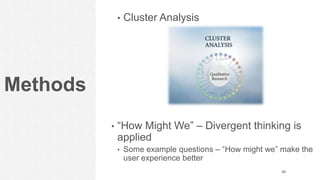
• Cluster Analysis
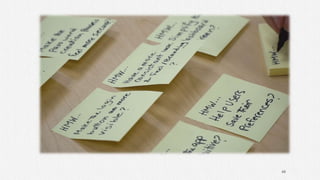
• “How Might We” – Divergent thinking is
applied
• Some example questions – “How might we” make the
user experience better
48
49
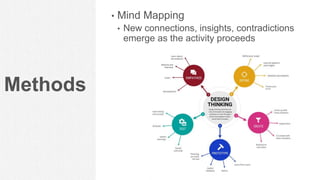
Methods
• Mind Mapping
• New connections, insights, contradictions
emerge as the activity proceeds
50
51
Why it is important
52
To find “new angles”
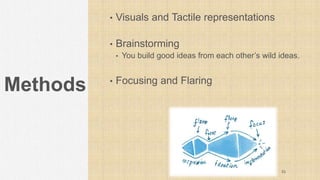
Methods
• Visuals and Tactile representations
• Brainstorming
• You build good ideas from each other’s wild ideas.
• Focusing and Flaring
53
Methods
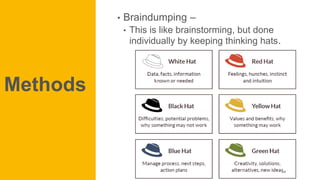
• Braindumping –
• This is like brainstorming, but done
individually by keeping thinking hats.
54
Methods
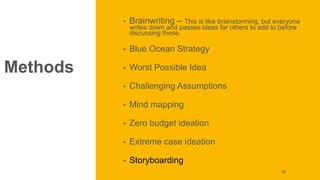
• Brainwriting – This is like brainstorming, but everyone
writes down and passes ideas for others to add to before
discussing these.
• Blue Ocean Strategy
• Worst Possible Idea
• Challenging Assumptions
• Mind mapping
• Zero budget ideation
• Extreme case ideation
• Storyboarding
55
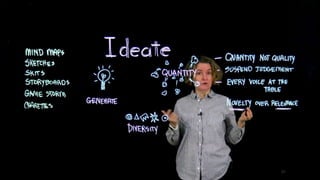
Rules of
Ideation
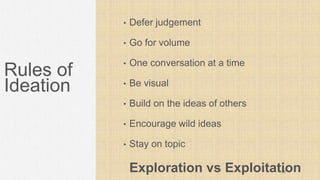
• Defer judgement
• Go for volume
• One conversation at a time
• Be visual
• Build on the ideas of others
• Encourage wild ideas
• Stay on topic
Exploration vs Exploitation
56
57
Why it is important
58
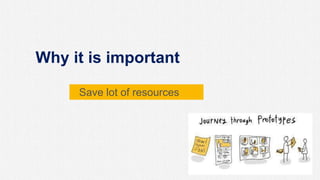
Save lot of resources
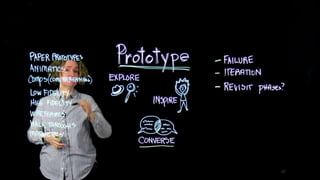
Prototype
Something we “build in
order to think”
Helps in SWOT analysis of our
ideas
59
Important
Question
(before starting the
prototyping)
Can you define the minimum features
needed to solve this problem?
60
Types
• proof-of-principle prototype
• verify some key functional aspects of the intended design
• working prototype
• represents all or nearly all of the functionality of the final
product
• visual prototype
• represents the size and appearance, but not the functionality
61
Types
• user experience prototype
• represents enough of the appearance and function of the
product that it can be used for user research
• functional prototype
• captures both function and appearance of the intended
design
• paper prototype
• printed or hand-drawn representation of the user interface of
a software product
62
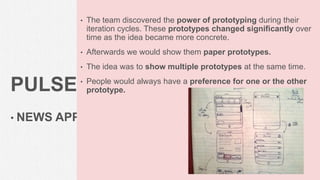
PULSE
• NEWS APP
• The team discovered the power of prototyping during their
iteration cycles. These prototypes changed significantly over
time as the idea became more concrete.
• Afterwards we would show them paper prototypes.
• The idea was to show multiple prototypes at the same time.
• People would always have a preference for one or the other
prototype.
63
64
Why it is important
65
Helps to “Fail (if at all) Early”
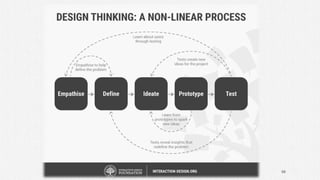
Guidelines
when
Planning a
Test
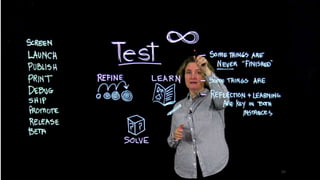
• 1.Let your users compare
alternatives
• 2.Show, don’t tell: let your users
experience the prototype
• 3.Ask users to talk through their
experience
• 4.Observe
• 5.Ask follow up questions
66
Prerequisite
to testing
A understanding that “users”
feedback is priceless
67
68
69
WHAT – VALUE DT HAS CREATED
- CASE STUDIES
70
71
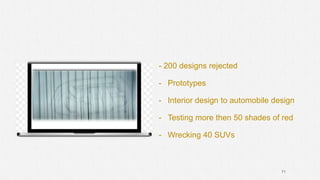
- 200 designs rejected
- Prototypes
- Interior design to automobile design
- Testing more then 50 shades of red
- Wrecking 40 SUVs
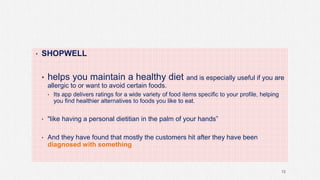
• SHOPWELL
• helps you maintain a healthy diet and is especially useful if you are
allergic to or want to avoid certain foods.
• Its app delivers ratings for a wide variety of food items specific to your profile, helping
you find healthier alternatives to foods you like to eat.
• "like having a personal dietitian in the palm of your hands”
• And they have found that mostly the customers hit after they have been
diagnosed with something
72
73
74
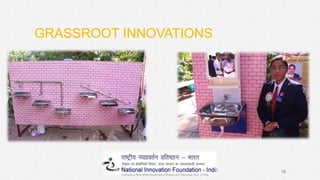
GRASSROOT INNOVATIONS
75
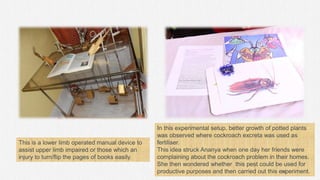
This is a lower limb operated manual device to
assist upper limb impaired or those which an
injury to turn/flip the pages of books easily.
In this experimental setup, better growth of potted plants
was observed where cockroach excreta was used as
fertiliser.
This idea struck Ananya when one day her friends were
complaining about the cockroach problem in their homes.
She then wondered whether this pest could be used for
productive purposes and then carried out this experiment.
76
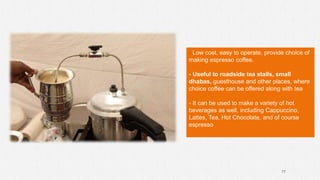
- Low cost, easy to operate, provide choice of
making espresso coffee.
- Useful to roadside tea stalls, small
dhabas, guesthouse and other places, where
choice coffee can be offered along with tea
- It can be used to make a variety of hot
beverages as well, including Cappuccino,
Lattes, Tea, Hot Chocolate, and of course
espresso
77
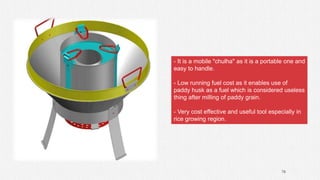
- It is a mobile "chulha" as it is a portable one and
easy to handle.
- Low running fuel cost as it enables use of
paddy husk as a fuel which is considered useless
thing after milling of paddy grain.
- Very cost effective and useful tool especially in
rice growing region.
78
• DT in Emerging Technologies
• AI, IoT, 3D Printing,
• Science, Technology Engineering, Mathematics (STEM)
• DT to solve math problems
• Case Study
79
• Baby Incubators – Case Study
• Arvind eye care
• They porotype the ide very early. They brought down the cost of intraocular lenses from
200 USD to 4 USD a pair.
• Manual Scavenging is still prevalent in India.
• A significant problem that needs design thinking solutions
• Design Thinking workshop has to be conducted in village schools
• Terms and conditions of a product – user friendly
80
• It’s a good approach for market-pull
kind of innovation, and not so much
about ‘technology-push’
• It’s a Method, not MAGIC
• DT as a CASE STUDY
• is itself in the “iterative” phase of
DT
81
@saurabhgupta218
THANK YOU
twitter - @saurabhgupta218
LinkedIn - https://www.linkedin.com/in/saurabh21/
Phone & WhatsApp : +91-7389727963

Design Thinking@saurabhgupta218

  • 1.
    DESIGN THINKING Saurabh Gupta,PhD NIT Raipur Twitter LinkedIn Phone & WhatsApp : +91-7389727963
  • 2.
    S Ramanujan Can welearn or teach – How to do Innovation? 2 Innovation is a “design” process
  • 3.
    • Jugaad Man:Uddhab Bharali • The Non-stop inventor Two important statements - Nobody can make you a innovator - You have to “feel” it 3
  • 4.
    What is DT? Design thinking is a human-centered approach to innovation that draws from the designer’s toolkit to integrate the needs of people, the possibilities of technology, and the requirements for business success. — TIM BROWN, EXECUTIVE CHAIR OF IDEO USE IN - SOLVING WICKED PROBLEMS … a panacea or silver bullet 4
  • 5.
  • 6.
    WHY HOW WHAT • … thetheme is important today • Philosophy and History of Design Thinking • … to approach • Preliminary Tools • Growth Mindset • Wicked Problems • Convergent and Divergent Thinking • Design thinking process • … value it has created • Case Studies 6
  • 7.
    WHY – …THE THEME IS IMPORTANT TODAY 7
  • 8.
    MELINDA GATES: HUMAN-CENTERED DESIGN (APROCESS NOT AN OUTCOME) MEETING PEOPLE WHERE THEY ARE AND REALLY TAKING THEIR NEEDS AND FEEDBACK INTO ACCOUNT. WHEN YOU LET PEOPLE PARTICIPATE IN THE DESIGN PROCESS, YOU FIND THAT THEY OFTEN HAVE INGENIOUS IDEAS ABOUT WHAT WOULD REALLY HELP THEM. AND IT’S NOT A ONETIME THING; IT’S AN ITERATIVE PROCESS. WIRED: What innovation do you think is changing the most lives in the developing world? 8
  • 9.
    HOW DOES THATWORK IN PRACTICE? PAUL FARMER IN HAITI I WOULD SEE PEOPLE SLEEPING OUTSIDE THE HOSPITAL WITH THEIR DONKEY SADDLE UNDER THEIR NECK — THEY’D BEEN WAITING THERE FOR DAYS. AND NO ONE WAS ASKING THEM, “WHAT ARE YOU EATING WHILE YOU’RE WAITING? WHAT IS YOUR FAMILY EATING WHILE YOU’RE GONE?” WE HAVE TO DESIGN A HEALTH DELIVERY SYSTEM BY ACTUALLY TALKING TO PEOPLE AND ASKING, “WHAT WOULD MAKE THIS SERVICE BETTER FOR YOU?” AS SOON AS YOU START ASKING, YOU GET A FLOOD OF ANSWERS. 9
  • 10.
    Paul Saffo –A futurist 19th century- Industrial Economy 20th century – Consumer Economy 21st century – Creators Economy 10
  • 11.
    If “Design Thinking”is a solution today, then what would have been the “need” or “pain point” it addressed years before That very first thought (DT as the case study itself) 11
  • 12.
    12 Design -> DesignThinking Focusing just on design is very incremental and don’t have much impact Emerged in later half of 20th century as design became a tool for consumerism It makes products amusing, desirable but “not important”
  • 13.
    The origins ofdesign thinking partially lie in the development of creativity techniques in the 1950s. PROBLEMS IDENTIFIED (NEEDFINDING) - - not much novel functionality - i.e. solutions that satisfy a novel need or solutions that satisfy an old need in an entirely new way, - lower performance levels of a solution - lower production costs - low saleability 13
  • 14.
    1970 s design and planningproblems are wicked problems as opposed to "tame", single disciplinary, problems of science 1980 s bring the rise of human-centered design 1990 s Design thinking was adapted for business purposes 2005 Stanford University's d.school begins to teach design thinking as a generalizable approach to technical and social innovation 14
  • 15.
  • 16.
  • 17.
  • 18.
    HOW – …TO APPROACH THE CONCEPT 18
  • 19.
    Preliminary Tools - Growth Mindset -Wicked Problems - Convergent and Divergent Thinking 19
  • 20.
  • 21.
    WICKED PROBLEMS - Initially Completelydifficult and almost impossible to solve - We don’t have data for these problems - Open ended, ill defined problems which creates new problems when you try to solve them - Examples - Computer mouse for grandmother - Traffic Jams - Queues in the public offices 21
  • 22.
  • 23.
  • 24.
  • 25.
  • 26.
    26 DT is notjust about creativity but also abductive reasoning
  • 27.
  • 28.
  • 29.
    29 Isambard Kingdom Brunelwas an English civil engineer who is considered "one of the most ingenious and prolific figures in engineering history,” "one of the 19th-century engineering giants,” and "one of the greatest figures of the Industrial Revolution, [who] changed the face of the English landscape with his groundbreaking designs and ingenious constructions." I want to give the Experience of “floating” to passengers along the countryside - flattest gradient, longest tunnels
  • 30.
    Why it isimportant 30 allows high-impact solutions to bubble up from below rather than being imposed from the top
  • 31.
  • 32.
    • “Needs” asVerbs vs Nouns • Nouns are mostly solutions • Verbs are more generative • Eg – Instead of platform, monkey needs solution to reach the tap, then we can think of many solutions (nouns) • Henry Ford and Steve Jobs – What the needs are • Try to find the ”need” the user has • Needs are opportunities, not solutions • Insights (“Why” response to the need) – • Maybe the monkey is not thirsty and just want to play with the tap • Immersion, observation 32 What the monkey is trying to do ? Wat concerns the user, what makes sense for them and interests and values of the users
  • 33.
    The handle ofpeeler was a metal band. So, the thought was, why not make a peeler that more ergonomic and easy to use? "We have people with severe arthritis use it," he says. "Four year olds open it." - Extreme Users 33
  • 34.
    • Problem –Kids in new school don’t take healthy food in lunchbox • A requirement of healthy food is a Projected need • The kids “need” is to get accepted among peer group • Point of View (PoV) : Components • User – A kid in a new school • Need – Social acceptance while having Healthy food • Insight – for a kid, Social risk is more dangerous then a health risk 34
  • 35.
    PULSE • NEWS APP •We did develop products before, but we didn’t think about things like gaining empathy for our users or developing prototypes at that time. That was missing.” • - Founders of PULSE • They met at cafés in Palo Alto where they also encountered their future users. It was often the little insights that shaped their idea further: • We started observing people reading news in cafés in Palo Alto. • We basically stayed all day in a café for user tests. • We then realized that other users felt the same way. They were also dissatisfied with how news was read on mobile phones at that time. • Newsreaders back then required you to put in RSS feeds and were tedious to set up. • We focused on visuals so that users could discover a lot of content really quickly.” 35
  • 36.
  • 37.
    Have you everworried about your drip ? 37
  • 38.
    • Automated Dripmonitoring system • (with my students for Calidad Healthcare Pvt Ltd) • We made it “very smart” and has put all kind of engineering, then we came to know most of the nurses don’t have smartphones. • And we redesigned it again. 38
  • 39.
    Methods • Observations • asat times it is difficult for the users to communicate the “need” • Baby products, people who has accepted the “problem” and started living with that 39
  • 40.
    • Interviews (Focusgroup, individual) • Make your customer feel comfortable. • Ask some introductory questions to collect basic demographics that you believe will drive how you segment and qualify your initial customer. • Outline the problem that you have identified as worth solving with some context. • Ask your prospect how critical is this problem – is it a must-have, good-to-have, or don’t need? • Explore Customer’s Worldview - Ask the prospect how he/she addresses this problem currently. • Wrapping Up - seek permission to follow-up for the Problem/Solution interview • Document Results 40
  • 41.
    • Walking Conversations • Listen– to get their perspectives • Design a workshop • Creating Ecosystem 41
  • 42.
    Designers Approach to Empathy - Withoutjudgement - With a beginners eyes - With curiosity - Optimistically - Respectfully 42
  • 43.
    best practices on howto run problem interviews - Prefer face-to-face interviews - Pick a neutral location - Ask for sufficient time - Avoid recording the interviewee 43
  • 44.
    44 Einstein must had empathizedwith Physics or other physicists
  • 45.
  • 46.
    Why it isimportant 46 Better understanding of the problem with thorough understanding of the users context and to go into the direction “problem worth solving”
  • 47.
    Methods • follow 5WHYs to get the “problem worth solving”) • NGO working with girls to train them for “Beautician course” • What is the job to be done? • Workshop with stakeholders - Present “problem statement” to other stakeholders in the ecosystem to refine it. 47
  • 48.
    Methods • Cluster Analysis •“How Might We” – Divergent thinking is applied • Some example questions – “How might we” make the user experience better 48
  • 49.
  • 50.
    Methods • Mind Mapping •New connections, insights, contradictions emerge as the activity proceeds 50
  • 51.
  • 52.
    Why it isimportant 52 To find “new angles”
  • 53.
    Methods • Visuals andTactile representations • Brainstorming • You build good ideas from each other’s wild ideas. • Focusing and Flaring 53
  • 54.
    Methods • Braindumping – •This is like brainstorming, but done individually by keeping thinking hats. 54
  • 55.
    Methods • Brainwriting –This is like brainstorming, but everyone writes down and passes ideas for others to add to before discussing these. • Blue Ocean Strategy • Worst Possible Idea • Challenging Assumptions • Mind mapping • Zero budget ideation • Extreme case ideation • Storyboarding 55
  • 56.
    Rules of Ideation • Deferjudgement • Go for volume • One conversation at a time • Be visual • Build on the ideas of others • Encourage wild ideas • Stay on topic Exploration vs Exploitation 56
  • 57.
  • 58.
    Why it isimportant 58 Save lot of resources
  • 59.
    Prototype Something we “buildin order to think” Helps in SWOT analysis of our ideas 59
  • 60.
    Important Question (before starting the prototyping) Canyou define the minimum features needed to solve this problem? 60
  • 61.
    Types • proof-of-principle prototype •verify some key functional aspects of the intended design • working prototype • represents all or nearly all of the functionality of the final product • visual prototype • represents the size and appearance, but not the functionality 61
  • 62.
    Types • user experienceprototype • represents enough of the appearance and function of the product that it can be used for user research • functional prototype • captures both function and appearance of the intended design • paper prototype • printed or hand-drawn representation of the user interface of a software product 62
  • 63.
    PULSE • NEWS APP •The team discovered the power of prototyping during their iteration cycles. These prototypes changed significantly over time as the idea became more concrete. • Afterwards we would show them paper prototypes. • The idea was to show multiple prototypes at the same time. • People would always have a preference for one or the other prototype. 63
  • 64.
  • 65.
    Why it isimportant 65 Helps to “Fail (if at all) Early”
  • 66.
    Guidelines when Planning a Test • 1.Letyour users compare alternatives • 2.Show, don’t tell: let your users experience the prototype • 3.Ask users to talk through their experience • 4.Observe • 5.Ask follow up questions 66
  • 67.
    Prerequisite to testing A understandingthat “users” feedback is priceless 67
  • 68.
  • 69.
  • 70.
    WHAT – VALUEDT HAS CREATED - CASE STUDIES 70
  • 71.
    71 - 200 designsrejected - Prototypes - Interior design to automobile design - Testing more then 50 shades of red - Wrecking 40 SUVs
  • 72.
    • SHOPWELL • helpsyou maintain a healthy diet and is especially useful if you are allergic to or want to avoid certain foods. • Its app delivers ratings for a wide variety of food items specific to your profile, helping you find healthier alternatives to foods you like to eat. • "like having a personal dietitian in the palm of your hands” • And they have found that mostly the customers hit after they have been diagnosed with something 72
  • 73.
  • 74.
  • 75.
  • 76.
    This is alower limb operated manual device to assist upper limb impaired or those which an injury to turn/flip the pages of books easily. In this experimental setup, better growth of potted plants was observed where cockroach excreta was used as fertiliser. This idea struck Ananya when one day her friends were complaining about the cockroach problem in their homes. She then wondered whether this pest could be used for productive purposes and then carried out this experiment. 76
  • 77.
    - Low cost,easy to operate, provide choice of making espresso coffee. - Useful to roadside tea stalls, small dhabas, guesthouse and other places, where choice coffee can be offered along with tea - It can be used to make a variety of hot beverages as well, including Cappuccino, Lattes, Tea, Hot Chocolate, and of course espresso 77
  • 78.
    - It isa mobile "chulha" as it is a portable one and easy to handle. - Low running fuel cost as it enables use of paddy husk as a fuel which is considered useless thing after milling of paddy grain. - Very cost effective and useful tool especially in rice growing region. 78
  • 79.
    • DT inEmerging Technologies • AI, IoT, 3D Printing, • Science, Technology Engineering, Mathematics (STEM) • DT to solve math problems • Case Study 79
  • 80.
    • Baby Incubators– Case Study • Arvind eye care • They porotype the ide very early. They brought down the cost of intraocular lenses from 200 USD to 4 USD a pair. • Manual Scavenging is still prevalent in India. • A significant problem that needs design thinking solutions • Design Thinking workshop has to be conducted in village schools • Terms and conditions of a product – user friendly 80
  • 81.
    • It’s agood approach for market-pull kind of innovation, and not so much about ‘technology-push’ • It’s a Method, not MAGIC • DT as a CASE STUDY • is itself in the “iterative” phase of DT 81
  • 82.
    @saurabhgupta218 THANK YOU twitter -@saurabhgupta218 LinkedIn - https://www.linkedin.com/in/saurabh21/ Phone & WhatsApp : +91-7389727963