DEVELOPING
             CREATIVIY AND
            UNDERSTANDING
              INNOVATION
7/27/2012                    1
INNOVATION AND THE
            ENTREPRENEUR
                  Innovation is the key function in the
                   entrepreneurial process
                  Innovation is the process by which
                   entrepreneurs convert opportunities
                   into marketable ideas.
                  Innovation is more than just a good
                   idea.
                  Entrepreneurs blend creative thinking
                   with a systematic,logical process
                   ability
7/27/2012                                            2
ROLE OF CREATIVITY
               Creativity is the generation of ideas
                that result in the improved efficiency
                or effectiveness of a system.
               Two important aspects of creativity
                are process and people.
                       Process is goal oriented.
                       People are the resources that
                       determine the solution.

7/27/2012                                                3
TWO APPROACHES TO CREATIVE PROBLEM SOLVING
     ADOPTOR                                  INNOVATOR
   Employs a disciplined,           Approaches tasks from unusual
    precise, methodical approach.     angles.
   Is concerned with solving,       Discovers problems and
    rather than finding problems.     avenues of solutions.
   Attempts to refine current       Questions basic assumptions
    practices.                        related to current practices.
   Tends to be means oriented.      Has little regard for means, is
   Is capable of extended detail     more interested in ends.
    work.                            Has little tolerance for routine
   Is sensitive to group cohesion    work.
    and cooperation.                 Has little or no need for
                                      consensus, often is insensitive
    7/27/2012                                                         4
                                      to others.
NATURE OF CREATIVE PROCESS
                    Creativity is a process that can be
                     developed and improved.
                    Everyone is creative to some
                     degree.
                    Creativity is not some mysterious
                     talent reserved for few.
                    Barriers to creative thinking are
                     sometimes the inadvertent ‘killer
                     phrases’.

7/27/2012                                             5
SOME IDEA STOPPERS
                   ‘Naah’
                   ‘That’s the dumbest thing I have ever
                    heard’.
                   ‘We have done all right so far why do
                    we need that?’
                   ‘That doesn’t sound practical’.
                   ‘Lets get back to reality’.
                   ‘Where do you get these weird ideas’

7/27/2012                                               6
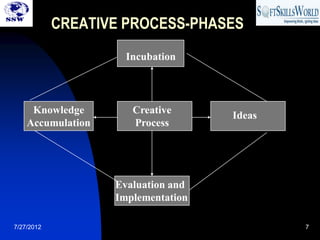
CREATIVE PROCESS-PHASES
                     Incubation


     Knowledge        Creative      Ideas
    Accumulation      Process


                   Evaluation and
                   Implementation

7/27/2012                                   7
PHASES OF CREATIVITY
   Phase 1 : Background or Knowledge
    Accumulation.
   Phase 2 : The Incubation process.
   Phase 3 : The idea experience.
   Phase 4 : Evaluation and Implementation


    7/27/2012                                 8
DEVELOPING YOUR CREATIVITY
               RECOGNIZING RELATIONSHIPS.
               DEVELOPING A FUNCTIONAL
                PERSPECTIVE.
               USING YOUR BRAIN.
               ELIMINATING MUDDLING MIND-SETS.


7/27/2012                                         9
DEVELOPING CREATIVITY
      RECOGNIZING RELATIONSHIPS :
       Seeing new and different relationships among
        objects, processes, materials, technologies and
        people.
       Perceiving in a relational mode.
      DEVELOPING A FUNCTIONAL PERSPECTIVE :
       View things and people in terms of how they
        can satisfy your need to complement a project
7/27/2012                                            10
DEVELOPING CREATIVITY
                       USING YOUR BRAIN

            LEFT HEMISPHERE         RIGHT HEMISPHERE

               VERBAL      NONVERBAL
                                

               ANALYTICAL SYNTHESIZING

               ABSTRACT   SEEING ANALOGIES

               RATIONAL   NONRATIONAL

               LOGICAL    SPATIAL

               LINEAR     INTUTIVE

                           IMAGINATIVE

   TO BECOME MORE CREATIVE IT IS NECESSARY TO
   PRACTICE AND DEVELOP BOTH HEMISPHERE SKILLS
7/27/2012                                              11
WAYS TO DEVELOP LEFT AND RIGHT HEMISPHERE SKILLS

LEFT HEMISPHERE SKILLS                    RIGHT-HEMISPHERE SKILLS
    Step by step planning of your           Using metaphors and
     work and life activities.                analogies to describe things
    Reading ancient, medieval, and           and people in your
     scholastic philosophy , legal            conversation.
     cases and books on logic.               Recording your hunches,
                                              feelings, and intuition and
    Establishing timetables for all of       calculating their accuracy.
     your activities.                        Detailed fantasizing and
    Using and working with a                 visualizing things and
     computer program.                        situations in future.
                                             Drawing faces, caricatures,
    7/27/2012
                                              and landscapes.             12
DEVELOPING CREATIVITY

   ELIMINATING MUDDLING MIND-SETS


                     EITHER / OR THINKING
                     SECURITY HUNTING
                     STEREOTYPING
                     PROBABILITY THINKING


7/27/2012                                    13
THE INNOVATION PROCESS

               Most innovations result from a
                conscious, purposeful search for
                new opportunities.
               Successful innovators use both left
                and right sides of the brain.
                Most successful innovations are
                simple and focused.
               Innovation often involves more
7/27/2012       work than genius                 14
TYPES OF INNOVATION
               INVENTION : Totally new product , service
                or process.
               EXTENSION : New use or different
                application of an already existing product,
                service ,or process.
               DUPLICATION : Creative replication of an
                existing concept.
               SYNTHESIS : Combination of existing
                concepts and factors into a new
                formulation or use.
7/27/2012                                                15
INNOVATION SOURCES
                  Unexpected occurrences.
                  Incongruities.
                  Process needs.
                  Industry and market changes.
                  Demographic changes.
                  Perceptual changes.
                  Knowledge-based concepts.

7/27/2012                                         16
MAJOR INNOVATION MYTHS
      INNOVATION IS PLANNED AND
       PREDICTABLE.
      TECHNICAL SPECIFICATIONS SHOULD BE
       THROUGHLY PREPARED.
      CREATIVITY RELIES ON DREAMS AND
       BLUE-SKY IDEAS
      BIG PROJECTS WILL DEVELOP BETTER
       INNOVATIONS THAN SMALLER
      TECHNOLOGY IS THE DRIVING FORCE OF
       INNOVATION AND SUCCESS
7/27/2012                                   17
PRINCIPLES OF INNOVATION
  Be action oriented.
 Make the product, process, or service simple and
   understandable.
 Make the product ,process or service customer based.

 Start small.

 Aim high.

 Try / Test / revise.

 Learn from failures.

 Follow a milestone schedule.

 Reward heroic activity.

   Work , Work , Work .
7/27/2012                                         18
FINANCIAL SUPPORT FOR
                 INNOVATION
                   VENTURE CAPITALISTS.
                   GOVERNMENT SUPPORT.
                   NGO’S.


7/27/2012                                  19
7/27/2012   20

Process innovation and leadership ppt

  • 1.
    DEVELOPING CREATIVIY AND UNDERSTANDING INNOVATION 7/27/2012 1
  • 2.
    INNOVATION AND THE ENTREPRENEUR  Innovation is the key function in the entrepreneurial process  Innovation is the process by which entrepreneurs convert opportunities into marketable ideas.  Innovation is more than just a good idea.  Entrepreneurs blend creative thinking with a systematic,logical process ability 7/27/2012 2
  • 3.
    ROLE OF CREATIVITY  Creativity is the generation of ideas that result in the improved efficiency or effectiveness of a system.  Two important aspects of creativity are process and people. Process is goal oriented. People are the resources that determine the solution. 7/27/2012 3
  • 4.
    TWO APPROACHES TOCREATIVE PROBLEM SOLVING ADOPTOR INNOVATOR  Employs a disciplined,  Approaches tasks from unusual precise, methodical approach. angles.  Is concerned with solving,  Discovers problems and rather than finding problems. avenues of solutions.  Attempts to refine current  Questions basic assumptions practices. related to current practices.  Tends to be means oriented.  Has little regard for means, is  Is capable of extended detail more interested in ends. work.  Has little tolerance for routine  Is sensitive to group cohesion work. and cooperation.  Has little or no need for consensus, often is insensitive 7/27/2012 4 to others.
  • 5.
    NATURE OF CREATIVEPROCESS  Creativity is a process that can be developed and improved.  Everyone is creative to some degree.  Creativity is not some mysterious talent reserved for few.  Barriers to creative thinking are sometimes the inadvertent ‘killer phrases’. 7/27/2012 5
  • 6.
    SOME IDEA STOPPERS  ‘Naah’  ‘That’s the dumbest thing I have ever heard’.  ‘We have done all right so far why do we need that?’  ‘That doesn’t sound practical’.  ‘Lets get back to reality’.  ‘Where do you get these weird ideas’ 7/27/2012 6
  • 7.
    CREATIVE PROCESS-PHASES Incubation Knowledge Creative Ideas Accumulation Process Evaluation and Implementation 7/27/2012 7
  • 8.
    PHASES OF CREATIVITY  Phase 1 : Background or Knowledge Accumulation.  Phase 2 : The Incubation process.  Phase 3 : The idea experience.  Phase 4 : Evaluation and Implementation 7/27/2012 8
  • 9.
    DEVELOPING YOUR CREATIVITY  RECOGNIZING RELATIONSHIPS.  DEVELOPING A FUNCTIONAL PERSPECTIVE.  USING YOUR BRAIN.  ELIMINATING MUDDLING MIND-SETS. 7/27/2012 9
  • 10.
    DEVELOPING CREATIVITY RECOGNIZING RELATIONSHIPS :  Seeing new and different relationships among objects, processes, materials, technologies and people.  Perceiving in a relational mode. DEVELOPING A FUNCTIONAL PERSPECTIVE :  View things and people in terms of how they can satisfy your need to complement a project 7/27/2012 10
  • 11.
    DEVELOPING CREATIVITY USING YOUR BRAIN LEFT HEMISPHERE RIGHT HEMISPHERE  VERBAL NONVERBAL   ANALYTICAL SYNTHESIZING  ABSTRACT  SEEING ANALOGIES  RATIONAL  NONRATIONAL  LOGICAL  SPATIAL  LINEAR  INTUTIVE  IMAGINATIVE TO BECOME MORE CREATIVE IT IS NECESSARY TO PRACTICE AND DEVELOP BOTH HEMISPHERE SKILLS 7/27/2012 11
  • 12.
    WAYS TO DEVELOPLEFT AND RIGHT HEMISPHERE SKILLS LEFT HEMISPHERE SKILLS RIGHT-HEMISPHERE SKILLS  Step by step planning of your  Using metaphors and work and life activities. analogies to describe things  Reading ancient, medieval, and and people in your scholastic philosophy , legal conversation. cases and books on logic.  Recording your hunches, feelings, and intuition and  Establishing timetables for all of calculating their accuracy. your activities.  Detailed fantasizing and  Using and working with a visualizing things and computer program. situations in future.  Drawing faces, caricatures, 7/27/2012 and landscapes. 12
  • 13.
    DEVELOPING CREATIVITY ELIMINATING MUDDLING MIND-SETS  EITHER / OR THINKING  SECURITY HUNTING  STEREOTYPING  PROBABILITY THINKING 7/27/2012 13
  • 14.
    THE INNOVATION PROCESS  Most innovations result from a conscious, purposeful search for new opportunities.  Successful innovators use both left and right sides of the brain.  Most successful innovations are simple and focused.  Innovation often involves more 7/27/2012 work than genius 14
  • 15.
    TYPES OF INNOVATION  INVENTION : Totally new product , service or process.  EXTENSION : New use or different application of an already existing product, service ,or process.  DUPLICATION : Creative replication of an existing concept.  SYNTHESIS : Combination of existing concepts and factors into a new formulation or use. 7/27/2012 15
  • 16.
    INNOVATION SOURCES  Unexpected occurrences.  Incongruities.  Process needs.  Industry and market changes.  Demographic changes.  Perceptual changes.  Knowledge-based concepts. 7/27/2012 16
  • 17.
    MAJOR INNOVATION MYTHS  INNOVATION IS PLANNED AND PREDICTABLE.  TECHNICAL SPECIFICATIONS SHOULD BE THROUGHLY PREPARED.  CREATIVITY RELIES ON DREAMS AND BLUE-SKY IDEAS  BIG PROJECTS WILL DEVELOP BETTER INNOVATIONS THAN SMALLER  TECHNOLOGY IS THE DRIVING FORCE OF INNOVATION AND SUCCESS 7/27/2012 17
  • 18.
    PRINCIPLES OF INNOVATION  Be action oriented.  Make the product, process, or service simple and understandable.  Make the product ,process or service customer based.  Start small.  Aim high.  Try / Test / revise.  Learn from failures.  Follow a milestone schedule.  Reward heroic activity. Work , Work , Work . 7/27/2012 18
  • 19.
    FINANCIAL SUPPORT FOR INNOVATION  VENTURE CAPITALISTS.  GOVERNMENT SUPPORT.  NGO’S. 7/27/2012 19
  • 20.