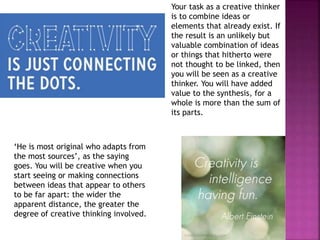
Your task as a creative thinker
is to combine ideas or
elements that already exist. If
the result is an unlikely but
valuable combination of ideas
or things that hitherto were
not thought to be linked, then
you will be seen as a creative
thinker. You will have added
value to the synthesis, for a
whole is more than the sum of
its parts.
‘He is most original who adapts from
the most sources’, as the saying
goes. You will be creative when you
start seeing or making connections
between ideas that appear to others
to be far apart: the wider the
apparent distance, the greater the
degree of creative thinking involved.
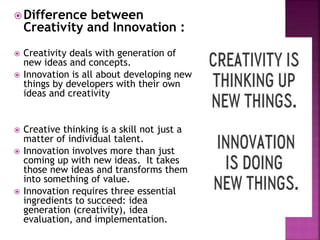
Difference between
Creativity and Innovation :
 Creativity deals with generation of
new ideas and concepts.
 Innovation is all about developing new
things by developers with their own
ideas and creativity
 Creative thinking is a skill not just a
matter of individual talent.
 Innovation involves more than just
coming up with new ideas. It takes
those new ideas and transforms them
into something of value.
 Innovation requires three essential
ingredients to succeed: idea
generation (creativity), idea
evaluation, and implementation.
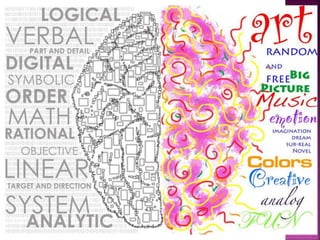
“Right brain: I am the right brain. I am creativity. A
free spirit. I am passion. Yearning. Sensuality. I am
the sound of roaring laughter. I am taste. The
feeling of sand beneath bare feat. I am movement.
Vivid colors. I am the urge to paint on an empty
canvas. I am boundless imagination. Art. Poetry. I
sense. I feel. I am everything I wanted to be.
Left brain: I am the left brain. I am a scientist. A
mathematician. I love the familiar. I categorize. I
am accurate. Linear. Analytical. Strategic. I am
practical. Always in control. A master of words and
language. Realistic. I calculate equations and play
with numbers. I am order. I am logic. I know exactly
who I am. “
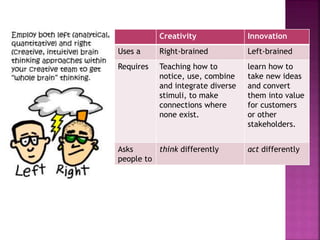
Creativity Innovation
Uses a Right-brained Left-brained
Requires Teaching how to
notice, use, combine
and integrate diverse
stimuli, to make
connections where
none exist.
learn how to
take new ideas
and convert
them into value
for customers
or other
stakeholders.
Asks
people to
think differently act differently
The Most Powerful Types of
Creative Thinking :
1. Reframing
Creative frames of Reference :
 Meaning — what else could this mean?
 Learning — what can I learn from this?
 Humor — what’s the funny side of this?
 Solution — what would I be doing if I’d solved the
problem? Can I start doing any of that right now?
 Silver lining — what opportunities are lurking inside this
problem?
 Points of view — how does this look to the other people
involved?
 Creative heroes — how would one of my creative heroes
approach this problem?
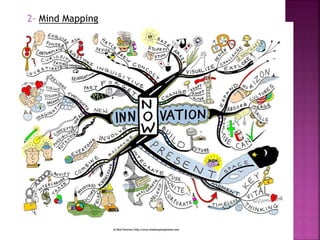
2- Mind Mapping
3- Insight
How to Have an Insight :
 Gathering knowledge — through both constant effort to
expand your general knowledge and also specific research for
each project.
 Hard thinking about the problem — doing your best to
combine the different elements into a workable solution.
 Taking a break and allowing the unconscious mind to work
its magic. Rather than simply doing nothing, do whatever
stimulate your imagination and emotions such as a trip to the
movies or reading fiction.
 The Eureka moment — when the idea appears as if from
nowhere.
 Developing the idea — expanding its possibilities, critiquing it
for weaknesses and translating into action.
Am I born Creative ?!
There is no such a question; Creativity is within
all of us. What differs from person to person is
how they tap into it and use it.
Having confidence of being creative makes you
have better ideas and make better decisions.
Creativity Killers :
1. Multi-tasking and not focusing
2. Lack of sleep
3. Fear of rejection
Always remember that if you got hired to do some
work it’s because that person thinks you’re talented
and remember that you’re probably not the first
freelancer this person contacted for the project.
4. Pressure and deadlines
Some clients have very high expectations, and it’s
understandable. Remember, they pay your bills! But
can you really be creative when you’re under heavy
pressure? Some people have no problem with stress
but for those of us who do it’s fairly easy to make sure
you’re never under pressure and still always deliver!
Give yourself the sufficient time to do the task with a
risk plan.
 10 Tips to Gain Creativity in your Ideas
1. List your ideas : to make it clear for you mind about the
benefits and risks involved.
2. Practice your favorite activity : listen to music, have a walk, ..
3. Change in perspective : be open to new ideas and understand
others' ideas.
4. Brainstorm : "Two heads are better than one." Share and discuss
ideas in a group.
5. Lateral Thinking tool :
Edward de Bono's Lateral Thinking tool, Random Entry, uses a
randomly chosen word, picture, sound, or other stimulus to
open new lines of thinking. This tool plays into the power of the
human mind to find connections between seemingly unrelated
things.
6. Just DO-IT: DO-IT
D – Define the problem,
O-Open mind and apply creative methods,
I-Identify the best possible solution,
T-Transform. In simple words,
the DO-IT process is a methodical or structured process for
creativity. It helps you maximize the returns of your creativity.
7. Read and research
8. Whatever you think, think the opposite.
9. View problems as opportunities for improvement.
10. Implement your ideas: Appreciate the goodness or returns in
your idea rather than looking at the loopholes. Never
hesitate to implement it. Act upon your idea and as you
succeed with each idea, your confidence grows and helps
you think of many more creative ones.
Creativity is sterile if action does not follow from
it. Ideas must be evaluated, improved, polished and
marketed before they have any value.
 When people are not interested in hearing about brands— which
is most of the time—they’re not really interested in looking at
ads either. But creativity can allow an ad to get past the normal
filtering process.
 Creativity can make people stop what they’re doing and pay
attention, even when they know what they’re looking at is an ad.
 Creativity helps to stimulate interest and curiosity in a brand.
 The question of how to define and evaluate creativity is an
important question for those of us in the advertising industry.
 The winning ads scored high on enjoyment, involvement, positive
emotions, and—crucially—being different from other ads.
 So our Link system confirms the notion that there are no
patterns, no rules to producing highly creative advertising.
 Creative ads also excelled on branding —and that is what made
those ads not only creative but effective. Their creativity was
linked to the brand.
 Creativity has long been at the heart of successful advertising.
This point of view goes some way toward explaining why:
Creativity helps grab attention, makes an ad memorable, makes
a brand seem more interesting, and helps frame a brand
experience.

Creativity - Pic.Sell

  • 2.
    Your task asa creative thinker is to combine ideas or elements that already exist. If the result is an unlikely but valuable combination of ideas or things that hitherto were not thought to be linked, then you will be seen as a creative thinker. You will have added value to the synthesis, for a whole is more than the sum of its parts. ‘He is most original who adapts from the most sources’, as the saying goes. You will be creative when you start seeing or making connections between ideas that appear to others to be far apart: the wider the apparent distance, the greater the degree of creative thinking involved.
  • 3.
    Difference between Creativity andInnovation :  Creativity deals with generation of new ideas and concepts.  Innovation is all about developing new things by developers with their own ideas and creativity  Creative thinking is a skill not just a matter of individual talent.  Innovation involves more than just coming up with new ideas. It takes those new ideas and transforms them into something of value.  Innovation requires three essential ingredients to succeed: idea generation (creativity), idea evaluation, and implementation.
  • 5.
    “Right brain: Iam the right brain. I am creativity. A free spirit. I am passion. Yearning. Sensuality. I am the sound of roaring laughter. I am taste. The feeling of sand beneath bare feat. I am movement. Vivid colors. I am the urge to paint on an empty canvas. I am boundless imagination. Art. Poetry. I sense. I feel. I am everything I wanted to be. Left brain: I am the left brain. I am a scientist. A mathematician. I love the familiar. I categorize. I am accurate. Linear. Analytical. Strategic. I am practical. Always in control. A master of words and language. Realistic. I calculate equations and play with numbers. I am order. I am logic. I know exactly who I am. “
  • 6.
    Creativity Innovation Uses aRight-brained Left-brained Requires Teaching how to notice, use, combine and integrate diverse stimuli, to make connections where none exist. learn how to take new ideas and convert them into value for customers or other stakeholders. Asks people to think differently act differently
  • 7.
    The Most PowerfulTypes of Creative Thinking : 1. Reframing Creative frames of Reference :  Meaning — what else could this mean?  Learning — what can I learn from this?  Humor — what’s the funny side of this?  Solution — what would I be doing if I’d solved the problem? Can I start doing any of that right now?  Silver lining — what opportunities are lurking inside this problem?  Points of view — how does this look to the other people involved?  Creative heroes — how would one of my creative heroes approach this problem?
  • 8.
  • 9.
    3- Insight How toHave an Insight :  Gathering knowledge — through both constant effort to expand your general knowledge and also specific research for each project.  Hard thinking about the problem — doing your best to combine the different elements into a workable solution.  Taking a break and allowing the unconscious mind to work its magic. Rather than simply doing nothing, do whatever stimulate your imagination and emotions such as a trip to the movies or reading fiction.  The Eureka moment — when the idea appears as if from nowhere.  Developing the idea — expanding its possibilities, critiquing it for weaknesses and translating into action. Am I born Creative ?! There is no such a question; Creativity is within all of us. What differs from person to person is how they tap into it and use it. Having confidence of being creative makes you have better ideas and make better decisions.
  • 10.
    Creativity Killers : 1.Multi-tasking and not focusing 2. Lack of sleep 3. Fear of rejection Always remember that if you got hired to do some work it’s because that person thinks you’re talented and remember that you’re probably not the first freelancer this person contacted for the project. 4. Pressure and deadlines Some clients have very high expectations, and it’s understandable. Remember, they pay your bills! But can you really be creative when you’re under heavy pressure? Some people have no problem with stress but for those of us who do it’s fairly easy to make sure you’re never under pressure and still always deliver! Give yourself the sufficient time to do the task with a risk plan.
  • 11.
     10 Tipsto Gain Creativity in your Ideas 1. List your ideas : to make it clear for you mind about the benefits and risks involved. 2. Practice your favorite activity : listen to music, have a walk, .. 3. Change in perspective : be open to new ideas and understand others' ideas. 4. Brainstorm : "Two heads are better than one." Share and discuss ideas in a group. 5. Lateral Thinking tool : Edward de Bono's Lateral Thinking tool, Random Entry, uses a randomly chosen word, picture, sound, or other stimulus to open new lines of thinking. This tool plays into the power of the human mind to find connections between seemingly unrelated things. 6. Just DO-IT: DO-IT D – Define the problem, O-Open mind and apply creative methods, I-Identify the best possible solution, T-Transform. In simple words, the DO-IT process is a methodical or structured process for creativity. It helps you maximize the returns of your creativity.
  • 12.
    7. Read andresearch 8. Whatever you think, think the opposite. 9. View problems as opportunities for improvement. 10. Implement your ideas: Appreciate the goodness or returns in your idea rather than looking at the loopholes. Never hesitate to implement it. Act upon your idea and as you succeed with each idea, your confidence grows and helps you think of many more creative ones. Creativity is sterile if action does not follow from it. Ideas must be evaluated, improved, polished and marketed before they have any value.
  • 13.
     When peopleare not interested in hearing about brands— which is most of the time—they’re not really interested in looking at ads either. But creativity can allow an ad to get past the normal filtering process.  Creativity can make people stop what they’re doing and pay attention, even when they know what they’re looking at is an ad.  Creativity helps to stimulate interest and curiosity in a brand.  The question of how to define and evaluate creativity is an important question for those of us in the advertising industry.  The winning ads scored high on enjoyment, involvement, positive emotions, and—crucially—being different from other ads.  So our Link system confirms the notion that there are no patterns, no rules to producing highly creative advertising.  Creative ads also excelled on branding —and that is what made those ads not only creative but effective. Their creativity was linked to the brand.  Creativity has long been at the heart of successful advertising. This point of view goes some way toward explaining why: Creativity helps grab attention, makes an ad memorable, makes a brand seem more interesting, and helps frame a brand experience.