



@UKIIBA #UKIIBA
IIBA UK BABOK online study group
27 July 2021
Starting at 7pm
Welcome
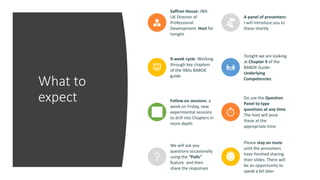
What to
expect
Saffron House: IIBA
UK Director of
Professional
Development. Host for
tonight
A panel of presenters:
I will introduce you to
these shortly
9-week cycle: Working
through key chapters
of the IIBAs BABOK
guide
Tonight we are looking
at Chapter 9 of the
BABOK Guide:
Underlying
Competencies
Follow on sessions: a
week on Friday, new
experimental sessions
to drill into Chapters in
more depth
Do use the Question
Panel to type
questions at any time.
The host will pose
these at the
appropriate time
We will ask you
questions occasionally
using the “Polls”
feature and then
share the responses
Please stay on mute
until the presenters
have finished sharing
their slides. There will
be an opportunity to
speak a bit later
Joining me tonight….
Vivienne Onwuocha
IIBA UK Volunteer &
Managing Partner with
SlingStone Business
Consulting
Himanshu Jain
IIBA UK Volunteer &
Agile & Project
Management Trainer
& Coach
Poll time!
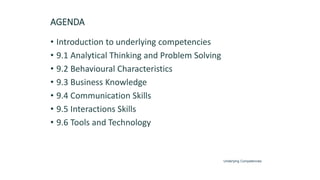
AGENDA
• Introduction to underlying competencies
• 9.1 Analytical Thinking and Problem Solving
• 9.2 Behavioural Characteristics
• 9.3 Business Knowledge
• 9.4 Communication Skills
• 9.5 Interactions Skills
• 9.6 Tools and Technology
Underlying Competencies
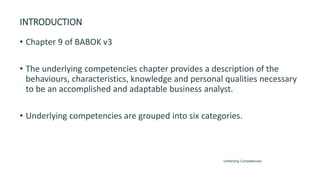
INTRODUCTION
• Chapter 9 of BABOK v3
• The underlying competencies chapter provides a description of the
behaviours, characteristics, knowledge and personal qualities necessary
to be an accomplished and adaptable business analyst.
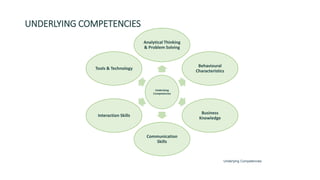
• Underlying competencies are grouped into six categories.
Underlying Competencies
UNDERLYING COMPETENCIES
Underlying
Competencies
Analytical Thinking
& Problem Solving
Behavioural
Characteristics
Business
Knowledge
Communication
Skills
Interaction Skills
Tools & Technology
Underlying Competencies
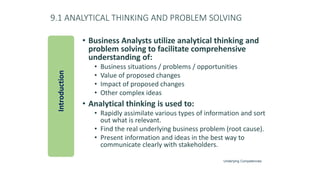
9.1 ANALYTICAL THINKING AND PROBLEM SOLVING
• Business Analysts utilize analytical thinking and
problem solving to facilitate comprehensive
understanding of:
• Business situations / problems / opportunities
• Value of proposed changes
• Impact of proposed changes
• Other complex ideas
• Analytical thinking is used to:
• Rapidly assimilate various types of information and sort
out what is relevant.
• Find the real underlying business problem (root cause).
• Present information and ideas in the best way to
communicate clearly with stakeholders.
Introduction
Underlying Competencies
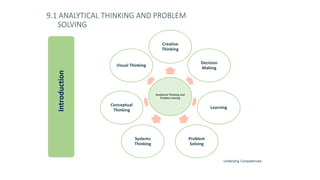
9.1 ANALYTICAL THINKING AND PROBLEM
SOLVING
Analytical Thinking and
Problem Solving
Creative
Thinking
Decision
Making
Learning
Problem
Solving
Systems
Thinking
Conceptual
Thinking
Visual Thinking
Introduction
Underlying Competencies
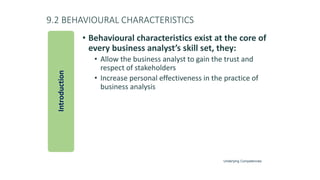
9.2 BEHAVIOURAL CHARACTERISTICS
• Behavioural characteristics exist at the core of
every business analyst’s skill set, they:
• Allow the business analyst to gain the trust and
respect of stakeholders
• Increase personal effectiveness in the practice of
business analysis
Introduction
Underlying Competencies
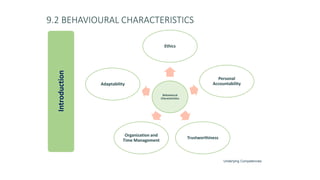
9.2 BEHAVIOURAL CHARACTERISTICS
Behavioural
Characteristics
Ethics
Personal
Accountability
Trustworthiness
Organization and
Time Management
Adaptability
Introduction
Underlying Competencies
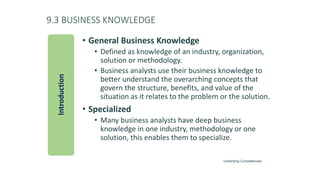
9.3 BUSINESS KNOWLEDGE
• General Business Knowledge
• Defined as knowledge of an industry, organization,
solution or methodology.
• Business analysts use their business knowledge to
better understand the overarching concepts that
govern the structure, benefits, and value of the
situation as it relates to the problem or the solution.
• Specialized
• Many business analysts have deep business
knowledge in one industry, methodology or one
solution, this enables them to specialize.
Introduction
Underlying Competencies
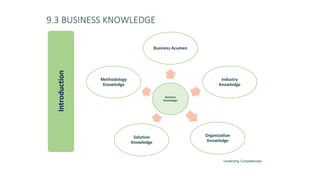
9.3 BUSINESS KNOWLEDGE
Business
Knowledge
Business Acumen
Industry
Knowledge
Organization
Knowledge
Solution
Knowledge
Methodology
Knowledge
Introduction
Underlying Competencies
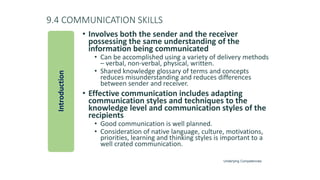
9.4 COMMUNICATION SKILLS
• Involves both the sender and the receiver
possessing the same understanding of the
information being communicated
• Can be accomplished using a variety of delivery methods
– verbal, non-verbal, physical, written.
• Shared knowledge glossary of terms and concepts
reduces misunderstanding and reduces differences
between sender and receiver.
• Effective communication includes adapting
communication styles and techniques to the
knowledge level and communication styles of the
recipients
• Good communication is well planned.
• Consideration of native language, culture, motivations,
priorities, learning and thinking styles is important to a
well crated communication.
Introduction
Underlying Competencies
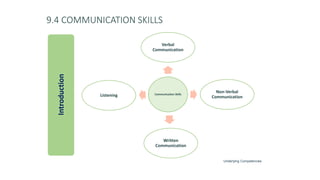
9.4 COMMUNICATION SKILLS
Communication Skills
Verbal
Communication
Non-Verbal
Communication
Written
Communication
Listening
Introduction
Underlying Competencies
9.5 INTERACTION SKILLS
• The ability to relate, cooperate and
communicate with different people
• Business analysts need to be confident and capable
so they can relate to executives, sponsors,
colleagues, team members, L&D professionals,
developers, project managers, vendors, end users,
customers and SME’s.
• We are uniquely positioned to facilitate
communication, provide leadership, encourage
comprehension of solution value, and promote
stakeholder support
Introduction
Underlying Competencies
9.5 INTERACTION SKILLS
Interaction Skills
Facilitation
Leadership and
Influencing
Teamwork
Negotiation and
Conflict Resolution
Teaching
Introduction
Underlying Competencies
9.6 TOOLS AND TECHNOLOGY
• Business Analysts use software applications to
support communication, collaboration,
requirement artifacts, and model concepts to
increase productivity, such as:
• Requirement documentation and management tools
• Traceability and impact assessment tools
• Proto-typing and simulation tools
• Modelling and diagramming tools
• Collaboration tools enhance the interaction
with stakeholders and team members and are
especially important for remote or virtual
teams
Introduction
Underlying Competencies
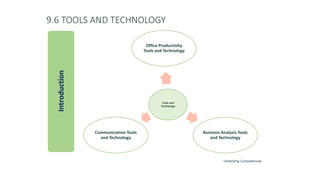
9.6 TOOLS AND TECHNOLOGY
Tools and
Technology
Office Productivity
Tools and Technology
Business Analysis Tools
and Technology
Communication Tools
and Technology
Introduction
Underlying Competencies
Questions!
Use the question panel or unmute
What next?
To join our WhatsApp group on BABOK matters email saffron.house@iibauk.org

Babok webinar underlying competencies 20210727

  • 1.
    @UKIIBA #UKIIBA IIBA UKBABOK online study group 27 July 2021 Starting at 7pm Welcome
  • 2.
    What to expect Saffron House:IIBA UK Director of Professional Development. Host for tonight A panel of presenters: I will introduce you to these shortly 9-week cycle: Working through key chapters of the IIBAs BABOK guide Tonight we are looking at Chapter 9 of the BABOK Guide: Underlying Competencies Follow on sessions: a week on Friday, new experimental sessions to drill into Chapters in more depth Do use the Question Panel to type questions at any time. The host will pose these at the appropriate time We will ask you questions occasionally using the “Polls” feature and then share the responses Please stay on mute until the presenters have finished sharing their slides. There will be an opportunity to speak a bit later
  • 3.
    Joining me tonight…. VivienneOnwuocha IIBA UK Volunteer & Managing Partner with SlingStone Business Consulting Himanshu Jain IIBA UK Volunteer & Agile & Project Management Trainer & Coach
  • 4.
  • 5.
    AGENDA • Introduction tounderlying competencies • 9.1 Analytical Thinking and Problem Solving • 9.2 Behavioural Characteristics • 9.3 Business Knowledge • 9.4 Communication Skills • 9.5 Interactions Skills • 9.6 Tools and Technology Underlying Competencies
  • 6.
    INTRODUCTION • Chapter 9of BABOK v3 • The underlying competencies chapter provides a description of the behaviours, characteristics, knowledge and personal qualities necessary to be an accomplished and adaptable business analyst. • Underlying competencies are grouped into six categories. Underlying Competencies
  • 7.
    UNDERLYING COMPETENCIES Underlying Competencies Analytical Thinking &Problem Solving Behavioural Characteristics Business Knowledge Communication Skills Interaction Skills Tools & Technology Underlying Competencies
  • 8.
    9.1 ANALYTICAL THINKINGAND PROBLEM SOLVING • Business Analysts utilize analytical thinking and problem solving to facilitate comprehensive understanding of: • Business situations / problems / opportunities • Value of proposed changes • Impact of proposed changes • Other complex ideas • Analytical thinking is used to: • Rapidly assimilate various types of information and sort out what is relevant. • Find the real underlying business problem (root cause). • Present information and ideas in the best way to communicate clearly with stakeholders. Introduction Underlying Competencies
  • 9.
    9.1 ANALYTICAL THINKINGAND PROBLEM SOLVING Analytical Thinking and Problem Solving Creative Thinking Decision Making Learning Problem Solving Systems Thinking Conceptual Thinking Visual Thinking Introduction Underlying Competencies
  • 10.
    9.2 BEHAVIOURAL CHARACTERISTICS •Behavioural characteristics exist at the core of every business analyst’s skill set, they: • Allow the business analyst to gain the trust and respect of stakeholders • Increase personal effectiveness in the practice of business analysis Introduction Underlying Competencies
  • 11.
  • 12.
    9.3 BUSINESS KNOWLEDGE •General Business Knowledge • Defined as knowledge of an industry, organization, solution or methodology. • Business analysts use their business knowledge to better understand the overarching concepts that govern the structure, benefits, and value of the situation as it relates to the problem or the solution. • Specialized • Many business analysts have deep business knowledge in one industry, methodology or one solution, this enables them to specialize. Introduction Underlying Competencies
  • 13.
    9.3 BUSINESS KNOWLEDGE Business Knowledge BusinessAcumen Industry Knowledge Organization Knowledge Solution Knowledge Methodology Knowledge Introduction Underlying Competencies
  • 14.
    9.4 COMMUNICATION SKILLS •Involves both the sender and the receiver possessing the same understanding of the information being communicated • Can be accomplished using a variety of delivery methods – verbal, non-verbal, physical, written. • Shared knowledge glossary of terms and concepts reduces misunderstanding and reduces differences between sender and receiver. • Effective communication includes adapting communication styles and techniques to the knowledge level and communication styles of the recipients • Good communication is well planned. • Consideration of native language, culture, motivations, priorities, learning and thinking styles is important to a well crated communication. Introduction Underlying Competencies
  • 15.
    9.4 COMMUNICATION SKILLS CommunicationSkills Verbal Communication Non-Verbal Communication Written Communication Listening Introduction Underlying Competencies
  • 16.
    9.5 INTERACTION SKILLS •The ability to relate, cooperate and communicate with different people • Business analysts need to be confident and capable so they can relate to executives, sponsors, colleagues, team members, L&D professionals, developers, project managers, vendors, end users, customers and SME’s. • We are uniquely positioned to facilitate communication, provide leadership, encourage comprehension of solution value, and promote stakeholder support Introduction Underlying Competencies
  • 17.
    9.5 INTERACTION SKILLS InteractionSkills Facilitation Leadership and Influencing Teamwork Negotiation and Conflict Resolution Teaching Introduction Underlying Competencies
  • 18.
    9.6 TOOLS ANDTECHNOLOGY • Business Analysts use software applications to support communication, collaboration, requirement artifacts, and model concepts to increase productivity, such as: • Requirement documentation and management tools • Traceability and impact assessment tools • Proto-typing and simulation tools • Modelling and diagramming tools • Collaboration tools enhance the interaction with stakeholders and team members and are especially important for remote or virtual teams Introduction Underlying Competencies
  • 19.
    9.6 TOOLS ANDTECHNOLOGY Tools and Technology Office Productivity Tools and Technology Business Analysis Tools and Technology Communication Tools and Technology Introduction Underlying Competencies
  • 20.
  • 21.
    What next? To joinour WhatsApp group on BABOK matters email saffron.house@iibauk.org