



@UKIIBA #UKIIBA
IIBA UK BABOK online study group
24th August 2021
Starting at 7pm
Welcome
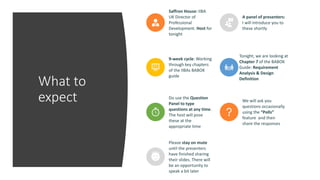
What to
expect
Saffron House: IIBA
UK Director of
Professional
Development. Host for
tonight
A panel of presenters:
I will introduce you to
these shortly
9-week cycle: Working
through key chapters
of the IIBAs BABOK
guide
Tonight, we are looking at
Chapter 7 of the BABOK
Guide: Requirement
Analysis & Design
Definition
Do use the Question
Panel to type
questions at any time.
The host will pose
these at the
appropriate time
We will ask you
questions occasionally
using the “Polls”
feature and then
share the responses
Please stay on mute
until the presenters
have finished sharing
their slides. There will
be an opportunity to
speak a bit later
Joining me tonight….
Vivienne Onwuocha
IIBA UK Volunteer &
Managing Partner with
SlingStone Business
Consulting
Himanshu Jain
IIBA UK Volunteer &
Agile & Project
Management Trainer
& Coach
Poll time!
5
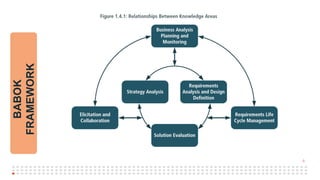
BABOK
FRAMEWORK
6
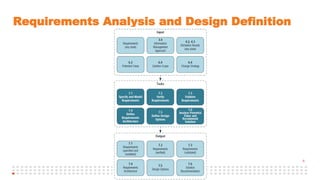
Requirements Analysis and Design Definition
7
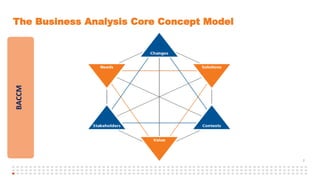
The Business Analysis Core Concept Model
BACCM
8
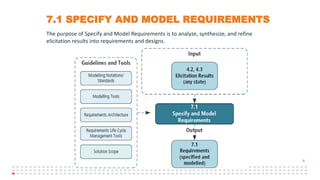
7.1 SPECIFY AND MODEL REQUIREMENTS
The purpose of Specify and Model Requirements is to analyze, synthesize, and refine
elicitation results into requirements and designs.
9
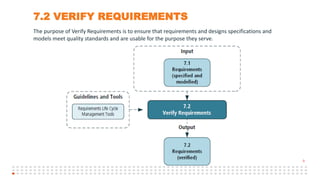
7.2 VERIFY REQUIREMENTS
The purpose of Verify Requirements is to ensure that requirements and designs specifications and
models meet quality standards and are usable for the purpose they serve.
10
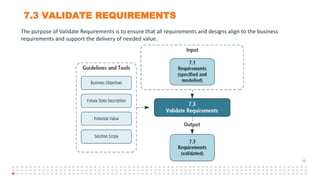
7.3 VALIDATE REQUIREMENTS
The purpose of Validate Requirements is to ensure that all requirements and designs align to the business
requirements and support the delivery of needed value.
11
7.4 DEFINE REQUIREMENTS ARCHITECTURE
The purpose of Define Requirements Architecture is to ensure that the requirements collectively support one
another to fully achieve the objectives.
12
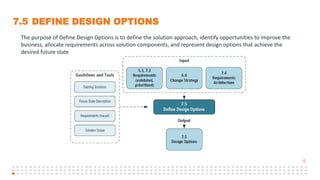
7.5 DEFINE DESIGN OPTIONS
The purpose of Define Design Options is to define the solution approach, identify opportunities to improve the
business, allocate requirements across solution components, and represent design options that achieve the
desired future state.
13
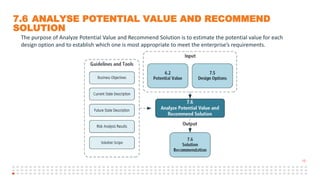
7.6 ANALYSE POTENTIAL VALUE AND RECOMMEND
SOLUTION
The purpose of Analyze Potential Value and Recommend Solution is to estimate the potential value for each
design option and to establish which one is most appropriate to meet the enterprise’s requirements.
Case Discussion
Pierre’s Restaurant
Pierre’s Restaurant
• Mr Pierre is the owner and manager of the restaurant
‘Pierre’s’. This is a popular French restaurant that is busy
most evenings and full at weekends with a lot of repeat
trade. The restaurant is only open in the evenings and seats
50 customers with only one service per night. Currently all
bookings are received over the telephone. On answering the
call, Mr Pierre always requests the required date and the
number of guests to be seated.
• He then checks to see if the booking can be accommodated.
Where the booking can be accommodated, he asks the
customer for further booking details including the booking
name, contact number and number of people in the booking.
He then logs the booking into the restaurant diary under the
relevant date. Mr Pierre also asks whether there are any
special dietary requirements or whether the booking is for a
special occasion such as birthday or anniversary, so he can
arrange for birthday cakes, balloons, special wines etc.
• Mr Pierre always reads the details he has taken back to the
customers so that they can confirm their bookings. If the
restaurant is full on the required evening, Mr Pierre offers an
alternative date for the booking or, if this is not acceptable,
asks if the customer would like to be added to a waiting list.
• The waiting list is recorded at the bottom of each page in the
diary and a contact name & number along with number of
people in the booking is taken. This enables Mr Pierre to
view bookings regularly and manage changes to bookings
should someone cancel or change their booking.
• On a daily basis the Head Chef, Jacques, will check the diary
to see if there is any special dietary requirement he needs to
be aware of that day. Francoise, the Head Waiter, also prints
the diary each day in order to draw up a table plan for each
service.
• As the restaurant is so busy Mr Pierre would like to start
opening lunch times but currently the telephone bookings
are taking up too much of his time. Further, Mr Pierre has
received feedback from his customers that they cannot
sometimes get through to book as the phone line is busy. In
response to this, Mr Pierre has decided to invest in an on-line
booking system that would enable customers to make
reservations on-line.
• Mr Pierre is keen that the new system does as a minimum
what his current restaurant diary enables him and his staff to
do. The hope is that this will reduce the telephone calls as
well as provide an alternative method of booking at his
restaurant which has been requested by for his loyal
customers.
Questions!
Use the question panel or unmute
What next?

BABOK Summer Bootcamp - Chapter 7: Requirements Analysis & Design Definition

  • 1.
    @UKIIBA #UKIIBA IIBA UKBABOK online study group 24th August 2021 Starting at 7pm Welcome
  • 2.
    What to expect Saffron House:IIBA UK Director of Professional Development. Host for tonight A panel of presenters: I will introduce you to these shortly 9-week cycle: Working through key chapters of the IIBAs BABOK guide Tonight, we are looking at Chapter 7 of the BABOK Guide: Requirement Analysis & Design Definition Do use the Question Panel to type questions at any time. The host will pose these at the appropriate time We will ask you questions occasionally using the “Polls” feature and then share the responses Please stay on mute until the presenters have finished sharing their slides. There will be an opportunity to speak a bit later
  • 3.
    Joining me tonight…. VivienneOnwuocha IIBA UK Volunteer & Managing Partner with SlingStone Business Consulting Himanshu Jain IIBA UK Volunteer & Agile & Project Management Trainer & Coach
  • 4.
  • 5.
  • 6.
    6 Requirements Analysis andDesign Definition
  • 7.
    7 The Business AnalysisCore Concept Model BACCM
  • 8.
    8 7.1 SPECIFY ANDMODEL REQUIREMENTS The purpose of Specify and Model Requirements is to analyze, synthesize, and refine elicitation results into requirements and designs.
  • 9.
    9 7.2 VERIFY REQUIREMENTS Thepurpose of Verify Requirements is to ensure that requirements and designs specifications and models meet quality standards and are usable for the purpose they serve.
  • 10.
    10 7.3 VALIDATE REQUIREMENTS Thepurpose of Validate Requirements is to ensure that all requirements and designs align to the business requirements and support the delivery of needed value.
  • 11.
    11 7.4 DEFINE REQUIREMENTSARCHITECTURE The purpose of Define Requirements Architecture is to ensure that the requirements collectively support one another to fully achieve the objectives.
  • 12.
    12 7.5 DEFINE DESIGNOPTIONS The purpose of Define Design Options is to define the solution approach, identify opportunities to improve the business, allocate requirements across solution components, and represent design options that achieve the desired future state.
  • 13.
    13 7.6 ANALYSE POTENTIALVALUE AND RECOMMEND SOLUTION The purpose of Analyze Potential Value and Recommend Solution is to estimate the potential value for each design option and to establish which one is most appropriate to meet the enterprise’s requirements.
  • 14.
  • 15.
    Pierre’s Restaurant • MrPierre is the owner and manager of the restaurant ‘Pierre’s’. This is a popular French restaurant that is busy most evenings and full at weekends with a lot of repeat trade. The restaurant is only open in the evenings and seats 50 customers with only one service per night. Currently all bookings are received over the telephone. On answering the call, Mr Pierre always requests the required date and the number of guests to be seated. • He then checks to see if the booking can be accommodated. Where the booking can be accommodated, he asks the customer for further booking details including the booking name, contact number and number of people in the booking. He then logs the booking into the restaurant diary under the relevant date. Mr Pierre also asks whether there are any special dietary requirements or whether the booking is for a special occasion such as birthday or anniversary, so he can arrange for birthday cakes, balloons, special wines etc. • Mr Pierre always reads the details he has taken back to the customers so that they can confirm their bookings. If the restaurant is full on the required evening, Mr Pierre offers an alternative date for the booking or, if this is not acceptable, asks if the customer would like to be added to a waiting list. • The waiting list is recorded at the bottom of each page in the diary and a contact name & number along with number of people in the booking is taken. This enables Mr Pierre to view bookings regularly and manage changes to bookings should someone cancel or change their booking. • On a daily basis the Head Chef, Jacques, will check the diary to see if there is any special dietary requirement he needs to be aware of that day. Francoise, the Head Waiter, also prints the diary each day in order to draw up a table plan for each service. • As the restaurant is so busy Mr Pierre would like to start opening lunch times but currently the telephone bookings are taking up too much of his time. Further, Mr Pierre has received feedback from his customers that they cannot sometimes get through to book as the phone line is busy. In response to this, Mr Pierre has decided to invest in an on-line booking system that would enable customers to make reservations on-line. • Mr Pierre is keen that the new system does as a minimum what his current restaurant diary enables him and his staff to do. The hope is that this will reduce the telephone calls as well as provide an alternative method of booking at his restaurant which has been requested by for his loyal customers.
  • 16.
  • 17.