

@UKIIBA #UKIIBA
IIBA UK BABOK online study group
7th September 2021
Starting at 7pm
Welcome
What to
expect
Saffron House: IIBA
UK Director of
Professional
Development. Host for
tonight
A panel of presenters:
I will introduce you to
these shortly
9-week cycle: Working
through key chapters
of the IIBAs BABOK
guide
Tonight, we are looking at
Chapter 8 of the BABOK
Guide: Solution
Evaluation
Do use the Question
Panel to type
questions at any time.
The host will pose
these at the
appropriate time
We will ask you
questions occasionally
using the “Polls”
feature and then
share the responses
Please stay on mute
until the presenters
have finished sharing
their slides. There will
be an opportunity to
speak a bit later
Joining me tonight….
Vivienne Onwuocha
IIBA UK Volunteer &
Managing Partner with
SlingStone Business
Consulting
Himanshu Jain
IIBA UK Volunteer &
Agile & Project
Management Trainer
& Coach
5
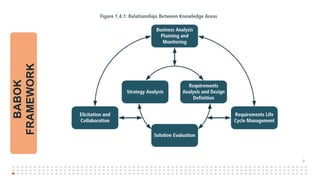
BABOK
FRAMEWORK
6
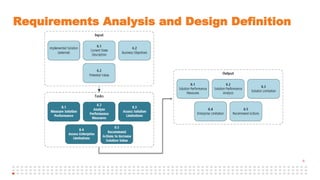
Requirements Analysis and Design Definition
7
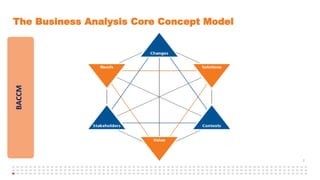
The Business Analysis Core Concept Model
BACCM
8
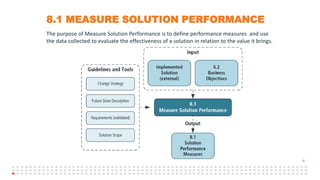
8.1 MEASURE SOLUTION PERFORMANCE
The purpose of Measure Solution Performance is to define performance measures and use
the data collected to evaluate the effectiveness of a solution in relation to the value it brings.
9
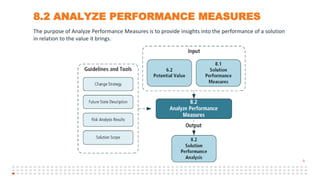
8.2 ANALYZE PERFORMANCE MEASURES
The purpose of Analyze Performance Measures is to provide insights into the performance of a solution
in relation to the value it brings.
10
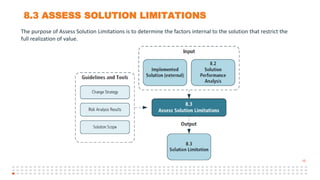
8.3 ASSESS SOLUTION LIMITATIONS
The purpose of Assess Solution Limitations is to determine the factors internal to the solution that restrict the
full realization of value.
11
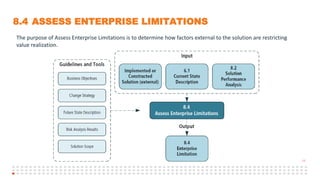
8.4 ASSESS ENTERPRISE LIMITATIONS
The purpose of Assess Enterprise Limitations is to determine how factors external to the solution are restricting
value realization.
12
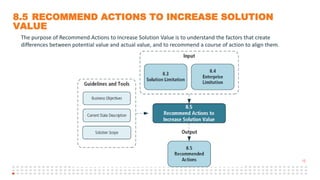
8.5 RECOMMEND ACTIONS TO INCREASE SOLUTION
VALUE
The purpose of Recommend Actions to Increase Solution Value is to understand the factors that create
differences between potential value and actual value, and to recommend a course of action to align them.
Case Discussion
Pierre’s Restaurant
Pierre’s Restaurant
• Mr Pierre is the owner and manager of the restaurant
‘Pierre’s’. This is a popular French restaurant that is busy
most evenings and full at weekends with a lot of repeat
trade. The restaurant is only open in the evenings and seats
50 customers with only one service per night. Currently all
bookings are received over the telephone. On answering the
call, Mr Pierre always requests the required date and the
number of guests to be seated.
• He then checks to see if the booking can be accommodated.
Where the booking can be accommodated, he asks the
customer for further booking details including the booking
name, contact number and number of people in the booking.
He then logs the booking into the restaurant diary under the
relevant date. Mr Pierre also asks whether there are any
special dietary requirements or whether the booking is for a
special occasion such as birthday or anniversary, so he can
arrange for birthday cakes, balloons, special wines etc.
• Mr Pierre always reads the details he has taken back to the
customers so that they can confirm their bookings. If the
restaurant is full on the required evening, Mr Pierre offers an
alternative date for the booking or, if this is not acceptable,
asks if the customer would like to be added to a waiting list.
• The waiting list is recorded at the bottom of each page in the
diary and a contact name & number along with number of
people in the booking is taken. This enables Mr Pierre to
view bookings regularly and manage changes to bookings
should someone cancel or change their booking.
• On a daily basis the Head Chef, Jacques, will check the diary
to see if there is any special dietary requirement he needs to
be aware of that day. Francoise, the Head Waiter, also prints
the diary each day in order to draw up a table plan for each
service.
• As the restaurant is so busy Mr Pierre would like to start
opening lunch times but currently the telephone bookings
are taking up too much of his time. Further, Mr Pierre has
received feedback from his customers that they cannot
sometimes get through to book as the phone line is busy. In
response to this, Mr Pierre has decided to invest in an on-line
booking system that would enable customers to make
reservations on-line.
• Mr Pierre is keen that the new system does as a minimum
what his current restaurant diary enables him and his staff to
do. The hope is that this will reduce the telephone calls as
well as provide an alternative method of booking at his
restaurant which has been requested by for his loyal
customers.
8.1 MEASURE SOLUTION PERFORMANCE
• Run a workshop to brainstorm on possible solution measures. Possible
measures are:
• KPIs – number of daily visitors using the booking system
• Goal completion rate – i.e. number of users completing their booking on the system
• Cart abandonment rate
• Repeat visitor rate
• Customer feedback
• Performance – reliability, security etc.
• Agree how often the measures will be reviewed - monthly, quarterly etc. to
analyse trends and possible new trends.
• Techniques: Key Performance Indicators (KPIs): used to measure solution
performance. Non-Functional Requirements Analysis: used to define
expected characteristics of a solution.
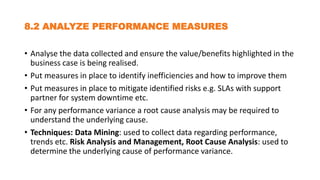
8.2 ANALYZE PERFORMANCE MEASURES
• Analyse the data collected and ensure the value/benefits highlighted in the
business case is being realised.
• Put measures in place to identify inefficiencies and how to improve them
• Put measures in place to mitigate identified risks e.g. SLAs with support
partner for system downtime etc.
• For any performance variance a root cause analysis may be required to
understand the underlying cause.
• Techniques: Data Mining: used to collect data regarding performance,
trends etc. Risk Analysis and Management, Root Cause Analysis: used to
determine the underlying cause of performance variance.
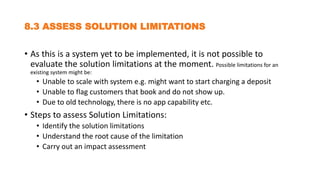
8.3 ASSESS SOLUTION LIMITATIONS
• As this is a system yet to be implemented, it is not possible to
evaluate the solution limitations at the moment. Possible limitations for an
existing system might be:
• Unable to scale with system e.g. might want to start charging a deposit
• Unable to flag customers that book and do not show up.
• Due to old technology, there is no app capability etc.
• Steps to assess Solution Limitations:
• Identify the solution limitations
• Understand the root cause of the limitation
• Carry out an impact assessment
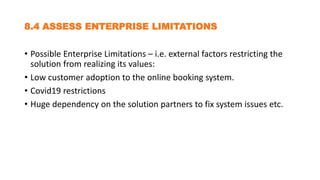
8.4 ASSESS ENTERPRISE LIMITATIONS
• Possible Enterprise Limitations – i.e. external factors restricting the
solution from realizing its values:
• Low customer adoption to the online booking system.
• Covid19 restrictions
• Huge dependency on the solution partners to fix system issues etc.
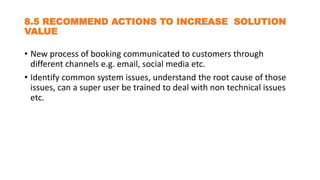
8.5 RECOMMEND ACTIONS TO INCREASE SOLUTION
VALUE
• New process of booking communicated to customers through
different channels e.g. email, social media etc.
• Identify common system issues, understand the root cause of those
issues, can a super user be trained to deal with non technical issues
etc.
Questions!
Use the question panel or unmute
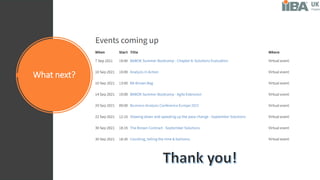
What next?

BABOK Summer Bootcamp - Chapter 8: Solutions Evaluation Date: 7 Sep 2021

  • 1.
    @UKIIBA #UKIIBA IIBA UKBABOK online study group 7th September 2021 Starting at 7pm Welcome
  • 2.
    What to expect Saffron House:IIBA UK Director of Professional Development. Host for tonight A panel of presenters: I will introduce you to these shortly 9-week cycle: Working through key chapters of the IIBAs BABOK guide Tonight, we are looking at Chapter 8 of the BABOK Guide: Solution Evaluation Do use the Question Panel to type questions at any time. The host will pose these at the appropriate time We will ask you questions occasionally using the “Polls” feature and then share the responses Please stay on mute until the presenters have finished sharing their slides. There will be an opportunity to speak a bit later
  • 3.
    Joining me tonight…. VivienneOnwuocha IIBA UK Volunteer & Managing Partner with SlingStone Business Consulting Himanshu Jain IIBA UK Volunteer & Agile & Project Management Trainer & Coach
  • 4.
  • 5.
    6 Requirements Analysis andDesign Definition
  • 6.
    7 The Business AnalysisCore Concept Model BACCM
  • 7.
    8 8.1 MEASURE SOLUTIONPERFORMANCE The purpose of Measure Solution Performance is to define performance measures and use the data collected to evaluate the effectiveness of a solution in relation to the value it brings.
  • 8.
    9 8.2 ANALYZE PERFORMANCEMEASURES The purpose of Analyze Performance Measures is to provide insights into the performance of a solution in relation to the value it brings.
  • 9.
    10 8.3 ASSESS SOLUTIONLIMITATIONS The purpose of Assess Solution Limitations is to determine the factors internal to the solution that restrict the full realization of value.
  • 10.
    11 8.4 ASSESS ENTERPRISELIMITATIONS The purpose of Assess Enterprise Limitations is to determine how factors external to the solution are restricting value realization.
  • 11.
    12 8.5 RECOMMEND ACTIONSTO INCREASE SOLUTION VALUE The purpose of Recommend Actions to Increase Solution Value is to understand the factors that create differences between potential value and actual value, and to recommend a course of action to align them.
  • 12.
  • 13.
    Pierre’s Restaurant • MrPierre is the owner and manager of the restaurant ‘Pierre’s’. This is a popular French restaurant that is busy most evenings and full at weekends with a lot of repeat trade. The restaurant is only open in the evenings and seats 50 customers with only one service per night. Currently all bookings are received over the telephone. On answering the call, Mr Pierre always requests the required date and the number of guests to be seated. • He then checks to see if the booking can be accommodated. Where the booking can be accommodated, he asks the customer for further booking details including the booking name, contact number and number of people in the booking. He then logs the booking into the restaurant diary under the relevant date. Mr Pierre also asks whether there are any special dietary requirements or whether the booking is for a special occasion such as birthday or anniversary, so he can arrange for birthday cakes, balloons, special wines etc. • Mr Pierre always reads the details he has taken back to the customers so that they can confirm their bookings. If the restaurant is full on the required evening, Mr Pierre offers an alternative date for the booking or, if this is not acceptable, asks if the customer would like to be added to a waiting list. • The waiting list is recorded at the bottom of each page in the diary and a contact name & number along with number of people in the booking is taken. This enables Mr Pierre to view bookings regularly and manage changes to bookings should someone cancel or change their booking. • On a daily basis the Head Chef, Jacques, will check the diary to see if there is any special dietary requirement he needs to be aware of that day. Francoise, the Head Waiter, also prints the diary each day in order to draw up a table plan for each service. • As the restaurant is so busy Mr Pierre would like to start opening lunch times but currently the telephone bookings are taking up too much of his time. Further, Mr Pierre has received feedback from his customers that they cannot sometimes get through to book as the phone line is busy. In response to this, Mr Pierre has decided to invest in an on-line booking system that would enable customers to make reservations on-line. • Mr Pierre is keen that the new system does as a minimum what his current restaurant diary enables him and his staff to do. The hope is that this will reduce the telephone calls as well as provide an alternative method of booking at his restaurant which has been requested by for his loyal customers.
  • 14.
    8.1 MEASURE SOLUTIONPERFORMANCE • Run a workshop to brainstorm on possible solution measures. Possible measures are: • KPIs – number of daily visitors using the booking system • Goal completion rate – i.e. number of users completing their booking on the system • Cart abandonment rate • Repeat visitor rate • Customer feedback • Performance – reliability, security etc. • Agree how often the measures will be reviewed - monthly, quarterly etc. to analyse trends and possible new trends. • Techniques: Key Performance Indicators (KPIs): used to measure solution performance. Non-Functional Requirements Analysis: used to define expected characteristics of a solution.
  • 15.
    8.2 ANALYZE PERFORMANCEMEASURES • Analyse the data collected and ensure the value/benefits highlighted in the business case is being realised. • Put measures in place to identify inefficiencies and how to improve them • Put measures in place to mitigate identified risks e.g. SLAs with support partner for system downtime etc. • For any performance variance a root cause analysis may be required to understand the underlying cause. • Techniques: Data Mining: used to collect data regarding performance, trends etc. Risk Analysis and Management, Root Cause Analysis: used to determine the underlying cause of performance variance.
  • 16.
    8.3 ASSESS SOLUTIONLIMITATIONS • As this is a system yet to be implemented, it is not possible to evaluate the solution limitations at the moment. Possible limitations for an existing system might be: • Unable to scale with system e.g. might want to start charging a deposit • Unable to flag customers that book and do not show up. • Due to old technology, there is no app capability etc. • Steps to assess Solution Limitations: • Identify the solution limitations • Understand the root cause of the limitation • Carry out an impact assessment
  • 17.
    8.4 ASSESS ENTERPRISELIMITATIONS • Possible Enterprise Limitations – i.e. external factors restricting the solution from realizing its values: • Low customer adoption to the online booking system. • Covid19 restrictions • Huge dependency on the solution partners to fix system issues etc.
  • 18.
    8.5 RECOMMEND ACTIONSTO INCREASE SOLUTION VALUE • New process of booking communicated to customers through different channels e.g. email, social media etc. • Identify common system issues, understand the root cause of those issues, can a super user be trained to deal with non technical issues etc.
  • 19.
  • 20.