Creating and delivering services
Delivering Services: Designing, Planning, Creating and Evaluation
All service organization face choices concerning the types of products to offer
and the operational procedures to use in creating them.
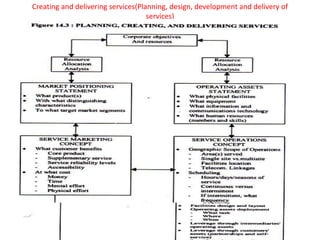
Figure 14.3 shows the key steps involved in planning, creating, and delivering
services.
The task begins at the corporate level with a statement of institution objectives
and an appraisal of current or obtainable resources.
 From market and competitive analysis, marketing opportunities can be
identified.
Positioning statement can be developed for each service that the firm plans to
offer to one or more specific market segments, indicating the characteristics that
distinguish it from the competition in meaningful ways.
Creating and delivering services(Planning, design, development and delivery of
services)
Creating and delivering services(Planning, design, development
and delivery of services)
 This positioning strategy must then be related to a statement of the operating
assets needed for execution. Can the organization afford to allocate the
necessary physical facilities, equipment, information and communication
technology, and human resources needed to support a given positioning
strategy?
 Alternatively, could the firm leverage its own resources by using off-balance
sheet assets obtained by developing partnerships with intermediaries or even
with customers themselves? Does the positioning strategy promise sufficient
profits to yield an acceptable return on the assets employed after deducting all
relevant costs?
 The next step in the process involves establishing a service marketing concept,
to clarify the benefits offered to customers and the costs that they will incur in
return. This marketing concept considers both core and supplementary services,
reliability levels for these services, and where and when customers will be able
to have access to them. Costs include money, time, mental effort, and physical
effort.
 The operations concept also addresses opportunities for leveraging through
intermediaries or the customers themselves. Finally, it clarifies which tasks will
be assigned to front stage and which to backstage operations.
Creating and delivering services(Planning, design, development
and delivery of services)
Creating and delivering services(Planning, design, development
and delivery of services)
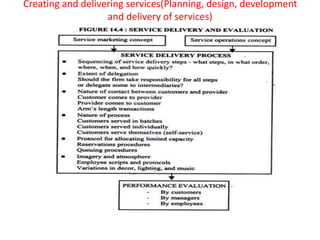
These two concepts interact with a set of choices that management must make
in configuring the service delivery process (Figure 14.4).
1. What should be the sequencing of the various steps in the service delivery
process? Where (location) and when (scheduling) should these steps take place?
2. Should service elements be bundled or unbundled for delivery purposes (for
instance, should a service firm take responsibility for all elements or delegate
certain supplementary services, such as information and reservations, to an
intermediary?)
3. What should be the nature of the service process at each step? Should customers
be served in batches or individually, or should they serve themselves?
Creating and delivering services(Planning, design, development
and delivery of services)
4. What should be the serving protocol: Should the firm operate a reservations
system or work on a first come, first served basis, with queuing as necessary?
Alternatively, should a priority system be established for certain types of
customers?
5. What imagery and atmosphere should the service delivery environment (or
service-scape) strive to create?
Creating and delivering services(Planning, design, development
and delivery of services)
For a high-contact service, this concerns decisions on:
(1) Facility design and layout,
(2) Staff uniforms, appearance and attitudes,
(3) The type of furnishings and equipment installed, and
(4) The use of music, lighting, and decor. The characteristics of the area surrounding
the chosen location will also contribute to the customers’ overall experience.
 Finally comes performance evaluations. Customer satisfaction will be based
largely on how users perceive service performance relative to their
expectations. The firm, by contrast, may use more formal approaches,
measuring performance on certain characteristics against predefined standards
and seeking employee inputs-assuming that management is sufficiently
disciplined.
 Falling prices, greater affluence, and new easy-to-use technologies also allow
individual and corporate users to replace service professional in a variety of
other fields

Creating and delivering services

  • 1.
    Creating and deliveringservices Delivering Services: Designing, Planning, Creating and Evaluation All service organization face choices concerning the types of products to offer and the operational procedures to use in creating them. Figure 14.3 shows the key steps involved in planning, creating, and delivering services. The task begins at the corporate level with a statement of institution objectives and an appraisal of current or obtainable resources.  From market and competitive analysis, marketing opportunities can be identified. Positioning statement can be developed for each service that the firm plans to offer to one or more specific market segments, indicating the characteristics that distinguish it from the competition in meaningful ways.
  • 2.
    Creating and deliveringservices(Planning, design, development and delivery of services)
  • 3.
    Creating and deliveringservices(Planning, design, development and delivery of services)  This positioning strategy must then be related to a statement of the operating assets needed for execution. Can the organization afford to allocate the necessary physical facilities, equipment, information and communication technology, and human resources needed to support a given positioning strategy?  Alternatively, could the firm leverage its own resources by using off-balance sheet assets obtained by developing partnerships with intermediaries or even with customers themselves? Does the positioning strategy promise sufficient profits to yield an acceptable return on the assets employed after deducting all relevant costs?  The next step in the process involves establishing a service marketing concept, to clarify the benefits offered to customers and the costs that they will incur in return. This marketing concept considers both core and supplementary services, reliability levels for these services, and where and when customers will be able to have access to them. Costs include money, time, mental effort, and physical effort.  The operations concept also addresses opportunities for leveraging through intermediaries or the customers themselves. Finally, it clarifies which tasks will be assigned to front stage and which to backstage operations.
  • 4.
    Creating and deliveringservices(Planning, design, development and delivery of services)
  • 5.
    Creating and deliveringservices(Planning, design, development and delivery of services) These two concepts interact with a set of choices that management must make in configuring the service delivery process (Figure 14.4). 1. What should be the sequencing of the various steps in the service delivery process? Where (location) and when (scheduling) should these steps take place? 2. Should service elements be bundled or unbundled for delivery purposes (for instance, should a service firm take responsibility for all elements or delegate certain supplementary services, such as information and reservations, to an intermediary?) 3. What should be the nature of the service process at each step? Should customers be served in batches or individually, or should they serve themselves?
  • 6.
    Creating and deliveringservices(Planning, design, development and delivery of services) 4. What should be the serving protocol: Should the firm operate a reservations system or work on a first come, first served basis, with queuing as necessary? Alternatively, should a priority system be established for certain types of customers? 5. What imagery and atmosphere should the service delivery environment (or service-scape) strive to create?
  • 7.
    Creating and deliveringservices(Planning, design, development and delivery of services) For a high-contact service, this concerns decisions on: (1) Facility design and layout, (2) Staff uniforms, appearance and attitudes, (3) The type of furnishings and equipment installed, and (4) The use of music, lighting, and decor. The characteristics of the area surrounding the chosen location will also contribute to the customers’ overall experience.  Finally comes performance evaluations. Customer satisfaction will be based largely on how users perceive service performance relative to their expectations. The firm, by contrast, may use more formal approaches, measuring performance on certain characteristics against predefined standards and seeking employee inputs-assuming that management is sufficiently disciplined.  Falling prices, greater affluence, and new easy-to-use technologies also allow individual and corporate users to replace service professional in a variety of other fields