Improving Patron
   Experience
   E     i
I. Understanding

    Philippe Ravanas
        Professor
Columbia College Chicago


                           1
2
                     If work is Theater,
               why does Theater feels like work?
                 y
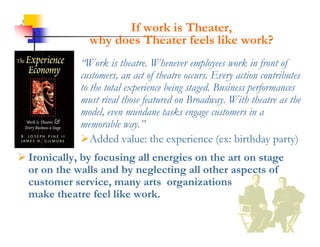
             “Work is theatre. Whenever employees work in front of
             customers,
             customers an act of theatre occurs. Every action contributes
                                          occurs
             to the total experience being staged. Business performances
             must rival those featured on Broadway. With theatre as the
             model, even mundane tasks engage customers in a
                 dl            d        k
             memorable way.”
             Added value: the experience (ex: birthday party)
 Ironically, by focusing all energies on the art on stage
  or on the walls and by neglecting all other aspects of
  customer service, many arts organizations
  make theatre feel like work.
3
                  The show is not enough
     Risk: Mediocre customer service affects our
      perception of the show (Ex: McDonald’s )
     Audience abuse: Arrogance of staff toward the
      customer, inflexibility of ticket exchange policies,
      unannounced seasons, last minute changes in
                                               g
      schedules, ticket issuing mistakes…
     Customer service is controllable: hire and train
      customer f i dl staff, make sure that queries are
                friendly ff        k        h      i
      answered promptly, etc.
     …the reaction of the audience to
      the show is not.
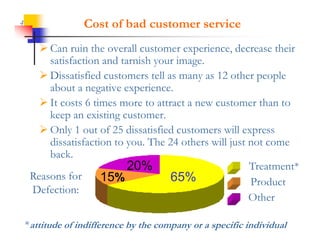
4                 Cost of bad customer service
        C ruin the overall customer experience, d
         Can i h             ll               i        decrease their
                                                                 h i
         satisfaction and tarnish your image.
        Dissatisfied customers tell as many as 12 other people
         about a negative experience.
        It costs 6 times more to attract a new customer than to
         keep an existing customer.
        Only 1 out of 25 dissatisfied customers will express
         di i f i to you. Th 24 others will j not come
         dissatisfaction         The       h     ill just
         back.
                            20% %                         Treatment*
     Reasons for      15%             65%                 Product
     Defection:
                                                          Other

    *attitude of indifference by the company or a specific individual
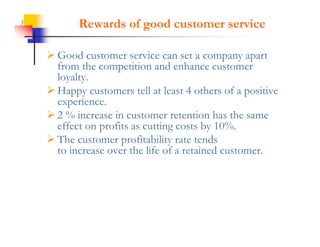
5          Rewards of good customer service

     Good customer service can set a company apart
      from the competition and enhance customer
      loyalty.
      loyalty
     Happy customers tell at least 4 others of a positive
      experience.
     2 % increase in customer retention has the same
      effect on profits as cutting costs by 10%.
     The customer profitability rate tends
      to increase over the life of a retained customer.
6
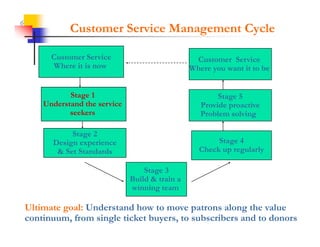
               Customer Service Management Cycle

          Customer Service                          Customer Service
          Where it is now                          Where you want it to be


               Stage 1                                     Stage 5
        Understand the service                        Provide proactive
                                                              p
               seekers                                Problem solving

               Stage 2
          Design experience                               Stage 4
                                                          S
           & Set Standards                           Check up regularly

                                     Stage 3
                                 Build & train a
                                 winning team

    Ultimate goal: Understand how to move patrons along the value
    continuum, from single ticket buyers, to subscribers and to donors
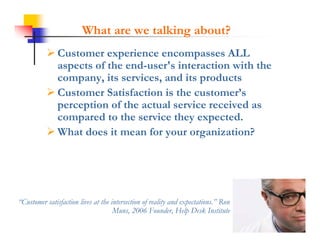
What are we talking about?
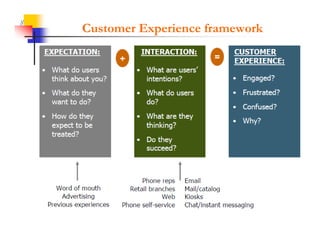
            Customer experience encompasses ALL
             aspects of the end-user's interaction with the
             company,
             company its services, and its products
                           services
            Customer Satisfaction is the customer’s
             perception of the actual service received as
             compared to the service they expected.
            What does it mean for your organization?


“Customer satisfaction lives at the intersection of reality and expectations.” Ron
 Customer                                                       expectations
                                     Muns, 2006 Founder, Help Desk Institute
8
    Customer Experience framework
9
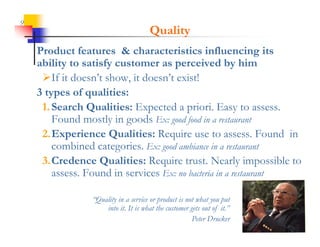
                                       Quality
    Product features & characteristics influencing its
    ability to satisfy customer as perceived by him
     If it doesn t show, it doesn t exist!
            doesn’t show doesn’t
    3 types of qualities:
     1.
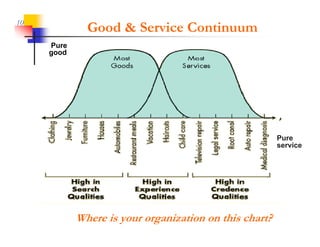
     1 Search Qualities: Expected a priori. Easy to assess
                                        priori              assess.
        Found mostly in goods Ex: good food in a restaurant
     2.Experience Q
           p         Qualities: Require use to assess. Found in
                                   q
        combined categories. Ex: good ambiance in a restaurant
     3.Credence Qualities: Require trust. Nearly impossible to
        assess. F
                Found in services E no bacteria in a restaurant
                     di      i Ex: b

                 “Quality in a service or product is not what you put
                  Quality
                     into it. It is what the customer gets out of it.”
                                                       Peter Drucker
10
              Good & Service Continuum
     Pure
     good


                                                        Pure
                                                        service


            Where is your organization on this chart?
11
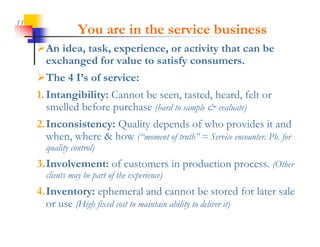
                 You are in the service business
     An idea, k
     A id task, experience, or activity that can b
                         i            i i h       be
      exchanged for value to satisfy consumers.
     The 4 I’s of service:
     1. Intangibility: Cannot be seen, tasted, heard, felt or
        smelled before purchase (hard to sample & evaluate)
     2.Inconsistency: Quality depends of who provides it and
       when, where & how (“moment of truth” = Service encounter. Pb. for
                         ( moment truth
       quality control)
     3.Involvement: of customers in production process. (Other
       clients may be part of the experience)
     4.Inventory: ephemeral and cannot be stored for later sale
       or use (Hi h fixed cost to maintain ability to deliver it)
              (High fi d            i i bili          d li i )
12
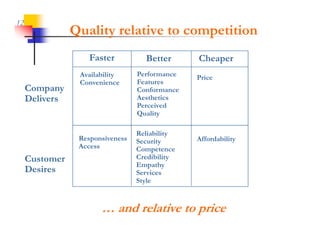
                Quality relative to competition
                    Faster          Better      Cheaper
                 Availability     Performance   Price
                 Convenience      Features
     Company                      Conformance
     Delivers                     Aesthetics
                                  Perceived
                                  Quality

                                  Reliability
                 Responsiveness   Security
                                  S     i       Affordability
                 Access           Competence
     Customer                     Credibility
                                  Empathy
     Desires                      Services
                                  Style


                       … and relative to price
13
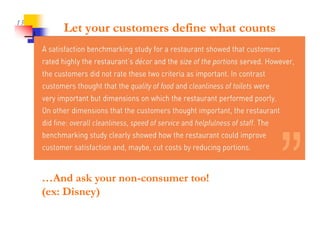
         Let your customers define what counts


     …And ask your non-consumer too!
     (ex: Disney)
14
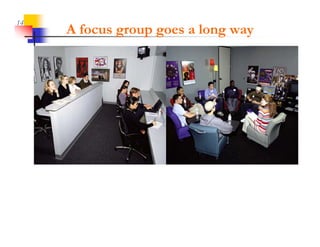
     A focus group goes a long way
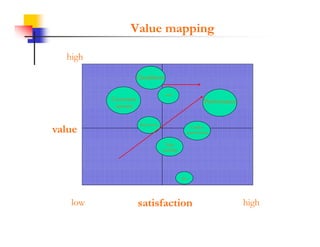
Value mapping

  high

                    Cleanliness

                                   staff
         Customer                                      Performance
          service

                     Reputation
value                                            Online
                                              transactions

                                   Valet
                                  parking


                                            Bar


   low
   l                satisfaction
                      ti f ti n                                      high
                                                                     hi h
16
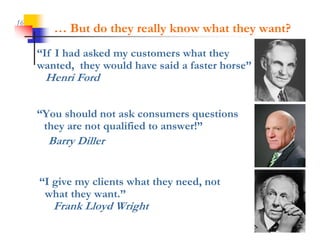
        … But do they really know what they want?
     “If I had asked my customers what they
     wanted, they would have said a faster horse”
      Henri Ford


     “You should not ask consumers questions
      they are not qualified to answer!”
       Barry Dill
       B     Diller


     “I give my clients what they need, not
      what they want.”
        Frank Lloyd Wright
17
                        Needs & Wants


      Need: Fundamental requirement the meeting
       of which is the ultimate goal of the behavior
      Want: A specific form of consumption
       desired to satisfy a need
18
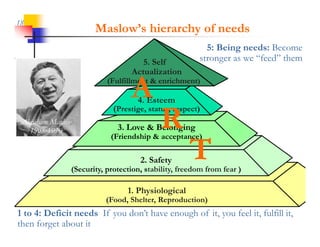
                         Maslow’s hierarchy of needs
                                                          5: B i
                                                          5 Being needs: B
                                                                       d Become
                                       5. Self          stronger as we “feed” them
                                    Actualization

                                    A
                            (Fulfillment & enrichment)

                                      4. Esteem

                                            R
                              (Pr ti status, respect)
                               Prestige, t t r p t)
 Abraham Maslow
   1908-1970                   3. Love & Belonging


                                                     T
                             (
                             (Friendship & acceptance)
                                       p       p     )

                                      2. Safety
                  (Security, protection, stability
                  (Security protection stability, freedom from fear )

                                  1. Physiological
                            (Food, Shelter, Reproduction)
1 to 4: Deficit needs If you don’t have enough of it, you feel it, fulfill it,
then forget about it
19
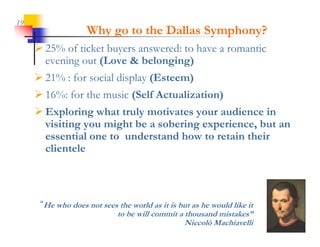
                   Why go to the Dallas Symphony?
      25% of ticket buyers answered: to have a romantic
             f i k b               d     h            i
       evening out (Love & belonging)
      21% : for social display (Esteem)
      16%: for the music (Self Actualization)
      Exploring what truly motivates your audience i
            l i     h     l      i            di     in
       visiting you might be a sobering experience, but an
       essential one to understand how to retain their
       clientele


      “He who does not sees the world as it is but as he would like it
                             to be will commit a thousand mistakes”
                                                 Niccolò Machiavelli
20
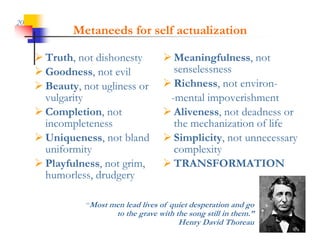
             Metaneeds for self actualization

      Truth, not dishonesty           Meaningfulness, not
      Goodness, not evil
                  ,                     senselessness
      Beauty, not ugliness or         Richness, not environ-
       vulgarity                       -mental impoverishment
     CCompletion, not
              l                        Al
                                        Aliveness, not d d
                                                       deadness or
       incompleteness                   the mechanization of life
      Uniqueness not bland
       Uniqueness,                     Simplicity not unnecessary
                                        Simplicity,
       uniformity                       complexity
      Playfulness, not grim,          TRANSFORMATION
       humorless, drudgery

                “Most men lead lives of quiet desperation and go
                        to the grave with the song still in them.”
                                           Henry David Thoreau
21
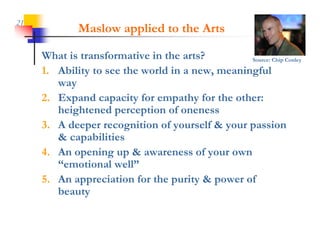
             Maslow applied to the Arts

     What is transformative in the arts?         Source: Chip Conley

                                                 g
     1. Ability to see the world in a new, meaningful
        way
     2. Expand capacity for empathy for the other:
        heightened
        h i ht d perception of oneness
                            ti    f
     3. A deeper recognition of yourself & your passion
        & capabilities
     4. An opening up & awareness of your own
        “emotional well”
     5. An appreciation for the purity & power of
        beauty
22
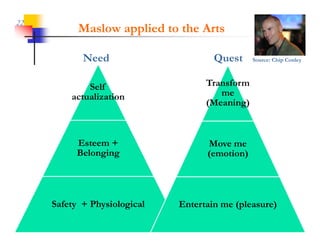
           Maslow applied to the Arts

            Need                      Quest     Source: Chip Conley


             Self                   Transform
         actualization                 me
                                            g
                                    (Meaning)


          Esteem +                  Move me
          Belonging                 (emotion)


     Safety + Ph i l i l
     S f      Physiological   Entertain me ( l
                              E      i     (pleasure)
                                                    )
23
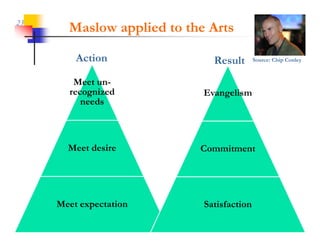
       Maslow applied to the Arts

        Action                Result       Source: Chip Conley


        Meet un-
       recognized           Evangelism
          needs


       Meet desire         Commitment


     Meet
     M expectation
               i            Satisfaction
                            S i f i
24


       Any questions?


     Let’s have a break!
25
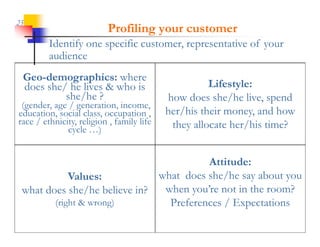
                          Profiling your customer
         Identify one specific customer, representative of your
                               customer
         audience
 Geo-demographics:
 Geo demographics: where
 does she/ he lives & who is                         Lifestyle:
          she/he ?                         how does she/he live, spend
 (gender, age / generation, income,
education, social class, occupation ,      her/his h i
                                           h /hi their money, and hd how
race / ethnicity, religion , family life    they allocate her/his time?
              cycle …)


                                        Attitude:
            Values:           what does she/he say about you
 what does she/he believe in?  when you’re not in the room?
        (right
        ( i ht & wrong)
                      )         Preferences Expectations
                                Pr f r n / E p t ti n
26
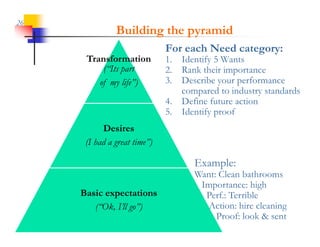
               Building the pyramid
                              For
                              F each Need category:
                                   hN d
      Transformation          1. Identify 5 Wants
          (“Its part          2. Rank their importance
         of my life”)         3. Describe your performance
                                 compared to industry standards
                              4. Define future action
                              5. Identify proof
           Desires
      (I had a great time”)
         h d          i ”)

                                     Example:
                                     Want: Clean bathrooms
                                      Importance: high
     Basic expectations                Perf.: Terrible
        (“Ok, I’ll go”)                 Action: hire cleaning
                                          Proof: look & sent
27


            Any questions?


               Thanks!
          Read for next week:
     Met, CSO & Steppenwolf cases

Casting Customer Service

  • 1.
    Improving Patron Experience E i I. Understanding Philippe Ravanas Professor Columbia College Chicago 1
  • 2.
    2 If work is Theater, why does Theater feels like work? y “Work is theatre. Whenever employees work in front of customers, customers an act of theatre occurs. Every action contributes occurs to the total experience being staged. Business performances must rival those featured on Broadway. With theatre as the model, even mundane tasks engage customers in a dl d k memorable way.” Added value: the experience (ex: birthday party)  Ironically, by focusing all energies on the art on stage or on the walls and by neglecting all other aspects of customer service, many arts organizations make theatre feel like work.
  • 3.
    3 The show is not enough  Risk: Mediocre customer service affects our perception of the show (Ex: McDonald’s )  Audience abuse: Arrogance of staff toward the customer, inflexibility of ticket exchange policies, unannounced seasons, last minute changes in g schedules, ticket issuing mistakes…  Customer service is controllable: hire and train customer f i dl staff, make sure that queries are friendly ff k h i answered promptly, etc.  …the reaction of the audience to the show is not.
  • 4.
    4 Cost of bad customer service  C ruin the overall customer experience, d Can i h ll i decrease their h i satisfaction and tarnish your image.  Dissatisfied customers tell as many as 12 other people about a negative experience.  It costs 6 times more to attract a new customer than to keep an existing customer.  Only 1 out of 25 dissatisfied customers will express di i f i to you. Th 24 others will j not come dissatisfaction The h ill just back. 20% % Treatment* Reasons for 15% 65% Product Defection: Other *attitude of indifference by the company or a specific individual
  • 5.
    5 Rewards of good customer service  Good customer service can set a company apart from the competition and enhance customer loyalty. loyalty  Happy customers tell at least 4 others of a positive experience.  2 % increase in customer retention has the same effect on profits as cutting costs by 10%.  The customer profitability rate tends to increase over the life of a retained customer.
  • 6.
    6 Customer Service Management Cycle Customer Service Customer Service Where it is now Where you want it to be Stage 1 Stage 5 Understand the service Provide proactive p seekers Problem solving Stage 2 Design experience Stage 4 S & Set Standards Check up regularly Stage 3 Build & train a winning team Ultimate goal: Understand how to move patrons along the value continuum, from single ticket buyers, to subscribers and to donors
  • 7.
    What are wetalking about?  Customer experience encompasses ALL aspects of the end-user's interaction with the company, company its services, and its products services  Customer Satisfaction is the customer’s perception of the actual service received as compared to the service they expected.  What does it mean for your organization? “Customer satisfaction lives at the intersection of reality and expectations.” Ron Customer expectations Muns, 2006 Founder, Help Desk Institute
  • 8.
    8 Customer Experience framework
  • 9.
    9 Quality Product features & characteristics influencing its ability to satisfy customer as perceived by him If it doesn t show, it doesn t exist! doesn’t show doesn’t 3 types of qualities: 1. 1 Search Qualities: Expected a priori. Easy to assess priori assess. Found mostly in goods Ex: good food in a restaurant 2.Experience Q p Qualities: Require use to assess. Found in q combined categories. Ex: good ambiance in a restaurant 3.Credence Qualities: Require trust. Nearly impossible to assess. F Found in services E no bacteria in a restaurant di i Ex: b “Quality in a service or product is not what you put Quality into it. It is what the customer gets out of it.” Peter Drucker
  • 10.
    10 Good & Service Continuum Pure good Pure service Where is your organization on this chart?
  • 11.
    11 You are in the service business An idea, k A id task, experience, or activity that can b i i i h be exchanged for value to satisfy consumers. The 4 I’s of service: 1. Intangibility: Cannot be seen, tasted, heard, felt or smelled before purchase (hard to sample & evaluate) 2.Inconsistency: Quality depends of who provides it and when, where & how (“moment of truth” = Service encounter. Pb. for ( moment truth quality control) 3.Involvement: of customers in production process. (Other clients may be part of the experience) 4.Inventory: ephemeral and cannot be stored for later sale or use (Hi h fixed cost to maintain ability to deliver it) (High fi d i i bili d li i )
  • 12.
    12 Quality relative to competition Faster Better Cheaper Availability Performance Price Convenience Features Company Conformance Delivers Aesthetics Perceived Quality Reliability Responsiveness Security S i Affordability Access Competence Customer Credibility Empathy Desires Services Style … and relative to price
  • 13.
    13 Let your customers define what counts …And ask your non-consumer too! (ex: Disney)
  • 14.
    14 A focus group goes a long way
  • 15.
    Value mapping high Cleanliness staff Customer Performance service Reputation value Online transactions Valet parking Bar low l satisfaction ti f ti n high hi h
  • 16.
    16 … But do they really know what they want? “If I had asked my customers what they wanted, they would have said a faster horse” Henri Ford “You should not ask consumers questions they are not qualified to answer!” Barry Dill B Diller “I give my clients what they need, not what they want.” Frank Lloyd Wright
  • 17.
    17 Needs & Wants  Need: Fundamental requirement the meeting of which is the ultimate goal of the behavior  Want: A specific form of consumption desired to satisfy a need
  • 18.
    18 Maslow’s hierarchy of needs 5: B i 5 Being needs: B d Become 5. Self stronger as we “feed” them Actualization A (Fulfillment & enrichment) 4. Esteem R (Pr ti status, respect) Prestige, t t r p t) Abraham Maslow 1908-1970 3. Love & Belonging T ( (Friendship & acceptance) p p ) 2. Safety (Security, protection, stability (Security protection stability, freedom from fear ) 1. Physiological (Food, Shelter, Reproduction) 1 to 4: Deficit needs If you don’t have enough of it, you feel it, fulfill it, then forget about it
  • 19.
    19 Why go to the Dallas Symphony?  25% of ticket buyers answered: to have a romantic f i k b d h i evening out (Love & belonging)  21% : for social display (Esteem)  16%: for the music (Self Actualization)  Exploring what truly motivates your audience i l i h l i di in visiting you might be a sobering experience, but an essential one to understand how to retain their clientele “He who does not sees the world as it is but as he would like it to be will commit a thousand mistakes” Niccolò Machiavelli
  • 20.
    20 Metaneeds for self actualization  Truth, not dishonesty  Meaningfulness, not  Goodness, not evil , senselessness  Beauty, not ugliness or  Richness, not environ- vulgarity -mental impoverishment CCompletion, not l  Al Aliveness, not d d deadness or incompleteness the mechanization of life  Uniqueness not bland Uniqueness,  Simplicity not unnecessary Simplicity, uniformity complexity  Playfulness, not grim,  TRANSFORMATION humorless, drudgery “Most men lead lives of quiet desperation and go to the grave with the song still in them.” Henry David Thoreau
  • 21.
    21 Maslow applied to the Arts What is transformative in the arts? Source: Chip Conley g 1. Ability to see the world in a new, meaningful way 2. Expand capacity for empathy for the other: heightened h i ht d perception of oneness ti f 3. A deeper recognition of yourself & your passion & capabilities 4. An opening up & awareness of your own “emotional well” 5. An appreciation for the purity & power of beauty
  • 22.
    22 Maslow applied to the Arts Need Quest Source: Chip Conley Self Transform actualization me g (Meaning) Esteem + Move me Belonging (emotion) Safety + Ph i l i l S f Physiological Entertain me ( l E i (pleasure) )
  • 23.
    23 Maslow applied to the Arts Action Result Source: Chip Conley Meet un- recognized Evangelism needs Meet desire Commitment Meet M expectation i Satisfaction S i f i
  • 24.
    24 Any questions? Let’s have a break!
  • 25.
    25 Profiling your customer Identify one specific customer, representative of your customer audience Geo-demographics: Geo demographics: where does she/ he lives & who is Lifestyle: she/he ? how does she/he live, spend (gender, age / generation, income, education, social class, occupation , her/his h i h /hi their money, and hd how race / ethnicity, religion , family life they allocate her/his time? cycle …) Attitude: Values: what does she/he say about you what does she/he believe in? when you’re not in the room? (right ( i ht & wrong) ) Preferences Expectations Pr f r n / E p t ti n
  • 26.
    26 Building the pyramid For F each Need category: hN d Transformation 1. Identify 5 Wants (“Its part 2. Rank their importance of my life”) 3. Describe your performance compared to industry standards 4. Define future action 5. Identify proof Desires (I had a great time”) h d i ”) Example: Want: Clean bathrooms Importance: high Basic expectations Perf.: Terrible (“Ok, I’ll go”) Action: hire cleaning Proof: look & sent
  • 27.
    27 Any questions? Thanks! Read for next week: Met, CSO & Steppenwolf cases