DELIVERING SERVICE
THROUGH INTERMEDIARIES
PRESENTING BY;
Vinayak Jituri
17MBA636
Manjunath Merwade
17MBA625
LEARNING OBJECTIVES
• Identify the primary channels through which
services are delivered to end customers.
• Provide examples of each of the key service
intermediaries.
• Discuss the benefits and challenges of each
method of service delivery.
• Outline the strategies that are used to manage
service delivery through intermediaries.
OUTLINE
• Service Distribution
• Direct or Company-Owned Channels
• Franchising
• Agents and Brokers
• Common Issues Involving Intermediaries
• Strategies for Effective Service Delivery
Through Intermediaries
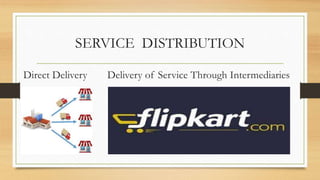
SERVICE DISTRIBUTION
Direct Delivery Delivery of Service Through Intermediaries
FRANCHISING
Franchising is a system used by a company (franchisor) that grants others (franchisees)
the right and license (franchise) to market a product or service under the franchisor’s
trade names, trademarks, service marks, know-how and method of doing business. It is
a system for distributing products or services through independent resellers. It is a
format of mutual dependence which allows both the franchisor and the franchisee
realize profits and benefits.
BENEFITS AND CHALLENGES FOR
FRANCHISERS OF SERVICE
• Leveraged business format for
greater expansion and revenues
• Consistency in outlets
• Knowledge of local markets
• Shared financial risk and more
working capital
• Difficulty in maintaining and motivating franchisees
• Highly publicized disputes and conflict
• Inconsistent quality
• Control of customer relationship by intermediary
BENEFITS AND CHALLENGES FOR
FRANCHISERS OF SERVICE
• An established business
format
• National or regional brand
marketing
• Minimized risk of starting a
business
• Encroachment
• Disappointing profits and revenues
• Lack of perceived control over operations
• High fees
AGENTS AND BROKERS
AGENTS
A agent is some one who legally represents the principal and has the authority
to act on the pricipal’s behalf.
BROKER
A agent in some one who legally represents the insured even though he or she
receives a commision from the insurer.
BENEFITS AND CHALLENGES IN SERVICES
THROUGH AGENTS AND BROKERS
• Reduced selling and distribution
costs
• Intermediary’s possession of
special skills and knowledge
• Wide representation
• Knowledge of local markets •
Customer choice
• Loss of control over pricing
• Representation of multiple service principals
BENEFITS AND CHALLENGES IN
DISTRIBUTION OF SERVICES
• Consistent delivery for
standardized services
• Customer convenience
• Wide distribution
• Quick customer feedback
• Price competition
• Inability to customize with highly standardized
services
• Lack of consistency due to customer
involvement
• Changes in consumer behavior
• Competition from widening geographies
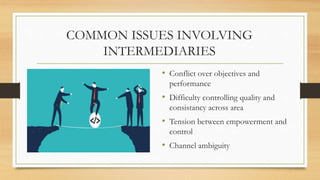
COMMON ISSUES INVOLVING
INTERMEDIARIES
• Conflict over objectives and
performance
• Difficulty controlling quality and
consistancy across area
• Tension between empowerment and
control
• Channel ambiguity
STRATEGIES FOR EFFECTIVE SERVICE
DELIVERY THROUGH INTERMEDIARIES
* Empowerment Strategies
* Control Strategies
* Partnering Strategies
STRATEGIES FOR EFFECTIVE SERVICE
DELIVERY THROUGH INTERMEDIARIES
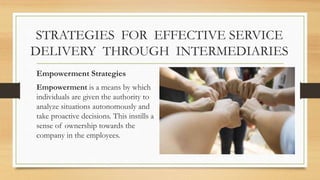
Empowerment Strategies
Empowerment is a means by which
individuals are given the authority to
analyze situations autonomously and
take proactive decisions. This instills a
sense of ownership towards the
company in the employees.
STRATEGIES FOR EFFECTIVE SERVICE
DELIVERY THROUGH INTERMEDIARIES
Control Strategies
Strategic control is a term used to
describe the process used by organizations
to control the formation and execution
of strategic plans, it is a specialised form
of management control, and differs from
other forms of management control in
respects of its need to handle.
STRATEGIES FOR EFFECTIVE SERVICE
DELIVERY THROUGH INTERMEDIARIES
Partnering Strategies
Partnering is both challenging and resource
intensive. A partnering strategy is essential to
guide an organisation to make robust choices
on its investment in collaboration: the right
issue area, the right type of
partnerships, and the right type of partners
to ensure the greatest value to the
organisations.
Delivering service through intermiditiors

Delivering service through intermiditiors

  • 1.
    DELIVERING SERVICE THROUGH INTERMEDIARIES PRESENTINGBY; Vinayak Jituri 17MBA636 Manjunath Merwade 17MBA625
  • 2.
    LEARNING OBJECTIVES • Identifythe primary channels through which services are delivered to end customers. • Provide examples of each of the key service intermediaries. • Discuss the benefits and challenges of each method of service delivery. • Outline the strategies that are used to manage service delivery through intermediaries.
  • 3.
    OUTLINE • Service Distribution •Direct or Company-Owned Channels • Franchising • Agents and Brokers • Common Issues Involving Intermediaries • Strategies for Effective Service Delivery Through Intermediaries
  • 4.
    SERVICE DISTRIBUTION Direct DeliveryDelivery of Service Through Intermediaries
  • 5.
    FRANCHISING Franchising is asystem used by a company (franchisor) that grants others (franchisees) the right and license (franchise) to market a product or service under the franchisor’s trade names, trademarks, service marks, know-how and method of doing business. It is a system for distributing products or services through independent resellers. It is a format of mutual dependence which allows both the franchisor and the franchisee realize profits and benefits.
  • 6.
    BENEFITS AND CHALLENGESFOR FRANCHISERS OF SERVICE • Leveraged business format for greater expansion and revenues • Consistency in outlets • Knowledge of local markets • Shared financial risk and more working capital • Difficulty in maintaining and motivating franchisees • Highly publicized disputes and conflict • Inconsistent quality • Control of customer relationship by intermediary
  • 7.
    BENEFITS AND CHALLENGESFOR FRANCHISERS OF SERVICE • An established business format • National or regional brand marketing • Minimized risk of starting a business • Encroachment • Disappointing profits and revenues • Lack of perceived control over operations • High fees
  • 8.
    AGENTS AND BROKERS AGENTS Aagent is some one who legally represents the principal and has the authority to act on the pricipal’s behalf. BROKER A agent in some one who legally represents the insured even though he or she receives a commision from the insurer.
  • 9.
    BENEFITS AND CHALLENGESIN SERVICES THROUGH AGENTS AND BROKERS • Reduced selling and distribution costs • Intermediary’s possession of special skills and knowledge • Wide representation • Knowledge of local markets • Customer choice • Loss of control over pricing • Representation of multiple service principals
  • 10.
    BENEFITS AND CHALLENGESIN DISTRIBUTION OF SERVICES • Consistent delivery for standardized services • Customer convenience • Wide distribution • Quick customer feedback • Price competition • Inability to customize with highly standardized services • Lack of consistency due to customer involvement • Changes in consumer behavior • Competition from widening geographies
  • 11.
    COMMON ISSUES INVOLVING INTERMEDIARIES •Conflict over objectives and performance • Difficulty controlling quality and consistancy across area • Tension between empowerment and control • Channel ambiguity
  • 12.
    STRATEGIES FOR EFFECTIVESERVICE DELIVERY THROUGH INTERMEDIARIES * Empowerment Strategies * Control Strategies * Partnering Strategies
  • 13.
    STRATEGIES FOR EFFECTIVESERVICE DELIVERY THROUGH INTERMEDIARIES Empowerment Strategies Empowerment is a means by which individuals are given the authority to analyze situations autonomously and take proactive decisions. This instills a sense of ownership towards the company in the employees.
  • 14.
    STRATEGIES FOR EFFECTIVESERVICE DELIVERY THROUGH INTERMEDIARIES Control Strategies Strategic control is a term used to describe the process used by organizations to control the formation and execution of strategic plans, it is a specialised form of management control, and differs from other forms of management control in respects of its need to handle.
  • 15.
    STRATEGIES FOR EFFECTIVESERVICE DELIVERY THROUGH INTERMEDIARIES Partnering Strategies Partnering is both challenging and resource intensive. A partnering strategy is essential to guide an organisation to make robust choices on its investment in collaboration: the right issue area, the right type of partnerships, and the right type of partners to ensure the greatest value to the organisations.