Stages of Service Life Cycle
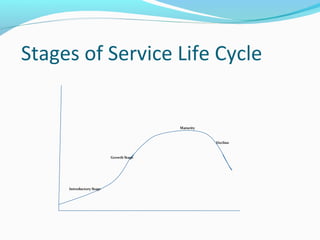
Maturity
Decline
Growth Stage
Introductory Stage
Introductory Stage:
New service or new form of current service is in the
introductory stage when offered first time.
Can be introduced on a small scale and expanded if
acceptance grows
Small scale introduction reduces financial risk
New services faces few or no direct competitors
Introductory stage normally short
Strategy to ensure new service accepted by consumers
is to have users of current service participate in new
service design.
Growth Stage:
Industry growing rapidly
Firms seeing positive cash flow
Industry is expanding and demand is high – firms
offering service can normally increase their prices –
higher margins and greater profits.
Thus more firms enter the market.
Distinct market segments emerge
Service providers need to develop a sustainable
competitive advantage.
Maturity Stage:
Sales level off.
Competition becomes very intense – intense
competitive advantage required – results in overall
industry profits.
Weaker firms will be shaken out of the industry.
At this stage in service life cycle, consumers see very
few distinguishable characteristics among the various
firms in a service industry.
Requires strong marketing program
Decline stage:
Industry sales decline – because of new technology
development
Because of decrease in demand – many companies
delete the service reducing competition
Cash flow and profit for companies throughout the
industry have declined.
Companies with the services in decline part of life cycle
have five options : Divest, harvest, Prune, Reentrench
or rejuvenate.
Decline stage:
Industry sales decline – because of new technology
development
Because of decrease in demand – many companies
delete the service reducing competition
Cash flow and profit for companies throughout the
industry have declined.
Companies with the services in decline part of life cycle
have five options : Divest, harvest, Prune, Reentrench
or rejuvenate.

Service life cycle

  • 2.
    Stages of ServiceLife Cycle Maturity Decline Growth Stage Introductory Stage
  • 3.
    Introductory Stage: New serviceor new form of current service is in the introductory stage when offered first time. Can be introduced on a small scale and expanded if acceptance grows Small scale introduction reduces financial risk New services faces few or no direct competitors Introductory stage normally short Strategy to ensure new service accepted by consumers is to have users of current service participate in new service design.
  • 4.
    Growth Stage: Industry growingrapidly Firms seeing positive cash flow Industry is expanding and demand is high – firms offering service can normally increase their prices – higher margins and greater profits. Thus more firms enter the market. Distinct market segments emerge Service providers need to develop a sustainable competitive advantage.
  • 5.
    Maturity Stage: Sales leveloff. Competition becomes very intense – intense competitive advantage required – results in overall industry profits. Weaker firms will be shaken out of the industry. At this stage in service life cycle, consumers see very few distinguishable characteristics among the various firms in a service industry. Requires strong marketing program
  • 6.
    Decline stage: Industry salesdecline – because of new technology development Because of decrease in demand – many companies delete the service reducing competition Cash flow and profit for companies throughout the industry have declined. Companies with the services in decline part of life cycle have five options : Divest, harvest, Prune, Reentrench or rejuvenate.
  • 7.
    Decline stage: Industry salesdecline – because of new technology development Because of decrease in demand – many companies delete the service reducing competition Cash flow and profit for companies throughout the industry have declined. Companies with the services in decline part of life cycle have five options : Divest, harvest, Prune, Reentrench or rejuvenate.