Service Concept, Characteristic
and Classification of Service
What are Services
• Gronoos (1990)
 Service is an activity or a series of activities of more or less intangible nature
that normally , but not necessarily, – take place in interactions between the
customer
and service employees and /or – physical resources or goods and/or systems of the
service provider, which are provided as a solution to customer problems.
Kotler (1991)
 Service is an act or performance that one party can offer to another that is
essentially intangible and does not result in the ownership of anything. Its
production may not be tied to a physical product.
.
Service Concept, Characteristic
and Classification of Service
Nature/ characterstics of Services
Researchers have proposed four basic traits of services.
Intangibility
 Services are performances rather than objects, they cannot be seen, felt, tasted
or touched like goods.
Inseparability
 Services are created and consumed simultaneously; they cannot be stored like
goods.
Variability
 Quality and essence of service vary from producer to producer, customer to
customer, and from day to day; it is largely the result of human interaction and
all the vagaries that accompany it.
Perishability
 Services once produced cannot be stored for future use.
Service Concept, Characteristic
and Classification of Service
Intangibility
 At times services are further classified into:-
Physical intangibility
 that which cannot be touched.
Mental intangibility
 that which is difficult for the consumer to grasp or measure even mentally.
 Services cannot be stored They cannot be patented legally, hence can easily be
copied by competitors.
 They cannot be readily displayed or communicated leading to difficulty in
assessing its quality.
Service Concept, Characteristic
and Classification of Service
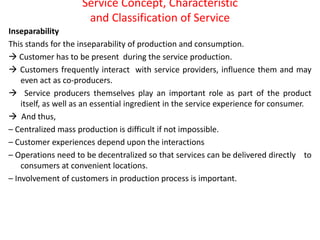
Inseparability
This stands for the inseparability of production and consumption.
 Customer has to be present during the service production.
 Customers frequently interact with service providers, influence them and may
even act as co-producers.
 Service producers themselves play an important role as part of the product
itself, as well as an essential ingredient in the service experience for consumer.
 And thus,
– Centralized mass production is difficult if not impossible.
– Customer experiences depend upon the interactions
– Operations need to be decentralized so that services can be delivered directly to
consumers at convenient locations.
– Involvement of customers in production process is important.
Service Concept, Characteristic
and Classification of Service
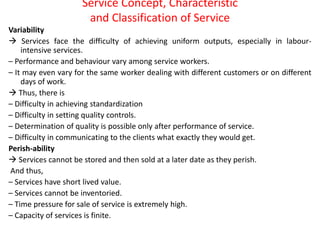
Variability
 Services face the difficulty of achieving uniform outputs, especially in labour-
intensive services.
– Performance and behaviour vary among service workers.
– It may even vary for the same worker dealing with different customers or on different
days of work.
 Thus, there is
– Difficulty in achieving standardization
– Difficulty in setting quality controls.
– Determination of quality is possible only after performance of service.
– Difficulty in communicating to the clients what exactly they would get.
Perish-ability
 Services cannot be stored and then sold at a later date as they perish.
And thus,
– Services have short lived value.
– Services cannot be inventoried.
– Time pressure for sale of service is extremely high.
– Capacity of services is finite.
Service Concept, Characteristic
and Classification of Service
Service Concept, Characteristic
and Classification of Service
Service Concept, Characteristic
and Classification of Service
Service Concept, Characteristic
and Classification of Service
Service Concept, Characteristic
and Classification of Service
Service Concept, Characteristic
and Classification of Service

Service concept, characteristic and classification

  • 1.
    Service Concept, Characteristic andClassification of Service What are Services • Gronoos (1990)  Service is an activity or a series of activities of more or less intangible nature that normally , but not necessarily, – take place in interactions between the customer and service employees and /or – physical resources or goods and/or systems of the service provider, which are provided as a solution to customer problems. Kotler (1991)  Service is an act or performance that one party can offer to another that is essentially intangible and does not result in the ownership of anything. Its production may not be tied to a physical product. .
  • 2.
    Service Concept, Characteristic andClassification of Service Nature/ characterstics of Services Researchers have proposed four basic traits of services. Intangibility  Services are performances rather than objects, they cannot be seen, felt, tasted or touched like goods. Inseparability  Services are created and consumed simultaneously; they cannot be stored like goods. Variability  Quality and essence of service vary from producer to producer, customer to customer, and from day to day; it is largely the result of human interaction and all the vagaries that accompany it. Perishability  Services once produced cannot be stored for future use.
  • 3.
    Service Concept, Characteristic andClassification of Service Intangibility  At times services are further classified into:- Physical intangibility  that which cannot be touched. Mental intangibility  that which is difficult for the consumer to grasp or measure even mentally.  Services cannot be stored They cannot be patented legally, hence can easily be copied by competitors.  They cannot be readily displayed or communicated leading to difficulty in assessing its quality.
  • 4.
    Service Concept, Characteristic andClassification of Service Inseparability This stands for the inseparability of production and consumption.  Customer has to be present during the service production.  Customers frequently interact with service providers, influence them and may even act as co-producers.  Service producers themselves play an important role as part of the product itself, as well as an essential ingredient in the service experience for consumer.  And thus, – Centralized mass production is difficult if not impossible. – Customer experiences depend upon the interactions – Operations need to be decentralized so that services can be delivered directly to consumers at convenient locations. – Involvement of customers in production process is important.
  • 5.
    Service Concept, Characteristic andClassification of Service Variability  Services face the difficulty of achieving uniform outputs, especially in labour- intensive services. – Performance and behaviour vary among service workers. – It may even vary for the same worker dealing with different customers or on different days of work.  Thus, there is – Difficulty in achieving standardization – Difficulty in setting quality controls. – Determination of quality is possible only after performance of service. – Difficulty in communicating to the clients what exactly they would get. Perish-ability  Services cannot be stored and then sold at a later date as they perish. And thus, – Services have short lived value. – Services cannot be inventoried. – Time pressure for sale of service is extremely high. – Capacity of services is finite.
  • 6.
    Service Concept, Characteristic andClassification of Service
  • 7.
    Service Concept, Characteristic andClassification of Service
  • 8.
    Service Concept, Characteristic andClassification of Service
  • 9.
    Service Concept, Characteristic andClassification of Service
  • 10.
    Service Concept, Characteristic andClassification of Service
  • 11.
    Service Concept, Characteristic andClassification of Service