Programming languages
Coded language used by programmers to write instructions
that a computer can understand to do what the programmer
(or the computer user) wants.
The most basic (called low-level) computer language is the
machine language that uses binary ('1' and '0') code which a
computer can run (execute) very fast without using any
translator or interpreter program, but is tedious and complex.
The high-level languages (such as Basic, C, Java) are much
simpler (more 'English-like') to use but need to use another
program (a compiler or an interpreter) to convert the high-
level code into the machine code, and are therefore slower.
Programming languages
A programming language is a vocabulary and set
of grammatical rules for instructing
a computer or computing device to perform
specific tasks.
The term programming language usually refers
to high-level languages, such as BASIC, C, C+
+, COBOL, Java, FORTRAN, Ada, and Pascal. Each
language has a unique set of keywords (words
that it understands) and a special syntax for
organizing program instructions.
Programming languages
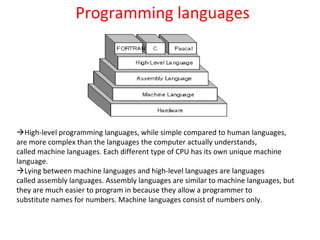
High-level programming languages, while simple compared to human languages,
are more complex than the languages the computer actually understands,
called machine languages. Each different type of CPU has its own unique machine
language.
Lying between machine languages and high-level languages are languages
called assembly languages. Assembly languages are similar to machine languages, but
they are much easier to program in because they allow a programmer to
substitute names for numbers. Machine languages consist of numbers only.
Programming languages
Converting to Machine Language
Regardless of what language you use, you eventually need
to convert your program into machine language so that the
computer can understand it. There are two ways to do this:
1) compile the program
2) interpret the program
 The question of which language is best is one that
consumes a lot of time and energy among computer
professionals. Every language has its strengths and
weaknesses. For example, FORTRAN is a particularly good
language for processing numerical data, but it does not lend
itself very well to organizing large programs. Pascal is very
good for writing well-structured and readable programs, but
it is not as flexible as the C programming language. C++
embodies powerful object-oriented features, but it is
complex and difficult to learn.
Programming languages
What Are the Top Programming Languages?
According to IEEE Spectrum's interactive ranking, Python is the top programming
language of 2017, followed by C, Java and C++. Of course, the choice of which
language to use depends on the type of computer the program is to run on, what sort
of program it is, and the expertise of the programmer.
Programming languages
Machine language is the lowest-level programming language
Machine languages are the only languages understood
by computer.
Programming language that can be directly understood and
obeyed by a machine (computer) without conversion
(translation). Different for each type of CPU, it is the native binary
language (comprised of only two characters: 0 and 1) of the
computer and is difficult to be read and understood by humans.
Programmers commonly use more English-like languages (called
high level languages) such as Basic, C, Java, etc., to write
programs which are then translated into machine language
(called a low level language) by an assembler, compiler, or
interpreter.
Programming languages
Machine code, also known as machine language, is the
elemental language of computers, comprising a long
sequence of binary digital zeros and ones (bits).
 The lowest and most elementary language and was the
first type of programming language to be developed.
Machine language is basically the only language which
computer can understand. In fact, a manufacturer
designs a computer to obey just one language.
 its machine code, which is represented inside the
computer by a string of binary digits (bits) 0 and 1. The
symbol 0 stand for the absence of an electric pulse and
1 for the presence of an electric pulse. Since a computer
is capable of recognizing electric signals, therefore, it
understands machine language.
Programming languages
The set of binary codes which can be recognize by the computer
is known as the machine code instruction set. A machine
language instruction consists of an operation code one or more
operands. The operation code specifies that operation that is to
be performed e.g. read, record etc.
 the operands identify the quantities to be operated on e.g. the
numbers to be added or the locations where data are stored. But,
it is almost impossible to write programs directly in machine
code. For this reason, programs are normally written in assembly
or high level languages and then are translated in the machine
language by different translators.
Programming languages
Advantages
It makes fast and efficient use of the computer
It requires no translator to translate the code i.e. directly
understood by the computer.
Disadvantages
All operation codes have to be remembered
All memory addresses have to be remembered
It is hard to amend or find errors in a program written in
the machine language
These languages are machine dependent i.e. a particular
machine language can be used on only one type of
computer.
Programming languages
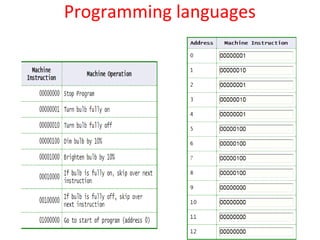
The bulb is wired so that when the switch is first turned on
the instruction at address zero is performed. Then,
instructions are performed one at a time, in order, until the
"Halt" instruction is encountered or the controller crashes.
The controller crashes if it encounters an instruction not in
the table or tries to get an instruction from an address that
does not exist.
The A "Skip" instruction checks the brightness of the bulb and
possibly skips over the instruction after it.
The "Go back" instruction causes the processor to start again
with the instruction at address 0.

Programming languages

  • 1.
    Programming languages Coded languageused by programmers to write instructions that a computer can understand to do what the programmer (or the computer user) wants. The most basic (called low-level) computer language is the machine language that uses binary ('1' and '0') code which a computer can run (execute) very fast without using any translator or interpreter program, but is tedious and complex. The high-level languages (such as Basic, C, Java) are much simpler (more 'English-like') to use but need to use another program (a compiler or an interpreter) to convert the high- level code into the machine code, and are therefore slower.
  • 2.
    Programming languages A programminglanguage is a vocabulary and set of grammatical rules for instructing a computer or computing device to perform specific tasks. The term programming language usually refers to high-level languages, such as BASIC, C, C+ +, COBOL, Java, FORTRAN, Ada, and Pascal. Each language has a unique set of keywords (words that it understands) and a special syntax for organizing program instructions.
  • 3.
    Programming languages High-level programminglanguages, while simple compared to human languages, are more complex than the languages the computer actually understands, called machine languages. Each different type of CPU has its own unique machine language. Lying between machine languages and high-level languages are languages called assembly languages. Assembly languages are similar to machine languages, but they are much easier to program in because they allow a programmer to substitute names for numbers. Machine languages consist of numbers only.
  • 4.
    Programming languages Converting toMachine Language Regardless of what language you use, you eventually need to convert your program into machine language so that the computer can understand it. There are two ways to do this: 1) compile the program 2) interpret the program  The question of which language is best is one that consumes a lot of time and energy among computer professionals. Every language has its strengths and weaknesses. For example, FORTRAN is a particularly good language for processing numerical data, but it does not lend itself very well to organizing large programs. Pascal is very good for writing well-structured and readable programs, but it is not as flexible as the C programming language. C++ embodies powerful object-oriented features, but it is complex and difficult to learn.
  • 5.
    Programming languages What Arethe Top Programming Languages? According to IEEE Spectrum's interactive ranking, Python is the top programming language of 2017, followed by C, Java and C++. Of course, the choice of which language to use depends on the type of computer the program is to run on, what sort of program it is, and the expertise of the programmer.
  • 6.
    Programming languages Machine languageis the lowest-level programming language Machine languages are the only languages understood by computer. Programming language that can be directly understood and obeyed by a machine (computer) without conversion (translation). Different for each type of CPU, it is the native binary language (comprised of only two characters: 0 and 1) of the computer and is difficult to be read and understood by humans. Programmers commonly use more English-like languages (called high level languages) such as Basic, C, Java, etc., to write programs which are then translated into machine language (called a low level language) by an assembler, compiler, or interpreter.
  • 7.
    Programming languages Machine code,also known as machine language, is the elemental language of computers, comprising a long sequence of binary digital zeros and ones (bits).  The lowest and most elementary language and was the first type of programming language to be developed. Machine language is basically the only language which computer can understand. In fact, a manufacturer designs a computer to obey just one language.  its machine code, which is represented inside the computer by a string of binary digits (bits) 0 and 1. The symbol 0 stand for the absence of an electric pulse and 1 for the presence of an electric pulse. Since a computer is capable of recognizing electric signals, therefore, it understands machine language.
  • 8.
    Programming languages The setof binary codes which can be recognize by the computer is known as the machine code instruction set. A machine language instruction consists of an operation code one or more operands. The operation code specifies that operation that is to be performed e.g. read, record etc.  the operands identify the quantities to be operated on e.g. the numbers to be added or the locations where data are stored. But, it is almost impossible to write programs directly in machine code. For this reason, programs are normally written in assembly or high level languages and then are translated in the machine language by different translators.
  • 9.
    Programming languages Advantages It makesfast and efficient use of the computer It requires no translator to translate the code i.e. directly understood by the computer. Disadvantages All operation codes have to be remembered All memory addresses have to be remembered It is hard to amend or find errors in a program written in the machine language These languages are machine dependent i.e. a particular machine language can be used on only one type of computer.
  • 10.
  • 11.
    Programming languages The bulbis wired so that when the switch is first turned on the instruction at address zero is performed. Then, instructions are performed one at a time, in order, until the "Halt" instruction is encountered or the controller crashes. The controller crashes if it encounters an instruction not in the table or tries to get an instruction from an address that does not exist. The A "Skip" instruction checks the brightness of the bulb and possibly skips over the instruction after it. The "Go back" instruction causes the processor to start again with the instruction at address 0.