SERVICE DESIGN AND DEVELOPMENT
UNIT 3
DR.SELVAMOHANA.K
• New Service Development
• Service Blue Printing
• Service Scape
• GAP’s Model of Service Quality
• Measuring Service Quality using SERVQUAL
Dimensions
• Quality Function Deployment
New Service Development
• New Service development (NSD) covers the complete
process of bringing a new service to market, renewing
an existing service or introducing a service in a new
market.
• A central aspect of NSD is service design, along with
various business considerations. New service
development is described broadly as the transformation
of a market opportunity into a service available for sale.
• The services developed by an organisation provide the
means for it to generate income.
New Service Characteristics
Since services are intangible, it has to have 4 basic
characteristics:
1.It must be objective, not subjective
2.It must be precise, not vague.
3.It must be fact driven, not opinion driven.
4.It must be methodological, not philosophical.
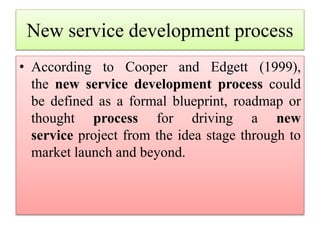
New service development process
• According to Cooper and Edgett (1999),
the new service development process could
be defined as a formal blueprint, roadmap or
thought process for driving a new
service project from the idea stage through to
market launch and beyond.
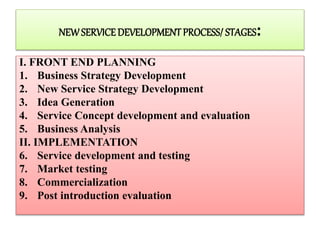
NEWSERVICEDEVELOPMENTPROCESS/ STAGES:
I. FRONT END PLANNING
1. Business Strategy Development
2. New Service Strategy Development
3. Idea Generation
4. Service Concept development and evaluation
5. Business Analysis
II. IMPLEMENTATION
6. Service development and testing
7. Market testing
8. Commercialization
9. Post introduction evaluation
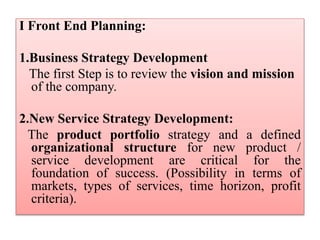
I Front End Planning:
1.Business Strategy Development
The first Step is to review the vision and mission
of the company.
2.New Service Strategy Development:
The product portfolio strategy and a defined
organizational structure for new product /
service development are critical for the
foundation of success. (Possibility in terms of
markets, types of services, time horizon, profit
criteria).
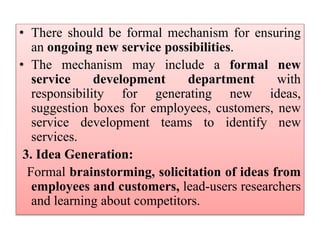
• There should be formal mechanism for ensuring
an ongoing new service possibilities.
• The mechanism may include a formal new
service development department with
responsibility for generating new ideas,
suggestion boxes for employees, customers, new
service development teams to identify new
services.
3. Idea Generation:
Formal brainstorming, solicitation of ideas from
employees and customers, lead-users researchers
and learning about competitors.
4.Service Concept development and evaluation:
After clear definition of the concept, it is important to
produce a description of the service that represents
its specific features and then to determine initial
customer and employee responses to the concept.
5. Business Analysis:
Assuming the service concept is favorably evaluated by
customers and employees at the concept development
stage, the next step is to determine its feasibility and
potential profit.
This stage will involve preliminary assumptions about
the costs of hiring and training personnel to determine
whether the new service idea meets the minimum
requirements.
II IMPLEMENTATION:
6. Service development and testing:
During this phase, the concept is refined to the point where
a detailed service blueprint representing the
implementation plan for the service can be produced.
7.Market testing:
• The new service may be offered to employees of the
organization and their families for a time to assess their
responses to variations in marketing mix.
• At this stage, pilot study has to be done for the service,
to be sure that the operational details are functioning
smoothly.
8. Commercialization:
• At this stage, the service introduced to the market place .
The first is to build and maintain acceptance of the new
service among large numbers of service delivery personnel
who will be responsibility day-to-day for service quality.
• To monitor all aspects of the service during introduction and
through the complete service cycle.
9. Post introduction evaluation:
At this stage, the information gathered during
commercialization of the service can be viewed and
changes made to the delivery process, staffing or
marketing –mix variables on the basis of actual offering to
the market response.
Service Blueprinting
• A service blueprint is a picture or map that
accurately portrays the service system so that
the different people can understand.
• It is useful at the design and redesign stages of
service development.
• It visually displays the service by
simultaneously depicting the process of service
delivery, the points of customer contact, the
roles of customers and employees.
BLUEPRINTING COMPONENTS
Line of interaction:
• It represents direct interactions between the customer and
the organization.
Ex: Initial interview, intermediate meetings.
Line of visibility:
• This line separates all service activities that are visible to
the customer from those that are not visible.
Line of internal interaction:
• It separates employee activities from those of other service
support activities and people.
BUILDING A BLUEPRINT
STEP -1
Blueprints can be developed at a variety of levels and there needs to
be agreement on the starting point. Identifying the process to be
mapped will be determined by the underlying purpose of building
the blueprint.
STEP-2
A common rationale for market segmentation is that each segments
needs are different and therefore will require variations in the
service features once any level of detail is reached, separate
blueprints should be developed to avoid confusion and maximize
their usefulness.
STEP-3
This step involves charting the choices and actions that the
customer experiences in purchasing, consuming and evaluating the
service.
STEP-4
In case of technology-delivered services, the required actions
of the technology interface will be mapped above the line of
visibility.
STEP-5:
Here the line of internal interaction can then be drawn and
linkages from contact activities to internal support
function can be identified.
STEP-6:
Finally, the evidence of service can be added to the
blueprint to illustrate what it is that the customer sees and
receives as tangible evidence of the service at each step in the
customer experience.
BENEFITS OF SERVICE BLUEPRINTING
1.It provides an overview of the service
2.It provides a basis for identifying and assessing
cost, revenue and capital invested in each
element of the service.
3.It facilitates top-down, bottom-up approach to
quality improvement.
SERVICE QUALITY
“The quality of service is the degree of conformance of all
the relevant features and characteristics of service to all
the aspects of customer needs limited by the price and
delivery he/she will accept.”
Quality may be judged from the following:
1) Design reflected through the relevant feature and
characteristics of service.
2) Satisfaction of customer needs
3) Production and delivery of service
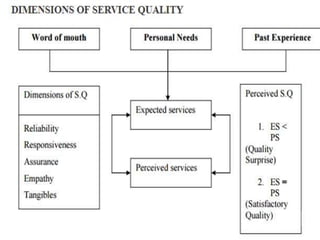
PRINCIPLES OF SERVICE QUALITY
• S.Q is more difficult for the consumer to evaluate
than the quality of goods.
• It is based on consumer perception.
• Service quality perception result from a
comparison of what the customer expected prior
to the service and the perceived level of service
received.
Service Scape
• Service scape is defined as the physical environment where a
service can take place. It helps to analyze and identify the impact of
a good environment on the service-based industry.
• Service scape deals in the settings where a service is consumed or
delivered and the place where both the company and customer
interactions with each other.
• It has a powerful impact on the assessment, perception, and response
of the customer.
• The important aspects of service scape are Spatial layout and
functionality, artwork, floor coverings, photographs on the wall,
color, noise, music, sound, lighting.
• The effect of the strong scent, for instance of coffee or cookies, act as
great tempting force and can easily draw people in.
Elements of service scape
Facility Exterior
• Landscape
• Exterior design
• Surrounding environment
• Parking
• Signage
Facility Interior
• Music
• Layout
• Equipment
• Air quality temperature
• Interior design
Others
• Virtual service scape
• Brochures
• Employee dress
• Billing Statements
• Web pages
• Reports
• Stationary
• Business cards
Types of service scape environment
The two types of service environment identified
on service scape are –
1. Lean service scape
• Designing this type of environment is
straightforward and includes fewer
interactions, elements, and spaces between
employees and customers.
• Some important examples are fast-food outlets,
vending machines.
2. Elaborate service scape
• Designing this type of service scape requires
teams that are skilled in their work and are
fully aware of the corporate vision and desired
outcome.
• The elaborate service scape includes multiple
spaces, elements, and interactions between
employees and customers.
• Some important examples include restaurants,
gym, swimming pool, bars, ocean liners,
and international hotels.
Functions of servicescape
The functions of service scape are as follows-
1. Image, differentiation, and positioning
• Service scape is an integral part of value
proposition and service experience as it can
attract attention very easily.
• It delivers leisure as well as a contact service,
for instance, in shopping malls, the staff and
the environment jointly makes an effort to
please its customers.
2. Facilitating service encounter and
increasing productivity
• Designing plays an important part in service
scape if you want to facilitate service
encounter and maximize productivity.
• Several shopping malls have included small
playhouse type of enclosures within its
innovative design so that mothers can avail the
services, keep their child over there, and
peacefully continue with their shopping.
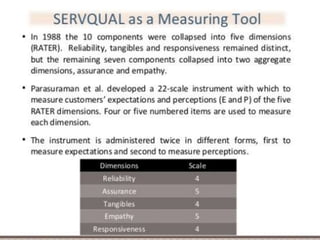
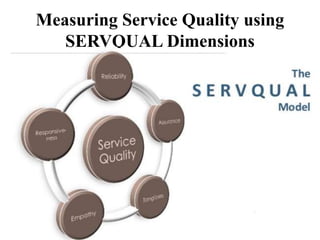
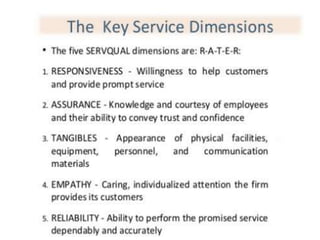
Measuring Service Quality using
SERVQUAL Dimensions
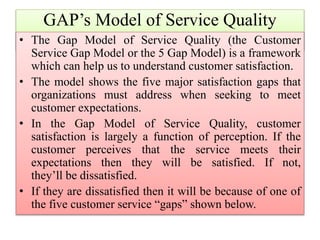
GAP’s Model of Service Quality
• The Gap Model of Service Quality (the Customer
Service Gap Model or the 5 Gap Model) is a framework
which can help us to understand customer satisfaction.
• The model shows the five major satisfaction gaps that
organizations must address when seeking to meet
customer expectations.
• In the Gap Model of Service Quality, customer
satisfaction is largely a function of perception. If the
customer perceives that the service meets their
expectations then they will be satisfied. If not,
they’ll be dissatisfied.
• If they are dissatisfied then it will be because of one of
the five customer service “gaps” shown below.
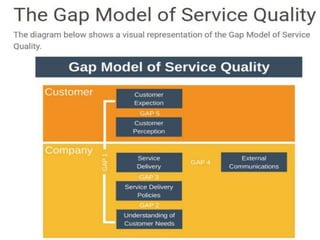
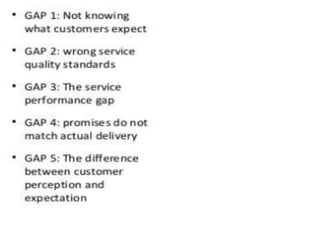
Gap 1: Knowledge Gap
• The knowledge gap is the difference between the
customer’s expectations of the service and the
company’s provision of that service.
• Essentially, this gap arises because management
doesn’t know exactly what customers expect.
There are a number of reasons this could happen,
including:
»Lack of management and customer interaction.
»Lack of communication between service
employees and management.
»Insufficient market research.
»Failure to listen to customer complaints.
Gap 2: The Policy Gap
• The policy gap is the difference between
management’s understanding of the customer
needs and the translation of that
understanding into service delivery policies
and standards.
• There are a number of reasons why this gap can
occur:
»Lack of customer service standards.
Poorly defined service levels.
»Failure to regularly update service level standards.
• This gap causes customers to seek a similar
service elsewhere but with better service.
Gap 3: The Delivery Gap
• The delivery gap is the difference between
service delivery policies and standards and
the actual delivery of the service.
• This gap can occur for a number of reasons:
»Deficiencies in human resources policies.
»Failure to match supply to demand.
»Employee lack of knowledge of the product.
»Lack of cohesive teamwork to deliver the
product or service.
Gap 4: The Communication Gap
• The communication gap is the gap between what gets
promised to customers through advertising and
what gets delivered.
• Again. there are a number of reasons why this can
happen:
»Overpromising.
»Viewing external communications as separate to what’s
going on internally.
»Insufficient communications between the operations and
advertising teams.
• Communication gaps lead to customer dissatisfaction.
This happens because what they receive isn’t what
they were promised. In the worst case, it may cause
them to turn to an alternative supplier.
Gap 5: The Customer Gap
• The customer gap is the difference between customer
expectations and customer perceptions.
• This gap occurs because customers do not always
understand what the service has done for them or they
misinterpret the service quality.
• Many organizations can be completely blind to this gap.
This gap can happen because of one of the other four
gaps, or simply because the customer perceives the
quality of the service incorrectly.
• In a worst-case scenario, it could lead to a business
losing a large proportion of their customers overnight.
• Although the company thought there was no gap, the
reality was that their customers were just waiting for
someone to fill their perceived gap.
• According to the Gap Model of Service
Quality, the only way to close the customer
gap is to close the other 4 gaps in the model.
• There is no way for the company to directly
close this gap.
Quality Function Deployment
• Quality Function Deployment, or QFD, is a
model for product development and production
popularized in Japan in the 1960’s.
• The model aids in translating customer needs
and expectations into technical requirements
by listening to the voice of customer.
• Once information about customer expectations has been
obtained, techniques such as quality function
deployment can be used to link the voice of
customer directly to internal processes.
• QFD is not only a quality tool but also an important
planning tool. It allows the consideration of the “voice
of the customer” along the service development path to
market entry.
Definition
• “Quality Function Deployment is a system with the
purpose of translating and planning the voice of
customer into the quality characteristics of products,
processes and services for reaching customer
satisfaction”
Benefits of QFD
• Quality Function Deployment is a powerful prioritization
tool that combines several different types of matrices into
one to form a house-like structure.
• Quality Function Deployment is a customer-driven
process for planning products and services.
• It starts with the voice of the customer, which becomes the
basis for setting requirements.
• Quality Function Deployment provides documentation for
the decision-making process.
• QFD helps you to:
– Translate customer requirements into specific offering
specifications
– Prioritize possible offering specifications and make trade-off
decisions based on weighted customer requirements and ranked
competitive assessment
QFD House of Quality Matrices
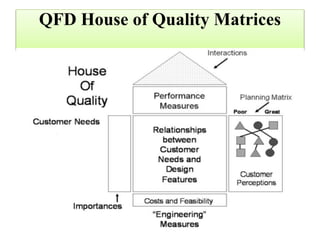
• The What or Wants: Customer requirements, needs,
and priorities that form the far left-wing of the house
• The Competitive Assessment: Compares customer
priorities with appropriate marketplace offerings, across
key competitive deployments, which forms the right-
wing annex of the house
• The How: The offering’s technical design features,
functionality, and characteristics to meet the customer
requirements. This forms the attic of the house
• The Design Relationships: Describes the
interrelationship between the design features, which
form the roof of the house
• The Foundation: Uses benchmarked target values as
objective measurements to evaluate each characteristic,
forming the basement of the house
Quality Function Deployment Process
1.Product Planning QFD. It helps identify
service offerings characteristics, that best meet
customer requirements, helps analyze
competitive opportunities, and establishes
critical target values too.
2.Component Deployment QFD. It helps
identify the critical parts and assembly
components using the prioritized offering
characteristics in QFD 1 and establishes
critical target values.
3.Process Planning QFD. It helps determine
critical process operational requirements and
elements using the prioritized components in
QFD 2 and establishes critical process parameters
4.Quality Control QFD. It helps prioritize the
process control methods and parameters and
establishes production and inspection methods
that best support the prioritized process elements
of QFD 3

SERVICES MARKETING

  • 1.
    SERVICE DESIGN ANDDEVELOPMENT UNIT 3 DR.SELVAMOHANA.K
  • 2.
    • New ServiceDevelopment • Service Blue Printing • Service Scape • GAP’s Model of Service Quality • Measuring Service Quality using SERVQUAL Dimensions • Quality Function Deployment
  • 3.
    New Service Development •New Service development (NSD) covers the complete process of bringing a new service to market, renewing an existing service or introducing a service in a new market. • A central aspect of NSD is service design, along with various business considerations. New service development is described broadly as the transformation of a market opportunity into a service available for sale. • The services developed by an organisation provide the means for it to generate income.
  • 4.
    New Service Characteristics Sinceservices are intangible, it has to have 4 basic characteristics: 1.It must be objective, not subjective 2.It must be precise, not vague. 3.It must be fact driven, not opinion driven. 4.It must be methodological, not philosophical.
  • 5.
    New service developmentprocess • According to Cooper and Edgett (1999), the new service development process could be defined as a formal blueprint, roadmap or thought process for driving a new service project from the idea stage through to market launch and beyond.
  • 6.
    NEWSERVICEDEVELOPMENTPROCESS/ STAGES: I. FRONTEND PLANNING 1. Business Strategy Development 2. New Service Strategy Development 3. Idea Generation 4. Service Concept development and evaluation 5. Business Analysis II. IMPLEMENTATION 6. Service development and testing 7. Market testing 8. Commercialization 9. Post introduction evaluation
  • 7.
    I Front EndPlanning: 1.Business Strategy Development The first Step is to review the vision and mission of the company. 2.New Service Strategy Development: The product portfolio strategy and a defined organizational structure for new product / service development are critical for the foundation of success. (Possibility in terms of markets, types of services, time horizon, profit criteria).
  • 8.
    • There shouldbe formal mechanism for ensuring an ongoing new service possibilities. • The mechanism may include a formal new service development department with responsibility for generating new ideas, suggestion boxes for employees, customers, new service development teams to identify new services. 3. Idea Generation: Formal brainstorming, solicitation of ideas from employees and customers, lead-users researchers and learning about competitors.
  • 9.
    4.Service Concept developmentand evaluation: After clear definition of the concept, it is important to produce a description of the service that represents its specific features and then to determine initial customer and employee responses to the concept. 5. Business Analysis: Assuming the service concept is favorably evaluated by customers and employees at the concept development stage, the next step is to determine its feasibility and potential profit. This stage will involve preliminary assumptions about the costs of hiring and training personnel to determine whether the new service idea meets the minimum requirements.
  • 10.
    II IMPLEMENTATION: 6. Servicedevelopment and testing: During this phase, the concept is refined to the point where a detailed service blueprint representing the implementation plan for the service can be produced. 7.Market testing: • The new service may be offered to employees of the organization and their families for a time to assess their responses to variations in marketing mix. • At this stage, pilot study has to be done for the service, to be sure that the operational details are functioning smoothly.
  • 11.
    8. Commercialization: • Atthis stage, the service introduced to the market place . The first is to build and maintain acceptance of the new service among large numbers of service delivery personnel who will be responsibility day-to-day for service quality. • To monitor all aspects of the service during introduction and through the complete service cycle. 9. Post introduction evaluation: At this stage, the information gathered during commercialization of the service can be viewed and changes made to the delivery process, staffing or marketing –mix variables on the basis of actual offering to the market response.
  • 12.
    Service Blueprinting • Aservice blueprint is a picture or map that accurately portrays the service system so that the different people can understand. • It is useful at the design and redesign stages of service development. • It visually displays the service by simultaneously depicting the process of service delivery, the points of customer contact, the roles of customers and employees.
  • 13.
    BLUEPRINTING COMPONENTS Line ofinteraction: • It represents direct interactions between the customer and the organization. Ex: Initial interview, intermediate meetings. Line of visibility: • This line separates all service activities that are visible to the customer from those that are not visible. Line of internal interaction: • It separates employee activities from those of other service support activities and people.
  • 14.
    BUILDING A BLUEPRINT STEP-1 Blueprints can be developed at a variety of levels and there needs to be agreement on the starting point. Identifying the process to be mapped will be determined by the underlying purpose of building the blueprint. STEP-2 A common rationale for market segmentation is that each segments needs are different and therefore will require variations in the service features once any level of detail is reached, separate blueprints should be developed to avoid confusion and maximize their usefulness. STEP-3 This step involves charting the choices and actions that the customer experiences in purchasing, consuming and evaluating the service.
  • 15.
    STEP-4 In case oftechnology-delivered services, the required actions of the technology interface will be mapped above the line of visibility. STEP-5: Here the line of internal interaction can then be drawn and linkages from contact activities to internal support function can be identified. STEP-6: Finally, the evidence of service can be added to the blueprint to illustrate what it is that the customer sees and receives as tangible evidence of the service at each step in the customer experience.
  • 16.
    BENEFITS OF SERVICEBLUEPRINTING 1.It provides an overview of the service 2.It provides a basis for identifying and assessing cost, revenue and capital invested in each element of the service. 3.It facilitates top-down, bottom-up approach to quality improvement.
  • 17.
    SERVICE QUALITY “The qualityof service is the degree of conformance of all the relevant features and characteristics of service to all the aspects of customer needs limited by the price and delivery he/she will accept.” Quality may be judged from the following: 1) Design reflected through the relevant feature and characteristics of service. 2) Satisfaction of customer needs 3) Production and delivery of service
  • 18.
    PRINCIPLES OF SERVICEQUALITY • S.Q is more difficult for the consumer to evaluate than the quality of goods. • It is based on consumer perception. • Service quality perception result from a comparison of what the customer expected prior to the service and the perceived level of service received.
  • 20.
    Service Scape • Servicescape is defined as the physical environment where a service can take place. It helps to analyze and identify the impact of a good environment on the service-based industry. • Service scape deals in the settings where a service is consumed or delivered and the place where both the company and customer interactions with each other. • It has a powerful impact on the assessment, perception, and response of the customer. • The important aspects of service scape are Spatial layout and functionality, artwork, floor coverings, photographs on the wall, color, noise, music, sound, lighting. • The effect of the strong scent, for instance of coffee or cookies, act as great tempting force and can easily draw people in.
  • 21.
    Elements of servicescape Facility Exterior • Landscape • Exterior design • Surrounding environment • Parking • Signage Facility Interior • Music • Layout • Equipment • Air quality temperature • Interior design
  • 22.
    Others • Virtual servicescape • Brochures • Employee dress • Billing Statements • Web pages • Reports • Stationary • Business cards
  • 23.
    Types of servicescape environment The two types of service environment identified on service scape are – 1. Lean service scape • Designing this type of environment is straightforward and includes fewer interactions, elements, and spaces between employees and customers. • Some important examples are fast-food outlets, vending machines.
  • 24.
    2. Elaborate servicescape • Designing this type of service scape requires teams that are skilled in their work and are fully aware of the corporate vision and desired outcome. • The elaborate service scape includes multiple spaces, elements, and interactions between employees and customers. • Some important examples include restaurants, gym, swimming pool, bars, ocean liners, and international hotels.
  • 25.
    Functions of servicescape Thefunctions of service scape are as follows- 1. Image, differentiation, and positioning • Service scape is an integral part of value proposition and service experience as it can attract attention very easily. • It delivers leisure as well as a contact service, for instance, in shopping malls, the staff and the environment jointly makes an effort to please its customers.
  • 26.
    2. Facilitating serviceencounter and increasing productivity • Designing plays an important part in service scape if you want to facilitate service encounter and maximize productivity. • Several shopping malls have included small playhouse type of enclosures within its innovative design so that mothers can avail the services, keep their child over there, and peacefully continue with their shopping.
  • 29.
    Measuring Service Qualityusing SERVQUAL Dimensions
  • 31.
    GAP’s Model ofService Quality • The Gap Model of Service Quality (the Customer Service Gap Model or the 5 Gap Model) is a framework which can help us to understand customer satisfaction. • The model shows the five major satisfaction gaps that organizations must address when seeking to meet customer expectations. • In the Gap Model of Service Quality, customer satisfaction is largely a function of perception. If the customer perceives that the service meets their expectations then they will be satisfied. If not, they’ll be dissatisfied. • If they are dissatisfied then it will be because of one of the five customer service “gaps” shown below.
  • 33.
    Gap 1: KnowledgeGap • The knowledge gap is the difference between the customer’s expectations of the service and the company’s provision of that service. • Essentially, this gap arises because management doesn’t know exactly what customers expect. There are a number of reasons this could happen, including: »Lack of management and customer interaction. »Lack of communication between service employees and management. »Insufficient market research. »Failure to listen to customer complaints.
  • 34.
    Gap 2: ThePolicy Gap • The policy gap is the difference between management’s understanding of the customer needs and the translation of that understanding into service delivery policies and standards. • There are a number of reasons why this gap can occur: »Lack of customer service standards. Poorly defined service levels. »Failure to regularly update service level standards. • This gap causes customers to seek a similar service elsewhere but with better service.
  • 35.
    Gap 3: TheDelivery Gap • The delivery gap is the difference between service delivery policies and standards and the actual delivery of the service. • This gap can occur for a number of reasons: »Deficiencies in human resources policies. »Failure to match supply to demand. »Employee lack of knowledge of the product. »Lack of cohesive teamwork to deliver the product or service.
  • 36.
    Gap 4: TheCommunication Gap • The communication gap is the gap between what gets promised to customers through advertising and what gets delivered. • Again. there are a number of reasons why this can happen: »Overpromising. »Viewing external communications as separate to what’s going on internally. »Insufficient communications between the operations and advertising teams. • Communication gaps lead to customer dissatisfaction. This happens because what they receive isn’t what they were promised. In the worst case, it may cause them to turn to an alternative supplier.
  • 37.
    Gap 5: TheCustomer Gap • The customer gap is the difference between customer expectations and customer perceptions. • This gap occurs because customers do not always understand what the service has done for them or they misinterpret the service quality. • Many organizations can be completely blind to this gap. This gap can happen because of one of the other four gaps, or simply because the customer perceives the quality of the service incorrectly. • In a worst-case scenario, it could lead to a business losing a large proportion of their customers overnight. • Although the company thought there was no gap, the reality was that their customers were just waiting for someone to fill their perceived gap.
  • 38.
    • According tothe Gap Model of Service Quality, the only way to close the customer gap is to close the other 4 gaps in the model. • There is no way for the company to directly close this gap.
  • 40.
    Quality Function Deployment •Quality Function Deployment, or QFD, is a model for product development and production popularized in Japan in the 1960’s. • The model aids in translating customer needs and expectations into technical requirements by listening to the voice of customer.
  • 41.
    • Once informationabout customer expectations has been obtained, techniques such as quality function deployment can be used to link the voice of customer directly to internal processes. • QFD is not only a quality tool but also an important planning tool. It allows the consideration of the “voice of the customer” along the service development path to market entry. Definition • “Quality Function Deployment is a system with the purpose of translating and planning the voice of customer into the quality characteristics of products, processes and services for reaching customer satisfaction”
  • 42.
    Benefits of QFD •Quality Function Deployment is a powerful prioritization tool that combines several different types of matrices into one to form a house-like structure. • Quality Function Deployment is a customer-driven process for planning products and services. • It starts with the voice of the customer, which becomes the basis for setting requirements. • Quality Function Deployment provides documentation for the decision-making process. • QFD helps you to: – Translate customer requirements into specific offering specifications – Prioritize possible offering specifications and make trade-off decisions based on weighted customer requirements and ranked competitive assessment
  • 43.
    QFD House ofQuality Matrices
  • 44.
    • The Whator Wants: Customer requirements, needs, and priorities that form the far left-wing of the house • The Competitive Assessment: Compares customer priorities with appropriate marketplace offerings, across key competitive deployments, which forms the right- wing annex of the house • The How: The offering’s technical design features, functionality, and characteristics to meet the customer requirements. This forms the attic of the house • The Design Relationships: Describes the interrelationship between the design features, which form the roof of the house • The Foundation: Uses benchmarked target values as objective measurements to evaluate each characteristic, forming the basement of the house
  • 45.
    Quality Function DeploymentProcess 1.Product Planning QFD. It helps identify service offerings characteristics, that best meet customer requirements, helps analyze competitive opportunities, and establishes critical target values too. 2.Component Deployment QFD. It helps identify the critical parts and assembly components using the prioritized offering characteristics in QFD 1 and establishes critical target values.
  • 46.
    3.Process Planning QFD.It helps determine critical process operational requirements and elements using the prioritized components in QFD 2 and establishes critical process parameters 4.Quality Control QFD. It helps prioritize the process control methods and parameters and establishes production and inspection methods that best support the prioritized process elements of QFD 3