New International  Guidelines  on Cardiopulmonary Resuscitation Last update dec 2005 CPR
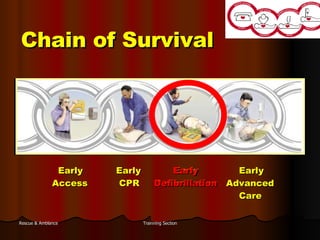
Chain of Survival Early   Early  Early   Early    Access   CPR  Defibrillation  Advanced     Care Early Defibrillation
For each minute that CPR & defibrillation is delayed Survival is reduced by 7 to 10%
Causes of circulation arrest Cardiac Ischemic heart disease (myocardial infarction,) Arrhythmias of different origin and character Electrolytic disorders Valvular disease Cardiac tamponade Ruptured aneurysm of aorta Extra-cardiac airway obstruction acute respiratory failure shock drug overdose electrocution poisoning
The goal of CPR is to produce the best     Coronary Perfusion Pressure   (CPP) Cardiac arrest  survival  is dependent upon: Early CPR. CPR performed  properly . Importance of CPR
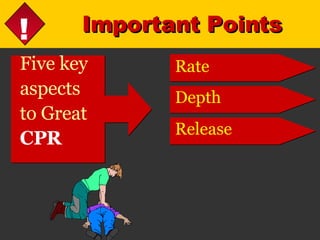
Important Points Five key aspects to Great  CPR ! Rate Depth Release
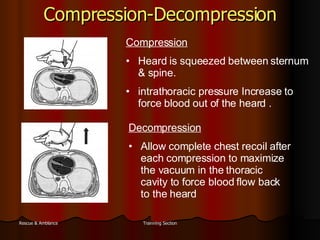
Compression-Decompression Compression Heard is squeezed between sternum & spine. intrathoracic pressure Increase to force blood out of the heard . Decompression Allow complete chest recoil after each compression to maximize the vacuum in the thoracic cavity to force blood flow back to the heard
Important Points Five key aspects to Great  CPR ! Rate Depth Release Ventilation
Ventilation: Inspiration phase of no more than 1 second. New Guidelines for Ventilation
Important Points Five key aspects to Great  CPR ! Rate Depth Release Uninterrupted Ventilation
Important Points CPR “protocols” scripted to  minimize hands-off time ! Initial assessment Reducing  Pulse   Checks
CPR  PROTOCOL
Check the victim for a response ( AVPU ). Is person unresponsive? Are you  okay? ACTIVATE  EMS  CALL 999
Head tilt and chin lift Open the airway &  Maintain the airway open
Look listen and feel for normal breathing & LOOK FOR SIGS OF LIFE . Check for breathing
START CHEST COMPRESSION push hard and push   fast 30 / 2 If no signs of life are present
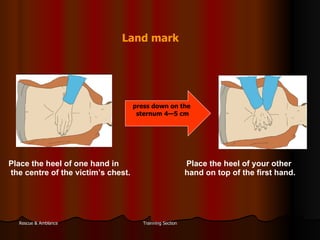
Place the heel of one hand in the centre of the victim’s chest. Place the heel of your other  hand on top of the first hand. press down on the sternum 4—5 cm Land mark
For one  rescuer  : After 30 compressions open the airway again using head tilt and chin lift  give two breaths while watching the chest rise  . For two rescuers  :  Rotate compressors every 2–3 minutes to minimize fatigue.
Main changes in adult CPR  The decision to start CPR is made if a victim is unresponsive and not breathing normally. Rescuers should place their hands on the center of the chest , rather than to spend more time using the ‘rib margin’ technique. Each rescue breath is given over 1 sec rather than 2 sec  The ratio of compressions to ventilations is 30\2 . Minimize interruptions in chest compressions. Rotate compressors every 2–3 minutes to minimize fatigue.
CHILD CPR
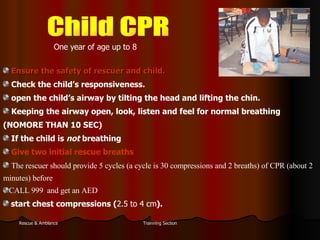
Ensure the safety of rescuer and child. Check the child’s responsiveness. open the child’s airway by tilting the head and lifting the chin. Keeping the airway open, look, listen and feel for normal breathing (NOMORE THAN 10 SEC) If the child is  not  breathing   Give two initial rescue breaths The rescuer should provide 5 cycles (a cycle is 30 compressions and 2 breaths) of CPR (about 2 minutes) before CALL 999  and get an AED start chest compressions ( 2.5 to 4 cm ). Child CPR  One year of age up to 8
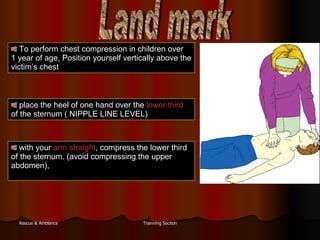
To perform chest compression in children over 1 year of age, Position yourself vertically above the victim’s chest with your  arm straight , compress the lower third of the sternum. (avoid compressing the upper abdomen), place the heel of one hand over the  lower third  of the sternum ( NIPPLE LINE LEVEL) Land mark
Infant CPR
Ensure the safety of rescuer and infant . Check the LOC. open the infant’s airway  by tilting on the patient’s ear-side angle of the jaw & tiding the head back ( do not hyperextend the neck ) Keeping the airway open, look, listen and feel for normal breathing (NOMORE THAN 10 SEC) If the infant  is  not  breathing   Give two initial rescue breaths The rescuer should provide 5 cycles (a cycle is 30 compressions and 2 breaths) of CPR (about 2 minutes) CALL 999  and  start chest compressions  (1 to 2.5 cm)(100\min). Infant CPR
Just below nipple line Compress the sternum with two fingers (One rescuer) 30\2 Just below nipple line Land mark
Patient Symptoms when in  Ventricular Fibrillation Unconscious No Breathing No Signs ol life  Resulting in… No Oxygen to the Brain or Body Organs
What does a defibrillator do ? The AED is programmed to analyze the heart’s electrical activity, and decide whether the electrical shock would help. It then builds up an electric charge and deliver to the patient when you push the button.
AED Don'ts  Don’t use the AED to monitor PTs who are awake or have a pulse  Don’t attach the AED to PTs in anticipation of arrest. Don’t defibrillate the PTs when both the PT and the defibrillator are in contact with metal or water . Don’t analyze with the AED while chest compression are in progress.
Electrode placement  Remove electrodes from package (check expiry date). Apply to PT :superior right chest  left lower lateral side of chest Wet PTs should be toweled dry. Hairy chest may need shaving. Can be use with pacemaker, electrode on right side should be beneath pacemaker.
CPR   (only)  ………………………  0-2% EMS/ER   ……………………  5-15% CPR + AED ……..  30 - 75% Sudden Death Reversal Rates
Don’t Touch Patient During Analysis Except for pulse check.  WARNING! Start chest compressions for 2 minutes immediately  after defibrillation. Without pulse check
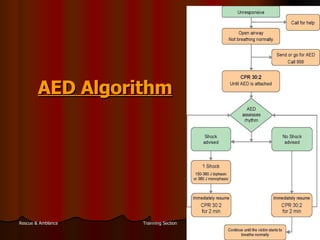
AED Changes Immediately  resume CPR for 2 minutes , no rhythm, breathing or pulse check( Compressions do not cause harm if there is a rhythm ). With past guideline AED’s there was a hands off delay of 29-37 seconds between first shock and first compression.
AED Algorithm
Thank You

New Guidelines On Cpr

  • 1.
    New International Guidelines on Cardiopulmonary Resuscitation Last update dec 2005 CPR
  • 2.
    Chain of SurvivalEarly Early Early Early Access CPR Defibrillation Advanced Care Early Defibrillation
  • 3.
    For each minutethat CPR & defibrillation is delayed Survival is reduced by 7 to 10%
  • 4.
    Causes of circulationarrest Cardiac Ischemic heart disease (myocardial infarction,) Arrhythmias of different origin and character Electrolytic disorders Valvular disease Cardiac tamponade Ruptured aneurysm of aorta Extra-cardiac airway obstruction acute respiratory failure shock drug overdose electrocution poisoning
  • 5.
    The goal ofCPR is to produce the best Coronary Perfusion Pressure (CPP) Cardiac arrest survival is dependent upon: Early CPR. CPR performed properly . Importance of CPR
  • 6.
    Important Points Fivekey aspects to Great CPR ! Rate Depth Release
  • 7.
    Compression-Decompression Compression Heardis squeezed between sternum & spine. intrathoracic pressure Increase to force blood out of the heard . Decompression Allow complete chest recoil after each compression to maximize the vacuum in the thoracic cavity to force blood flow back to the heard
  • 8.
    Important Points Fivekey aspects to Great CPR ! Rate Depth Release Ventilation
  • 9.
    Ventilation: Inspiration phaseof no more than 1 second. New Guidelines for Ventilation
  • 10.
    Important Points Fivekey aspects to Great CPR ! Rate Depth Release Uninterrupted Ventilation
  • 11.
    Important Points CPR“protocols” scripted to minimize hands-off time ! Initial assessment Reducing Pulse Checks
  • 12.
  • 13.
    Check the victimfor a response ( AVPU ). Is person unresponsive? Are you okay? ACTIVATE EMS CALL 999
  • 14.
    Head tilt andchin lift Open the airway & Maintain the airway open
  • 15.
    Look listen andfeel for normal breathing & LOOK FOR SIGS OF LIFE . Check for breathing
  • 16.
    START CHEST COMPRESSIONpush hard and push fast 30 / 2 If no signs of life are present
  • 17.
    Place the heelof one hand in the centre of the victim’s chest. Place the heel of your other hand on top of the first hand. press down on the sternum 4—5 cm Land mark
  • 18.
    For one rescuer : After 30 compressions open the airway again using head tilt and chin lift give two breaths while watching the chest rise . For two rescuers : Rotate compressors every 2–3 minutes to minimize fatigue.
  • 19.
    Main changes inadult CPR The decision to start CPR is made if a victim is unresponsive and not breathing normally. Rescuers should place their hands on the center of the chest , rather than to spend more time using the ‘rib margin’ technique. Each rescue breath is given over 1 sec rather than 2 sec The ratio of compressions to ventilations is 30\2 . Minimize interruptions in chest compressions. Rotate compressors every 2–3 minutes to minimize fatigue.
  • 20.
  • 21.
    Ensure the safetyof rescuer and child. Check the child’s responsiveness. open the child’s airway by tilting the head and lifting the chin. Keeping the airway open, look, listen and feel for normal breathing (NOMORE THAN 10 SEC) If the child is not breathing Give two initial rescue breaths The rescuer should provide 5 cycles (a cycle is 30 compressions and 2 breaths) of CPR (about 2 minutes) before CALL 999 and get an AED start chest compressions ( 2.5 to 4 cm ). Child CPR One year of age up to 8
  • 22.
    To perform chestcompression in children over 1 year of age, Position yourself vertically above the victim’s chest with your arm straight , compress the lower third of the sternum. (avoid compressing the upper abdomen), place the heel of one hand over the lower third of the sternum ( NIPPLE LINE LEVEL) Land mark
  • 23.
  • 24.
    Ensure the safetyof rescuer and infant . Check the LOC. open the infant’s airway by tilting on the patient’s ear-side angle of the jaw & tiding the head back ( do not hyperextend the neck ) Keeping the airway open, look, listen and feel for normal breathing (NOMORE THAN 10 SEC) If the infant is not breathing Give two initial rescue breaths The rescuer should provide 5 cycles (a cycle is 30 compressions and 2 breaths) of CPR (about 2 minutes) CALL 999 and start chest compressions (1 to 2.5 cm)(100\min). Infant CPR
  • 25.
    Just below nippleline Compress the sternum with two fingers (One rescuer) 30\2 Just below nipple line Land mark
  • 26.
    Patient Symptoms whenin Ventricular Fibrillation Unconscious No Breathing No Signs ol life Resulting in… No Oxygen to the Brain or Body Organs
  • 27.
    What does adefibrillator do ? The AED is programmed to analyze the heart’s electrical activity, and decide whether the electrical shock would help. It then builds up an electric charge and deliver to the patient when you push the button.
  • 28.
    AED Don'ts Don’t use the AED to monitor PTs who are awake or have a pulse Don’t attach the AED to PTs in anticipation of arrest. Don’t defibrillate the PTs when both the PT and the defibrillator are in contact with metal or water . Don’t analyze with the AED while chest compression are in progress.
  • 29.
    Electrode placement Remove electrodes from package (check expiry date). Apply to PT :superior right chest left lower lateral side of chest Wet PTs should be toweled dry. Hairy chest may need shaving. Can be use with pacemaker, electrode on right side should be beneath pacemaker.
  • 30.
    CPR (only) ……………………… 0-2% EMS/ER …………………… 5-15% CPR + AED …….. 30 - 75% Sudden Death Reversal Rates
  • 31.
    Don’t Touch PatientDuring Analysis Except for pulse check. WARNING! Start chest compressions for 2 minutes immediately after defibrillation. Without pulse check
  • 32.
    AED Changes Immediately resume CPR for 2 minutes , no rhythm, breathing or pulse check( Compressions do not cause harm if there is a rhythm ). With past guideline AED’s there was a hands off delay of 29-37 seconds between first shock and first compression.
  • 33.
  • 34.

Editor's Notes

  • #2 Why Change? 80% of cardiac arrests occur out with hospital setting. Number of compressions may be most important factor Chest compressions provide circulatory support during cardiac arrest Studies show that number, rate and quality of chest compressions are usually far from optimal