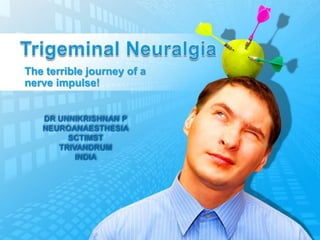
The terrible journey of a
nerve impulse!


   DR UNNIKRISHNAN P
   NEUROANAESTHESIA
        SCTIMST
      TRIVANDRUM
          INDIA
Demotivating , demoralizing..


one of the most painful neuropathic pains

IASP definition: Sudden, recurrent, severe pain in the
distribution of one or more branches of the fifth cranial nerve

no universal treatment is capable of reverting completely

impairment of daily functionality, reduced quality of life and
depression

overwhelming fear that pain can suddenly return again
Peculiar neuropathic pain


not accompanied by sensory deficit

Can be cured by a small nerve or root lesion

Cause ? Now… sound hypothesis of neurovascular conflict
(NVC)      [ Are we still hearing sounds of conflict? ]

tic douloureux = since painful brief muscle spasms
EPIDEMIOLOGY


3-5/ one lac; 52- 69 years most common
More recent estimates suggest the prevalence is
approximately 1.5 cases per 10,000 population, with an
incidence of approximately 15,000 cases per year
Multiple sclerosis is found to be a risk factor; ?HTN

                                     I‟m also having..[youngest 12m]
     3.4/lac          5.9/lac
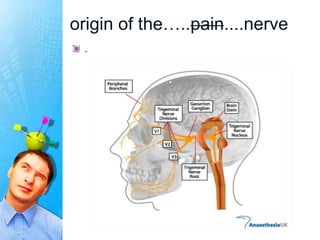
Anatomy - whereabouts
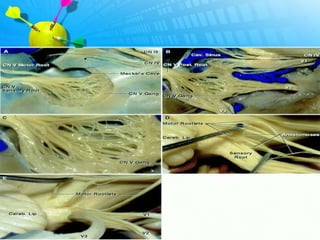
• Emerge as a larger sensory and smaller motor root
• Fibres in sensory root are axons of cells in
  trigeminal ganglion which occupies Meckels cave
• Neurons of the unipolar cells of the ganglion
  divides into central and peripheral processes
• Peripheral ophthalmic,maxillary and sensory part
  of mandibular
• Central fibres of the sensory root
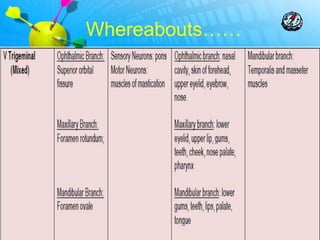
Whereabouts……
origin of the…..pain....nerve
 .
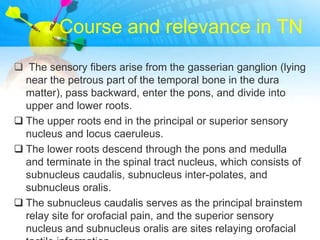
Course and relevance in TN
 The sensory fibers arise from the gasserian ganglion (lying
  near the petrous part of the temporal bone in the dura
  matter), pass backward, enter the pons, and divide into
  upper and lower roots.
 The upper roots end in the principal or superior sensory
  nucleus and locus caeruleus.
 The lower roots descend through the pons and medulla
  and terminate in the spinal tract nucleus, which consists of
  subnucleus caudalis, subnucleus inter-polates, and
  subnucleus oralis.
 The subnucleus caudalis serves as the principal brainstem
  relay site for orofacial pain, and the superior sensory
  nucleus and subnucleus oralis are sites relaying orofacial
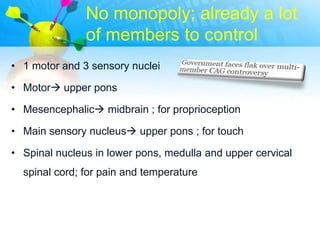
No monopoly; already a lot
               of members to control
• 1 motor and 3 sensory nuclei

• Motor upper pons

• Mesencephalic midbrain ; for proprioception

• Main sensory nucleus upper pons ; for touch

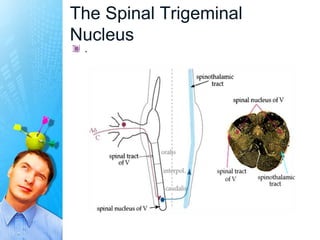
• Spinal nucleus in lower pons, medulla and upper cervical
  spinal cord; for pain and temperature
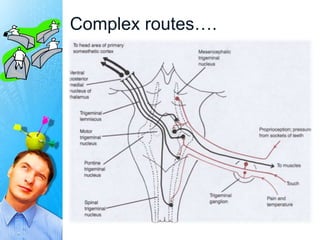
Complex routes….
 .
The Spinal Trigeminal
Nucleus
 .
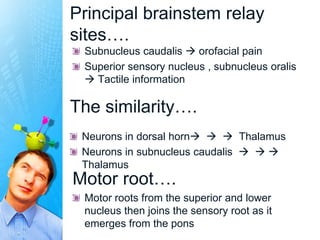
Principal brainstem relay
sites….
 Subnucleus caudalis  orofacial pain
 Superior sensory nucleus , subnucleus oralis
  Tactile information

The similarity….
 Neurons in dorsal horn   Thalamus
 Neurons in subnucleus caudalis   
 Thalamus
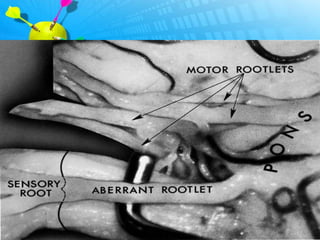
Motor root….
 Motor roots from the superior and lower
 nucleus then joins the sensory root as it
 emerges from the pons
Eagerly waiting for chaos..
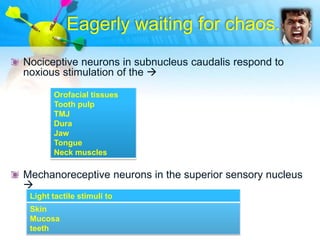
Nociceptive neurons in subnucleus caudalis respond to
noxious stimulation of the 

       Orofacial tissues
       Tooth pulp
       TMJ
       Dura
       Jaw
       Tongue
       Neck muscles

Mechanoreceptive neurons in the superior sensory nucleus

 Light tactile stimuli to
 Skin
 Mucosa
 teeth
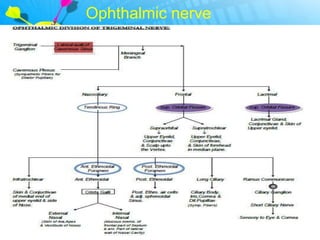
Ophthalmic nerve
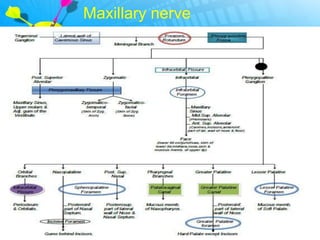
Maxillary nerve
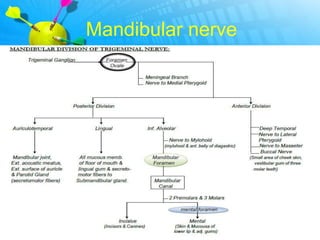
Mandibular nerve
ETIOLOGY AND
          PATHOPHYSIOLOGY
“Pain is temporary. Quitting lasts forever”…Lance Armstrong

His quotes also are loosing integrity...???
Central vs Peripheral

Central theories emphasize the role of deafferentation
(secondary to compression of the trigeminal roots or
ganglion) in the genesis of neural hyperactivity.

Peripheral theories note that changes in peripheral axons
and myelin may lead to altered nerve sensitivity to chemical
and mechanical stimuli.

Starts as a peripheral lesion; response of central synapses
to this sets stage for the war; SO BOTH MECHANISMS
PLAY
Painful and annoying
                      conflict…

In 85%, no structural lesion is seen

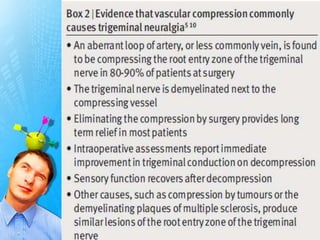
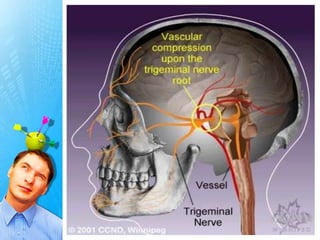
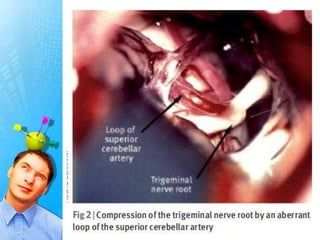
Classic [idiopathic] form: “Neurovascular conflict” i.e.
vascular compression of nerve most commonly @ its entry
into pons [REZ]

Significant NVC= an artery (not a vein), crossing (not
parallel to) the nerve and provoking displacement/grooving
of it (Casselman,2000)
Amplifying….

compression results in focal trigeminal nerve demyelination

leads to ephaptic transmission [action potentials jump from
one fiber to another]

A lack of inhibitory inputs from large myelinated nerve fibers
plays a role.

a reentry mechanism causes an amplification of sensory
inputs
Print master
 Your Text here
Two types....One feature..

Trigeminal neuralgia is divided into classic [idiopathic] and
symptomatic types
The classic form includes the cases that are due to a normal
artery present in contact with the nerve, such as the SCA or
even a primitive trigeminal artery
Symptomatic forms can have multiple origins: Aneurysms,
tumors, chronic meningeal inflammation.An abnormal
vascular course of the superior cerebellar artery is often
cited as the cause
Uncommonly, an area of demyelination from multiple
sclerosis may be the precipitant
ETIOLOGY

• compression of nerve root [most common-vascular; rarely
  tumor/vein/avm] usually when pain @ v2 / v3, compression
  is by SCA ; pain @ v1  by AICA
• Inflammatory causes: multiple sclerosis [in1-5% of patients
  with MS;more likely if patient with TN is 20-40ys] ; Damage
  to myelin sheath [Myelin gone….signals blend….nerves
  may sense light touch as pain!!!!!] ), sarcoidosis, and Lyme
  disease neuropathy
• traumatic accidents
• unsuccessful dental work
ETIOLOGY

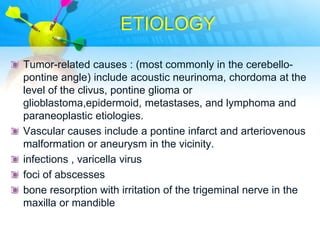
Tumor-related causes : (most commonly in the cerebello-
pontine angle) include acoustic neurinoma, chordoma at the
level of the clivus, pontine glioma or
glioblastoma,epidermoid, metastases, and lymphoma and
paraneoplastic etiologies.
Vascular causes include a pontine infarct and arteriovenous
malformation or aneurysm in the vicinity.
infections , varicella virus
foci of abscesses
bone resorption with irritation of the trigeminal nerve in the
maxilla or mandible
Print master
 Your Text here
Print master
 Your Text here
Don‟t get deceived by
                          imitations
 DIFFERENTIAL DIAGNOSIS
 variety of tumours and other lesions involving, or impinging
 on, the trigeminal nerve, ganglion or sensory root 
 tumours of the C-P angle, MCF, cranium or extracranial
 tissues (often metastatic), and from the envelopes of the
 Gasserian ganglion.
OTHERS
atypical facial pain syndromes
cluster headache
postherpetic neuralgia
geniculate neuralgia (Ramsay Hunt)
sphenopalatine ganglion neuralgia
glossopharyngeal neuralgia
dental disease, orbital disease
temporomandibular dysfunction
temporal arteritis
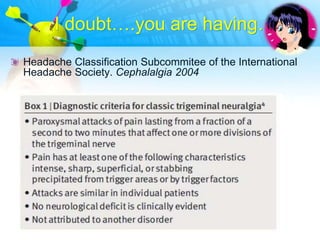
I doubt….you are having….
Headache Classification Subcommitee of the International
Headache Society. Cephalalgia 2004
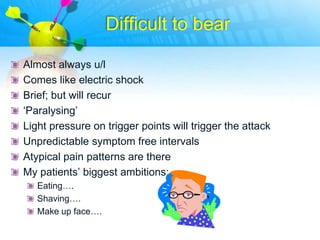
Difficult to bear

Almost always u/l
Comes like electric shock
Brief; but will recur
„Paralysing‟
Light pressure on trigger points will trigger the attack
Unpredictable symptom free intervals
Atypical pain patterns are there
My patients‟ biggest ambitions:
   Eating….
   Shaving….
   Make up face….
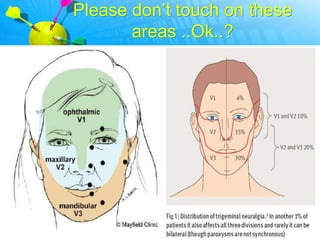
Please don‟t touch on these
           areas ..Ok..?
.
DIAGNOSIS
Keep a low threshold for MRI
                  in
younger patients
 atypical clinical features
sensory loss
dull burning pain between paroxysms
patients who do not respond to initial medical therapy
Imaging

C.T.
M.R.I. :
   CONVENTIONAL: can rule out tumour / multiple sclerosis
   3-D VOLUME ACQUISITION, with contrast injection and thin cuts
   (ie, 0.8 mm) without gaps can see Trigeminal nerve and associated
   blood vessels
   The trigeminal nerve is easily observed in the axial plane when the
   MRI series is centered at die midpoint of the 4th ventricle.
   To ensure adequate evaluation, the nerve should be observed on 3
   adjacent cuts.
   when an offending vessel is present, it will be detected 80% of the
   time
   OTHERS: TOF, CISTERNOGRAPHY
Also look for tumours, multiple sclerosis, abnormalities of
Imaging

Meckel‟s cave, the cavernous sinus, the skull base
foramina, the pterygopalatine fossa and the peripheral
trigeminal nerve course

always look for a normal gray and white matter and
brainstem, a normal cisternal segment, a fluid fi lled
Meckel‟s cave, a homogeneously enhancing cavernous
sinus, a fat-filled superior orbital fissure and pterygopalatine
fossa, normal foramen rotondum and ovale, and a
symmetrical appearance of the masticator muscles with
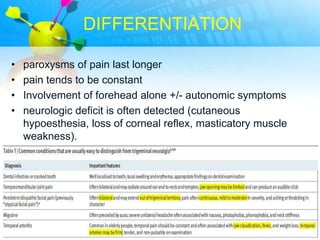
DIFFERENTIATION

•   paroxysms of pain last longer
•   pain tends to be constant
•   Involvement of forehead alone +/- autonomic symptoms
•   neurologic deficit is often detected (cutaneous
    hypoesthesia, loss of corneal reflex, masticatory muscle
    weakness).
.


    Treatment
PHARMACOLOGICAL

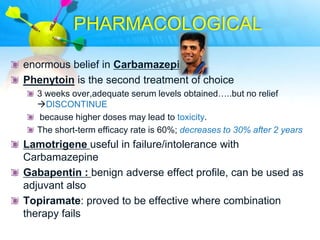
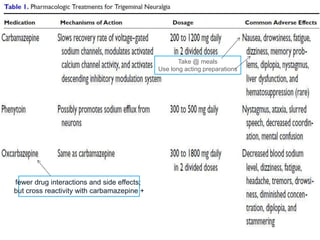
enormous belief in Carbamazepine
Phenytoin is the second treatment of choice
  3 weeks over,adequate serum levels obtained…..but no relief
  DISCONTINUE
  because higher doses may lead to toxicity.
  The short-term efficacy rate is 60%; decreases to 30% after 2 years
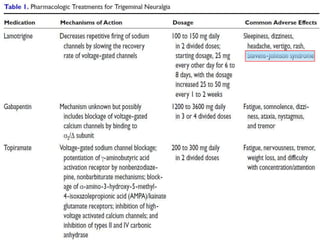
Lamotrigene useful in failure/intolerance with
Carbamazepine
Gabapentin : benign adverse effect profile, can be used as
adjuvant also
Topiramate: proved to be effective where combination
therapy fails
Treatment
  Your Text here                                   Take @ meals
                                            Use long acting preparations


fewer drug interactions and side effects;
but cross reactivity with carbamazepine +
Treatment
Your Text here
SURGICAL Rx-FACTS

aimed at either destroying parts of nerve fibers or
decompressing the trigeminal nerve to relieve pain
although surgical treatment may initially be successful,
trigeminal neuralgia may recur retry medical therapy
[because drugs that were previously ineffective may
become effective later]
patients with classic trigeminal neuralgia, evidence of
vascular compression, shorter duration of disease, and no
previous surgery respond better to all treatment options.
In such patients, MVD can be considered the “gold
standard” surgical procedure, and it offers the best long
term cure rates.
SURGICAL Rx-FACTS

All procedures have high initial response rate, except for
stereotactic radiosurgery, which usually takes maximum
effect at one to two months
Ablative Rxs are used to a greater extent in patients with
high operative risk
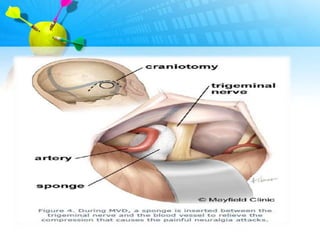
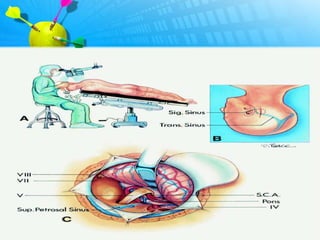
Microvascular decompression
      (MVD) of the posterior fossa
junction of the Vth nerve with the pons is explored

blood vessels and tumors removed from direct contact with
the nerve. The SCA, PICA, VA, and AICA (& small
branches) are separated from the nerve by a piece of
Dacron fabric

Efficacy is reported to be 85% initially, and 80% at 5 years.

carries a relatively low risk of pain
recurrence, dysthesia, corneal analgesia, and trigeminal
motor weakness
.
MVD-Risks

Risks higher in patients who have an ecstatic
(atherosclerotic) and a tortuous vertebrobasilar arterial tree

the risk for perioperative mortality [around 0.4%], serious
morbidity (eg, stroke, hemorrhage, venous occlussion,
M.I.,HCP), permanent hearing loss, and facial palsy is
higher after MVD than after percutaneous procedures.

But ablative procedures are less effective in the long term
and more likely to produce facial numbness and other minor
complications than MVD
MVD-Follow up

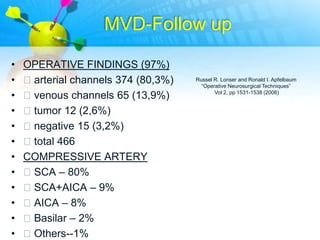
•   OPERATIVE FINDINGS (97%)
•   arterial channels 374 (80,3%)   Russel R. Lonser and Ronald I. Apfelbaum
                                       “Operative Neurosurgical Techniques”

•   venous channels 65 (13,9%)             Vol 2, pp 1531-1538 (2006)


•   tumor 12 (2,6%)
•   negative 15 (3,2%)
•   total 466
•   COMPRESSIVE ARTERY
•   SCA – 80%
•   SCA+AICA – 9%
•   AICA – 8%
•   Basilar – 2%
•   Others--1%
MVD-Follow up

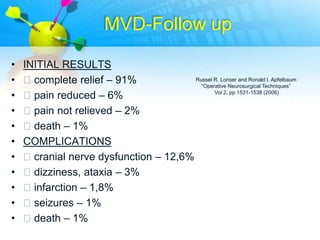
•   INITIAL RESULTS
•   complete relief – 91%             Russel R. Lonser and Ronald I. Apfelbaum
                                         “Operative Neurosurgical Techniques”

•   pain reduced – 6%                        Vol 2, pp 1531-1538 (2006)


•   pain not relieved – 2%
•   death – 1%
•   COMPLICATIONS
•   cranial nerve dysfunction – 12,6%
•   dizziness, ataxia – 3%
•   infarction – 1,8%
•   seizures – 1%
•   death – 1%
MVD-Follow up

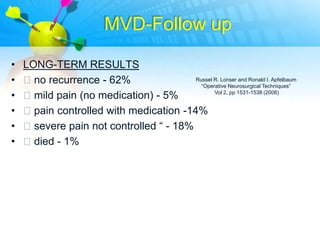
•   LONG-TERM RESULTS
•   no recurrence - 62%                Russel R. Lonser and Ronald I. Apfelbaum
                                          “Operative Neurosurgical Techniques”

•   mild pain (no medication) - 5%            Vol 2, pp 1531-1538 (2006)


•   pain controlled with medication -14%
•   severe pain not controlled “ - 18%
•   died - 1%
PREOPERATIVE
    SIMULATION
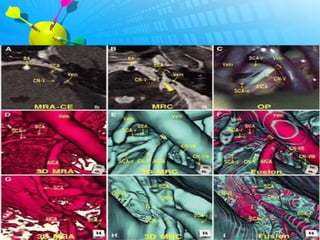
fusion imaging technique of three-dimensional (3-D) MR
cisternography and co-registered 3-D MRA
The presence of offending vessels and compressive site of
neurovascular conflict was assessed from the various
viewpoints within the cistern
surgeon's-eye view, bird's-eye view
PREOPERATIVE
    SIMULATION
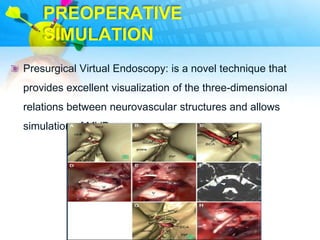
Presurgical Virtual Endoscopy: is a novel technique that
provides excellent visualization of the three-dimensional
relations between neurovascular structures and allows
simulation of MVD
Percutaneous radiofrequency
          thermocoagulation of the gasserian
                      ganglion

A high-frequency current used to destroy precisely the A-
delta and C-fiber nociceptors

based on the theory that lower temperatures selectively
destroys the nociceptive unmyelinated C-fibers & the poorly
myelinated A-delta fibers while sparing the heavily
myelinated A-alpha & A-beta fibers which convey the touch,
proprioceptive & motor impulses.
Percutaneous radiofrequency
          thermocoagulation of the gasserian
                      ganglion

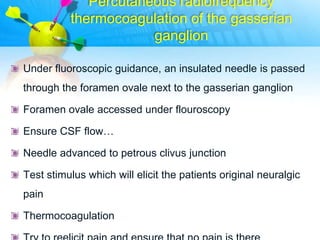
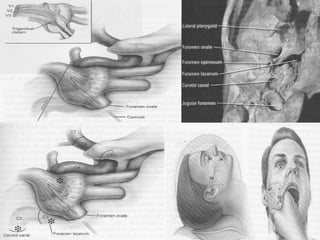
Under fluoroscopic guidance, an insulated needle is passed
through the foramen ovale next to the gasserian ganglion

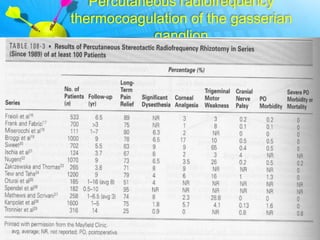
The initial efficacy ̴ 90%, with 80% patients remaining free of
pain at 1 year and 50% remaining pain free at 5 years.

appropriate for elderly and for those with poor medical
conditions

Risks : numbness, paresthesia, and anesthesia
dolorosa,corneal anesthesia [may develop after lesioning of
the ophthalmic division]
Percutaneous radiofrequency
          thermocoagulation of the gasserian
                      ganglion

Under fluoroscopic guidance, an insulated needle is passed
through the foramen ovale next to the gasserian ganglion

Foramen ovale accessed under flouroscopy

Ensure CSF flow…

Needle advanced to petrous clivus junction

Test stimulus which will elicit the patients original neuralgic
pain

Thermocoagulation
.
Percutaneous radiofrequency
    thermocoagulation of the gasserian
                ganglion
A
Percutaneous
          microcompression of the
            gasserian ganglion
involves passing a fine balloon catheter through the foramen
ovale.
Inflation of the balloon produces an ischemic or mechanical
destruction of cells in the ganglion.38
associated with the highest risk for postoperative motor
trigeminal weakness.
the best choice for patients who have ophthalmic nerve pain
and who are not candidates for MVD
Gamma knife irradiation
                  [NIHCE,U.K. APPROVED]

radiation is aimed at the proximal nerve and root entry zone
in the pons
gamma knife projects 201 very fine beams of gamma rays
(generated by RA Cobalt) through the skull and brain.
The dose of radiation along any one beam is too small to
effect any change by itself
but when all 201 beams intersect, a very high dose of
radiation can be administered with little or no radiation to
surrounding tissue.41
has been shown to affect abnormal ephaptic transmission
but not normal axonal conduction
Glycerol injection


Injected behind the ganglion, which destroys small and large
myelinated and unmyelinated fibers.
Under fluoroscopic guidance, glycerol is injected into the
cistern of Meckle's cave.
OTHERS METHODS : Laser irradiation of the skin overlying
peripheral nerves with a heliium-neon laser
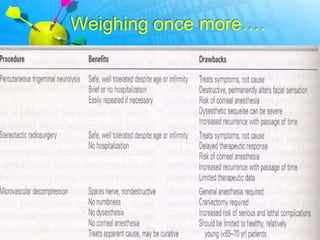
Weighing once more….
Your Text here
Proparacaine eye drops

Is a local anesthetic agent that anesthetizes the eye and
possibly the nerves around it.
It is shown that it can give short-term relief in some
instances
usually effective if the pain is in the distribution of the
ophthalmic division of the trigeminal nerve.
almost certainly ineffective for classic trigeminal neuralgia.
relatively harmless, but can damage the eye if used
extensively
So it cannot be considered a long-term treatment.
Final words….


patients with trigeminal neuralgia deserve an accurate and
dispassionate explanation of the merits and drawbacks of all
methods of treatment from the outset.
References
•   Trigeminal neuralgia Pathophysiology and treatment A.
    JOFFROY, M. LEVIVIER and N. MASSAGER
•   Manish K Singh, MD; Chief Editor: Robert A Egan, MD[2012]
    Medscape
•   Pain Management: Trigeminal Neuralgia;Meraj N. Siddiqui,
    Hospital Physician;Turner White;2003
•   BMJ Luke Bennetto, Nikunj K Patel and Geraint Fuller ;2008
•   John tew, Mayfield Clinic Update,2012
•   review on the causes of trigeminal neuralgia symptomatic to
    other diseases florin popovici1, ROMANIAN JOURNAL OF
    NEUROLOGY – VOLUME X, NO. 2, 2011
HOPING FOR MORE AND MORE WAYS TO COOL THIS
  HEAD


        THANK YOU

TRIGEMINAL NEURALGIA

  • 1.
    The terrible journeyof a nerve impulse! DR UNNIKRISHNAN P NEUROANAESTHESIA SCTIMST TRIVANDRUM INDIA
  • 2.
    Demotivating , demoralizing.. oneof the most painful neuropathic pains IASP definition: Sudden, recurrent, severe pain in the distribution of one or more branches of the fifth cranial nerve no universal treatment is capable of reverting completely impairment of daily functionality, reduced quality of life and depression overwhelming fear that pain can suddenly return again
  • 3.
    Peculiar neuropathic pain notaccompanied by sensory deficit Can be cured by a small nerve or root lesion Cause ? Now… sound hypothesis of neurovascular conflict (NVC) [ Are we still hearing sounds of conflict? ] tic douloureux = since painful brief muscle spasms
  • 4.
    EPIDEMIOLOGY 3-5/ one lac;52- 69 years most common More recent estimates suggest the prevalence is approximately 1.5 cases per 10,000 population, with an incidence of approximately 15,000 cases per year Multiple sclerosis is found to be a risk factor; ?HTN I‟m also having..[youngest 12m] 3.4/lac 5.9/lac
  • 5.
    Anatomy - whereabouts •Emerge as a larger sensory and smaller motor root • Fibres in sensory root are axons of cells in trigeminal ganglion which occupies Meckels cave • Neurons of the unipolar cells of the ganglion divides into central and peripheral processes • Peripheral ophthalmic,maxillary and sensory part of mandibular • Central fibres of the sensory root
  • 6.
  • 7.
  • 8.
    Course and relevancein TN  The sensory fibers arise from the gasserian ganglion (lying near the petrous part of the temporal bone in the dura matter), pass backward, enter the pons, and divide into upper and lower roots.  The upper roots end in the principal or superior sensory nucleus and locus caeruleus.  The lower roots descend through the pons and medulla and terminate in the spinal tract nucleus, which consists of subnucleus caudalis, subnucleus inter-polates, and subnucleus oralis.  The subnucleus caudalis serves as the principal brainstem relay site for orofacial pain, and the superior sensory nucleus and subnucleus oralis are sites relaying orofacial
  • 9.
    No monopoly; alreadya lot of members to control • 1 motor and 3 sensory nuclei • Motor upper pons • Mesencephalic midbrain ; for proprioception • Main sensory nucleus upper pons ; for touch • Spinal nucleus in lower pons, medulla and upper cervical spinal cord; for pain and temperature
  • 10.
  • 11.
  • 12.
    Principal brainstem relay sites…. Subnucleus caudalis  orofacial pain Superior sensory nucleus , subnucleus oralis  Tactile information The similarity…. Neurons in dorsal horn   Thalamus Neurons in subnucleus caudalis    Thalamus Motor root…. Motor roots from the superior and lower nucleus then joins the sensory root as it emerges from the pons
  • 13.
    Eagerly waiting forchaos.. Nociceptive neurons in subnucleus caudalis respond to noxious stimulation of the  Orofacial tissues Tooth pulp TMJ Dura Jaw Tongue Neck muscles Mechanoreceptive neurons in the superior sensory nucleus  Light tactile stimuli to Skin Mucosa teeth
  • 14.
  • 15.
  • 16.
  • 17.
    ETIOLOGY AND PATHOPHYSIOLOGY “Pain is temporary. Quitting lasts forever”…Lance Armstrong His quotes also are loosing integrity...???
  • 18.
    Central vs Peripheral Centraltheories emphasize the role of deafferentation (secondary to compression of the trigeminal roots or ganglion) in the genesis of neural hyperactivity. Peripheral theories note that changes in peripheral axons and myelin may lead to altered nerve sensitivity to chemical and mechanical stimuli. Starts as a peripheral lesion; response of central synapses to this sets stage for the war; SO BOTH MECHANISMS PLAY
  • 19.
    Painful and annoying conflict… In 85%, no structural lesion is seen Classic [idiopathic] form: “Neurovascular conflict” i.e. vascular compression of nerve most commonly @ its entry into pons [REZ] Significant NVC= an artery (not a vein), crossing (not parallel to) the nerve and provoking displacement/grooving of it (Casselman,2000)
  • 20.
    Amplifying…. compression results infocal trigeminal nerve demyelination leads to ephaptic transmission [action potentials jump from one fiber to another] A lack of inhibitory inputs from large myelinated nerve fibers plays a role. a reentry mechanism causes an amplification of sensory inputs
  • 21.
  • 22.
    Two types....One feature.. Trigeminalneuralgia is divided into classic [idiopathic] and symptomatic types The classic form includes the cases that are due to a normal artery present in contact with the nerve, such as the SCA or even a primitive trigeminal artery Symptomatic forms can have multiple origins: Aneurysms, tumors, chronic meningeal inflammation.An abnormal vascular course of the superior cerebellar artery is often cited as the cause Uncommonly, an area of demyelination from multiple sclerosis may be the precipitant
  • 23.
    ETIOLOGY • compression ofnerve root [most common-vascular; rarely tumor/vein/avm] usually when pain @ v2 / v3, compression is by SCA ; pain @ v1  by AICA • Inflammatory causes: multiple sclerosis [in1-5% of patients with MS;more likely if patient with TN is 20-40ys] ; Damage to myelin sheath [Myelin gone….signals blend….nerves may sense light touch as pain!!!!!] ), sarcoidosis, and Lyme disease neuropathy • traumatic accidents • unsuccessful dental work
  • 24.
    ETIOLOGY Tumor-related causes :(most commonly in the cerebello- pontine angle) include acoustic neurinoma, chordoma at the level of the clivus, pontine glioma or glioblastoma,epidermoid, metastases, and lymphoma and paraneoplastic etiologies. Vascular causes include a pontine infarct and arteriovenous malformation or aneurysm in the vicinity. infections , varicella virus foci of abscesses bone resorption with irritation of the trigeminal nerve in the maxilla or mandible
  • 25.
  • 26.
  • 27.
    Don‟t get deceivedby imitations DIFFERENTIAL DIAGNOSIS variety of tumours and other lesions involving, or impinging on, the trigeminal nerve, ganglion or sensory root  tumours of the C-P angle, MCF, cranium or extracranial tissues (often metastatic), and from the envelopes of the Gasserian ganglion. OTHERS atypical facial pain syndromes cluster headache postherpetic neuralgia geniculate neuralgia (Ramsay Hunt) sphenopalatine ganglion neuralgia glossopharyngeal neuralgia dental disease, orbital disease temporomandibular dysfunction temporal arteritis
  • 28.
    I doubt….you arehaving…. Headache Classification Subcommitee of the International Headache Society. Cephalalgia 2004
  • 29.
    Difficult to bear Almostalways u/l Comes like electric shock Brief; but will recur „Paralysing‟ Light pressure on trigger points will trigger the attack Unpredictable symptom free intervals Atypical pain patterns are there My patients‟ biggest ambitions: Eating…. Shaving…. Make up face….
  • 30.
    Please don‟t touchon these areas ..Ok..? .
  • 31.
  • 32.
    Keep a lowthreshold for MRI in younger patients atypical clinical features sensory loss dull burning pain between paroxysms patients who do not respond to initial medical therapy
  • 33.
    Imaging C.T. M.R.I. : CONVENTIONAL: can rule out tumour / multiple sclerosis 3-D VOLUME ACQUISITION, with contrast injection and thin cuts (ie, 0.8 mm) without gaps can see Trigeminal nerve and associated blood vessels The trigeminal nerve is easily observed in the axial plane when the MRI series is centered at die midpoint of the 4th ventricle. To ensure adequate evaluation, the nerve should be observed on 3 adjacent cuts. when an offending vessel is present, it will be detected 80% of the time OTHERS: TOF, CISTERNOGRAPHY Also look for tumours, multiple sclerosis, abnormalities of
  • 34.
    Imaging Meckel‟s cave, thecavernous sinus, the skull base foramina, the pterygopalatine fossa and the peripheral trigeminal nerve course always look for a normal gray and white matter and brainstem, a normal cisternal segment, a fluid fi lled Meckel‟s cave, a homogeneously enhancing cavernous sinus, a fat-filled superior orbital fissure and pterygopalatine fossa, normal foramen rotondum and ovale, and a symmetrical appearance of the masticator muscles with
  • 35.
    DIFFERENTIATION • paroxysms of pain last longer • pain tends to be constant • Involvement of forehead alone +/- autonomic symptoms • neurologic deficit is often detected (cutaneous hypoesthesia, loss of corneal reflex, masticatory muscle weakness).
  • 36.
    . Treatment
  • 37.
    PHARMACOLOGICAL enormous belief inCarbamazepine Phenytoin is the second treatment of choice 3 weeks over,adequate serum levels obtained…..but no relief DISCONTINUE because higher doses may lead to toxicity. The short-term efficacy rate is 60%; decreases to 30% after 2 years Lamotrigene useful in failure/intolerance with Carbamazepine Gabapentin : benign adverse effect profile, can be used as adjuvant also Topiramate: proved to be effective where combination therapy fails
  • 38.
    Treatment YourText here Take @ meals Use long acting preparations fewer drug interactions and side effects; but cross reactivity with carbamazepine +
  • 39.
  • 40.
    SURGICAL Rx-FACTS aimed ateither destroying parts of nerve fibers or decompressing the trigeminal nerve to relieve pain although surgical treatment may initially be successful, trigeminal neuralgia may recur retry medical therapy [because drugs that were previously ineffective may become effective later] patients with classic trigeminal neuralgia, evidence of vascular compression, shorter duration of disease, and no previous surgery respond better to all treatment options. In such patients, MVD can be considered the “gold standard” surgical procedure, and it offers the best long term cure rates.
  • 41.
    SURGICAL Rx-FACTS All procedureshave high initial response rate, except for stereotactic radiosurgery, which usually takes maximum effect at one to two months Ablative Rxs are used to a greater extent in patients with high operative risk
  • 42.
    Microvascular decompression (MVD) of the posterior fossa junction of the Vth nerve with the pons is explored blood vessels and tumors removed from direct contact with the nerve. The SCA, PICA, VA, and AICA (& small branches) are separated from the nerve by a piece of Dacron fabric Efficacy is reported to be 85% initially, and 80% at 5 years. carries a relatively low risk of pain recurrence, dysthesia, corneal analgesia, and trigeminal motor weakness
  • 43.
  • 44.
    MVD-Risks Risks higher inpatients who have an ecstatic (atherosclerotic) and a tortuous vertebrobasilar arterial tree the risk for perioperative mortality [around 0.4%], serious morbidity (eg, stroke, hemorrhage, venous occlussion, M.I.,HCP), permanent hearing loss, and facial palsy is higher after MVD than after percutaneous procedures. But ablative procedures are less effective in the long term and more likely to produce facial numbness and other minor complications than MVD
  • 45.
    MVD-Follow up • OPERATIVE FINDINGS (97%) • arterial channels 374 (80,3%) Russel R. Lonser and Ronald I. Apfelbaum “Operative Neurosurgical Techniques” • venous channels 65 (13,9%) Vol 2, pp 1531-1538 (2006) • tumor 12 (2,6%) • negative 15 (3,2%) • total 466 • COMPRESSIVE ARTERY • SCA – 80% • SCA+AICA – 9% • AICA – 8% • Basilar – 2% • Others--1%
  • 46.
    MVD-Follow up • INITIAL RESULTS • complete relief – 91% Russel R. Lonser and Ronald I. Apfelbaum “Operative Neurosurgical Techniques” • pain reduced – 6% Vol 2, pp 1531-1538 (2006) • pain not relieved – 2% • death – 1% • COMPLICATIONS • cranial nerve dysfunction – 12,6% • dizziness, ataxia – 3% • infarction – 1,8% • seizures – 1% • death – 1%
  • 47.
    MVD-Follow up • LONG-TERM RESULTS • no recurrence - 62% Russel R. Lonser and Ronald I. Apfelbaum “Operative Neurosurgical Techniques” • mild pain (no medication) - 5% Vol 2, pp 1531-1538 (2006) • pain controlled with medication -14% • severe pain not controlled “ - 18% • died - 1%
  • 51.
    PREOPERATIVE SIMULATION fusion imaging technique of three-dimensional (3-D) MR cisternography and co-registered 3-D MRA The presence of offending vessels and compressive site of neurovascular conflict was assessed from the various viewpoints within the cistern surgeon's-eye view, bird's-eye view
  • 53.
    PREOPERATIVE SIMULATION Presurgical Virtual Endoscopy: is a novel technique that provides excellent visualization of the three-dimensional relations between neurovascular structures and allows simulation of MVD
  • 54.
    Percutaneous radiofrequency thermocoagulation of the gasserian ganglion A high-frequency current used to destroy precisely the A- delta and C-fiber nociceptors based on the theory that lower temperatures selectively destroys the nociceptive unmyelinated C-fibers & the poorly myelinated A-delta fibers while sparing the heavily myelinated A-alpha & A-beta fibers which convey the touch, proprioceptive & motor impulses.
  • 55.
    Percutaneous radiofrequency thermocoagulation of the gasserian ganglion Under fluoroscopic guidance, an insulated needle is passed through the foramen ovale next to the gasserian ganglion The initial efficacy ̴ 90%, with 80% patients remaining free of pain at 1 year and 50% remaining pain free at 5 years. appropriate for elderly and for those with poor medical conditions Risks : numbness, paresthesia, and anesthesia dolorosa,corneal anesthesia [may develop after lesioning of the ophthalmic division]
  • 56.
    Percutaneous radiofrequency thermocoagulation of the gasserian ganglion Under fluoroscopic guidance, an insulated needle is passed through the foramen ovale next to the gasserian ganglion Foramen ovale accessed under flouroscopy Ensure CSF flow… Needle advanced to petrous clivus junction Test stimulus which will elicit the patients original neuralgic pain Thermocoagulation
  • 57.
  • 58.
    Percutaneous radiofrequency thermocoagulation of the gasserian ganglion A
  • 59.
    Percutaneous microcompression of the gasserian ganglion involves passing a fine balloon catheter through the foramen ovale. Inflation of the balloon produces an ischemic or mechanical destruction of cells in the ganglion.38 associated with the highest risk for postoperative motor trigeminal weakness. the best choice for patients who have ophthalmic nerve pain and who are not candidates for MVD
  • 60.
    Gamma knife irradiation [NIHCE,U.K. APPROVED] radiation is aimed at the proximal nerve and root entry zone in the pons gamma knife projects 201 very fine beams of gamma rays (generated by RA Cobalt) through the skull and brain. The dose of radiation along any one beam is too small to effect any change by itself but when all 201 beams intersect, a very high dose of radiation can be administered with little or no radiation to surrounding tissue.41 has been shown to affect abnormal ephaptic transmission but not normal axonal conduction
  • 61.
    Glycerol injection Injected behindthe ganglion, which destroys small and large myelinated and unmyelinated fibers. Under fluoroscopic guidance, glycerol is injected into the cistern of Meckle's cave. OTHERS METHODS : Laser irradiation of the skin overlying peripheral nerves with a heliium-neon laser
  • 62.
  • 63.
    Proparacaine eye drops Isa local anesthetic agent that anesthetizes the eye and possibly the nerves around it. It is shown that it can give short-term relief in some instances usually effective if the pain is in the distribution of the ophthalmic division of the trigeminal nerve. almost certainly ineffective for classic trigeminal neuralgia. relatively harmless, but can damage the eye if used extensively So it cannot be considered a long-term treatment.
  • 64.
    Final words…. patients withtrigeminal neuralgia deserve an accurate and dispassionate explanation of the merits and drawbacks of all methods of treatment from the outset.
  • 65.
    References • Trigeminal neuralgia Pathophysiology and treatment A. JOFFROY, M. LEVIVIER and N. MASSAGER • Manish K Singh, MD; Chief Editor: Robert A Egan, MD[2012] Medscape • Pain Management: Trigeminal Neuralgia;Meraj N. Siddiqui, Hospital Physician;Turner White;2003 • BMJ Luke Bennetto, Nikunj K Patel and Geraint Fuller ;2008 • John tew, Mayfield Clinic Update,2012 • review on the causes of trigeminal neuralgia symptomatic to other diseases florin popovici1, ROMANIAN JOURNAL OF NEUROLOGY – VOLUME X, NO. 2, 2011
  • 66.
    HOPING FOR MOREAND MORE WAYS TO COOL THIS HEAD THANK YOU