Paediatric Basic Life Support
DR. DEEPASHREE PAUL
What is BLS?
Definition
• Paediatric Basic Life Support (PBLS) is a rescue
procedure which has purpose of preventing the anoxic
brain damage by promoting the return of spontaneous
circulation and breathing.
AHA
Introduction
• Dentistry is a surgical specialty` often associated with
high levels of patient anxiety, that may be conducive to
medical emergencies.
• Highly vasoactive drugs like LAs, vasoconstrictors etc
and drugs like antibiotics, sedatives, analgesics carry
potential for producing acute life threatening reactions.
• It should be appreciated that the role of a dental surgeon
in the management of a medical emergency is to stabilize
the patient until transferred to emergency Medical
Services (EMS) personnel.
Prevention is better than
Cure!
Prevention of Medical Emergencies
• Thorough medical history
• Physical Examination
• Medical Consultation (as and when required)
• Vigilant patient monitoring
Patient Monitoring for a
pediatric patient
• Observe general appearance from time to time
• Level of consciousness
• Level of comfort
• Muscle tonicity
• Colour of skin and mucosa
• Respiratory pattern
When moderate sedation is used especially in a child with
narrow safety margin due to smaller degree of respiratory
and cardiovascular reserve, additional monitoring should
routinely be employed.
• Continual monitoring of B.P via automated B.P cuff.
• Oxygenation and pulse rate via pulse oximetry.
• Ventilation via pretracheal/ pre chordial stethoscope or a
capnograph.
In case of deep sedation / GA more sophisticated
monitoring is required.
Preparation For Emergencies
• Personal Preparation
• Staff preparation
• Back-up medical assistance
• Office preparation
 Emergency equipment
 Emergency drugs
• A practicing dental surgeon cannot be expected to be able
to diagnose and manage every possible medical
emergency.
• However, can prepare to deal with the most likely
emergencies in a dental office and those with greater
potential to cause morbidity or mortality.
A. Syncope
B. Hyperventilation
C. Seizures
D. Hypoglycemia
E. Acute Asthmatic attack
F. Allergic reactions
G. Airway obstruction
• Knowledge of signs and symptoms, course and therapy of
common emergencies.
• Training in basic life support at health care provider level.
• Intramuscular injection techniques (most common
method of emergency drug delivery).
• Deltoid of U/arm and Vastus lateralis of thigh.
Staff preparation
• Desirable to keep certified BLS-HCP clinical staff.
• Pre assign and organize individual roles.
• Run mock drill to keep team protocol run smoothly.
Back-up medical
assistance
• Arrangements with nearest physician (arranged not
assumed!)
• Current EMS telephone no. conveniently displayed.
Office preparation
• Emergency equipment
• Correct sized equipment for infants and adolescents.
• Oxygen is the primary emergency drug in the dental
office.
• >90% O2 at 10 L/min for minimum 1 hour source should
be available. Therefore minimum “E” cylinder should be
available.
Non
rebreathing
face mask
for
spontaneous
breather
• Since pediatric dental patients very rarely suffer MI or
cardiac arrest as initiating medical events and drug
induced respiratory depression and loss of patent airway
during unconsciousness much more likely.
• The primary goal of BLS is to maintain proper respiratory
function. Hypoxemia ( low arterial blood O2) leads to
morbidity and mortality in majority of patients.
Bag valve
mask device
connected to
high flow
O2 essential
for apneic
patientsRobertshaw demand
valve device
• Next, essential equipment is a high volume suction
device, esp in those obtunded patients in whom vomiting
is induced. Aspiration of vomitus can be dangerous.
Prevented by positioning and suctioning.
• Yankaeur type suction can be connected to dental high
volm evacuation dental suction unit.
• Syringes and needles for IM drug administration.
• Automated external defibrillator. (AED)
Emergency Drugs
• Most medical emergencies in dental office do not require
drugs. Practitioner’s thought should primarily directed
towards BLS and drug therapy only when clearly
indicated.
Epinephrine
• Second most important after oxygen in emergency
armamentarium.
• Drug of choice for life threatening anaphylactic reactions and
severe asthmatic attacks unresponsive to salbutamol/ albuterol.
• It is early advanced cardiac life support drug for cardiac arrest.
• EpiPen 0.3mg per dose, EpiPen Jr 0.15mg per dose (Dey
Pharma LP)
• Pediatric Doses: 0.01mg/kg IM
• Side effects: hypertension, tachycardia, arrythmia, chest pain,
anxiety, headache.
Albuterol
• Use : acute asthmatic attack
• Doses: two puffs with deep inspiration
• SE: tachycardia, anxiety.
Nitroglycerine
• Chest pain due to stable/unstable angina pectoris/
evolving MI. Unlikely in pediatric patients.
• Dose: 0.4 mg, every 5 mins until chest pain subsides or
<100mm Hg B.P. max 3 sprays.
• SE: hypotension, headache.
Diphenhydramine
(Benadryl)
• Use: allergic reactions
• 1-2mg/kg IM, upto 50mg.
• SE: Sedation, dry mouth.
Midazolam
• Use: Anticonvulsant in Status epilepticus or seizures from
LA over dose.
• 0.15 mg/kg IM.
• SE: sedation, respiratory depression.
Sugar
• Source of simple sugars to manage hypoglycaemic
shocks.
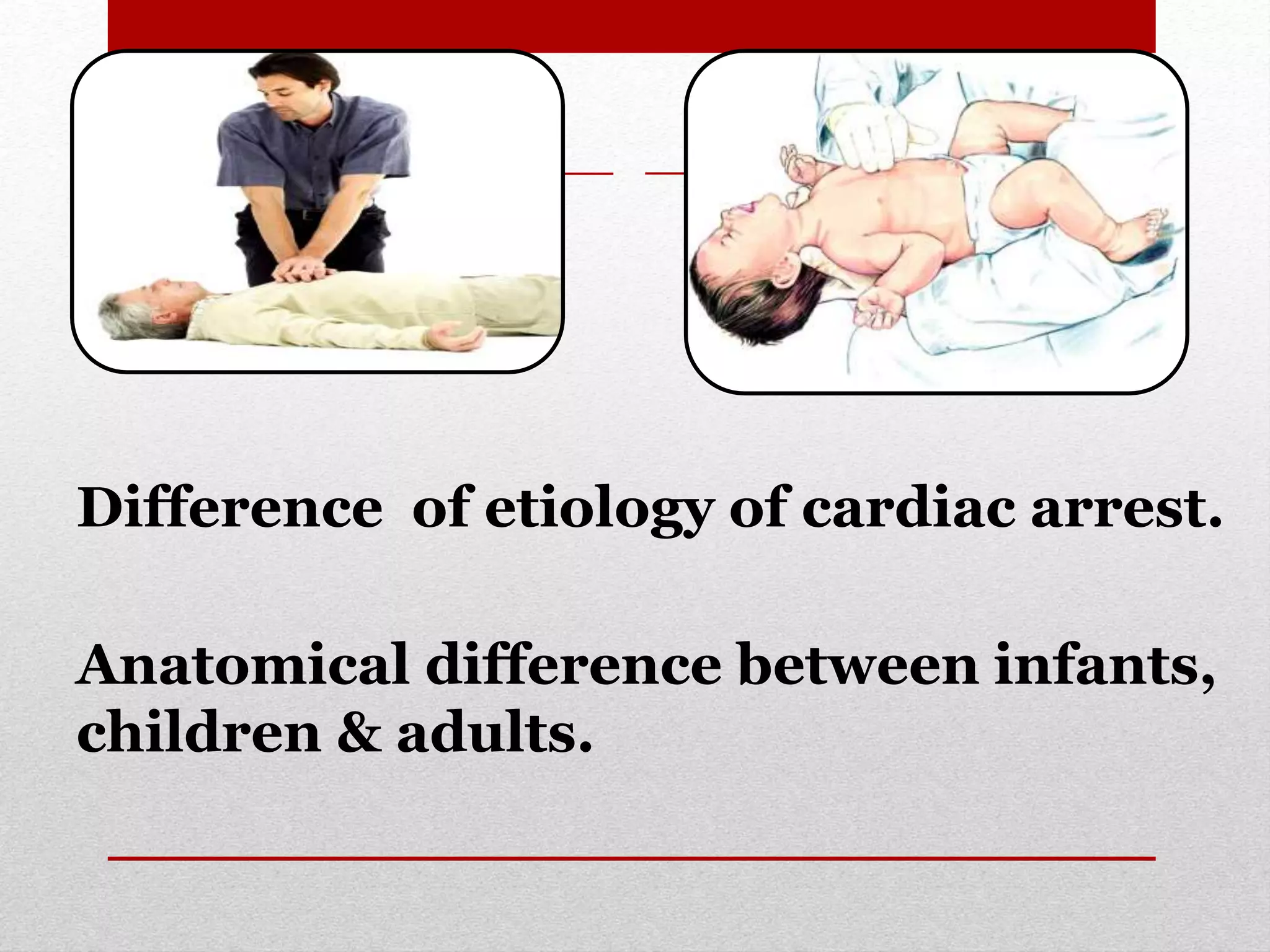
Difference of etiology of cardiac arrest.
Anatomical difference between infants,
children & adults.
Highlight
the major
consideratio
ns in
Paediatric
Basic Life
Support
AIRWAY
BREATHING
CHEST
COMPRESSION
BLS
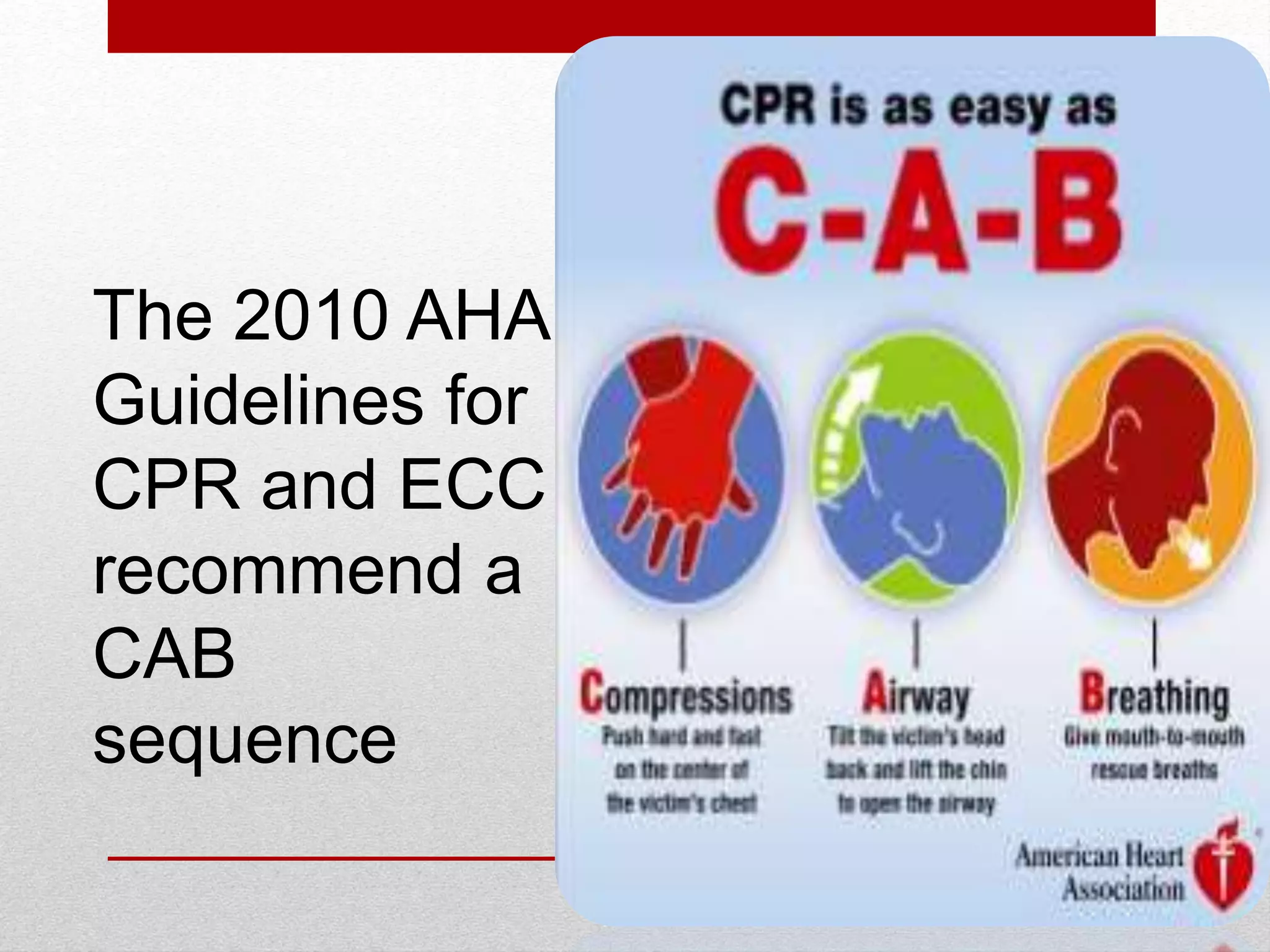
ABC OR CAB?
The 2010 AHA
Guidelines for
CPR and ECC
recommend a
CAB
sequence
Paediatric BLS at a
glance……….
Check for Response
No
Response
Shout for Help
Responds
Allow most comfortable
position
Safety of the Rescuer & Victim
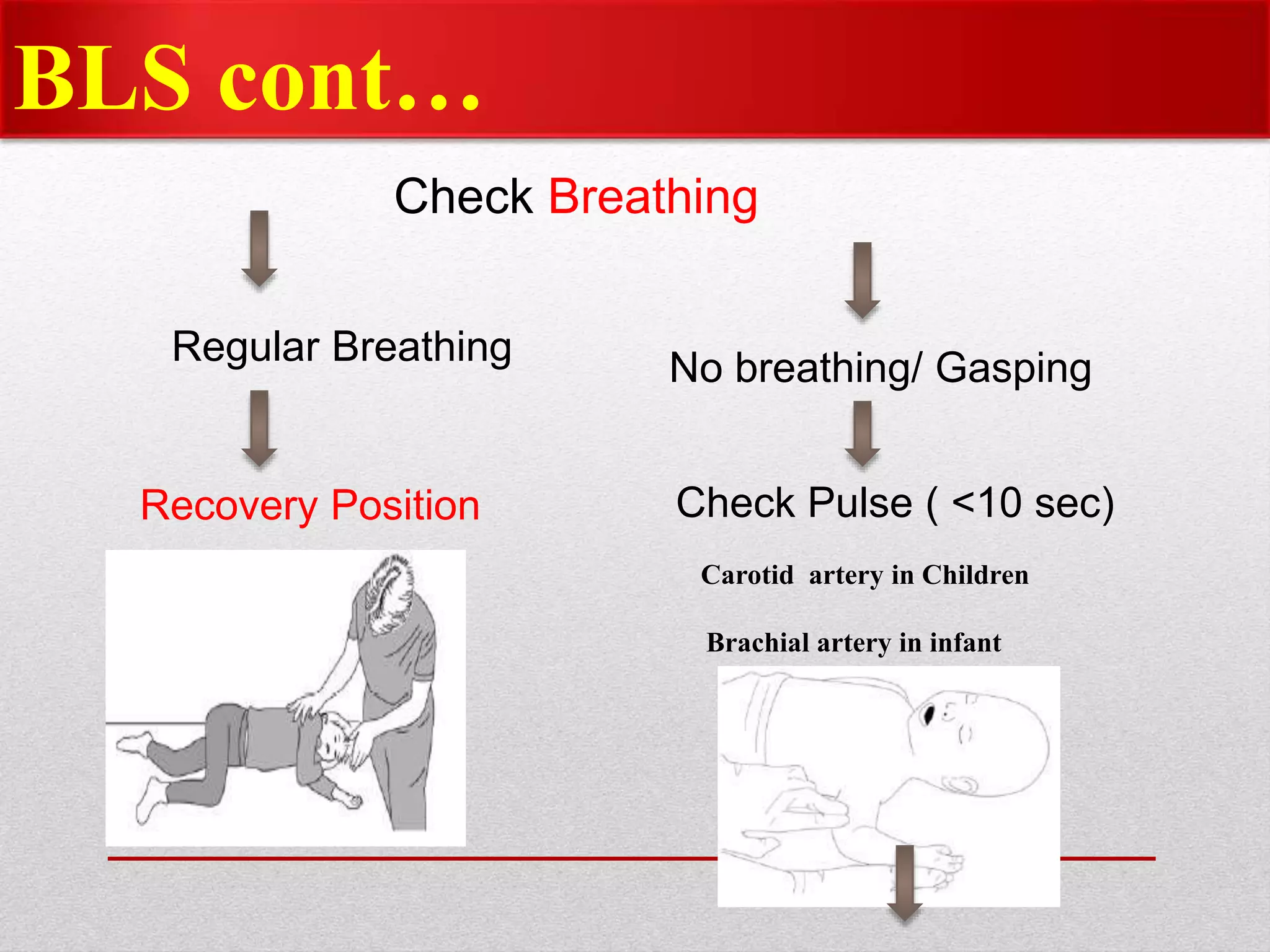
BLS cont…
Check Breathing
Regular Breathing
Recovery Position
No breathing/ Gasping
Check Pulse ( <10 sec)
Carotid artery in Children
Brachial artery in infant
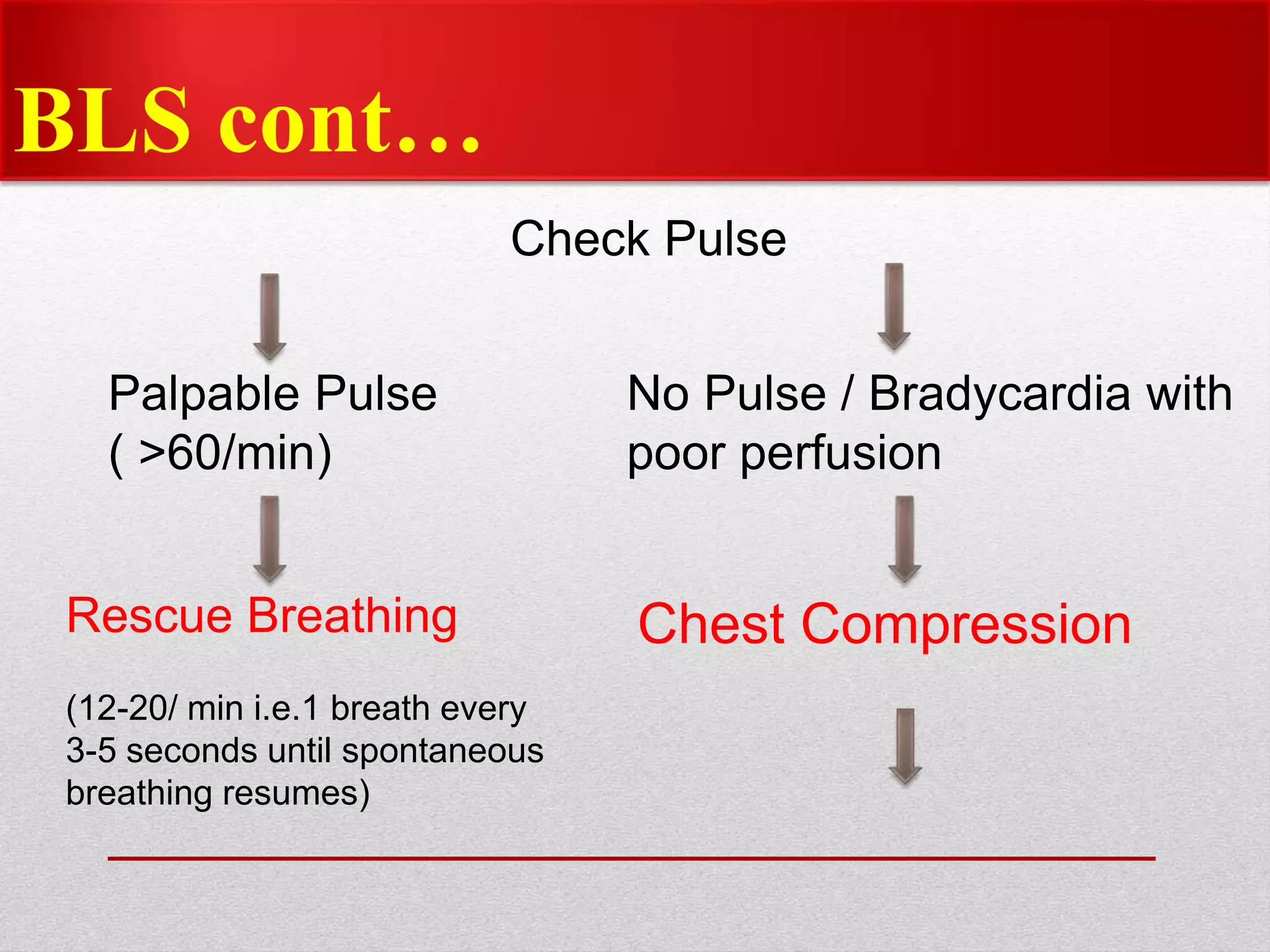
BLS cont…
Check Pulse
Palpable Pulse
( >60/min)
Rescue Breathing
(12-20/ min i.e.1 breath every
3-5 seconds until spontaneous
breathing resumes)
No Pulse / Bradycardia with
poor perfusion
Chest Compression
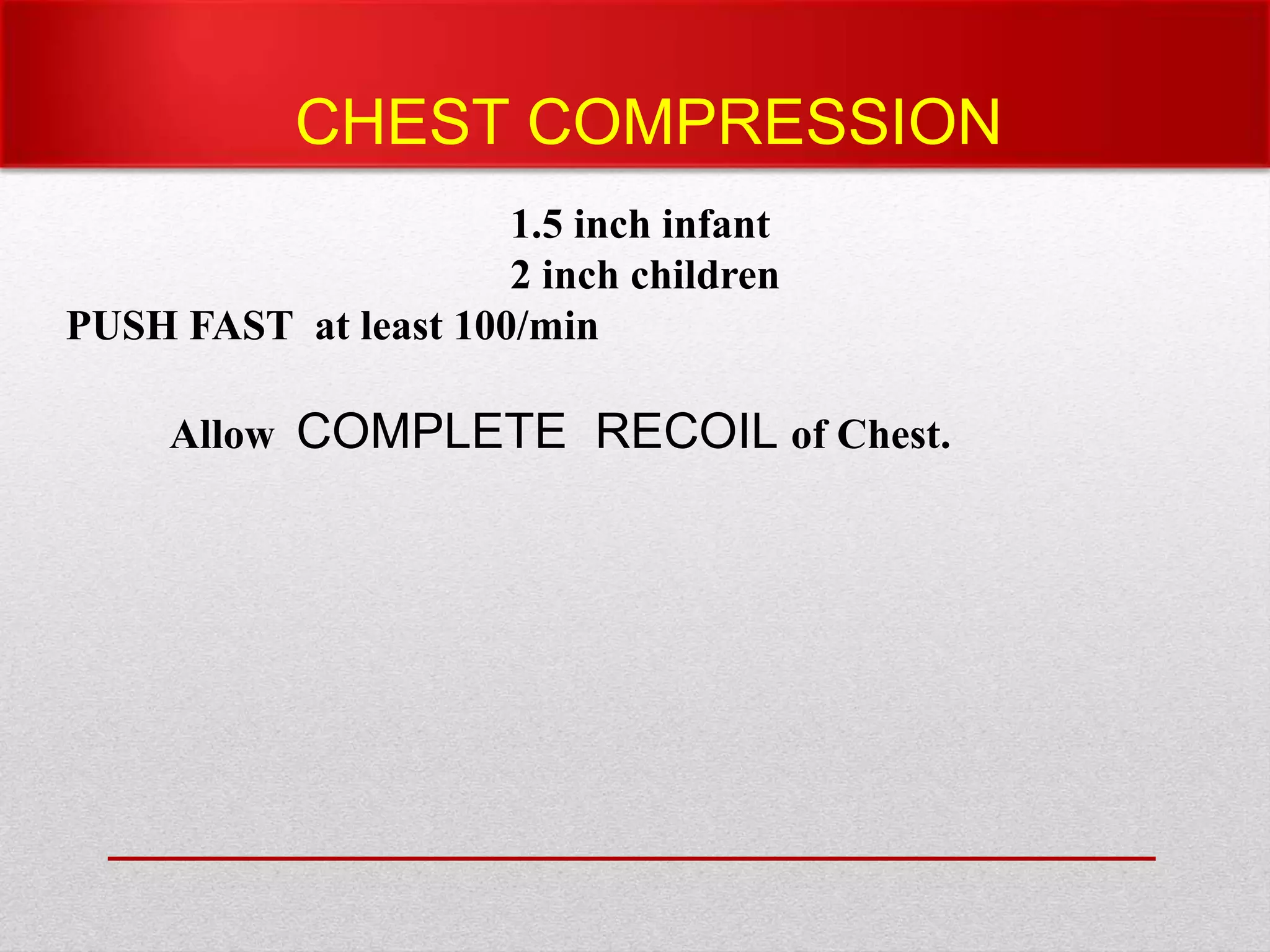
PUSH HARD compress 1/3rd of A-P dia of
sternum .
1.5 inch infant
2 inch children
PUSH FAST at least 100/min
Allow COMPLETE RECOIL of Chest.
CHEST COMPRESSION
30 Compression for 1 rescuer & 15 for 2 rescuer
Open Airway
NO BLIND FINGER
SWEEP
1. Head Tilt/Chin Lift
2. Jaw Thurst
1. Head Tilt/Chin Lift
NEUTRAL POSITION
SNIFFING POSITION
2. Jaw Thurst
INFANT CHILDRE
N
After chest compression (C) and opening
airway (A) give 2 Breaths (B)
Each Breath should be of 1 Sec
Mouth to Mouth
Mouth to Mouth & Nose
Mouth to Mask
Bag valve mask (BVM)
FOR 1 RESCUER COMPRESSION : VENTILATION IS
30 :2 & FOR 2 OR MORE RESCUERS RATIO IS 15
:2
CONTINUE 5 CYCLES (2 MINS) BEFORE ACTIVATING
EMERGENCY SYSTEM OR SWITCHING TO OTHER
RESCUER
Duration of CPR
• Signs of life return
• Qualified help arrives to assist you
• It is impossible to continue (e.g.exhaustion)
• An authorised person pronounces life extinct.
Paediatric basic life support ppt

Paediatric basic life support ppt

  • 1.
    Paediatric Basic LifeSupport DR. DEEPASHREE PAUL
  • 2.
  • 3.
    Definition • Paediatric BasicLife Support (PBLS) is a rescue procedure which has purpose of preventing the anoxic brain damage by promoting the return of spontaneous circulation and breathing. AHA
  • 4.
    Introduction • Dentistry isa surgical specialty` often associated with high levels of patient anxiety, that may be conducive to medical emergencies. • Highly vasoactive drugs like LAs, vasoconstrictors etc and drugs like antibiotics, sedatives, analgesics carry potential for producing acute life threatening reactions. • It should be appreciated that the role of a dental surgeon in the management of a medical emergency is to stabilize the patient until transferred to emergency Medical Services (EMS) personnel.
  • 5.
    Prevention is betterthan Cure! Prevention of Medical Emergencies • Thorough medical history • Physical Examination • Medical Consultation (as and when required) • Vigilant patient monitoring
  • 6.
    Patient Monitoring fora pediatric patient • Observe general appearance from time to time • Level of consciousness • Level of comfort • Muscle tonicity • Colour of skin and mucosa • Respiratory pattern
  • 7.
    When moderate sedationis used especially in a child with narrow safety margin due to smaller degree of respiratory and cardiovascular reserve, additional monitoring should routinely be employed. • Continual monitoring of B.P via automated B.P cuff. • Oxygenation and pulse rate via pulse oximetry. • Ventilation via pretracheal/ pre chordial stethoscope or a capnograph. In case of deep sedation / GA more sophisticated monitoring is required.
  • 8.
    Preparation For Emergencies •Personal Preparation • Staff preparation • Back-up medical assistance • Office preparation  Emergency equipment  Emergency drugs
  • 9.
    • A practicingdental surgeon cannot be expected to be able to diagnose and manage every possible medical emergency. • However, can prepare to deal with the most likely emergencies in a dental office and those with greater potential to cause morbidity or mortality. A. Syncope B. Hyperventilation C. Seizures D. Hypoglycemia E. Acute Asthmatic attack F. Allergic reactions G. Airway obstruction
  • 10.
    • Knowledge ofsigns and symptoms, course and therapy of common emergencies. • Training in basic life support at health care provider level. • Intramuscular injection techniques (most common method of emergency drug delivery). • Deltoid of U/arm and Vastus lateralis of thigh.
  • 11.
    Staff preparation • Desirableto keep certified BLS-HCP clinical staff. • Pre assign and organize individual roles. • Run mock drill to keep team protocol run smoothly.
  • 12.
    Back-up medical assistance • Arrangementswith nearest physician (arranged not assumed!) • Current EMS telephone no. conveniently displayed.
  • 13.
    Office preparation • Emergencyequipment • Correct sized equipment for infants and adolescents. • Oxygen is the primary emergency drug in the dental office. • >90% O2 at 10 L/min for minimum 1 hour source should be available. Therefore minimum “E” cylinder should be available.
  • 14.
    Non rebreathing face mask for spontaneous breather • Sincepediatric dental patients very rarely suffer MI or cardiac arrest as initiating medical events and drug induced respiratory depression and loss of patent airway during unconsciousness much more likely. • The primary goal of BLS is to maintain proper respiratory function. Hypoxemia ( low arterial blood O2) leads to morbidity and mortality in majority of patients. Bag valve mask device connected to high flow O2 essential for apneic patientsRobertshaw demand valve device
  • 15.
    • Next, essentialequipment is a high volume suction device, esp in those obtunded patients in whom vomiting is induced. Aspiration of vomitus can be dangerous. Prevented by positioning and suctioning. • Yankaeur type suction can be connected to dental high volm evacuation dental suction unit. • Syringes and needles for IM drug administration. • Automated external defibrillator. (AED)
  • 16.
    Emergency Drugs • Mostmedical emergencies in dental office do not require drugs. Practitioner’s thought should primarily directed towards BLS and drug therapy only when clearly indicated.
  • 17.
    Epinephrine • Second mostimportant after oxygen in emergency armamentarium. • Drug of choice for life threatening anaphylactic reactions and severe asthmatic attacks unresponsive to salbutamol/ albuterol. • It is early advanced cardiac life support drug for cardiac arrest. • EpiPen 0.3mg per dose, EpiPen Jr 0.15mg per dose (Dey Pharma LP) • Pediatric Doses: 0.01mg/kg IM • Side effects: hypertension, tachycardia, arrythmia, chest pain, anxiety, headache.
  • 18.
    Albuterol • Use :acute asthmatic attack • Doses: two puffs with deep inspiration • SE: tachycardia, anxiety.
  • 19.
    Nitroglycerine • Chest paindue to stable/unstable angina pectoris/ evolving MI. Unlikely in pediatric patients. • Dose: 0.4 mg, every 5 mins until chest pain subsides or <100mm Hg B.P. max 3 sprays. • SE: hypotension, headache.
  • 20.
    Diphenhydramine (Benadryl) • Use: allergicreactions • 1-2mg/kg IM, upto 50mg. • SE: Sedation, dry mouth.
  • 21.
    Midazolam • Use: Anticonvulsantin Status epilepticus or seizures from LA over dose. • 0.15 mg/kg IM. • SE: sedation, respiratory depression.
  • 22.
    Sugar • Source ofsimple sugars to manage hypoglycaemic shocks.
  • 23.
    Difference of etiologyof cardiac arrest. Anatomical difference between infants, children & adults.
  • 24.
  • 25.
  • 26.
  • 27.
    The 2010 AHA Guidelinesfor CPR and ECC recommend a CAB sequence
  • 28.
    Paediatric BLS ata glance………. Check for Response No Response Shout for Help Responds Allow most comfortable position Safety of the Rescuer & Victim
  • 29.
    BLS cont… Check Breathing RegularBreathing Recovery Position No breathing/ Gasping Check Pulse ( <10 sec) Carotid artery in Children Brachial artery in infant
  • 30.
    BLS cont… Check Pulse PalpablePulse ( >60/min) Rescue Breathing (12-20/ min i.e.1 breath every 3-5 seconds until spontaneous breathing resumes) No Pulse / Bradycardia with poor perfusion Chest Compression
  • 31.
    PUSH HARD compress1/3rd of A-P dia of sternum . 1.5 inch infant 2 inch children PUSH FAST at least 100/min Allow COMPLETE RECOIL of Chest. CHEST COMPRESSION
  • 35.
    30 Compression for1 rescuer & 15 for 2 rescuer Open Airway
  • 36.
    NO BLIND FINGER SWEEP 1.Head Tilt/Chin Lift 2. Jaw Thurst
  • 37.
    1. Head Tilt/ChinLift NEUTRAL POSITION SNIFFING POSITION
  • 38.
  • 39.
    After chest compression(C) and opening airway (A) give 2 Breaths (B) Each Breath should be of 1 Sec Mouth to Mouth Mouth to Mouth & Nose Mouth to Mask Bag valve mask (BVM)
  • 40.
    FOR 1 RESCUERCOMPRESSION : VENTILATION IS 30 :2 & FOR 2 OR MORE RESCUERS RATIO IS 15 :2 CONTINUE 5 CYCLES (2 MINS) BEFORE ACTIVATING EMERGENCY SYSTEM OR SWITCHING TO OTHER RESCUER
  • 41.
    Duration of CPR •Signs of life return • Qualified help arrives to assist you • It is impossible to continue (e.g.exhaustion) • An authorised person pronounces life extinct.