Nutritional Guidelines for ICU Patients


             Dr.Geeta Dharmatti M.Sc, Ph.d
                   Chief Dietician
                      ABMH
Dr. Dr.(Mrs.) Geeta Dharmatti,
              Ph.D in (Food Science and Nutrition), Nagpur University
              Chief Dietician and Clinical Nutritionist at Aditya Birla Memorial Hospital,
              Pune.


She has over 15 years of experience working with Hospitals. She has expertise in Enteral and
Parental Nutrition, sound experience in setting up of Hospital Dietetics Department,
designing of obesity, support group and Scientific Management of obesity clinic.
She has been also actively associated with academics, worked as Associate professor with
Pune University, Guest Faculty with SNDT, Nutrition session with AFIH course,
Corporate Nutrition-Training and Managing healthy Food in Industrial Software canteen.
She has done research in Clinical nutrition and got her several research papers presented and
published on various occasion; she also shares her knowledge ofnutrition to Media through
TV and Newspapers.

She is the member of Nutrition Society of India (NSI), Hyderabad chapter, Indian Society of
Parenteral and Enteral Nutrition (ISPEN) Pune chapter and presently serving as the president
of Indian Dietetic Association, Pune Chapter.

 
AGENDA


SECTION I – Status of Critically Ill Patients


SECTION II – Nutritional Screening & Assessment


SECTION III- Nutrition Assessment Methods


SECTION IV- Nutritional Management

Questions and Answers
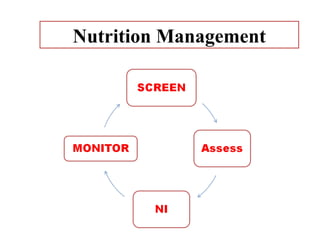
Nutrition Management
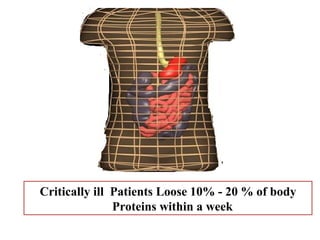
Critically ill Patients Loose 10% - 20 % of body
               Proteins within a week
AGENDA


SECTION I – Status of Critically Ill Patients


SECTION II – Nutritional Screening & Assessment


SECTION III- Nutrition Assessment Methods


SECTION IV- Nutritional Management

Questions and Answers
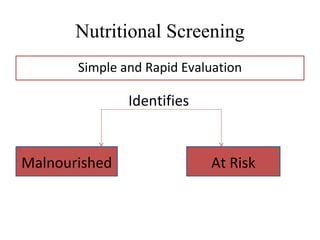
Nutritional Screening
       Simple and Rapid Evaluation

               Identifies


Malnourished                At Risk
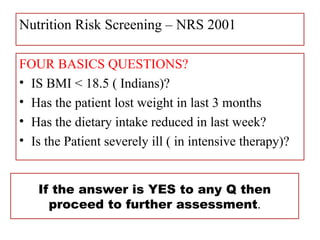
Nutrition Risk Screening – NRS 2001

FOUR BASICS QUESTIONS?
• IS BMI < 18.5 ( Indians)?
• Has the patient lost weight in last 3 months
• Has the dietary intake reduced in last week?
• Is the Patient severely ill ( in intensive therapy)?


   If the answer is YES to any Q then
     proceed to further assessment.
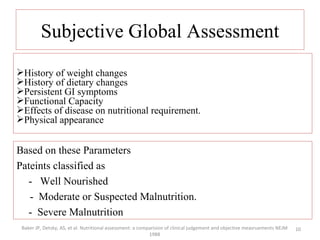
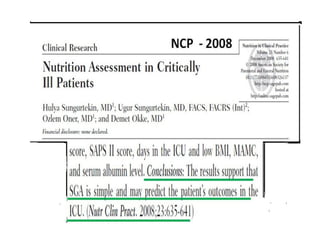
Subjective Global Assessment
History of weight changes
History of dietary changes
Persistent GI symptoms
Functional Capacity
Effects of disease on nutritional requirement.
Physical appearance


Based on these Parameters
Pateints classified as
  - Well Nourished
   - Moderate or Suspected Malnutrition.
  - Severe Malnutrition
 Baker JP, Detsky, AS, et al. Nutritional assessment: a comparision of clinical judgement and objective measruements NEJM    10
                                                            1988
Nutrition Assessment

• It is Mandatory to assess the nutritional status 
  of all the patients within 24 hours of 
  admission. 
AGENDA


SECTION I – Status of Critically Ill Patients


SECTION II – Nutritional Screening & Assessment


SECTION III- Nutrition Assessment Methods


SECTION IV- Nutritional Management

Questions and Answers
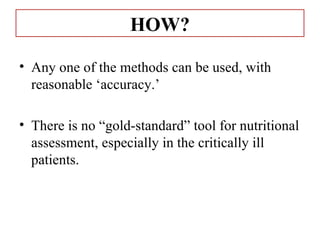
HOW?

• Any one of the methods can be used, with
  reasonable ‘accuracy.’

• There is no “gold-standard” tool for nutritional
  assessment, especially in the critically ill
  patients.
Under
 Disease               nutrition

                     Over nutrition
                                         Screening


                      Inflammation


  CVD                 Abnormal
 Aging                  Body
Diabetes             Compostion
                                         Assessment
                      Diminished
                       Function


            Mobility, Muscle Strength,
             Cognitive Function Host
           Response/Immune Function
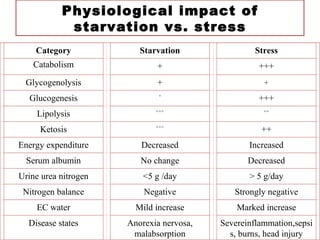
Physiological impact of
            starvation vs. stress
    Category             Starvation                Stress
    Catabolism               +                      +++
 Glycogenolysis              +                       +
                              +
  Glucogenesis                                      +++
                             +++                     ++
     Lipolysis
                             +++
     Ketosis                                        ++
Energy expenditure       Decreased               Increased
  Serum albumin          No change               Decreased
Urine urea nitrogen       <5 g /day              > 5 g/day
 Nitrogen balance         Negative           Strongly negative
    EC water            Mild increase         Marked increase
  Disease states      Anorexia nervosa,   Severeinflammation,sepsi
                       malabsorption        s, burns, head injury
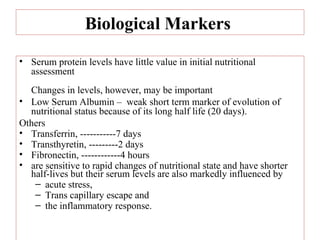
Biological Markers
• Serum protein levels have little value in initial nutritional
  assessment
  Changes in levels, however, may be important
• Low Serum Albumin – weak short term marker of evolution of
  nutritional status because of its long half life (20 days).
Others
• Transferrin, -----------7 days
• Transthyretin, ---------2 days
• Fibronectin, ------------4 hours
• are sensitive to rapid changes of nutritional state and have shorter
  half-lives but their serum levels are also markedly influenced by
   – acute stress,
   – Trans capillary escape and
   – the inflammatory response.
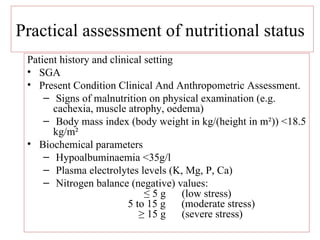
Practical assessment of nutritional status
 Patient history and clinical setting
 • SGA
 • Present Condition Clinical And Anthropometric Assessment.
     – Signs of malnutrition on physical examination (e.g.
       cachexia, muscle atrophy, oedema)
     – Body mass index (body weight in kg/(height in m²)) <18.5
       kg/m²
 • Biochemical parameters
     – Hypoalbuminaemia <35g/l
     – Plasma electrolytes levels (K, Mg, P, Ca)
     – Nitrogen balance (negative) values:
                              ≤5g     (low stress)
                          5 to 15 g   (moderate stress)
                             ≥ 15 g   (severe stress)
AGENDA


SECTION I – Status of Critically Ill Patients


SECTION II – Nutritional Screening & Assessment


SECTION III- Nutrition Assessment Methods


SECTION IV- Nutritional Management

Questions and Answers
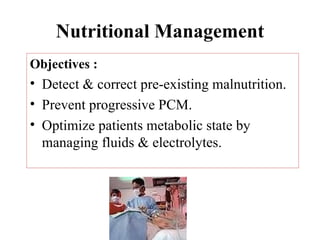
Nutritional Management
Objectives :
• Detect & correct pre-existing malnutrition.
• Prevent progressive PCM.
• Optimize patients metabolic state by
  managing fluids & electrolytes.
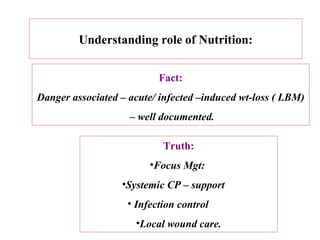
Understanding role of Nutrition:


                          Fact:
Danger associated – acute/ infected –induced wt-loss ( LBM)
                    – well documented.

                           Truth:
                        •Focus Mgt:
                  •Systemic CP – support
                   • Infection control
                     •Local wound care.
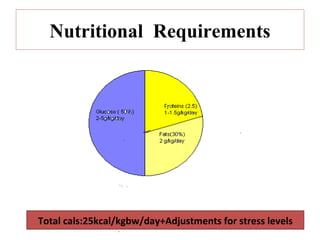
Nutritional Requirements


Total cals:25kcal/kgbw/day+Adjustments for stress levels
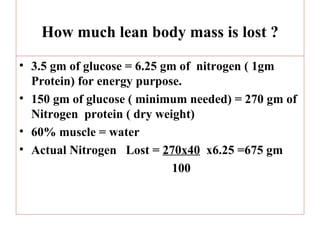
How much lean body mass is lost ?

• 3.5 gm of glucose = 6.25 gm of nitrogen ( 1gm
  Protein) for energy purpose.
• 150 gm of glucose ( minimum needed) = 270 gm of
  Nitrogen protein ( dry weight)
• 60% muscle = water
• Actual Nitrogen Lost = 270x40 x6.25 =675 gm
                             100
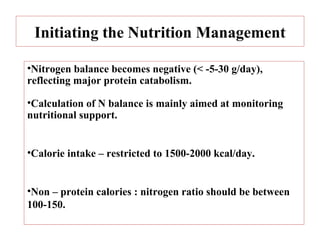
Initiating the Nutrition Management

•Nitrogen balance becomes negative (< -5-30 g/day),
reflecting major protein catabolism.

•Calculation of N balance is mainly aimed at monitoring
nutritional support.


•Calorie intake – restricted to 1500-2000 kcal/day.


•Non – protein calories : nitrogen ratio should be between
100-150.
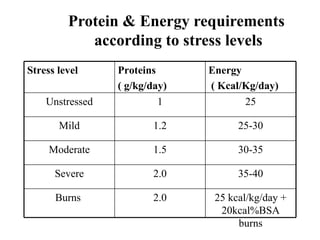
Protein & Energy requirements
            according to stress levels
Stress level     Proteins      Energy
                 ( g/kg/day)   ( Kcal/Kg/day)
    Unstressed            1           25

       Mild             1.2          25-30

     Moderate           1.5          30-35

      Severe            2.0          35-40

      Burns             2.0     25 kcal/kg/day +
                                 20kcal%BSA
                                     burns
Eucaloric Feeds
• Excess feeding increases the risk metabolic
  complications.
• Hyperglycemia
• Pulmonary Edema
• Respiratory Distress
• Patients should be given with no more calories than
  actually estimated during early resuscitative phase.
• After the patient is transferred to ward- anabolism is
  desired, energy intake may be then liberated for weight
  gain.
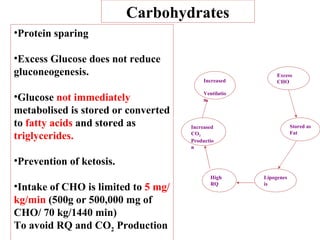
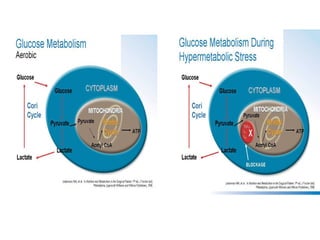
Carbohydrates
•Protein sparing

•Excess Glucose does not reduce
gluconeogenesis.                                            Excess
                                          Increased         CHO

                                          Ventilatio
•Glucose not immediately                  n

metabolised is stored or converted
to fatty acids and stored as         Increased                     Stored as

triglycerides.                       CO2
                                     Productio
                                                                   Fat

                                     n

•Prevention of ketosis.
                                             High      Lipogenes
•Intake of CHO is limited to 5 mg/           RQ        is


kg/min (500g or 500,000 mg of
CHO/ 70 kg/1440 min)
To avoid RQ and CO2 Production
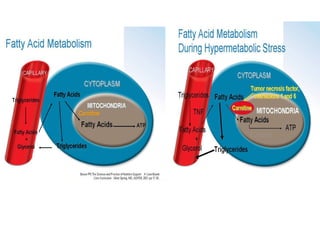
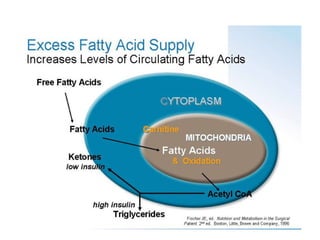
Fats
• Increased Lipolysis
• But also increased Re-esterification
• Net effect: Ineffective utilization of endogenous fat as an
  energy source.
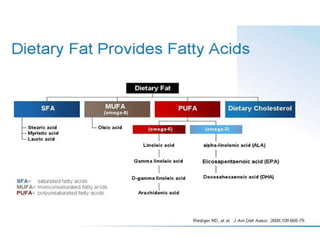
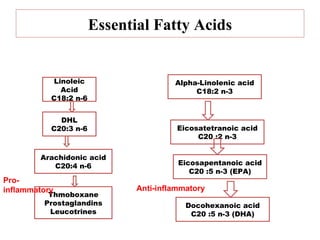
Essential Fatty Acids


            Linoleic                   Alpha-Linolenic acid
              Acid                          C18:2 n-3
           C18:2 n-6


             DHL
           C20:3 n-6                    Eicosatetranoic acid
                                             C20 :2 n-3

        Arachidonic acid
           C20:4 n-6                    Eicosapentanoic acid
                                           C20 :5 n-3 (EPA)
Pro-
inflammatory                  Anti-inflammatory
          Thmoboxane
         Prostaglandins                   Docohexanoic acid
          Leucotrines                      C20 :5 n-3 (DHA)
EFA


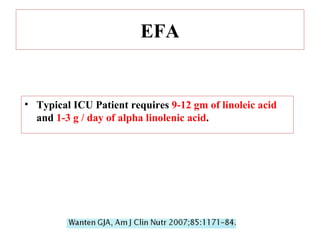
• Typical ICU Patient requires 9-12 gm of linoleic acid
  and 1-3 g / day of alpha linolenic acid.
Vitamins & Trace elements
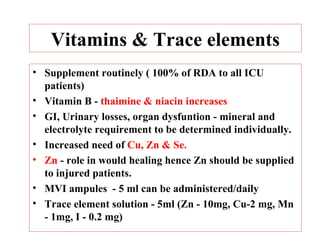
• Supplement routinely ( 100% of RDA to all ICU
  patients)
• Vitamin B - thaimine & niacin increases
• GI, Urinary losses, organ dysfuntion - mineral and
  electrolyte requirement to be determined individually.
• Increased need of Cu, Zn & Se.
• Zn - role in would healing hence Zn should be supplied
  to injured patients.
• MVI ampules - 5 ml can be administered/daily
• Trace element solution - 5ml (Zn - 10mg, Cu-2 mg, Mn
  - 1mg, I - 0.2 mg)
Electrolyte Requirements
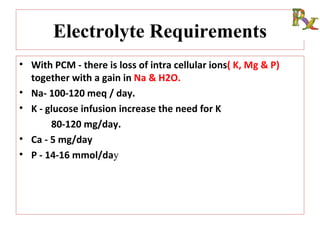
• With PCM - there is loss of intra cellular ions( K, Mg & P)
  together with a gain in Na & H2O.
• Na- 100-120 meq / day.
• K - glucose infusion increase the need for K
       80-120 mg/day.
• Ca - 5 mg/day
• P - 14-16 mmol/day
Immunonutrition
• Immunonutrients – helps in reduction of infectious
  complications and hospital stay.
• Improvement of survival rate not clear.
• Immunonurtrients:
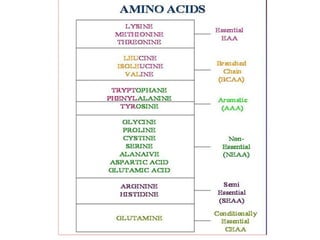
   – Aa arginine and glutamine
   Glutamine: If on TPN – 0.2-0.4 g/kg/day of L-glutamine*
   Enteral supplement – 0.3-0.5g/kg/enteral glutamin/day
   – Omega 3 fatty acids,
   – Nucleotides
   – Vitamins and minerals.

                     * Canadian Critical Care Practice Guidelines 2009
AGENDA


SECTION I – Status of Critically Ill Patients


SECTION II – Nutritional Screening & Assessment


SECTION III- Nutrition Assessment Methods


SECTION IV- Nutritional Management

Questions and Answers
Questions & Answers

To submit a question for Dr. Geeta Dharmatti,
please message Akash Srivastava via the chat
Closing Remarks

Nutritional Guidelines for ICU Patients

  • 1.
    Nutritional Guidelines forICU Patients Dr.Geeta Dharmatti M.Sc, Ph.d Chief Dietician ABMH
  • 2.
    Dr. Dr.(Mrs.) GeetaDharmatti, Ph.D in (Food Science and Nutrition), Nagpur University Chief Dietician and Clinical Nutritionist at Aditya Birla Memorial Hospital, Pune. She has over 15 years of experience working with Hospitals. She has expertise in Enteral and Parental Nutrition, sound experience in setting up of Hospital Dietetics Department, designing of obesity, support group and Scientific Management of obesity clinic. She has been also actively associated with academics, worked as Associate professor with Pune University, Guest Faculty with SNDT, Nutrition session with AFIH course, Corporate Nutrition-Training and Managing healthy Food in Industrial Software canteen. She has done research in Clinical nutrition and got her several research papers presented and published on various occasion; she also shares her knowledge ofnutrition to Media through TV and Newspapers. She is the member of Nutrition Society of India (NSI), Hyderabad chapter, Indian Society of Parenteral and Enteral Nutrition (ISPEN) Pune chapter and presently serving as the president of Indian Dietetic Association, Pune Chapter.  
  • 3.
    AGENDA SECTION I –Status of Critically Ill Patients SECTION II – Nutritional Screening & Assessment SECTION III- Nutrition Assessment Methods SECTION IV- Nutritional Management Questions and Answers
  • 4.
  • 5.
    Critically ill PatientsLoose 10% - 20 % of body Proteins within a week
  • 7.
    AGENDA SECTION I –Status of Critically Ill Patients SECTION II – Nutritional Screening & Assessment SECTION III- Nutrition Assessment Methods SECTION IV- Nutritional Management Questions and Answers
  • 8.
    Nutritional Screening Simple and Rapid Evaluation Identifies Malnourished At Risk
  • 9.
    Nutrition Risk Screening– NRS 2001 FOUR BASICS QUESTIONS? • IS BMI < 18.5 ( Indians)? • Has the patient lost weight in last 3 months • Has the dietary intake reduced in last week? • Is the Patient severely ill ( in intensive therapy)? If the answer is YES to any Q then proceed to further assessment.
  • 10.
    Subjective Global Assessment Historyof weight changes History of dietary changes Persistent GI symptoms Functional Capacity Effects of disease on nutritional requirement. Physical appearance Based on these Parameters Pateints classified as - Well Nourished - Moderate or Suspected Malnutrition. - Severe Malnutrition Baker JP, Detsky, AS, et al. Nutritional assessment: a comparision of clinical judgement and objective measruements NEJM  10 1988
  • 12.
    Nutrition Assessment • It is Mandatory to assess the nutritional status  of all the patients within 24 hours of  admission. 
  • 13.
    AGENDA SECTION I –Status of Critically Ill Patients SECTION II – Nutritional Screening & Assessment SECTION III- Nutrition Assessment Methods SECTION IV- Nutritional Management Questions and Answers
  • 14.
    HOW? • Any oneof the methods can be used, with reasonable ‘accuracy.’ • There is no “gold-standard” tool for nutritional assessment, especially in the critically ill patients.
  • 15.
    Under Disease nutrition Over nutrition Screening Inflammation CVD Abnormal Aging Body Diabetes Compostion Assessment Diminished Function Mobility, Muscle Strength, Cognitive Function Host Response/Immune Function
  • 16.
    Physiological impact of starvation vs. stress Category Starvation Stress Catabolism + +++ Glycogenolysis + + + Glucogenesis +++ +++ ++ Lipolysis +++ Ketosis ++ Energy expenditure Decreased Increased Serum albumin No change Decreased Urine urea nitrogen <5 g /day > 5 g/day Nitrogen balance Negative Strongly negative EC water Mild increase Marked increase Disease states Anorexia nervosa, Severeinflammation,sepsi malabsorption s, burns, head injury
  • 17.
    Biological Markers • Serumprotein levels have little value in initial nutritional assessment Changes in levels, however, may be important • Low Serum Albumin – weak short term marker of evolution of nutritional status because of its long half life (20 days). Others • Transferrin, -----------7 days • Transthyretin, ---------2 days • Fibronectin, ------------4 hours • are sensitive to rapid changes of nutritional state and have shorter half-lives but their serum levels are also markedly influenced by – acute stress, – Trans capillary escape and – the inflammatory response.
  • 18.
    Practical assessment ofnutritional status Patient history and clinical setting • SGA • Present Condition Clinical And Anthropometric Assessment. – Signs of malnutrition on physical examination (e.g. cachexia, muscle atrophy, oedema) – Body mass index (body weight in kg/(height in m²)) <18.5 kg/m² • Biochemical parameters – Hypoalbuminaemia <35g/l – Plasma electrolytes levels (K, Mg, P, Ca) – Nitrogen balance (negative) values: ≤5g (low stress) 5 to 15 g (moderate stress) ≥ 15 g (severe stress)
  • 19.
    AGENDA SECTION I –Status of Critically Ill Patients SECTION II – Nutritional Screening & Assessment SECTION III- Nutrition Assessment Methods SECTION IV- Nutritional Management Questions and Answers
  • 20.
    Nutritional Management Objectives : •Detect & correct pre-existing malnutrition. • Prevent progressive PCM. • Optimize patients metabolic state by managing fluids & electrolytes.
  • 21.
    Understanding role ofNutrition: Fact: Danger associated – acute/ infected –induced wt-loss ( LBM) – well documented. Truth: •Focus Mgt: •Systemic CP – support • Infection control •Local wound care.
  • 22.
  • 23.
    How much leanbody mass is lost ? • 3.5 gm of glucose = 6.25 gm of nitrogen ( 1gm Protein) for energy purpose. • 150 gm of glucose ( minimum needed) = 270 gm of Nitrogen protein ( dry weight) • 60% muscle = water • Actual Nitrogen Lost = 270x40 x6.25 =675 gm 100
  • 24.
    Initiating the NutritionManagement •Nitrogen balance becomes negative (< -5-30 g/day), reflecting major protein catabolism. •Calculation of N balance is mainly aimed at monitoring nutritional support. •Calorie intake – restricted to 1500-2000 kcal/day. •Non – protein calories : nitrogen ratio should be between 100-150.
  • 25.
    Protein & Energyrequirements according to stress levels Stress level Proteins Energy ( g/kg/day) ( Kcal/Kg/day) Unstressed 1 25 Mild 1.2 25-30 Moderate 1.5 30-35 Severe 2.0 35-40 Burns 2.0 25 kcal/kg/day + 20kcal%BSA burns
  • 26.
    Eucaloric Feeds • Excessfeeding increases the risk metabolic complications. • Hyperglycemia • Pulmonary Edema • Respiratory Distress • Patients should be given with no more calories than actually estimated during early resuscitative phase. • After the patient is transferred to ward- anabolism is desired, energy intake may be then liberated for weight gain.
  • 27.
    Carbohydrates •Protein sparing •Excess Glucosedoes not reduce gluconeogenesis. Excess Increased CHO Ventilatio •Glucose not immediately n metabolised is stored or converted to fatty acids and stored as Increased Stored as triglycerides. CO2 Productio Fat n •Prevention of ketosis. High Lipogenes •Intake of CHO is limited to 5 mg/ RQ is kg/min (500g or 500,000 mg of CHO/ 70 kg/1440 min) To avoid RQ and CO2 Production
  • 30.
    Fats • Increased Lipolysis •But also increased Re-esterification • Net effect: Ineffective utilization of endogenous fat as an energy source.
  • 34.
    Essential Fatty Acids Linoleic Alpha-Linolenic acid Acid C18:2 n-3 C18:2 n-6 DHL C20:3 n-6 Eicosatetranoic acid C20 :2 n-3 Arachidonic acid C20:4 n-6 Eicosapentanoic acid C20 :5 n-3 (EPA) Pro- inflammatory Anti-inflammatory Thmoboxane Prostaglandins Docohexanoic acid Leucotrines C20 :5 n-3 (DHA)
  • 35.
    EFA • Typical ICUPatient requires 9-12 gm of linoleic acid and 1-3 g / day of alpha linolenic acid.
  • 36.
    Vitamins & Traceelements • Supplement routinely ( 100% of RDA to all ICU patients) • Vitamin B - thaimine & niacin increases • GI, Urinary losses, organ dysfuntion - mineral and electrolyte requirement to be determined individually. • Increased need of Cu, Zn & Se. • Zn - role in would healing hence Zn should be supplied to injured patients. • MVI ampules - 5 ml can be administered/daily • Trace element solution - 5ml (Zn - 10mg, Cu-2 mg, Mn - 1mg, I - 0.2 mg)
  • 37.
    Electrolyte Requirements • WithPCM - there is loss of intra cellular ions( K, Mg & P) together with a gain in Na & H2O. • Na- 100-120 meq / day. • K - glucose infusion increase the need for K 80-120 mg/day. • Ca - 5 mg/day • P - 14-16 mmol/day
  • 38.
    Immunonutrition • Immunonutrients –helps in reduction of infectious complications and hospital stay. • Improvement of survival rate not clear. • Immunonurtrients: – Aa arginine and glutamine Glutamine: If on TPN – 0.2-0.4 g/kg/day of L-glutamine* Enteral supplement – 0.3-0.5g/kg/enteral glutamin/day – Omega 3 fatty acids, – Nucleotides – Vitamins and minerals. * Canadian Critical Care Practice Guidelines 2009
  • 39.
    AGENDA SECTION I –Status of Critically Ill Patients SECTION II – Nutritional Screening & Assessment SECTION III- Nutrition Assessment Methods SECTION IV- Nutritional Management Questions and Answers
  • 41.
    Questions & Answers Tosubmit a question for Dr. Geeta Dharmatti, please message Akash Srivastava via the chat
  • 42.