
COVID-19 variants and vaccines
Varsha Khodiyar, PhD
What is a virus?
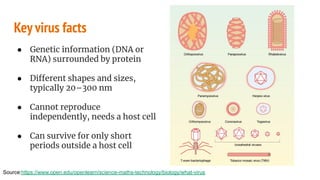
Key virus facts
Source:https://www.open.edu/openlearn/science-maths-technology/biology/what-virus
● Genetic information (DNA or
RNA) surrounded by protein
● Different shapes and sizes,
typically 20–300 nm
● Cannot reproduce
independently, needs a host cell
● Can survive for only short
periods outside a host cell
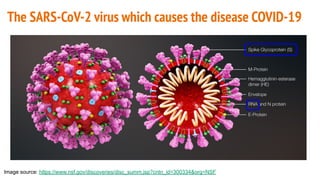
The SARS-CoV-2 virus which causes the disease COVID-19
Image source: https://www.nsf.gov/discoveries/disc_summ.jsp?cntn_id=300334&org=NSF
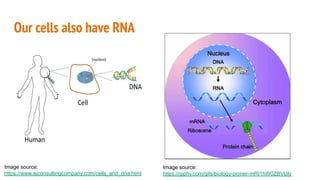
Our cells also have RNA
Image source:
https://giphy.com/gifs/biology-primer-mRI1hW0ZBVUly
Image source:
https://www.ajconsultingcompany.com/cells_and_dna.html
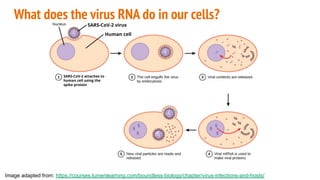
What does the virus RNA do in our cells?
Image adapted from: https://courses.lumenlearning.com/boundless-biology/chapter/virus-infections-and-hosts/
SARS-CoV-2 attaches to
human cell using the
spike protein
SARS-CoV-2 virus
Human cell
● DNA and RNA are types of
genetic material
● RNA is a naturally
occurring part of our cells
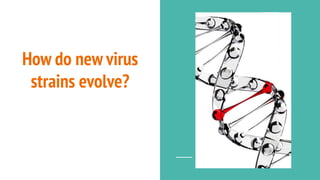
How do new virus
strains evolve?
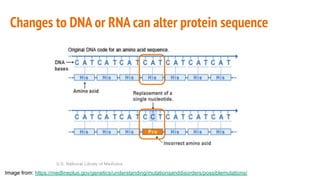
Changes to DNA or RNA can alter protein sequence
Image from: https://medlineplus.gov/genetics/understanding/mutationsanddisorders/possiblemutations/
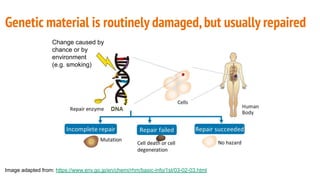
Genetic material is routinely damaged,but usually repaired
Image adapted from: https://www.env.go.jp/en/chemi/rhm/basic-info/1st/03-02-03.html
Change caused by
chance or by
environment
(e.g. smoking)
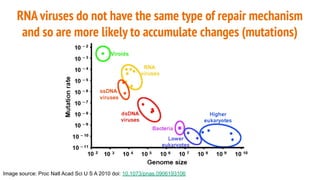
RNA viruses do not have the same type of repair mechanism
and so are more likely to accumulate changes (mutations)
Image source: Proc Natl Acad Sci U S A 2010 doi: 10.1073/pnas.0906193106
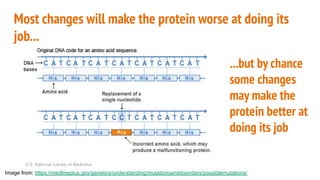
Most changes will make the protein worse at doing its
job...
Image from: https://medlineplus.gov/genetics/understanding/mutationsanddisorders/possiblemutations/
...but by chance
some changes
may make the
protein better at
doing its job
Lots of changes results in new virus variants
Source: https://www.bbc.co.uk/news/health-55659820
● Changes to the genetic code
(mutations) happen all the time
● Most changes will make a protein
less effective
● Multiple changes can result in the
evolution of a new virus variant
What do we know
about the new
SARS-CoV-2 strains?
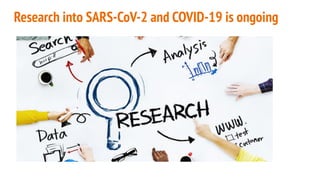
Research into SARS-CoV-2 and COVID-19 is ongoing
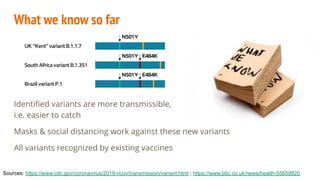
What we know so far
Sources: https://www.cdc.gov/coronavirus/2019-ncov/transmission/variant.html ; https://www.bbc.co.uk/news/health-55659820
Identified variants are more transmissible,
i.e. easier to catch
Masks & social distancing work against these new variants
All variants recognized by existing vaccines
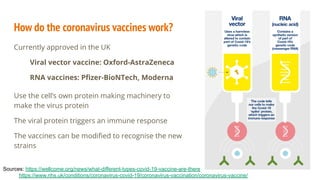
How do the coronavirus vaccines work?
Sources: https://wellcome.org/news/what-different-types-covid-19-vaccine-are-there
https://www.nhs.uk/conditions/coronavirus-covid-19/coronavirus-vaccination/coronavirus-vaccine/
Currently approved in the UK
Viral vector vaccine: Oxford-AstraZeneca
RNA vaccines: Pfizer-BioNTech, Moderna
Use the cell’s own protein making machinery to
make the virus protein
The viral protein triggers an immune response
The vaccines can be modified to recognise the new
strains
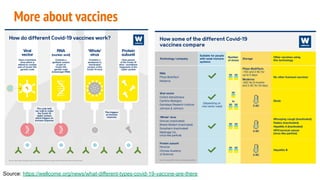
More about vaccines
Source: https://wellcome.org/news/what-different-types-covid-19-vaccine-are-there
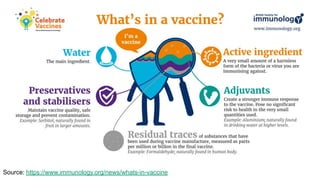
Source: https://www.immunology.org/news/whats-in-vaccine
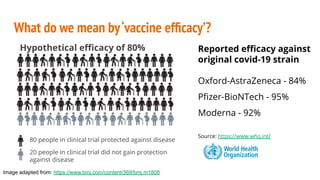
What do we mean by‘vaccine efficacy’?
Hypothetical efficacy of 80%
80 people in clinical trial protected against disease
20 people in clinical trial did not gain protection
against disease
Image adapted from: https://www.bmj.com/content/369/bmj.m1808
Reported efficacy against
original covid-19 strain
Oxford-AstraZeneca - 84%
Pfizer-BioNTech - 95%
Moderna - 92%
Source: https://www.who.int/
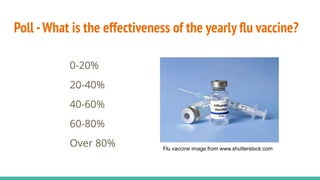
Poll -What is the effectiveness of the yearly flu vaccine?
0-20%
20-40%
40-60%
60-80%
Over 80% Flu vaccine image from www.shutterstock.com
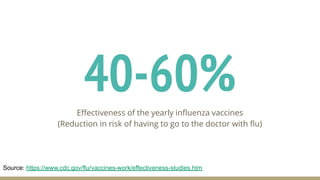
40-60%
Effectiveness of the yearly influenza vaccines
(Reduction in risk of having to go to the doctor with flu)
Source: https://www.cdc.gov/flu/vaccines-work/effectiveness-studies.htm
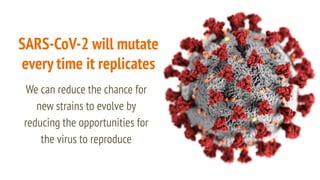
SARS-CoV-2 will mutate
every time it replicates
We can reduce the chance for
new strains to evolve by
reducing the opportunities for
the virus to reproduce
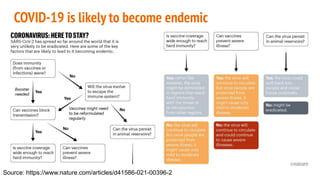
COVID-19 is likely to become endemic
Source: https://www.nature.com/articles/d41586-021-00396-2
Finding out more
Image source:
https://mrbarlow.wordpress.com/2012/11/24/take-breaks-to-learn-more/
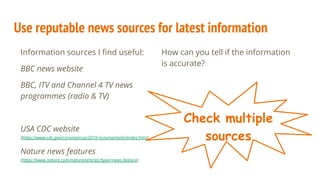
Use reputable news sources for latest information
Information sources I find useful:
BBC news website
BBC, ITV and Channel 4 TV news
programmes (radio & TV)
USA CDC website
(https://www.cdc.gov/coronavirus/2019-ncov/variants/index.html)
Nature news features
(https://www.nature.com/nature/articles?type=news-feature)
How can you tell if the information
is accurate?
Check multiple
sources
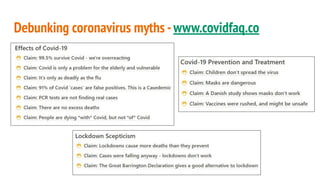
Debunking coronavirus myths -www.covidfaq.co
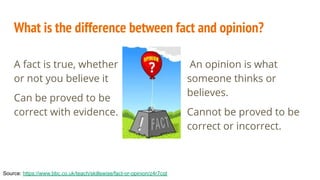
What is the difference between fact and opinion?
A fact is true, whether
or not you believe it
Can be proved to be
correct with evidence.
An opinion is what
someone thinks or
believes.
Cannot be proved to be
correct or incorrect.
Source: https://www.bbc.co.uk/teach/skillswise/fact-or-opinion/z4r7cqt
Check that your information
sources are reputable and
worthy of your trust
“Knowledge is power”
Sir Francis Bacon (1597)
@varsha_khodiyar
Varsha Khodiyar
The information in this slide deck was presented at
the Asha-Deep Project webinar
Thursday 18th February 2021
Asha-Deep Project email: ashadeepc19@gmail.com
Slide deck created by
Varsha Khodiyar
Slide deck licensed as CC-BY
https://creativecommons.org/licenses/by/4.0/

COVID-19 variants and vaccines

  • 1.
    COVID-19 variants andvaccines Varsha Khodiyar, PhD
  • 2.
    What is avirus?
  • 3.
    Key virus facts Source:https://www.open.edu/openlearn/science-maths-technology/biology/what-virus ●Genetic information (DNA or RNA) surrounded by protein ● Different shapes and sizes, typically 20–300 nm ● Cannot reproduce independently, needs a host cell ● Can survive for only short periods outside a host cell
  • 4.
    The SARS-CoV-2 viruswhich causes the disease COVID-19 Image source: https://www.nsf.gov/discoveries/disc_summ.jsp?cntn_id=300334&org=NSF
  • 5.
    Our cells alsohave RNA Image source: https://giphy.com/gifs/biology-primer-mRI1hW0ZBVUly Image source: https://www.ajconsultingcompany.com/cells_and_dna.html
  • 6.
    What does thevirus RNA do in our cells? Image adapted from: https://courses.lumenlearning.com/boundless-biology/chapter/virus-infections-and-hosts/ SARS-CoV-2 attaches to human cell using the spike protein SARS-CoV-2 virus Human cell
  • 7.
    ● DNA andRNA are types of genetic material ● RNA is a naturally occurring part of our cells
  • 8.
    How do newvirus strains evolve?
  • 9.
    Changes to DNAor RNA can alter protein sequence Image from: https://medlineplus.gov/genetics/understanding/mutationsanddisorders/possiblemutations/
  • 10.
    Genetic material isroutinely damaged,but usually repaired Image adapted from: https://www.env.go.jp/en/chemi/rhm/basic-info/1st/03-02-03.html Change caused by chance or by environment (e.g. smoking)
  • 11.
    RNA viruses donot have the same type of repair mechanism and so are more likely to accumulate changes (mutations) Image source: Proc Natl Acad Sci U S A 2010 doi: 10.1073/pnas.0906193106
  • 12.
    Most changes willmake the protein worse at doing its job... Image from: https://medlineplus.gov/genetics/understanding/mutationsanddisorders/possiblemutations/ ...but by chance some changes may make the protein better at doing its job
  • 13.
    Lots of changesresults in new virus variants Source: https://www.bbc.co.uk/news/health-55659820
  • 14.
    ● Changes tothe genetic code (mutations) happen all the time ● Most changes will make a protein less effective ● Multiple changes can result in the evolution of a new virus variant
  • 15.
    What do weknow about the new SARS-CoV-2 strains?
  • 16.
    Research into SARS-CoV-2and COVID-19 is ongoing
  • 17.
    What we knowso far Sources: https://www.cdc.gov/coronavirus/2019-ncov/transmission/variant.html ; https://www.bbc.co.uk/news/health-55659820 Identified variants are more transmissible, i.e. easier to catch Masks & social distancing work against these new variants All variants recognized by existing vaccines
  • 18.
    How do thecoronavirus vaccines work? Sources: https://wellcome.org/news/what-different-types-covid-19-vaccine-are-there https://www.nhs.uk/conditions/coronavirus-covid-19/coronavirus-vaccination/coronavirus-vaccine/ Currently approved in the UK Viral vector vaccine: Oxford-AstraZeneca RNA vaccines: Pfizer-BioNTech, Moderna Use the cell’s own protein making machinery to make the virus protein The viral protein triggers an immune response The vaccines can be modified to recognise the new strains
  • 19.
    More about vaccines Source:https://wellcome.org/news/what-different-types-covid-19-vaccine-are-there
  • 20.
  • 21.
    What do wemean by‘vaccine efficacy’? Hypothetical efficacy of 80% 80 people in clinical trial protected against disease 20 people in clinical trial did not gain protection against disease Image adapted from: https://www.bmj.com/content/369/bmj.m1808 Reported efficacy against original covid-19 strain Oxford-AstraZeneca - 84% Pfizer-BioNTech - 95% Moderna - 92% Source: https://www.who.int/
  • 22.
    Poll -What isthe effectiveness of the yearly flu vaccine? 0-20% 20-40% 40-60% 60-80% Over 80% Flu vaccine image from www.shutterstock.com
  • 23.
    40-60% Effectiveness of theyearly influenza vaccines (Reduction in risk of having to go to the doctor with flu) Source: https://www.cdc.gov/flu/vaccines-work/effectiveness-studies.htm
  • 24.
    SARS-CoV-2 will mutate everytime it replicates We can reduce the chance for new strains to evolve by reducing the opportunities for the virus to reproduce
  • 25.
    COVID-19 is likelyto become endemic Source: https://www.nature.com/articles/d41586-021-00396-2
  • 26.
    Finding out more Imagesource: https://mrbarlow.wordpress.com/2012/11/24/take-breaks-to-learn-more/
  • 27.
    Use reputable newssources for latest information Information sources I find useful: BBC news website BBC, ITV and Channel 4 TV news programmes (radio & TV) USA CDC website (https://www.cdc.gov/coronavirus/2019-ncov/variants/index.html) Nature news features (https://www.nature.com/nature/articles?type=news-feature) How can you tell if the information is accurate? Check multiple sources
  • 28.
  • 29.
    What is thedifference between fact and opinion? A fact is true, whether or not you believe it Can be proved to be correct with evidence. An opinion is what someone thinks or believes. Cannot be proved to be correct or incorrect. Source: https://www.bbc.co.uk/teach/skillswise/fact-or-opinion/z4r7cqt
  • 30.
    Check that yourinformation sources are reputable and worthy of your trust
  • 31.
    “Knowledge is power” SirFrancis Bacon (1597)
  • 32.
    @varsha_khodiyar Varsha Khodiyar The informationin this slide deck was presented at the Asha-Deep Project webinar Thursday 18th February 2021 Asha-Deep Project email: ashadeepc19@gmail.com Slide deck created by Varsha Khodiyar Slide deck licensed as CC-BY https://creativecommons.org/licenses/by/4.0/