New approaches to data
management: supporting FAIR
data sharing at Springer Nature
Varsha Khodiyar, PhD
Biocuration 2019
IllustrationinspiredbytheworkofJohnMaynardKeynes
1
New approaches to data management: supporting FAIR data sharing at Springer Nature
Springer Nature is a leading research, educational and professional publisher, providing
quality content to our communities through a range of innovative platforms, products
and services.
Home to brands including Springer, Nature Research, BioMed Central, Palgrave
Macmillan and Scientific American.
As the leading open access publisher, we see the rise of open research in all its
manifestations as one of the major forces reshaping the way that researchers
communicate and collaborate to advance the pace and quality of discovery.
Our focus is on investing in and creating tools, services or training that help the research
community to understand and utilise new ideas and concepts.
2
New approaches to data management: supporting FAIR data sharing at Springer Nature
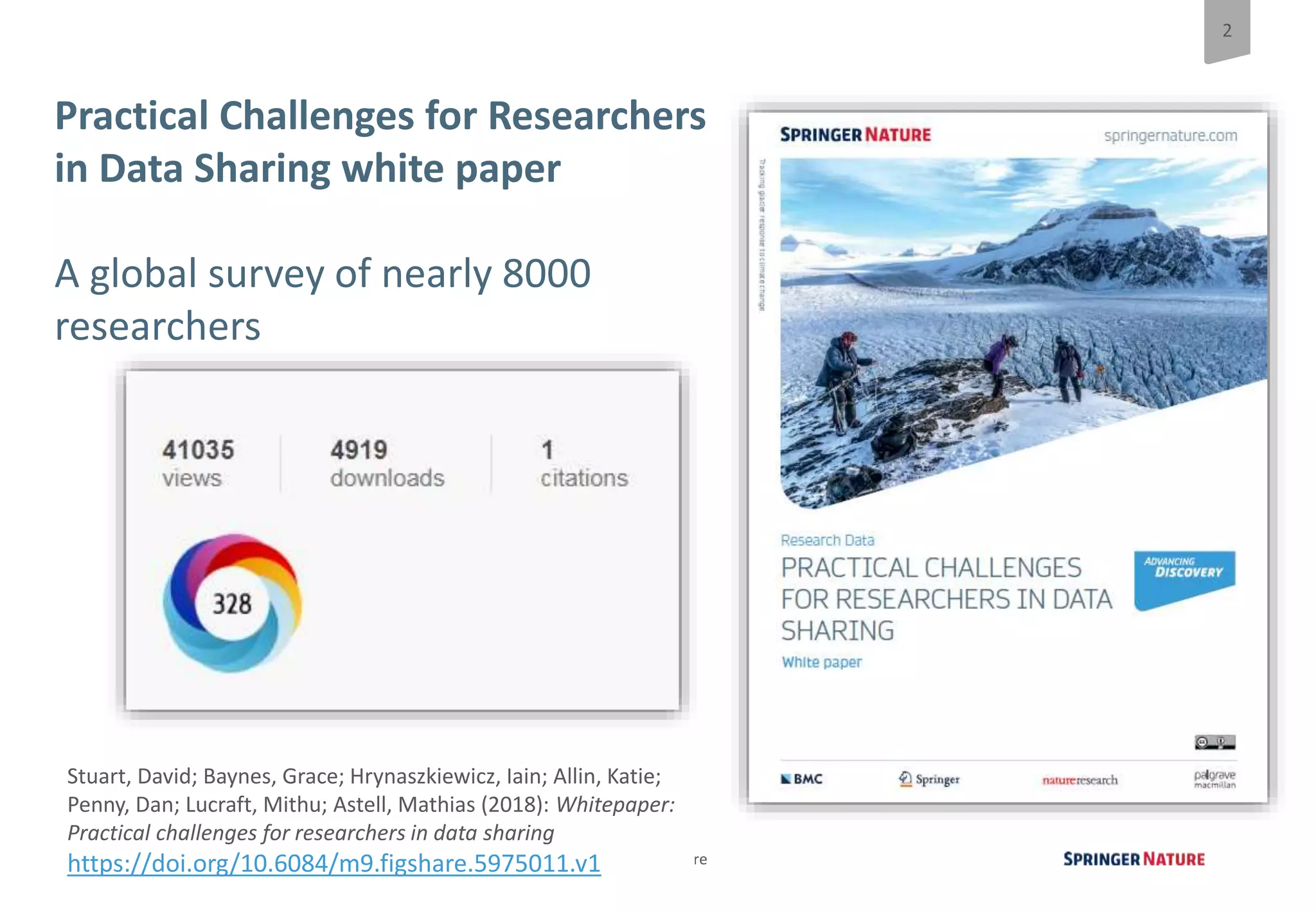
Practical Challenges for Researchers
in Data Sharing white paper
A global survey of nearly 8000
researchers
Stuart, David; Baynes, Grace; Hrynaszkiewicz, Iain; Allin, Katie;
Penny, Dan; Lucraft, Mithu; Astell, Mathias (2018): Whitepaper:
Practical challenges for researchers in data sharing
https://doi.org/10.6084/m9.figshare.5975011.v1
3
New approaches to data management: supporting FAIR data sharing at Springer Nature
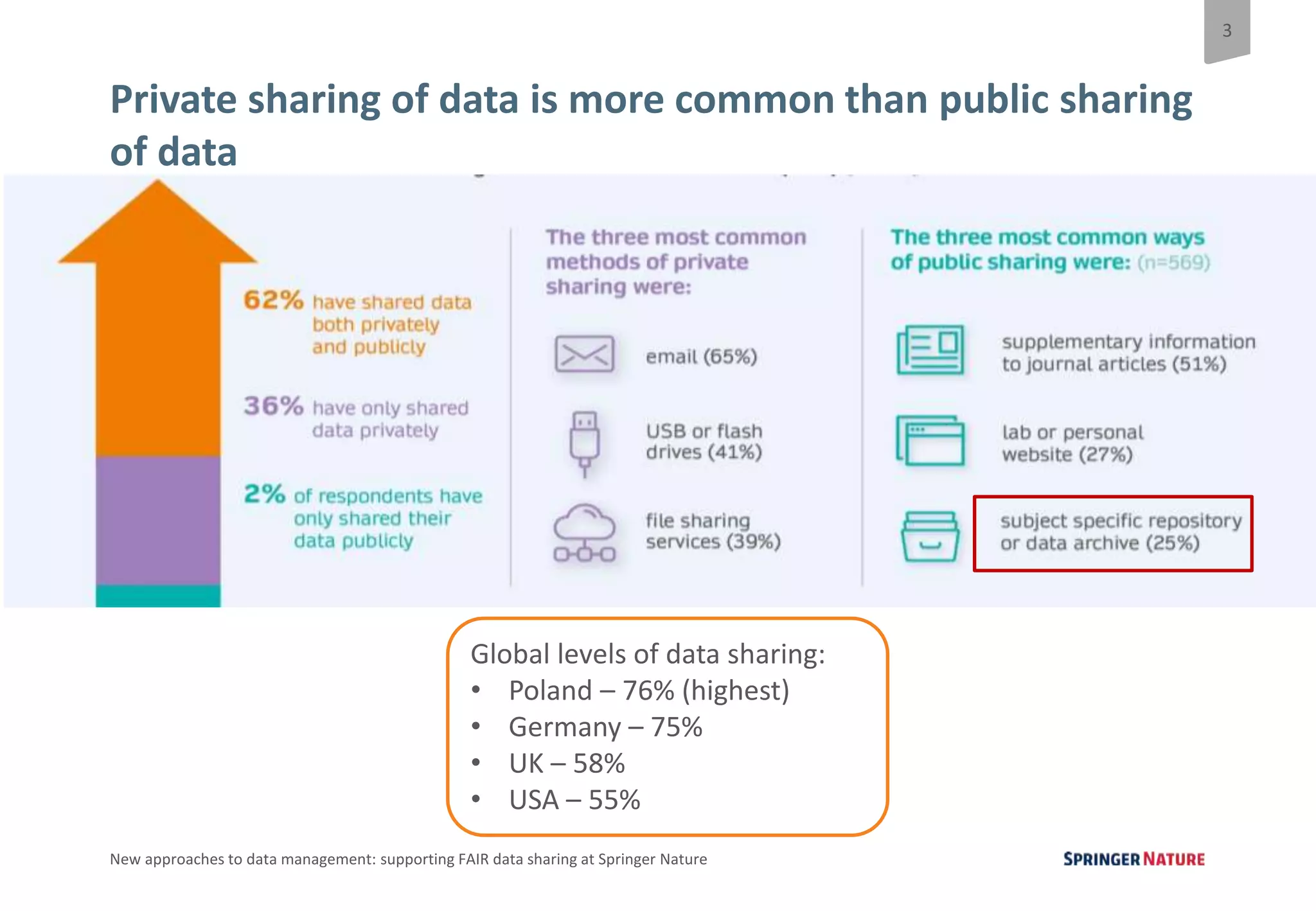
Private sharing of data is more common than public sharing
of data
Global levels of data sharing:
• Poland – 76% (highest)
• Germany – 75%
• UK – 58%
• USA – 55%
4
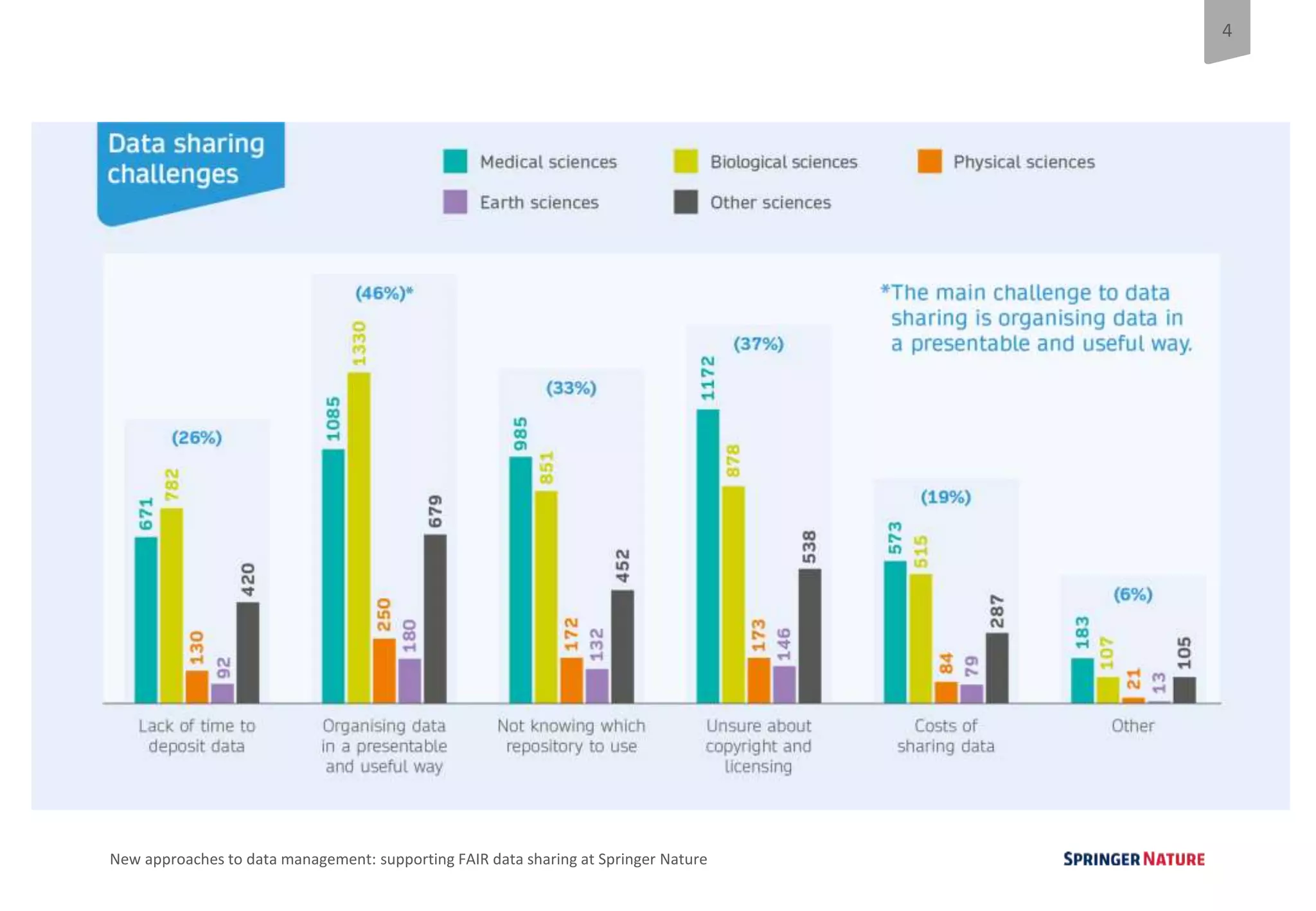
New approaches to data management: supporting FAIR data sharing at Springer Nature
5
New approaches to data management: supporting FAIR data sharing at Springer Nature
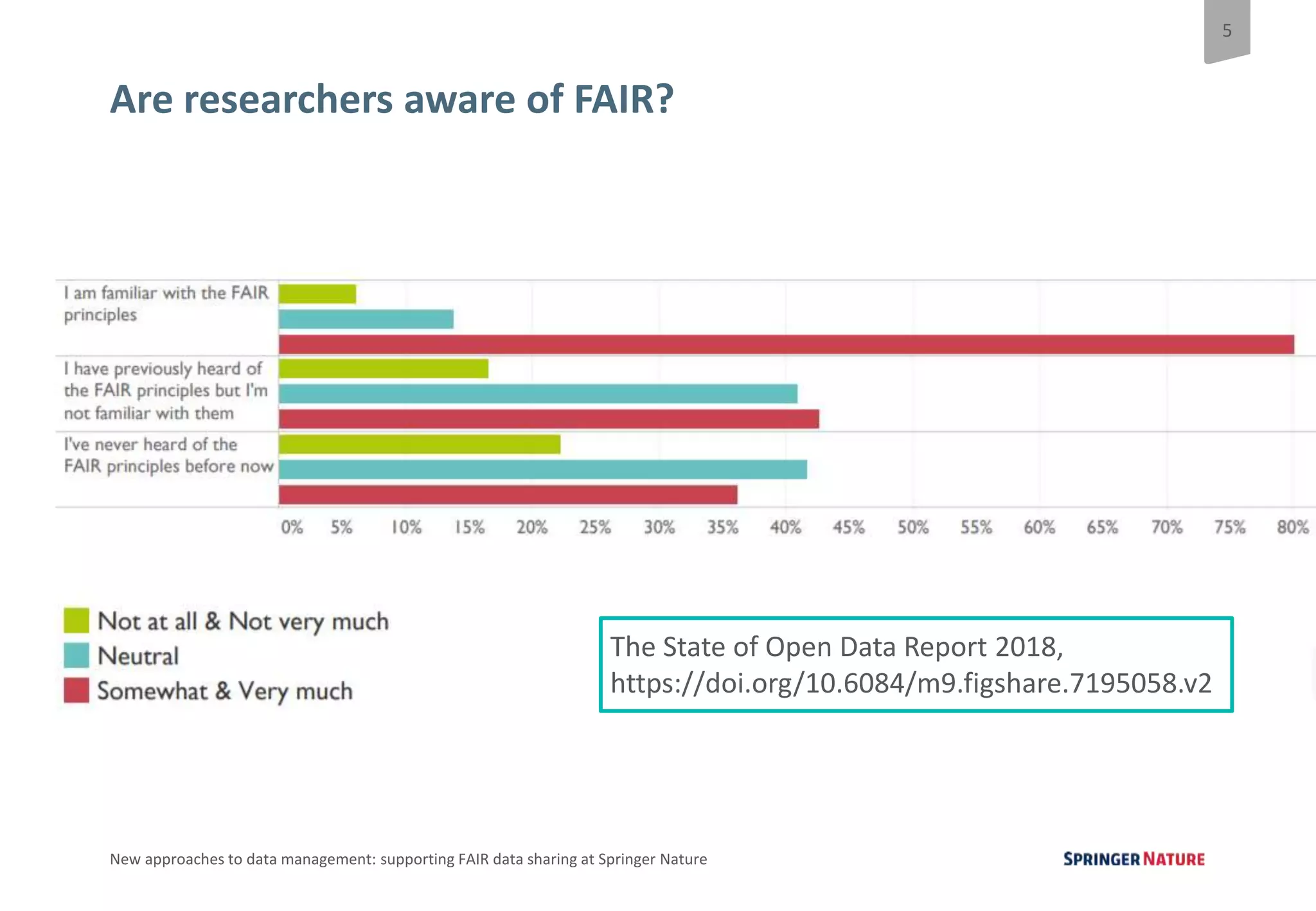
Are researchers aware of FAIR?
The State of Open Data Report 2018,
https://doi.org/10.6084/m9.figshare.7195058.v2
6
New approaches to data management: supporting FAIR data sharing at Springer Nature
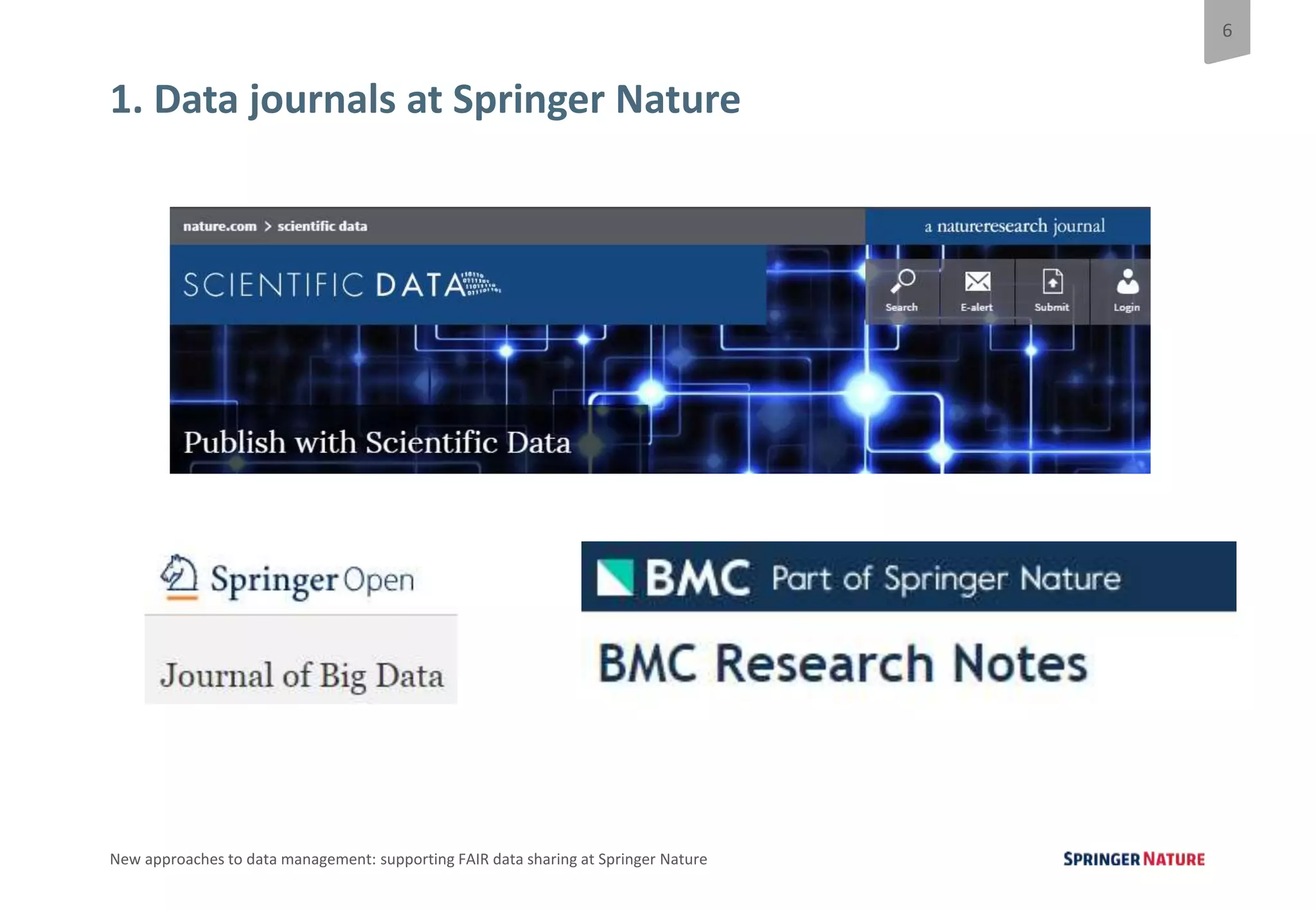
1. Data journals at Springer Nature
7
New approaches to data management: supporting FAIR data sharing at Springer Nature
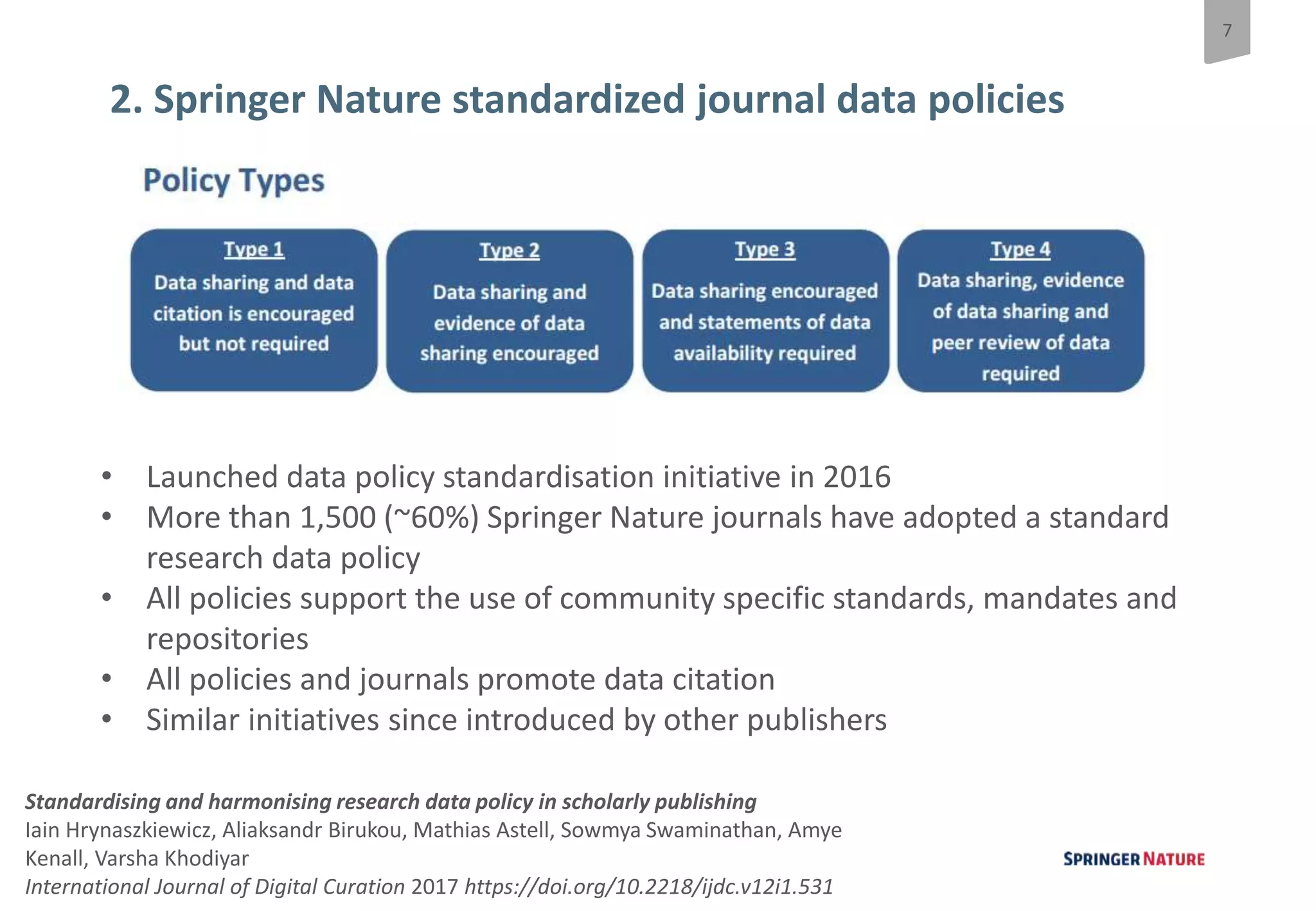
2. Springer Nature standardized journal data policies
• Launched data policy standardisation initiative in 2016
• More than 1,500 (~60%) Springer Nature journals have adopted a standard
research data policy
• All policies support the use of community specific standards, mandates and
repositories
• All policies and journals promote data citation
• Similar initiatives since introduced by other publishers
Standardising and harmonising research data policy in scholarly publishing
Iain Hrynaszkiewicz, Aliaksandr Birukou, Mathias Astell, Sowmya Swaminathan, Amye
Kenall, Varsha Khodiyar
International Journal of Digital Curation 2017 https://doi.org/10.2218/ijdc.v12i1.531
8
New approaches to data management: supporting FAIR data sharing at Springer Nature
How do journal policies improve FAIRness of published
data?
 A journal policy may be the first time that a researcher has been
encouraged (or required) to share their research data openly
 The policies always recommend that data are shared in suitable
repositories rather than made available on request or uploaded as
supplementary material
 The policies encourage any data used to be cited in the reference list,
to allow it to be found and accessed more easily
 Mandatory aspects of the policy are checked before the article is
published
9
New approaches to data management: supporting FAIR data sharing at Springer Nature
3. Research Data Helpdesk
Queries are answered within two business days
Run by members of the Springer Nature Research Data team
Expertise in data curation and management, archiving and
digital preservation, copyright and licensing, Open Access
publishing
Always encourage best practices, e.g. the use of
community repositories for specific data types
Email: researchdata@springernature.com
http://www.springernature.com/gp/group/data-policy/helpdesk
10
New approaches to data management: supporting FAIR data sharing at Springer Nature
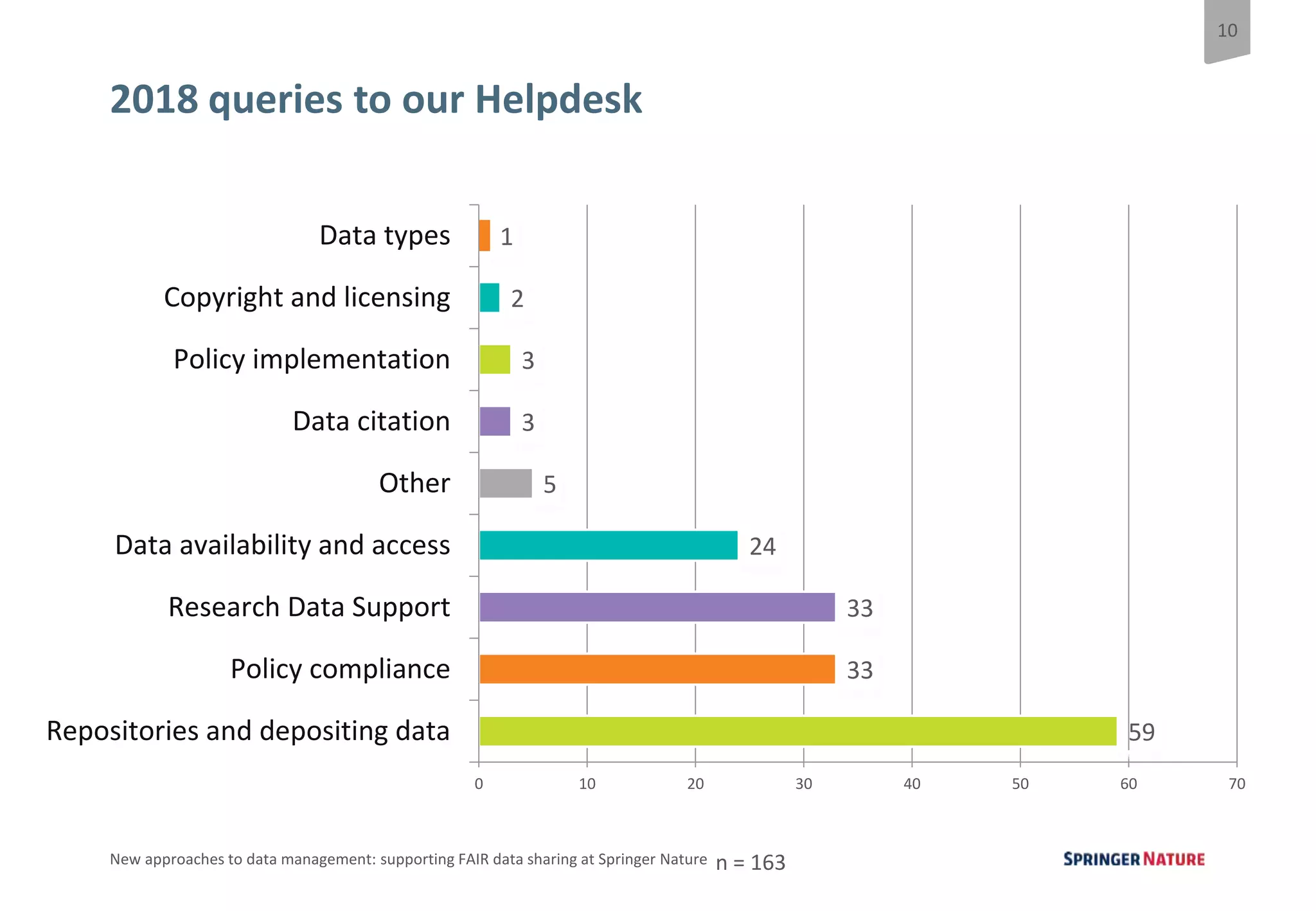
2018 queries to our Helpdesk
59
33
33
24
5
3
3
2
1
Repositories and depositing data
Policy compliance
Research Data Support
Data availability and access
Other
Data citation
Policy implementation
Copyright and licensing
Data types
0 10 20 30 40 50 60 70
n = 163
11
New approaches to data management: supporting FAIR data sharing at Springer Nature
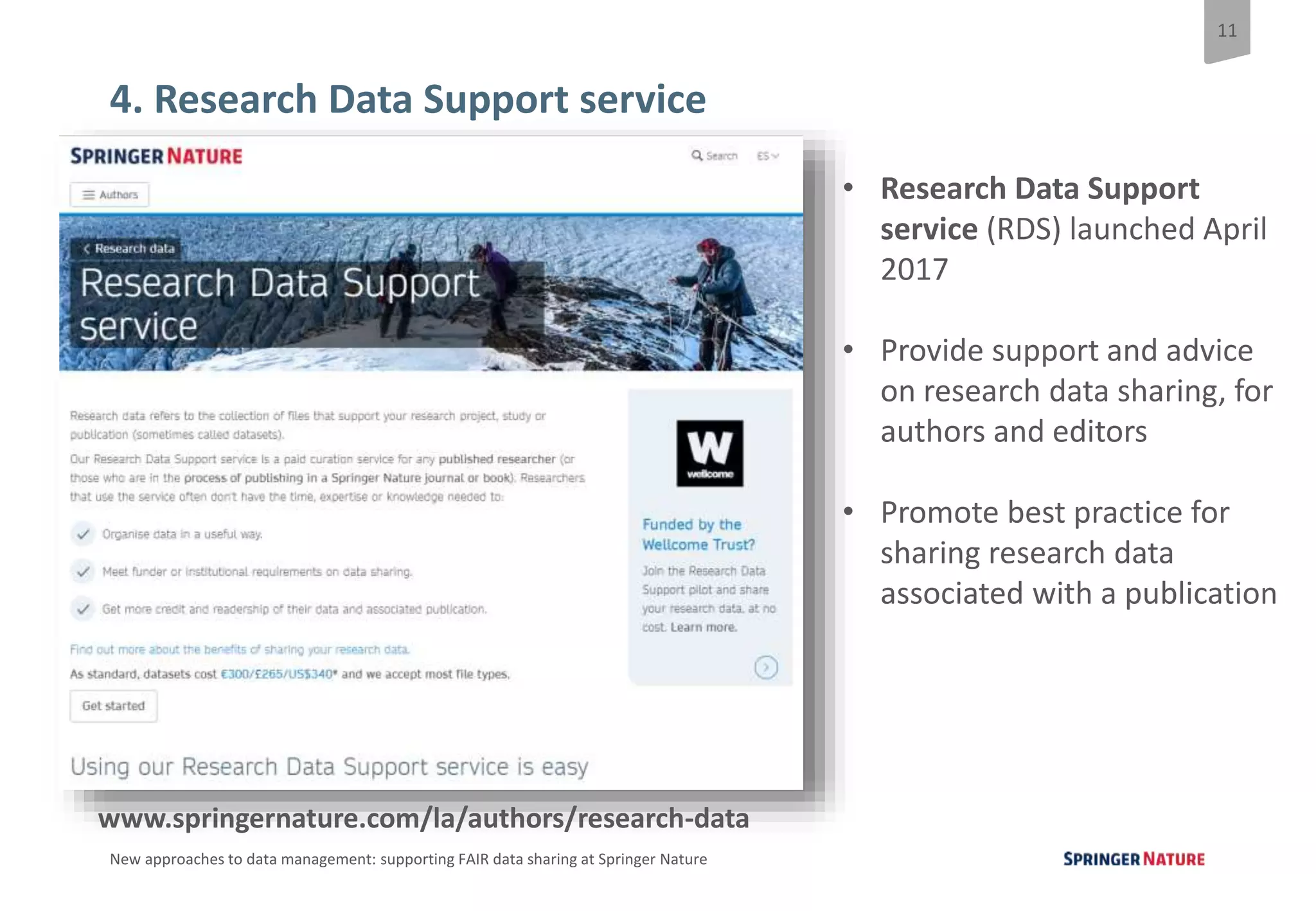
4. Research Data Support service
• Research Data Support
service (RDS) launched April
2017
• Provide support and advice
on research data sharing, for
authors and editors
• Promote best practice for
sharing research data
associated with a publication
www.springernature.com/la/authors/research-data
12
New approaches to data management: supporting FAIR data sharing at Springer Nature
Analysing DAS across published articles allows us to assess how authors choose
to share their data
Analyzing the impact via data availability statements (DAS)
“The datasets generated during and/or analysed
during the current study are available in the [NAME]
repository, [PERSISTENT WEB LINK TO DATASETS].”
“The datasets generated during and/or analysed
during the current study are available from the
corresponding author on reasonable request.”
“All data generated or analysed during this study are
included in this published article (and its
supplementary information files).”
13
New approaches to data management: supporting FAIR data sharing at Springer Nature
Analysing Data Availability at Nature journals
An analysis of data sharing at Nature Research journals
(including Nature, Nature Ecology and Evolution, Nature Human Behaviour, Nature
Microbiology, Nature Plants, Nature Medicine, Nature Methods, Nature Biotechnology,
Nature Genetics, Nature Chemical Biology, Nature Immunology, Nature Structural and
Molecular Biology, Nature Astronomy, Nature Chemistry, Nature Climate Change, Nature
Materials, Nature Energy, Nature Nanotechnology, Nature Biomedical Engineering and
Nature Photonics)
Data availability statements were coded to assess what methods authors are using to
share the data that accompanies their published articles.
The disciplinary focus of each journal was also captured
14
New approaches to data management: supporting FAIR data sharing at Springer Nature
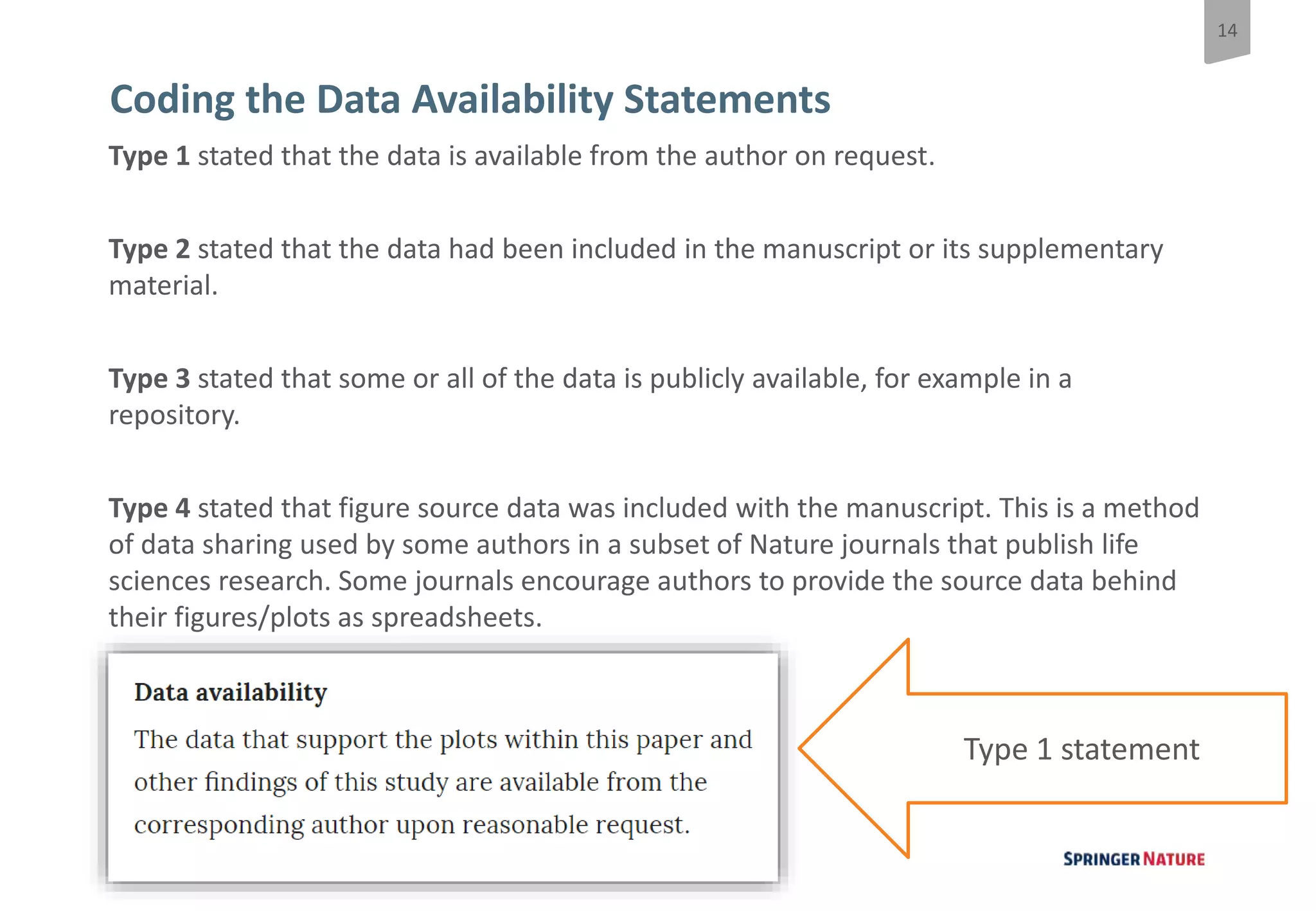
Coding the Data Availability Statements
Type 1 stated that the data is available from the author on request.
Type 2 stated that the data had been included in the manuscript or its supplementary
material.
Type 3 stated that some or all of the data is publicly available, for example in a
repository.
Type 4 stated that figure source data was included with the manuscript. This is a method
of data sharing used by some authors in a subset of Nature journals that publish life
sciences research. Some journals encourage authors to provide the source data behind
their figures/plots as spreadsheets.
Type 1 statement
15
New approaches to data management: supporting FAIR data sharing at Springer Nature
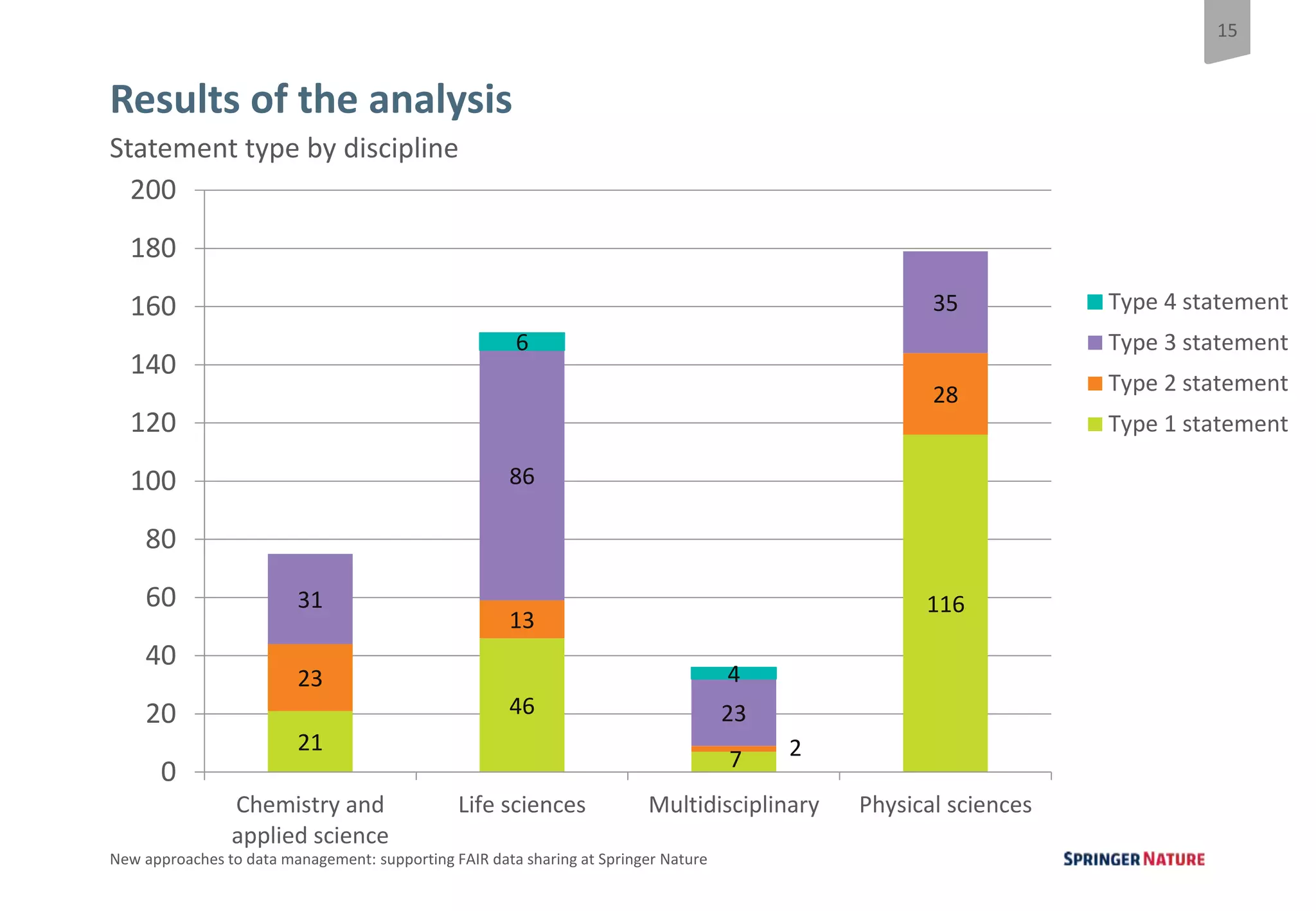
Results of the analysis
Statement type by discipline
21
46
7
116
23
13
2
28
31
86
23
35
6
4
0
20
40
60
80
100
120
140
160
180
200
Chemistry and
applied science
Life sciences Multidisciplinary Physical sciences
Type 4 statement
Type 3 statement
Type 2 statement
Type 1 statement
16
New approaches to data management: supporting FAIR data sharing at Springer Nature
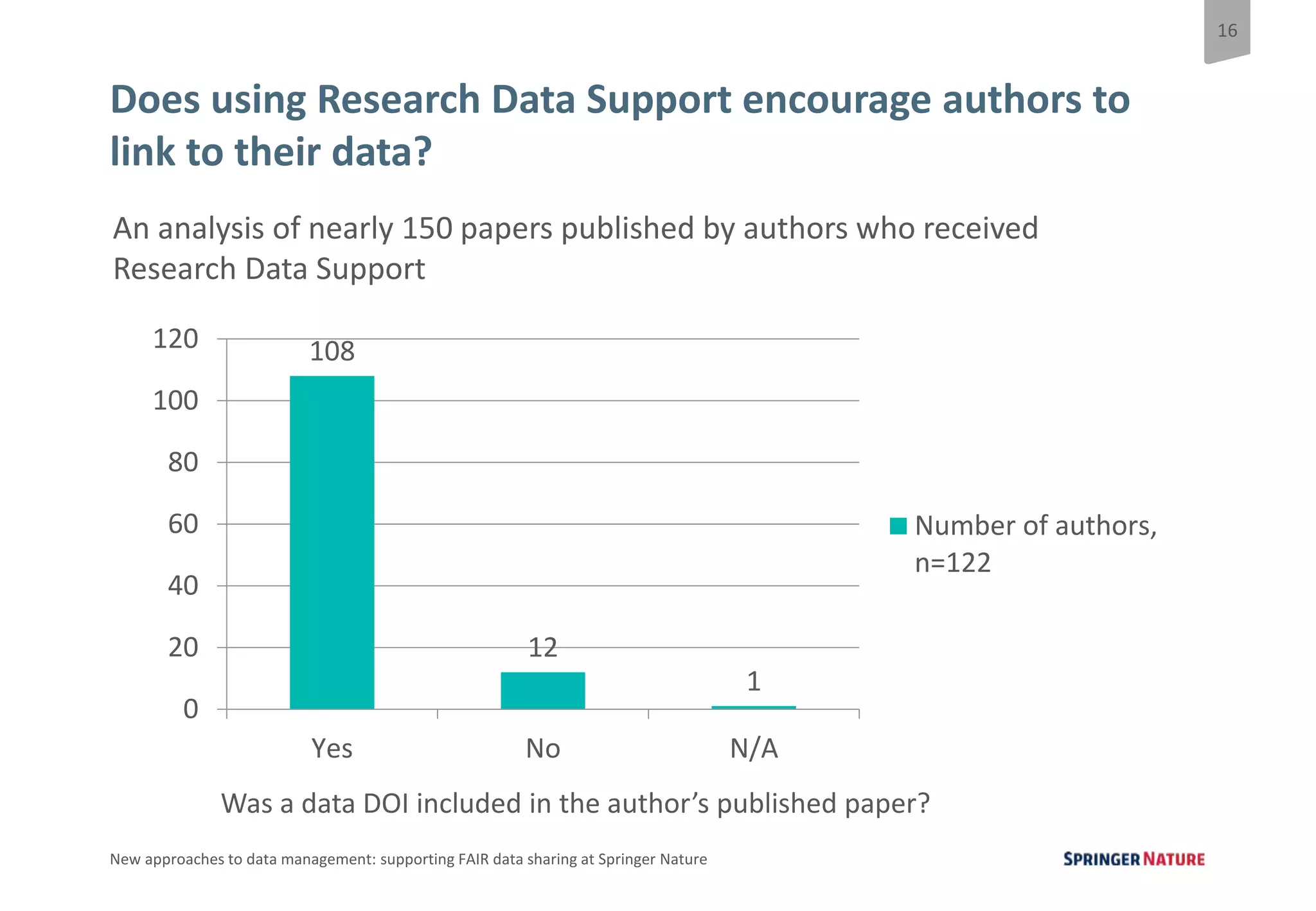
Does using Research Data Support encourage authors to
link to their data?
An analysis of nearly 150 papers published by authors who received
Research Data Support
108
12
1
0
20
40
60
80
100
120
Yes No N/A
Number of authors,
n=122
Was a data DOI included in the author’s published paper?
17
New approaches to data management: supporting FAIR data sharing at Springer Nature
5. Incentives for data sharing: Open data badges pilot
Currently piloting on BMC Microbiology
Does the application of badges to published
papers which share their data openly:
• Affect levels of data sharing by authors?
• Affect reader engagement with articles and
their supporting data, and perceptions of
article quality?
And can we assess the benefits and costs of
consistently assessing and awarding open data
badges for a Springer Nature journal?
18
New approaches to data management: supporting FAIR data sharing at Springer Nature
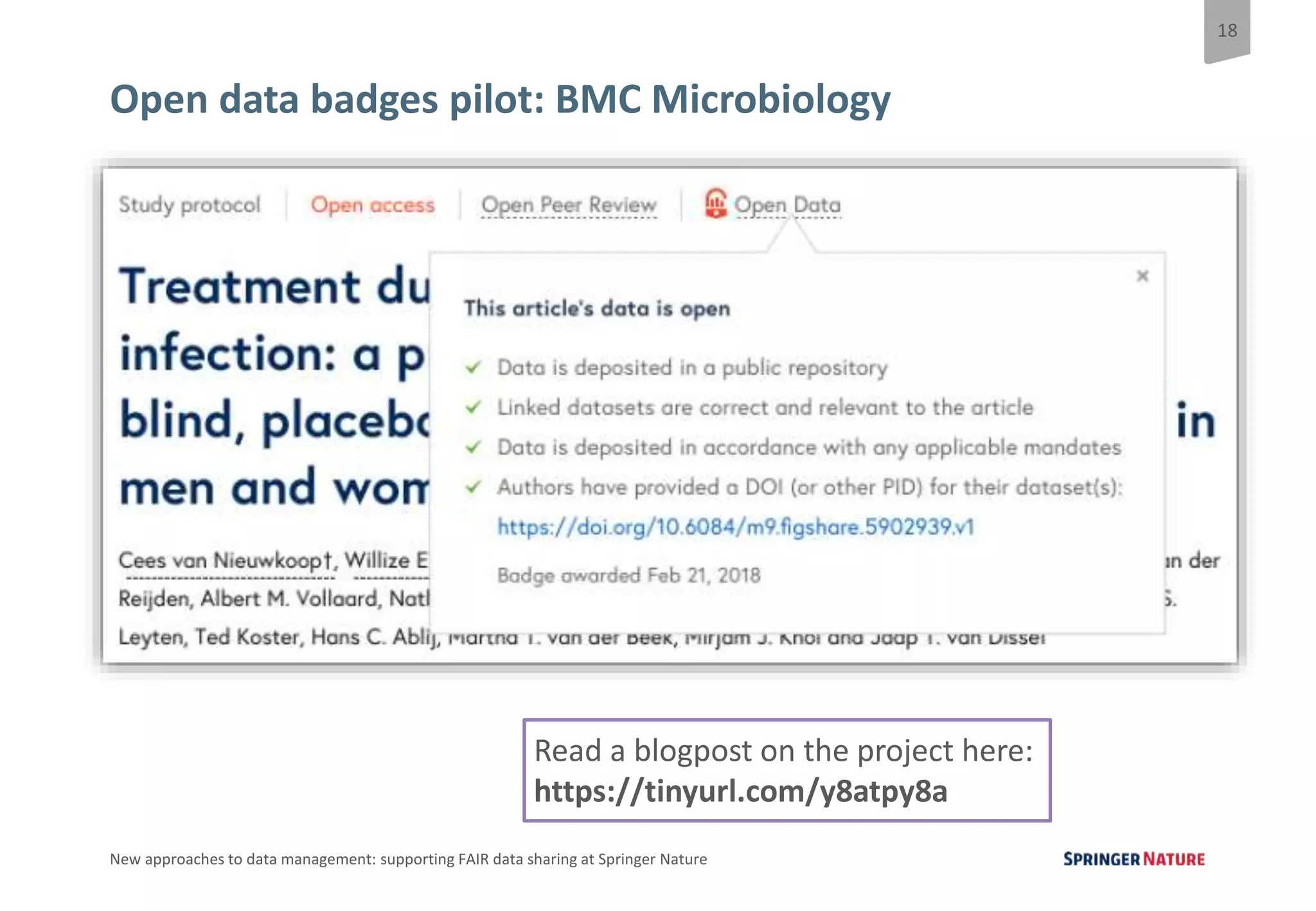
Open data badges pilot: BMC Microbiology
Read a blogpost on the project here:
https://tinyurl.com/y8atpy8a
19
New approaches to data management: supporting FAIR data sharing at Springer Nature
Summary: Publisher interventions to increase data FAIRness
• Publisher policies for data sharing can help to encourage data sharing, even
in disciplines where it is not currently common practice.
• Researchers may not be familiar with the FAIR principles, but they can still
be supported to increase the FAIRness of their data.
• Different levels of support may be required, from advice to hands-on data
curation.
• Analysis of data sharing methods can be used over time to assess changes
in practice.
• Providing hands on support leads to good data sharing practice by authors.
20
New approaches to data management: supporting FAIR data sharing at Springer Nature
20
The story behind the image
John Maynard Keynes (1883–1946)
John Maynard Keynes was a British economist who
revolutionised the theory and practice of macroeconomics,
reformed economics and had a profound influence on
economic policy. This illustration represents the Keynesian
model which shows that in a monetary economy it is
possible to have periods of high unemployment unless
governments use active monetary and fiscal policy to
stimulate aggregate demand.
Varsha Khodiyar, PhD
Data Curation Manager
varsha.khodiyar@nature.com
@varsha_khodiyar
go.nature.com/ResearchDataServices
researchdata.springernature.com
researchdata@springernature.com
With thanks to Rebecca Grant for
pulling together this slide deck!

New approaches to data management: supporting FAIR data sharing at Springer Nature

  • 1.
    New approaches todata management: supporting FAIR data sharing at Springer Nature Varsha Khodiyar, PhD Biocuration 2019 IllustrationinspiredbytheworkofJohnMaynardKeynes
  • 2.
    1 New approaches todata management: supporting FAIR data sharing at Springer Nature Springer Nature is a leading research, educational and professional publisher, providing quality content to our communities through a range of innovative platforms, products and services. Home to brands including Springer, Nature Research, BioMed Central, Palgrave Macmillan and Scientific American. As the leading open access publisher, we see the rise of open research in all its manifestations as one of the major forces reshaping the way that researchers communicate and collaborate to advance the pace and quality of discovery. Our focus is on investing in and creating tools, services or training that help the research community to understand and utilise new ideas and concepts.
  • 3.
    2 New approaches todata management: supporting FAIR data sharing at Springer Nature Practical Challenges for Researchers in Data Sharing white paper A global survey of nearly 8000 researchers Stuart, David; Baynes, Grace; Hrynaszkiewicz, Iain; Allin, Katie; Penny, Dan; Lucraft, Mithu; Astell, Mathias (2018): Whitepaper: Practical challenges for researchers in data sharing https://doi.org/10.6084/m9.figshare.5975011.v1
  • 4.
    3 New approaches todata management: supporting FAIR data sharing at Springer Nature Private sharing of data is more common than public sharing of data Global levels of data sharing: • Poland – 76% (highest) • Germany – 75% • UK – 58% • USA – 55%
  • 5.
    4 New approaches todata management: supporting FAIR data sharing at Springer Nature
  • 6.
    5 New approaches todata management: supporting FAIR data sharing at Springer Nature Are researchers aware of FAIR? The State of Open Data Report 2018, https://doi.org/10.6084/m9.figshare.7195058.v2
  • 7.
    6 New approaches todata management: supporting FAIR data sharing at Springer Nature 1. Data journals at Springer Nature
  • 8.
    7 New approaches todata management: supporting FAIR data sharing at Springer Nature 2. Springer Nature standardized journal data policies • Launched data policy standardisation initiative in 2016 • More than 1,500 (~60%) Springer Nature journals have adopted a standard research data policy • All policies support the use of community specific standards, mandates and repositories • All policies and journals promote data citation • Similar initiatives since introduced by other publishers Standardising and harmonising research data policy in scholarly publishing Iain Hrynaszkiewicz, Aliaksandr Birukou, Mathias Astell, Sowmya Swaminathan, Amye Kenall, Varsha Khodiyar International Journal of Digital Curation 2017 https://doi.org/10.2218/ijdc.v12i1.531
  • 9.
    8 New approaches todata management: supporting FAIR data sharing at Springer Nature How do journal policies improve FAIRness of published data?  A journal policy may be the first time that a researcher has been encouraged (or required) to share their research data openly  The policies always recommend that data are shared in suitable repositories rather than made available on request or uploaded as supplementary material  The policies encourage any data used to be cited in the reference list, to allow it to be found and accessed more easily  Mandatory aspects of the policy are checked before the article is published
  • 10.
    9 New approaches todata management: supporting FAIR data sharing at Springer Nature 3. Research Data Helpdesk Queries are answered within two business days Run by members of the Springer Nature Research Data team Expertise in data curation and management, archiving and digital preservation, copyright and licensing, Open Access publishing Always encourage best practices, e.g. the use of community repositories for specific data types Email: researchdata@springernature.com http://www.springernature.com/gp/group/data-policy/helpdesk
  • 11.
    10 New approaches todata management: supporting FAIR data sharing at Springer Nature 2018 queries to our Helpdesk 59 33 33 24 5 3 3 2 1 Repositories and depositing data Policy compliance Research Data Support Data availability and access Other Data citation Policy implementation Copyright and licensing Data types 0 10 20 30 40 50 60 70 n = 163
  • 12.
    11 New approaches todata management: supporting FAIR data sharing at Springer Nature 4. Research Data Support service • Research Data Support service (RDS) launched April 2017 • Provide support and advice on research data sharing, for authors and editors • Promote best practice for sharing research data associated with a publication www.springernature.com/la/authors/research-data
  • 13.
    12 New approaches todata management: supporting FAIR data sharing at Springer Nature Analysing DAS across published articles allows us to assess how authors choose to share their data Analyzing the impact via data availability statements (DAS) “The datasets generated during and/or analysed during the current study are available in the [NAME] repository, [PERSISTENT WEB LINK TO DATASETS].” “The datasets generated during and/or analysed during the current study are available from the corresponding author on reasonable request.” “All data generated or analysed during this study are included in this published article (and its supplementary information files).”
  • 14.
    13 New approaches todata management: supporting FAIR data sharing at Springer Nature Analysing Data Availability at Nature journals An analysis of data sharing at Nature Research journals (including Nature, Nature Ecology and Evolution, Nature Human Behaviour, Nature Microbiology, Nature Plants, Nature Medicine, Nature Methods, Nature Biotechnology, Nature Genetics, Nature Chemical Biology, Nature Immunology, Nature Structural and Molecular Biology, Nature Astronomy, Nature Chemistry, Nature Climate Change, Nature Materials, Nature Energy, Nature Nanotechnology, Nature Biomedical Engineering and Nature Photonics) Data availability statements were coded to assess what methods authors are using to share the data that accompanies their published articles. The disciplinary focus of each journal was also captured
  • 15.
    14 New approaches todata management: supporting FAIR data sharing at Springer Nature Coding the Data Availability Statements Type 1 stated that the data is available from the author on request. Type 2 stated that the data had been included in the manuscript or its supplementary material. Type 3 stated that some or all of the data is publicly available, for example in a repository. Type 4 stated that figure source data was included with the manuscript. This is a method of data sharing used by some authors in a subset of Nature journals that publish life sciences research. Some journals encourage authors to provide the source data behind their figures/plots as spreadsheets. Type 1 statement
  • 16.
    15 New approaches todata management: supporting FAIR data sharing at Springer Nature Results of the analysis Statement type by discipline 21 46 7 116 23 13 2 28 31 86 23 35 6 4 0 20 40 60 80 100 120 140 160 180 200 Chemistry and applied science Life sciences Multidisciplinary Physical sciences Type 4 statement Type 3 statement Type 2 statement Type 1 statement
  • 17.
    16 New approaches todata management: supporting FAIR data sharing at Springer Nature Does using Research Data Support encourage authors to link to their data? An analysis of nearly 150 papers published by authors who received Research Data Support 108 12 1 0 20 40 60 80 100 120 Yes No N/A Number of authors, n=122 Was a data DOI included in the author’s published paper?
  • 18.
    17 New approaches todata management: supporting FAIR data sharing at Springer Nature 5. Incentives for data sharing: Open data badges pilot Currently piloting on BMC Microbiology Does the application of badges to published papers which share their data openly: • Affect levels of data sharing by authors? • Affect reader engagement with articles and their supporting data, and perceptions of article quality? And can we assess the benefits and costs of consistently assessing and awarding open data badges for a Springer Nature journal?
  • 19.
    18 New approaches todata management: supporting FAIR data sharing at Springer Nature Open data badges pilot: BMC Microbiology Read a blogpost on the project here: https://tinyurl.com/y8atpy8a
  • 20.
    19 New approaches todata management: supporting FAIR data sharing at Springer Nature Summary: Publisher interventions to increase data FAIRness • Publisher policies for data sharing can help to encourage data sharing, even in disciplines where it is not currently common practice. • Researchers may not be familiar with the FAIR principles, but they can still be supported to increase the FAIRness of their data. • Different levels of support may be required, from advice to hands-on data curation. • Analysis of data sharing methods can be used over time to assess changes in practice. • Providing hands on support leads to good data sharing practice by authors.
  • 21.
    20 New approaches todata management: supporting FAIR data sharing at Springer Nature 20 The story behind the image John Maynard Keynes (1883–1946) John Maynard Keynes was a British economist who revolutionised the theory and practice of macroeconomics, reformed economics and had a profound influence on economic policy. This illustration represents the Keynesian model which shows that in a monetary economy it is possible to have periods of high unemployment unless governments use active monetary and fiscal policy to stimulate aggregate demand. Varsha Khodiyar, PhD Data Curation Manager varsha.khodiyar@nature.com @varsha_khodiyar go.nature.com/ResearchDataServices researchdata.springernature.com researchdata@springernature.com With thanks to Rebecca Grant for pulling together this slide deck!