TOPIC PRESENTATION
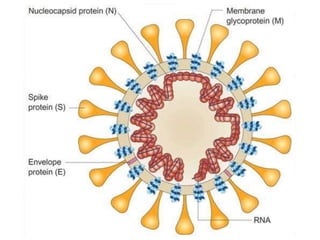
CORONA VIRUS
Sansar Babu Tiwari, MBBS, PGY I
Department of Pathology
TUTH
9th February 2020
1
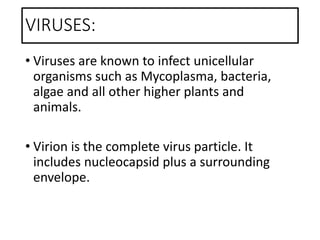
VIRUSES: Vs Bacteria vs Fungi
VIRUSES:
• Viruses are known to infect unicellular
organisms such as Mycoplasma, bacteria,
algae and all other higher plants and
animals.
• Virion is the complete virus particle. It
includes nucleocapsid plus a surrounding
envelope.
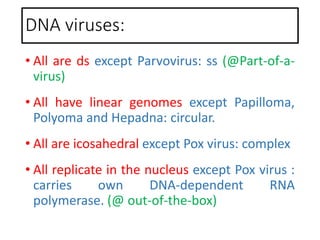
DNA viruses:
• All are ds except Parvovirus: ss (@Part-of-a-
virus)
• All have linear genomes except Papilloma,
Polyoma and Hepadna: circular.
• All are icosahedral except Pox virus: complex
• All replicate in the nucleus except Pox virus :
carries own DNA-dependent RNA
polymerase. (@ out-of-the-box)
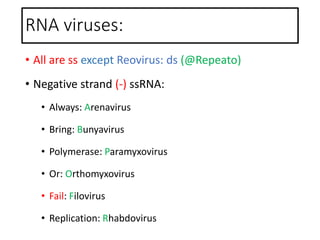
RNA viruses:
• All are ss except Reovirus: ds (@Repeato)
• Negative strand (-) ssRNA:
• Always: Arenavirus
• Bring: Bunyavirus
• Polymerase: Paramyxovirus
• Or: Orthomyxovirus
• Fail: Filovirus
• Replication: Rhabdovirus
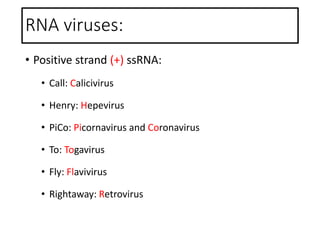
RNA viruses:
• Positive strand (+) ssRNA:
• Call: Calicivirus
• Henry: Hepevirus
• PiCo: Picornavirus and Coronavirus
• To: Togavirus
• Fly: Flavivirus
• Rightaway: Retrovirus
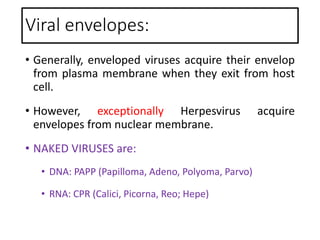
Viral envelopes:
• Generally, enveloped viruses acquire their envelop
from plasma membrane when they exit from host
cell.
• However, exceptionally Herpesvirus acquire
envelopes from nuclear membrane.
• NAKED VIRUSES are:
• DNA: PAPP (Papilloma, Adeno, Polyoma, Parvo)
• RNA: CPR (Calici, Picorna, Reo; Hepe)
RNA viruses:
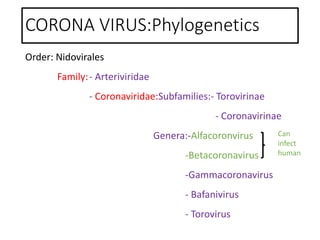
CORONA VIRUS:Phylogenetics
Order: Nidovirales
Family:- Arteriviridae
- Coronaviridae:Subfamilies:- Torovirinae
- Coronavirinae
Genera:-Alfacoronvirus
-Betacoronavirus
-Gammacoronavirus
- Bafanivirus
- Torovirus
Can
infect
human
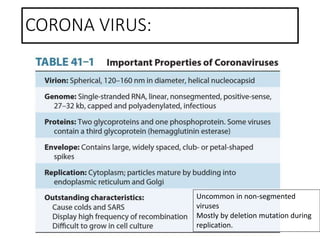
CORONA VIRUS:
Uncommon in non-segmented
viruses
Mostly by deletion mutation during
replication.
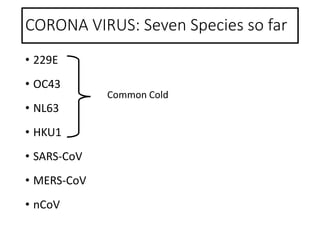
CORONA VIRUS: Seven Species so far
• 229E
• OC43
• NL63
• HKU1
• SARS-CoV
• MERS-CoV
• nCoV
Common Cold
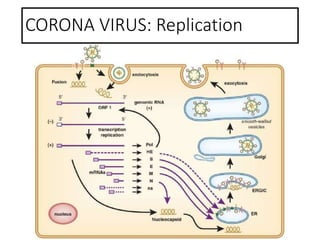
CORONA VIRUS: Replication
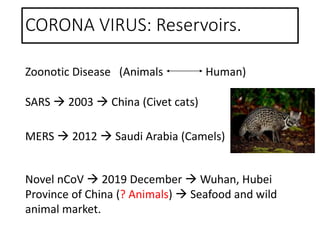
CORONA VIRUS: Reservoirs.
Zoonotic Disease (Animals Human)
SARS  2003  China (Civet cats)
MERS  2012  Saudi Arabia (Camels)
Novel nCoV  2019 December  Wuhan, Hubei
Province of China (? Animals)  Seafood and wild
animal market.
CORONA VIRUS: nCoV
Although, sea foods and wild animal markets were
thought to be the epicenter of the outbreak.
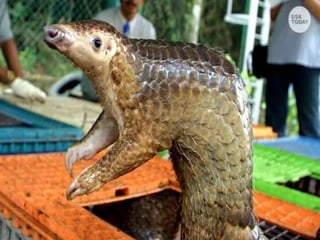
Now, there is a school of thought regarding Pangolins
could have transmitted these disease. Genetic analysis
showed almost 99% similarity of the viral genome in
human to that of the Pangolins.
Pangolins are considered of medicinal value in treatment
of skin diseases, menstrual abnormalities and joint
diseases. The trading of these valuable animal could
subject to imprisonment for 10 years in China.
CORONA VIRUS: Pathogenesis
Highly species-specific
Display tropism for epithelial cells. However, SARS
had also predilection for salivary glands in monkeys.
Virus can also be detected in kidneys, liver and small
intestine and, and in stool.
Coronaviruses are suspected of causing some
gastroenteritis in humans.
CORONA VIRUS: Clinical features
Mostly: Common cold usually afebrile as caused by
rhinovirus.
SARS and MERS: Severe Respiratory Illnesses
requiring ventilator support.
Diarrhea as caused by rotavirus.
CORONA VIRUS: Immunity
As with other respiratory viruses, immunity develops
but is not absolute.
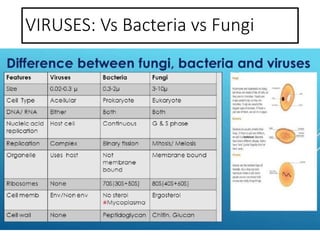
Immunity against the surface projection antigen is
probably most important for protection.
CORONA VIRUS: Lab Diagnosis
1. Antigen and nucleic acid detection.
1. ELISA if high-quality antiserum is available
2. Electron microscopy of stool specimen
3. PCR assays
2. Isolation and identification of virus.
1. Difficult to culture in-vitro
2. SARS was recovered from oropharyngeal specimens using
Vero monkey kidney cells.
3. Serology.
1. ELISA-Indirect IF
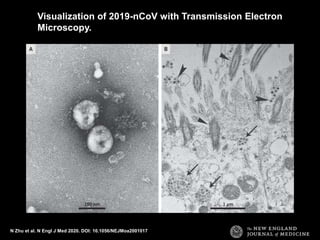
N Zhu et al. N Engl J Med 2020. DOI: 10.1056/NEJMoa2001017
Visualization of 2019-nCoV with Transmission Electron
Microscopy.
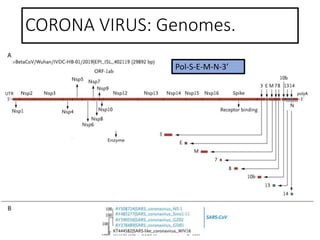
CORONA VIRUS: Genomes.
Pol-S-E-M-N-3’
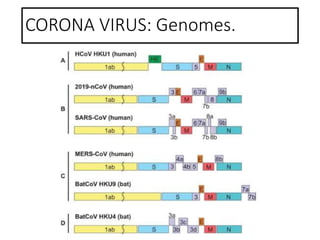
CORONA VIRUS: Genomes.
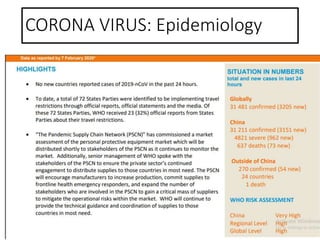
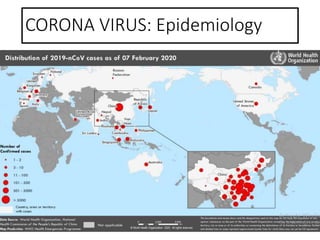
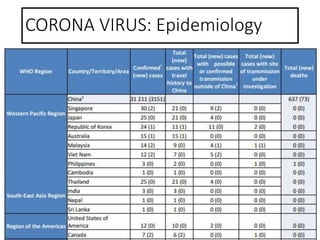
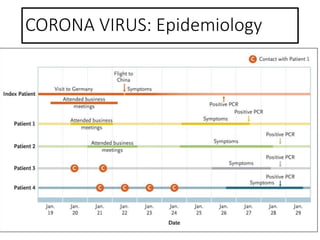
CORONA VIRUS: Epidemiology
CORONA VIRUS: nCoV: Nepal: 3 cases
• A 31 year old student returned from Wuhan was
found Corona positive when his throat swab was
sent and examined in the WHO regional
headquarter, Hongkong.
• Later a man and women were also suspected.
However, 28 yr old man who had transit in China
was positive for the corona virus.
• 48 yr old women who went for an event was found
negative for the virus.
• December 31st 2019  Clusters of cases of
pneumonia in Wuhan, Hubei Province of  Huanan
seafood wholesale market  On Jan 7th Chinese
authorities confirmed these cases were associated
with novel corona virus.
• First case reported in US was in 20th January 2020.
CORONA VIRUS: nCoV: 1st case in US
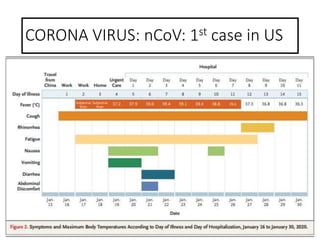
On January 19, 35-years-old man presented to an
urgent care clinic in Snohomish County, Washington
with 4 day h/o cough and subjective fever
He disclosed he has returned to Washington on
January 15 after traveling to visit family in Wuhan.
He said he had seen the health alert systems from
CDC regarding symptoms of the disease.
CORONA VIRUS: nCoV: 1st case in US
He has h/o hypertriglyceridemia. Otherwise healthy
non-smoker.
Temp: 37.2 celcius
BP: 134/87 mmHg
Pulse: 110 bpm
RR: 16 bpm
Spo2 @ ambient air: 96%
CORONA VIRUS: nCoV: 1st case in US
A rapid nucleic acid amplification test (NAAT) for
influenza A and B was negative.
A nasopharyngeal swab specimen was obtained and
sent for detection of viral respiratory pathogens by
NAAT; this was reported back within 48 hours as
negative for all pathogens tested, including influenza
A and B, parainfluenza, respiratory syncytial virus,
rhinovirus, adenovirus, and four common
coronavirus strains known to cause illness in humans
(HKU1, NL63, 229E, and OC43).
CORONA VIRUS: nCoV: 1st case in US
Although the patient reported that he had not spent
time at the Huanan seafood market and reported no
known contact with ill persons during his travel to
China, CDC staff concurred with the need to test the
patient for 2019-nCoV on the basis of current CDC
“persons under investigation” case definitions.
After specimen collection, the patient was
discharged to home isolation with active monitoring
by the local health department.
CORONA VIRUS: nCoV: 1st case in US
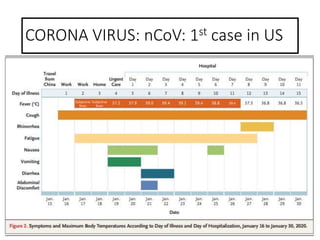
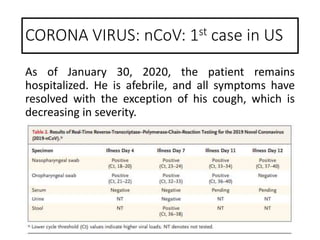
On January 20, 2020, the CDC confirmed that the
patient’s nasopharyngeal and oropharyngeal swabs
tested positive for 2019-nCoV by real-time reverse-
transcriptase–polymerase-chain-reaction (rRT-PCR)
assay.
On admission, the patient reported persistent dry
cough and a 2-day history of nausea and vomiting;
he reported that he had no shortness of breath or
chest pain.
Vital signs were within normal ranges
CORONA VIRUS: nCoV: 1st case in US
After admission, the patient received supportive care,
including 2 liters of normal saline and ondansetron for
nausea.
The patient continued to report a nonproductive cough
and appeared fatigued.
On the afternoon of hospital day 2, the patient passed a
loose bowel movement and reported abdominal
discomfort. A second episode of loose stool was reported
overnight
A sample of this stool was collected for rRT-PCR testing,
along with additional respiratory specimens
(nasopharyngeal and oropharyngeal) and serum.
The stool and both respiratory specimens later tested
positive by rRT-PCR for 2019-nCoV, whereas the serum
remained negative.
CORONA VIRUS: nCoV: 1st case in US
Treatment during this time was largely supportive.
For symptom management, the patient received, as
needed,
antipyretic therapy consisting of 650 mg of
acetaminophen every 4 hours and
600 mg of ibuprofen every 6 hours
600 mg of guaifenesin for his continued cough
approximately 6 liters of normal saline over the first
6 days of hospitalization.
CORONA VIRUS: nCoV: 1st case in US
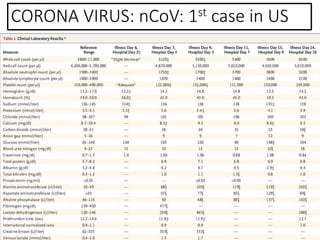
Laboratory results on hospital days 3 and 5 (illness
days 7 and 9) reflected leukopenia, mild
thrombocytopenia, and elevated levels of creatine
kinase.
In addition, there were alterations in hepatic
function measures on day 5 of hospitalization:
alkaline phosphatase (68 U per liter),
alanine aminotransferase (105 U per liter),
aspartate aminotransferase (77 U per liter),
lactate dehydrogenase (465 U per liter)
CORONA VIRUS: nCoV: 1st case in US
Change in respiratory status was noticed starting on
the evening of hospital day 5, when the patient’s
oxygen saturation values as measured by pulse
oximetry dropped to as low as 90% while he was
breathing ambient air
Given the changing clinical presentation and concern
about hospital-acquired pneumonia, treatment with
vancomycin (a 1750-mg loading dose followed by 1 g
administered intravenously every 8 hours) and
cefepime (administered intravenously every 8 hours)
was initiated.
CORONA VIRUS: nCoV: 1st case in US
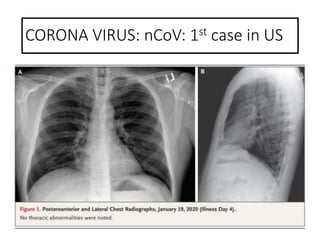
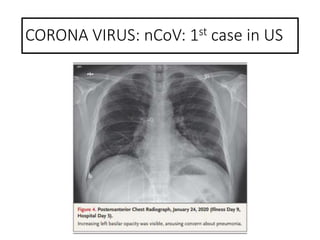
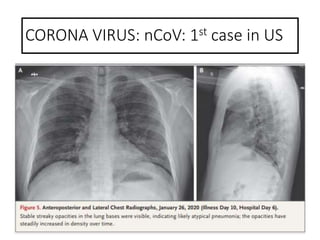
Given the radiographic findings, the decision to
administer oxygen supplementation, the patient’s
ongoing fevers, the persistent positive 2019-nCoV
RNA at multiple sites, and published reports of the
development of severe pneumonia at a period
consistent with the development of radiographic
pneumonia in this patient, clinicians pursued
compassionate use of an investigational antiviral
therapy
CORONA VIRUS: nCoV: 1st case in US
Treatment with intravenous remdesivir (a novel
nucleotide analogue prodrug in development) was
initiated on the evening of day 7, and no adverse
events were observed in association with the
infusion.
Vancomycin was discontinued on the evening of day
7, and cefepime was discontinued on the following
day, after serial negative procalcitonin levels and
negative nasal PCR testing for methicillin-resistant
Staphylococcus aureus.
CORONA VIRUS: nCoV: 1st case in US
On hospital day 8 (illness day 12), the patient’s
clinical condition improved. Supplemental oxygen
was discontinued, and his oxygen saturation values
improved to 94 to 96% while he was breathing
ambient air.
The previous bilateral lower-lobe rales were no
longer present. His appetite improved, and he was
asymptomatic aside from intermittent dry cough and
rhinorrhea.
CORONA VIRUS: nCoV: 1st case in US
As of January 30, 2020, the patient remains
hospitalized. He is afebrile, and all symptoms have
resolved with the exception of his cough, which is
decreasing in severity.
CORONA VIRUS: nCoV: 1st case in US
CORONA VIRUS: nCoV: WHO video
• WHO corona virus.mp4
Corona virus

Corona virus

  • 1.
    TOPIC PRESENTATION CORONA VIRUS SansarBabu Tiwari, MBBS, PGY I Department of Pathology TUTH 9th February 2020 1
  • 2.
  • 3.
    VIRUSES: • Viruses areknown to infect unicellular organisms such as Mycoplasma, bacteria, algae and all other higher plants and animals. • Virion is the complete virus particle. It includes nucleocapsid plus a surrounding envelope.
  • 4.
    DNA viruses: • Allare ds except Parvovirus: ss (@Part-of-a- virus) • All have linear genomes except Papilloma, Polyoma and Hepadna: circular. • All are icosahedral except Pox virus: complex • All replicate in the nucleus except Pox virus : carries own DNA-dependent RNA polymerase. (@ out-of-the-box)
  • 5.
    RNA viruses: • Allare ss except Reovirus: ds (@Repeato) • Negative strand (-) ssRNA: • Always: Arenavirus • Bring: Bunyavirus • Polymerase: Paramyxovirus • Or: Orthomyxovirus • Fail: Filovirus • Replication: Rhabdovirus
  • 6.
    RNA viruses: • Positivestrand (+) ssRNA: • Call: Calicivirus • Henry: Hepevirus • PiCo: Picornavirus and Coronavirus • To: Togavirus • Fly: Flavivirus • Rightaway: Retrovirus
  • 7.
    Viral envelopes: • Generally,enveloped viruses acquire their envelop from plasma membrane when they exit from host cell. • However, exceptionally Herpesvirus acquire envelopes from nuclear membrane. • NAKED VIRUSES are: • DNA: PAPP (Papilloma, Adeno, Polyoma, Parvo) • RNA: CPR (Calici, Picorna, Reo; Hepe)
  • 8.
  • 9.
    CORONA VIRUS:Phylogenetics Order: Nidovirales Family:-Arteriviridae - Coronaviridae:Subfamilies:- Torovirinae - Coronavirinae Genera:-Alfacoronvirus -Betacoronavirus -Gammacoronavirus - Bafanivirus - Torovirus Can infect human
  • 10.
    CORONA VIRUS: Uncommon innon-segmented viruses Mostly by deletion mutation during replication.
  • 11.
    CORONA VIRUS: SevenSpecies so far • 229E • OC43 • NL63 • HKU1 • SARS-CoV • MERS-CoV • nCoV Common Cold
  • 12.
  • 13.
    CORONA VIRUS: Reservoirs. ZoonoticDisease (Animals Human) SARS  2003  China (Civet cats) MERS  2012  Saudi Arabia (Camels) Novel nCoV  2019 December  Wuhan, Hubei Province of China (? Animals)  Seafood and wild animal market.
  • 14.
    CORONA VIRUS: nCoV Although,sea foods and wild animal markets were thought to be the epicenter of the outbreak. Now, there is a school of thought regarding Pangolins could have transmitted these disease. Genetic analysis showed almost 99% similarity of the viral genome in human to that of the Pangolins. Pangolins are considered of medicinal value in treatment of skin diseases, menstrual abnormalities and joint diseases. The trading of these valuable animal could subject to imprisonment for 10 years in China.
  • 16.
    CORONA VIRUS: Pathogenesis Highlyspecies-specific Display tropism for epithelial cells. However, SARS had also predilection for salivary glands in monkeys. Virus can also be detected in kidneys, liver and small intestine and, and in stool. Coronaviruses are suspected of causing some gastroenteritis in humans.
  • 17.
    CORONA VIRUS: Clinicalfeatures Mostly: Common cold usually afebrile as caused by rhinovirus. SARS and MERS: Severe Respiratory Illnesses requiring ventilator support. Diarrhea as caused by rotavirus.
  • 18.
    CORONA VIRUS: Immunity Aswith other respiratory viruses, immunity develops but is not absolute. Immunity against the surface projection antigen is probably most important for protection.
  • 19.
    CORONA VIRUS: LabDiagnosis 1. Antigen and nucleic acid detection. 1. ELISA if high-quality antiserum is available 2. Electron microscopy of stool specimen 3. PCR assays 2. Isolation and identification of virus. 1. Difficult to culture in-vitro 2. SARS was recovered from oropharyngeal specimens using Vero monkey kidney cells. 3. Serology. 1. ELISA-Indirect IF
  • 20.
    N Zhu etal. N Engl J Med 2020. DOI: 10.1056/NEJMoa2001017 Visualization of 2019-nCoV with Transmission Electron Microscopy.
  • 21.
  • 22.
  • 23.
  • 24.
  • 25.
  • 26.
  • 27.
    CORONA VIRUS: nCoV:Nepal: 3 cases • A 31 year old student returned from Wuhan was found Corona positive when his throat swab was sent and examined in the WHO regional headquarter, Hongkong. • Later a man and women were also suspected. However, 28 yr old man who had transit in China was positive for the corona virus. • 48 yr old women who went for an event was found negative for the virus.
  • 29.
    • December 31st2019  Clusters of cases of pneumonia in Wuhan, Hubei Province of  Huanan seafood wholesale market  On Jan 7th Chinese authorities confirmed these cases were associated with novel corona virus. • First case reported in US was in 20th January 2020. CORONA VIRUS: nCoV: 1st case in US
  • 30.
    On January 19,35-years-old man presented to an urgent care clinic in Snohomish County, Washington with 4 day h/o cough and subjective fever He disclosed he has returned to Washington on January 15 after traveling to visit family in Wuhan. He said he had seen the health alert systems from CDC regarding symptoms of the disease. CORONA VIRUS: nCoV: 1st case in US
  • 31.
    He has h/ohypertriglyceridemia. Otherwise healthy non-smoker. Temp: 37.2 celcius BP: 134/87 mmHg Pulse: 110 bpm RR: 16 bpm Spo2 @ ambient air: 96% CORONA VIRUS: nCoV: 1st case in US
  • 32.
    A rapid nucleicacid amplification test (NAAT) for influenza A and B was negative. A nasopharyngeal swab specimen was obtained and sent for detection of viral respiratory pathogens by NAAT; this was reported back within 48 hours as negative for all pathogens tested, including influenza A and B, parainfluenza, respiratory syncytial virus, rhinovirus, adenovirus, and four common coronavirus strains known to cause illness in humans (HKU1, NL63, 229E, and OC43). CORONA VIRUS: nCoV: 1st case in US
  • 33.
    Although the patientreported that he had not spent time at the Huanan seafood market and reported no known contact with ill persons during his travel to China, CDC staff concurred with the need to test the patient for 2019-nCoV on the basis of current CDC “persons under investigation” case definitions. After specimen collection, the patient was discharged to home isolation with active monitoring by the local health department. CORONA VIRUS: nCoV: 1st case in US
  • 34.
    CORONA VIRUS: nCoV:1st case in US
  • 35.
    On January 20,2020, the CDC confirmed that the patient’s nasopharyngeal and oropharyngeal swabs tested positive for 2019-nCoV by real-time reverse- transcriptase–polymerase-chain-reaction (rRT-PCR) assay. On admission, the patient reported persistent dry cough and a 2-day history of nausea and vomiting; he reported that he had no shortness of breath or chest pain. Vital signs were within normal ranges CORONA VIRUS: nCoV: 1st case in US
  • 36.
    After admission, thepatient received supportive care, including 2 liters of normal saline and ondansetron for nausea. The patient continued to report a nonproductive cough and appeared fatigued. On the afternoon of hospital day 2, the patient passed a loose bowel movement and reported abdominal discomfort. A second episode of loose stool was reported overnight A sample of this stool was collected for rRT-PCR testing, along with additional respiratory specimens (nasopharyngeal and oropharyngeal) and serum. The stool and both respiratory specimens later tested positive by rRT-PCR for 2019-nCoV, whereas the serum remained negative. CORONA VIRUS: nCoV: 1st case in US
  • 37.
    Treatment during thistime was largely supportive. For symptom management, the patient received, as needed, antipyretic therapy consisting of 650 mg of acetaminophen every 4 hours and 600 mg of ibuprofen every 6 hours 600 mg of guaifenesin for his continued cough approximately 6 liters of normal saline over the first 6 days of hospitalization. CORONA VIRUS: nCoV: 1st case in US
  • 38.
    CORONA VIRUS: nCoV:1st case in US
  • 39.
    CORONA VIRUS: nCoV:1st case in US
  • 40.
    CORONA VIRUS: nCoV:1st case in US
  • 41.
    Laboratory results onhospital days 3 and 5 (illness days 7 and 9) reflected leukopenia, mild thrombocytopenia, and elevated levels of creatine kinase. In addition, there were alterations in hepatic function measures on day 5 of hospitalization: alkaline phosphatase (68 U per liter), alanine aminotransferase (105 U per liter), aspartate aminotransferase (77 U per liter), lactate dehydrogenase (465 U per liter) CORONA VIRUS: nCoV: 1st case in US
  • 42.
    CORONA VIRUS: nCoV:1st case in US
  • 43.
    Change in respiratorystatus was noticed starting on the evening of hospital day 5, when the patient’s oxygen saturation values as measured by pulse oximetry dropped to as low as 90% while he was breathing ambient air Given the changing clinical presentation and concern about hospital-acquired pneumonia, treatment with vancomycin (a 1750-mg loading dose followed by 1 g administered intravenously every 8 hours) and cefepime (administered intravenously every 8 hours) was initiated. CORONA VIRUS: nCoV: 1st case in US
  • 44.
    CORONA VIRUS: nCoV:1st case in US
  • 45.
    Given the radiographicfindings, the decision to administer oxygen supplementation, the patient’s ongoing fevers, the persistent positive 2019-nCoV RNA at multiple sites, and published reports of the development of severe pneumonia at a period consistent with the development of radiographic pneumonia in this patient, clinicians pursued compassionate use of an investigational antiviral therapy CORONA VIRUS: nCoV: 1st case in US
  • 46.
    Treatment with intravenousremdesivir (a novel nucleotide analogue prodrug in development) was initiated on the evening of day 7, and no adverse events were observed in association with the infusion. Vancomycin was discontinued on the evening of day 7, and cefepime was discontinued on the following day, after serial negative procalcitonin levels and negative nasal PCR testing for methicillin-resistant Staphylococcus aureus. CORONA VIRUS: nCoV: 1st case in US
  • 47.
    On hospital day8 (illness day 12), the patient’s clinical condition improved. Supplemental oxygen was discontinued, and his oxygen saturation values improved to 94 to 96% while he was breathing ambient air. The previous bilateral lower-lobe rales were no longer present. His appetite improved, and he was asymptomatic aside from intermittent dry cough and rhinorrhea. CORONA VIRUS: nCoV: 1st case in US
  • 48.
    As of January30, 2020, the patient remains hospitalized. He is afebrile, and all symptoms have resolved with the exception of his cough, which is decreasing in severity. CORONA VIRUS: nCoV: 1st case in US
  • 49.
    CORONA VIRUS: nCoV:WHO video • WHO corona virus.mp4