Course Title: Pharmaceutical Technology-II
Course code: BPH-322
Assignment on: Coronavirus (Covid-19)
Submitted to Submitted By
Md.Mizanur Rahman Shopnil Akash
Assistant Professor ID:181-29-059
Department of Pharmacy Department of Pharmacy
Daffodil International University Daffodil International University
Submission Date:06.11.2020
Assignment
Contents
Introduction...........................................................................................................................................01
What is corona virus?............................................................................................................................01
Coronavirus Physical Structure.............................................................................................................01
Classification of coronaviruses.............................................................................................................02
Figure: Coronavirus classification Flowchart.......................................................................................02
Characteristics of SARS-CoV-2 ...........................................................................................................02
Coronavirus Genome Structure and Replication...................................................................................03
Fig.Coronavirus replication Flowchart .................................................................................................03
Sign and Symptoms ..............................................................................................................................04
Treatment of Coronavirus.....................................................................................................................04
Plasma Therapy.....................................................................................................................................04
Remdesivir............................................................................................................................................04
Dexamethasone.....................................................................................................................................04
How can corona vaccine be made?.......................................................................................................05
• Inactivated corona virus or part of corona virus .................................................................05
• The DNA-based corona virus vaccine ...................................................................................05
• RNA-based corona virus vaccine...........................................................................................05
Conclusion ............................................................................................................................................05
The novel coronavirus (Covid-19)
Introduction
A pneumonia of unknown cause detected in Wuhan, China was first reported to the WHO
Country Office in China on 31 December 2019.In the last Nine months, almost Ten lakhs of
lives have already been Death, around three billion of people are in quarantine, and global
economies have been decreased. The outbreak of pandemic Covid-19 all over the world has
broken down the political, social, economic, religious and financial structures of the whole
world. The World’s top economies country such as the Australia, USA, India China, UK,
Germany, France, Italy, Japan and many others. The Stock Markets around the world have
been broken down and oil prices have fallen off a cliff. A report was published on BBC where
they describe every single week 3.3 million Americans have been unemployment and a week
later another 6.6 million people started searching for new jobs. The novel coronavirus is a
microscopic organism that has become an epidemic over time around the world. The United
States, Europe, Britain, Italy, Spain and France have already been hit by the virus. These
countries have already become mortal by Corona virus.
What is corona virus?
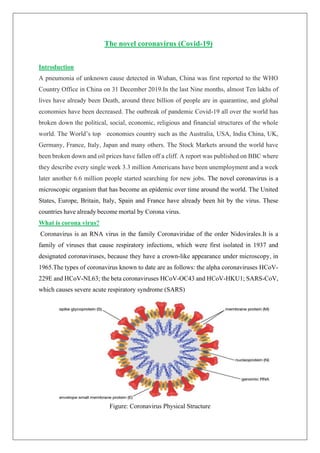
Coronavirus is an RNA virus in the family Coronaviridae of the order Nidovirales.It is a
family of viruses that cause respiratory infections, which were first isolated in 1937 and
designated coronaviruses, because they have a crown-like appearance under microscopy, in
1965.The types of coronavirus known to date are as follows: the alpha coronaviruses HCoV-
229E and HCoV-NL63; the beta coronaviruses HCoV-OC43 and HCoV-HKU1; SARS-CoV,
which causes severe acute respiratory syndrome (SARS)
Figure: Coronavirus Physical Structure
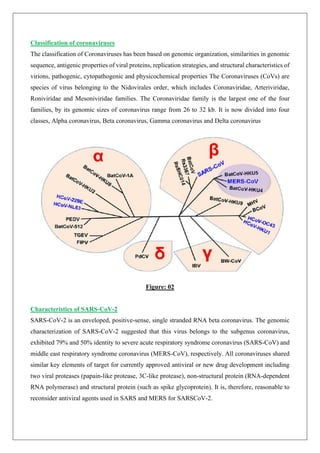
Classification of coronaviruses
The classification of Coronaviruses has been based on genomic organization, similarities in genomic
sequence, antigenic properties of viral proteins, replication strategies, and structural characteristics of
virions, pathogenic, cytopathogenic and physicochemical properties The Coronaviruses (CoVs) are
species of virus belonging to the Nidovirales order, which includes Coronaviridae, Arteriviridae,
Roniviridae and Mesoniviridae families. The Coronaviridae family is the largest one of the four
families, by its genomic sizes of coronavirus range from 26 to 32 kb. It is now divided into four
classes, Alpha coronavirus, Beta coronavirus, Gamma coronavirus and Delta coronavirus
Figure: 02
Characteristics of SARS-CoV-2
SARS-CoV-2 is an enveloped, positive-sense, single stranded RNA beta coronavirus. The genomic
characterization of SARS-CoV-2 suggested that this virus belongs to the subgenus coronavirus,
exhibited 79% and 50% identity to severe acute respiratory syndrome coronavirus (SARS-CoV) and
middle east respiratory syndrome coronavirus (MERS-CoV), respectively. All coronaviruses shared
similar key elements of target for currently approved antiviral or new drug development including
two viral proteases (papain-like protease, 3C-like protease), non-structural protein (RNA-dependent
RNA polymerase) and structural protein (such as spike glycoprotein). It is, therefore, reasonable to
reconsider antiviral agents used in SARS and MERS for SARSCoV-2.
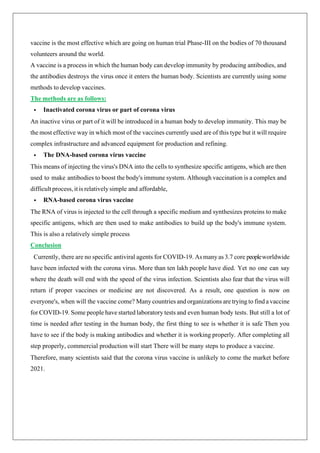
Coronavirus Genome Structure and Replication
The CoVs genome is a single-stranded RNA molecule. The genome size ranges between 27–32 kbp,
one of the largest known RNA viruses. The genomic structure of CoVs contains at least six open
reading frames (ORFs). The expression of the coronavirus replicase-transcriptase protein genes is
mediated by the translation of the genomic RNA. The replicase-transcriptase proteins are encoded in
open-reading frame 1a (ORF1a) and ORF1b and are synthesized initially as two large polyproteins,
pp1a and pp1ab. The synthesis of pp1ab involves programmed ribosomal frame shifting during
translation of ORF1a. During or after synthesis, these polyproteins are cleaved by virus-encoded
proteinases with papain-like (PLpro) and chymotrypsin-like folds into 16 proteins; nsp1 to nsp11 are
encoded in ORF1a, and nsp12 to nsp16 are encoded in ORF1b. The replicase-transcriptase proteins,
together with other viral proteins and, possibly, cellular proteins, assemble into membrane-bound
replication-transcription complexes (RTC). (We will use the term RTC to describe complexes
copying or producing genome- or sub genome-length RNA.) These complexes accumulate at
perinuclear regions and are associated with double-membrane vesicles. Hydrophobic transmembrane
domains are present in nsp3, nsp4, and nsp6 and likely serve to anchor the nascent pp1a/pp1ab
polyproteins to membranes during the first step of RTC formation
Fig.Coronavirus replication
Sign and Symptoms
Main coronavirus-associated symptoms.
1. Fever
2. Cough
3. Dyspnoea
4. Headache
5. Sore throat
6. Rhinorrhea
Treatment of Coronavirus
Plasma Therapy
On March 24, 2020, the FDA issued an Emergency Investigational New Drug (eIND) application for
the use of convalescent plasma to treat people with COVID-19. Plasma is the liquid part of blood that
carries blood cells. Convalescent plasma is collected from people who have recovered from COVID-
19. It is then transfused into someone with an active coronavirus infection. It is thought that antibodies
found in the convalescent plasma can help fight the coronavirus infection.
Remdesivir is an antiviral that is given by intravenous (IV) infusion in the hospital. On October 22,
2020, the FDA approved remdesivir (Veklury) for treatment of COVID-19 in patients ages 12 and
older requiring hospitalization. Below we summarize a few studies leading up to the approval.
Remdesivir was previously shown to have some effect against SARS, MERS, and Ebola in cell and
animal models. In a recent in vitro study (studies done in a petri dish or test tube rather than in animals
or humans), remdesivir prevented human cells from being infected with SARS-CoV-2 (the virus that
causes COVID-19).
Dexamethasone
Dexamethasone is a common corticosteroid (steroid) medication that has been used for many years
to treat various health conditions, such as autoimmune conditions and allergic reactions.
RECOVERY, a randomized clinical trial in the UK, is studying many medications, including
dexamethasone, to see if any are effective against COVID-19.
How can corona vaccine be made?
The role of vaccines in eradicating the corona virus is undeniable, so the focus of scientists around
the world right now is on discovering effective vaccines. According to a BBC Bangla, Prothom Alo
and world health organization’s report, more than 50 teams or organizations around the world are
working to discover the vaccine. Clinical trials have begun in the human body to test the
effectiveness and safety of some of these vaccines. Among these vaccines, the oxford covid-19
vaccine is the most effective which are going on human trial Phase-III on the bodies of 70 thousand
volunteers around the world.
A vaccine is a process in which the human body can develop immunity by producing antibodies, and
the antibodies destroys the virus once it enters the human body. Scientists are currently using some
methods to develop vaccines.
The methods are as follows:
• Inactivated corona virus or part of corona virus
An inactive virus or part of it will be introduced in a human body to develop immunity. This may be
the most effective way in which most of the vaccines currently used are of this type but it will require
complex infrastructure and advanced equipment for production and refining.
• The DNA-based corona virus vaccine
This means of injecting the virus's DNA into the cells to synthesize specific antigens, which are then
used to make antibodies to boost the body's immune system. Although vaccination is a complex and
difficult process, it is relatively simple and affordable,
• RNA-based corona virus vaccine
The RNA of virus is injected to the cell through a specific medium and synthesizes proteins to make
specific antigens, which are then used to make antibodies to build up the body's immune system.
This is also a relatively simple process
Conclusion
Currently, there are no specific antiviral agents for COVID-19. As manyas 3.7 core peopleworldwide
have been infected with the corona virus. More than ten lakh people have died. Yet no one can say
where the death will end with the speed of the virus infection. Scientists also fear that the virus will
return if proper vaccines or medicine are not discovered. As a result, one question is now on
everyone's, when will the vaccine come? Many countries and organizations are trying to find a vaccine
for COVID-19. Some people have started laboratory tests and even human body tests. But still a lot of
time is needed after testing in the human body, the first thing to see is whether it is safe Then you
have to see if the body is making antibodies and whether it is working properly. After completing all
step properly, commercial production will start There will be many steps to produce a vaccine.
Therefore, many scientists said that the corona virus vaccine is unlikely to come the market before
2021.

Corona virus

  • 1.
    Course Title: PharmaceuticalTechnology-II Course code: BPH-322 Assignment on: Coronavirus (Covid-19) Submitted to Submitted By Md.Mizanur Rahman Shopnil Akash Assistant Professor ID:181-29-059 Department of Pharmacy Department of Pharmacy Daffodil International University Daffodil International University Submission Date:06.11.2020 Assignment
  • 2.
    Contents Introduction...........................................................................................................................................01 What is coronavirus?............................................................................................................................01 Coronavirus Physical Structure.............................................................................................................01 Classification of coronaviruses.............................................................................................................02 Figure: Coronavirus classification Flowchart.......................................................................................02 Characteristics of SARS-CoV-2 ...........................................................................................................02 Coronavirus Genome Structure and Replication...................................................................................03 Fig.Coronavirus replication Flowchart .................................................................................................03 Sign and Symptoms ..............................................................................................................................04 Treatment of Coronavirus.....................................................................................................................04 Plasma Therapy.....................................................................................................................................04 Remdesivir............................................................................................................................................04 Dexamethasone.....................................................................................................................................04 How can corona vaccine be made?.......................................................................................................05 • Inactivated corona virus or part of corona virus .................................................................05 • The DNA-based corona virus vaccine ...................................................................................05 • RNA-based corona virus vaccine...........................................................................................05 Conclusion ............................................................................................................................................05
  • 3.
    The novel coronavirus(Covid-19) Introduction A pneumonia of unknown cause detected in Wuhan, China was first reported to the WHO Country Office in China on 31 December 2019.In the last Nine months, almost Ten lakhs of lives have already been Death, around three billion of people are in quarantine, and global economies have been decreased. The outbreak of pandemic Covid-19 all over the world has broken down the political, social, economic, religious and financial structures of the whole world. The World’s top economies country such as the Australia, USA, India China, UK, Germany, France, Italy, Japan and many others. The Stock Markets around the world have been broken down and oil prices have fallen off a cliff. A report was published on BBC where they describe every single week 3.3 million Americans have been unemployment and a week later another 6.6 million people started searching for new jobs. The novel coronavirus is a microscopic organism that has become an epidemic over time around the world. The United States, Europe, Britain, Italy, Spain and France have already been hit by the virus. These countries have already become mortal by Corona virus. What is corona virus? Coronavirus is an RNA virus in the family Coronaviridae of the order Nidovirales.It is a family of viruses that cause respiratory infections, which were first isolated in 1937 and designated coronaviruses, because they have a crown-like appearance under microscopy, in 1965.The types of coronavirus known to date are as follows: the alpha coronaviruses HCoV- 229E and HCoV-NL63; the beta coronaviruses HCoV-OC43 and HCoV-HKU1; SARS-CoV, which causes severe acute respiratory syndrome (SARS) Figure: Coronavirus Physical Structure
  • 4.
    Classification of coronaviruses Theclassification of Coronaviruses has been based on genomic organization, similarities in genomic sequence, antigenic properties of viral proteins, replication strategies, and structural characteristics of virions, pathogenic, cytopathogenic and physicochemical properties The Coronaviruses (CoVs) are species of virus belonging to the Nidovirales order, which includes Coronaviridae, Arteriviridae, Roniviridae and Mesoniviridae families. The Coronaviridae family is the largest one of the four families, by its genomic sizes of coronavirus range from 26 to 32 kb. It is now divided into four classes, Alpha coronavirus, Beta coronavirus, Gamma coronavirus and Delta coronavirus Figure: 02 Characteristics of SARS-CoV-2 SARS-CoV-2 is an enveloped, positive-sense, single stranded RNA beta coronavirus. The genomic characterization of SARS-CoV-2 suggested that this virus belongs to the subgenus coronavirus, exhibited 79% and 50% identity to severe acute respiratory syndrome coronavirus (SARS-CoV) and middle east respiratory syndrome coronavirus (MERS-CoV), respectively. All coronaviruses shared similar key elements of target for currently approved antiviral or new drug development including two viral proteases (papain-like protease, 3C-like protease), non-structural protein (RNA-dependent RNA polymerase) and structural protein (such as spike glycoprotein). It is, therefore, reasonable to reconsider antiviral agents used in SARS and MERS for SARSCoV-2.
  • 5.
    Coronavirus Genome Structureand Replication The CoVs genome is a single-stranded RNA molecule. The genome size ranges between 27–32 kbp, one of the largest known RNA viruses. The genomic structure of CoVs contains at least six open reading frames (ORFs). The expression of the coronavirus replicase-transcriptase protein genes is mediated by the translation of the genomic RNA. The replicase-transcriptase proteins are encoded in open-reading frame 1a (ORF1a) and ORF1b and are synthesized initially as two large polyproteins, pp1a and pp1ab. The synthesis of pp1ab involves programmed ribosomal frame shifting during translation of ORF1a. During or after synthesis, these polyproteins are cleaved by virus-encoded proteinases with papain-like (PLpro) and chymotrypsin-like folds into 16 proteins; nsp1 to nsp11 are encoded in ORF1a, and nsp12 to nsp16 are encoded in ORF1b. The replicase-transcriptase proteins, together with other viral proteins and, possibly, cellular proteins, assemble into membrane-bound replication-transcription complexes (RTC). (We will use the term RTC to describe complexes copying or producing genome- or sub genome-length RNA.) These complexes accumulate at perinuclear regions and are associated with double-membrane vesicles. Hydrophobic transmembrane domains are present in nsp3, nsp4, and nsp6 and likely serve to anchor the nascent pp1a/pp1ab polyproteins to membranes during the first step of RTC formation Fig.Coronavirus replication
  • 6.
    Sign and Symptoms Maincoronavirus-associated symptoms. 1. Fever 2. Cough 3. Dyspnoea 4. Headache 5. Sore throat 6. Rhinorrhea Treatment of Coronavirus Plasma Therapy On March 24, 2020, the FDA issued an Emergency Investigational New Drug (eIND) application for the use of convalescent plasma to treat people with COVID-19. Plasma is the liquid part of blood that carries blood cells. Convalescent plasma is collected from people who have recovered from COVID- 19. It is then transfused into someone with an active coronavirus infection. It is thought that antibodies found in the convalescent plasma can help fight the coronavirus infection. Remdesivir is an antiviral that is given by intravenous (IV) infusion in the hospital. On October 22, 2020, the FDA approved remdesivir (Veklury) for treatment of COVID-19 in patients ages 12 and older requiring hospitalization. Below we summarize a few studies leading up to the approval. Remdesivir was previously shown to have some effect against SARS, MERS, and Ebola in cell and animal models. In a recent in vitro study (studies done in a petri dish or test tube rather than in animals or humans), remdesivir prevented human cells from being infected with SARS-CoV-2 (the virus that causes COVID-19). Dexamethasone Dexamethasone is a common corticosteroid (steroid) medication that has been used for many years to treat various health conditions, such as autoimmune conditions and allergic reactions. RECOVERY, a randomized clinical trial in the UK, is studying many medications, including dexamethasone, to see if any are effective against COVID-19. How can corona vaccine be made? The role of vaccines in eradicating the corona virus is undeniable, so the focus of scientists around the world right now is on discovering effective vaccines. According to a BBC Bangla, Prothom Alo and world health organization’s report, more than 50 teams or organizations around the world are working to discover the vaccine. Clinical trials have begun in the human body to test the effectiveness and safety of some of these vaccines. Among these vaccines, the oxford covid-19
  • 7.
    vaccine is themost effective which are going on human trial Phase-III on the bodies of 70 thousand volunteers around the world. A vaccine is a process in which the human body can develop immunity by producing antibodies, and the antibodies destroys the virus once it enters the human body. Scientists are currently using some methods to develop vaccines. The methods are as follows: • Inactivated corona virus or part of corona virus An inactive virus or part of it will be introduced in a human body to develop immunity. This may be the most effective way in which most of the vaccines currently used are of this type but it will require complex infrastructure and advanced equipment for production and refining. • The DNA-based corona virus vaccine This means of injecting the virus's DNA into the cells to synthesize specific antigens, which are then used to make antibodies to boost the body's immune system. Although vaccination is a complex and difficult process, it is relatively simple and affordable, • RNA-based corona virus vaccine The RNA of virus is injected to the cell through a specific medium and synthesizes proteins to make specific antigens, which are then used to make antibodies to build up the body's immune system. This is also a relatively simple process Conclusion Currently, there are no specific antiviral agents for COVID-19. As manyas 3.7 core peopleworldwide have been infected with the corona virus. More than ten lakh people have died. Yet no one can say where the death will end with the speed of the virus infection. Scientists also fear that the virus will return if proper vaccines or medicine are not discovered. As a result, one question is now on everyone's, when will the vaccine come? Many countries and organizations are trying to find a vaccine for COVID-19. Some people have started laboratory tests and even human body tests. But still a lot of time is needed after testing in the human body, the first thing to see is whether it is safe Then you have to see if the body is making antibodies and whether it is working properly. After completing all step properly, commercial production will start There will be many steps to produce a vaccine. Therefore, many scientists said that the corona virus vaccine is unlikely to come the market before 2021.