Dr. SURENDRAN PARAMBADATH
           (M.Sc, M.Phil, M.Tech)


  Formerly: Post Doctoral Research Associate,
Nano-Information Materials Research Laboratory,
 Pusan National University, Busan-South Korea

         Currently: Assistant Professor
   Govt. Polytechnic College, Perinthalmanna
Nature keep all metals in their ore form.

         Metals are usually extracted from their ores.

 Nature tries to convert the metals again into their ore form.

The surface of metals are attacked             when exposed to
environment.

Chemicals are chemically turned to new substances such as
oxides,                                                hydated
oxides, carbonates, chlorides, sulphides, sulphates etc having
entirely new properties.

Once the metals begin to decay or get corroded, they suffer a
loss in electrical conductivity, tensile strength, color and luster.
Definition of Corrosion
Corrosion is the slow process of decay of the
metal, due to the attack of the atmosphere gases
on the surface of the metal, resulting in the
formation of metallic compounds such oxides,
hydroxides, carbonates, sulphides etc.
                       OR
Corrosion is the process of destruction or
deterioration of the metal and alloys by unwanted
or unintentional chemical or electrochemical
attack by its environments staring its surface.
Type of Corrosion
1. Dry or Chemical Corrosion:
It is due to the direct chemical action of
environmental atmosphere gases such as O2.
H2S, SO2, N2, halogens or anhydrous
inorganic liquids with metal surfaces.


2. Wet or Electrochemical Corrosion:
   It is due to the existence of separate
“anodic” and “cathodic” areas in the system
between which current flows through the
conducting liquid and the anode gets oxidized
and wasted.
Electrochemical Theory of Corrosion
                 (Mechanism Of Corrosion)
Corrosion is an electrochemical process.

Galvanic cells are setup between dissimilar metals in contact with each
other or between dissimilar parts of he same metal when surrounded by
moist air or liquid.

Anodic area oxidation takes place

Cathodic area reduction takes place.

Metallic ions formed at the anodic part and ions formed at the
cathodic part diffuses towards each other through conducting
medium and the corrosion product is formed somewhere between
the anodic and cathodic areas.
Anodic iron gets oxidised to Fe2+

M                 Mn+ + ne-

The oxygen at the cathode changes to OH- by reduction.
½ O2 + H2O +2e-                 2 OH-
Factors Affecting
   Corrosion
 Rate & Extent of corrosion
1. The position of metals in the electrochemical Series
                 Metal                     SRP, Eo
                 Lithium----------------- -3.05 V
More oxidation                                         Less Reduction
                 Potassium
                 Calcium
                 Sodium
  Decreasing     Magnesium                            Increasing
  tendency       Aluminum                             order of std
  to loose       Zinc                                 reduction
  electrons      Nickel                               potential
                 Tin
                 Hydrogen--------------- 0.00
                 Copper
                 Silver
                 Platinum
                 Gold---------------------- +1.15 V
When two metals are in contact with each other, in
presence of an electrolyte, the more active metal
becomes the anode and easily undergoes oxidation
ie, corrosion.


                                More active


                          Less active


Greater the difference between the reduction
potentials of the metals, more severe will be the rate of
corrosion.
2. Relative areas of anodic and cathodic parts


When two dissimilar metals or alloys are in
contact and the anodic area is smaller than the
cathodic area, the corrosion of the anode become
rapid and severe.
                    Cathode

                                          Anode
3. Purity of the metal

A pure metal is more corrosion resistant than an
impure metal. The rate and extent of corrosion
increases with the amount of impurities present.
4.Physical state of the metal

Smaller the size of the metal, more the area under
stress and greater is the corrosion.
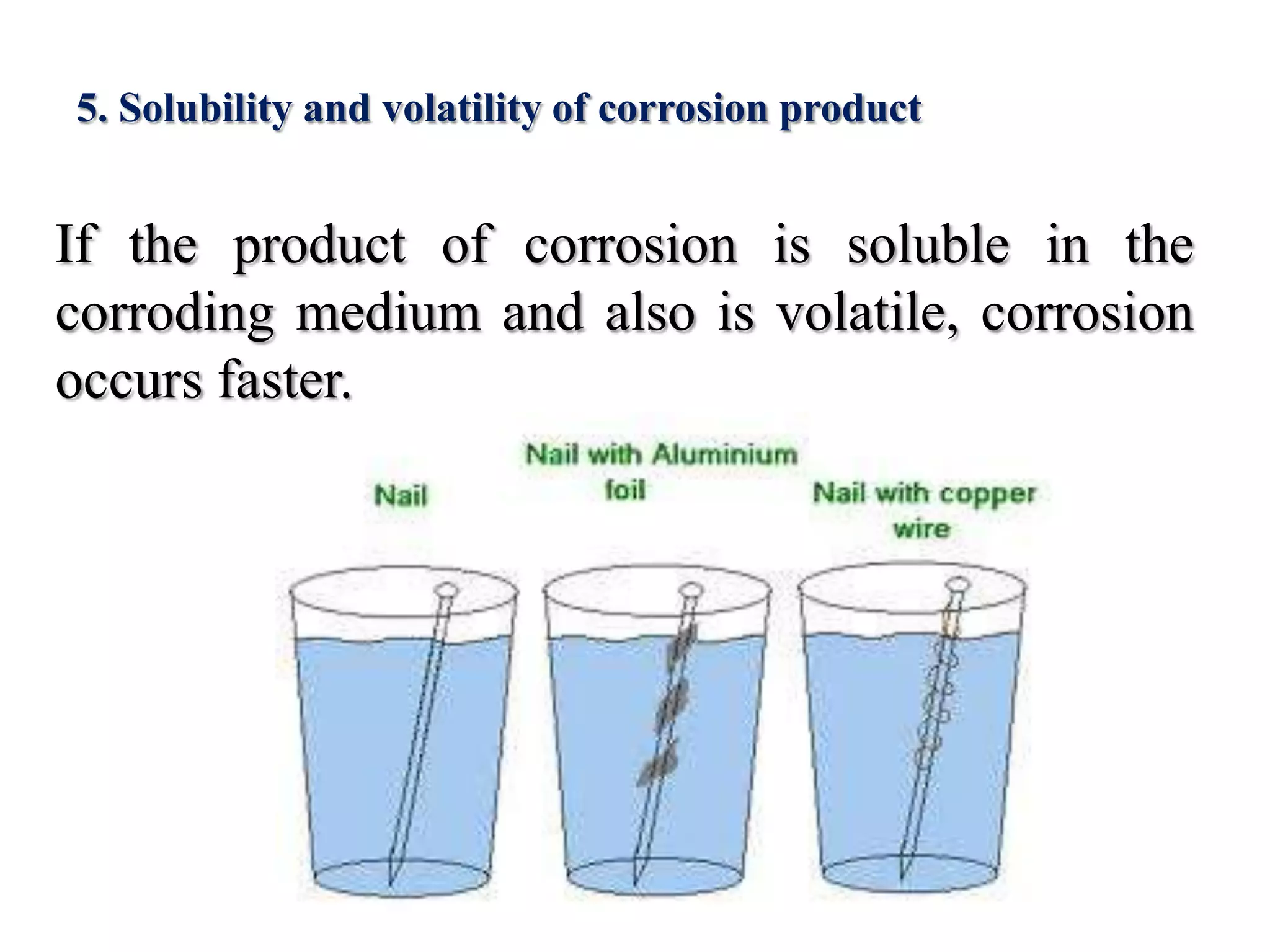
5. Solubility and volatility of corrosion product


If the product of corrosion is soluble in the
corroding medium and also is volatile, corrosion
occurs faster.
6. Nature of the corroding environment

 A.Temperature: Corrosion generally increases
   with rise in temperature of environment.
 B.Humidity of the air: Rate of corrosion
   increases with presence of moisture in the
   atmosphere.
 C.Impurities: Presence of impurities like
   CO2, H2S, SO2, acid fumes etc increases
   corrosion rate.
 D.Influence of pH: In acid medium corrosion is
   more and in alkaline medium it is less.
Rusting of Iron
Rust: Fe2O3.XH2O            or Fe(OH)3
A galvanic cell is set up between two dissimilar parts of the same
metal iron.

a) The portion of iron which is in contact with water acts as
anode and the other portion in contact with air acts as cathode.

b) Anodic iron gets oxidised to Fe2+
Anode
Fe                Fe2+ + 2e-
Cathode
The oxygen at the cathode changes to OH- by reduction.
½ O2 + H2O +2e-                    2 OH-

The electron released at the anode move through the metal to the
cathodic site.
c) Fe2+ and OH- ions combine to form Fe(OH)2 which gets
oxidized to Fe(OH)3.

Fe2+ + OH-                Fe(OH)2

4 Fe(OH)2   + O2 + 2H2O                     4Fe(OH)3

Overall reaction

2 Fe + O2 + 4H+                     2Fe2+    + 2H2O
Conditions for rusting

1.Impurities in iron
2.Presence of oxygen
3.Presence of moisture
4.Presence of electrolyte
5.Presence of Cl2 or SO2 in the atm.
Prevention of rusting

1.Minimizing the impurities in iron
2. Giving suitable coating of Zn/Sn/Cr
3.Painting the iron surface
Prevention of Corrosion
1. Maintaining the purity of the metal
Pure metals are generally corrosion resistant.
2. Alloying with other elements
It to found that alloying with suitable
elements increases corrosion resistance of
most metals.
3. Modification of environment

Deaeration of aqueous environment and
dehumidification decreases the rate of
corrosion.
4. Barrier protection or Protective coatings


    1.Metallic Coating
    2.Non-metallic coatings
    3.Organic coatings
i. Metallic Coating

a) Using less active metal
b) Using a more active metal


Galvanization is the process of
coating iron or steel sheets with a
thin layer of zinc by dipping in
molten zinc.
The iron or steel article is first cleaned with
dil. H2SO4 at 60-90oC (Pickling).

Then the article is treated with 5% HF to remove
grains of sand, washed with water and dried.

It is dipped in molten zinc (425-450oC).

A layer of zinc gets coated on the article, which
is then pressed through a roller to remove excess
zinc.
ii. Non-Metallic Coating


a) Phosphate coating by alkaline solution of phosphate.
b) Chromate coating using chromate solutions.
c) Anodizing on non-ferrous metals.
iii. Organic Coating

Plastics, polythene, rubber etc, are used for coating to
prevent corrosion.

Mainly on articles like, ship, submarines. Etc.
CATHODIC PROTECTION
         OR
ELECTRICAL PROTECTION
Zn             Zn2+ + 2e-   Anode


½ O2 + H2O + 2e-            2OH-      Cathode


     Cathode


                                      Zn


                                    Anode
Thank You

Corrosion-Dr. Surendran Parambadath

  • 2.
    Dr. SURENDRAN PARAMBADATH (M.Sc, M.Phil, M.Tech) Formerly: Post Doctoral Research Associate, Nano-Information Materials Research Laboratory, Pusan National University, Busan-South Korea Currently: Assistant Professor Govt. Polytechnic College, Perinthalmanna
  • 3.
    Nature keep allmetals in their ore form. Metals are usually extracted from their ores. Nature tries to convert the metals again into their ore form. The surface of metals are attacked when exposed to environment. Chemicals are chemically turned to new substances such as oxides, hydated oxides, carbonates, chlorides, sulphides, sulphates etc having entirely new properties. Once the metals begin to decay or get corroded, they suffer a loss in electrical conductivity, tensile strength, color and luster.
  • 4.
    Definition of Corrosion Corrosionis the slow process of decay of the metal, due to the attack of the atmosphere gases on the surface of the metal, resulting in the formation of metallic compounds such oxides, hydroxides, carbonates, sulphides etc. OR Corrosion is the process of destruction or deterioration of the metal and alloys by unwanted or unintentional chemical or electrochemical attack by its environments staring its surface.
  • 5.
    Type of Corrosion 1.Dry or Chemical Corrosion: It is due to the direct chemical action of environmental atmosphere gases such as O2. H2S, SO2, N2, halogens or anhydrous inorganic liquids with metal surfaces. 2. Wet or Electrochemical Corrosion: It is due to the existence of separate “anodic” and “cathodic” areas in the system between which current flows through the conducting liquid and the anode gets oxidized and wasted.
  • 6.
    Electrochemical Theory ofCorrosion (Mechanism Of Corrosion) Corrosion is an electrochemical process. Galvanic cells are setup between dissimilar metals in contact with each other or between dissimilar parts of he same metal when surrounded by moist air or liquid. Anodic area oxidation takes place Cathodic area reduction takes place. Metallic ions formed at the anodic part and ions formed at the cathodic part diffuses towards each other through conducting medium and the corrosion product is formed somewhere between the anodic and cathodic areas.
  • 7.
    Anodic iron getsoxidised to Fe2+ M Mn+ + ne- The oxygen at the cathode changes to OH- by reduction. ½ O2 + H2O +2e- 2 OH-
  • 8.
    Factors Affecting Corrosion Rate & Extent of corrosion
  • 9.
    1. The positionof metals in the electrochemical Series Metal SRP, Eo Lithium----------------- -3.05 V More oxidation Less Reduction Potassium Calcium Sodium Decreasing Magnesium Increasing tendency Aluminum order of std to loose Zinc reduction electrons Nickel potential Tin Hydrogen--------------- 0.00 Copper Silver Platinum Gold---------------------- +1.15 V
  • 10.
    When two metalsare in contact with each other, in presence of an electrolyte, the more active metal becomes the anode and easily undergoes oxidation ie, corrosion. More active Less active Greater the difference between the reduction potentials of the metals, more severe will be the rate of corrosion.
  • 11.
    2. Relative areasof anodic and cathodic parts When two dissimilar metals or alloys are in contact and the anodic area is smaller than the cathodic area, the corrosion of the anode become rapid and severe. Cathode Anode
  • 12.
    3. Purity ofthe metal A pure metal is more corrosion resistant than an impure metal. The rate and extent of corrosion increases with the amount of impurities present.
  • 13.
    4.Physical state ofthe metal Smaller the size of the metal, more the area under stress and greater is the corrosion.
  • 14.
    5. Solubility andvolatility of corrosion product If the product of corrosion is soluble in the corroding medium and also is volatile, corrosion occurs faster.
  • 15.
    6. Nature ofthe corroding environment A.Temperature: Corrosion generally increases with rise in temperature of environment. B.Humidity of the air: Rate of corrosion increases with presence of moisture in the atmosphere. C.Impurities: Presence of impurities like CO2, H2S, SO2, acid fumes etc increases corrosion rate. D.Influence of pH: In acid medium corrosion is more and in alkaline medium it is less.
  • 16.
  • 18.
    Rust: Fe2O3.XH2O or Fe(OH)3 A galvanic cell is set up between two dissimilar parts of the same metal iron. a) The portion of iron which is in contact with water acts as anode and the other portion in contact with air acts as cathode. b) Anodic iron gets oxidised to Fe2+ Anode Fe Fe2+ + 2e- Cathode The oxygen at the cathode changes to OH- by reduction. ½ O2 + H2O +2e- 2 OH- The electron released at the anode move through the metal to the cathodic site.
  • 19.
    c) Fe2+ andOH- ions combine to form Fe(OH)2 which gets oxidized to Fe(OH)3. Fe2+ + OH- Fe(OH)2 4 Fe(OH)2 + O2 + 2H2O 4Fe(OH)3 Overall reaction 2 Fe + O2 + 4H+ 2Fe2+ + 2H2O
  • 20.
    Conditions for rusting 1.Impuritiesin iron 2.Presence of oxygen 3.Presence of moisture 4.Presence of electrolyte 5.Presence of Cl2 or SO2 in the atm.
  • 21.
    Prevention of rusting 1.Minimizingthe impurities in iron 2. Giving suitable coating of Zn/Sn/Cr 3.Painting the iron surface
  • 22.
  • 23.
    1. Maintaining thepurity of the metal Pure metals are generally corrosion resistant.
  • 25.
    2. Alloying withother elements It to found that alloying with suitable elements increases corrosion resistance of most metals.
  • 26.
    3. Modification ofenvironment Deaeration of aqueous environment and dehumidification decreases the rate of corrosion.
  • 27.
    4. Barrier protectionor Protective coatings 1.Metallic Coating 2.Non-metallic coatings 3.Organic coatings
  • 28.
    i. Metallic Coating a)Using less active metal b) Using a more active metal Galvanization is the process of coating iron or steel sheets with a thin layer of zinc by dipping in molten zinc.
  • 30.
    The iron orsteel article is first cleaned with dil. H2SO4 at 60-90oC (Pickling). Then the article is treated with 5% HF to remove grains of sand, washed with water and dried. It is dipped in molten zinc (425-450oC). A layer of zinc gets coated on the article, which is then pressed through a roller to remove excess zinc.
  • 31.
    ii. Non-Metallic Coating a)Phosphate coating by alkaline solution of phosphate. b) Chromate coating using chromate solutions. c) Anodizing on non-ferrous metals.
  • 32.
    iii. Organic Coating Plastics,polythene, rubber etc, are used for coating to prevent corrosion. Mainly on articles like, ship, submarines. Etc.
  • 34.
    CATHODIC PROTECTION OR ELECTRICAL PROTECTION
  • 35.
    Zn Zn2+ + 2e- Anode ½ O2 + H2O + 2e- 2OH- Cathode Cathode Zn Anode
  • 37.