PRESENTATION
ENVIRONMENTAL DEGRADATION OF MATERIALS
EROSION CORROSION
RISHABH SHARMA
(16210015)
CORROSION EROSION
(“Flow-Assisted” or “Flow-Accelerated”
Corrosion)
An increase in corrosion brought about by a
high relative velocity between the
corrosive environment and the surface.
Remember the distinction between erosion-corrosion
and erosion:
– erosion is the straightforward wearing away by the
mechanical abrasion caused by suspended particles
. . . e.g., sand-blasting, erosion of turbine blades by
droplets . . .(mechanical action)
– erosion-corrosion also involves a corrosive
environment . . . the metal undergoes a chemical
reaction….(chemical action but corroded metal may
come out due to mechanical acion)
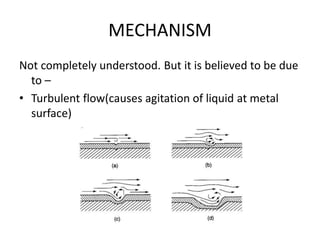
MECHANISM
Not completely understood. But it is believed to be due
to –
• Turbulent flow(causes agitation of liquid at metal
surface)
Other mechanisms
• Suspended solid particles in fluid flow
• Gas bubble formation and bursting during
fluid flow(cavitation)
• Liquid drops in gas flow
MECHANISM
Removal of the metal may be:
 as corrosion product which “spalls off” the
surface because of the high fluid shear and
bares the metal beneath
 as metal ions, which are swept away by the
fluid flow before they can deposit as
corrosion product.
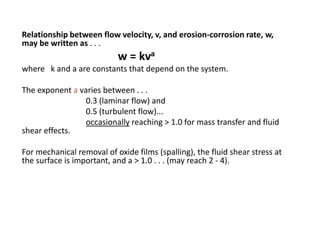
Relationship between flow velocity, v, and erosion-corrosion rate, w,
may be written as . . .
w = kva
where k and a are constants that depend on the system.
The exponent a varies between . . .
0.3 (laminar flow) and
0.5 (turbulent flow)...
occasionally reaching > 1.0 for mass transfer and fluid
shear effects.
For mechanical removal of oxide films (spalling), the fluid shear stress at
the surface is important, and a > 1.0 . . . (may reach 2 - 4).
PRONE AREAS/EXAMPLES
• If fluid contains suspended solids,
erosion-corrosion may be aggravated.
Equipment that is subjected to ---
• high-velocity fluid,
• to rapid change in direction of fluid,
• to excessive turbulence . . .
• high mass transfer rates.
PRONE AREAS/EXAMPLES
• Most metals and alloys
• Metals which are soft to wear off mechanically like copper and lead are
more prone.
• pipes (bends, elbows, tees);
• valves;
• pumps;
• blowers;
• propellers, impellers;
• stirrers;
• stirred vessels;
• tubing (heaters, condensers);
• flow-measuring orifices, venturies;
• turbine blades;
• nozzles;
• baffles;
• metal-working equipment (scrapers, cutters, grinders, mills);
• spray impingement components etc.
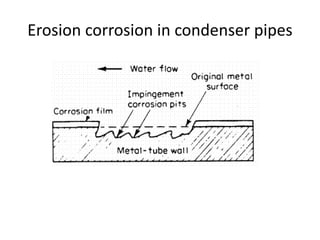
Erosion corrosion in condenser pipes
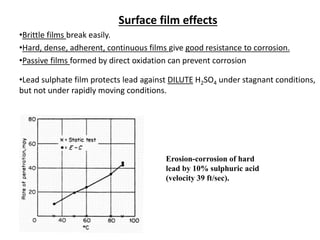
Surface film effects
•Brittle films break easily.
•Hard, dense, adherent, continuous films give good resistance to corrosion.
•Passive films formed by direct oxidation can prevent corrosion
•Lead sulphate film protects lead against DILUTE H2SO4 under stagnant conditions,
but not under rapidly moving conditions.
Erosion-corrosion of hard
lead by 10% sulphuric acid
(velocity 39 ft/sec).
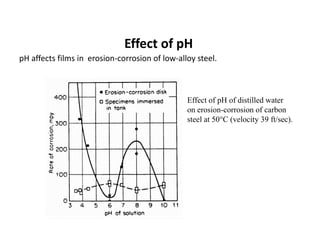
Effect of pH
pH affects films in erosion-corrosion of low-alloy steel.
Effect of pH of distilled water
on erosion-corrosion of carbon
steel at 50C (velocity 39 ft/sec).
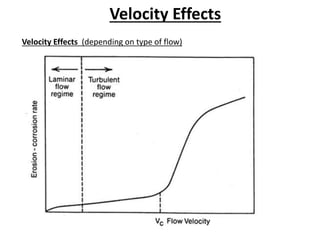
Velocity Effects
Velocity Effects (depending on type of flow)
Velocity Effects
• At high velocities corrosion rate may be high
or low.
• Corrosion rate of steel is high at high velocity.
• High velocity may decrease corrosion rate by
avoiding deposition of silt and dirt over metal.
• Suspended solid will damage more at high
velocity.
Material effect
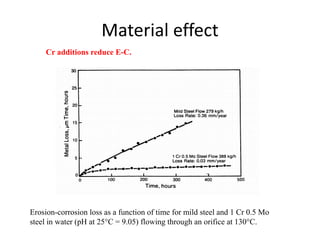
Cr additions reduce E-C.
Erosion-corrosion loss as a function of time for mild steel and 1 Cr 0.5 Mo
steel in water (pH at 25C = 9.05) flowing through an orifice at 130C.
Prevention of Erosion-Corrosion
• design (avoid impingement geometries, high velocity, etc.);
• Change Environment (use of inhibitors e.g., in steam
supply systems . . . for CS or low-alloy steel add O2 )
• Choice of Materials (use Cr-containing steels or titanium);
• use hard, corrosion-resistant coatings (titanium
coatings).
ANY QUERY
THANK YOU!!!!!

Presentation ON EROSION CORROSION

  • 1.
    PRESENTATION ENVIRONMENTAL DEGRADATION OFMATERIALS EROSION CORROSION RISHABH SHARMA (16210015)
  • 2.
    CORROSION EROSION (“Flow-Assisted” or“Flow-Accelerated” Corrosion) An increase in corrosion brought about by a high relative velocity between the corrosive environment and the surface.
  • 3.
    Remember the distinctionbetween erosion-corrosion and erosion: – erosion is the straightforward wearing away by the mechanical abrasion caused by suspended particles . . . e.g., sand-blasting, erosion of turbine blades by droplets . . .(mechanical action) – erosion-corrosion also involves a corrosive environment . . . the metal undergoes a chemical reaction….(chemical action but corroded metal may come out due to mechanical acion)
  • 4.
    MECHANISM Not completely understood.But it is believed to be due to – • Turbulent flow(causes agitation of liquid at metal surface)
  • 5.
    Other mechanisms • Suspendedsolid particles in fluid flow • Gas bubble formation and bursting during fluid flow(cavitation) • Liquid drops in gas flow
  • 6.
    MECHANISM Removal of themetal may be:  as corrosion product which “spalls off” the surface because of the high fluid shear and bares the metal beneath  as metal ions, which are swept away by the fluid flow before they can deposit as corrosion product.
  • 7.
    Relationship between flowvelocity, v, and erosion-corrosion rate, w, may be written as . . . w = kva where k and a are constants that depend on the system. The exponent a varies between . . . 0.3 (laminar flow) and 0.5 (turbulent flow)... occasionally reaching > 1.0 for mass transfer and fluid shear effects. For mechanical removal of oxide films (spalling), the fluid shear stress at the surface is important, and a > 1.0 . . . (may reach 2 - 4).
  • 8.
    PRONE AREAS/EXAMPLES • Iffluid contains suspended solids, erosion-corrosion may be aggravated. Equipment that is subjected to --- • high-velocity fluid, • to rapid change in direction of fluid, • to excessive turbulence . . . • high mass transfer rates.
  • 9.
    PRONE AREAS/EXAMPLES • Mostmetals and alloys • Metals which are soft to wear off mechanically like copper and lead are more prone. • pipes (bends, elbows, tees); • valves; • pumps; • blowers; • propellers, impellers; • stirrers; • stirred vessels; • tubing (heaters, condensers); • flow-measuring orifices, venturies; • turbine blades; • nozzles; • baffles; • metal-working equipment (scrapers, cutters, grinders, mills); • spray impingement components etc.
  • 10.
    Erosion corrosion incondenser pipes
  • 11.
    Surface film effects •Brittlefilms break easily. •Hard, dense, adherent, continuous films give good resistance to corrosion. •Passive films formed by direct oxidation can prevent corrosion •Lead sulphate film protects lead against DILUTE H2SO4 under stagnant conditions, but not under rapidly moving conditions. Erosion-corrosion of hard lead by 10% sulphuric acid (velocity 39 ft/sec).
  • 12.
    Effect of pH pHaffects films in erosion-corrosion of low-alloy steel. Effect of pH of distilled water on erosion-corrosion of carbon steel at 50C (velocity 39 ft/sec).
  • 13.
    Velocity Effects Velocity Effects(depending on type of flow)
  • 14.
    Velocity Effects • Athigh velocities corrosion rate may be high or low. • Corrosion rate of steel is high at high velocity. • High velocity may decrease corrosion rate by avoiding deposition of silt and dirt over metal. • Suspended solid will damage more at high velocity.
  • 15.
    Material effect Cr additionsreduce E-C. Erosion-corrosion loss as a function of time for mild steel and 1 Cr 0.5 Mo steel in water (pH at 25C = 9.05) flowing through an orifice at 130C.
  • 16.
    Prevention of Erosion-Corrosion •design (avoid impingement geometries, high velocity, etc.); • Change Environment (use of inhibitors e.g., in steam supply systems . . . for CS or low-alloy steel add O2 ) • Choice of Materials (use Cr-containing steels or titanium); • use hard, corrosion-resistant coatings (titanium coatings).
  • 17.
  • 18.