


Dr. SURENDRAN PARAMBADATH
           (M.Sc, M.Phil, M.Tech)


  Formerly: Post Doctoral Research Associate,
Nano-Information Materials Research Laboratory,
 Pusan National University, Busan-South Korea

         Currently: Assistant Professor
   Govt. Polytechnic College, Perinthalmanna
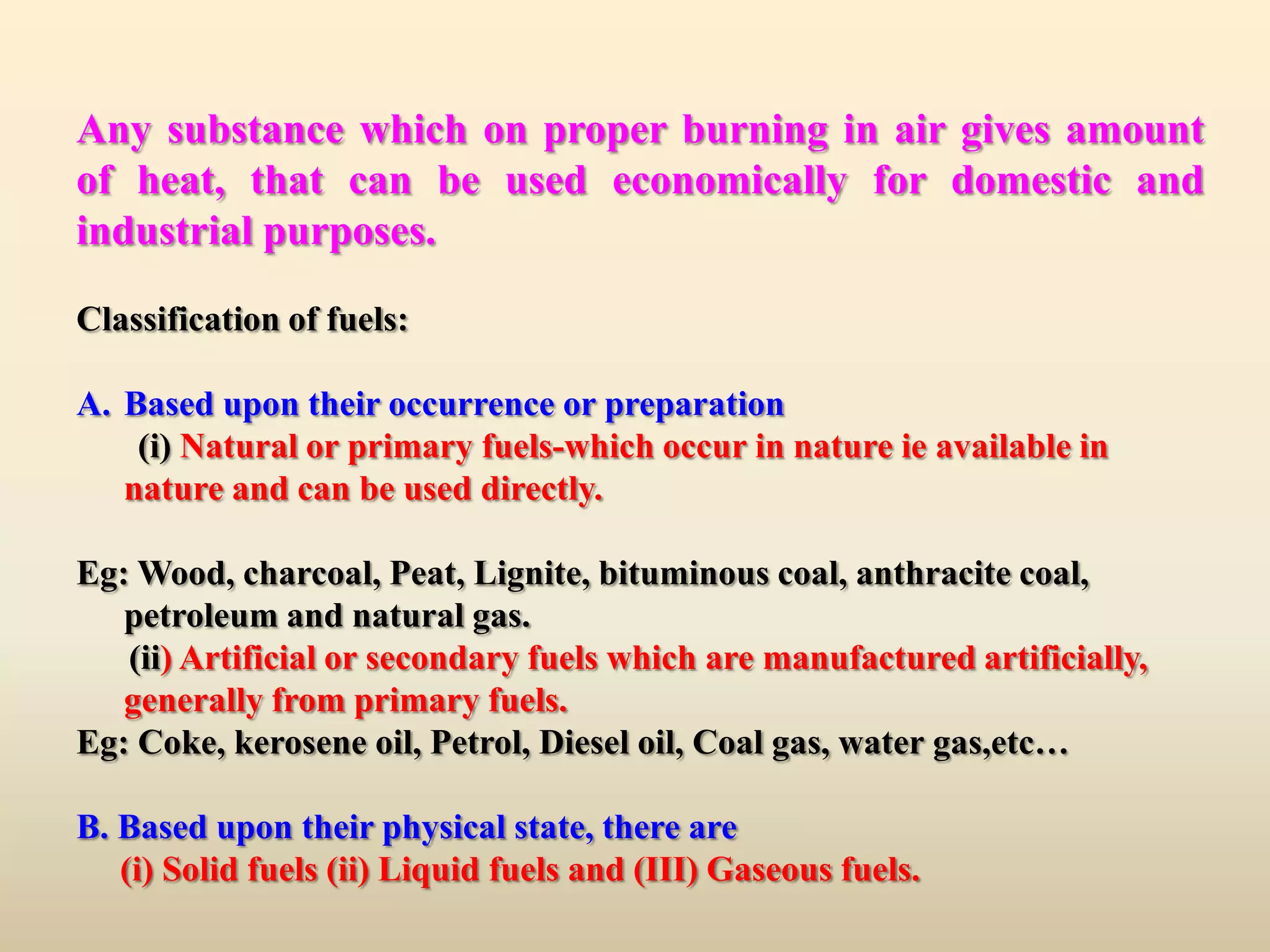
Any substance which on proper burning in air gives amount
of heat, that can be used economically for domestic and
industrial purposes.

Classification of fuels:

A. Based upon their occurrence or preparation
    (i) Natural or primary fuels-which occur in nature ie available in
   nature and can be used directly.

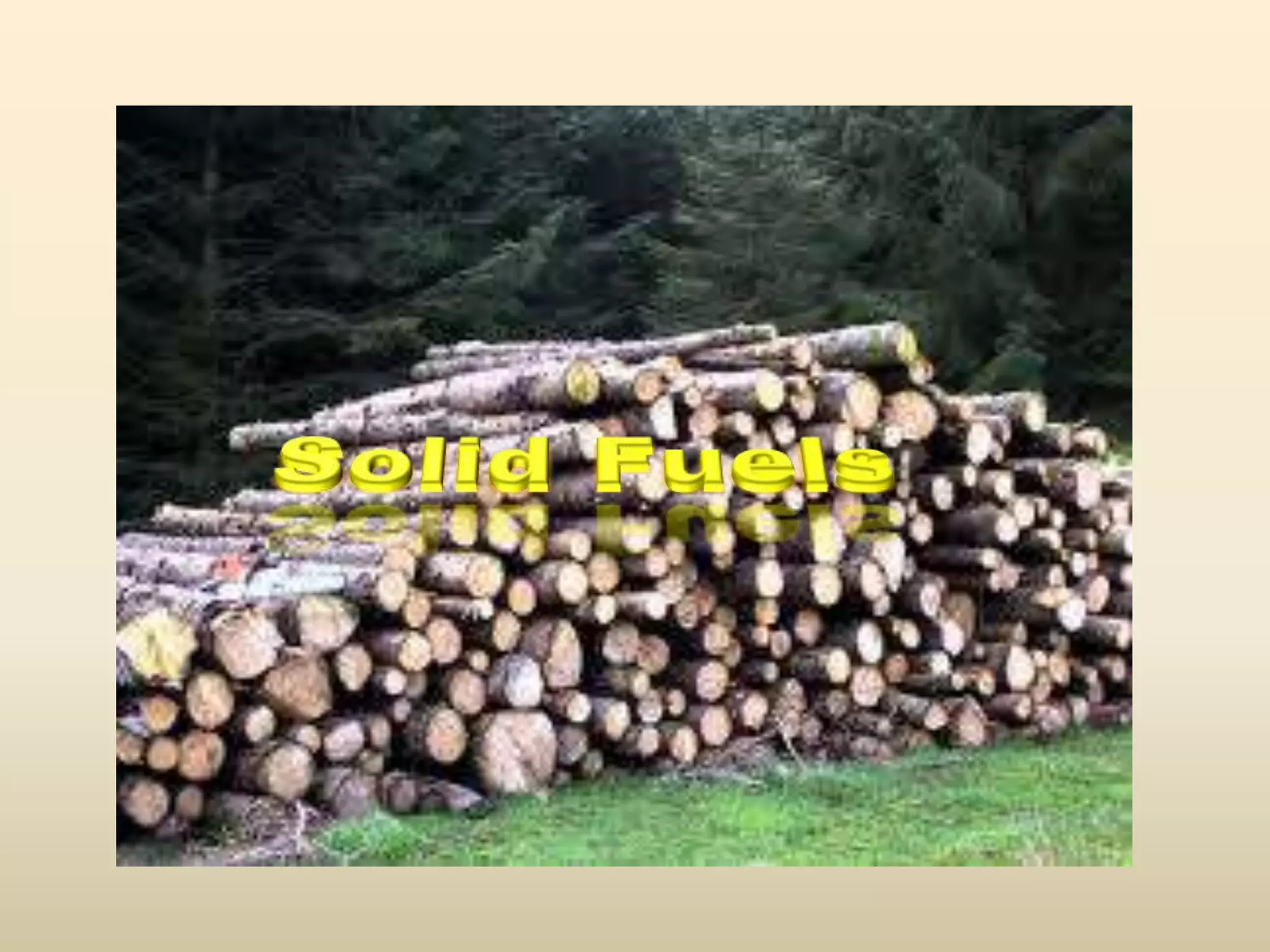
Eg: Wood, charcoal, Peat, Lignite, bituminous coal, anthracite coal,
   petroleum and natural gas.
   (ii) Artificial or secondary fuels which are manufactured artificially,
   generally from primary fuels.
Eg: Coke, kerosene oil, Petrol, Diesel oil, Coal gas, water gas,etc…

B. Based upon their physical state, there are
   (i) Solid fuels (ii) Liquid fuels and (III) Gaseous fuels.
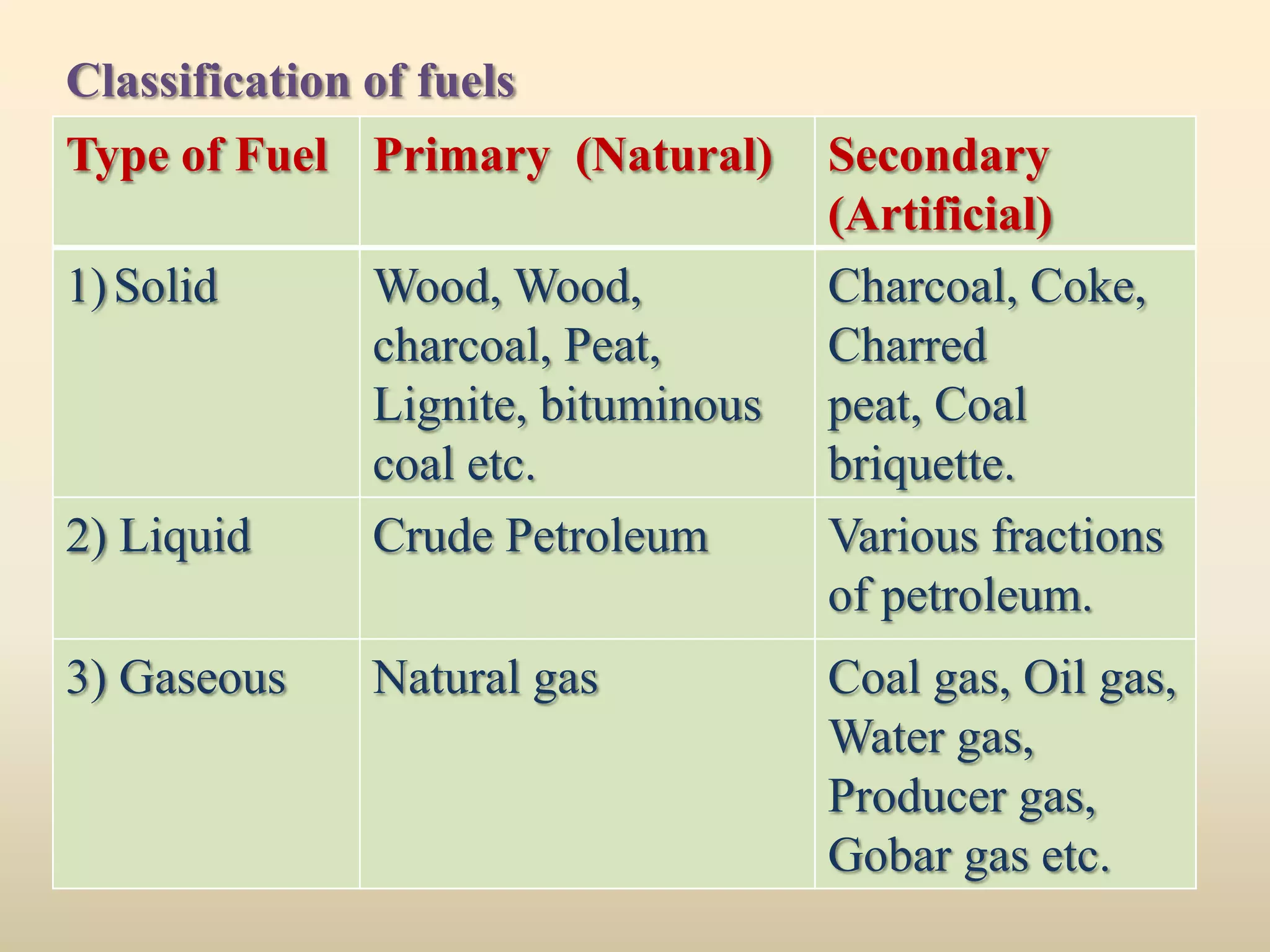
Classification of fuels
Type of Fuel Primary (Natural)       Secondary
                                     (Artificial)
1) Solid       Wood, Wood,           Charcoal, Coke,
               charcoal, Peat,       Charred
               Lignite, bituminous   peat, Coal
               coal etc.             briquette.
2) Liquid      Crude Petroleum       Various fractions
                                     of petroleum.
3) Gaseous     Natural gas           Coal gas, Oil gas,
                                     Water gas,
                                     Producer gas,
                                     Gobar gas etc.
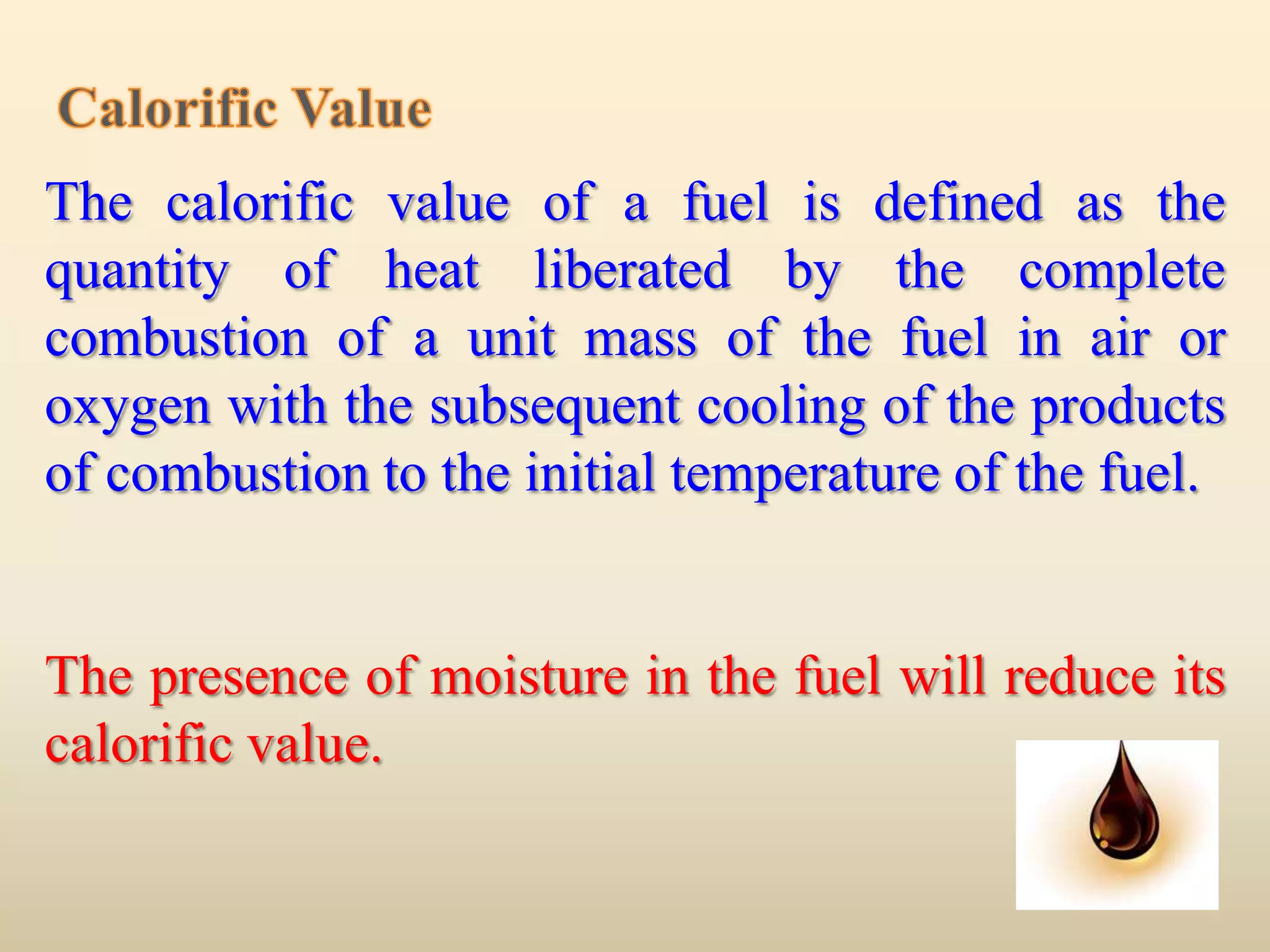
The calorific value of a fuel is defined as the
quantity of heat liberated by the complete
combustion of a unit mass of the fuel in air or
oxygen with the subsequent cooling of the products
of combustion to the initial temperature of the fuel.


The presence of moisture in the fuel will reduce its
calorific value.
Characteristics of a good fuel
1   High calorific value which determines the amount of heat
    produced and temperature attained.

2   Moderate ignition temperature.

3   Moderate velocity of combustion for continuous supply of
    heat.

4   Low moisture content. Velocity of combustion in presence of
    moisture leads to low temperature.

5   Low non-combustible matter content, as their presence lead
    to formation of ash, decreases in calorific value of fuel,
    additional cost of storage handling of disposal of waste
    products etc.
Liquid Fuels
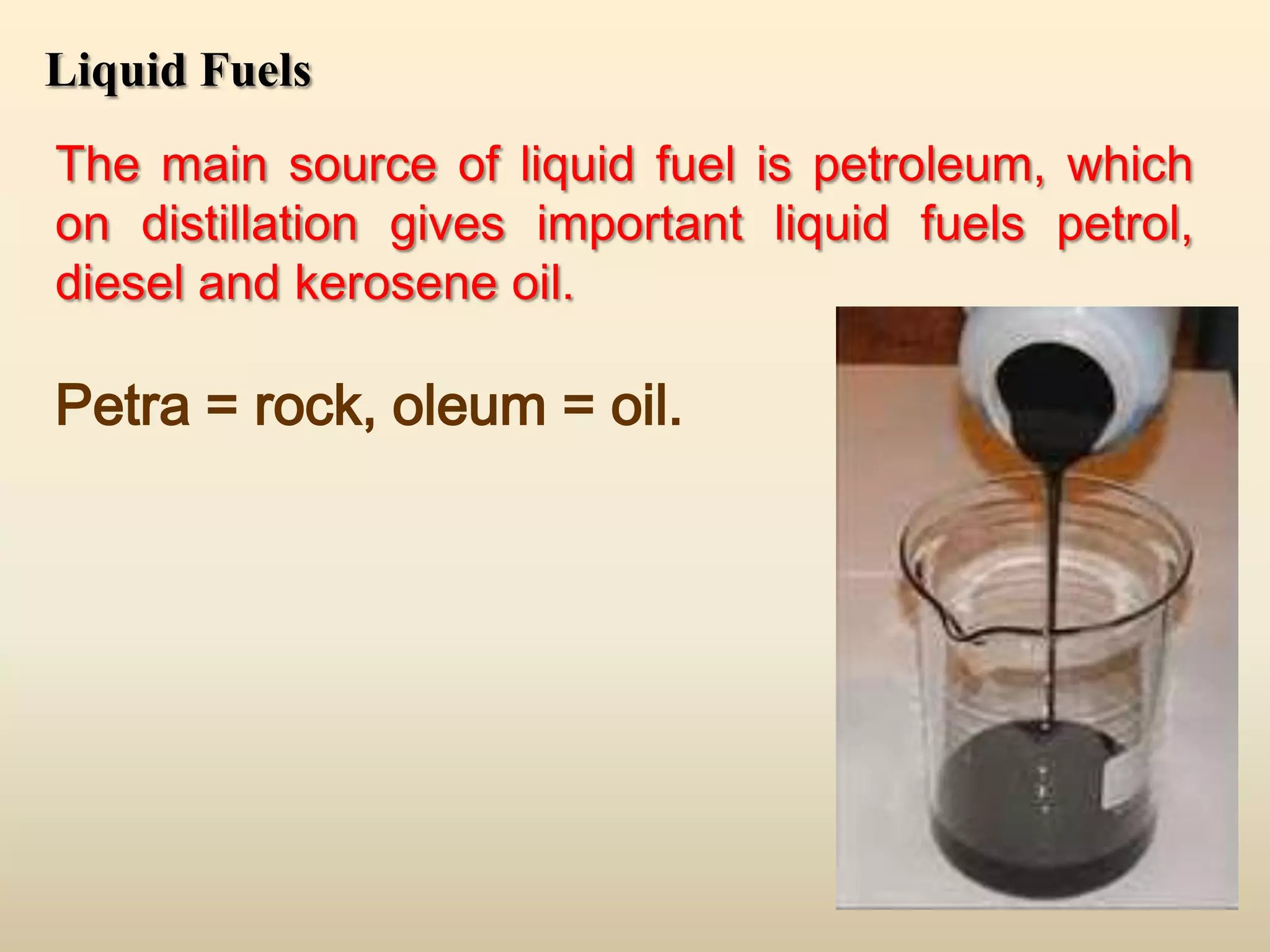
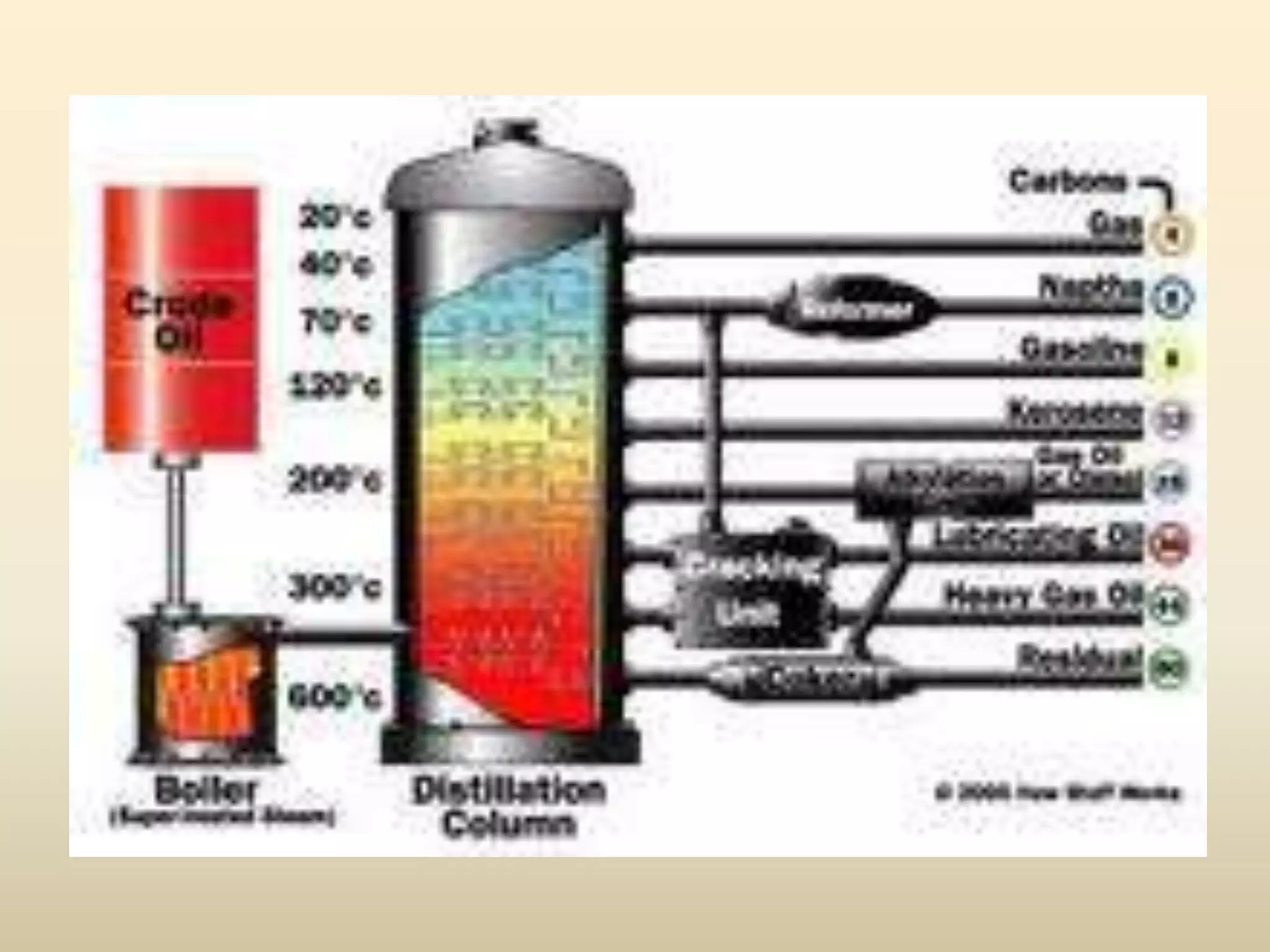
The main source of liquid fuel is petroleum, which
on distillation gives important liquid fuels petrol,
diesel and kerosene oil.

Petra = rock, oleum = oil.
Treatment of Petroleum

Remove dirt, water sulphur etc.

Fractional distillation

  Heating up to 400oC in an iron
retort,   whereby     all     volatile
constituents except the residue are
evaporated,     and       fractionally
separated during condensation.
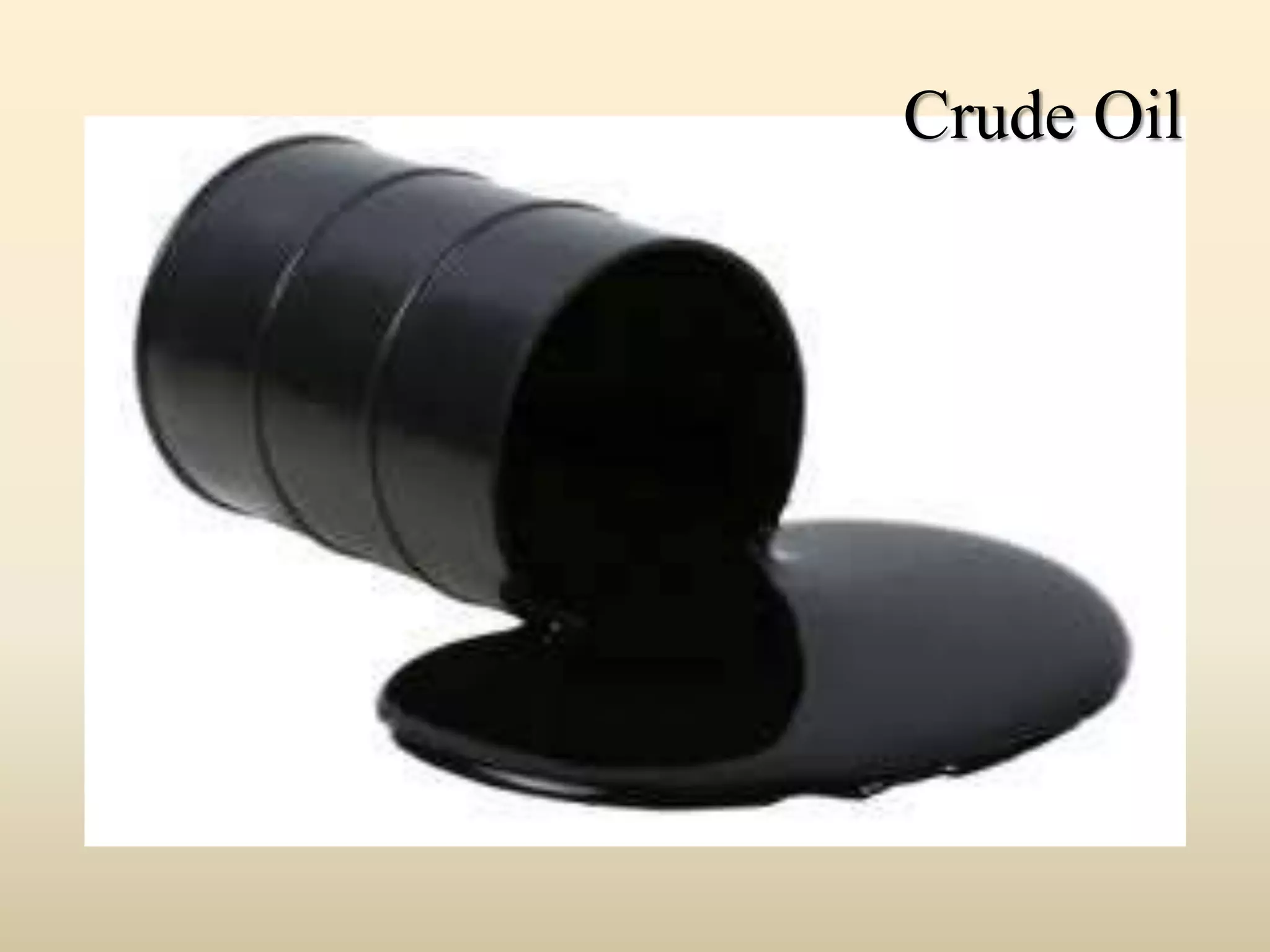
Crude Oil
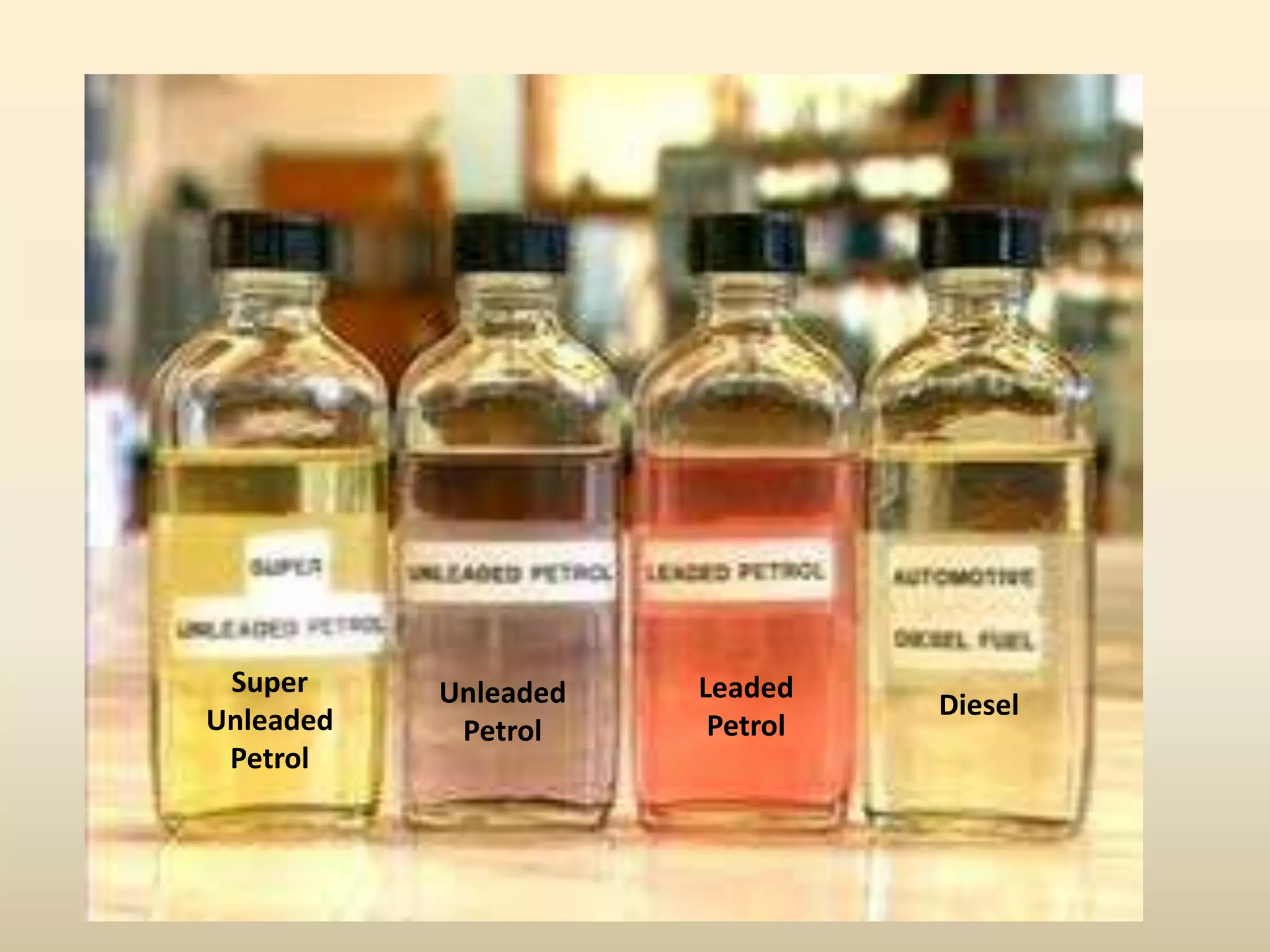
Super     Unleaded   Leaded
Unleaded                        Diesel
            Petrol     Petrol
 Petrol
1. Gasoline or Petrol or Motor Spirit.

It is a mixture of low boiling (40-120oC)
hydrocarbons            such           as
pentane, hexane, heptane and octane.
Petrol and alcohol in the ratio o 4:1
gives Power alcohol.
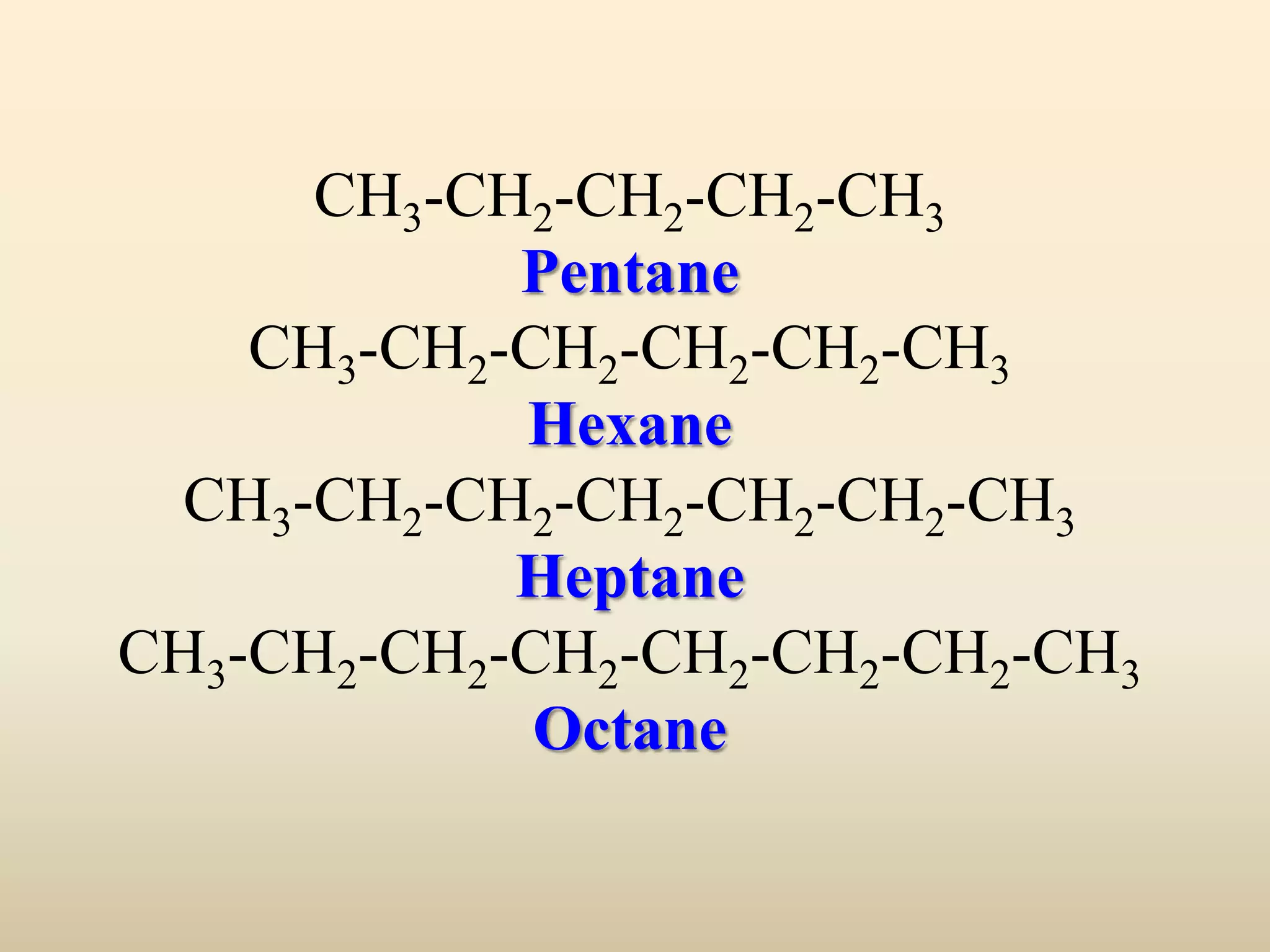
CH3-CH2-CH2-CH2-CH3
            Pentane
    CH3-CH2-CH2-CH2-CH2-CH3
            Hexane
  CH3-CH2-CH2-CH2-CH2-CH2-CH3
            Heptane
CH3-CH2-CH2-CH2-CH2-CH2-CH2-CH3
             Octane
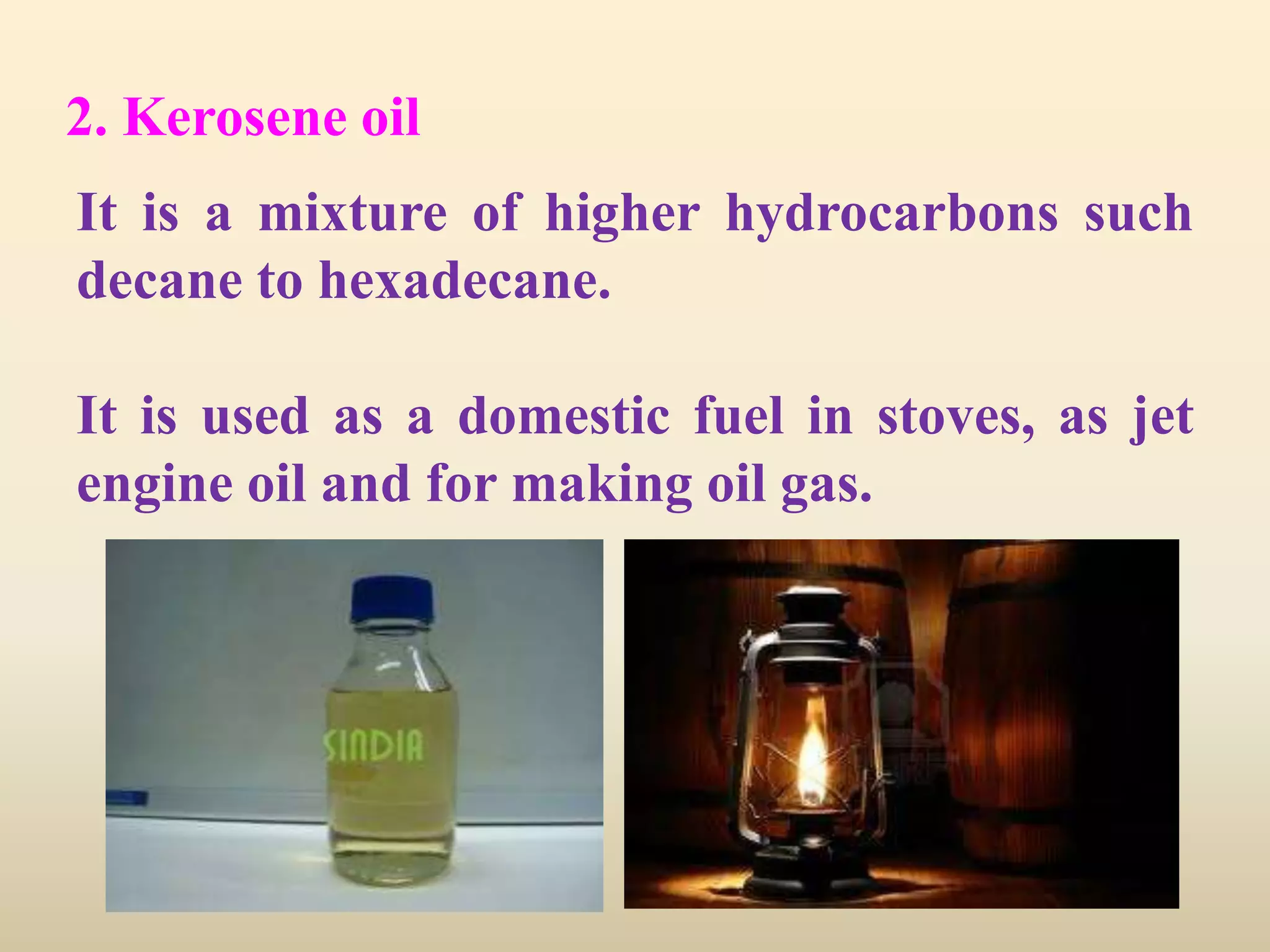
2. Kerosene oil
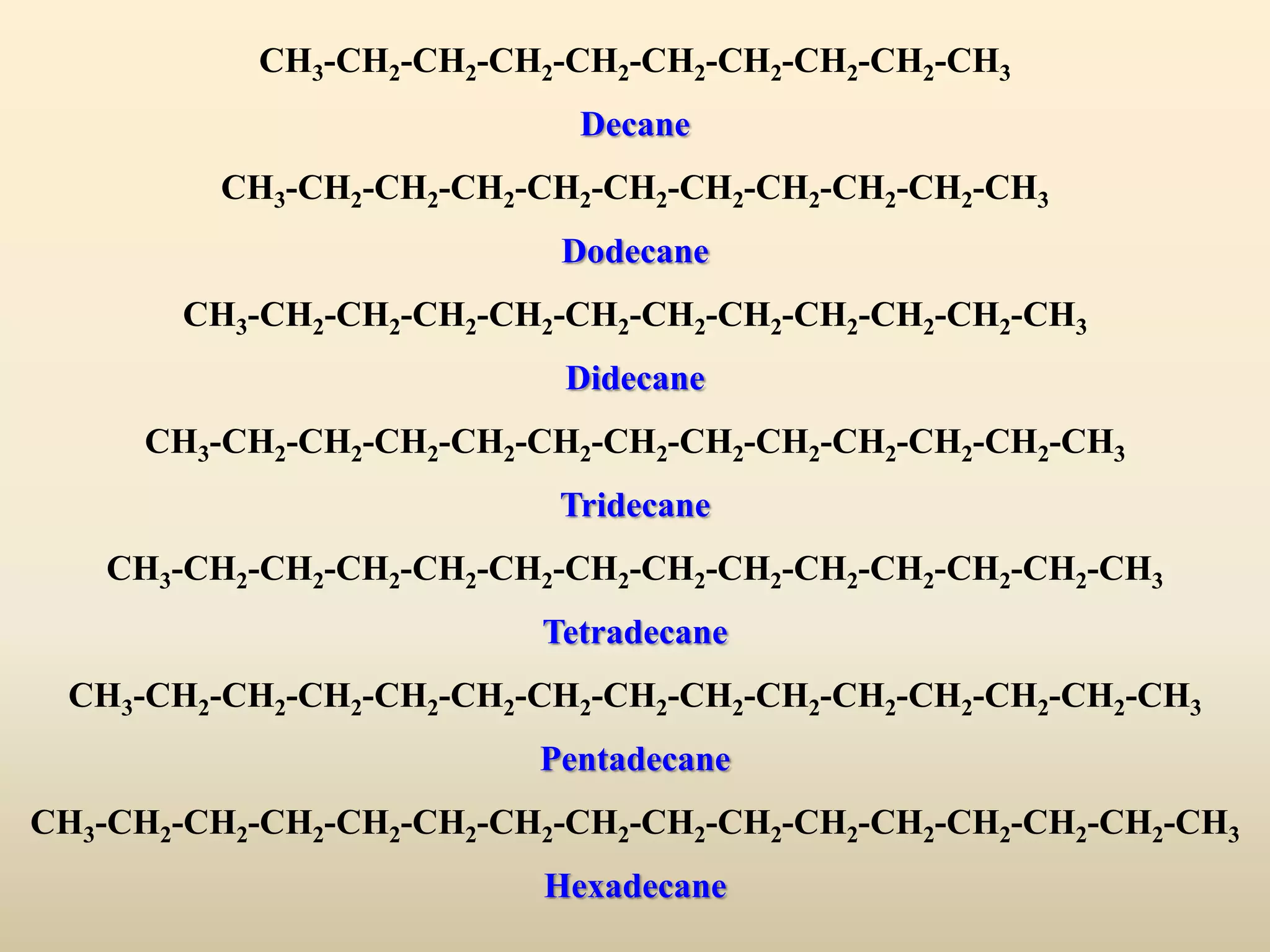
It is a mixture of higher hydrocarbons such
decane to hexadecane.

It is used as a domestic fuel in stoves, as jet
engine oil and for making oil gas.
CH3-CH2-CH2-CH2-CH2-CH2-CH2-CH2-CH2-CH3
                            Decane
         CH3-CH2-CH2-CH2-CH2-CH2-CH2-CH2-CH2-CH2-CH3
                           Dodecane
       CH3-CH2-CH2-CH2-CH2-CH2-CH2-CH2-CH2-CH2-CH2-CH3
                           Didecane
     CH3-CH2-CH2-CH2-CH2-CH2-CH2-CH2-CH2-CH2-CH2-CH2-CH3
                           Tridecane
   CH3-CH2-CH2-CH2-CH2-CH2-CH2-CH2-CH2-CH2-CH2-CH2-CH2-CH3
                          Tetradecane
 CH3-CH2-CH2-CH2-CH2-CH2-CH2-CH2-CH2-CH2-CH2-CH2-CH2-CH2-CH3
                          Pentadecane
CH3-CH2-CH2-CH2-CH2-CH2-CH2-CH2-CH2-CH2-CH2-CH2-CH2-CH2-CH2-CH3
                          Hexadecane
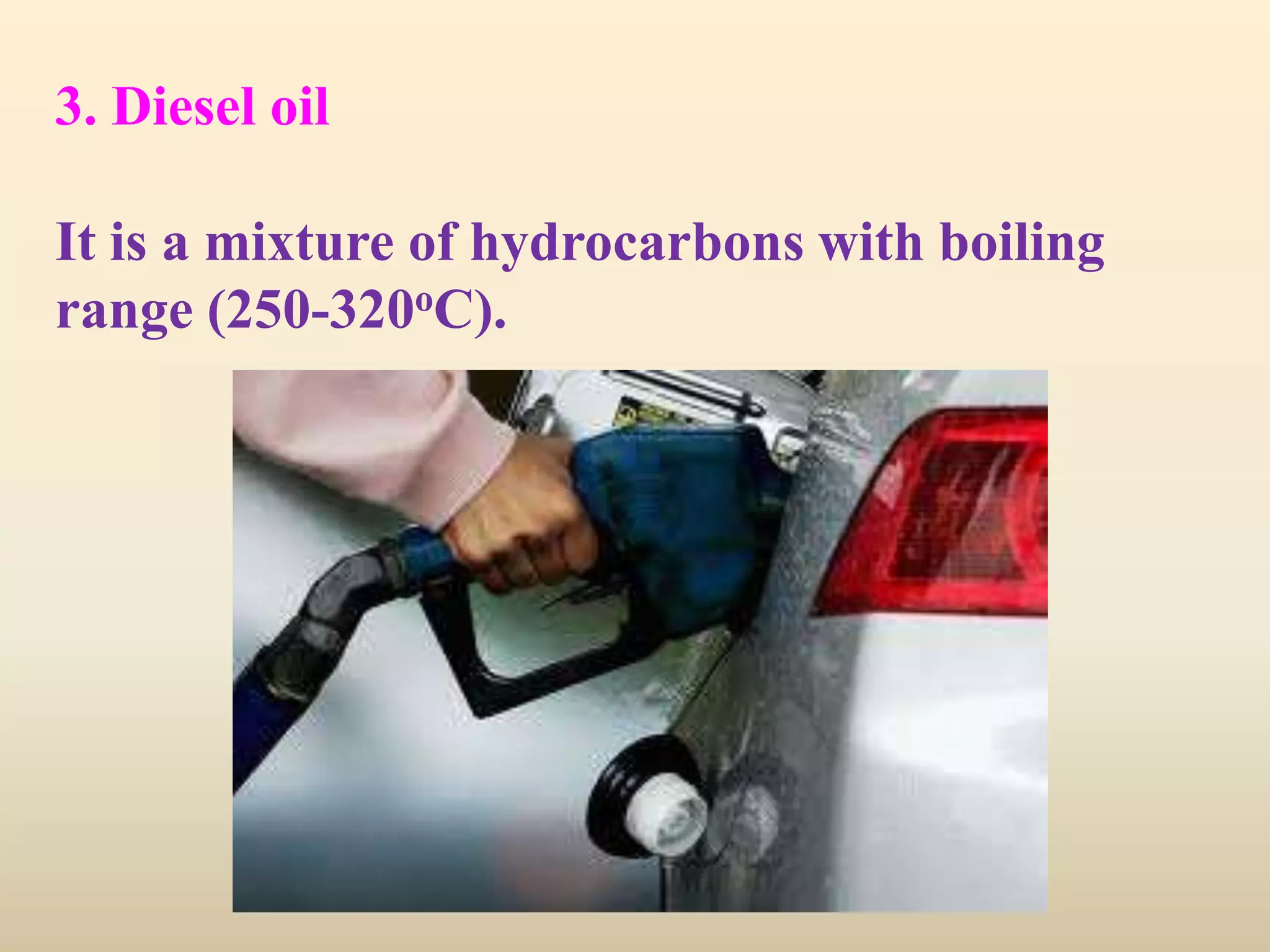
3. Diesel oil

It is a mixture of hydrocarbons with boiling
range (250-320oC).
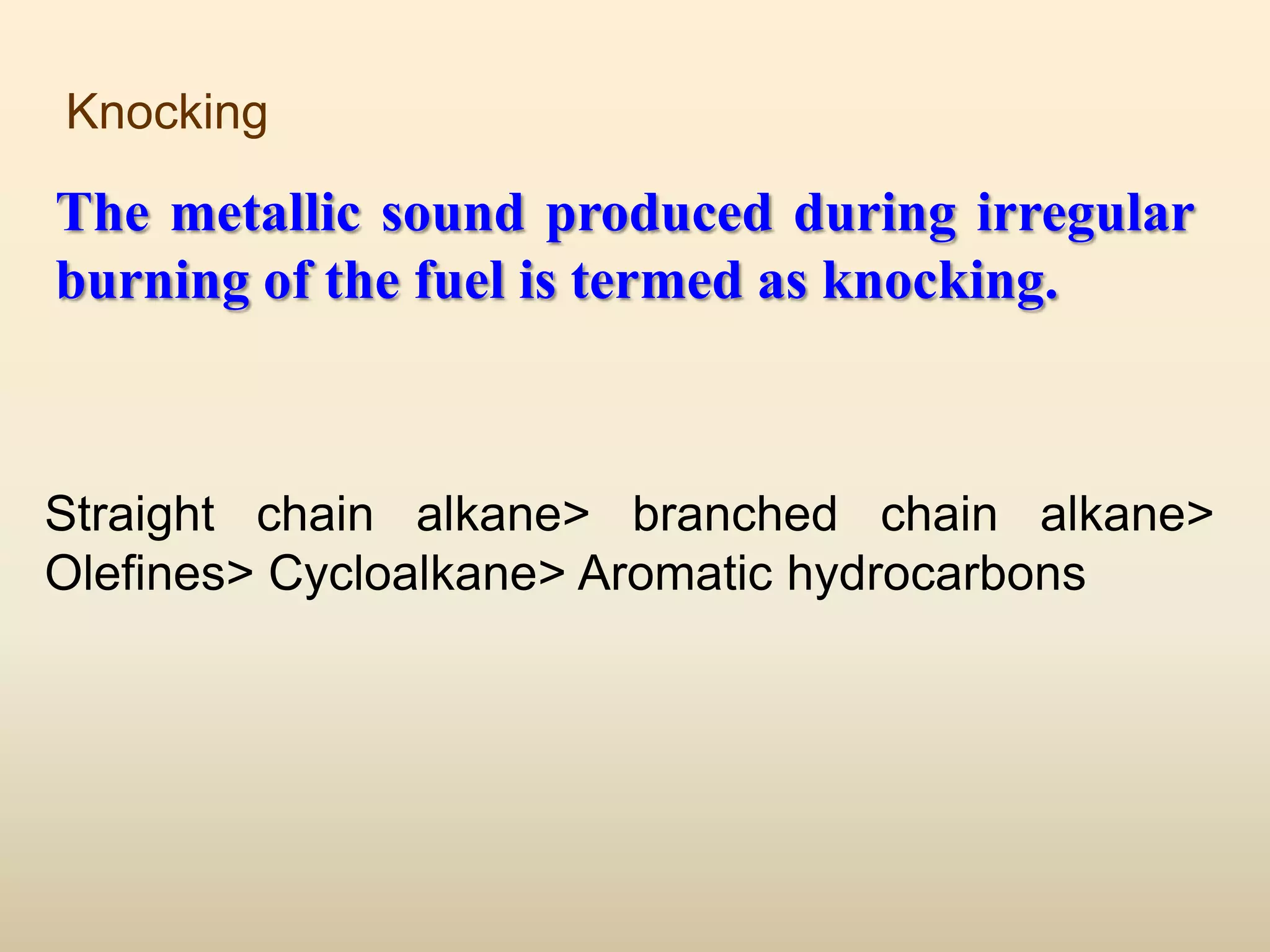
Knocking

The metallic sound produced during irregular
burning of the fuel is termed as knocking.


Straight chain alkane> branched chain alkane>
Olefines> Cycloalkane> Aromatic hydrocarbons
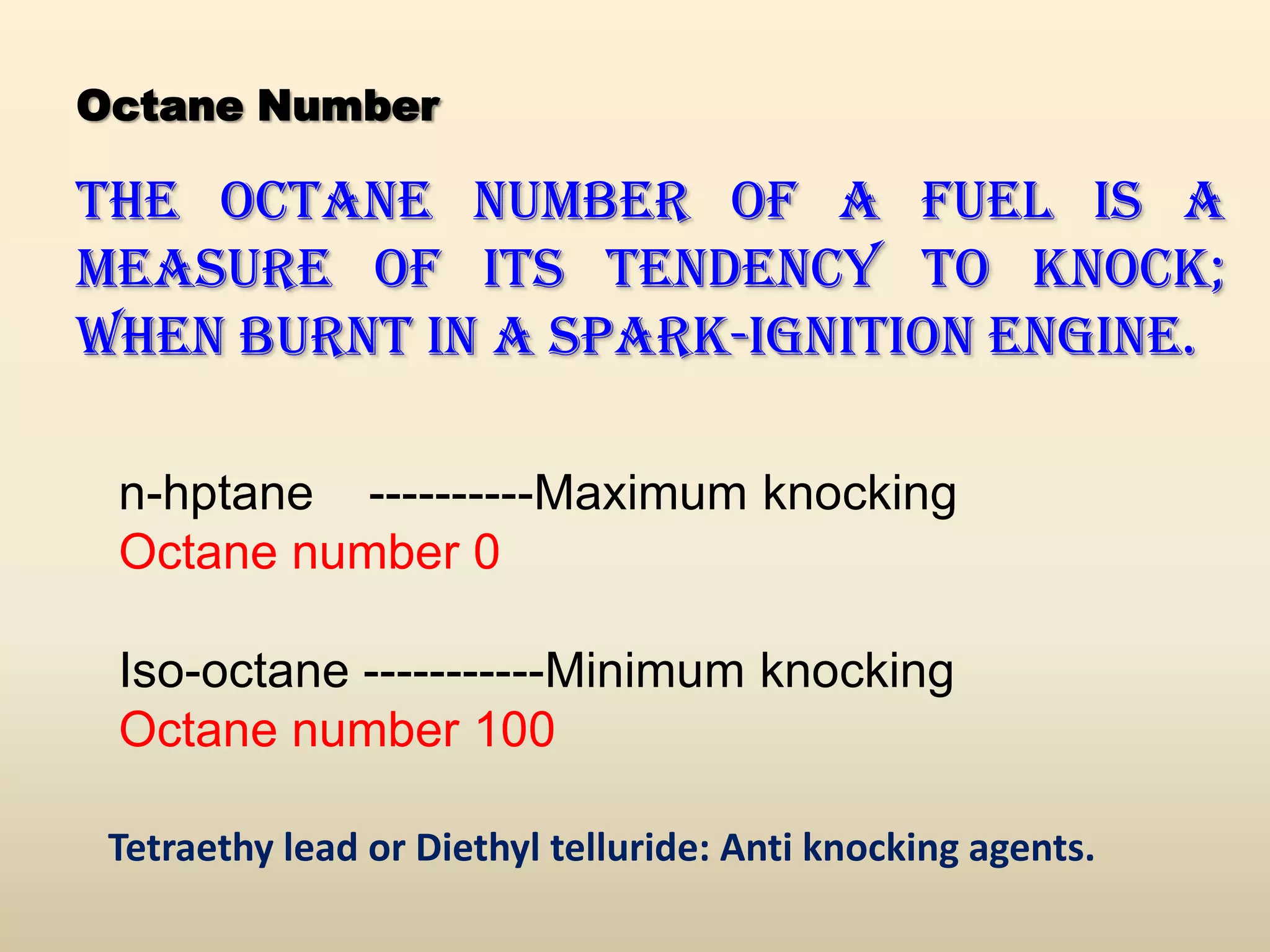
Octane Number

The octane number of a fuel is a
measure of its tendency to knock;
when burnt in a spark-ignition engine.

 n-hptane ----------Maximum knocking
 Octane number 0

 Iso-octane -----------Minimum knocking
 Octane number 100

 Tetraethy lead or Diethyl telluride: Anti knocking agents.
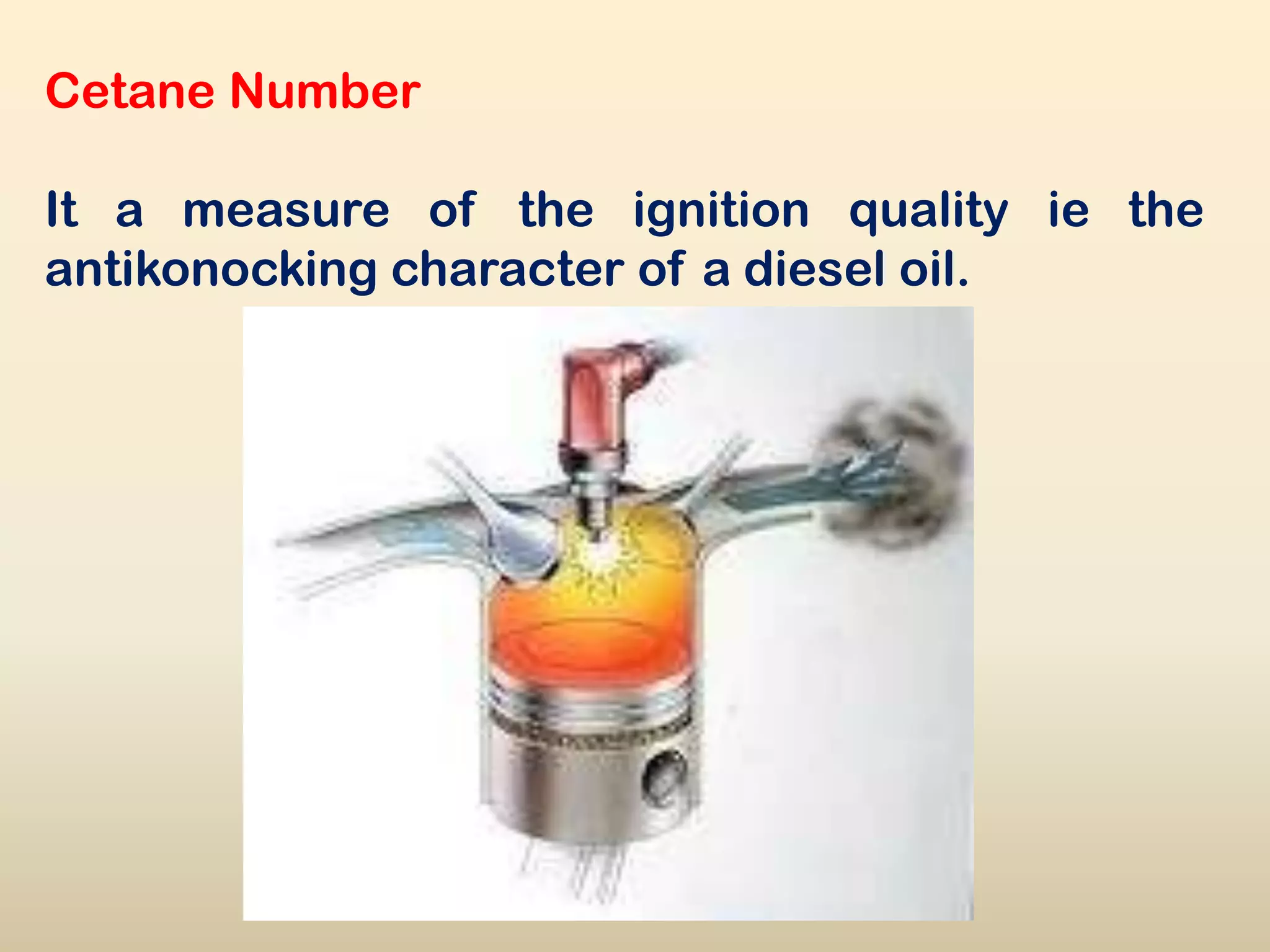
Cetane Number

It a measure of the ignition quality ie the
antikonocking character of a diesel oil.
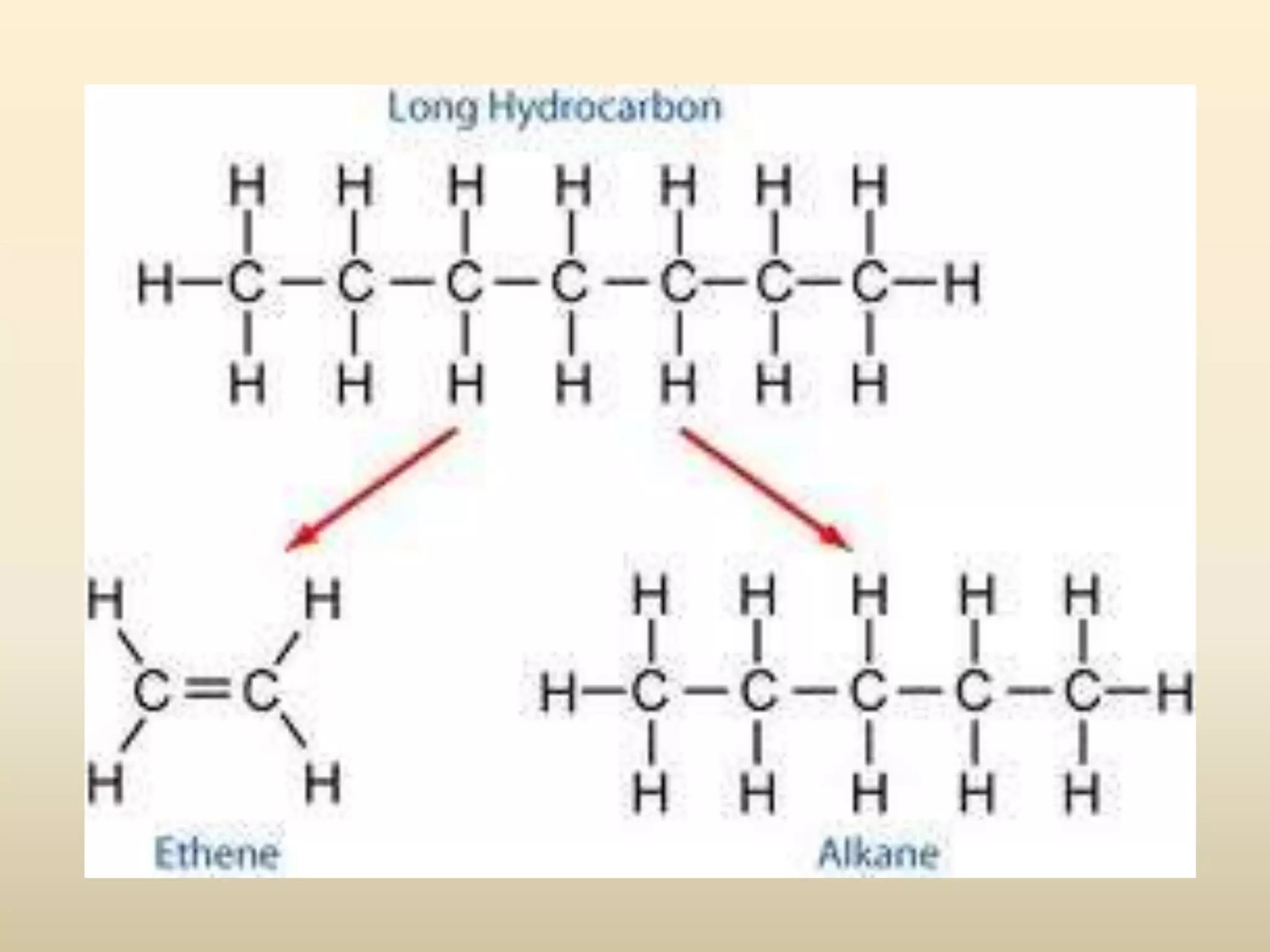
Cracking
It is the process of breaking up of less
volatile bigger molecule of hydrocarbons
from petroleum into more volatile lower
molecules of hydrocarbons.
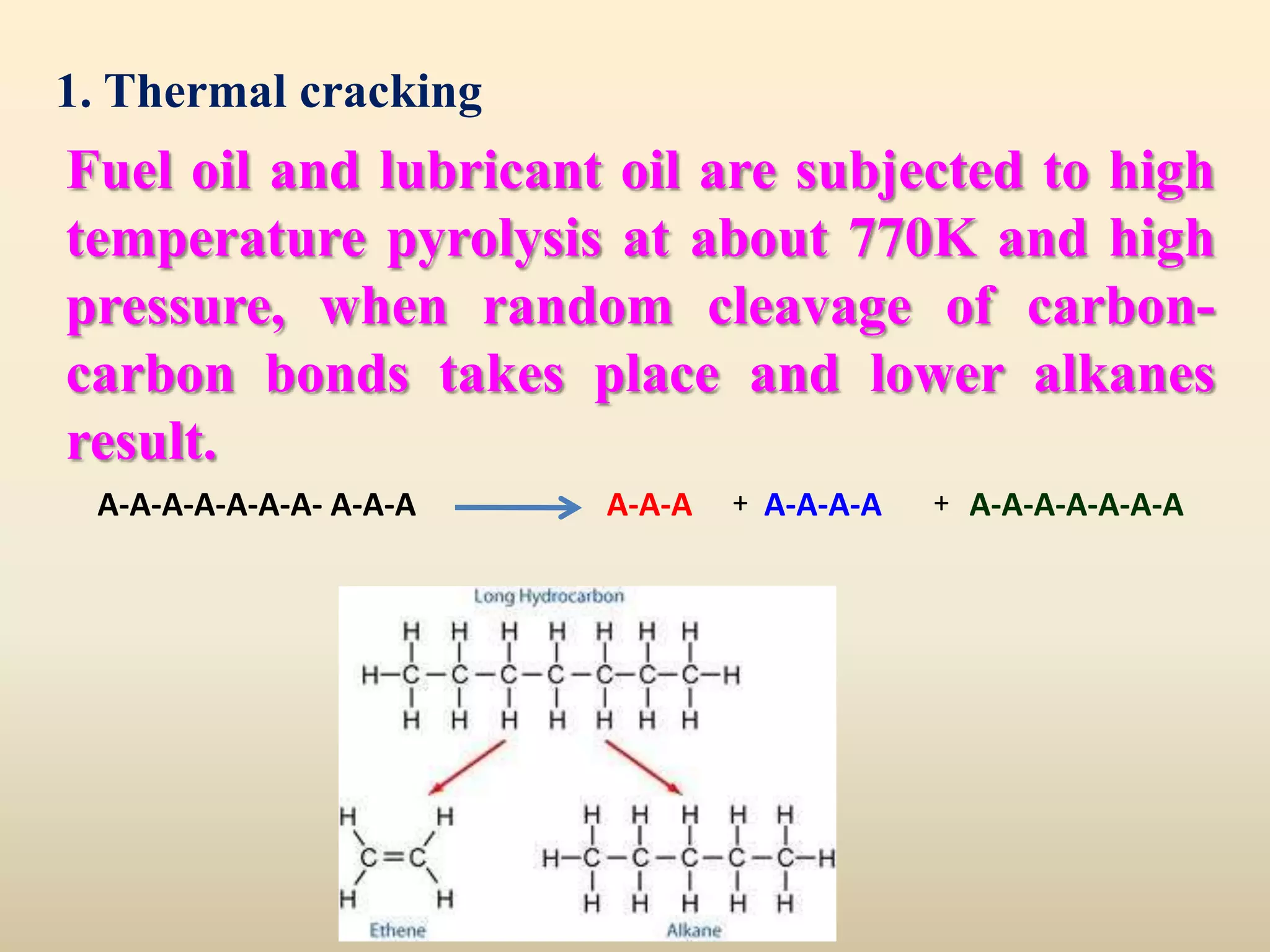
1. Thermal cracking
Fuel oil and lubricant oil are subjected to high
temperature pyrolysis at about 770K and high
pressure, when random cleavage of carbon-
carbon bonds takes place and lower alkanes
result.
 A-A-A-A-A-A-A- A-A-A   A-A-A   + A-A-A-A   + A-A-A-A-A-A-A
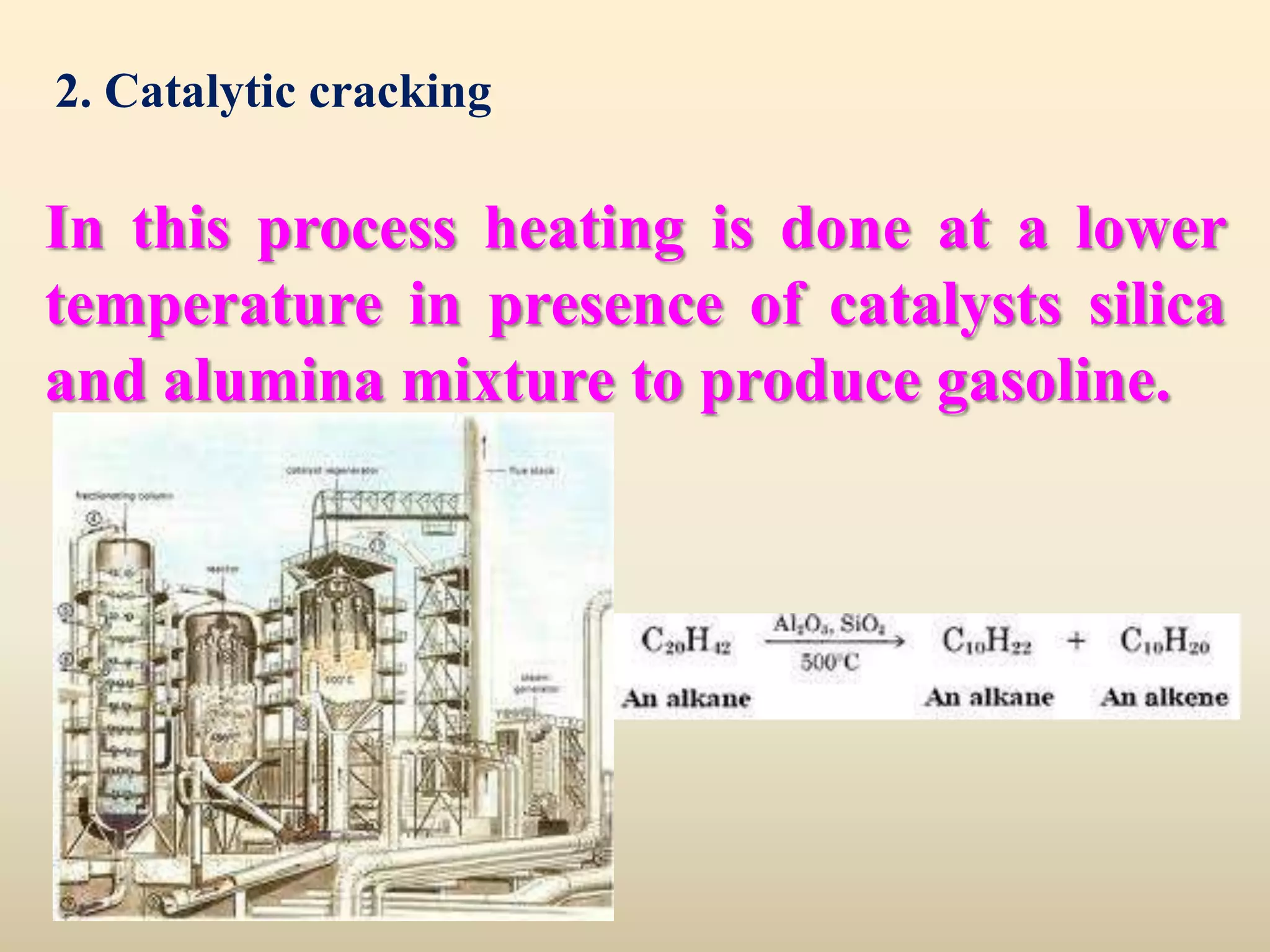
2. Catalytic cracking

In this process heating is done at a lower
temperature in presence of catalysts silica
and alumina mixture to produce gasoline.
1. Natural Gas
It is formed by the decomposition of organic matter under the
earth and is almost always present in petroleum wells.
Composition:

CH4 = 71%, C2H6 = 5-10% , H2 = 3%, CO + CO2 = rest

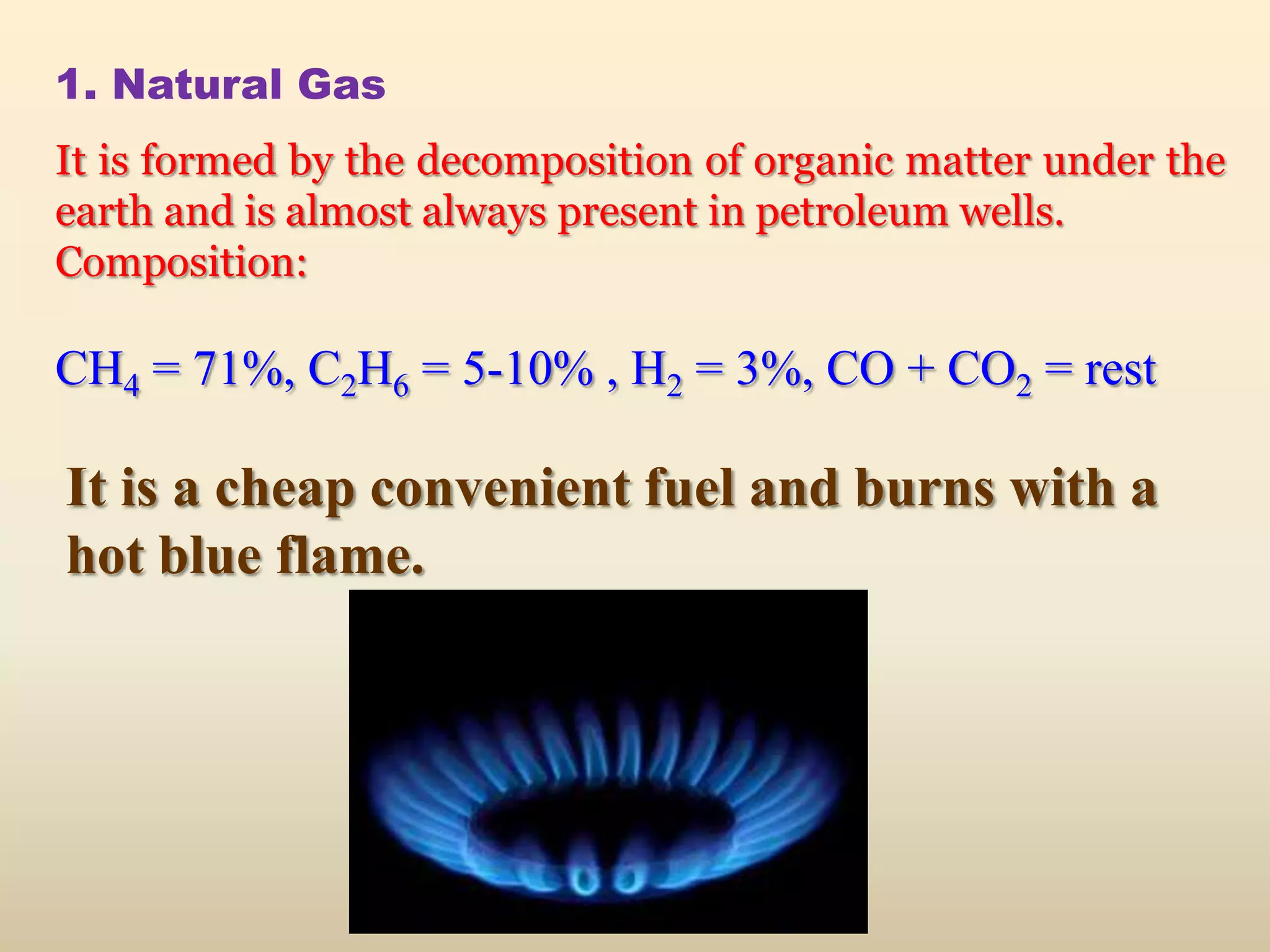
It is a cheap convenient fuel and burns with a
hot blue flame.
Uses:
1.It is an excellent fuel for domestic and
  industrial purpose.
2.Manufacture of a number of chemicals by
  synthetic process.
3.As a raw material for the manufacture of
  carbon black.
4.In preparation of synthetic proteins by
  microbiological fermentation of methane
  (CH4)
2. Water Gas
It is a mixture of combustible gases CO and H2
with small amounts of non-combustible CO2 and
N2.

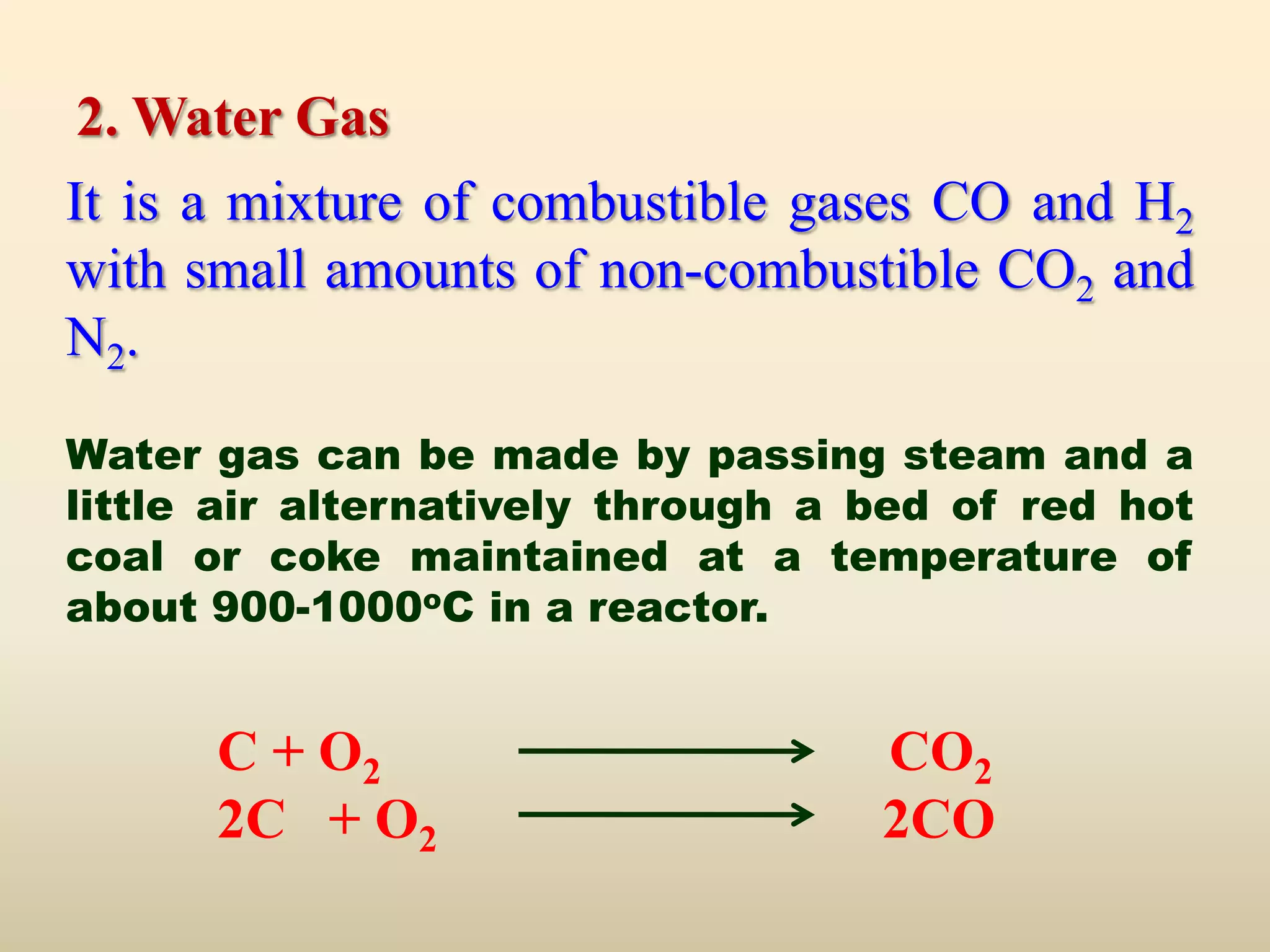
Water gas can be made by passing steam and a
little air alternatively through a bed of red hot
coal or coke maintained at a temperature of
about 900-1000oC in a reactor.


      C + O2                       CO2
      2C + O2                      2CO
Uses:
1.As a fuel gas
2.As an illuminating gas
3.As a source of hydrogen gas
4.In manufacture of ammonia
 gas.
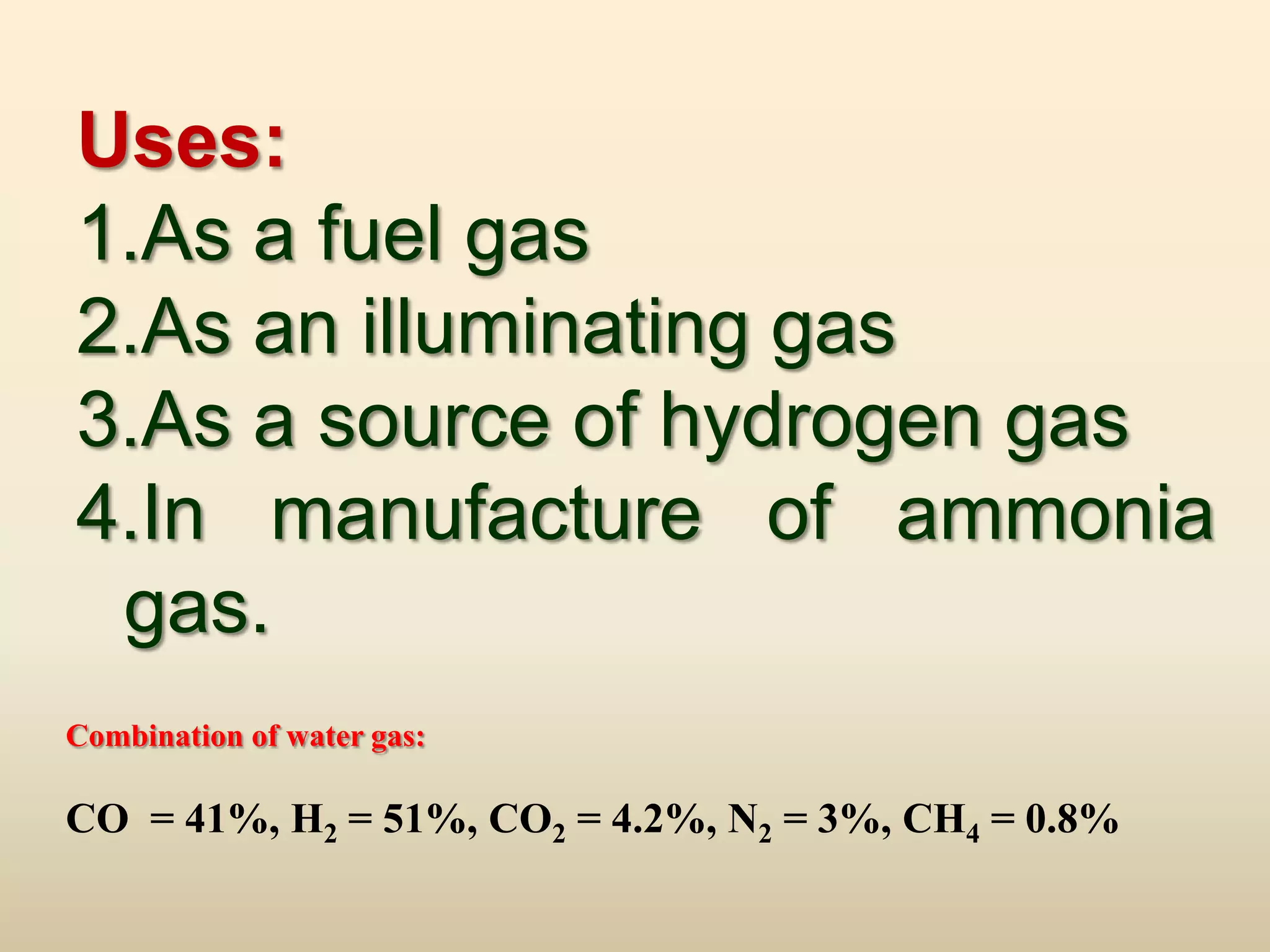
Combination of water gas:

CO = 41%, H2 = 51%, CO2 = 4.2%, N2 = 3%, CH4 = 0.8%
3. Producer Gas

It is a mixture of CO and N2 and is
prepared by blowing controlled amount
of air through a deep bed of red hot coke
or coal, maintained at about 1100oC in a
special reactor.
Composition:

CO = 30%, N2 = 52%, H2 = 13%, CH4 = 3% and CO2 = 2%
Uses:
1.For running gas engines.
2.For heating open-hearth furnace
  muffle furnace, retorts etc.
3.As a reducing agent in metallurgical
  operations.
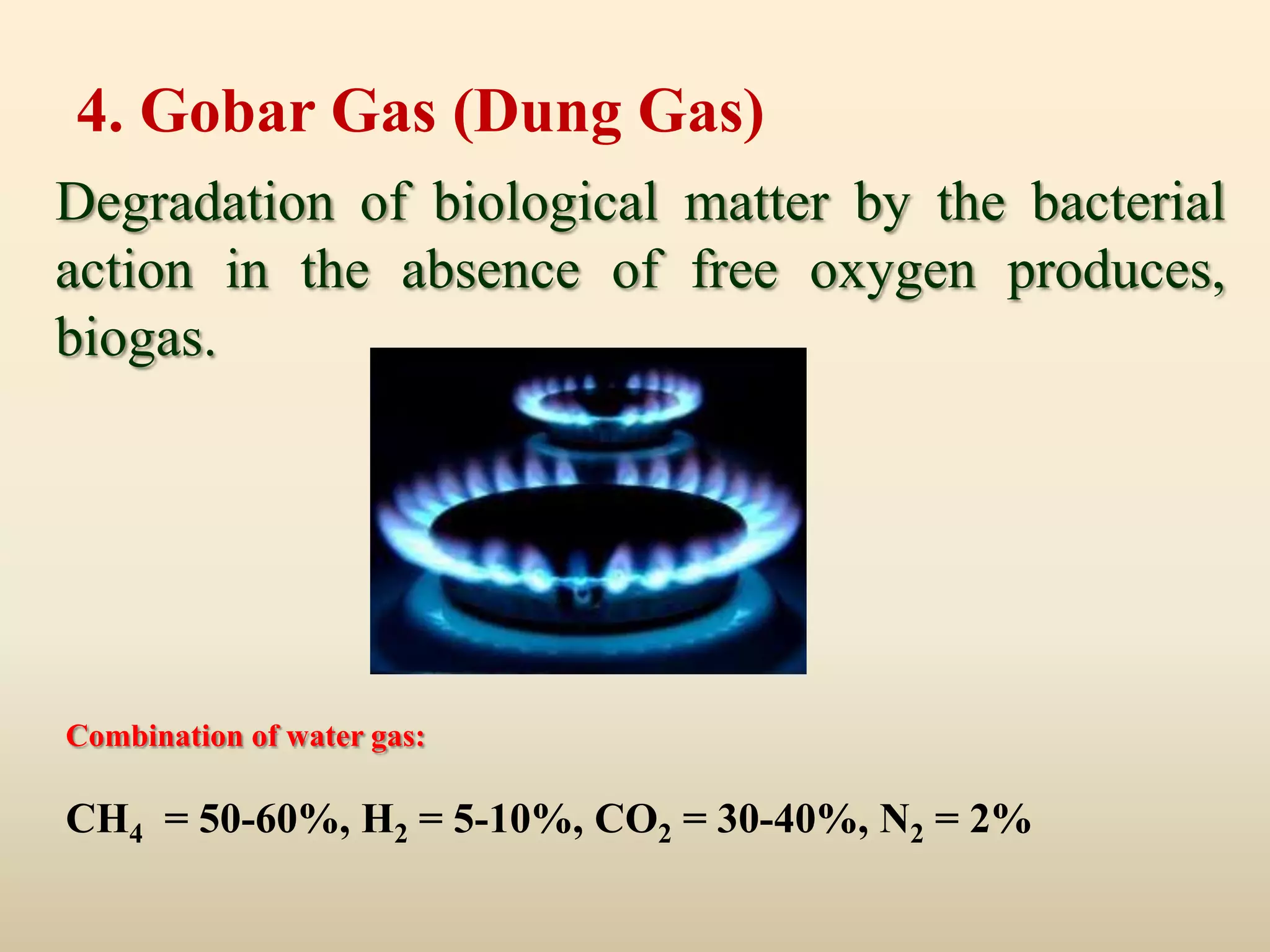
4. Gobar Gas (Dung Gas)
Degradation of biological matter by the bacterial
action in the absence of free oxygen produces,
biogas.


Combination of water gas:

CH4 = 50-60%, H2 = 5-10%, CO2 = 30-40%, N2 = 2%
Uses:
1.It is mainly used as domestic cooking
  gas.
2.As an illuminant in villages
3.As a fuel to run engines.
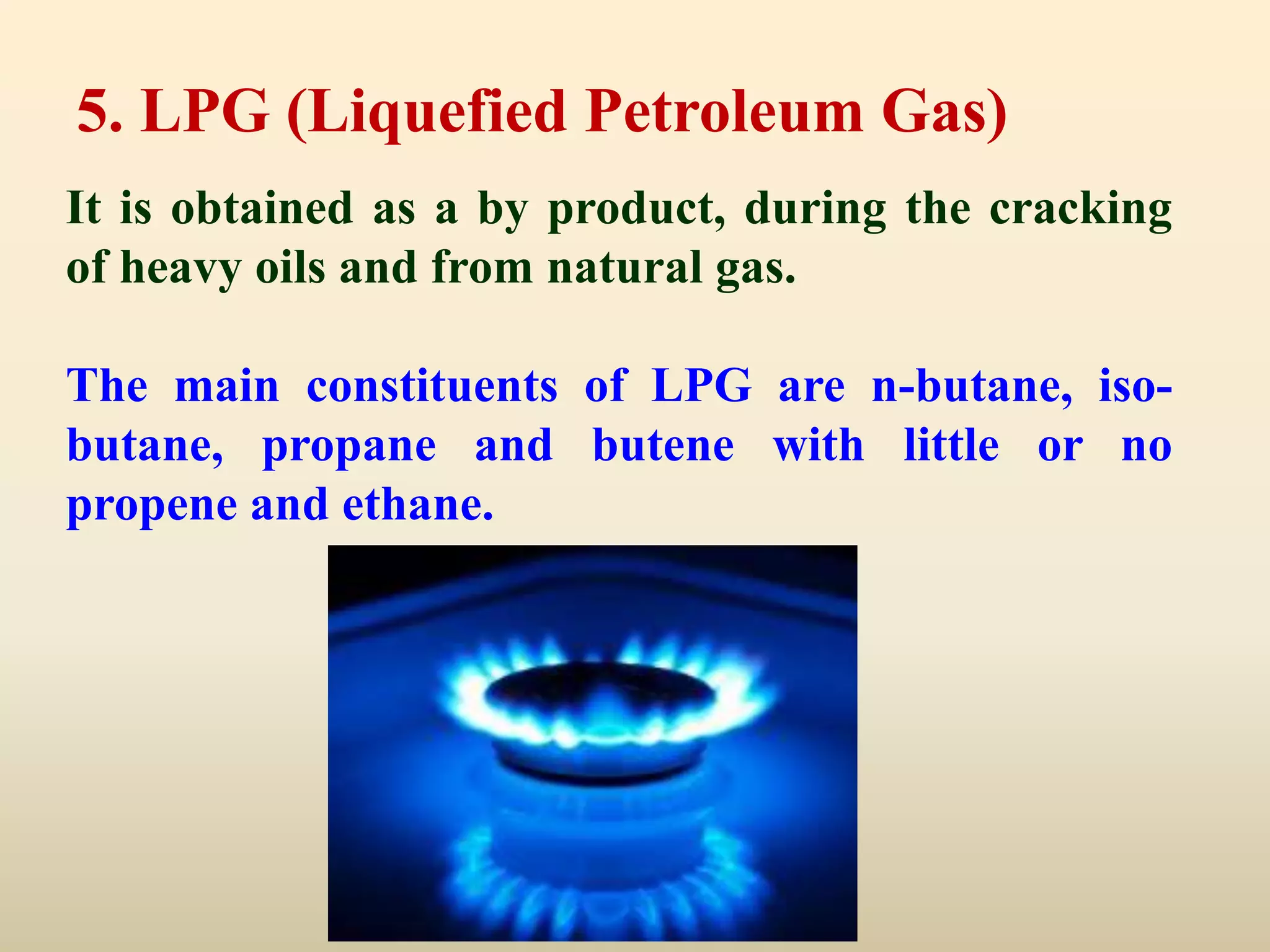
5. LPG (Liquefied Petroleum Gas)
It is obtained as a by product, during the cracking
of heavy oils and from natural gas.

The main constituents of LPG are n-butane, iso-
butane, propane and butene with little or no
propene and ethane.
Uses:
1.Mainly as a domestic fuel for
 burning gas stove in houses.
2.As a fuel in some of the
 industries.
3.As motor fuel.
4.In laboratories in gas burners
 for heating purpose.
Advantages of LPG

1.Easy to operate, to control and easy to
  store.
2.Higher efficiency and heating rate.
3.No smoke and hence neat, clean and no
  pollution.
4.Easy to transport, undergoes complete
  combustion.
5.Cheaper than gasoline, as a motor fuel.
6. CNG (Compressed Natural Gas)

It is highly compressed form of natural gas. It
consists of methane and may contain small
amounts of ethane and propane.
Uses:
1. In commercial vehicles such as taxis, truck, buses.
Disadvantage:
1. Mainly maintaining at high pressure.
2. The release of methane gas through pipe line
      during transport and from vehicles due to its
      incomplete combustion.
1. Wood
2. Charcoal
     Charcoal is a black porous brittle solid which can burn in air
   to give CO2 and traces of CO. It is the most active form of
   carbon and a good adsorbent.
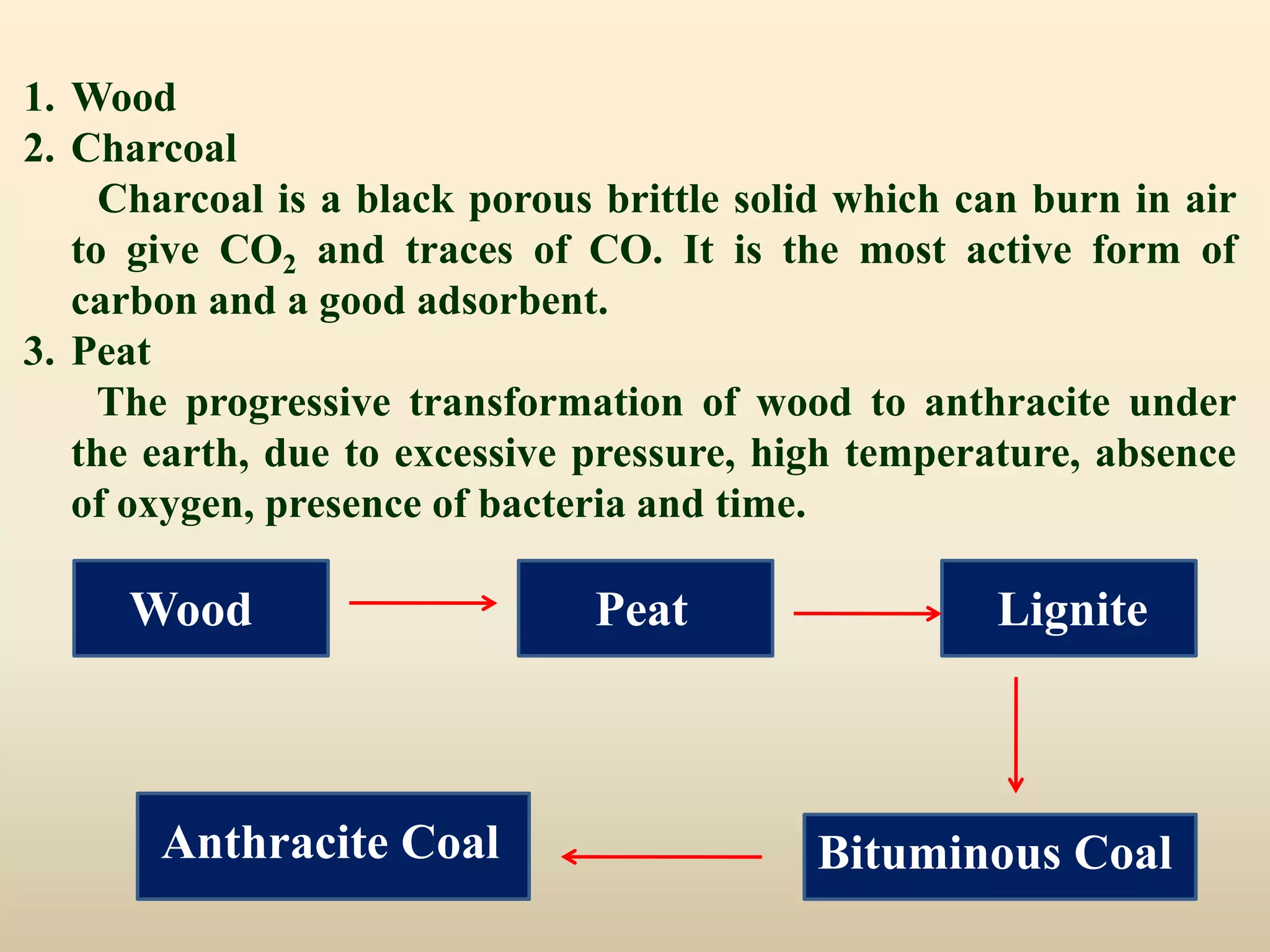
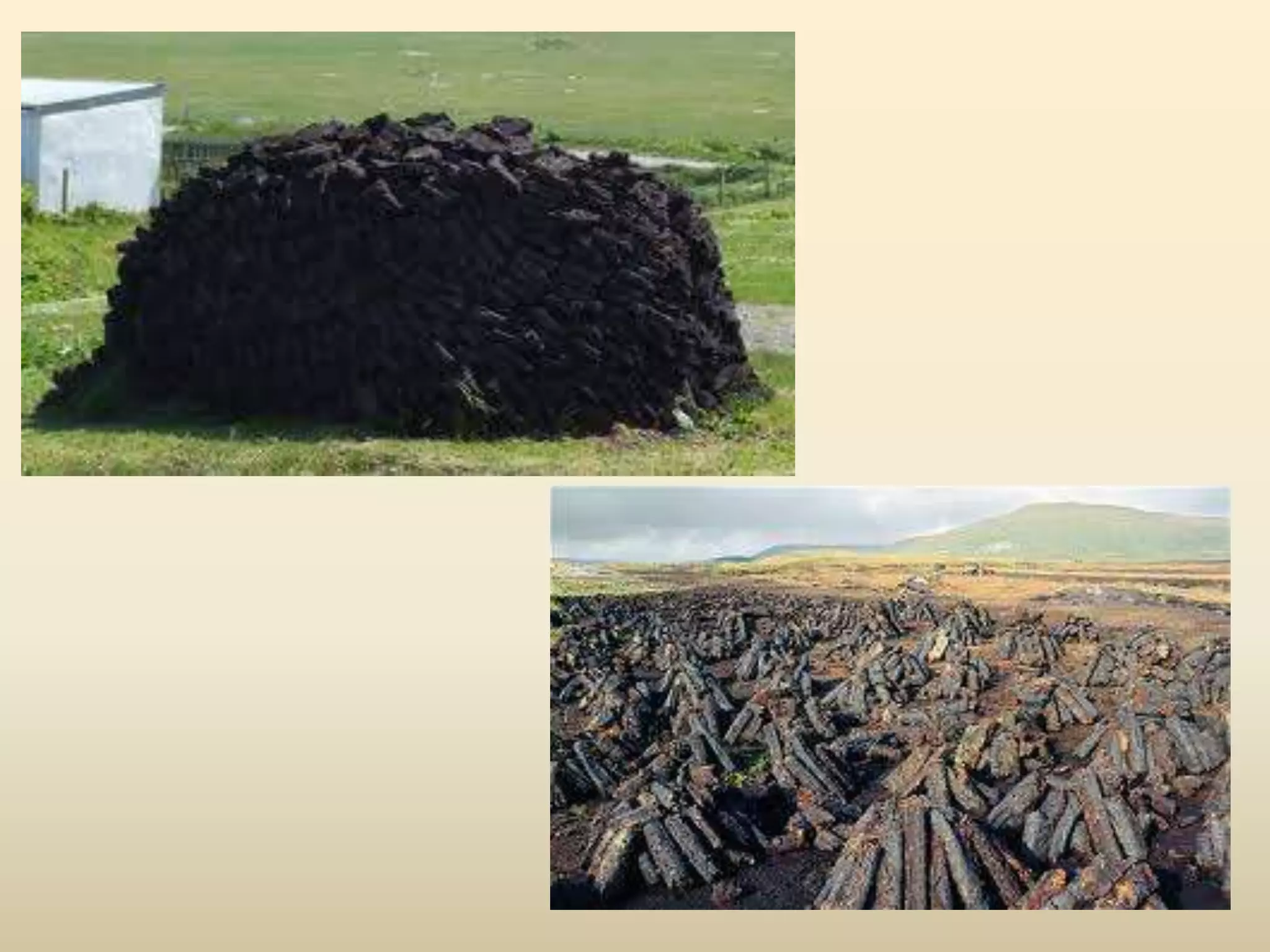
3. Peat
     The progressive transformation of wood to anthracite under
   the earth, due to excessive pressure, high temperature, absence
   of oxygen, presence of bacteria and time.

     Wood                      Peat                  Lignite


       Anthracite Coal                     Bituminous Coal
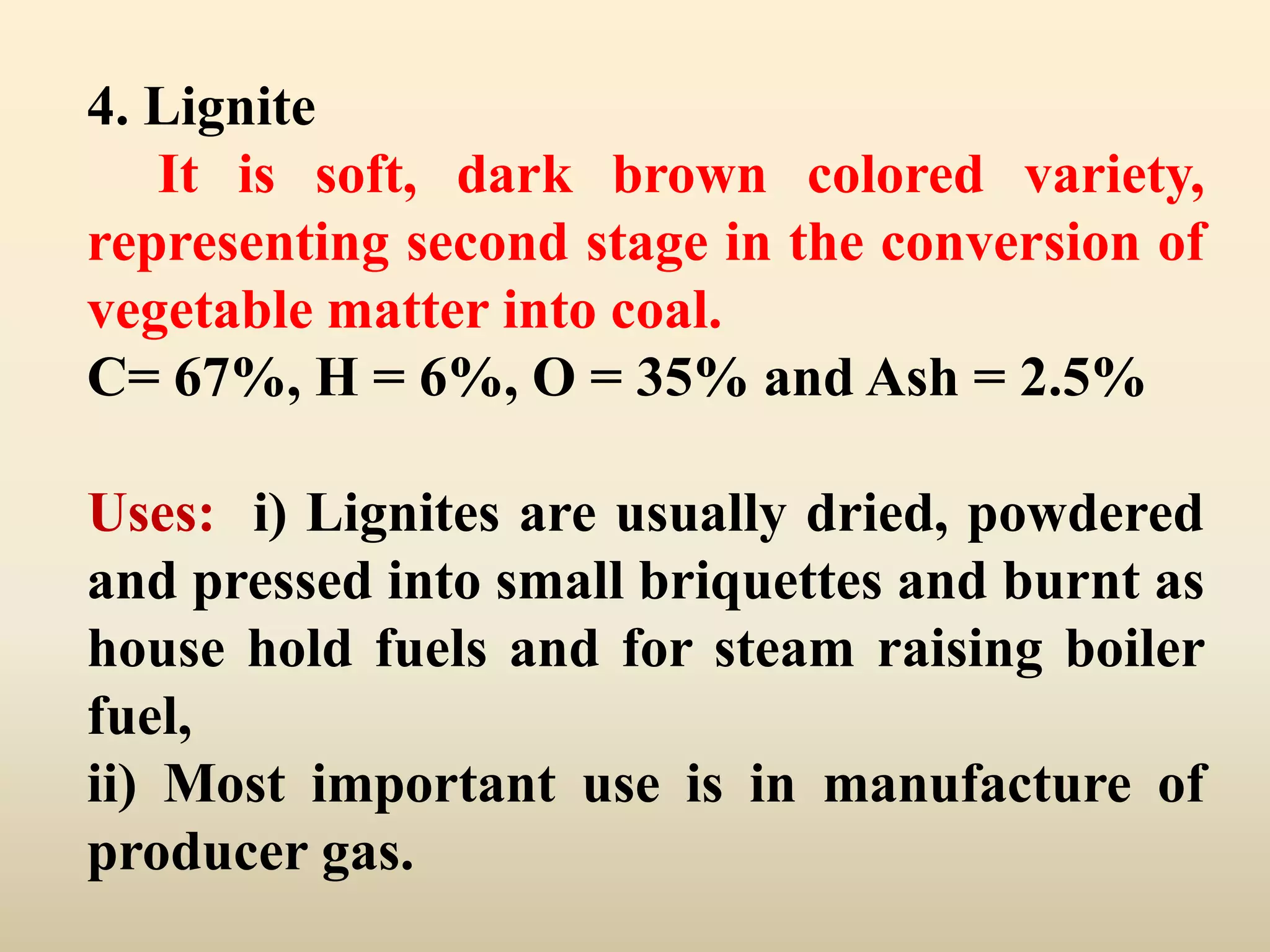
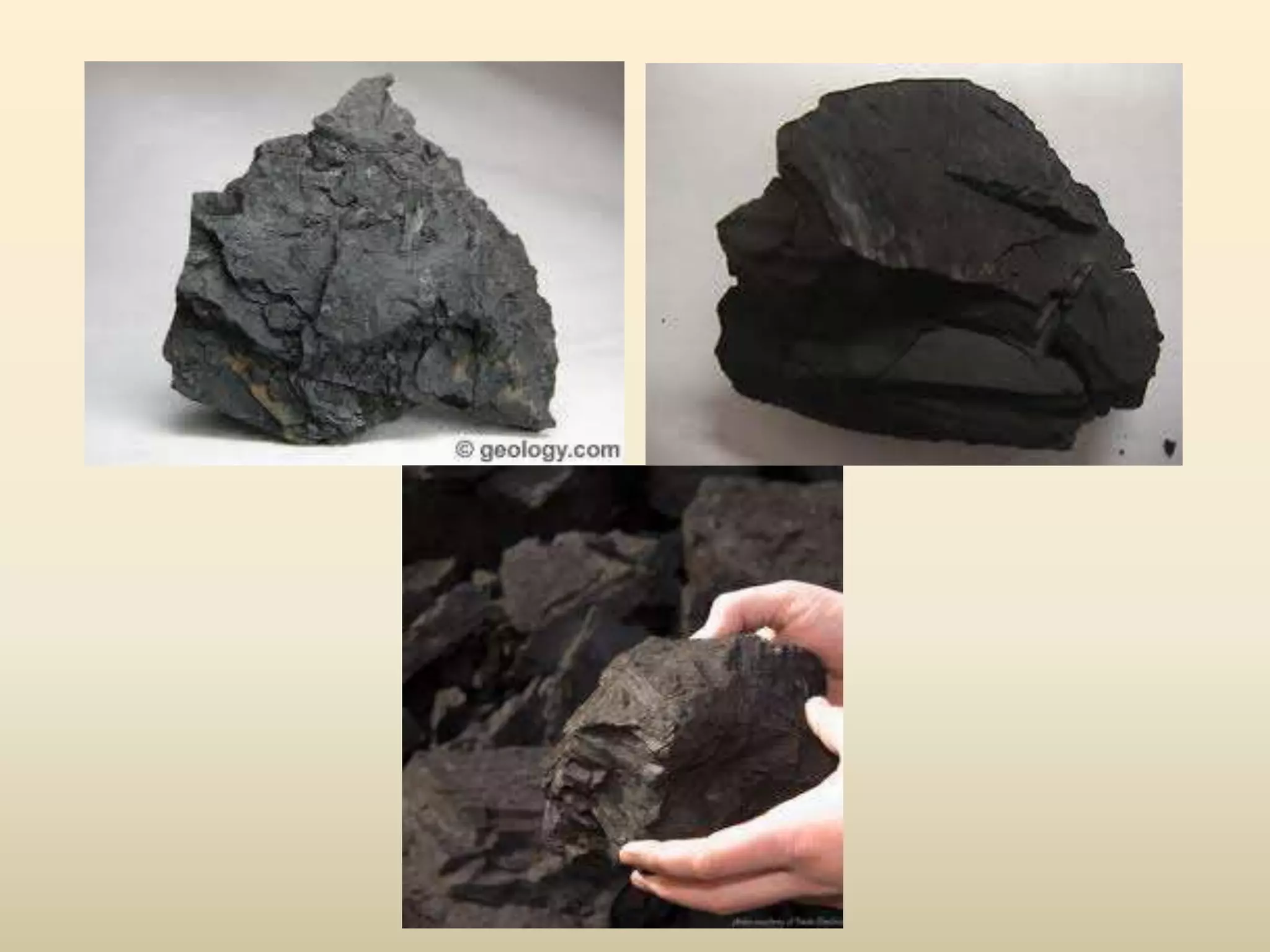
4. Lignite
   It is soft, dark brown colored variety,
representing second stage in the conversion of
vegetable matter into coal.
C= 67%, H = 6%, O = 35% and Ash = 2.5%

Uses: i) Lignites are usually dried, powdered
and pressed into small briquettes and burnt as
house hold fuels and for steam raising boiler
fuel,
ii) Most important use is in manufacture of
producer gas.
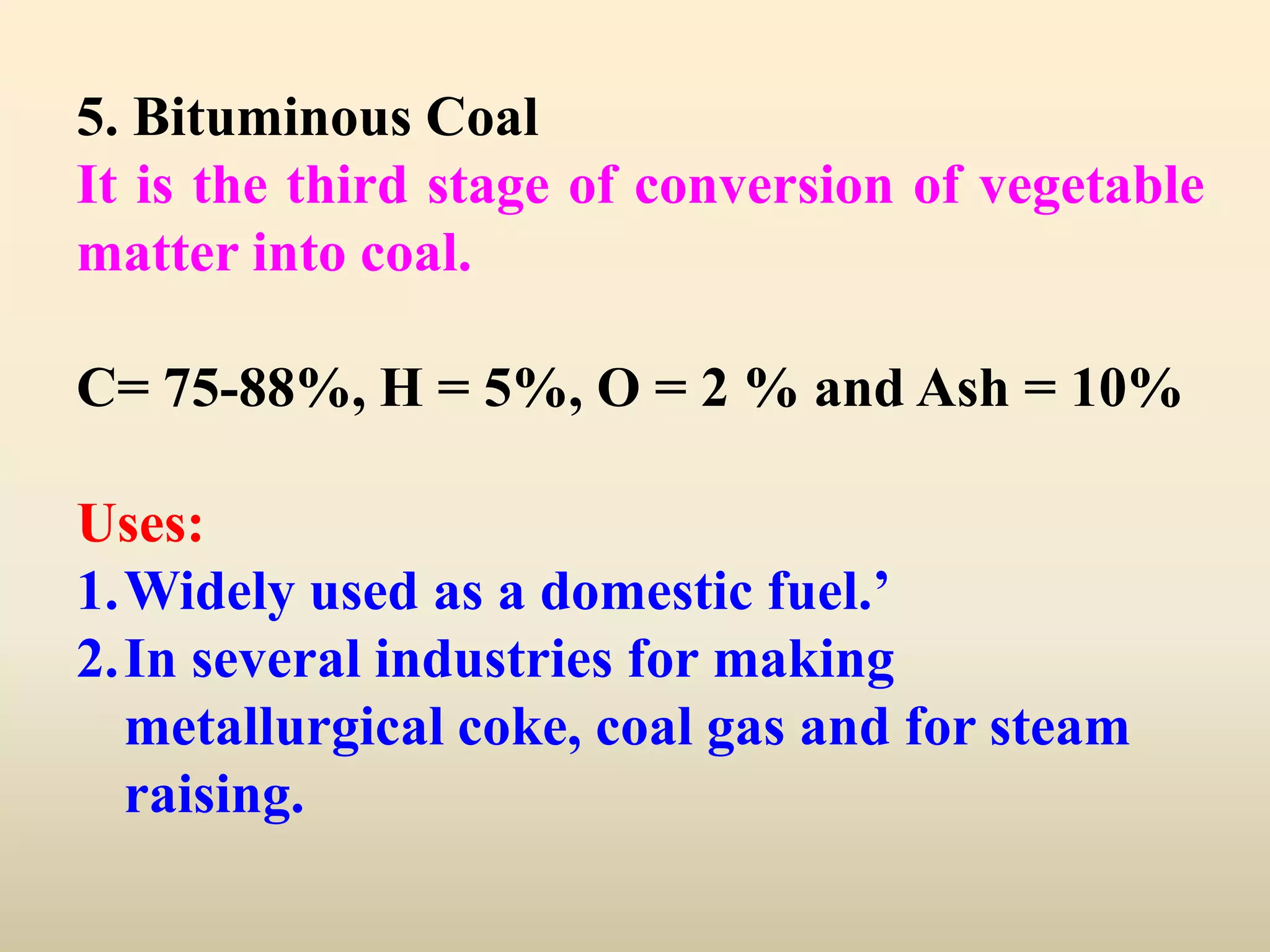
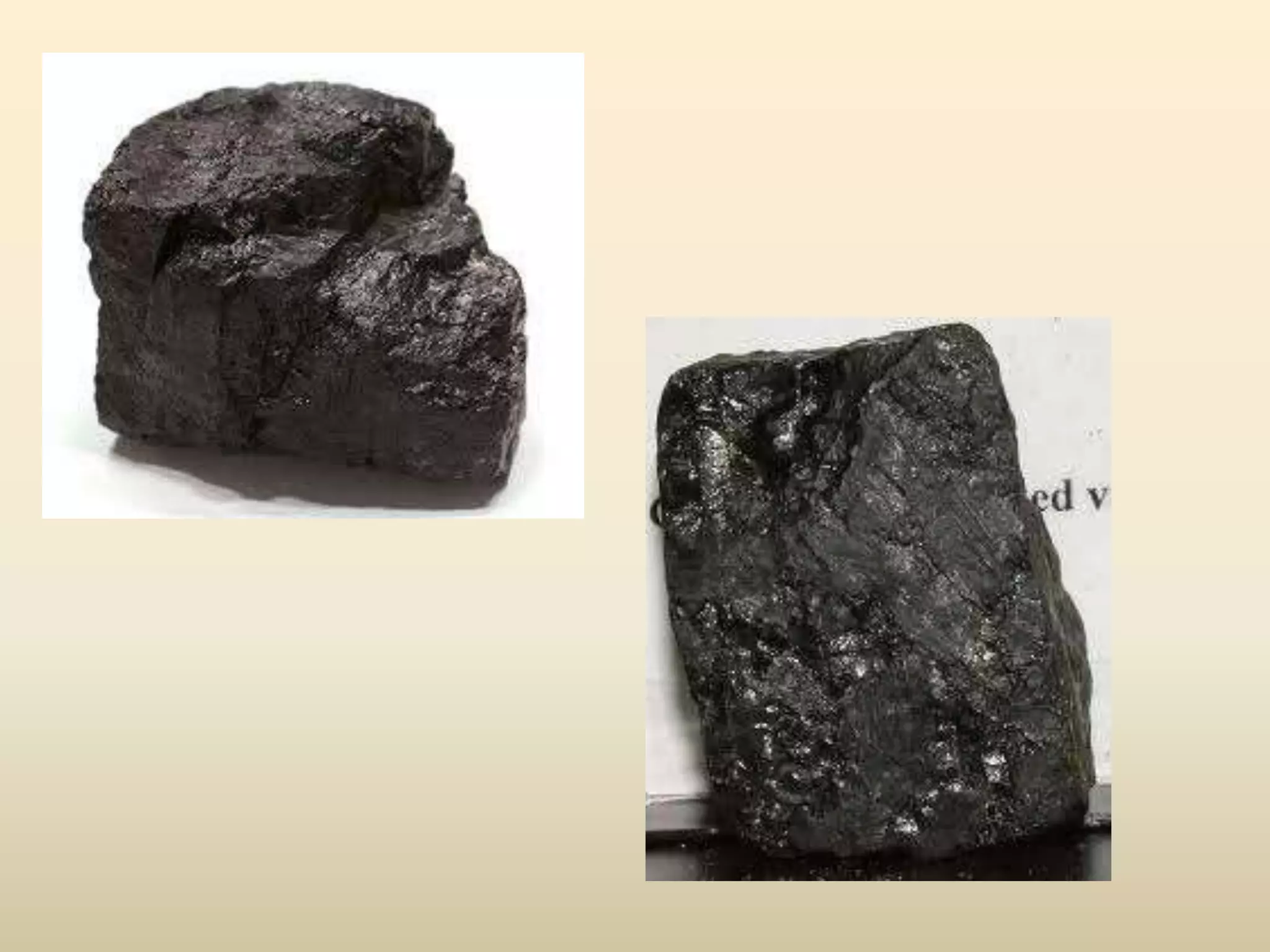
5. Bituminous Coal
It is the third stage of conversion of vegetable
matter into coal.

C= 75-88%, H = 5%, O = 2 % and Ash = 10%

Uses:
1.Widely used as a domestic fuel.’
2.In several industries for making
  metallurgical coke, coal gas and for steam
  raising.
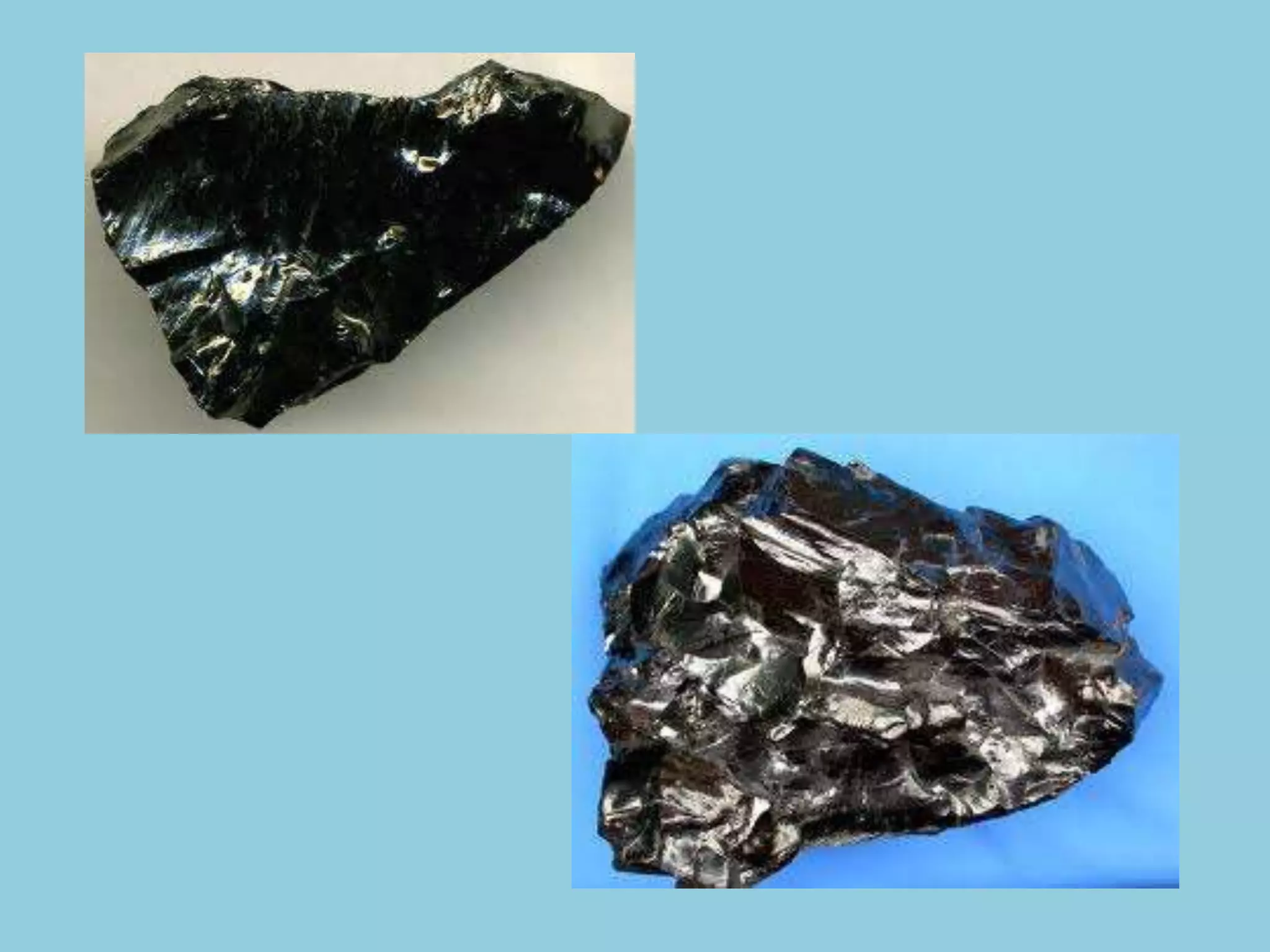
6. Anthracite Coal
It is a class of highest rank coal, the last one in the
formation of coal from vegetable matter. It is the
hardest of all kind of coal.
It is dense, black and brittle.

C= 90%, H = 3%, O = 2 % and Ash = 5%

Uses:
1. As a fuel for house hold purposes
2. For steam raising
3. In metallurgical purposes, where high local heat
   and no smoke are desirable.
Nuclear Fuels
Otto Han discovered the fission
of    Uranium   opened      the
prospects of using the vast
energy stored in the atomic
nucleus for the production of
electric power.

1 Kg of Uranium = 3x10⁶ Kg of high grade coal.
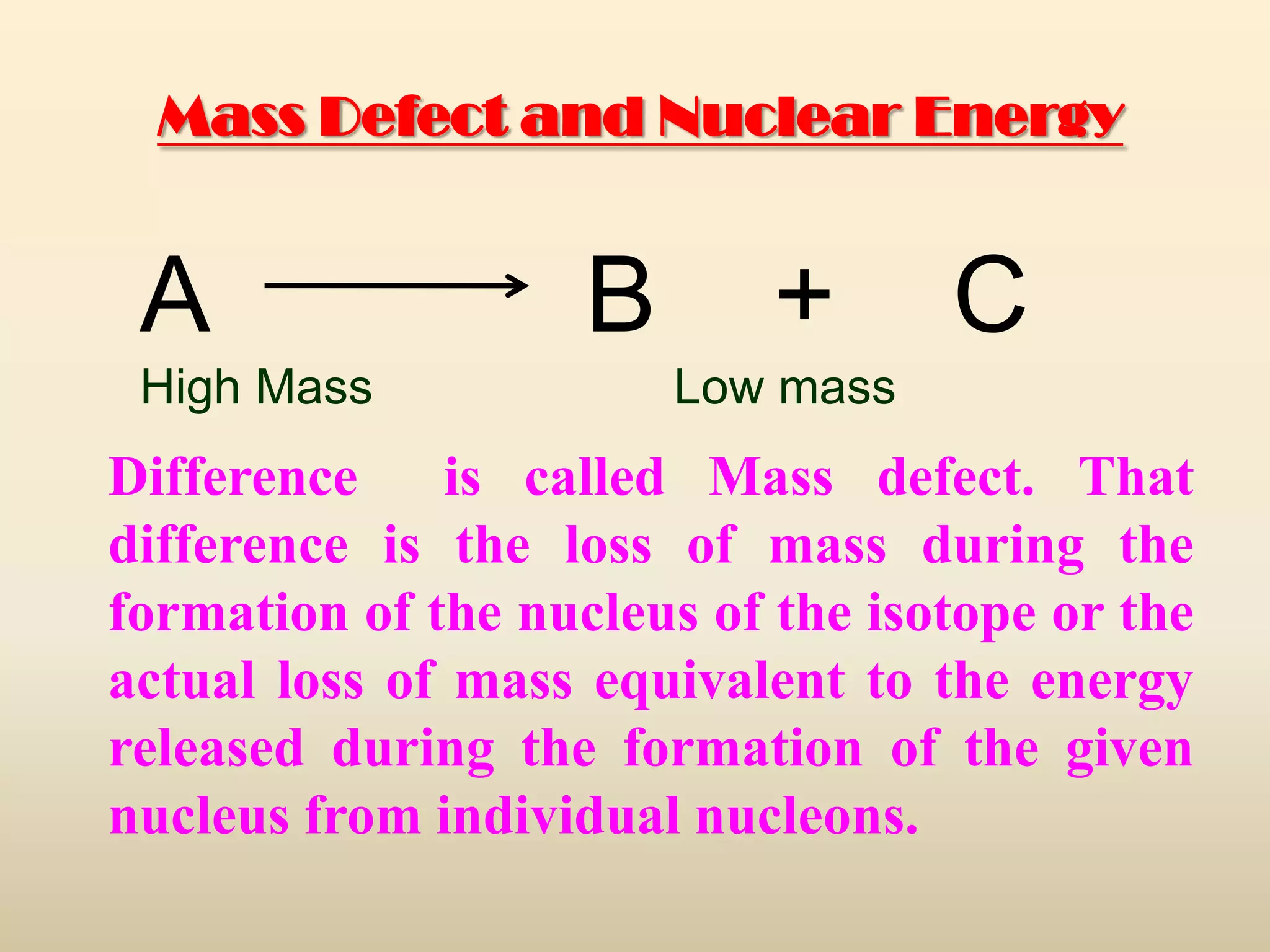
Mass Defect and Nuclear Energy


 A                  B       +      C
 High Mass              Low mass
Difference     is called Mass defect. That
difference is the loss of mass during the
formation of the nucleus of the isotope or the
actual loss of mass equivalent to the energy
released during the formation of the given
nucleus from individual nucleons.
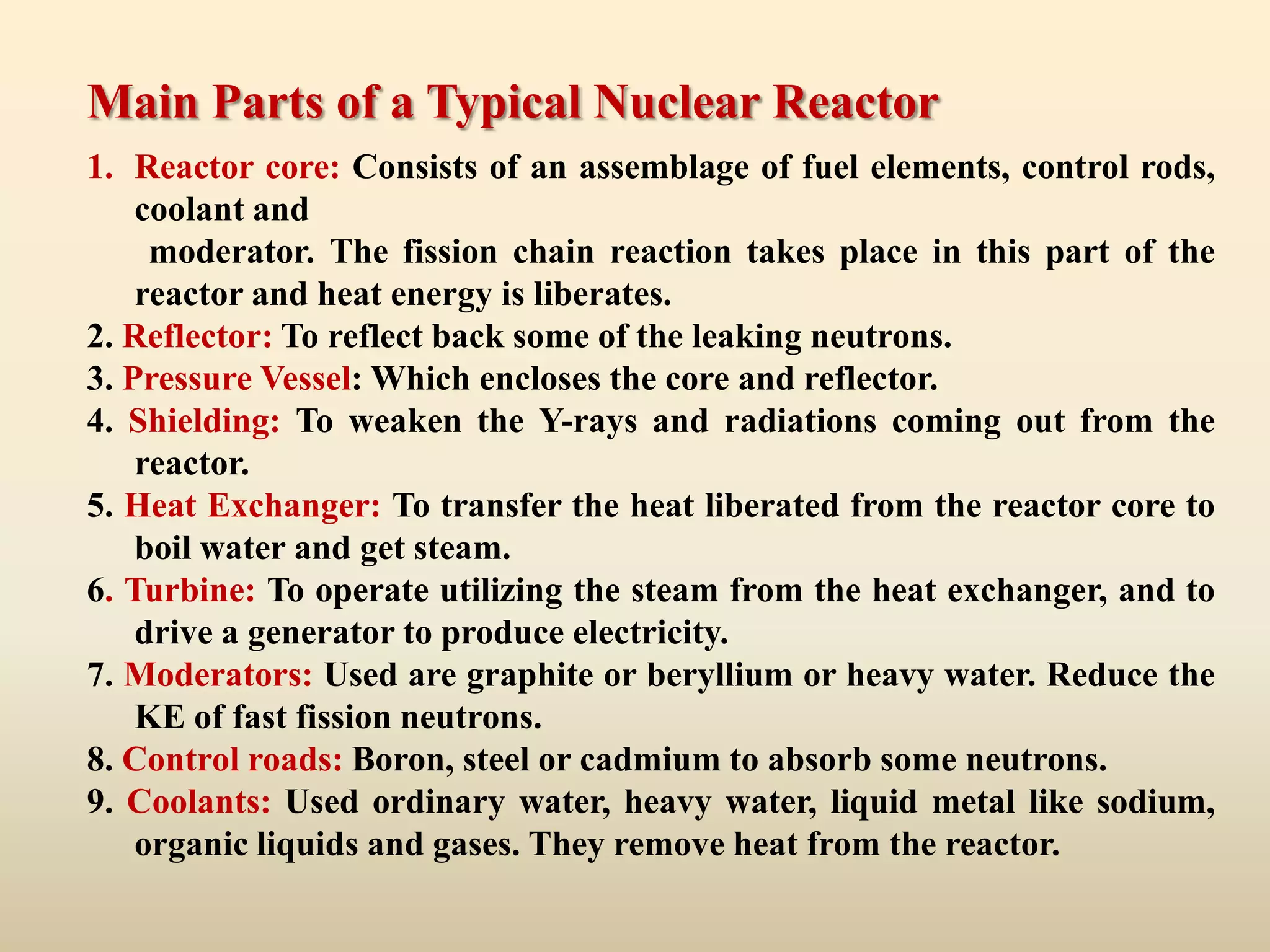
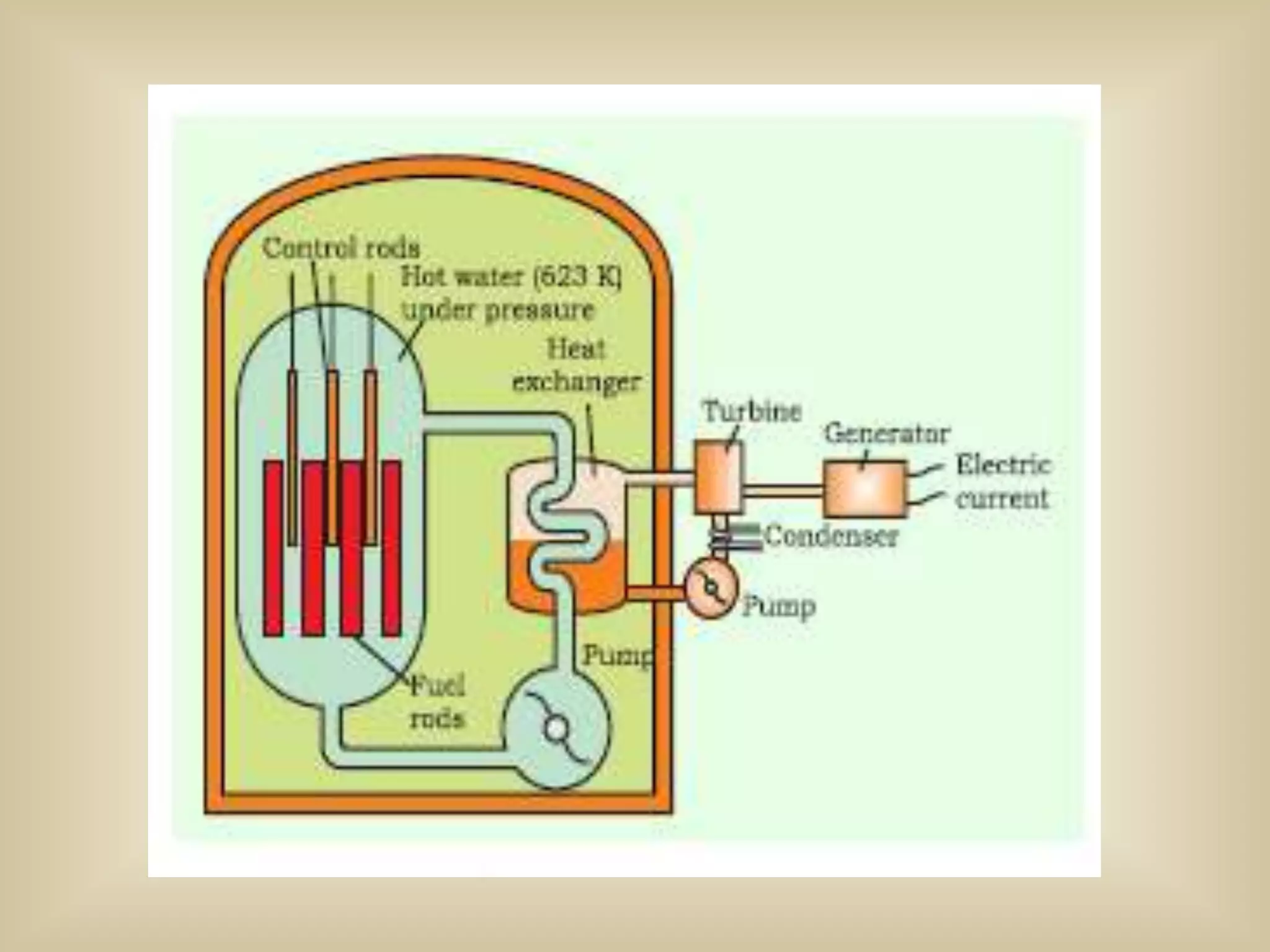
Main Parts of a Typical Nuclear Reactor
1. Reactor core: Consists of an assemblage of fuel elements, control rods,
    coolant and
     moderator. The fission chain reaction takes place in this part of the
    reactor and heat energy is liberates.
2. Reflector: To reflect back some of the leaking neutrons.
3. Pressure Vessel: Which encloses the core and reflector.
4. Shielding: To weaken the Y-rays and radiations coming out from the
    reactor.
5. Heat Exchanger: To transfer the heat liberated from the reactor core to
    boil water and get steam.
6. Turbine: To operate utilizing the steam from the heat exchanger, and to
    drive a generator to produce electricity.
7. Moderators: Used are graphite or beryllium or heavy water. Reduce the
    KE of fast fission neutrons.
8. Control roads: Boron, steel or cadmium to absorb some neutrons.
9. Coolants: Used ordinary water, heavy water, liquid metal like sodium,
    organic liquids and gases. They remove heat from the reactor.
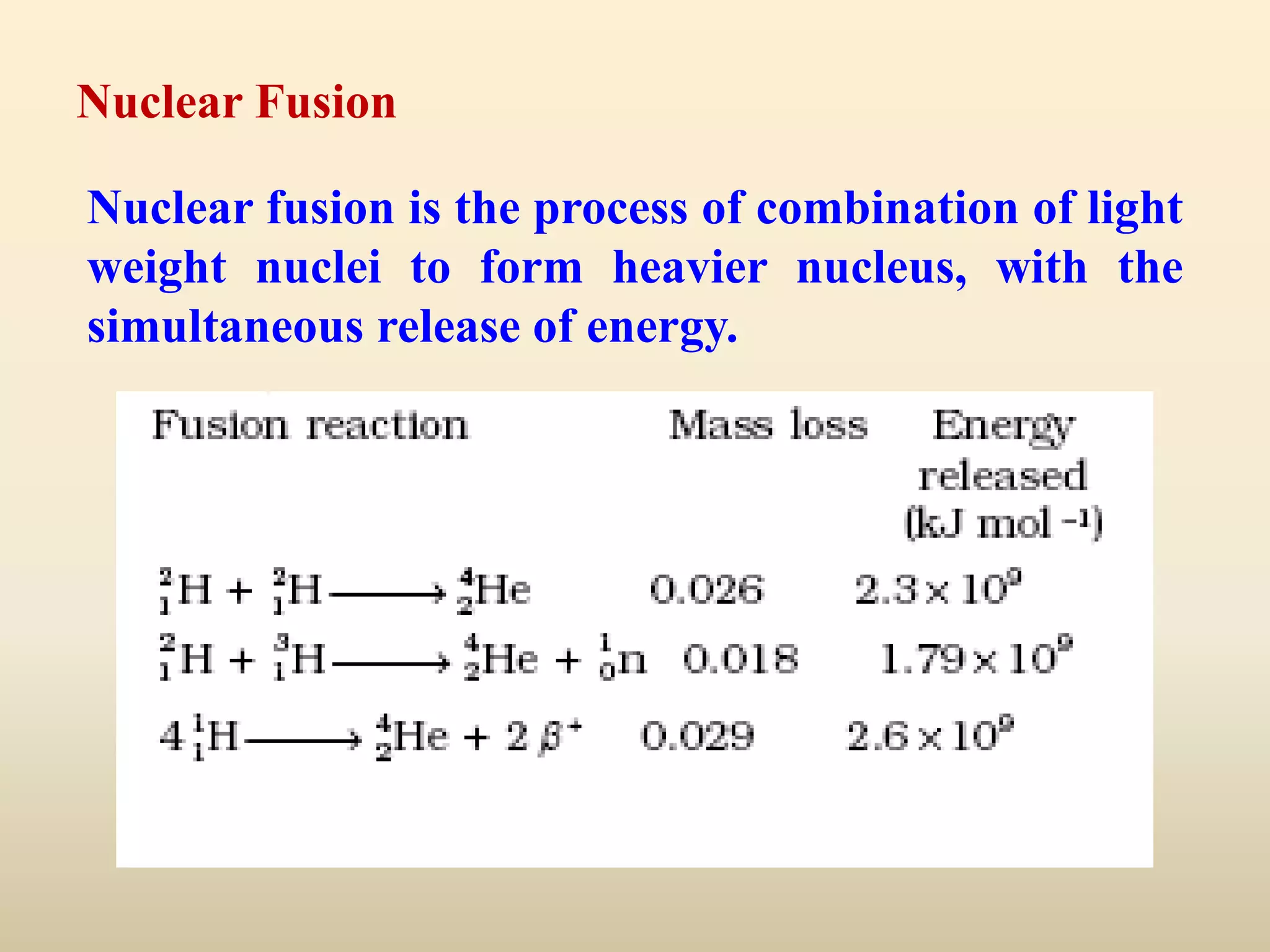
Nuclear Fusion

Nuclear fusion is the process of combination of light
weight nuclei to form heavier nucleus, with the
simultaneous release of energy.
Advantageous Over Fission Reaction

1.Much greater amount of energy.
2.Products of fusion are non
  radioactive while fission products
  are unstable and radioactive and
  hence fission products pose a
  waste-disposal problem.
Rocket Propellant

Fuels used in rockets for their propulsion are called
propellant.


1.Solid Propellant
2.Liquid Propellant
3.Hybrid propellant
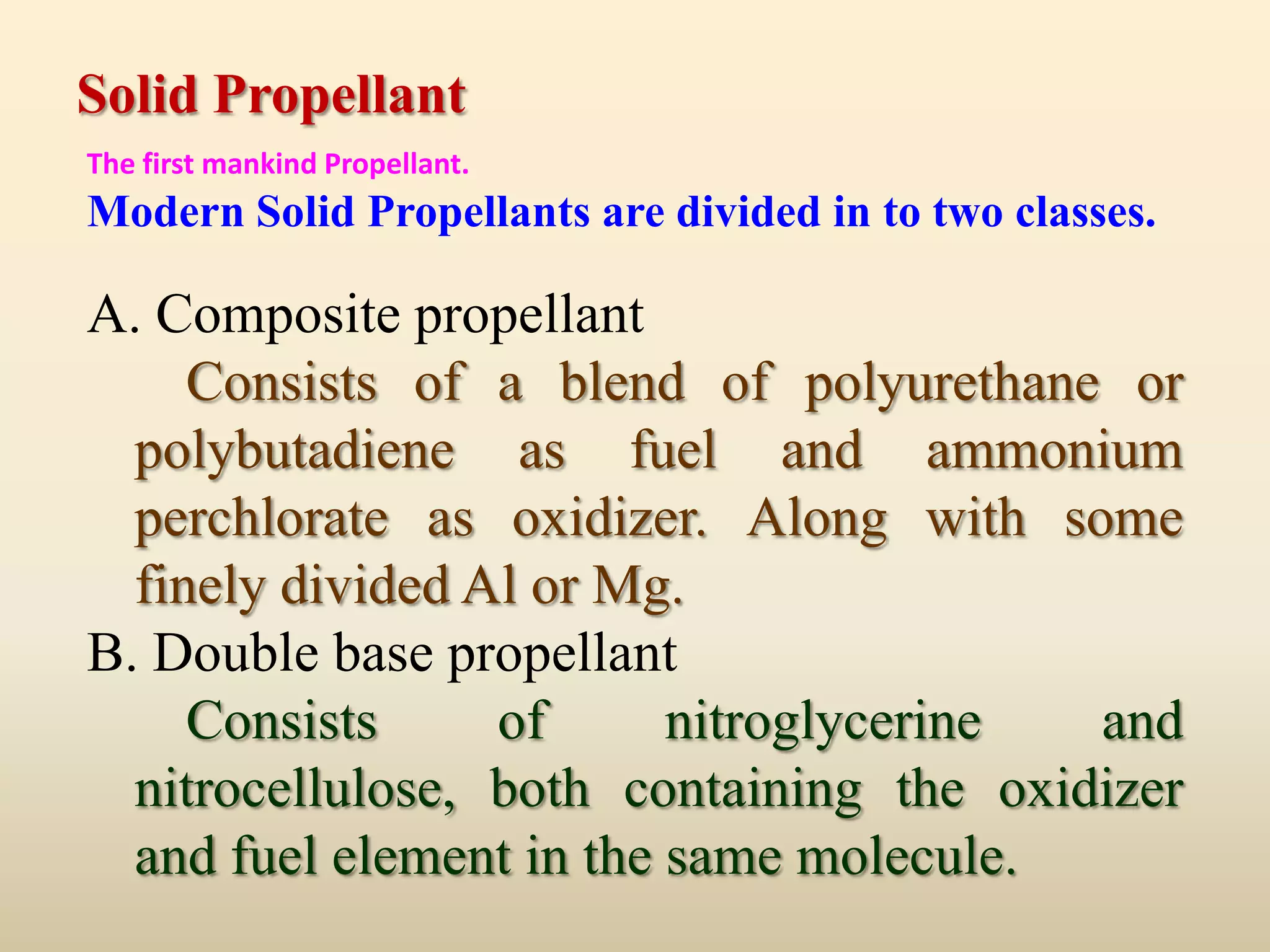
Solid Propellant
The first mankind Propellant.
Modern Solid Propellants are divided in to two classes.

A. Composite propellant
     Consists of a blend of polyurethane or
  polybutadiene as fuel and ammonium
  perchlorate as oxidizer. Along with some
  finely divided Al or Mg.
B. Double base propellant
     Consists     of      nitroglycerine  and
  nitrocellulose, both containing the oxidizer
  and fuel element in the same molecule.
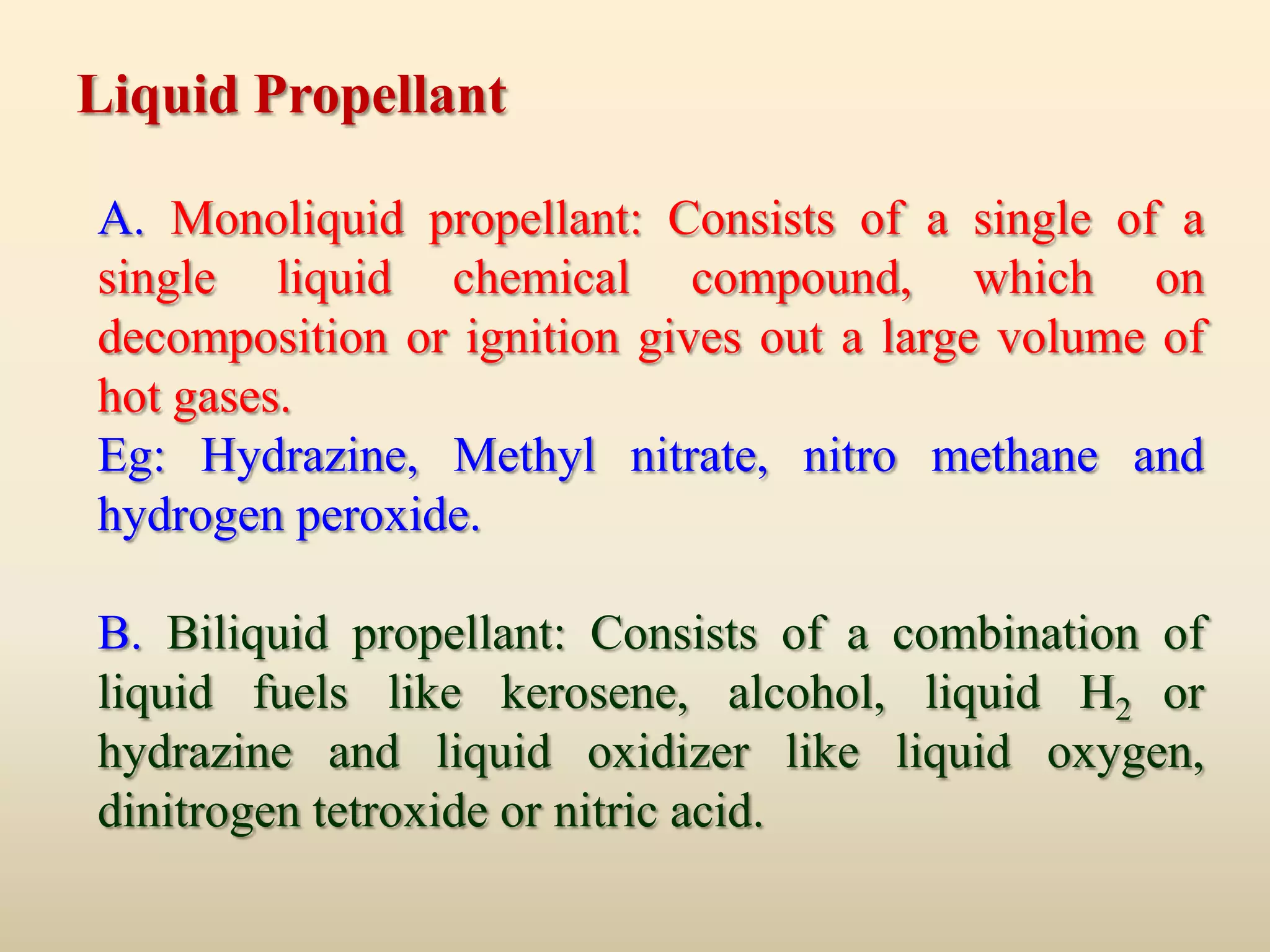
Liquid Propellant

A. Monoliquid propellant: Consists of a single of a
single liquid chemical compound, which on
decomposition or ignition gives out a large volume of
hot gases.
Eg: Hydrazine, Methyl nitrate, nitro methane and
hydrogen peroxide.

B. Biliquid propellant: Consists of a combination of
liquid fuels like kerosene, alcohol, liquid H2 or
hydrazine and liquid oxidizer like liquid oxygen,
dinitrogen tetroxide or nitric acid.
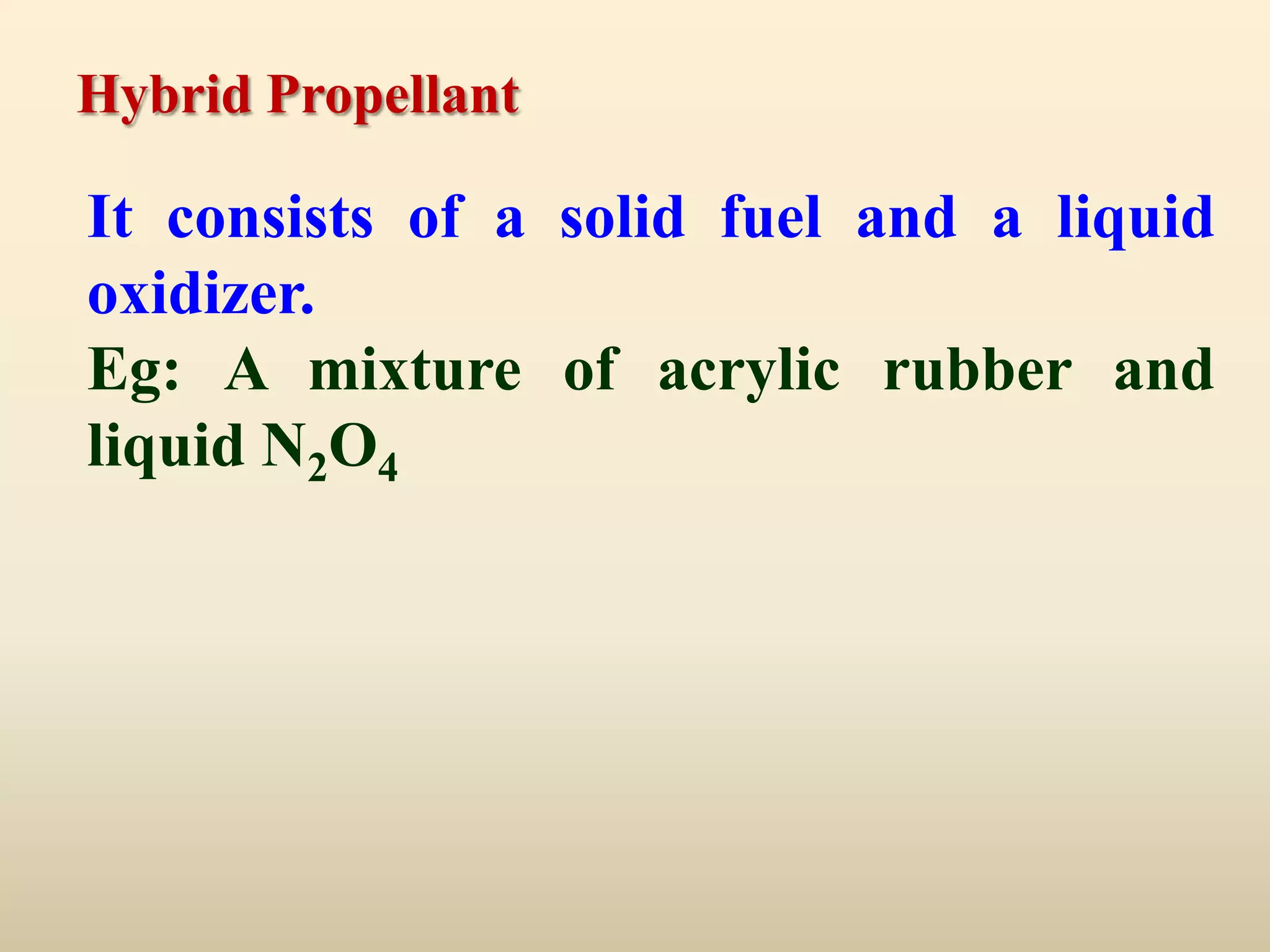
Hybrid Propellant

It consists of a solid fuel and a liquid
oxidizer.
Eg: A mixture of acrylic rubber and
liquid N2O4
Fuels-Dr. Surendran Parambadath

Fuels-Dr. Surendran Parambadath

  • 2.
    Dr. SURENDRAN PARAMBADATH (M.Sc, M.Phil, M.Tech) Formerly: Post Doctoral Research Associate, Nano-Information Materials Research Laboratory, Pusan National University, Busan-South Korea Currently: Assistant Professor Govt. Polytechnic College, Perinthalmanna
  • 3.
    Any substance whichon proper burning in air gives amount of heat, that can be used economically for domestic and industrial purposes. Classification of fuels: A. Based upon their occurrence or preparation (i) Natural or primary fuels-which occur in nature ie available in nature and can be used directly. Eg: Wood, charcoal, Peat, Lignite, bituminous coal, anthracite coal, petroleum and natural gas. (ii) Artificial or secondary fuels which are manufactured artificially, generally from primary fuels. Eg: Coke, kerosene oil, Petrol, Diesel oil, Coal gas, water gas,etc… B. Based upon their physical state, there are (i) Solid fuels (ii) Liquid fuels and (III) Gaseous fuels.
  • 4.
    Classification of fuels Typeof Fuel Primary (Natural) Secondary (Artificial) 1) Solid Wood, Wood, Charcoal, Coke, charcoal, Peat, Charred Lignite, bituminous peat, Coal coal etc. briquette. 2) Liquid Crude Petroleum Various fractions of petroleum. 3) Gaseous Natural gas Coal gas, Oil gas, Water gas, Producer gas, Gobar gas etc.
  • 5.
    The calorific valueof a fuel is defined as the quantity of heat liberated by the complete combustion of a unit mass of the fuel in air or oxygen with the subsequent cooling of the products of combustion to the initial temperature of the fuel. The presence of moisture in the fuel will reduce its calorific value.
  • 6.
    Characteristics of agood fuel 1 High calorific value which determines the amount of heat produced and temperature attained. 2 Moderate ignition temperature. 3 Moderate velocity of combustion for continuous supply of heat. 4 Low moisture content. Velocity of combustion in presence of moisture leads to low temperature. 5 Low non-combustible matter content, as their presence lead to formation of ash, decreases in calorific value of fuel, additional cost of storage handling of disposal of waste products etc.
  • 7.
    Liquid Fuels The mainsource of liquid fuel is petroleum, which on distillation gives important liquid fuels petrol, diesel and kerosene oil. Petra = rock, oleum = oil.
  • 8.
    Treatment of Petroleum Removedirt, water sulphur etc. Fractional distillation Heating up to 400oC in an iron retort, whereby all volatile constituents except the residue are evaporated, and fractionally separated during condensation.
  • 9.
  • 10.
    Super Unleaded Leaded Unleaded Diesel Petrol Petrol Petrol
  • 11.
    1. Gasoline orPetrol or Motor Spirit. It is a mixture of low boiling (40-120oC) hydrocarbons such as pentane, hexane, heptane and octane. Petrol and alcohol in the ratio o 4:1 gives Power alcohol.
  • 12.
    CH3-CH2-CH2-CH2-CH3 Pentane CH3-CH2-CH2-CH2-CH2-CH3 Hexane CH3-CH2-CH2-CH2-CH2-CH2-CH3 Heptane CH3-CH2-CH2-CH2-CH2-CH2-CH2-CH3 Octane
  • 13.
    2. Kerosene oil Itis a mixture of higher hydrocarbons such decane to hexadecane. It is used as a domestic fuel in stoves, as jet engine oil and for making oil gas.
  • 14.
    CH3-CH2-CH2-CH2-CH2-CH2-CH2-CH2-CH2-CH3 Decane CH3-CH2-CH2-CH2-CH2-CH2-CH2-CH2-CH2-CH2-CH3 Dodecane CH3-CH2-CH2-CH2-CH2-CH2-CH2-CH2-CH2-CH2-CH2-CH3 Didecane CH3-CH2-CH2-CH2-CH2-CH2-CH2-CH2-CH2-CH2-CH2-CH2-CH3 Tridecane CH3-CH2-CH2-CH2-CH2-CH2-CH2-CH2-CH2-CH2-CH2-CH2-CH2-CH3 Tetradecane CH3-CH2-CH2-CH2-CH2-CH2-CH2-CH2-CH2-CH2-CH2-CH2-CH2-CH2-CH3 Pentadecane CH3-CH2-CH2-CH2-CH2-CH2-CH2-CH2-CH2-CH2-CH2-CH2-CH2-CH2-CH2-CH3 Hexadecane
  • 15.
    3. Diesel oil Itis a mixture of hydrocarbons with boiling range (250-320oC).
  • 16.
    Knocking The metallic soundproduced during irregular burning of the fuel is termed as knocking. Straight chain alkane> branched chain alkane> Olefines> Cycloalkane> Aromatic hydrocarbons
  • 17.
    Octane Number The octanenumber of a fuel is a measure of its tendency to knock; when burnt in a spark-ignition engine. n-hptane ----------Maximum knocking Octane number 0 Iso-octane -----------Minimum knocking Octane number 100 Tetraethy lead or Diethyl telluride: Anti knocking agents.
  • 18.
    Cetane Number It ameasure of the ignition quality ie the antikonocking character of a diesel oil.
  • 19.
    Cracking It is theprocess of breaking up of less volatile bigger molecule of hydrocarbons from petroleum into more volatile lower molecules of hydrocarbons.
  • 23.
    1. Thermal cracking Fueloil and lubricant oil are subjected to high temperature pyrolysis at about 770K and high pressure, when random cleavage of carbon- carbon bonds takes place and lower alkanes result. A-A-A-A-A-A-A- A-A-A A-A-A + A-A-A-A + A-A-A-A-A-A-A
  • 24.
    2. Catalytic cracking Inthis process heating is done at a lower temperature in presence of catalysts silica and alumina mixture to produce gasoline.
  • 26.
    1. Natural Gas Itis formed by the decomposition of organic matter under the earth and is almost always present in petroleum wells. Composition: CH4 = 71%, C2H6 = 5-10% , H2 = 3%, CO + CO2 = rest It is a cheap convenient fuel and burns with a hot blue flame.
  • 27.
    Uses: 1.It is anexcellent fuel for domestic and industrial purpose. 2.Manufacture of a number of chemicals by synthetic process. 3.As a raw material for the manufacture of carbon black. 4.In preparation of synthetic proteins by microbiological fermentation of methane (CH4)
  • 28.
    2. Water Gas Itis a mixture of combustible gases CO and H2 with small amounts of non-combustible CO2 and N2. Water gas can be made by passing steam and a little air alternatively through a bed of red hot coal or coke maintained at a temperature of about 900-1000oC in a reactor. C + O2 CO2 2C + O2 2CO
  • 29.
    Uses: 1.As a fuelgas 2.As an illuminating gas 3.As a source of hydrogen gas 4.In manufacture of ammonia gas. Combination of water gas: CO = 41%, H2 = 51%, CO2 = 4.2%, N2 = 3%, CH4 = 0.8%
  • 30.
    3. Producer Gas Itis a mixture of CO and N2 and is prepared by blowing controlled amount of air through a deep bed of red hot coke or coal, maintained at about 1100oC in a special reactor. Composition: CO = 30%, N2 = 52%, H2 = 13%, CH4 = 3% and CO2 = 2%
  • 31.
    Uses: 1.For running gasengines. 2.For heating open-hearth furnace muffle furnace, retorts etc. 3.As a reducing agent in metallurgical operations.
  • 32.
    4. Gobar Gas(Dung Gas) Degradation of biological matter by the bacterial action in the absence of free oxygen produces, biogas. Combination of water gas: CH4 = 50-60%, H2 = 5-10%, CO2 = 30-40%, N2 = 2%
  • 33.
    Uses: 1.It is mainlyused as domestic cooking gas. 2.As an illuminant in villages 3.As a fuel to run engines.
  • 34.
    5. LPG (LiquefiedPetroleum Gas) It is obtained as a by product, during the cracking of heavy oils and from natural gas. The main constituents of LPG are n-butane, iso- butane, propane and butene with little or no propene and ethane.
  • 35.
    Uses: 1.Mainly as adomestic fuel for burning gas stove in houses. 2.As a fuel in some of the industries. 3.As motor fuel. 4.In laboratories in gas burners for heating purpose.
  • 36.
    Advantages of LPG 1.Easyto operate, to control and easy to store. 2.Higher efficiency and heating rate. 3.No smoke and hence neat, clean and no pollution. 4.Easy to transport, undergoes complete combustion. 5.Cheaper than gasoline, as a motor fuel.
  • 37.
    6. CNG (CompressedNatural Gas) It is highly compressed form of natural gas. It consists of methane and may contain small amounts of ethane and propane. Uses: 1. In commercial vehicles such as taxis, truck, buses. Disadvantage: 1. Mainly maintaining at high pressure. 2. The release of methane gas through pipe line during transport and from vehicles due to its incomplete combustion.
  • 40.
    1. Wood 2. Charcoal Charcoal is a black porous brittle solid which can burn in air to give CO2 and traces of CO. It is the most active form of carbon and a good adsorbent. 3. Peat The progressive transformation of wood to anthracite under the earth, due to excessive pressure, high temperature, absence of oxygen, presence of bacteria and time. Wood Peat Lignite Anthracite Coal Bituminous Coal
  • 42.
    4. Lignite It is soft, dark brown colored variety, representing second stage in the conversion of vegetable matter into coal. C= 67%, H = 6%, O = 35% and Ash = 2.5% Uses: i) Lignites are usually dried, powdered and pressed into small briquettes and burnt as house hold fuels and for steam raising boiler fuel, ii) Most important use is in manufacture of producer gas.
  • 44.
    5. Bituminous Coal Itis the third stage of conversion of vegetable matter into coal. C= 75-88%, H = 5%, O = 2 % and Ash = 10% Uses: 1.Widely used as a domestic fuel.’ 2.In several industries for making metallurgical coke, coal gas and for steam raising.
  • 46.
    6. Anthracite Coal Itis a class of highest rank coal, the last one in the formation of coal from vegetable matter. It is the hardest of all kind of coal. It is dense, black and brittle. C= 90%, H = 3%, O = 2 % and Ash = 5% Uses: 1. As a fuel for house hold purposes 2. For steam raising 3. In metallurgical purposes, where high local heat and no smoke are desirable.
  • 48.
  • 49.
    Otto Han discoveredthe fission of Uranium opened the prospects of using the vast energy stored in the atomic nucleus for the production of electric power. 1 Kg of Uranium = 3x10⁶ Kg of high grade coal.
  • 50.
    Mass Defect andNuclear Energy A B + C High Mass Low mass Difference is called Mass defect. That difference is the loss of mass during the formation of the nucleus of the isotope or the actual loss of mass equivalent to the energy released during the formation of the given nucleus from individual nucleons.
  • 53.
    Main Parts ofa Typical Nuclear Reactor 1. Reactor core: Consists of an assemblage of fuel elements, control rods, coolant and moderator. The fission chain reaction takes place in this part of the reactor and heat energy is liberates. 2. Reflector: To reflect back some of the leaking neutrons. 3. Pressure Vessel: Which encloses the core and reflector. 4. Shielding: To weaken the Y-rays and radiations coming out from the reactor. 5. Heat Exchanger: To transfer the heat liberated from the reactor core to boil water and get steam. 6. Turbine: To operate utilizing the steam from the heat exchanger, and to drive a generator to produce electricity. 7. Moderators: Used are graphite or beryllium or heavy water. Reduce the KE of fast fission neutrons. 8. Control roads: Boron, steel or cadmium to absorb some neutrons. 9. Coolants: Used ordinary water, heavy water, liquid metal like sodium, organic liquids and gases. They remove heat from the reactor.
  • 55.
    Nuclear Fusion Nuclear fusionis the process of combination of light weight nuclei to form heavier nucleus, with the simultaneous release of energy.
  • 56.
    Advantageous Over FissionReaction 1.Much greater amount of energy. 2.Products of fusion are non radioactive while fission products are unstable and radioactive and hence fission products pose a waste-disposal problem.
  • 57.
    Rocket Propellant Fuels usedin rockets for their propulsion are called propellant. 1.Solid Propellant 2.Liquid Propellant 3.Hybrid propellant
  • 58.
    Solid Propellant The firstmankind Propellant. Modern Solid Propellants are divided in to two classes. A. Composite propellant Consists of a blend of polyurethane or polybutadiene as fuel and ammonium perchlorate as oxidizer. Along with some finely divided Al or Mg. B. Double base propellant Consists of nitroglycerine and nitrocellulose, both containing the oxidizer and fuel element in the same molecule.
  • 59.
    Liquid Propellant A. Monoliquidpropellant: Consists of a single of a single liquid chemical compound, which on decomposition or ignition gives out a large volume of hot gases. Eg: Hydrazine, Methyl nitrate, nitro methane and hydrogen peroxide. B. Biliquid propellant: Consists of a combination of liquid fuels like kerosene, alcohol, liquid H2 or hydrazine and liquid oxidizer like liquid oxygen, dinitrogen tetroxide or nitric acid.
  • 60.
    Hybrid Propellant It consistsof a solid fuel and a liquid oxidizer. Eg: A mixture of acrylic rubber and liquid N2O4