CORROSION
The loss of materials(metal and alloys) or its useful
properties, by chemical or electrochemical interaction
with its environment is called corrosion.

Example:
1. Rusting of iron
2. formation of green layer on copper surface.
CORROSION ENGINEERING
  The branch of Engineering that deals with
the study of corrosion mechanisms and to
prevent or control it economically and
safely is known as Corrosion Engineering.
FACTS ABOUT CORROSION
• Corrosion is a natural process.
• Corrosion is an electrochemical process.
• Corrosion leads to tremendous loss. It can’t be
  eliminated completely. However, its extent can be
  minimized.
• Corrosion is exactly the reverse of extraction of
  metals and also known as weeping of metals.
CAUSE OF CORROSION


          Metal         Metal salt
(higher energy state)   (lower energy state)
THEORIES OF CORROSION

1. Direct chemical attack theory (Chemical
   corrosion or dry corrosion)
   By direct attack of gas in absence of a liquid or
   electrolyte
•. Insoluble corrosion product – further corrosion is
   checked. E.g. Attack of Cl2 or I2 on Ag
•. soluble or liquid corrosion product – further
   corrosion is continued. E.g in the de-tinning of
   metal cans
Types of chemical corrosion

i) Oxidation Corrosion
    2M              2Mn+ + 2ne-      (oxidation)
    n/2O2 + 2ne-      nO2-          (reduction)
   2M + n/2O2        2Mn+ + nO2-

                                   Metal oxide
Case I: When metal ion diffuses faster outward:
In this case oxide layer is formed at the metal oxide –
gas or scale – gas interface. Eg. In FeO, CoO, NiO,
Cu2O
Case II: When oxygen diffuses inward:
 In this case oxide layer is formed at the metal- scale
interface or metal – metal oxide interface. Eg in ZnO,
CdO, TiO2 etc
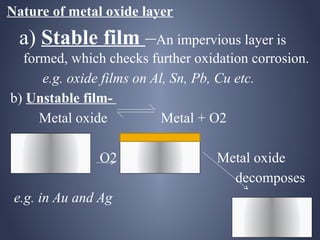
Nature of metal oxide layer

  a) Stable film –An impervious layer is
  formed, which checks further oxidation corrosion.
     e.g. oxide films on Al, Sn, Pb, Cu etc.
b) Unstable film-
     Metal oxide           Metal + O2

               O2                  Metal oxide
                                     decomposes
 e.g. in Au and Ag
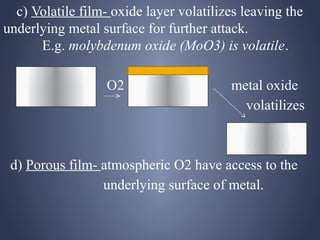
c) Volatile film- oxide layer volatilizes leaving the
underlying metal surface for further attack.
      E.g. molybdenum oxide (MoO3) is volatile.

                  O2                     metal oxide
                                           volatilizes


 d) Porous film- atmospheric O2 have access to the
                 underlying surface of metal.
Pilling Bedworth rule
      If Volume of metal oxide ≥ volume of metal
         Oxide layer is protective or non-porous
                          e.g. Al
      If Volume of metal oxide < volume of metal
                  Oxide layer is porous
          e.g. Alkali and alkaline earth metals

 ii) Corrosion by other gases- by CO2, SO2,Cl2,H2S,
                                 etc
 Extent of corrosion depends upon the chemical affinity
between metal and the gas involved and the nature of the
               film formed on the surface.
protective or non-porous.
       E.g. AgCl layer formed by the attack of
       Cl2 on Ag
Film
        non-protective or porous.
        E.g. i) formation of volatile SnCl4 by the
        attack of dry Cl2 on Sn.
        ii) in petroleum industry, H2S at high T

        attacks steel forming porous FeS scale
iii) Liquid metal corrosion- occurs due to the
  chemical action of flowing liquid metal at high T on

  solid metal or alloy.
Possible processes are:
• Dissolution of a solid metal by a liquid metal
• Internal penetration of the liquid metal into the solid

 metal
2. Wet or electrochemical corrosion
    (electrochemical theory)        Two essential
     requirements are
 i) Formation of anodic and cathodic areas
 ii) Electrical contact between the cathodic and anodic
    parts to enable the conduction of e-
 Mechanism
  i)Anodic reactions
      M(s)       Mn+(aq) + ne-         (oxidation)
      Fe(s)           Fe2+(aq) + 2e-     (oxidation)
      Fe2+(aq) + 2OH-(aq)         Fe(OH)2
ii) Cathodic reactions
  a)Electroplating
     Cu2+(aq) + 2e-         Cu(s)
  b) In acidic solution in the absence of O2
     2H+ + 2e-         H2
c) In acidic solution in the presence of O2
     O2 + 4H+ + 4e-            2H2O
  d) In neutral or alkaline medium in the absence of O2
     2H2O + 2e-             H2 + 2OH-
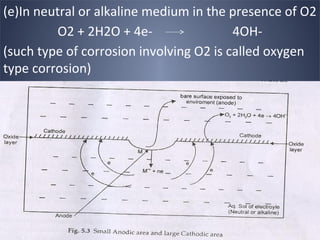
(e)In neutral or alkaline medium in the presence of O2
          O2 + 2H2O + 4e-                4OH-
(such type of corrosion involving O2 is called oxygen
type corrosion)
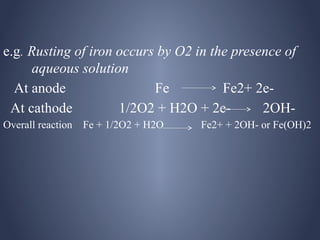
e.g. Rusting of iron occurs by O2 in the presence of
     aqueous solution
  At anode                 Fe          Fe2+ 2e-
 At cathode          1/2O2 + H2O + 2e-        2OH-
Overall reaction Fe + 1/2O2 + H2O   Fe2+ + 2OH- or Fe(OH)2
(i)In excess supply of oxygen: In excess supply of
oxygen, ferrous hydroxide is easily oxidized to ferric
hydroxide.
2Fe(OH)2 + H2O + 1/2O2               2Fe(OH)3


    Fe2O3.xH2O
           Yellow rust
(ii) In limited supply of oxygen: In limited supply of
oxygen, black magnetite Fe3O4 or ferroferric oxide is
formed.
   Fe(OH)2                 Fe2O3.FeO.6H2O
                    Black
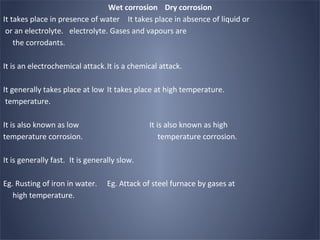
Wet corrosion Dry corrosion
It takes place in presence of water It takes place in absence of liquid or
 or an electrolyte. electrolyte. Gases and vapours are
    the corrodants.

It is an electrochemical attack.It is a chemical attack.

It generally takes place at low It takes place at high temperature.
 temperature.

It is also known as low                       It is also known as high
temperature corrosion.                            temperature corrosion.

It is generally fast. It is generally slow.

Eg. Rusting of iron in water.     Eg. Attack of steel furnace by gases at
   high temperature.
3) The Acid Theory – applicable particularly to
                       rusting of iron
2Fe + O2 + 4CO2 + 2H2O            2Fe(HCO3)2
2Fe(HCO3)2 + H2O + [O]      2Fe(OH)CO3+2CO2+
2H2O
2Fe(OH)CO3 + 2H2O              2Fe(OH)3 + 2CO2
TYPES OF CORROSION
[I] Galvanic Corrosion (Bimetallic corroson):
E.g. Zinc and copper couple
More reactive Zn         Zn2+ + 2e-    At anode
 (Corrodes)
Less reactive    Cu2+ + 2e-      Cu At Cathode
(protected)
Factors affecting galvanic corrosion:
(i) Potential difference between the two metals
     coupled
(ii) Relative area of cathode and anode

e.g. a) Steel pipe connected to copper plumbing.
   b) Steel screw in brass marine hardware
Electrochemical seriesGalvanic series

The arrangement of metals and non-metals in increasing order The arrangement of metals and alloys in
their standard reduction potential is known as  decreasing order of their corroding electrochemical
series tendency in an unpolluted sea water is known as galvanic series.

It contains metals and non-metals It contains metals and alloys.

It is an ideal series   It is a practical series

ECS is based upon the electrode potential which This series is based on actual                   is
determined by using Nernst equation      corrosion rate

Position of metals is fixed in ECS       Position of a given metal in Galvanic
  series may change

It gives no idea about the position of alloys It gives clear idea about the position of alloys

It gives information about the It gives information about the
displacement tendencies relative corrosion tendencies
[II] Erosion Corrosion:
Due to abrading action of flow of gases or
mechanical rubbing action of solids over the
metal surface.
[III] Crevice Corrosion:
Due to cracks in paint coating
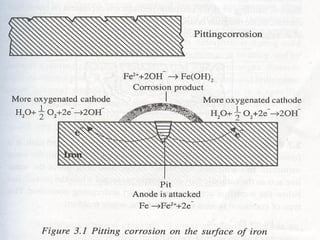
[IV] Pitting Corrosion:
Most dangerous form of corrosion as it leads to
sudden failure of material due to formation of
holes.
Facts about pitting corrosion
• Pitting corrosion is autocatalytic, self
  stimulating and self propagating.
• It takes place exclusively in chloride and
  chloride containing environment.
[IV] Differential aeration Corrosion (Oxygen
             Concentration Cell Corrosion)


• One part of the metal is exposed to a different
  air/O2 concentration from the rest of the part.
• Portion with lesser O2 = Anode
• Portion with more O2 = Cathode
• e.g. A iron nail inside the wood undergoes
  corrosion easily
[V] Waterline Corrosion
[VI] Micro-Biological Corrosion :
Due to metabolic activity of various micro-
organisms
[VII]   Stress-Corrosion Cracking
•Metal under stress becomes more anodic and
tend to increase the rate of corrosion.
•The stress can be due to non-uniform
deformation by unequal cooling from high
temperature as in welding
Factors affecting chemical corrosion
1. Nature of the metal
i) Position in the Galvanic series
ii) Relative areas of anode and cathode
iii) Purity of metal
iv) Solubility of corrosion products
x) Volatility of corrosion products
●
    (vii) Nature of surface film :
     ●
        Specific volume ratio = Volume of metal
            oxide
     ●
                          volume of metal

●
    (viii) Passive character of metal: Tl, Al, Cr, Mg
             etc form thin layer of passive metal
             oxide.
     ●
       e.g. Cr present in stainless steel
2. Nature of environment

i) Temperature: Rate of chemical reaction and rate of
   diffusion increases with temperature
ii) Presence of moisture:
    Critical humidity is the relative humidity above which
   the atmospheric corrosion rate of metal increases
   sharply
(iii)Presence of impurities in atmosphere: due to
     CO2, H2S, SO2 etc in the vicinity of industrial
     area
(iii) Effect of pH
(iv)Nature of ions present: Chloride ions present in
     the medium destroy the passive film, while silicate
     in the medium leads to the formation of insoluble
     film over the metal surface.
(v) Concentration of O2
PROTECTION FROM CORROSION
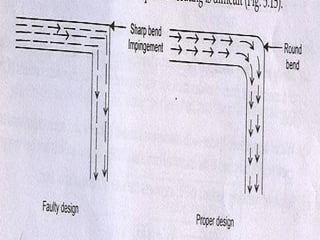
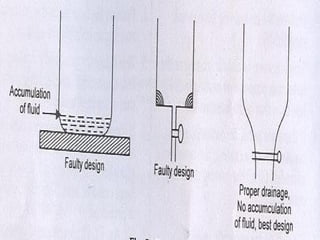
[I] Design and Material Selection
When contact of dissimilar metals is unavoidable,
suitable insulator should be inserted between them
  to reduce current flow and attack on the anode.
[II] Cathodic Protection
(i) By appropriate galvanic coupling:
(ii) By impressed current
advantages over sacrificial cathodic
                   protection
• It is controlled from outside.
•No anode has to be replaced.
[III] Modifying the Environment
i) Deaeration
ii) Deactivation : addition of chemicals, capable of
     combining rapidly with O2 in aqueous solution
iii) Dehumidification: by using alumina or silica gel
iv) Alkaline neutralization
v) Use of inhibitors
a. By forming a layer in between which acts as a
barrier between the material and environment.
b. Or by retarding the anodic or cathodic or both
processes
4. Metallic coatings
i. Electroplating
ii. Hot dipping
iii. Vaporising
iv. Metal spraying
v. Cementation: The base metal articles are packed
     in the powdered coating metal and is heated to a
     temperature just below the m.p. of more fusible
     metal, so that an alloy layer is formed over the
     surface.
Metallic coating are of two types:
Sacrificial coating
Noble coating

                             Sacrificial coating Noble coating
Base metal is coated with a metal which is Base metal is coated with a
more reactive than the base metal. metal which is more noble than the base metal.
Protects the underlying base metal sacrificially.Protects the underlying base metal due
to its noble character and    higher corrosion resistance.

This is known as anodic coating as the reduction This is known as cathodic coating as
potential of coating metal is less than that the reduction potential of coating the base
metal. Metal is more than that of the base metal

Zn, Cd, Al are generally used as sacrificial coating Ni, Ag, Cr, Pb, Au etc. are generally
   used as noble coating
E.g. Galvanised iron i.e. coating of Zn E.g. coating of Sn on Fe
on Fe.
5. Inorganic non-metallic coatings
i. Chemical dip coating or surface conversion
ii. Anodized oxide coating


6. Organic coatings

Corrosion

  • 1.
    CORROSION The loss ofmaterials(metal and alloys) or its useful properties, by chemical or electrochemical interaction with its environment is called corrosion. Example: 1. Rusting of iron 2. formation of green layer on copper surface.
  • 2.
    CORROSION ENGINEERING The branch of Engineering that deals with the study of corrosion mechanisms and to prevent or control it economically and safely is known as Corrosion Engineering.
  • 3.
    FACTS ABOUT CORROSION •Corrosion is a natural process. • Corrosion is an electrochemical process. • Corrosion leads to tremendous loss. It can’t be eliminated completely. However, its extent can be minimized. • Corrosion is exactly the reverse of extraction of metals and also known as weeping of metals.
  • 4.
    CAUSE OF CORROSION Metal Metal salt (higher energy state) (lower energy state)
  • 5.
    THEORIES OF CORROSION 1.Direct chemical attack theory (Chemical corrosion or dry corrosion) By direct attack of gas in absence of a liquid or electrolyte •. Insoluble corrosion product – further corrosion is checked. E.g. Attack of Cl2 or I2 on Ag •. soluble or liquid corrosion product – further corrosion is continued. E.g in the de-tinning of metal cans
  • 6.
    Types of chemicalcorrosion i) Oxidation Corrosion 2M 2Mn+ + 2ne- (oxidation) n/2O2 + 2ne- nO2- (reduction) 2M + n/2O2 2Mn+ + nO2- Metal oxide
  • 7.
    Case I: Whenmetal ion diffuses faster outward: In this case oxide layer is formed at the metal oxide – gas or scale – gas interface. Eg. In FeO, CoO, NiO, Cu2O
  • 8.
    Case II: Whenoxygen diffuses inward: In this case oxide layer is formed at the metal- scale interface or metal – metal oxide interface. Eg in ZnO, CdO, TiO2 etc
  • 9.
    Nature of metaloxide layer a) Stable film –An impervious layer is formed, which checks further oxidation corrosion. e.g. oxide films on Al, Sn, Pb, Cu etc. b) Unstable film- Metal oxide Metal + O2 O2 Metal oxide decomposes e.g. in Au and Ag
  • 10.
    c) Volatile film-oxide layer volatilizes leaving the underlying metal surface for further attack. E.g. molybdenum oxide (MoO3) is volatile. O2 metal oxide volatilizes d) Porous film- atmospheric O2 have access to the underlying surface of metal.
  • 11.
    Pilling Bedworth rule If Volume of metal oxide ≥ volume of metal Oxide layer is protective or non-porous e.g. Al If Volume of metal oxide < volume of metal Oxide layer is porous e.g. Alkali and alkaline earth metals ii) Corrosion by other gases- by CO2, SO2,Cl2,H2S, etc Extent of corrosion depends upon the chemical affinity between metal and the gas involved and the nature of the film formed on the surface.
  • 12.
    protective or non-porous. E.g. AgCl layer formed by the attack of Cl2 on Ag Film non-protective or porous. E.g. i) formation of volatile SnCl4 by the attack of dry Cl2 on Sn. ii) in petroleum industry, H2S at high T attacks steel forming porous FeS scale
  • 13.
    iii) Liquid metalcorrosion- occurs due to the chemical action of flowing liquid metal at high T on solid metal or alloy. Possible processes are: • Dissolution of a solid metal by a liquid metal • Internal penetration of the liquid metal into the solid metal
  • 14.
    2. Wet orelectrochemical corrosion (electrochemical theory) Two essential requirements are i) Formation of anodic and cathodic areas ii) Electrical contact between the cathodic and anodic parts to enable the conduction of e- Mechanism i)Anodic reactions M(s) Mn+(aq) + ne- (oxidation) Fe(s) Fe2+(aq) + 2e- (oxidation) Fe2+(aq) + 2OH-(aq) Fe(OH)2
  • 15.
    ii) Cathodic reactions a)Electroplating Cu2+(aq) + 2e- Cu(s) b) In acidic solution in the absence of O2 2H+ + 2e- H2 c) In acidic solution in the presence of O2 O2 + 4H+ + 4e- 2H2O d) In neutral or alkaline medium in the absence of O2 2H2O + 2e- H2 + 2OH-
  • 16.
    (e)In neutral oralkaline medium in the presence of O2 O2 + 2H2O + 4e- 4OH- (such type of corrosion involving O2 is called oxygen type corrosion)
  • 17.
    e.g. Rusting ofiron occurs by O2 in the presence of aqueous solution At anode Fe Fe2+ 2e- At cathode 1/2O2 + H2O + 2e- 2OH- Overall reaction Fe + 1/2O2 + H2O Fe2+ + 2OH- or Fe(OH)2
  • 18.
    (i)In excess supplyof oxygen: In excess supply of oxygen, ferrous hydroxide is easily oxidized to ferric hydroxide. 2Fe(OH)2 + H2O + 1/2O2 2Fe(OH)3 Fe2O3.xH2O Yellow rust (ii) In limited supply of oxygen: In limited supply of oxygen, black magnetite Fe3O4 or ferroferric oxide is formed. Fe(OH)2 Fe2O3.FeO.6H2O Black
  • 19.
    Wet corrosion Drycorrosion It takes place in presence of water It takes place in absence of liquid or or an electrolyte. electrolyte. Gases and vapours are the corrodants. It is an electrochemical attack.It is a chemical attack. It generally takes place at low It takes place at high temperature. temperature. It is also known as low It is also known as high temperature corrosion. temperature corrosion. It is generally fast. It is generally slow. Eg. Rusting of iron in water. Eg. Attack of steel furnace by gases at high temperature.
  • 20.
    3) The AcidTheory – applicable particularly to rusting of iron 2Fe + O2 + 4CO2 + 2H2O 2Fe(HCO3)2 2Fe(HCO3)2 + H2O + [O] 2Fe(OH)CO3+2CO2+ 2H2O 2Fe(OH)CO3 + 2H2O 2Fe(OH)3 + 2CO2
  • 21.
    TYPES OF CORROSION [I]Galvanic Corrosion (Bimetallic corroson): E.g. Zinc and copper couple More reactive Zn Zn2+ + 2e- At anode (Corrodes) Less reactive Cu2+ + 2e- Cu At Cathode (protected)
  • 23.
    Factors affecting galvaniccorrosion: (i) Potential difference between the two metals coupled (ii) Relative area of cathode and anode e.g. a) Steel pipe connected to copper plumbing. b) Steel screw in brass marine hardware
  • 24.
    Electrochemical seriesGalvanic series Thearrangement of metals and non-metals in increasing order The arrangement of metals and alloys in their standard reduction potential is known as decreasing order of their corroding electrochemical series tendency in an unpolluted sea water is known as galvanic series. It contains metals and non-metals It contains metals and alloys. It is an ideal series It is a practical series ECS is based upon the electrode potential which This series is based on actual is determined by using Nernst equation corrosion rate Position of metals is fixed in ECS Position of a given metal in Galvanic series may change It gives no idea about the position of alloys It gives clear idea about the position of alloys It gives information about the It gives information about the displacement tendencies relative corrosion tendencies
  • 25.
    [II] Erosion Corrosion: Dueto abrading action of flow of gases or mechanical rubbing action of solids over the metal surface. [III] Crevice Corrosion: Due to cracks in paint coating [IV] Pitting Corrosion: Most dangerous form of corrosion as it leads to sudden failure of material due to formation of holes.
  • 26.
    Facts about pittingcorrosion • Pitting corrosion is autocatalytic, self stimulating and self propagating. • It takes place exclusively in chloride and chloride containing environment.
  • 29.
    [IV] Differential aerationCorrosion (Oxygen Concentration Cell Corrosion) • One part of the metal is exposed to a different air/O2 concentration from the rest of the part. • Portion with lesser O2 = Anode • Portion with more O2 = Cathode • e.g. A iron nail inside the wood undergoes corrosion easily
  • 30.
  • 31.
    [VI] Micro-Biological Corrosion: Due to metabolic activity of various micro- organisms [VII] Stress-Corrosion Cracking •Metal under stress becomes more anodic and tend to increase the rate of corrosion. •The stress can be due to non-uniform deformation by unequal cooling from high temperature as in welding
  • 32.
    Factors affecting chemicalcorrosion 1. Nature of the metal i) Position in the Galvanic series ii) Relative areas of anode and cathode iii) Purity of metal iv) Solubility of corrosion products x) Volatility of corrosion products
  • 33.
    (vii) Nature of surface film : ● Specific volume ratio = Volume of metal oxide ● volume of metal ● (viii) Passive character of metal: Tl, Al, Cr, Mg etc form thin layer of passive metal oxide. ● e.g. Cr present in stainless steel
  • 34.
    2. Nature ofenvironment i) Temperature: Rate of chemical reaction and rate of diffusion increases with temperature ii) Presence of moisture: Critical humidity is the relative humidity above which the atmospheric corrosion rate of metal increases sharply (iii)Presence of impurities in atmosphere: due to CO2, H2S, SO2 etc in the vicinity of industrial area
  • 35.
    (iii) Effect ofpH (iv)Nature of ions present: Chloride ions present in the medium destroy the passive film, while silicate in the medium leads to the formation of insoluble film over the metal surface. (v) Concentration of O2
  • 36.
    PROTECTION FROM CORROSION [I]Design and Material Selection
  • 37.
    When contact ofdissimilar metals is unavoidable, suitable insulator should be inserted between them to reduce current flow and attack on the anode.
  • 40.
    [II] Cathodic Protection (i)By appropriate galvanic coupling:
  • 41.
  • 42.
    advantages over sacrificialcathodic protection • It is controlled from outside. •No anode has to be replaced.
  • 43.
    [III] Modifying theEnvironment i) Deaeration ii) Deactivation : addition of chemicals, capable of combining rapidly with O2 in aqueous solution iii) Dehumidification: by using alumina or silica gel iv) Alkaline neutralization v) Use of inhibitors a. By forming a layer in between which acts as a barrier between the material and environment. b. Or by retarding the anodic or cathodic or both processes
  • 44.
    4. Metallic coatings i.Electroplating ii. Hot dipping iii. Vaporising iv. Metal spraying v. Cementation: The base metal articles are packed in the powdered coating metal and is heated to a temperature just below the m.p. of more fusible metal, so that an alloy layer is formed over the surface.
  • 45.
    Metallic coating areof two types: Sacrificial coating Noble coating Sacrificial coating Noble coating Base metal is coated with a metal which is Base metal is coated with a more reactive than the base metal. metal which is more noble than the base metal. Protects the underlying base metal sacrificially.Protects the underlying base metal due to its noble character and higher corrosion resistance. This is known as anodic coating as the reduction This is known as cathodic coating as potential of coating metal is less than that the reduction potential of coating the base metal. Metal is more than that of the base metal Zn, Cd, Al are generally used as sacrificial coating Ni, Ag, Cr, Pb, Au etc. are generally used as noble coating E.g. Galvanised iron i.e. coating of Zn E.g. coating of Sn on Fe on Fe.
  • 46.
    5. Inorganic non-metalliccoatings i. Chemical dip coating or surface conversion ii. Anodized oxide coating 6. Organic coatings