Factors influencing corrosion
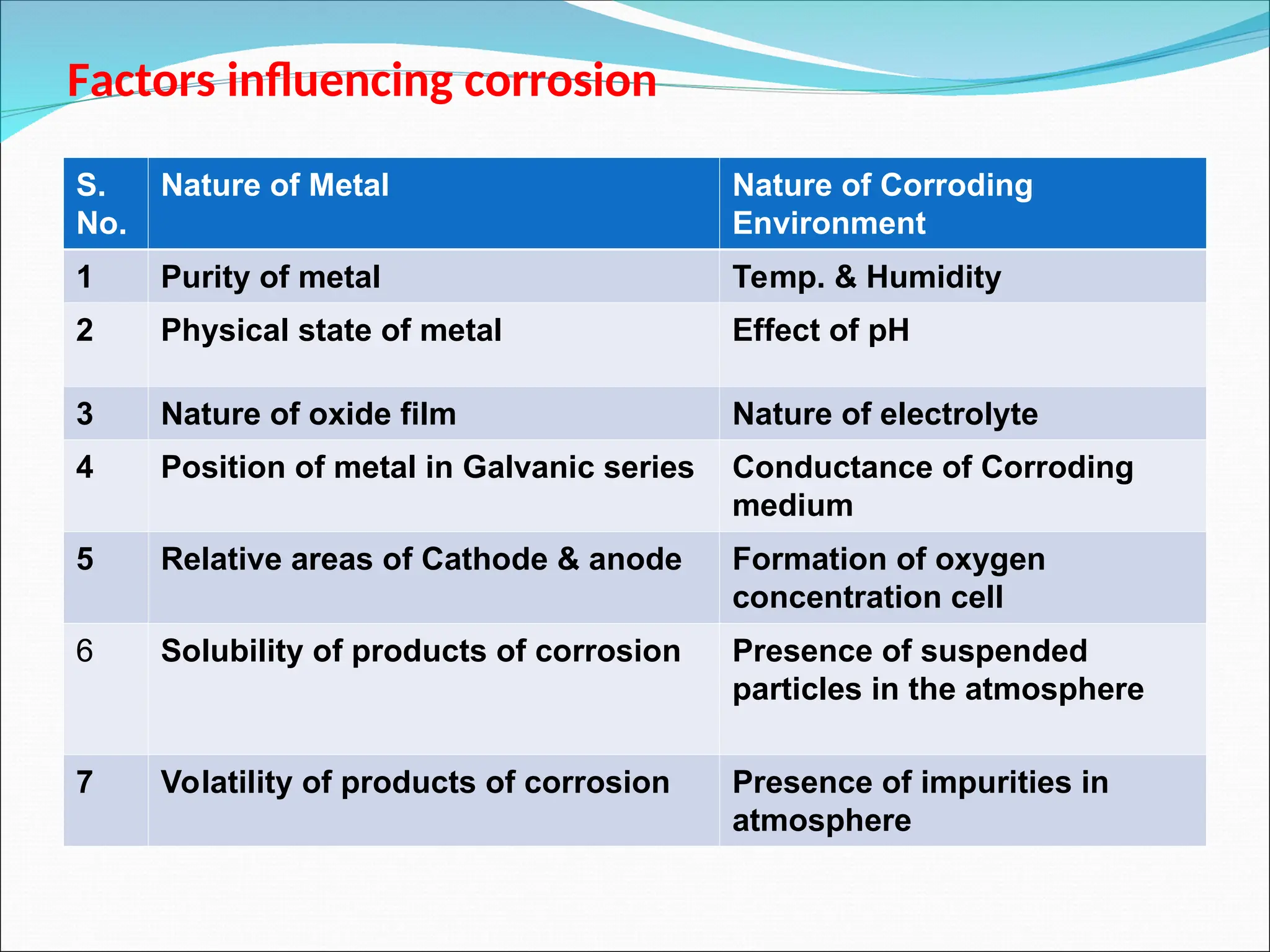
S.
No.
Nature of Metal Nature of Corroding
Environment
1 Purity of metal Temp. & Humidity
2 Physical state of metal Effect of pH
3 Nature of oxide film Nature of electrolyte
4 Position of metal in Galvanic series Conductance of Corroding
medium
5 Relative areas of Cathode & anode Formation of oxygen
concentration cell
6 Solubility of products of corrosion Presence of suspended
particles in the atmosphere
7 Volatility of products of corrosion Presence of impurities in
atmosphere
Nature of Metal
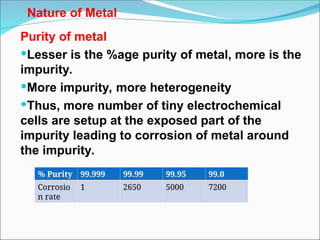
Purity of metal
Lesser is the %age purity of metal, more is the
impurity.
More impurity, more heterogeneity
Thus, more number of tiny electrochemical
cells are setup at the exposed part of the
impurity leading to corrosion of metal around
the impurity.
% Purity 99.999 99.99 99.95 99.0
Corrosio
n rate
1 2650 5000 7200
Physical state of metal
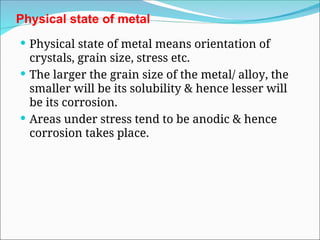
 Physical state of metal means orientation of
crystals, grain size, stress etc.
 The larger the grain size of the metal/ alloy, the
smaller will be its solubility & hence lesser will
be its corrosion.
 Areas under stress tend to be anodic & hence
corrosion takes place.
Nature of oxide Film
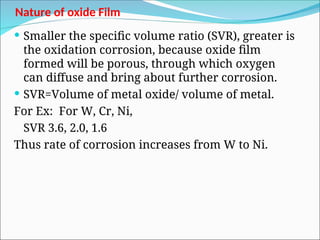
 Smaller the specific volume ratio (SVR), greater is
the oxidation corrosion, because oxide film
formed will be porous, through which oxygen
can diffuse and bring about further corrosion.
 SVR=Volume of metal oxide/ volume of metal.
For Ex: For W, Cr, Ni,
SVR 3.6, 2.0, 1.6
Thus rate of corrosion increases from W to Ni.
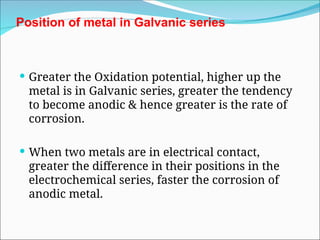
Position of metal in Galvanic series
 Greater the Oxidation potential, higher up the
metal is in Galvanic series, greater the tendency
to become anodic & hence greater is the rate of
corrosion.
 When two metals are in electrical contact,
greater the difference in their positions in the
electrochemical series, faster the corrosion of
anodic metal.
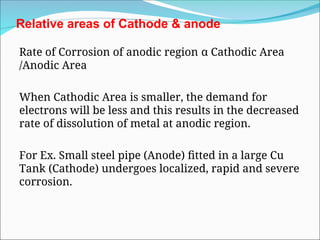
Relative areas of Cathode & anode
Rate of Corrosion of anodic region α Cathodic Area
/Anodic Area
When Cathodic Area is smaller, the demand for
electrons will be less and this results in the decreased
rate of dissolution of metal at anodic region.
For Ex. Small steel pipe (Anode) fitted in a large Cu
Tank (Cathode) undergoes localized, rapid and severe
corrosion.
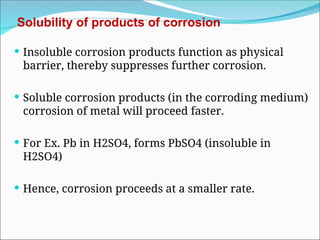
Solubility of products of corrosion
 Insoluble corrosion products function as physical
barrier, thereby suppresses further corrosion.
 Soluble corrosion products (in the corroding medium)
corrosion of metal will proceed faster.
 For Ex. Pb in H2SO4, forms PbSO4 (insoluble in
H2SO4)
 Hence, corrosion proceeds at a smaller rate.
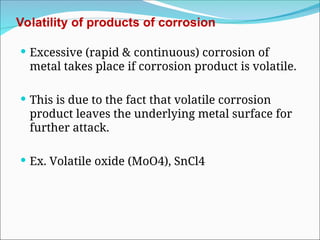
Volatility of products of corrosion
 Excessive (rapid & continuous) corrosion of
metal takes place if corrosion product is volatile.
 This is due to the fact that volatile corrosion
product leaves the underlying metal surface for
further attack.
 Ex. Volatile oxide (MoO4), SnCl4
Nature of Corroding Environment
Temperature
Rise in temp increase rate of corrosion.
Increase in temp reduce the solubility of oxygen or air. The
released oxygen (being insoluble)enhances the corrosion.
Increase in temp induces phase change, which enhance the
rate of corrosion. At high temp organic chemicals are
saturated with water. as temp decreases, water gets
condensed.
Caustic Embrittlement takes place only at higher temperature
in high pressure boilers.
Oxygen is needed for maintaining iron oxide film. In the
absence of O2 corrosion of S.S. increases.
Copper based alloys do not depend on oxide film for
corrosion.
Humidity
 Greater the humidity, greater the rate and extent of
corrosion.
 This is due to the fact that moisture acts as a
solventfor O2, H2S, SO2 and NaCl etc. to furnish the
electrolyte essential for setting up a corrosion cell.
 For Ex. Atmospheric corrosion of iron is slow in dry
air in comparison to moist air.
 Gases like H2S, SO2 etc. increase the acidity of
medium by their dissolution in water and hence
increase the corrosion rate.
 Dissolution of NaCl in water leads to increased
conductivity and thereby increased corrosion rate.
pH
 Corrosion of those metals which are readily
attacked by acids can be reduced by increasing
the pH of the attacking environment.
 For Ex. Corrosion of Zn can be minimized by
increasing the pH to 11.
 In general acidic media are more corrosive than
alkaline and neutral media.
 The correlation between pH and corrosion can
be obtained from pH-potential diagram
(Pourbiax diagram)
Solution pH
 Metals such as iron dissolve rapidly in acidic
solution. In the middle pH range (4 to 10), the
conc of H+ ions is low. Hence, the corrosion rate
is controlled by the rate of transport of oxygen.
 Certain amphoteric metals dissolve rapidly in
either acidic or basic solution. E.g. Al and Zn.
 Noble metals are not affected by pH. E.g. gold and
platinum.
 H + ions capture electrons and promote anodic
corrosion.
Nature of Electrolyte
 (a) Anions: If electrolyte consist of silicate ions,
they form insoluble silicates and prevent further
corrosion.
 If the electrolyte consists of Cl- (chloride) ions,
they destroy the protective film & the surface is
exposed for further corrosion.
 For Ex. Rapid corrosion of Al in sea water
(b)Cations Corrosion of many metals is rapid in
presence of NH4
+
ions in corroding media.
Conductance of Corroding medium
 Conductance of clayed and mineralized soils is
more than that of dry sandy soils, hence
corrosion of underground metallic structures is
more in clayed & mineralized soils.
 Soil corrosion
Formation of oxygen concentration cell
 Due to differential aeration, oxygen
concentration cell set up and anodic part having
less oxygen concentration suffers corrosion.
Presence of suspended particles in the atmosphere
 Atmospheric suspended particles can be
classified into two types.
 (A) Active Like NaCl, (NH4)2SO4 etc.
 (B) Inactive like Charcoal
 Type A enhance atmospheric corrosion as they
can absorb moisture and act as strong
electrolyte.
 Type B slowly enhance corrosion rate as they can
absorb moisture and sulphur gases although
they are not electrolytes.
Presence of impurities in atmosphere
 Concentration of metals is more in areas near
industry and sea.
 This is due to corrosive gasses like H2S, SO2, CO2
and fumes of H2SO4and HCl in industrial areas
and NaCl of sea water leads to increased
conductivity of the liquid layer in contact with
the metal surface, thereby increase the corrosion
rate.
Oxidizing agents
 Oxidizing agents accelerate the corrosion of one class of
materials, whereas retard another class.
 Oxidizing agents such as oxygen react with hydrogen to
form water. Once hydrogen is removed, corrosion is
accelerated. E.g. copper in NaCl
 Oxidizing agent retard corrosion due to formation of
surface oxide films, which makes the surface more
resistant to chemical attack.
 Thus a balance between the power of oxidizing agent to
preserve the protective layer and their tendency to
destroy the protective film determine the corrosion of
metal.
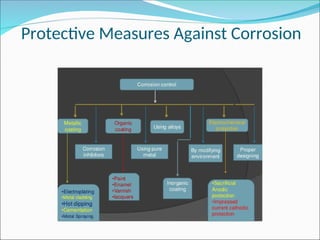
Protective Measures Against Corrosion
There are many methods of protecting metals against corrosion
• Barrier protection
• Sacrificial protection
• Cathodic protection
• Alloy formation
Barrier protection :
Here, a thin barrier is developed between the surface of iron and
atmosphere by one of the following methods:
a) Painting of the surface
b) Coating the surface with a thin film of some non –corrosive metal like
nickel, chromium copper etc.
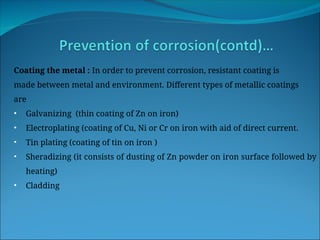
Coating the metal : In order to prevent corrosion, resistant coating is
made between metal and environment. Different types of metallic coatings
are
• Galvanizing (thin coating of Zn on iron)
• Electroplating (coating of Cu, Ni or Cr on iron with aid of direct current.
• Tin plating (coating of tin on iron )
• Sheradizing (it consists of dusting of Zn powder on iron surface followed by
heating)
• Cladding
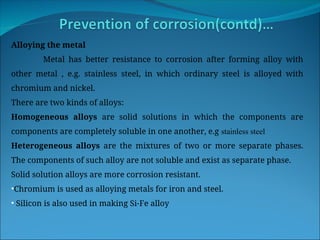
Alloying the metal
Metal has better resistance to corrosion after forming alloy with
other metal , e.g. stainless steel, in which ordinary steel is alloyed with
chromium and nickel.
There are two kinds of alloys:
Homogeneous alloys are solid solutions in which the components are
components are completely soluble in one another, e.g stainless steel
Heterogeneous alloys are the mixtures of two or more separate phases.
The components of such alloy are not soluble and exist as separate phase.
Solid solution alloys are more corrosion resistant.
•Chromium is used as alloying metals for iron and steel.
• Silicon is also used in making Si-Fe alloy
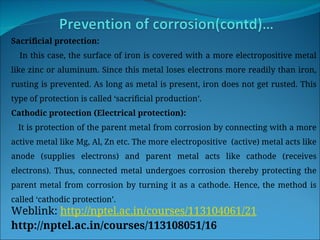
Sacrificial protection:
In this case, the surface of iron is covered with a more electropositive metal
like zinc or aluminum. Since this metal loses electrons more readily than iron,
rusting is prevented. As long as metal is present, iron does not get rusted. This
type of protection is called ‘sacrificial production’.
Cathodic protection (Electrical protection):
It is protection of the parent metal from corrosion by connecting with a more
active metal like Mg, Al, Zn etc. The more electropositive (active) metal acts like
anode (supplies electrons) and parent metal acts like cathode (receives
electrons). Thus, connected metal undergoes corrosion thereby protecting the
parent metal from corrosion by turning it as a cathode. Hence, the method is
called ‘cathodic protection’.
Weblink: http://nptel.ac.in/courses/113104061/21
http://nptel.ac.in/courses/113108051/16
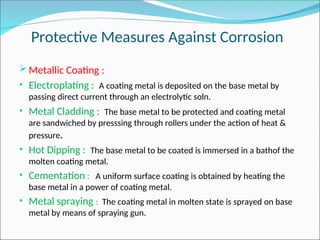
Protective Measures Against Corrosion
Metallic Coating :
• Electroplating : A coating metal is deposited on the base metal by
passing direct current through an electrolytic soln.
• Metal Cladding : The base metal to be protected and coating metal
are sandwiched by presssing through rollers under the action of heat &
pressure.
• Hot Dipping : The base metal to be coated is immersed in a bathof the
molten coating metal.
• Cementation : A uniform surface coating is obtained by heating the
base metal in a power of coating metal.
• Metal spraying : The coating metal in molten state is sprayed on base
metal by means of spraying gun.
Protective Measures Against Corrosion
 Organic Coating :
• Apply on metallic surface for protection from corrosion & also to impart
decorative value. Such as paints, enamel, Varnishes & lacquers
 Corrosion Inhibitors :
• Substances which when added in a small amount in an environment
reduces the rate of corrosion of a metal exposed to that enviornment.
These are of two types Cathodic & anodic
 Inorganic Coatings : are produced by chemical or electrochemical
reactions at a metal surface to protect base metal from corrosion eg. :
phophates, oxides etc.
 Using Pure Metal :
 Using Alloys :
Protective Measures Against Corrosion
 By Modifying Environment :
• By lowering the temp.
• By reducing the moisture
• By reducing the acidic corrosion environment
 Proper Designing :
• Proper designing of the equipment
• Avoid the direct contact of dissimilar metals
• Electrochemical Protection or Cathodic Protection :
• Sacrifical Anodic Protection : Metal to be protected is connected to more anodic metal to
avoid corrosion
• Impressed Current Cathodic Protection : This process consists of connecting the material to
be protected to –ve terminal of DC source& +ve terminal of DC source is connected toa
insoluble anode . The current supplied is in opposite direction to the corrosion current.Thus
the metal to be protected act as cathode & get protected.
Prevention and control
The corrosion may be prevented or controlled
by following ways:
1.Selection of proper material
2.Proper design of equipment
3.Coating and lining
4.Altering environment
5.Inhibitors
6.Cathodic protection
7.Anodic protection
1. Selection of proper material
 Corrosion should not be permitted in fine wire
screen, orifice and other items in which the
dimensions are critical and change is not permitted.
 In some cases, non metallic materials will be more
economic and have good performance. It should be
considered if their strength, temp and design is
satisfactory.
 The corrosion characteristics of chemicals and
limitation of construction material can be
considered.
 The processing conditions should also be considered.
2. Proper design of equipment
 In the design of equipment, the number of fittings
like, baffles, valves and pumps should be
considered.
 Corrosion can be minimized if the equipment
design facilitates
Elimination of crevices
Complete drainage of liquids
Ease of cleaning
Ease of inspection and maintenance
 A direct contact between two metal is avoided, if
they are seperated widely in elecrochemical
3. Coatings and Linings
 Nonmetallic coatings and linings can be applied
on steel and other materials of construction in
order to combat corrosion.
 Coating methods: electroplating, cladding,
organic coating.
 The thickness of lining is important.
 Effective linings can be obtained by bonding
directly to substrate metal or building multiple
layers.
 Organic coatings can be used in tanks, piping
and pumping lines.
3. Coatings and Linings
 A thin non-reinforced paint like coating of
less than 0.75 mm thickness should not be
used in services for which full protection is
required.
 The cladding of steel with an alloy is another
approach to this problem.
 Sp glass can be bonded to steel so that the
liner is 1.5 mm thick which is impervious.
 Piping and equipment lined in this manner
are used in severely corrosive acid services.
4. Altering Environment
Corrosion can be reduced by employing
following conditions:
1. Removing air from boiler feed water
prevents the influence of water on steel
2. Reducing the temp
3. Eliminating moisture
4. Reducing the velocity of turbulence
5. Shortening the time of exposure
6. Pumping the inert gas into solutions
7. Reducing aeration.
5. Inhibitors
The corrosion inhibitors are added to the
environment to decrease corrosion of
metals. This form protective films.
1.Adsorption type, e.g. adsorbed on metal
2.Scavenger phase type, e.g. remove corrosion
agent
3.Vapor phase type, e.g. sublime and
condense on metal surface.
Inhibitors are generally used in quantities
less than 0.1 % by weight.
5. Inhibitors
e.g. of inhibitors
1.Chromate, Phosphates & Silicates protect
iron and Steel in aq solution.
2.Organic sulphide and Amines protect iron
and Steel in acidic solution.
3.Copper sulphate protects S.S in hot diluted
solution of H2SO4.
6. Cathodic protection
 It is based on the galvanic action between the
metals of the anode and cathode suspended
in the solution.
 The metals to be protected is made a cathode.
 Electrons are supplied , there by dissolution
of metal is suppressed.
 It can be achieved by:
 1. Sacrificial anode method
 2. Impressed emf method
Sacrificial anode method
 In this method, anodes are kept in electrical contact
with the metal to be protected.
 The anodes are sacrificed, since it goes into solution.
 E.g. for the protection of iron and steel tanks, the
metals such as Zinc, Al, Mg and their alloy are used
as sacrificial anodes.
 This are used in limited pH range.
 Anode metal is selected from electrochemical series.
 The anodes should not be poisonous and not
detrimental to the pdts.
Impressed emf method
 It is also known as applied current system, i.e.,
external voltage is impressed between tank and
electrodes.
 The negative terminal of power is connected to
the material to be protected.
 So the natural galvanic effect is avoided and
the anode is maintained positive.
 Since anode is not consumed, metal or non
corrodable material can be used.
Advantages
This method is used for large tanks to store
mild corrosive liquors. In these cases, mild
steel is used with negligible corrosion.
Cathodic protection method is simple and
the most effective.
It is inexpensive. It enables the use of
cheaper material for plant construction.
Dis-advantage: Corrosion can not be
reduced to zero.
7. Anodic Protection
 In this method, a predetermined potential is
applied to the metal specimen and the
corresponding current changes are observed.
 During the initial stage, the current increases
indicating the dissolution of the metal.
 When the current reaches a critical point,
passivisation occur, i.e., the oxide layers set in
suitable oxidizing environment. The potential at
the critical point is called passivating potential.
 Above this passivating potential, the current
flows decreases to a very small value called
passivating current.
7. Anodic Protection
The passivating current is defined as
the minimum protective current
density required to maintain
passivisation.
At this stage, an increase in potential
will not be corrode the metal since the
later is in highly passive state.
E.g. in case of S.S. titanium becomes
easily passive and can not offer
cathodic protection.
Advantages :
The anodic protection method is
utilized in the transportation of
conc H2SO4.
Dis-advantages:
Corrosion can not be reduced to
zero.
This method cannot be applied for
metals, which do not passivate.
Text books references
1. Jain P C and Jain M: Engineering Chemistry (15th Edition) 2006 Dhanpat
Rai Publishing Company, NewDelhi.
2. Dara S.S. & Umare S.S. A Text Book of Engineering Chemistry(12th
Edition ) 2008 S.Chand Publishing Company, New Delhi
3. Chawla Shashi: A text book of Engineering Chemistry (3rd Edition) 2010
Dhanpat Rai Publishing Company, New Delhi.
4. Palanna O G : A text book of Engineering Chemistry(4th Reprint) 2012
McGraw Hill, New Delhi
5. Sharma BK, Industrial Chemistry (16th Edition), 2014, Krishna Prakashan
Media (P) ltd. Meerut.
Factors affecting and prevention_Corrosion (1).ppt

Factors affecting and prevention_Corrosion (1).ppt

  • 1.
    Factors influencing corrosion S. No. Natureof Metal Nature of Corroding Environment 1 Purity of metal Temp. & Humidity 2 Physical state of metal Effect of pH 3 Nature of oxide film Nature of electrolyte 4 Position of metal in Galvanic series Conductance of Corroding medium 5 Relative areas of Cathode & anode Formation of oxygen concentration cell 6 Solubility of products of corrosion Presence of suspended particles in the atmosphere 7 Volatility of products of corrosion Presence of impurities in atmosphere
  • 2.
    Nature of Metal Purityof metal Lesser is the %age purity of metal, more is the impurity. More impurity, more heterogeneity Thus, more number of tiny electrochemical cells are setup at the exposed part of the impurity leading to corrosion of metal around the impurity. % Purity 99.999 99.99 99.95 99.0 Corrosio n rate 1 2650 5000 7200
  • 3.
    Physical state ofmetal  Physical state of metal means orientation of crystals, grain size, stress etc.  The larger the grain size of the metal/ alloy, the smaller will be its solubility & hence lesser will be its corrosion.  Areas under stress tend to be anodic & hence corrosion takes place.
  • 4.
    Nature of oxideFilm  Smaller the specific volume ratio (SVR), greater is the oxidation corrosion, because oxide film formed will be porous, through which oxygen can diffuse and bring about further corrosion.  SVR=Volume of metal oxide/ volume of metal. For Ex: For W, Cr, Ni, SVR 3.6, 2.0, 1.6 Thus rate of corrosion increases from W to Ni.
  • 5.
    Position of metalin Galvanic series  Greater the Oxidation potential, higher up the metal is in Galvanic series, greater the tendency to become anodic & hence greater is the rate of corrosion.  When two metals are in electrical contact, greater the difference in their positions in the electrochemical series, faster the corrosion of anodic metal.
  • 6.
    Relative areas ofCathode & anode Rate of Corrosion of anodic region α Cathodic Area /Anodic Area When Cathodic Area is smaller, the demand for electrons will be less and this results in the decreased rate of dissolution of metal at anodic region. For Ex. Small steel pipe (Anode) fitted in a large Cu Tank (Cathode) undergoes localized, rapid and severe corrosion.
  • 7.
    Solubility of productsof corrosion  Insoluble corrosion products function as physical barrier, thereby suppresses further corrosion.  Soluble corrosion products (in the corroding medium) corrosion of metal will proceed faster.  For Ex. Pb in H2SO4, forms PbSO4 (insoluble in H2SO4)  Hence, corrosion proceeds at a smaller rate.
  • 8.
    Volatility of productsof corrosion  Excessive (rapid & continuous) corrosion of metal takes place if corrosion product is volatile.  This is due to the fact that volatile corrosion product leaves the underlying metal surface for further attack.  Ex. Volatile oxide (MoO4), SnCl4
  • 9.
    Nature of CorrodingEnvironment Temperature Rise in temp increase rate of corrosion. Increase in temp reduce the solubility of oxygen or air. The released oxygen (being insoluble)enhances the corrosion. Increase in temp induces phase change, which enhance the rate of corrosion. At high temp organic chemicals are saturated with water. as temp decreases, water gets condensed. Caustic Embrittlement takes place only at higher temperature in high pressure boilers. Oxygen is needed for maintaining iron oxide film. In the absence of O2 corrosion of S.S. increases. Copper based alloys do not depend on oxide film for corrosion.
  • 10.
    Humidity  Greater thehumidity, greater the rate and extent of corrosion.  This is due to the fact that moisture acts as a solventfor O2, H2S, SO2 and NaCl etc. to furnish the electrolyte essential for setting up a corrosion cell.  For Ex. Atmospheric corrosion of iron is slow in dry air in comparison to moist air.  Gases like H2S, SO2 etc. increase the acidity of medium by their dissolution in water and hence increase the corrosion rate.  Dissolution of NaCl in water leads to increased conductivity and thereby increased corrosion rate.
  • 11.
    pH  Corrosion ofthose metals which are readily attacked by acids can be reduced by increasing the pH of the attacking environment.  For Ex. Corrosion of Zn can be minimized by increasing the pH to 11.  In general acidic media are more corrosive than alkaline and neutral media.  The correlation between pH and corrosion can be obtained from pH-potential diagram (Pourbiax diagram)
  • 12.
    Solution pH  Metalssuch as iron dissolve rapidly in acidic solution. In the middle pH range (4 to 10), the conc of H+ ions is low. Hence, the corrosion rate is controlled by the rate of transport of oxygen.  Certain amphoteric metals dissolve rapidly in either acidic or basic solution. E.g. Al and Zn.  Noble metals are not affected by pH. E.g. gold and platinum.  H + ions capture electrons and promote anodic corrosion.
  • 13.
    Nature of Electrolyte (a) Anions: If electrolyte consist of silicate ions, they form insoluble silicates and prevent further corrosion.  If the electrolyte consists of Cl- (chloride) ions, they destroy the protective film & the surface is exposed for further corrosion.  For Ex. Rapid corrosion of Al in sea water (b)Cations Corrosion of many metals is rapid in presence of NH4 + ions in corroding media.
  • 14.
    Conductance of Corrodingmedium  Conductance of clayed and mineralized soils is more than that of dry sandy soils, hence corrosion of underground metallic structures is more in clayed & mineralized soils.  Soil corrosion
  • 15.
    Formation of oxygenconcentration cell  Due to differential aeration, oxygen concentration cell set up and anodic part having less oxygen concentration suffers corrosion.
  • 16.
    Presence of suspendedparticles in the atmosphere  Atmospheric suspended particles can be classified into two types.  (A) Active Like NaCl, (NH4)2SO4 etc.  (B) Inactive like Charcoal  Type A enhance atmospheric corrosion as they can absorb moisture and act as strong electrolyte.  Type B slowly enhance corrosion rate as they can absorb moisture and sulphur gases although they are not electrolytes.
  • 17.
    Presence of impuritiesin atmosphere  Concentration of metals is more in areas near industry and sea.  This is due to corrosive gasses like H2S, SO2, CO2 and fumes of H2SO4and HCl in industrial areas and NaCl of sea water leads to increased conductivity of the liquid layer in contact with the metal surface, thereby increase the corrosion rate.
  • 18.
    Oxidizing agents  Oxidizingagents accelerate the corrosion of one class of materials, whereas retard another class.  Oxidizing agents such as oxygen react with hydrogen to form water. Once hydrogen is removed, corrosion is accelerated. E.g. copper in NaCl  Oxidizing agent retard corrosion due to formation of surface oxide films, which makes the surface more resistant to chemical attack.  Thus a balance between the power of oxidizing agent to preserve the protective layer and their tendency to destroy the protective film determine the corrosion of metal.
  • 19.
  • 20.
    There are manymethods of protecting metals against corrosion • Barrier protection • Sacrificial protection • Cathodic protection • Alloy formation Barrier protection : Here, a thin barrier is developed between the surface of iron and atmosphere by one of the following methods: a) Painting of the surface b) Coating the surface with a thin film of some non –corrosive metal like nickel, chromium copper etc.
  • 21.
    Coating the metal: In order to prevent corrosion, resistant coating is made between metal and environment. Different types of metallic coatings are • Galvanizing (thin coating of Zn on iron) • Electroplating (coating of Cu, Ni or Cr on iron with aid of direct current. • Tin plating (coating of tin on iron ) • Sheradizing (it consists of dusting of Zn powder on iron surface followed by heating) • Cladding
  • 22.
    Alloying the metal Metalhas better resistance to corrosion after forming alloy with other metal , e.g. stainless steel, in which ordinary steel is alloyed with chromium and nickel. There are two kinds of alloys: Homogeneous alloys are solid solutions in which the components are components are completely soluble in one another, e.g stainless steel Heterogeneous alloys are the mixtures of two or more separate phases. The components of such alloy are not soluble and exist as separate phase. Solid solution alloys are more corrosion resistant. •Chromium is used as alloying metals for iron and steel. • Silicon is also used in making Si-Fe alloy
  • 23.
    Sacrificial protection: In thiscase, the surface of iron is covered with a more electropositive metal like zinc or aluminum. Since this metal loses electrons more readily than iron, rusting is prevented. As long as metal is present, iron does not get rusted. This type of protection is called ‘sacrificial production’. Cathodic protection (Electrical protection): It is protection of the parent metal from corrosion by connecting with a more active metal like Mg, Al, Zn etc. The more electropositive (active) metal acts like anode (supplies electrons) and parent metal acts like cathode (receives electrons). Thus, connected metal undergoes corrosion thereby protecting the parent metal from corrosion by turning it as a cathode. Hence, the method is called ‘cathodic protection’. Weblink: http://nptel.ac.in/courses/113104061/21 http://nptel.ac.in/courses/113108051/16
  • 24.
    Protective Measures AgainstCorrosion Metallic Coating : • Electroplating : A coating metal is deposited on the base metal by passing direct current through an electrolytic soln. • Metal Cladding : The base metal to be protected and coating metal are sandwiched by presssing through rollers under the action of heat & pressure. • Hot Dipping : The base metal to be coated is immersed in a bathof the molten coating metal. • Cementation : A uniform surface coating is obtained by heating the base metal in a power of coating metal. • Metal spraying : The coating metal in molten state is sprayed on base metal by means of spraying gun.
  • 25.
    Protective Measures AgainstCorrosion  Organic Coating : • Apply on metallic surface for protection from corrosion & also to impart decorative value. Such as paints, enamel, Varnishes & lacquers  Corrosion Inhibitors : • Substances which when added in a small amount in an environment reduces the rate of corrosion of a metal exposed to that enviornment. These are of two types Cathodic & anodic  Inorganic Coatings : are produced by chemical or electrochemical reactions at a metal surface to protect base metal from corrosion eg. : phophates, oxides etc.  Using Pure Metal :  Using Alloys :
  • 26.
    Protective Measures AgainstCorrosion  By Modifying Environment : • By lowering the temp. • By reducing the moisture • By reducing the acidic corrosion environment  Proper Designing : • Proper designing of the equipment • Avoid the direct contact of dissimilar metals • Electrochemical Protection or Cathodic Protection : • Sacrifical Anodic Protection : Metal to be protected is connected to more anodic metal to avoid corrosion • Impressed Current Cathodic Protection : This process consists of connecting the material to be protected to –ve terminal of DC source& +ve terminal of DC source is connected toa insoluble anode . The current supplied is in opposite direction to the corrosion current.Thus the metal to be protected act as cathode & get protected.
  • 27.
    Prevention and control Thecorrosion may be prevented or controlled by following ways: 1.Selection of proper material 2.Proper design of equipment 3.Coating and lining 4.Altering environment 5.Inhibitors 6.Cathodic protection 7.Anodic protection
  • 28.
    1. Selection ofproper material  Corrosion should not be permitted in fine wire screen, orifice and other items in which the dimensions are critical and change is not permitted.  In some cases, non metallic materials will be more economic and have good performance. It should be considered if their strength, temp and design is satisfactory.  The corrosion characteristics of chemicals and limitation of construction material can be considered.  The processing conditions should also be considered.
  • 29.
    2. Proper designof equipment  In the design of equipment, the number of fittings like, baffles, valves and pumps should be considered.  Corrosion can be minimized if the equipment design facilitates Elimination of crevices Complete drainage of liquids Ease of cleaning Ease of inspection and maintenance  A direct contact between two metal is avoided, if they are seperated widely in elecrochemical
  • 30.
    3. Coatings andLinings  Nonmetallic coatings and linings can be applied on steel and other materials of construction in order to combat corrosion.  Coating methods: electroplating, cladding, organic coating.  The thickness of lining is important.  Effective linings can be obtained by bonding directly to substrate metal or building multiple layers.  Organic coatings can be used in tanks, piping and pumping lines.
  • 31.
    3. Coatings andLinings  A thin non-reinforced paint like coating of less than 0.75 mm thickness should not be used in services for which full protection is required.  The cladding of steel with an alloy is another approach to this problem.  Sp glass can be bonded to steel so that the liner is 1.5 mm thick which is impervious.  Piping and equipment lined in this manner are used in severely corrosive acid services.
  • 32.
    4. Altering Environment Corrosioncan be reduced by employing following conditions: 1. Removing air from boiler feed water prevents the influence of water on steel 2. Reducing the temp 3. Eliminating moisture 4. Reducing the velocity of turbulence 5. Shortening the time of exposure 6. Pumping the inert gas into solutions 7. Reducing aeration.
  • 33.
    5. Inhibitors The corrosioninhibitors are added to the environment to decrease corrosion of metals. This form protective films. 1.Adsorption type, e.g. adsorbed on metal 2.Scavenger phase type, e.g. remove corrosion agent 3.Vapor phase type, e.g. sublime and condense on metal surface. Inhibitors are generally used in quantities less than 0.1 % by weight.
  • 34.
    5. Inhibitors e.g. ofinhibitors 1.Chromate, Phosphates & Silicates protect iron and Steel in aq solution. 2.Organic sulphide and Amines protect iron and Steel in acidic solution. 3.Copper sulphate protects S.S in hot diluted solution of H2SO4.
  • 35.
    6. Cathodic protection It is based on the galvanic action between the metals of the anode and cathode suspended in the solution.  The metals to be protected is made a cathode.  Electrons are supplied , there by dissolution of metal is suppressed.  It can be achieved by:  1. Sacrificial anode method  2. Impressed emf method
  • 36.
    Sacrificial anode method In this method, anodes are kept in electrical contact with the metal to be protected.  The anodes are sacrificed, since it goes into solution.  E.g. for the protection of iron and steel tanks, the metals such as Zinc, Al, Mg and their alloy are used as sacrificial anodes.  This are used in limited pH range.  Anode metal is selected from electrochemical series.  The anodes should not be poisonous and not detrimental to the pdts.
  • 37.
    Impressed emf method It is also known as applied current system, i.e., external voltage is impressed between tank and electrodes.  The negative terminal of power is connected to the material to be protected.  So the natural galvanic effect is avoided and the anode is maintained positive.  Since anode is not consumed, metal or non corrodable material can be used.
  • 38.
    Advantages This method isused for large tanks to store mild corrosive liquors. In these cases, mild steel is used with negligible corrosion. Cathodic protection method is simple and the most effective. It is inexpensive. It enables the use of cheaper material for plant construction. Dis-advantage: Corrosion can not be reduced to zero.
  • 39.
    7. Anodic Protection In this method, a predetermined potential is applied to the metal specimen and the corresponding current changes are observed.  During the initial stage, the current increases indicating the dissolution of the metal.  When the current reaches a critical point, passivisation occur, i.e., the oxide layers set in suitable oxidizing environment. The potential at the critical point is called passivating potential.  Above this passivating potential, the current flows decreases to a very small value called passivating current.
  • 40.
    7. Anodic Protection Thepassivating current is defined as the minimum protective current density required to maintain passivisation. At this stage, an increase in potential will not be corrode the metal since the later is in highly passive state. E.g. in case of S.S. titanium becomes easily passive and can not offer cathodic protection.
  • 41.
    Advantages : The anodicprotection method is utilized in the transportation of conc H2SO4. Dis-advantages: Corrosion can not be reduced to zero. This method cannot be applied for metals, which do not passivate.
  • 42.
    Text books references 1.Jain P C and Jain M: Engineering Chemistry (15th Edition) 2006 Dhanpat Rai Publishing Company, NewDelhi. 2. Dara S.S. & Umare S.S. A Text Book of Engineering Chemistry(12th Edition ) 2008 S.Chand Publishing Company, New Delhi 3. Chawla Shashi: A text book of Engineering Chemistry (3rd Edition) 2010 Dhanpat Rai Publishing Company, New Delhi. 4. Palanna O G : A text book of Engineering Chemistry(4th Reprint) 2012 McGraw Hill, New Delhi 5. Sharma BK, Industrial Chemistry (16th Edition), 2014, Krishna Prakashan Media (P) ltd. Meerut.