CORROSION is the degradation of materials by reaction with surrounding 
media through chemical or electrochemical process 
STEEL (IRON), Fe 
WATER 
H2O 
WATER 
H2O 
OXYGEN 
OXYGEN 
O2 
O2 
RUST, Fe (OH) 
Cathode Site : 2 H2O + O2 + 4 e -> 4 OH- 
[Water + Oxygen + Electron (Iron) = Hydroxyl Ions] 
Cathode Site : 2 Fe++ + 4 OH- -> 2 Fe (OH)2 
[Iron Ions + Hydroxyl Ions = Ferrous Hydroxide] 
Anode Site : 
2 Fe (OH)2 + H2O + ½ O2 -> 2 Fe (OH)3 
[Iron Hydroxide + Water + Oxygen = Iron 
Hydroxide (RUST)] 
1
Cathode (+) Cathode (+) 
e- e- 
Anode (-) 
Acid Solution Droplet 
Iron (Fe+++) Ions 
Hydrogen Gas 
2 H+ + 2 e-  H2 
[ Acid Solution + Iron Ion = Hydrogen Gas ] 
2
1. UNIFORM (General) 
CORROSION 
Corrosion that develops at approximately the same 
rate over the entire metal surfaces. 
Steel 
[Ignoble] 
Corrosion on Steel 2. GALVANIC (Bimetallic) 
Brass 
[Noble] 
CORROSION 
Occurs when there is metallic contact between two dis-similar 
metals in a corrosive environment. 
Water more rich in Oxygen 
becomes the Cathodic 
region 
Crevice becomes the 
Oxygen depleted area, i.e. 
Anodic region 
Corroding Area 
3. CREVICE CORROSION 
Narrow crevices exposed to a liquid, typically water 
containing solutions, may be open enough to allow the 
liquid to penetrate, but still narrow that liquid becomes 
stagnant & crevice corrosion occurs. The driving force 
is the difference in Oxygen content inside & outside the 
crevice. 
3
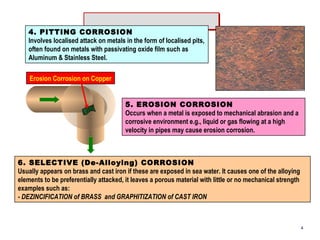
4. PITTING CORROSION 
Involves localised attack on metals in the form of localised pits, 
often found on metals with passivating oxide film such as 
Aluminum & Stainless Steel. 
Erosion Corrosion on Copper 
5. EROSION CORROSION 
Occurs when a metal is exposed to mechanical abrasion and a 
corrosive environment e.g., liquid or gas flowing at a high 
velocity in pipes may cause erosion corrosion. 
6. SELECTIVE (De-Alloying) CORROSION 
Usually appears on brass and cast iron if these are exposed in sea water. It causes one of the alloying 
elements to be preferentially attacked, it leaves a porous material with little or no mechanical strength 
examples such as: 
- DEZINCIFICATION of BRASS and GRAPHITIZATION of CAST IRON 
4
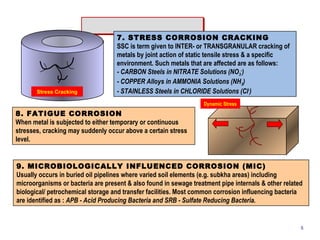
Stress Cracking 
7. STRESS CORROSION CRACKING 
SSC is term given to INTER- or TRANSGRANULAR cracking of 
metals by joint action of static tensile stress & a specific 
environment. Such metals that are affected are as follows: 
- CARBON Steels in NITRATE Solutions (NO-) 
3 
- COPPER Alloys in AMMONIA Solutions (NH3) 
- STAINLESS Steels in CHLORIDE Solutions (Cl-) 
8. FATIGUE CORROSION 
When metal is subjected to either temporary or continuous 
stresses, cracking may suddenly occur above a certain stress 
level. 
Dynamic Stress 
9. MICROBIOLOGICALLY INFLUENCED CORROSION (MIC) 
Usually occurs in buried oil pipelines where varied soil elements (e.g. subkha areas) including 
microorganisms or bacteria are present & also found in sewage treatment pipe internals & other related 
biological/ petrochemical storage and transfer facilities. Most common corrosion influencing bacteria 
are identified as : APB - Acid Producing Bacteria and SRB - Sulfate Reducing Bacteria. 
5
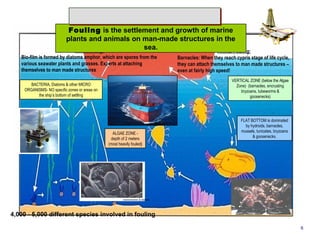
Fouling is the settlement and growth of marine 
plants and animals on man-made structures in the 
ALGAE ANIMALS 
Mobile 
spores 
Mobile 
larvae 
Attack Attack 
Animal Fouling: 
Barnacles: When they reach cypris stage of life cycle, 
they can attach themselves to man made structures – 
even at fairly high speed! 
Plant Fouling: 
Bio-film is formed by diatoms amphor, which are spores from the 
various seawater plants and grasses. Experts at attaching 
themselves to man made structures 
ALGAE ZONE - 
depth of 2 meters 
(most heavily fouled) 
4,000 - 5,000 different species involved in fouling 
VERTICAL ZONE (below the Algae 
Zone) (barnacles, encrusting 
bryzoans, tubeworms & 
goosenecks) 
FLAT BOTTOM is dominated 
by hydroids, barnacles, 
mussels, tunicates, bryzoans 
& goosenecks. 
BACTERIA, Diatoms & other MICRO 
ORGANISMS- NO specific zones or areas on 
the ship’s bottom of settling 
sea. 
5 micron 
6
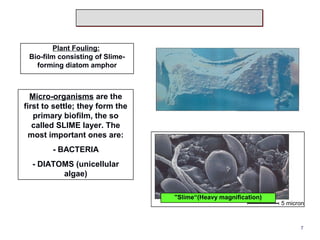
5 micron 
"Slime“(Heavy magnification) 
Plant Fouling: 
Bio-film consisting of Slime-forming 
diatom amphor 
Micro-organisms are the 
first to settle; they form the 
primary biofilm, the so 
called SLIME layer. The 
most important ones are: 
- BACTERIA 
- DIATOMS (unicellular 
algae) 
7
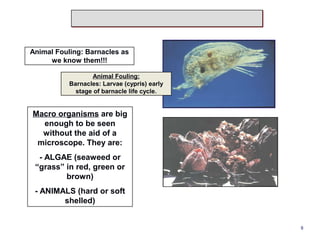
Animal Fouling: Barnacles as 
we know them!!! 
Animal Fouling: 
Barnacles: Larvae (cypris) early 
stage of barnacle life cycle. 
Macro organisms are big 
enough to be seen 
without the aid of a 
microscope. They are: 
- ALGAE (seaweed or 
“grass” in red, green or 
brown) 
- ANIMALS (hard or soft 
shelled) 
8
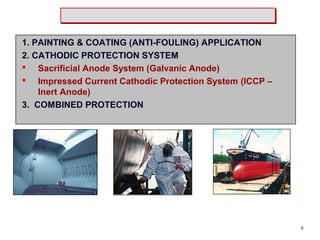
1. PAINTING & COATING (ANTI-FOULING) APPLICATION 
2. CATHODIC PROTECTION SYSTEM 
 Sacrificial Anode System (Galvanic Anode) 
 Impressed Current Cathodic Protection System (ICCP – 
Inert Anode) 
3. COMBINED PROTECTION 
9
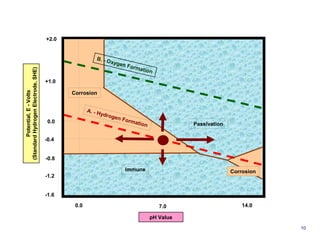
0.0 
7.0 
B. - Oxygen Formation 
pH Value 
Corrosion 
A. - Hydrogen Formation 
Passivation 
Immune Corrosion 
+2.0 
+1.0 
-0.4 
-0.8 
-1.2 
-1.6 
0.0 14.0 
(Standard Hydrogen Electrode, SHE) 
Potential, E - Volts 
10
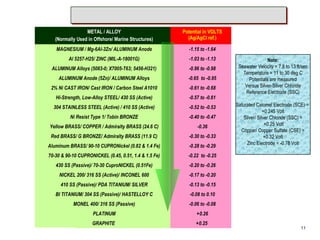
METAL / ALLOY 
(Normally Used in Offshore/ Marine Structures) 
Potential in VOLTS 
(Ag/AgCl ref.) 
MAGNESIUM / Mg-6Al-3Zn/ ALUMINUM Anode -1.15 to -1.64 
Al 5257-H25/ ZINC (MIL-A-18001G) -1.03 to -1.13 
ALUMINUM Alloys (5083-0; X7005-T63; 5456-H321) -0.96 to -0.98 
ALUMINUM Anode (5Zn)/ ALUMINUM Alloys -0.65 to -0.95 
2% Ni CAST IRON/ Cast IRON / Carbon Steel A1010 -0.61 to -0.68 
Hi-Strength, Low-Alloy STEEL/ 430 SS (Active) -0.57 to -0.61 
304 STAINLESS STEEL (Active) / 410 SS (Active) -0.52 to -0.53 
Ni Resist Type 1/ Tobin BRONZE -0.40 to -0.47 
Yellow BRASS/ COPPER / Admiralty BRASS (24.6 C) -0.36 
Red BRASS/ G BRONZE/ Admiralty BRASS (11.9 C) -0.30 to -0.33 
Aluminum BRASS/ 90-10 CUPRONickel (0.82 & 1.4 Fe) -0.28 to -0.29 
70-30 & 90-10 CUPRONICKEL (0.45, 0.51, 1.4 & 1.5 Fe) -0.22 to -0.25 
430 SS (Passive)/ 70-30 CuproNICKEL (0.51Fe) -0.20 to -0.26 
NICKEL 200/ 316 SS (Active)/ INCONEL 600 -0.17 to -0.20 
410 SS (Passive)/ PDA TITANIUM/ SILVER -0.13 to -0.15 
BI TITANIUM/ 304 SS (Passive)/ HASTELLOY C -0.08 to 0.10 
MONEL 400/ 316 SS (Passive) -0.06 to -0.08 
PLATINUM +0.26 
GRAPHITE +0.25 
Note: 
Seawater Velocity = 7.8 to 13 ft/sec 
Temperature = 11 to 30 deg C 
Potentials are measured 
Versus Silver-Silver Chloride 
Reference Electrode (SSC) 
Saturated Calomel Electrode (SCE) = 
+0.245 Volt 
Silver/ Silver Chloride (SSC) = 
+0.25 Volt 
Copper/ Copper Sulfate (CSE) = 
+0.32 Volt 
Zinc Electrode = -0.78 Volt 
11
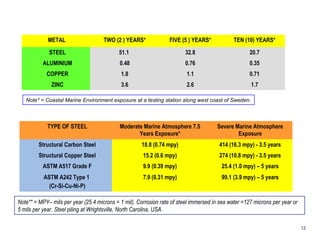
METAL TWO (2 ) YEARS* FIVE (5 ) YEARS* TEN (10) YEARS* 
STEEL 51.1 32.8 20.7 
ALUMINIUM 0.48 0.76 0.35 
COPPER 1.8 1.1 0.71 
ZINC 3.6 2.6 1.7 
Note* = Coastal Marine Environment exposure at a testing station along west coast of Sweden. 
TYPE OF STEEL Moderate Marine Atmosphere 7.5 
Years Exposure* 
Severe Marine Atmosphere 
Exposure 
Structural Carbon Steel 18.8 (0.74 mpy) 414 (16.3 mpy) - 3.5 years 
Structural Copper Steel 15.2 (0.6 mpy) 274 (10.8 mpy) - 3.5 years 
ASTM A517 Grade F 9.9 (0.39 mpy) 25.4 (1.0 mpy) – 5 years 
ASTM A242 Type 1 
(Cr-Si-Cu-Ni-P) 
7.9 (0.31 mpy) 99.1 (3.9 mpy) – 5 years 
Note** = MPY– mils per year (25.4 microns = 1 mil). Corrosion rate of steel immersed in sea water =127 microns per year or 
5 mils per year. Steel piling at Wrightsville, North Carolina, USA. 
12
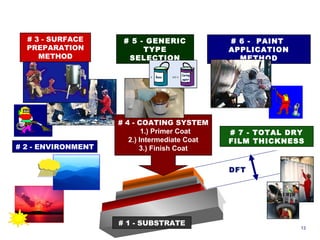
# 5 - GENERIC 
TYPE 
SELECTION 
# 1 - SUBSTRATE 
# 3 - SURFACE 
PREPARATION 
METHOD 
# 2 - ENVIRONMENT 
# 4 - COATING SYSTEM 
1.) Primer Coat 
2.) Intermediate Coat 
3.) Finish Coat 
# 6 - PAINT 
APPLICATION 
METHOD 
# 7 - TOTAL DRY 
FILM THICKNESS 
DFT 
13
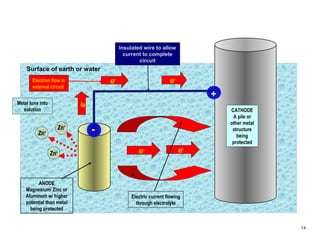
Surface of earth or water 
Metal Ions into 
solution CATHODE 
e- 
Electron flow in 
external circuit 
Electric current flowing 
through electrolyte 
A pile or 
other metal 
structure 
being 
protected 
+ 
e-e- 
e- 
ANODE 
Magnesium/ Zinc or 
Aluminum w/ higher 
potential than metal 
being protected 
- 
Insulated wire to allow 
current to complete 
circuit 
e- 
Zn+ 
Zn+ 
Zn+ 
14
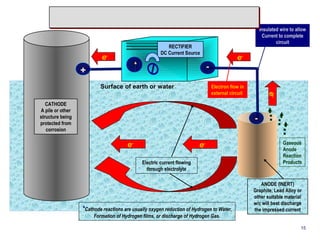
Surface of earth or water 
Insulated wire to allow 
Current to complete 
circuit 
Electron flow in 
external circuit 
e- Gaseous 
Electric current flowing 
through electrolyte 
Anode 
Reaction 
Products 
CATHODE 
A pile or other 
structure being 
protected from 
corrosion 
RECTIFIER 
DC Current Source e- e-e- 
+ 
- 
- 
e- 
*Cathode reactions are usually oxygen reduction of Hydrogen to Water, 
Formation of Hydrogen films, or discharge of Hydrogen Gas. 
ANODE (INERT) 
Graphite, Lead Alloy or 
other suitable material 
w/c will best discharge 
the impressed current 
15
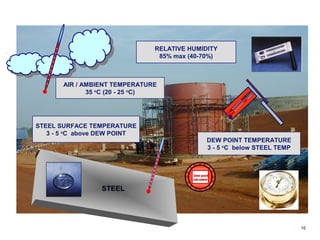
STEEL 
DDeeww ppooiinntt 
ccaallccuullaattoorr 
AIR / AMBIENT TEMPERATURE 
35 oC (20 - 25 oC) 
RELATIVE HUMIDITY 
85% max (40-70%) 
STEEL SURFACE TEMPERATURE 
3 - 5 oC above DEW POINT 
DEW POINT TEMPERATURE 
3 - 5 oC below STEEL TEMP 
16
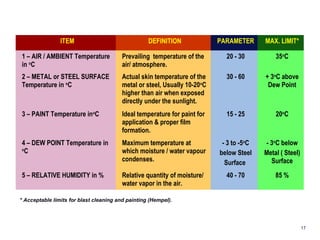
ITEM DEFINITION PARAMETER MAX. LIMIT* 
1 – AIR / AMBIENT Temperature 
in oC 
Prevailing temperature of the 
air/ atmosphere. 
20 - 30 35oC 
2 – METAL or STEEL SURFACE 
Temperature in oC 
Actual skin temperature of the 
metal or steel, Usually 10-20oC 
higher than air when exposed 
directly under the sunlight. 
30 - 60 + 3oC above 
Dew Point 
3 – PAINT Temperature inoC Ideal temperature for paint for 
application & proper film 
formation. 
15 - 25 20oC 
4 – DEW POINT Temperature in 
oC 
Maximum temperature at 
which moisture / water vapour 
condenses. 
- 3 to -5oC 
below Steel 
Surface 
- 3oC below 
Metal ( Steel) 
Surface 
5 – RELATIVE HUMIDITY in % Relative quantity of moisture/ 
water vapor in the air. 
40 - 70 85 % 
* Acceptable limits for blast cleaning and painting (Hempel). 
17
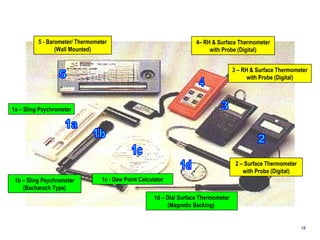
5 - Barometer/ Thermometer 
(Wall Mounted) 
1a – Sling Psychrometer 
1b – Sling Psychrometer 
(Bacharach Type) 
1c - Dew Point Calculator 
4– RH & Surface Thermometer 
with Probe (Digital) 
3 – RH & Surface Thermometer 
with Probe (Digital) 
2 – Surface Thermometer 
with Probe (Digital) 
1d – Dial Surface Thermometer 
(Magnetic Backing) 
18
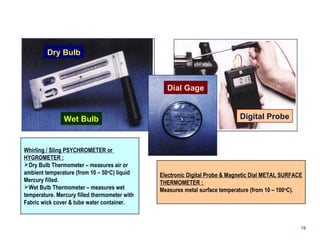
Dry Bulb 
Wet Bulb 
Whirling / Sling PSYCHROMETER or 
HYGROMETER : 
Dry Bulb Thermometer – measures air or 
ambient temperature (from 10 – 50oC) liquid 
Mercury filled. 
Wet Bulb Thermometer – measures wet 
temperature. Mercury filled thermometer with 
Fabric wick cover & tube water container. 
Dial Gage 
Digital Probe 
Electronic Digital Probe & Magnetic Dial METAL SURFACE 
THERMOMETER : 
Measures metal surface temperature (from 10 – 100oC). 
19
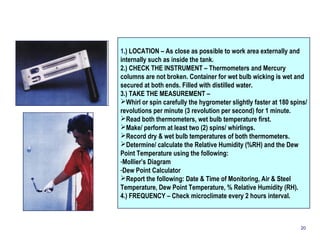
1.) LOCATION – As close as possible to work area externally and 
internally such as inside the tank. 
2.) CHECK THE INSTRUMENT – Thermometers and Mercury 
columns are not broken. Container for wet bulb wicking is wet and 
secured at both ends. Filled with distilled water. 
3.) TAKE THE MEASUREMENT – 
Whirl or spin carefully the hygrometer slightly faster at 180 spins/ 
revolutions per minute (3 revolution per second) for 1 minute. 
Read both thermometers, wet bulb temperature first. 
Make/ perform at least two (2) spins/ whirlings. 
Record dry & wet bulb temperatures of both thermometers. 
Determine/ calculate the Relative Humidity (%RH) and the Dew 
Point Temperature using the following: 
-Mollier’s Diagram 
-Dew Point Calculator 
Report the following: Date & Time of Monitoring, Air & Steel 
Temperature, Dew Point Temperature, % Relative Humidity (RH). 
4.) FREQUENCY – Check microclimate every 2 hours interval. 
20

Corrosion Process and Control

  • 2.
    CORROSION is thedegradation of materials by reaction with surrounding media through chemical or electrochemical process STEEL (IRON), Fe WATER H2O WATER H2O OXYGEN OXYGEN O2 O2 RUST, Fe (OH) Cathode Site : 2 H2O + O2 + 4 e -> 4 OH- [Water + Oxygen + Electron (Iron) = Hydroxyl Ions] Cathode Site : 2 Fe++ + 4 OH- -> 2 Fe (OH)2 [Iron Ions + Hydroxyl Ions = Ferrous Hydroxide] Anode Site : 2 Fe (OH)2 + H2O + ½ O2 -> 2 Fe (OH)3 [Iron Hydroxide + Water + Oxygen = Iron Hydroxide (RUST)] 1
  • 3.
    Cathode (+) Cathode(+) e- e- Anode (-) Acid Solution Droplet Iron (Fe+++) Ions Hydrogen Gas 2 H+ + 2 e-  H2 [ Acid Solution + Iron Ion = Hydrogen Gas ] 2
  • 4.
    1. UNIFORM (General) CORROSION Corrosion that develops at approximately the same rate over the entire metal surfaces. Steel [Ignoble] Corrosion on Steel 2. GALVANIC (Bimetallic) Brass [Noble] CORROSION Occurs when there is metallic contact between two dis-similar metals in a corrosive environment. Water more rich in Oxygen becomes the Cathodic region Crevice becomes the Oxygen depleted area, i.e. Anodic region Corroding Area 3. CREVICE CORROSION Narrow crevices exposed to a liquid, typically water containing solutions, may be open enough to allow the liquid to penetrate, but still narrow that liquid becomes stagnant & crevice corrosion occurs. The driving force is the difference in Oxygen content inside & outside the crevice. 3
  • 5.
    4. PITTING CORROSION Involves localised attack on metals in the form of localised pits, often found on metals with passivating oxide film such as Aluminum & Stainless Steel. Erosion Corrosion on Copper 5. EROSION CORROSION Occurs when a metal is exposed to mechanical abrasion and a corrosive environment e.g., liquid or gas flowing at a high velocity in pipes may cause erosion corrosion. 6. SELECTIVE (De-Alloying) CORROSION Usually appears on brass and cast iron if these are exposed in sea water. It causes one of the alloying elements to be preferentially attacked, it leaves a porous material with little or no mechanical strength examples such as: - DEZINCIFICATION of BRASS and GRAPHITIZATION of CAST IRON 4
  • 6.
    Stress Cracking 7.STRESS CORROSION CRACKING SSC is term given to INTER- or TRANSGRANULAR cracking of metals by joint action of static tensile stress & a specific environment. Such metals that are affected are as follows: - CARBON Steels in NITRATE Solutions (NO-) 3 - COPPER Alloys in AMMONIA Solutions (NH3) - STAINLESS Steels in CHLORIDE Solutions (Cl-) 8. FATIGUE CORROSION When metal is subjected to either temporary or continuous stresses, cracking may suddenly occur above a certain stress level. Dynamic Stress 9. MICROBIOLOGICALLY INFLUENCED CORROSION (MIC) Usually occurs in buried oil pipelines where varied soil elements (e.g. subkha areas) including microorganisms or bacteria are present & also found in sewage treatment pipe internals & other related biological/ petrochemical storage and transfer facilities. Most common corrosion influencing bacteria are identified as : APB - Acid Producing Bacteria and SRB - Sulfate Reducing Bacteria. 5
  • 7.
    Fouling is thesettlement and growth of marine plants and animals on man-made structures in the ALGAE ANIMALS Mobile spores Mobile larvae Attack Attack Animal Fouling: Barnacles: When they reach cypris stage of life cycle, they can attach themselves to man made structures – even at fairly high speed! Plant Fouling: Bio-film is formed by diatoms amphor, which are spores from the various seawater plants and grasses. Experts at attaching themselves to man made structures ALGAE ZONE - depth of 2 meters (most heavily fouled) 4,000 - 5,000 different species involved in fouling VERTICAL ZONE (below the Algae Zone) (barnacles, encrusting bryzoans, tubeworms & goosenecks) FLAT BOTTOM is dominated by hydroids, barnacles, mussels, tunicates, bryzoans & goosenecks. BACTERIA, Diatoms & other MICRO ORGANISMS- NO specific zones or areas on the ship’s bottom of settling sea. 5 micron 6
  • 8.
    5 micron "Slime“(Heavymagnification) Plant Fouling: Bio-film consisting of Slime-forming diatom amphor Micro-organisms are the first to settle; they form the primary biofilm, the so called SLIME layer. The most important ones are: - BACTERIA - DIATOMS (unicellular algae) 7
  • 9.
    Animal Fouling: Barnaclesas we know them!!! Animal Fouling: Barnacles: Larvae (cypris) early stage of barnacle life cycle. Macro organisms are big enough to be seen without the aid of a microscope. They are: - ALGAE (seaweed or “grass” in red, green or brown) - ANIMALS (hard or soft shelled) 8
  • 10.
    1. PAINTING &COATING (ANTI-FOULING) APPLICATION 2. CATHODIC PROTECTION SYSTEM  Sacrificial Anode System (Galvanic Anode)  Impressed Current Cathodic Protection System (ICCP – Inert Anode) 3. COMBINED PROTECTION 9
  • 11.
    0.0 7.0 B.- Oxygen Formation pH Value Corrosion A. - Hydrogen Formation Passivation Immune Corrosion +2.0 +1.0 -0.4 -0.8 -1.2 -1.6 0.0 14.0 (Standard Hydrogen Electrode, SHE) Potential, E - Volts 10
  • 12.
    METAL / ALLOY (Normally Used in Offshore/ Marine Structures) Potential in VOLTS (Ag/AgCl ref.) MAGNESIUM / Mg-6Al-3Zn/ ALUMINUM Anode -1.15 to -1.64 Al 5257-H25/ ZINC (MIL-A-18001G) -1.03 to -1.13 ALUMINUM Alloys (5083-0; X7005-T63; 5456-H321) -0.96 to -0.98 ALUMINUM Anode (5Zn)/ ALUMINUM Alloys -0.65 to -0.95 2% Ni CAST IRON/ Cast IRON / Carbon Steel A1010 -0.61 to -0.68 Hi-Strength, Low-Alloy STEEL/ 430 SS (Active) -0.57 to -0.61 304 STAINLESS STEEL (Active) / 410 SS (Active) -0.52 to -0.53 Ni Resist Type 1/ Tobin BRONZE -0.40 to -0.47 Yellow BRASS/ COPPER / Admiralty BRASS (24.6 C) -0.36 Red BRASS/ G BRONZE/ Admiralty BRASS (11.9 C) -0.30 to -0.33 Aluminum BRASS/ 90-10 CUPRONickel (0.82 & 1.4 Fe) -0.28 to -0.29 70-30 & 90-10 CUPRONICKEL (0.45, 0.51, 1.4 & 1.5 Fe) -0.22 to -0.25 430 SS (Passive)/ 70-30 CuproNICKEL (0.51Fe) -0.20 to -0.26 NICKEL 200/ 316 SS (Active)/ INCONEL 600 -0.17 to -0.20 410 SS (Passive)/ PDA TITANIUM/ SILVER -0.13 to -0.15 BI TITANIUM/ 304 SS (Passive)/ HASTELLOY C -0.08 to 0.10 MONEL 400/ 316 SS (Passive) -0.06 to -0.08 PLATINUM +0.26 GRAPHITE +0.25 Note: Seawater Velocity = 7.8 to 13 ft/sec Temperature = 11 to 30 deg C Potentials are measured Versus Silver-Silver Chloride Reference Electrode (SSC) Saturated Calomel Electrode (SCE) = +0.245 Volt Silver/ Silver Chloride (SSC) = +0.25 Volt Copper/ Copper Sulfate (CSE) = +0.32 Volt Zinc Electrode = -0.78 Volt 11
  • 13.
    METAL TWO (2) YEARS* FIVE (5 ) YEARS* TEN (10) YEARS* STEEL 51.1 32.8 20.7 ALUMINIUM 0.48 0.76 0.35 COPPER 1.8 1.1 0.71 ZINC 3.6 2.6 1.7 Note* = Coastal Marine Environment exposure at a testing station along west coast of Sweden. TYPE OF STEEL Moderate Marine Atmosphere 7.5 Years Exposure* Severe Marine Atmosphere Exposure Structural Carbon Steel 18.8 (0.74 mpy) 414 (16.3 mpy) - 3.5 years Structural Copper Steel 15.2 (0.6 mpy) 274 (10.8 mpy) - 3.5 years ASTM A517 Grade F 9.9 (0.39 mpy) 25.4 (1.0 mpy) – 5 years ASTM A242 Type 1 (Cr-Si-Cu-Ni-P) 7.9 (0.31 mpy) 99.1 (3.9 mpy) – 5 years Note** = MPY– mils per year (25.4 microns = 1 mil). Corrosion rate of steel immersed in sea water =127 microns per year or 5 mils per year. Steel piling at Wrightsville, North Carolina, USA. 12
  • 14.
    # 5 -GENERIC TYPE SELECTION # 1 - SUBSTRATE # 3 - SURFACE PREPARATION METHOD # 2 - ENVIRONMENT # 4 - COATING SYSTEM 1.) Primer Coat 2.) Intermediate Coat 3.) Finish Coat # 6 - PAINT APPLICATION METHOD # 7 - TOTAL DRY FILM THICKNESS DFT 13
  • 15.
    Surface of earthor water Metal Ions into solution CATHODE e- Electron flow in external circuit Electric current flowing through electrolyte A pile or other metal structure being protected + e-e- e- ANODE Magnesium/ Zinc or Aluminum w/ higher potential than metal being protected - Insulated wire to allow current to complete circuit e- Zn+ Zn+ Zn+ 14
  • 16.
    Surface of earthor water Insulated wire to allow Current to complete circuit Electron flow in external circuit e- Gaseous Electric current flowing through electrolyte Anode Reaction Products CATHODE A pile or other structure being protected from corrosion RECTIFIER DC Current Source e- e-e- + - - e- *Cathode reactions are usually oxygen reduction of Hydrogen to Water, Formation of Hydrogen films, or discharge of Hydrogen Gas. ANODE (INERT) Graphite, Lead Alloy or other suitable material w/c will best discharge the impressed current 15
  • 17.
    STEEL DDeeww ppooiinntt ccaallccuullaattoorr AIR / AMBIENT TEMPERATURE 35 oC (20 - 25 oC) RELATIVE HUMIDITY 85% max (40-70%) STEEL SURFACE TEMPERATURE 3 - 5 oC above DEW POINT DEW POINT TEMPERATURE 3 - 5 oC below STEEL TEMP 16
  • 18.
    ITEM DEFINITION PARAMETERMAX. LIMIT* 1 – AIR / AMBIENT Temperature in oC Prevailing temperature of the air/ atmosphere. 20 - 30 35oC 2 – METAL or STEEL SURFACE Temperature in oC Actual skin temperature of the metal or steel, Usually 10-20oC higher than air when exposed directly under the sunlight. 30 - 60 + 3oC above Dew Point 3 – PAINT Temperature inoC Ideal temperature for paint for application & proper film formation. 15 - 25 20oC 4 – DEW POINT Temperature in oC Maximum temperature at which moisture / water vapour condenses. - 3 to -5oC below Steel Surface - 3oC below Metal ( Steel) Surface 5 – RELATIVE HUMIDITY in % Relative quantity of moisture/ water vapor in the air. 40 - 70 85 % * Acceptable limits for blast cleaning and painting (Hempel). 17
  • 19.
    5 - Barometer/Thermometer (Wall Mounted) 1a – Sling Psychrometer 1b – Sling Psychrometer (Bacharach Type) 1c - Dew Point Calculator 4– RH & Surface Thermometer with Probe (Digital) 3 – RH & Surface Thermometer with Probe (Digital) 2 – Surface Thermometer with Probe (Digital) 1d – Dial Surface Thermometer (Magnetic Backing) 18
  • 20.
    Dry Bulb WetBulb Whirling / Sling PSYCHROMETER or HYGROMETER : Dry Bulb Thermometer – measures air or ambient temperature (from 10 – 50oC) liquid Mercury filled. Wet Bulb Thermometer – measures wet temperature. Mercury filled thermometer with Fabric wick cover & tube water container. Dial Gage Digital Probe Electronic Digital Probe & Magnetic Dial METAL SURFACE THERMOMETER : Measures metal surface temperature (from 10 – 100oC). 19
  • 21.
    1.) LOCATION –As close as possible to work area externally and internally such as inside the tank. 2.) CHECK THE INSTRUMENT – Thermometers and Mercury columns are not broken. Container for wet bulb wicking is wet and secured at both ends. Filled with distilled water. 3.) TAKE THE MEASUREMENT – Whirl or spin carefully the hygrometer slightly faster at 180 spins/ revolutions per minute (3 revolution per second) for 1 minute. Read both thermometers, wet bulb temperature first. Make/ perform at least two (2) spins/ whirlings. Record dry & wet bulb temperatures of both thermometers. Determine/ calculate the Relative Humidity (%RH) and the Dew Point Temperature using the following: -Mollier’s Diagram -Dew Point Calculator Report the following: Date & Time of Monitoring, Air & Steel Temperature, Dew Point Temperature, % Relative Humidity (RH). 4.) FREQUENCY – Check microclimate every 2 hours interval. 20