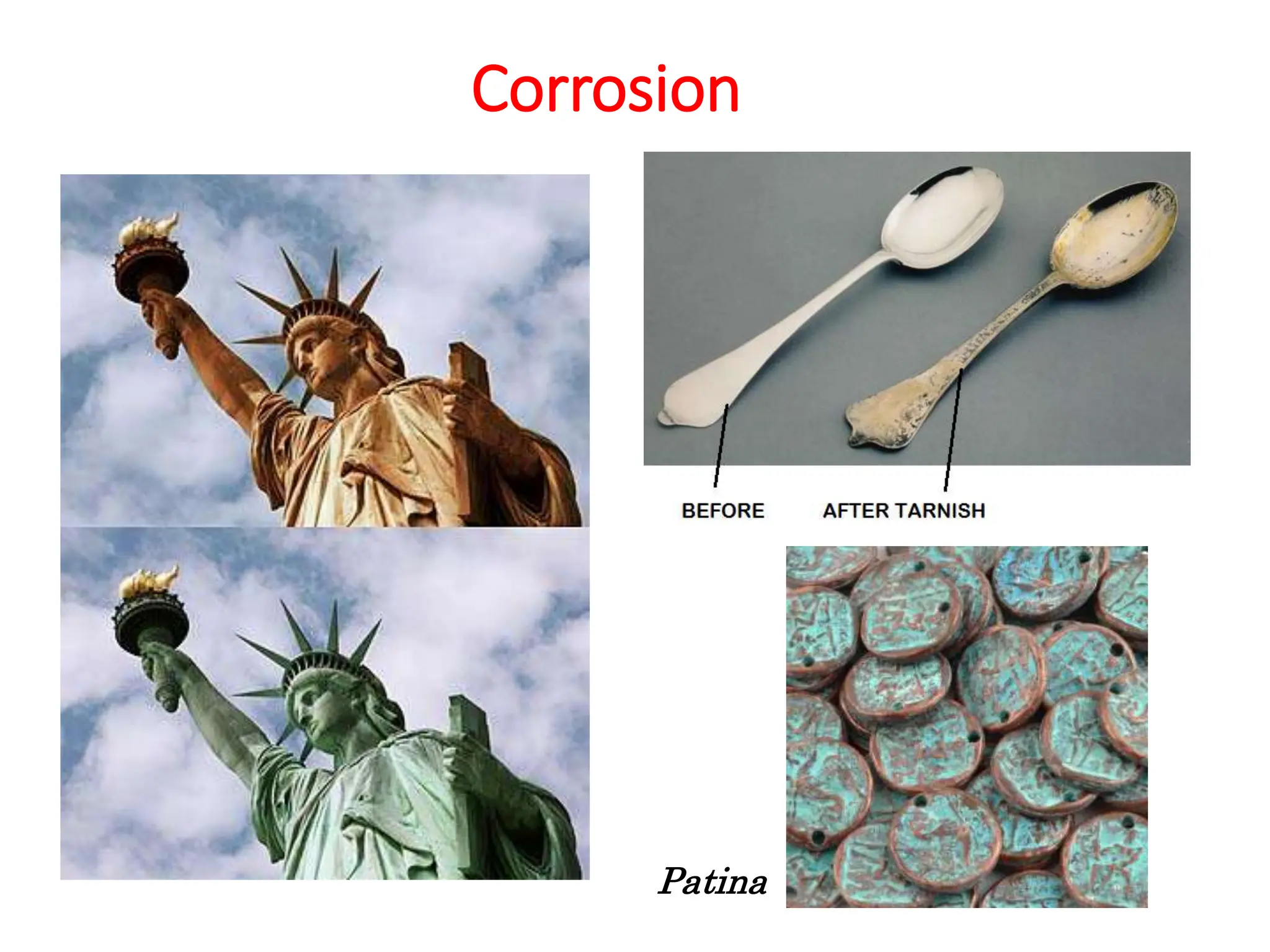
Patina
Corrosion
Corrosion
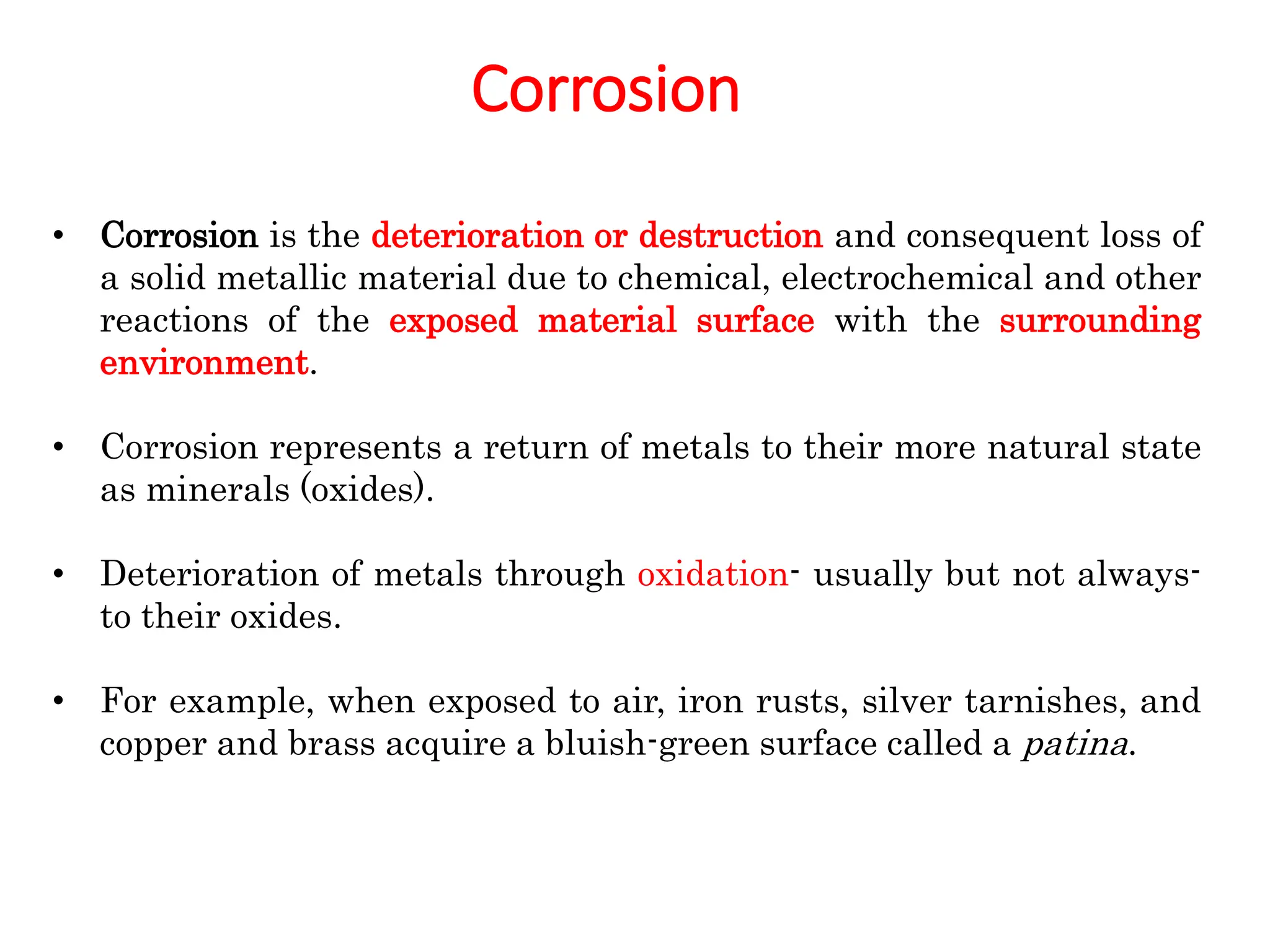
• Corrosion is the deterioration or destruction and consequent loss of
a solid metallic material due to chemical, electrochemical and other
reactions of the exposed material surface with the surrounding
environment.
• Corrosion represents a return of metals to their more natural state
as minerals (oxides).
• Deterioration of metals through oxidation- usually but not always-
to their oxides.
• For example, when exposed to air, iron rusts, silver tarnishes, and
copper and brass acquire a bluish-green surface called a patina.
Corrosion
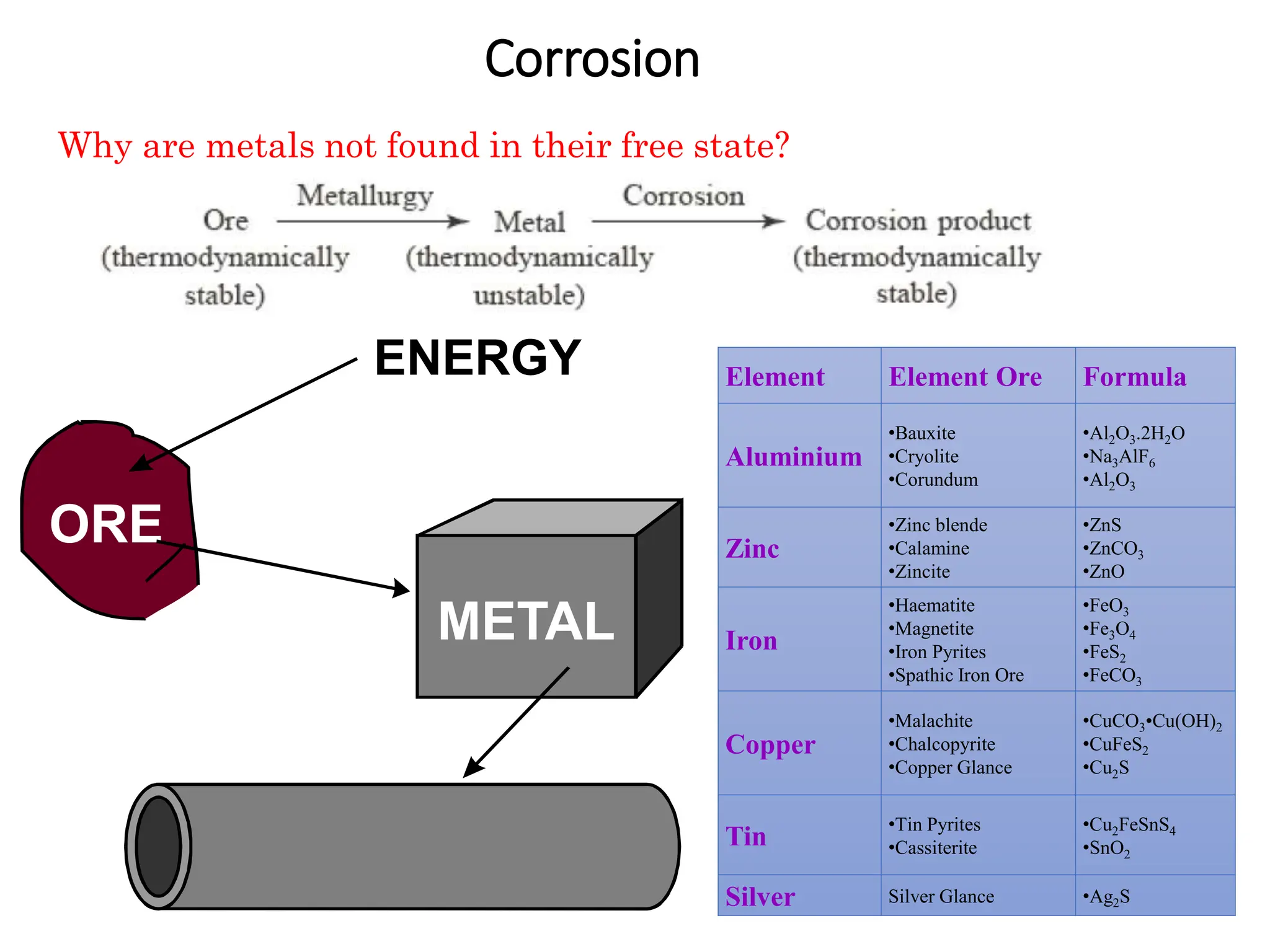
Why are metals not found in their free state?
Element Element Ore Formula
Aluminium
•Bauxite
•Cryolite
•Corundum
•Al2O3.2H2O
•Na3AlF6
•Al2O3
Zinc
•Zinc blende
•Calamine
•Zincite
•ZnS
•ZnCO3
•ZnO
Iron
•Haematite
•Magnetite
•Iron Pyrites
•Spathic Iron Ore
•FeO3
•Fe3O4
•FeS2
•FeCO3
Copper
•Malachite
•Chalcopyrite
•Copper Glance
•CuCO3•Cu(OH)2
•CuFeS2
•Cu2S
Tin
•Tin Pyrites
•Cassiterite
•Cu2FeSnS4
•SnO2
Silver Silver Glance •Ag2S
ENERGY
METAL
ORE
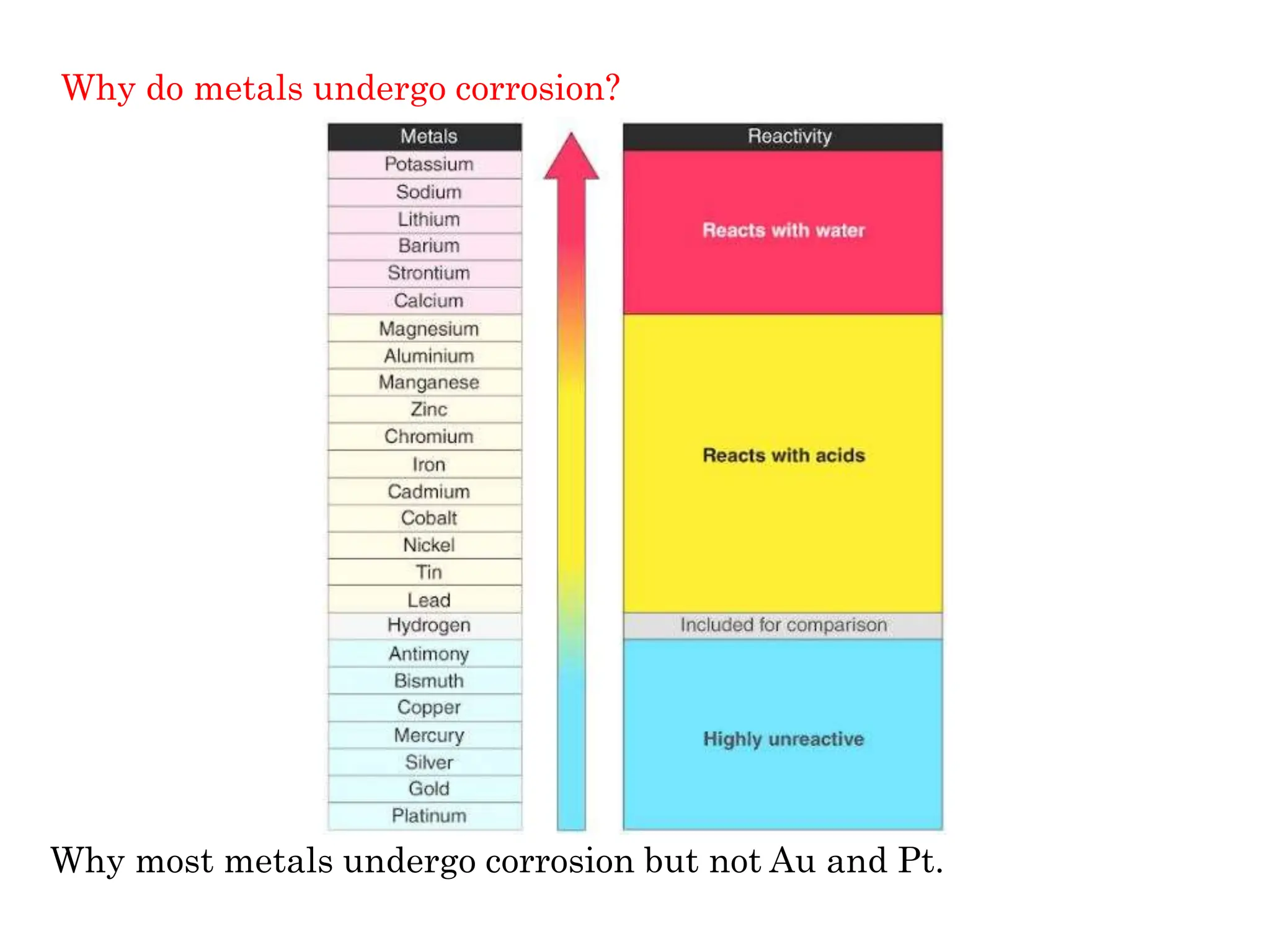
Why do metals undergo corrosion?
Why most metals undergo corrosion but not Au and Pt.
Consequences of Corrosion
 Due to formation of corrosion product over the machinery, the efficiency of
the machine gets lost.
 The products are contaminated due to corrosion.
 The corroded equipment must be replaced frequently.
 Plant failure due to corrosion.
 Corrosion releases toxic products, health hazard, etc.
Basics of Corrosion
Need:
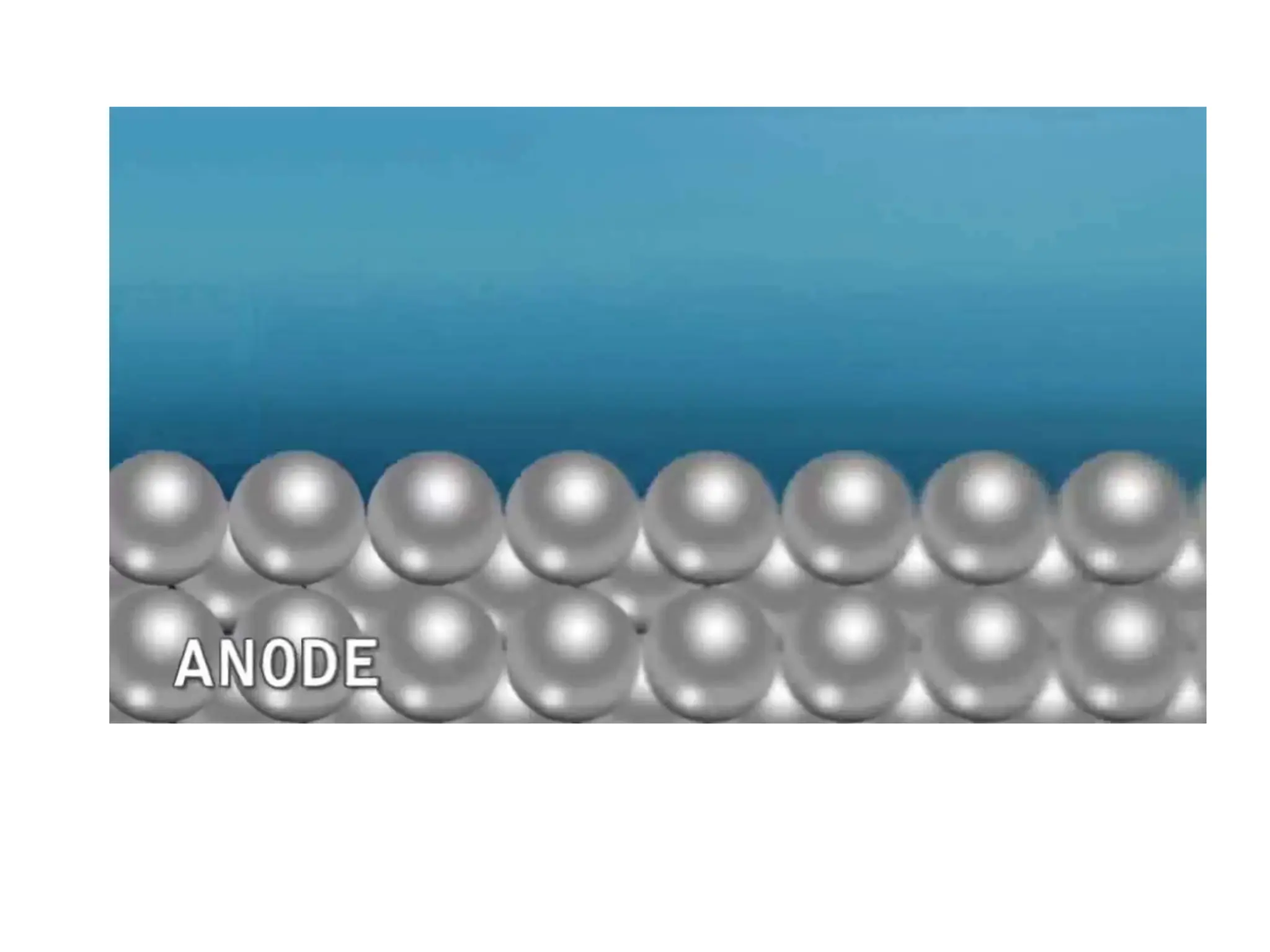
1. An Anode (where oxidation is taking place)
2. A Cathode (where reduction is taking place)
3. Conductive electrolyte
4. Electrical contact between the Anode and Cathode
Basics of Corrosion
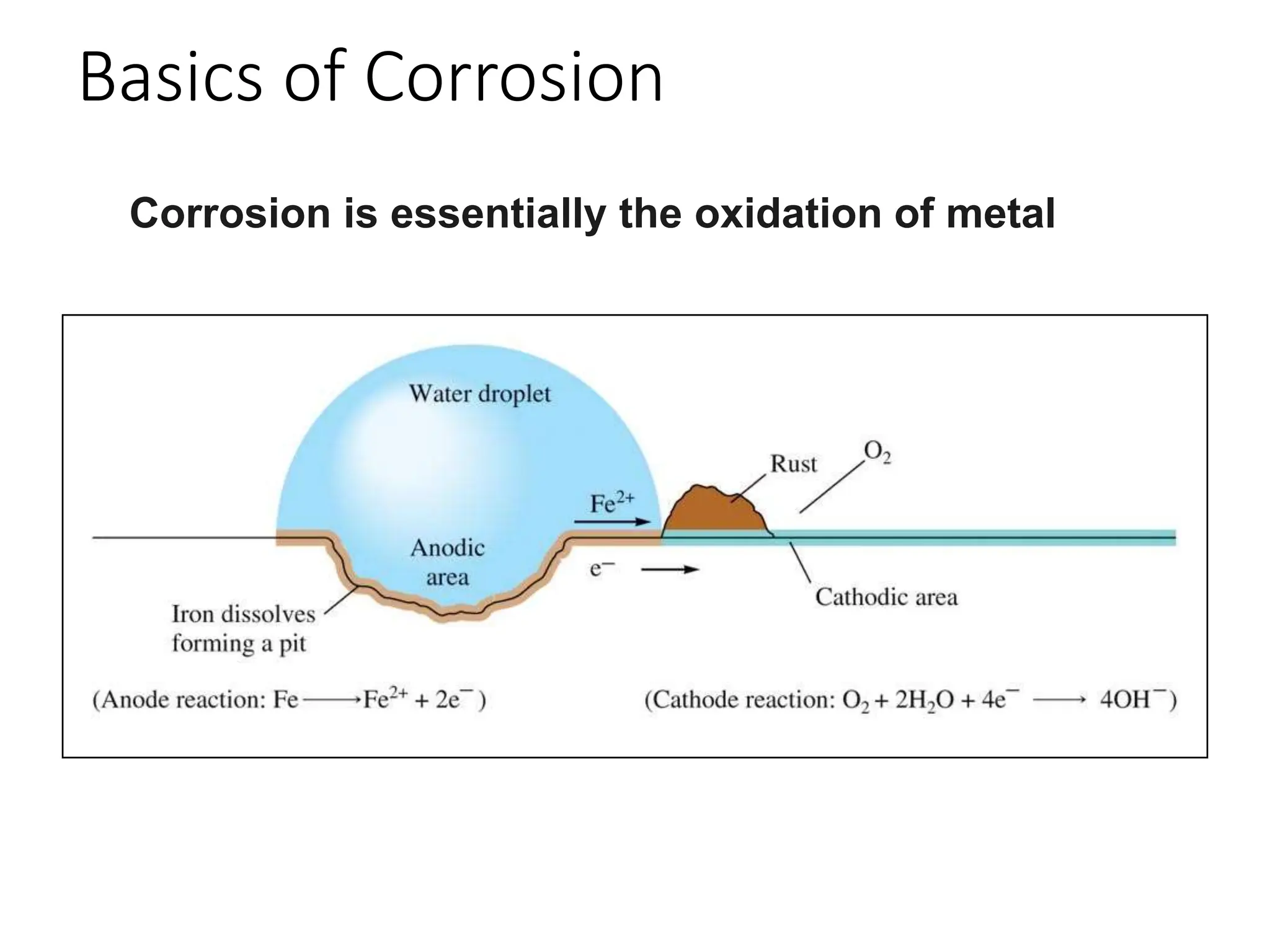
Corrosion is essentially the oxidation of metal
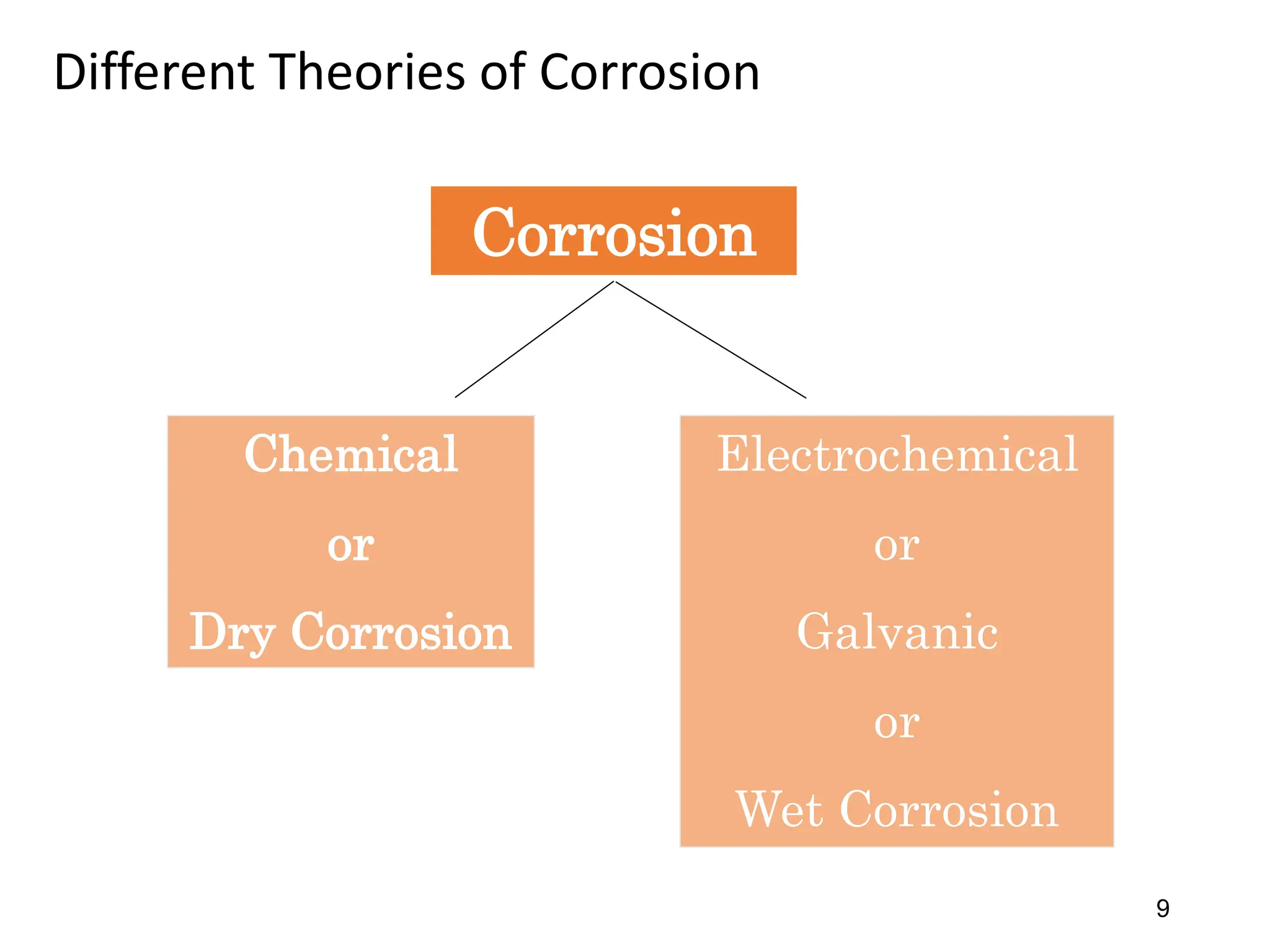
Different Theories of Corrosion
9
Chemical
or
Dry Corrosion
Electrochemical
or
Galvanic
or
Wet Corrosion
Corrosion
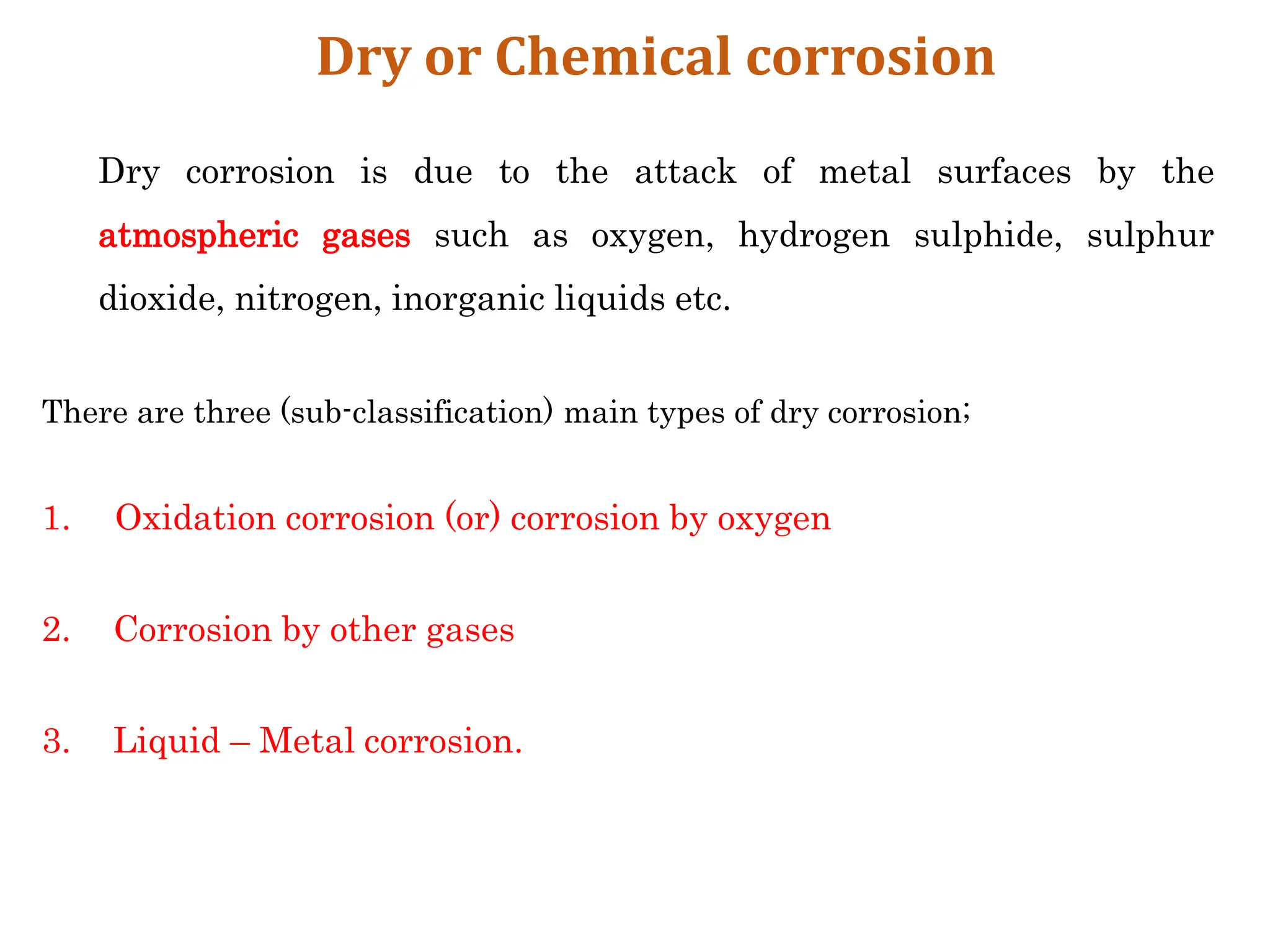
Dry or Chemical corrosion
Dry corrosion is due to the attack of metal surfaces by the
atmospheric gases such as oxygen, hydrogen sulphide, sulphur
dioxide, nitrogen, inorganic liquids etc.
There are three (sub-classification) main types of dry corrosion;
1. Oxidation corrosion (or) corrosion by oxygen
2. Corrosion by other gases
3. Liquid – Metal corrosion.
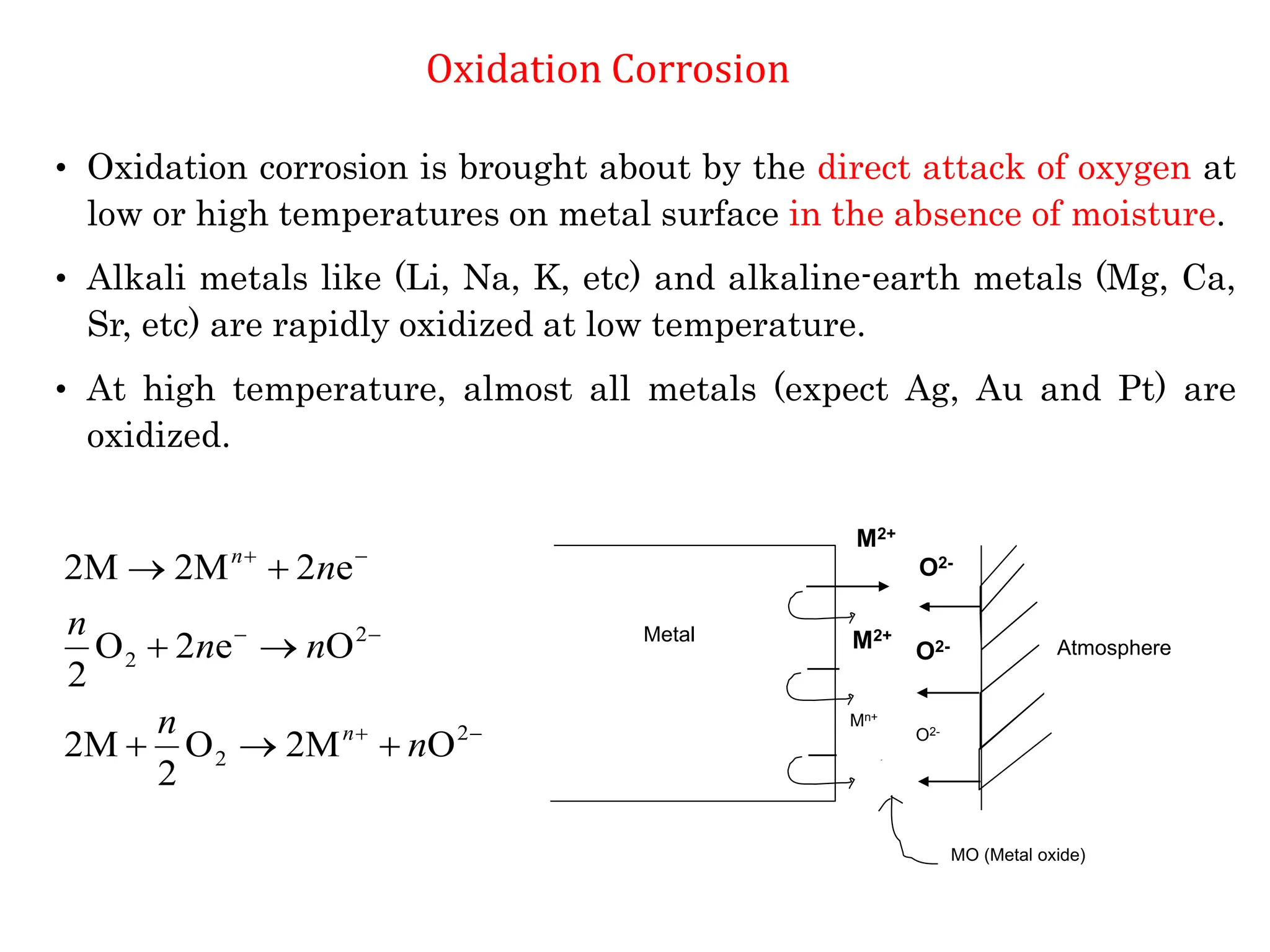
Oxidation Corrosion
• Oxidation corrosion is brought about by the direct attack of oxygen at
low or high temperatures on metal surface in the absence of moisture.
• Alkali metals like (Li, Na, K, etc) and alkaline-earth metals (Mg, Ca,
Sr, etc) are rapidly oxidized at low temperature.
• At high temperature, almost all metals (expect Ag, Au and Pt) are
oxidized.













2
2
2
2
O
2M
O
2
2M
O
e
2
O
2
e
2
2M
2M
n
n
n
n
n
n
n
n
M2+
M2+
Mn+
O2-
O2-
O2-
Metal
Atmosphere
MO (Metal oxide)
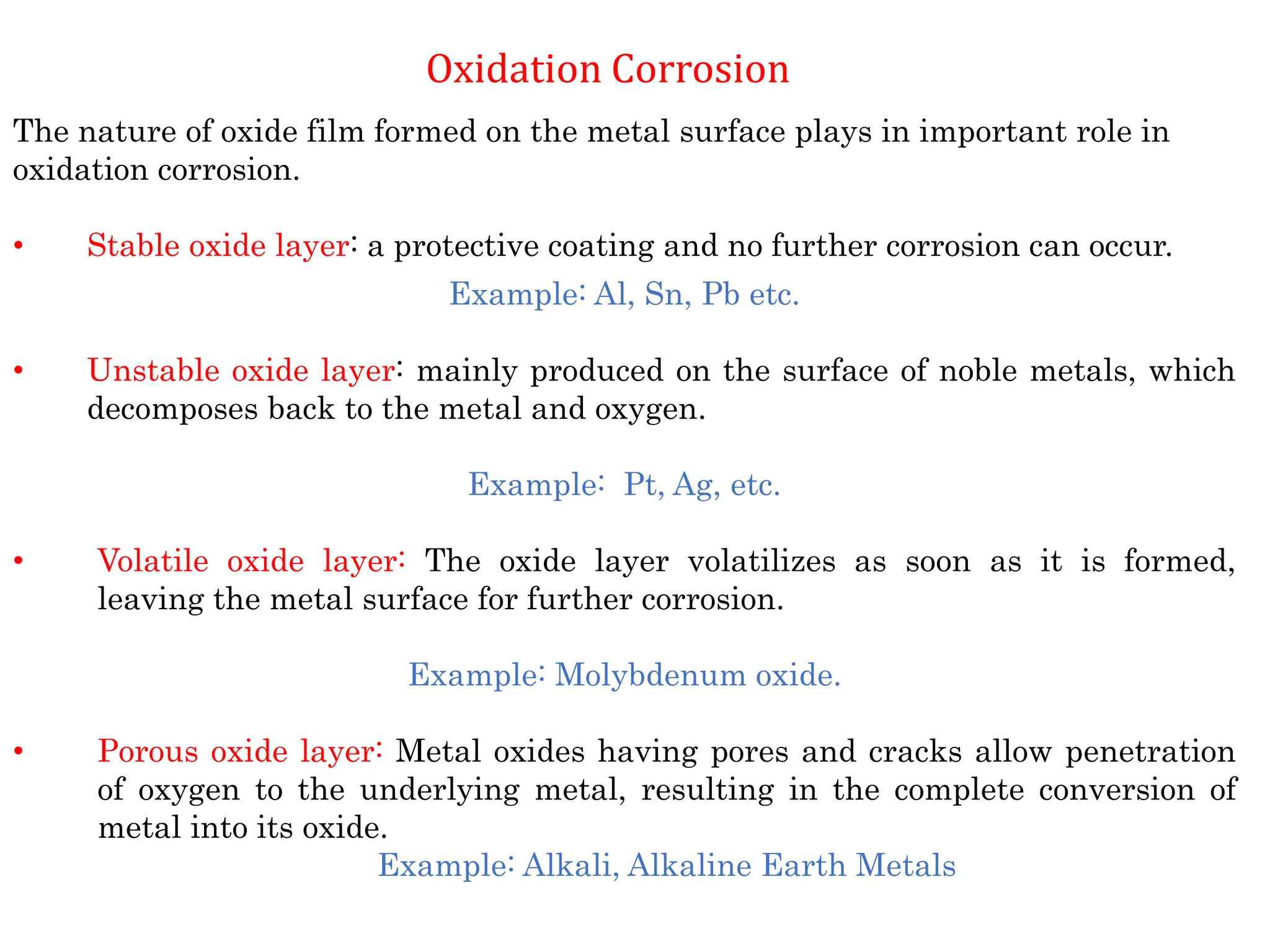
Oxidation Corrosion
The nature of oxide film formed on the metal surface plays in important role in
oxidation corrosion.
• Stable oxide layer: a protective coating and no further corrosion can occur.
Example: Al, Sn, Pb etc.
• Unstable oxide layer: mainly produced on the surface of noble metals, which
decomposes back to the metal and oxygen.
Example: Pt, Ag, etc.
• Volatile oxide layer: The oxide layer volatilizes as soon as it is formed,
leaving the metal surface for further corrosion.
Example: Molybdenum oxide.
• Porous oxide layer: Metal oxides having pores and cracks allow penetration
of oxygen to the underlying metal, resulting in the complete conversion of
metal into its oxide.
Example: Alkali, Alkaline Earth Metals
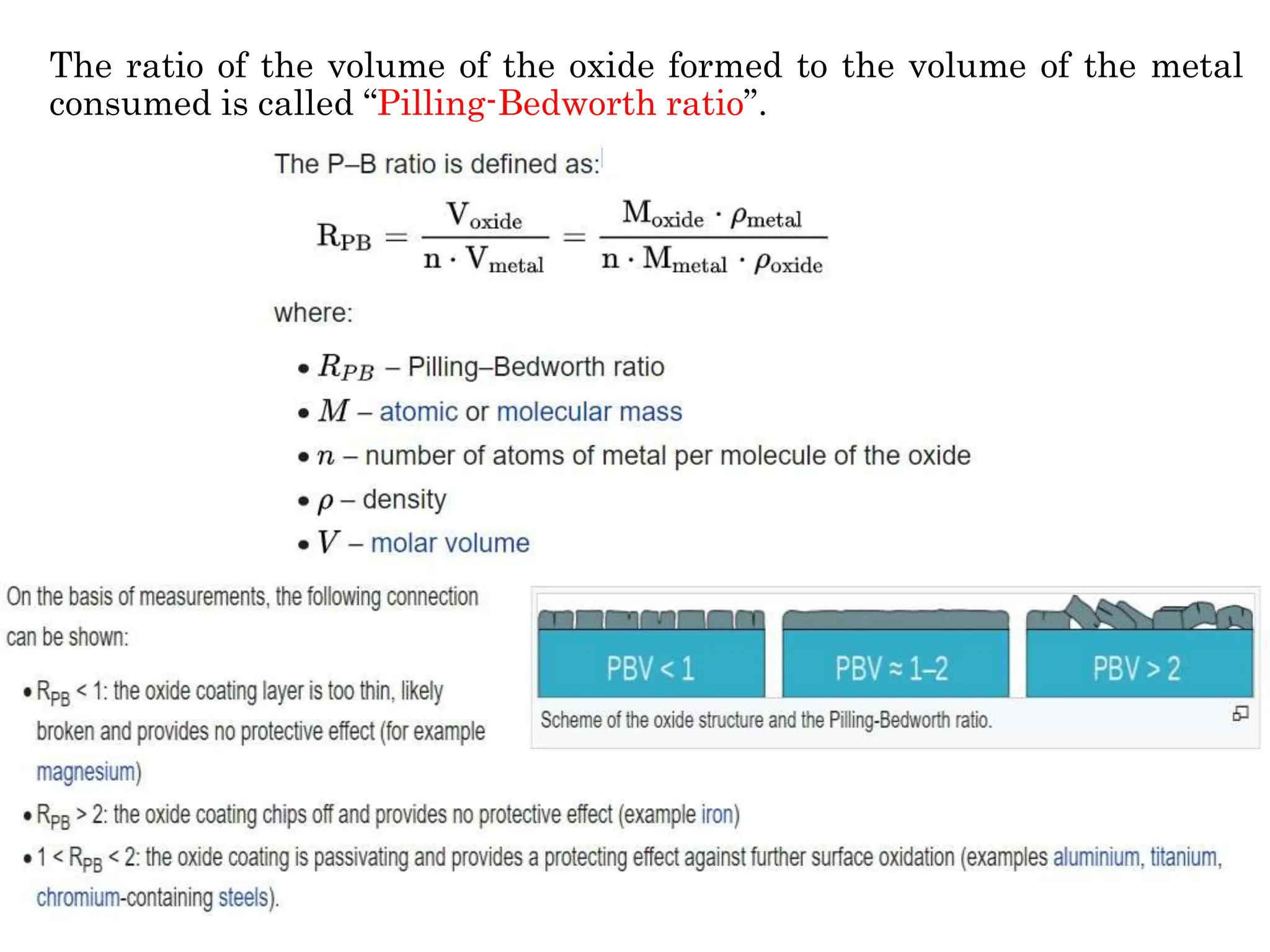
The ratio of the volume of the oxide formed to the volume of the metal
consumed is called “Pilling-Bedworth ratio”.
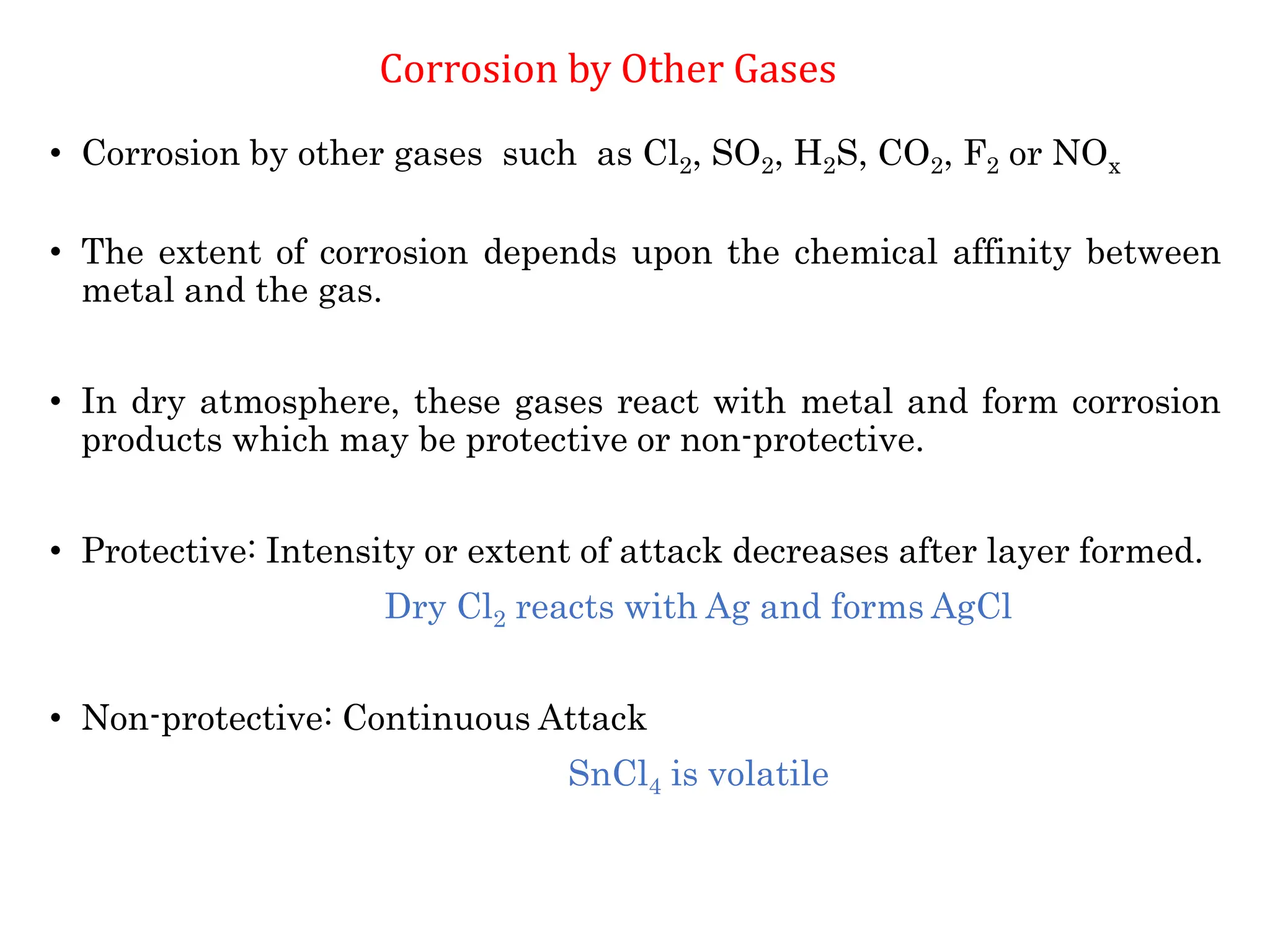
• Corrosion by other gases such as Cl2, SO2, H2S, CO2, F2 or NOx
• The extent of corrosion depends upon the chemical affinity between
metal and the gas.
• In dry atmosphere, these gases react with metal and form corrosion
products which may be protective or non-protective.
• Protective: Intensity or extent of attack decreases after layer formed.
Dry Cl2 reacts with Ag and forms AgCl
• Non-protective: Continuous Attack
SnCl4 is volatile
Corrosion by Other Gases
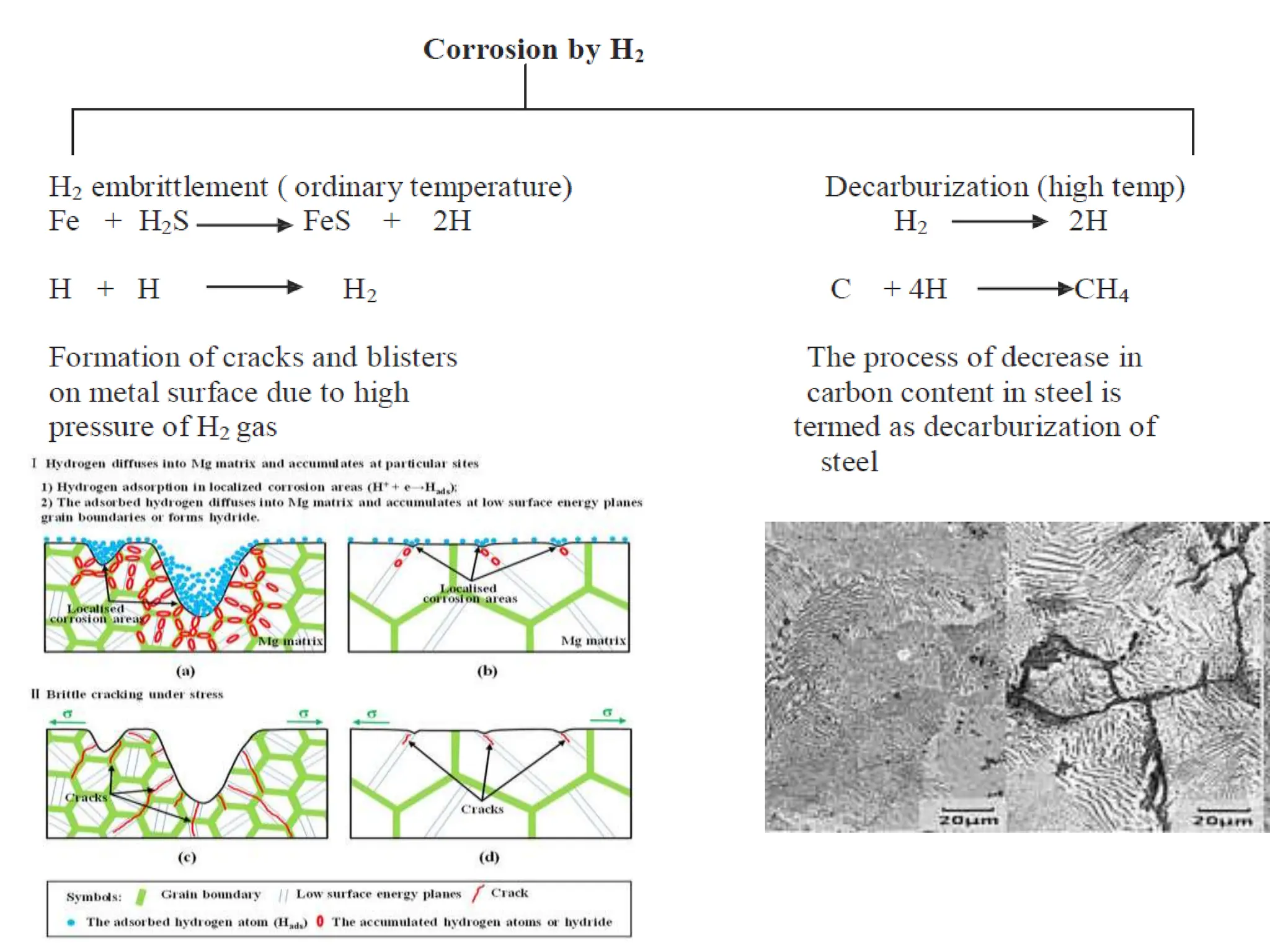
Corrosion by hydrogen
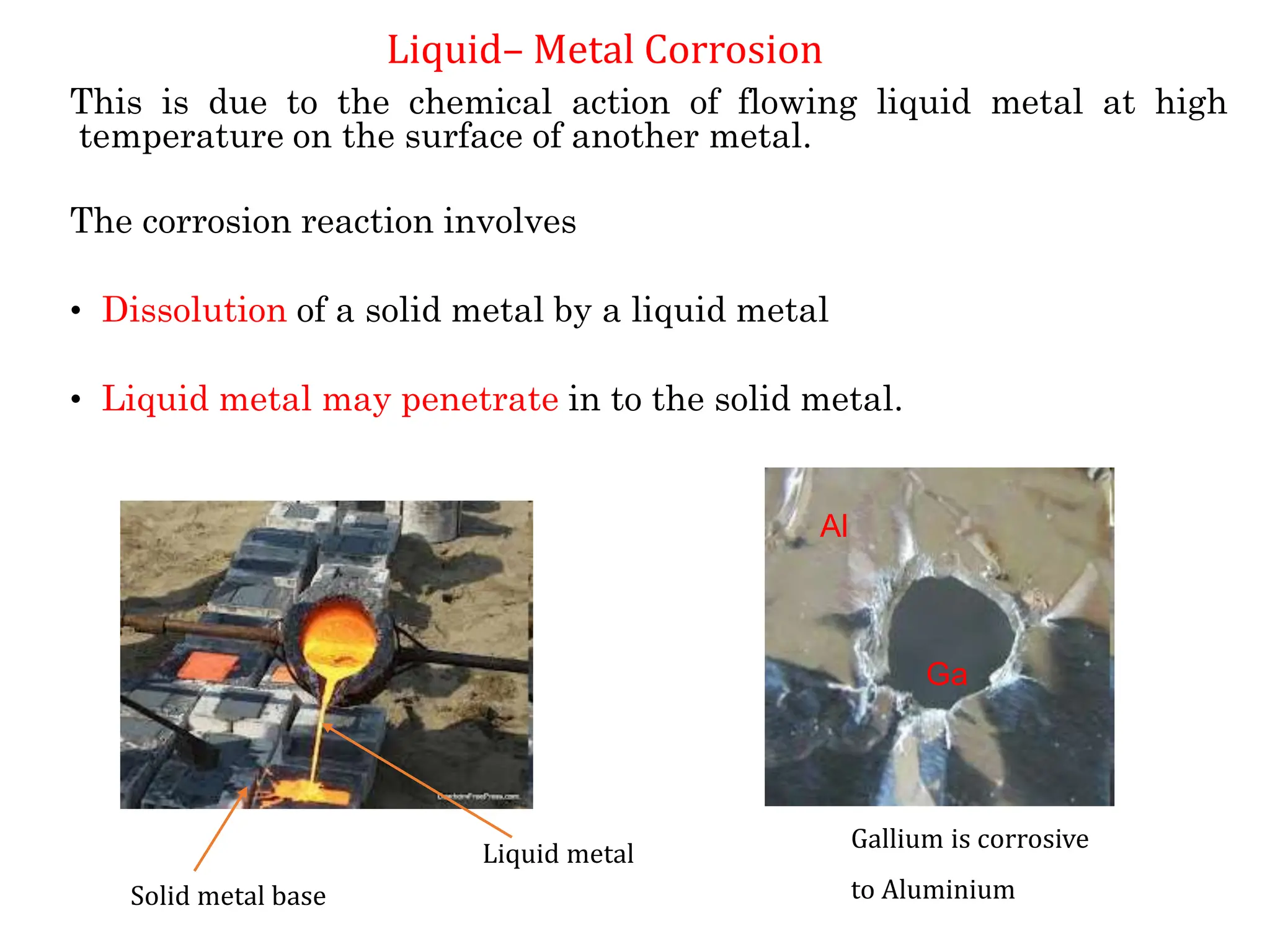
This is due to the chemical action of flowing liquid metal at high
temperature on the surface of another metal.
The corrosion reaction involves
• Dissolution of a solid metal by a liquid metal
• Liquid metal may penetrate in to the solid metal.
Al
Ga
Gallium is corrosive
to Aluminium
Liquid metal
Solid metal base
Liquid– Metal Corrosion
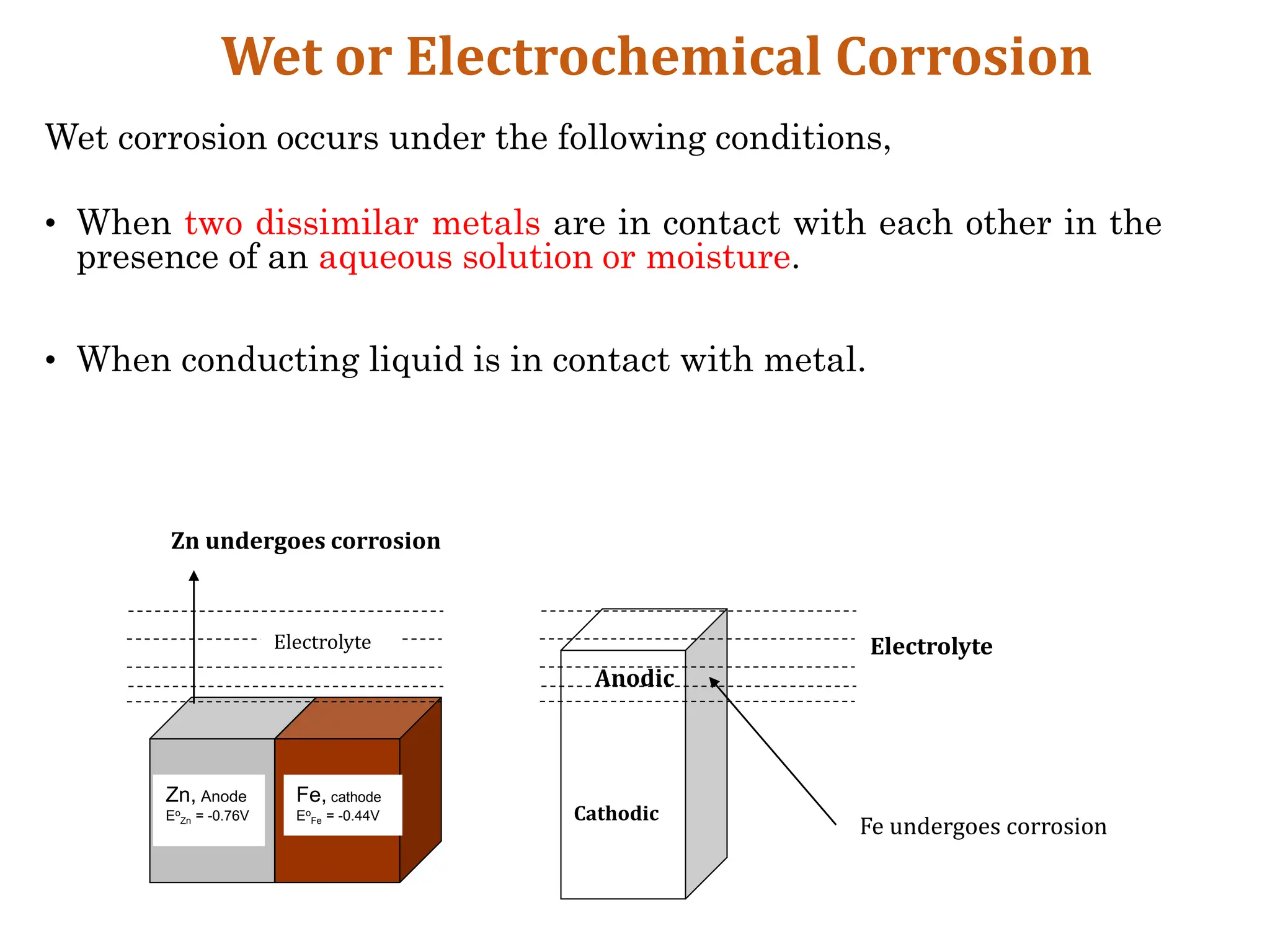
Wet corrosion occurs under the following conditions,
• When two dissimilar metals are in contact with each other in the
presence of an aqueous solution or moisture.
• When conducting liquid is in contact with metal.
Zn, Anode
Eo
Zn = -0.76V
Fe, cathode
Eo
Fe = -0.44V
Electrolyte
Zn undergoes corrosion
Electrolyte
Fe undergoes corrosion
Anodic
Cathodic
Wet or Electrochemical Corrosion
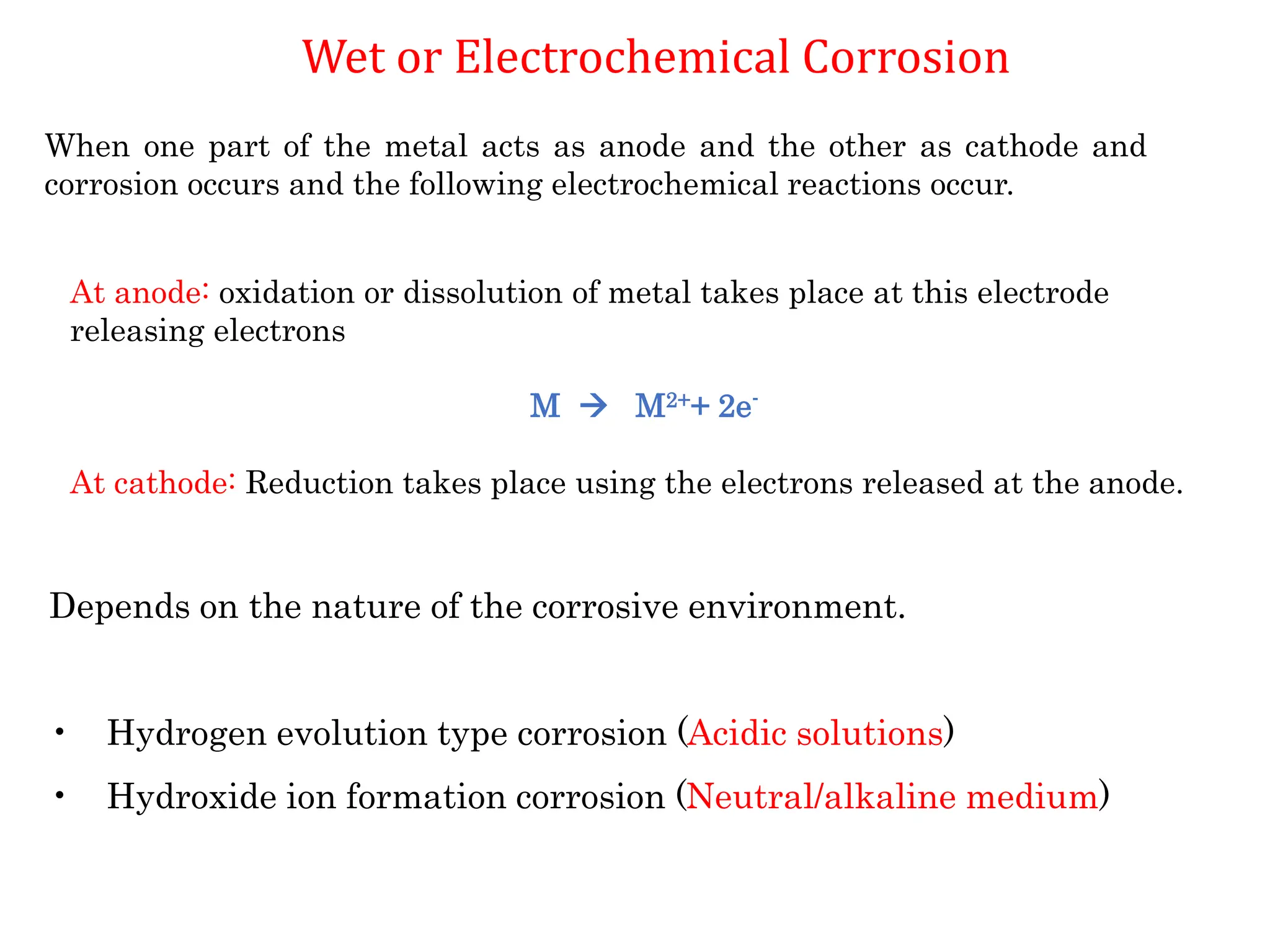
At anode: oxidation or dissolution of metal takes place at this electrode
releasing electrons
M  M2++ 2e-
At cathode: Reduction takes place using the electrons released at the anode.
When one part of the metal acts as anode and the other as cathode and
corrosion occurs and the following electrochemical reactions occur.
Depends on the nature of the corrosive environment.
• Hydrogen evolution type corrosion (Acidic solutions)
• Hydroxide ion formation corrosion (Neutral/alkaline medium)
Wet or Electrochemical Corrosion
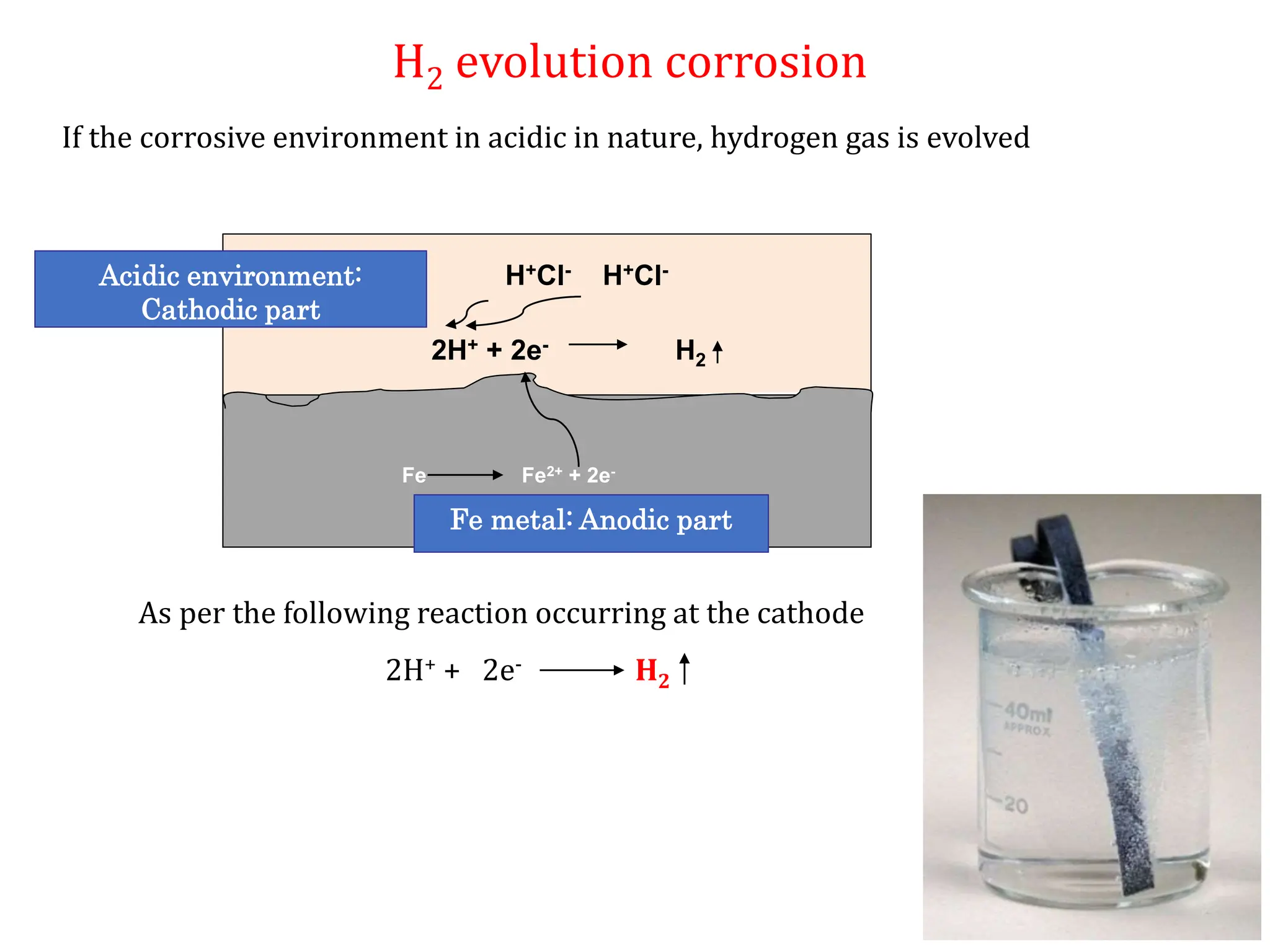
If the corrosive environment in acidic in nature, hydrogen gas is evolved
Fe metal: Anodic part
Fe Fe2+ + 2e-
Acidic environment:
Cathodic part
2H+ + 2e- H2
H+Cl- H+Cl-
As per the following reaction occurring at the cathode
2H+ + 2e- H2
H2 evolution corrosion
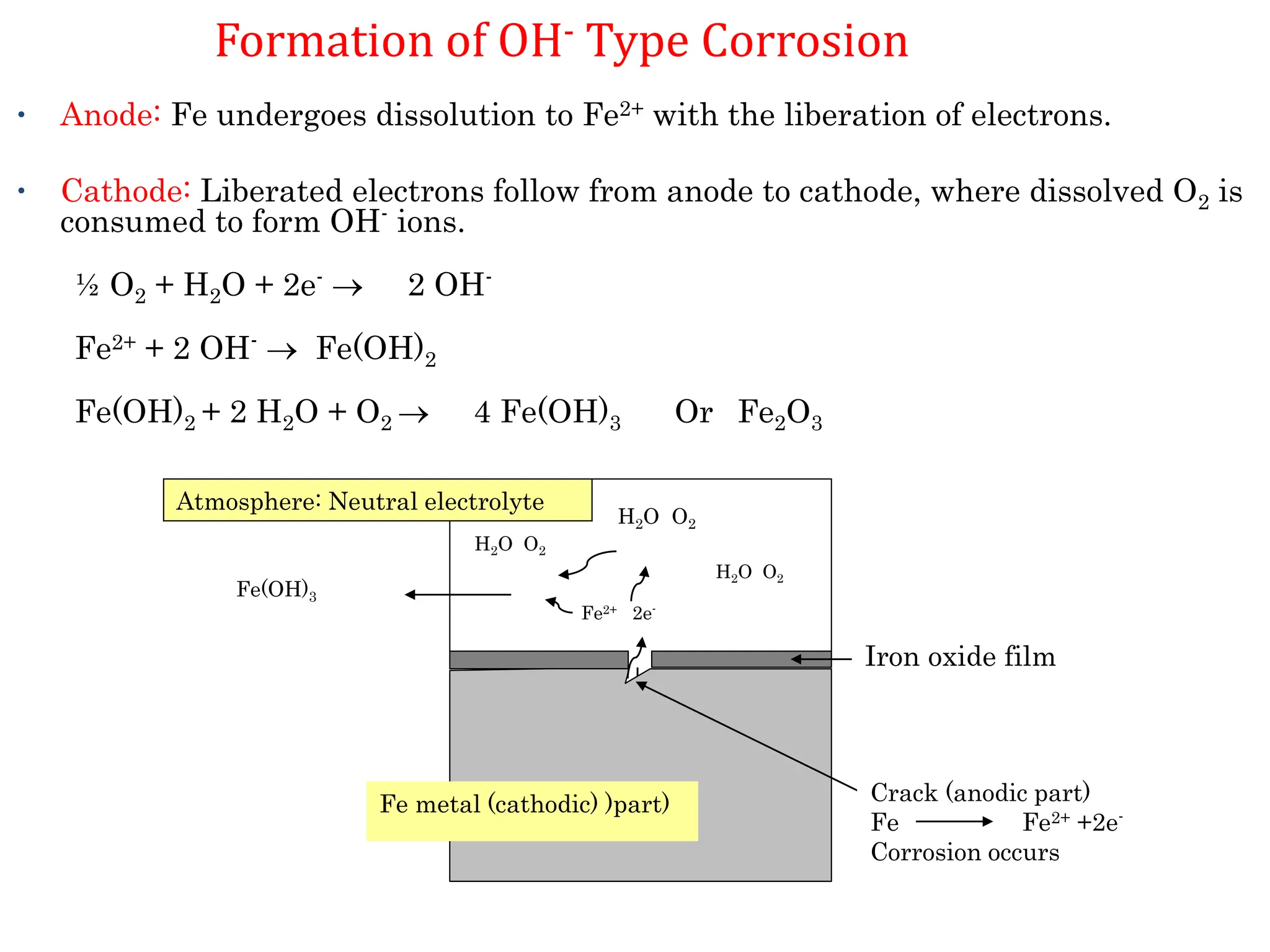
Formation of OH- Type Corrosion
• Anode: Fe undergoes dissolution to Fe2+ with the liberation of electrons.
• Cathode: Liberated electrons follow from anode to cathode, where dissolved O2 is
consumed to form OH- ions.
½ O2 + H2O + 2e-  2 OH-
Fe2+ + 2 OH-  Fe(OH)2
Fe(OH)2 + 2 H2O + O2  4 Fe(OH)3 Or Fe2O3
Iron oxide film
Fe metal (cathodic) )part) Crack (anodic part)
Fe Fe2+ +2e-
Corrosion occurs
Atmosphere: Neutral electrolyte
H2O O2
H2O O2
H2O O2
Fe2+ 2e-
Fe(OH)3
21
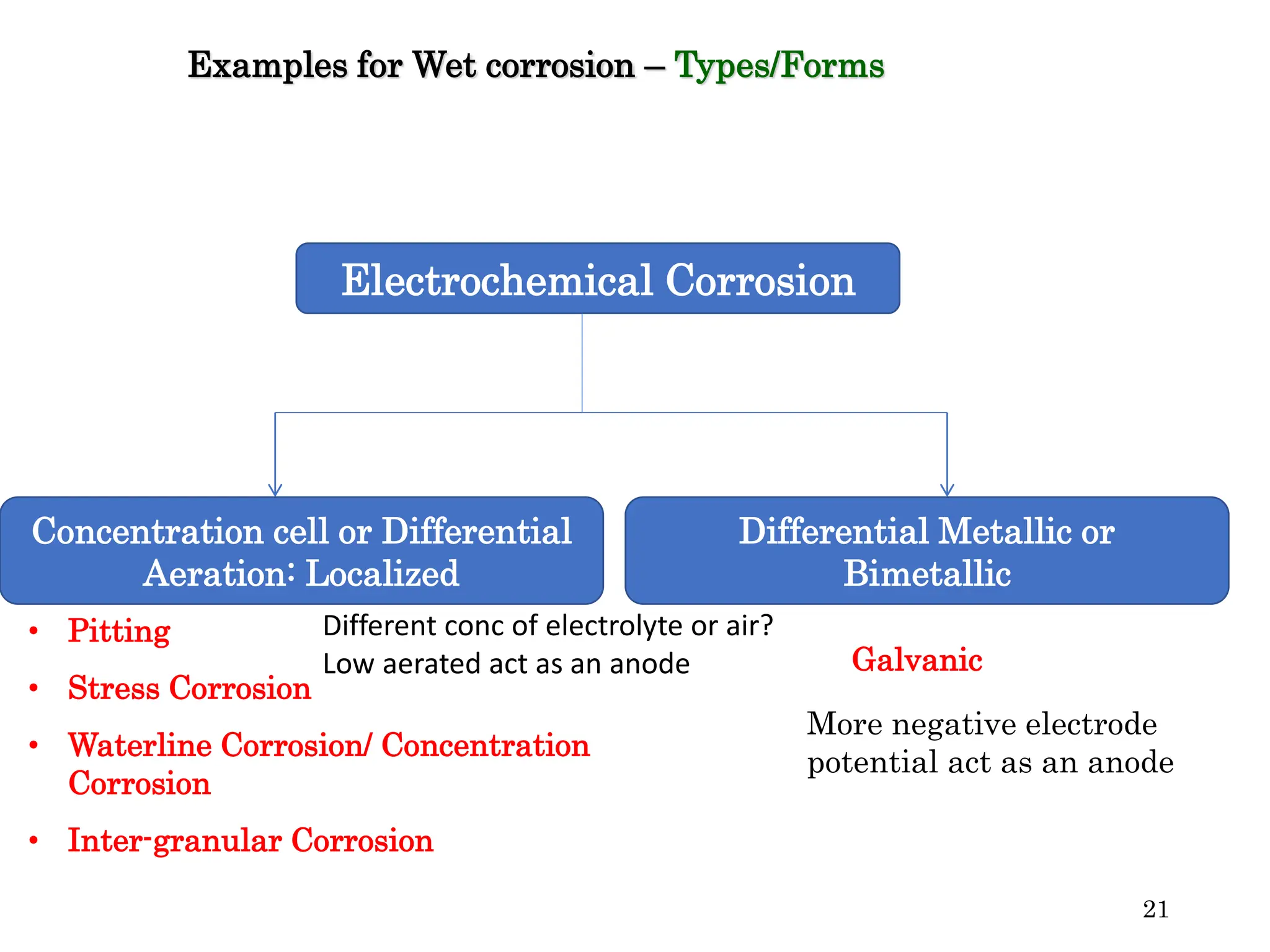
Examples for Wet corrosion – Types/Forms
Electrochemical Corrosion
Concentration cell or Differential
Aeration: Localized
Differential Metallic or
Bimetallic
• Pitting
• Stress Corrosion
• Waterline Corrosion/ Concentration
Corrosion
• Inter-granular Corrosion
Galvanic
More negative electrode
potential act as an anode
Different conc of electrolyte or air?
Low aerated act as an anode
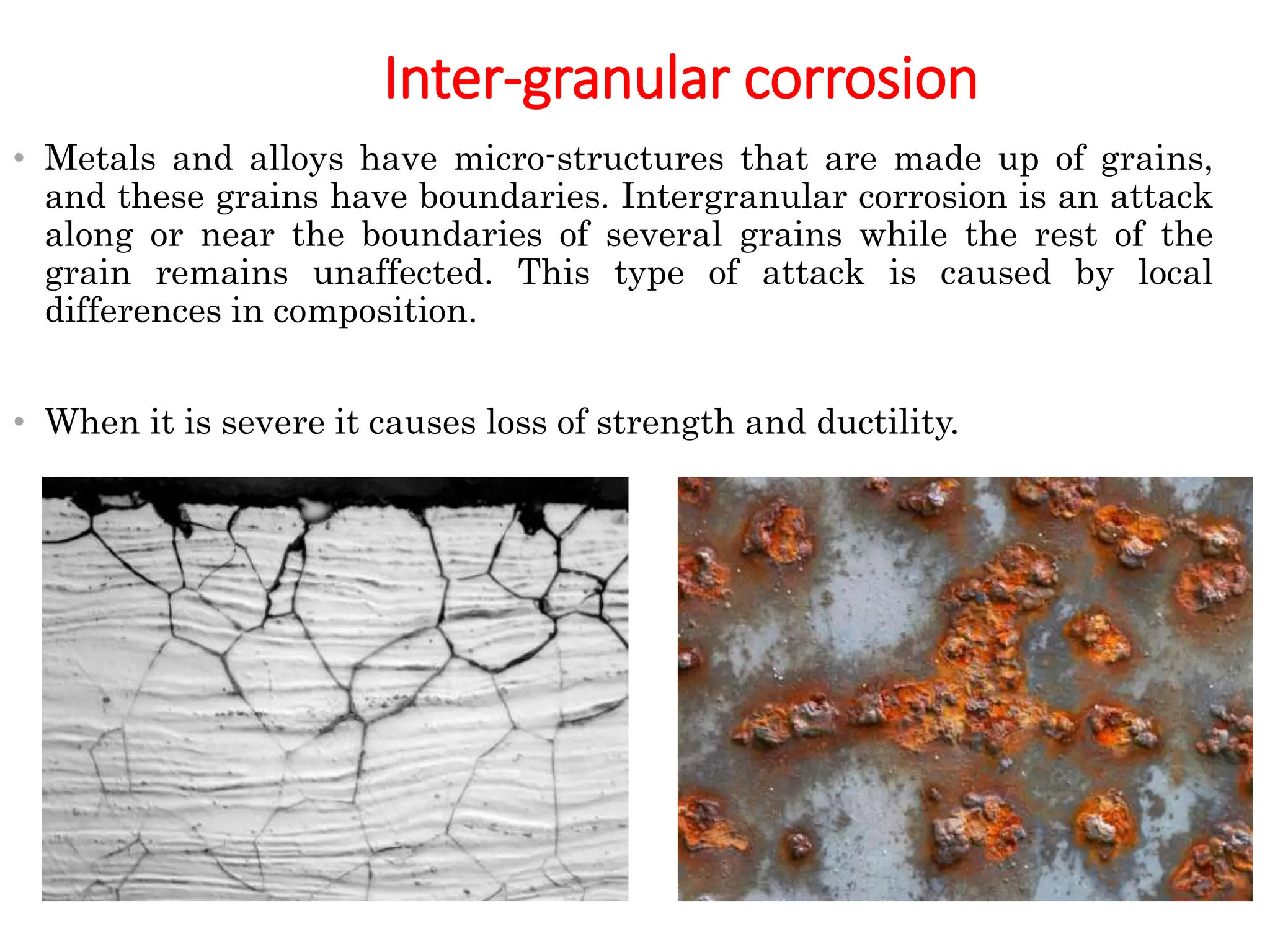
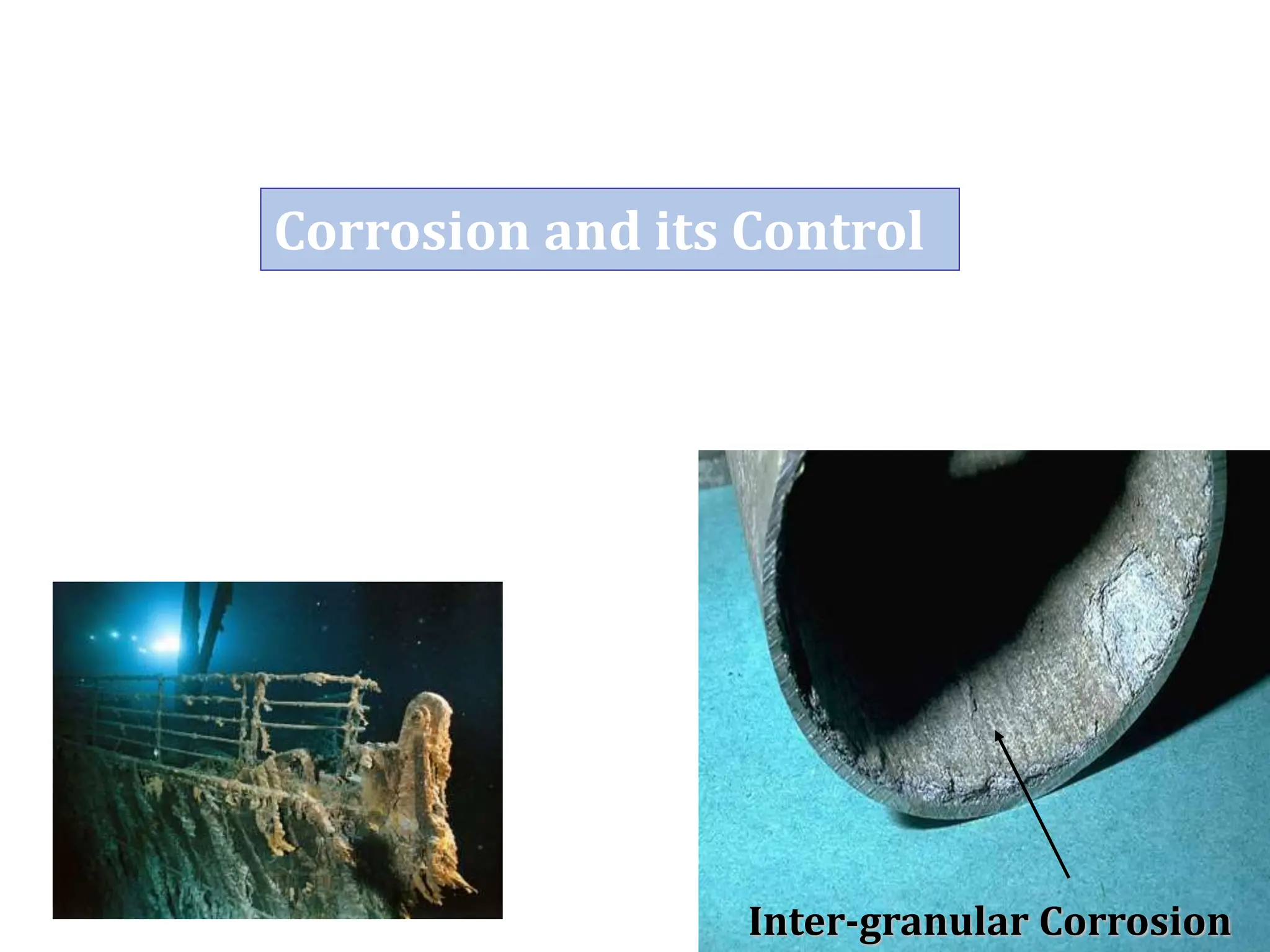
Inter-granular corrosion
• Metals and alloys have micro-structures that are made up of grains,
and these grains have boundaries. Intergranular corrosion is an attack
along or near the boundaries of several grains while the rest of the
grain remains unaffected. This type of attack is caused by local
differences in composition.
• When it is severe it causes loss of strength and ductility.
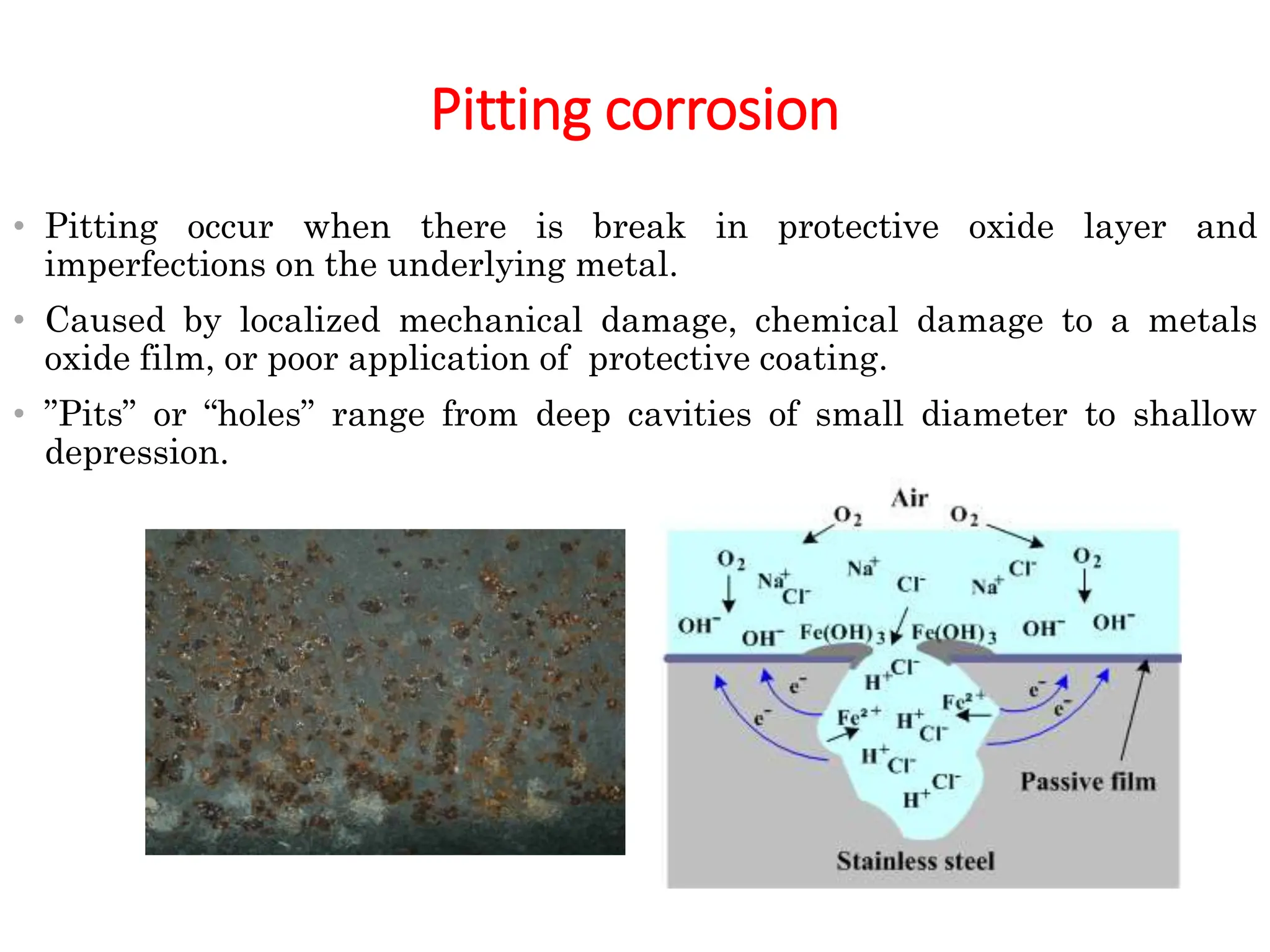
Pitting corrosion
• Pitting occur when there is break in protective oxide layer and
imperfections on the underlying metal.
• Caused by localized mechanical damage, chemical damage to a metals
oxide film, or poor application of protective coating.
• ”Pits” or “holes” range from deep cavities of small diameter to shallow
depression.
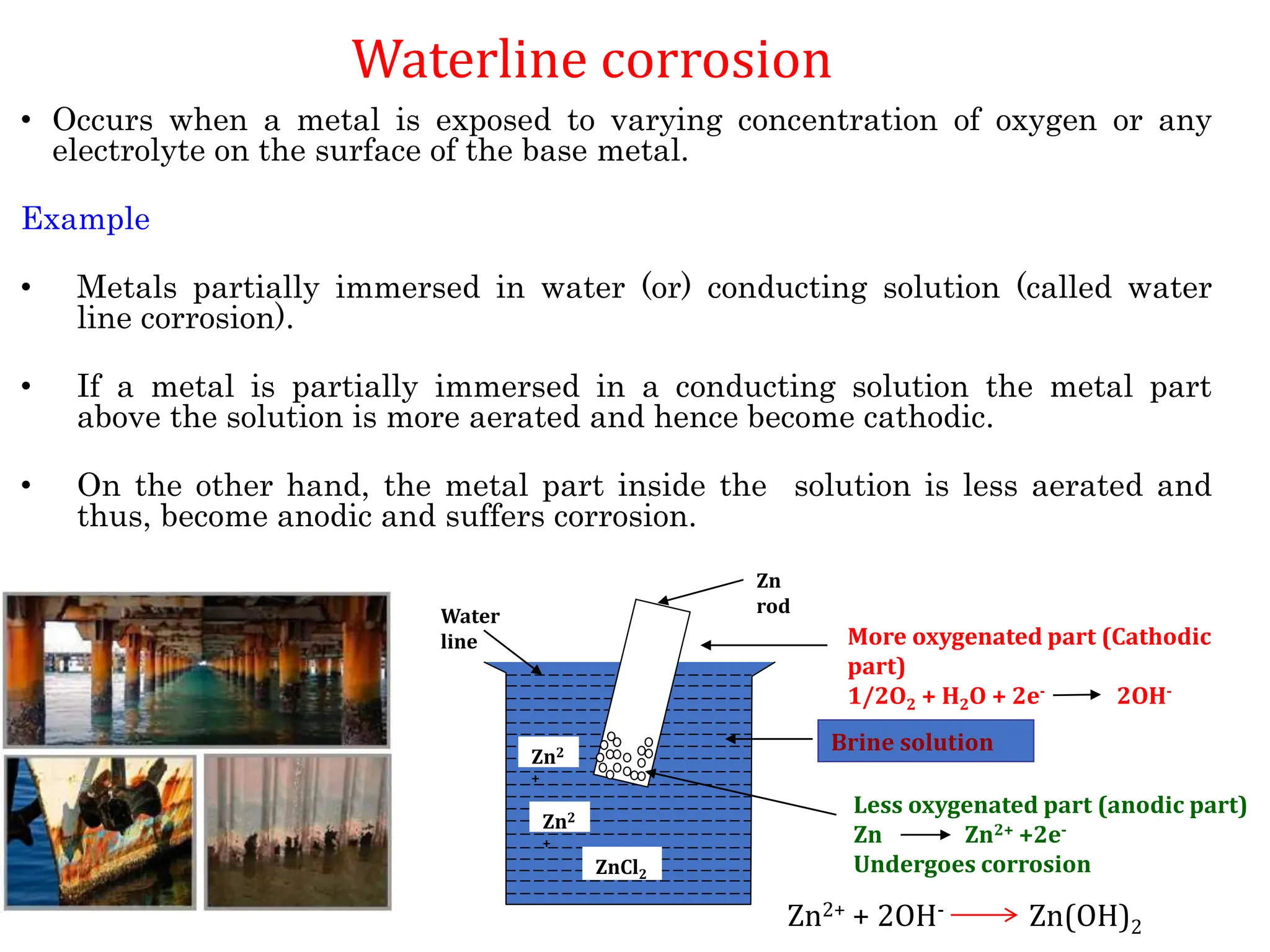
• Occurs when a metal is exposed to varying concentration of oxygen or any
electrolyte on the surface of the base metal.
Example
• Metals partially immersed in water (or) conducting solution (called water
line corrosion).
• If a metal is partially immersed in a conducting solution the metal part
above the solution is more aerated and hence become cathodic.
• On the other hand, the metal part inside the solution is less aerated and
thus, become anodic and suffers corrosion.
ZnCl2
Zn
rod
More oxygenated part (Cathodic
part)
1/2O2 + H2O + 2e- 2OH-
Less oxygenated part (anodic part)
Zn Zn2+ +2e-
Undergoes corrosion
Brine solution
Water
line
Zn2
+
Zn2
+
Zn2+ + 2OH- Zn(OH)2
Waterline corrosion
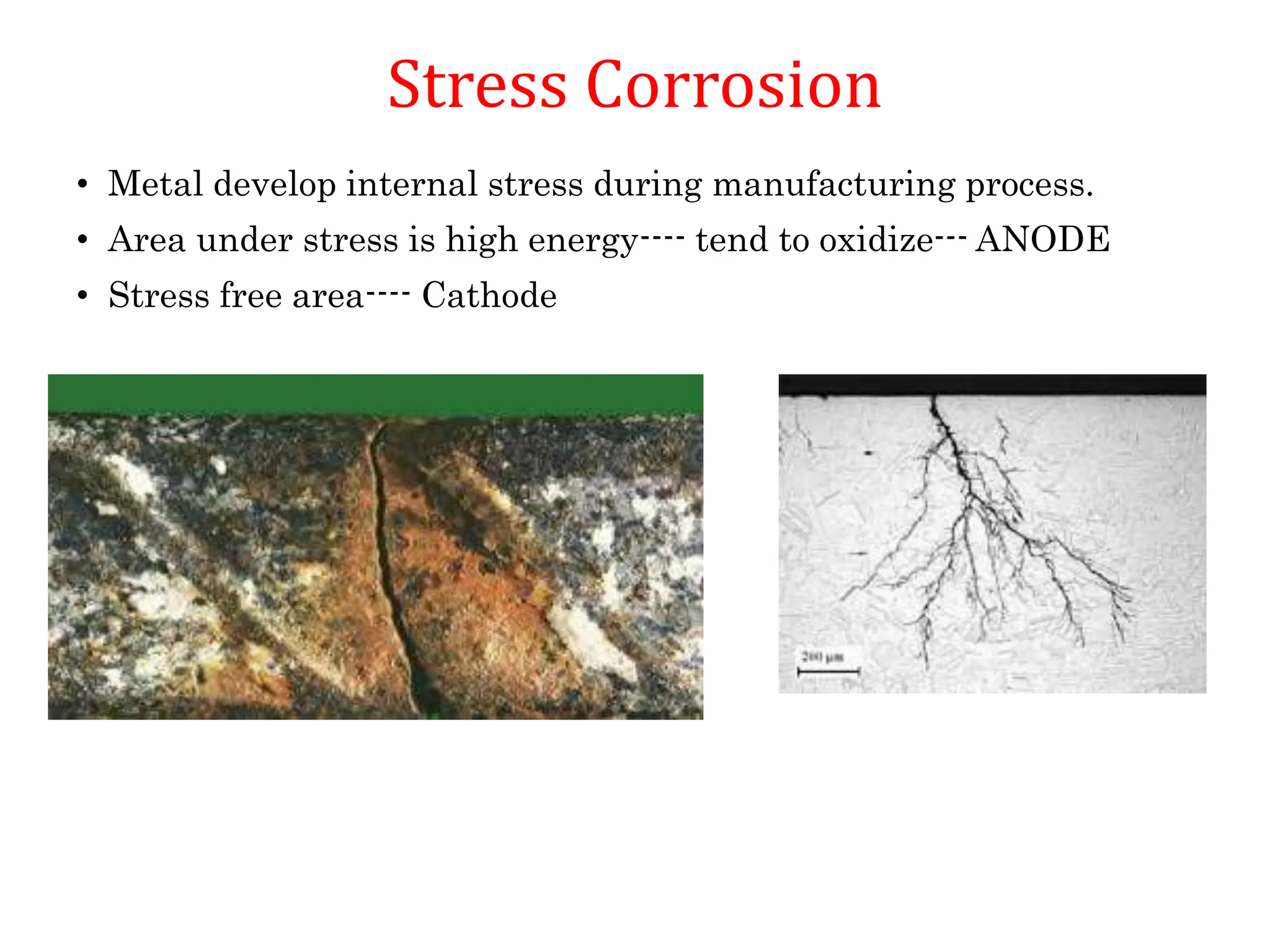
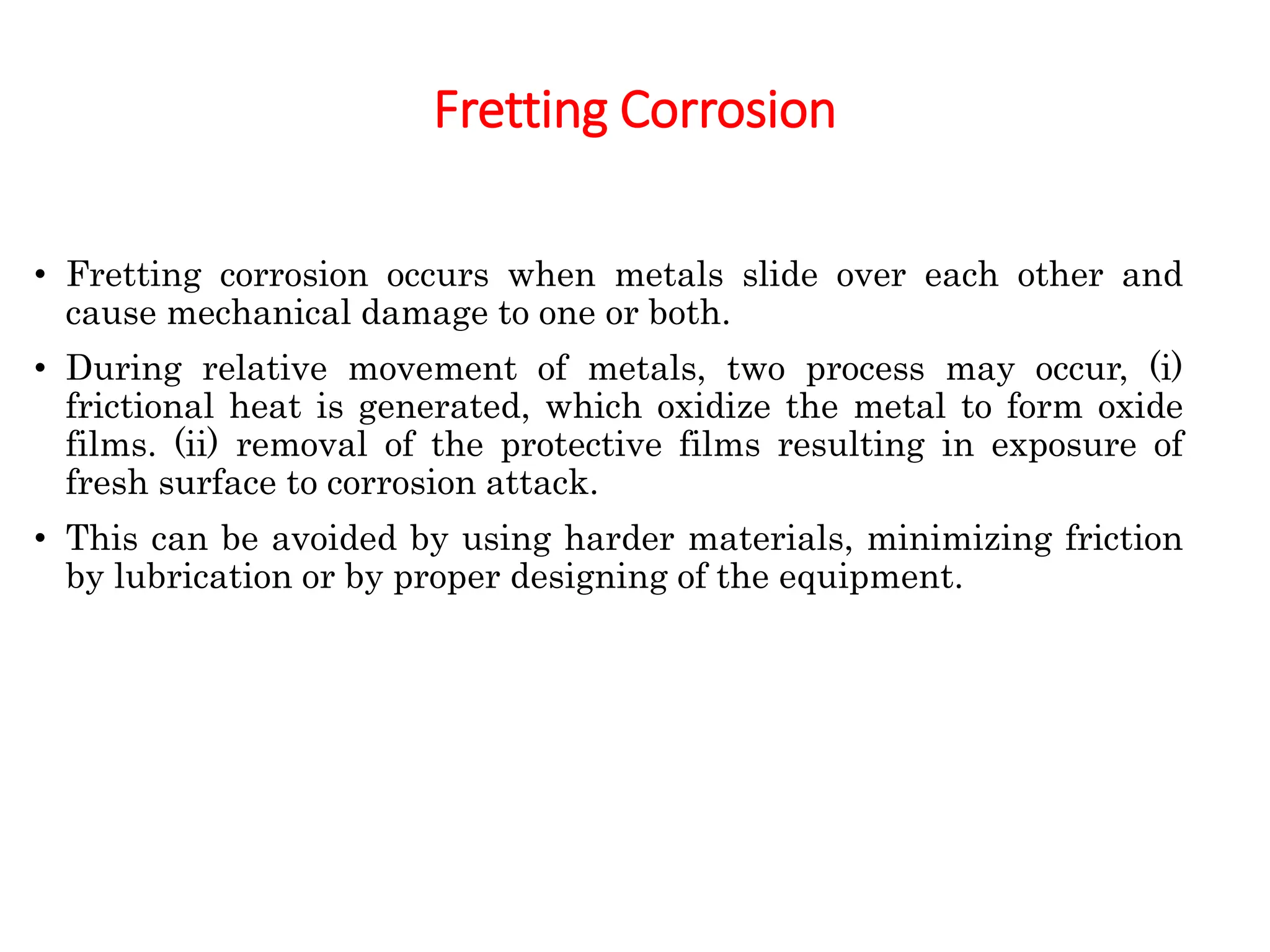
Stress Corrosion
• Metal develop internal stress during manufacturing process.
• Area under stress is high energy---- tend to oxidize--- ANODE
• Stress free area---- Cathode
Fretting Corrosion
• Fretting corrosion occurs when metals slide over each other and
cause mechanical damage to one or both.
• During relative movement of metals, two process may occur, (i)
frictional heat is generated, which oxidize the metal to form oxide
films. (ii) removal of the protective films resulting in exposure of
fresh surface to corrosion attack.
• This can be avoided by using harder materials, minimizing friction
by lubrication or by proper designing of the equipment.
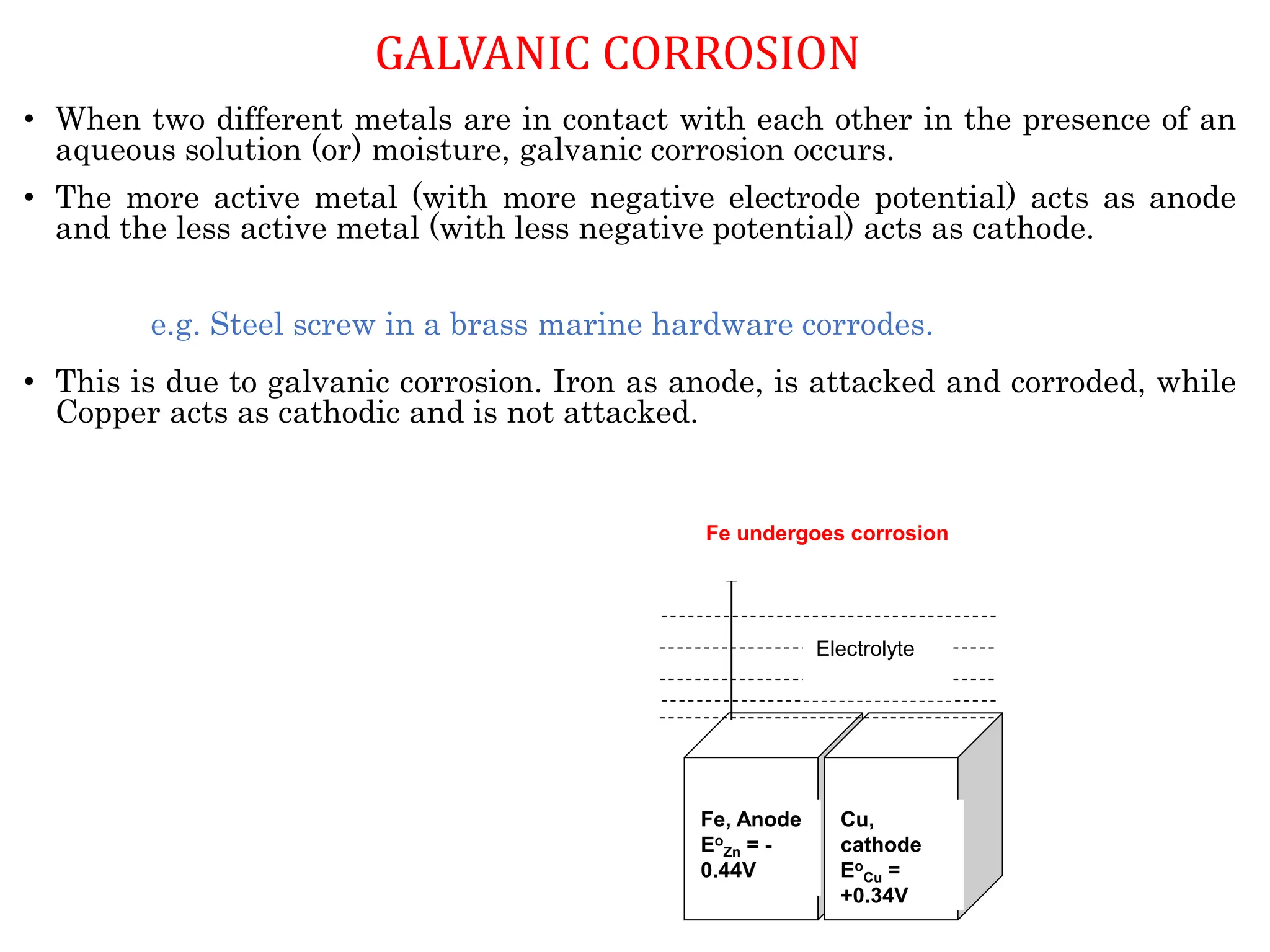
• When two different metals are in contact with each other in the presence of an
aqueous solution (or) moisture, galvanic corrosion occurs.
• The more active metal (with more negative electrode potential) acts as anode
and the less active metal (with less negative potential) acts as cathode.
e.g. Steel screw in a brass marine hardware corrodes.
• This is due to galvanic corrosion. Iron as anode, is attacked and corroded, while
Copper acts as cathodic and is not attacked.
Fe, Anode
Eo
Zn = -
0.44V
Cu,
cathode
Eo
Cu =
+0.34V
Electrolyte
Fe undergoes corrosion
GALVANIC CORROSION
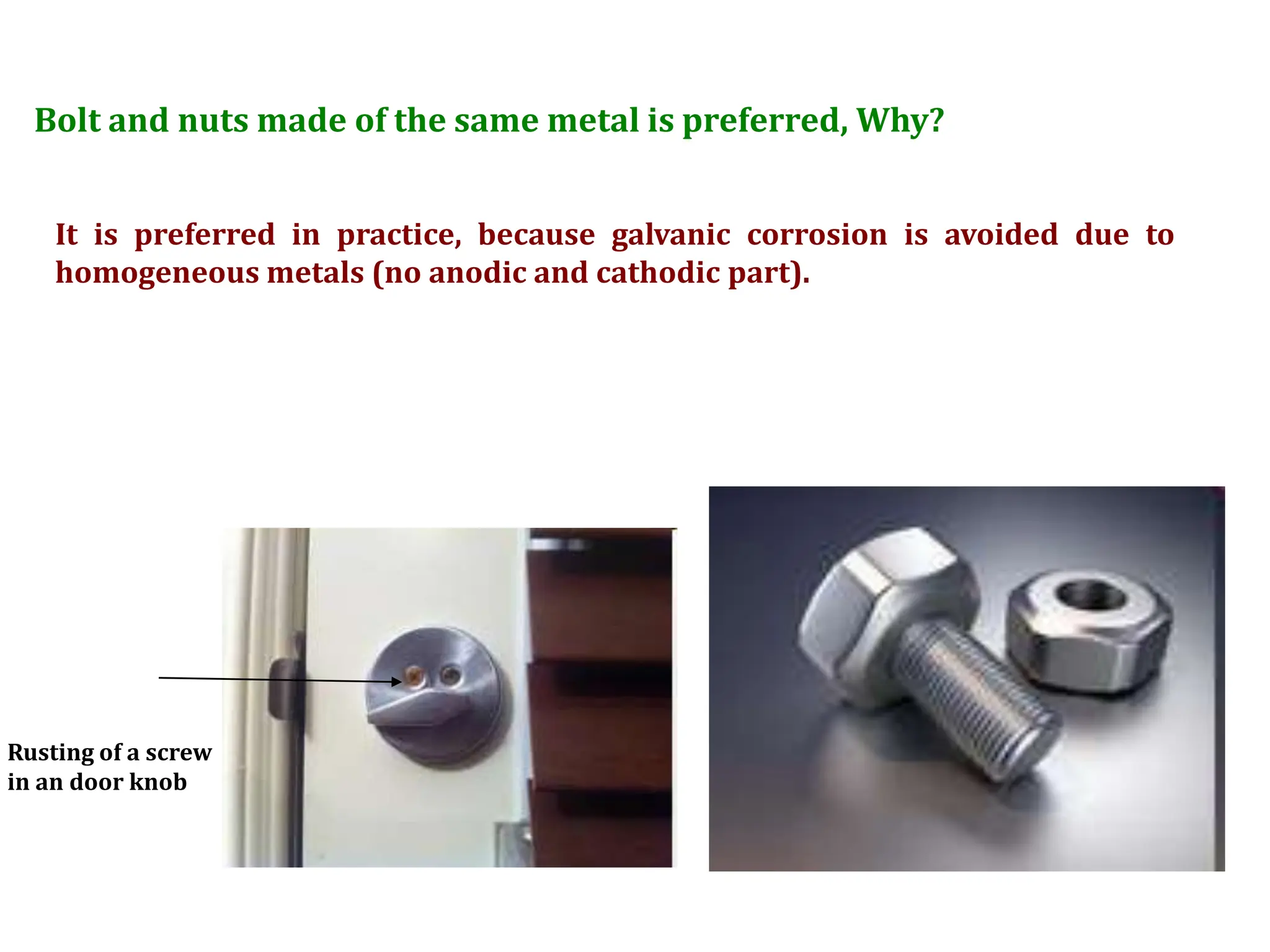
Bolt and nuts made of the same metal is preferred, Why?
Rusting of a screw
in an door knob
It is preferred in practice, because galvanic corrosion is avoided due to
homogeneous metals (no anodic and cathodic part).
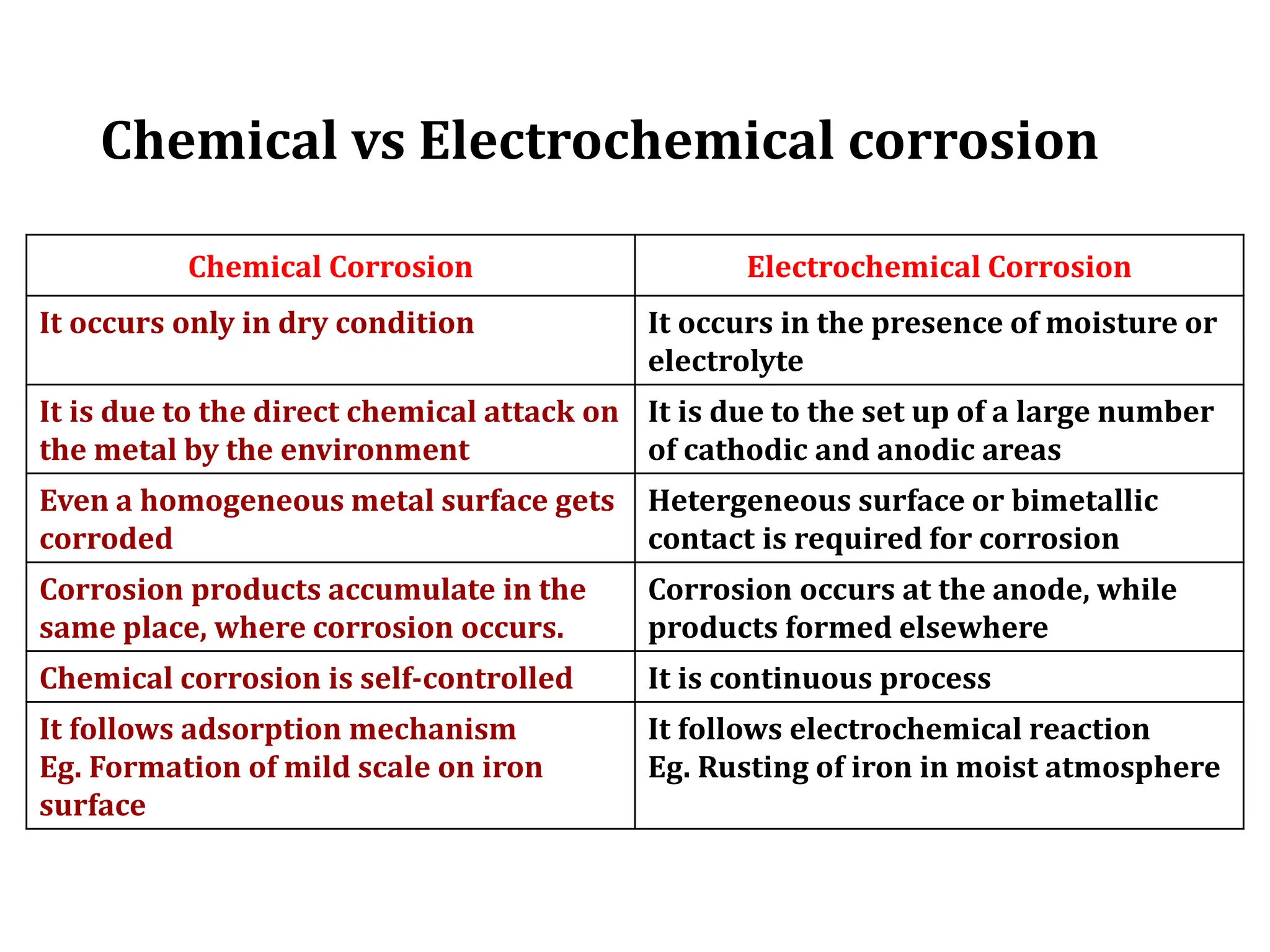
Chemical vs Electrochemical corrosion
Chemical Corrosion Electrochemical Corrosion
It occurs only in dry condition It occurs in the presence of moisture or
electrolyte
It is due to the direct chemical attack on
the metal by the environment
It is due to the set up of a large number
of cathodic and anodic areas
Even a homogeneous metal surface gets
corroded
Hetergeneous surface or bimetallic
contact is required for corrosion
Corrosion products accumulate in the
same place, where corrosion occurs.
Corrosion occurs at the anode, while
products formed elsewhere
Chemical corrosion is self-controlled It is continuous process
It follows adsorption mechanism
Eg. Formation of mild scale on iron
surface
It follows electrochemical reaction
Eg. Rusting of iron in moist atmosphere
Factors Affecting the Rate of Corrosion
34
Nature of the metal
1. Position of the metal in EMF series
More the diff. more the corrosion
2. Purity of the metal
Pure less prone
3. Relative area of Anode and Cathode
Low anodic area and high cathodic area
Steel rivets in Cu plate
4. Physical state (Stress) on the metal
5. Solubility of corrosion product
6. Nature of the metal oxide (corrosion
product) formed
Like volatile?
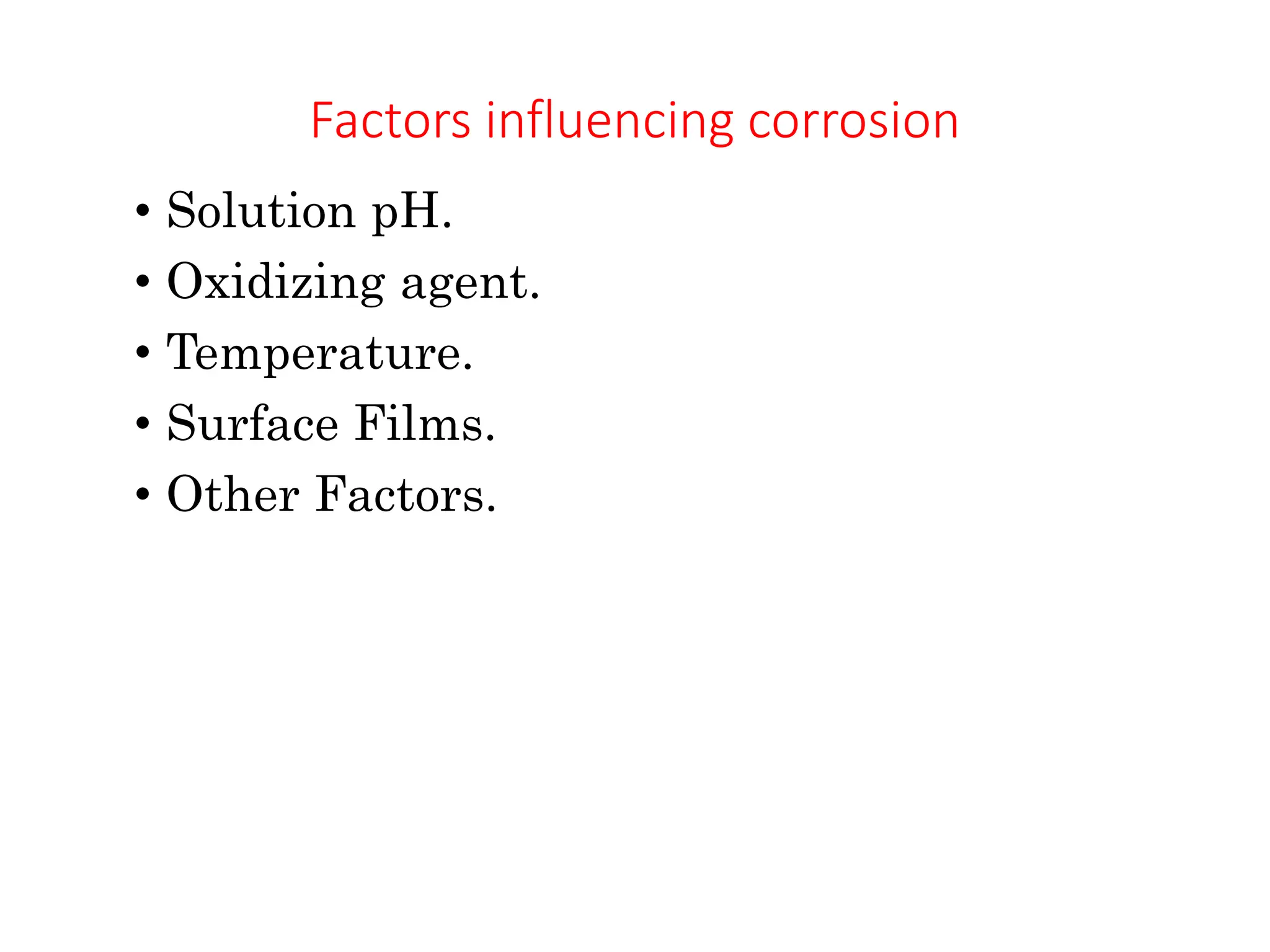
Factors influencing corrosion
• Solution pH.
• Oxidizing agent.
• Temperature.
• Surface Films.
• Other Factors.
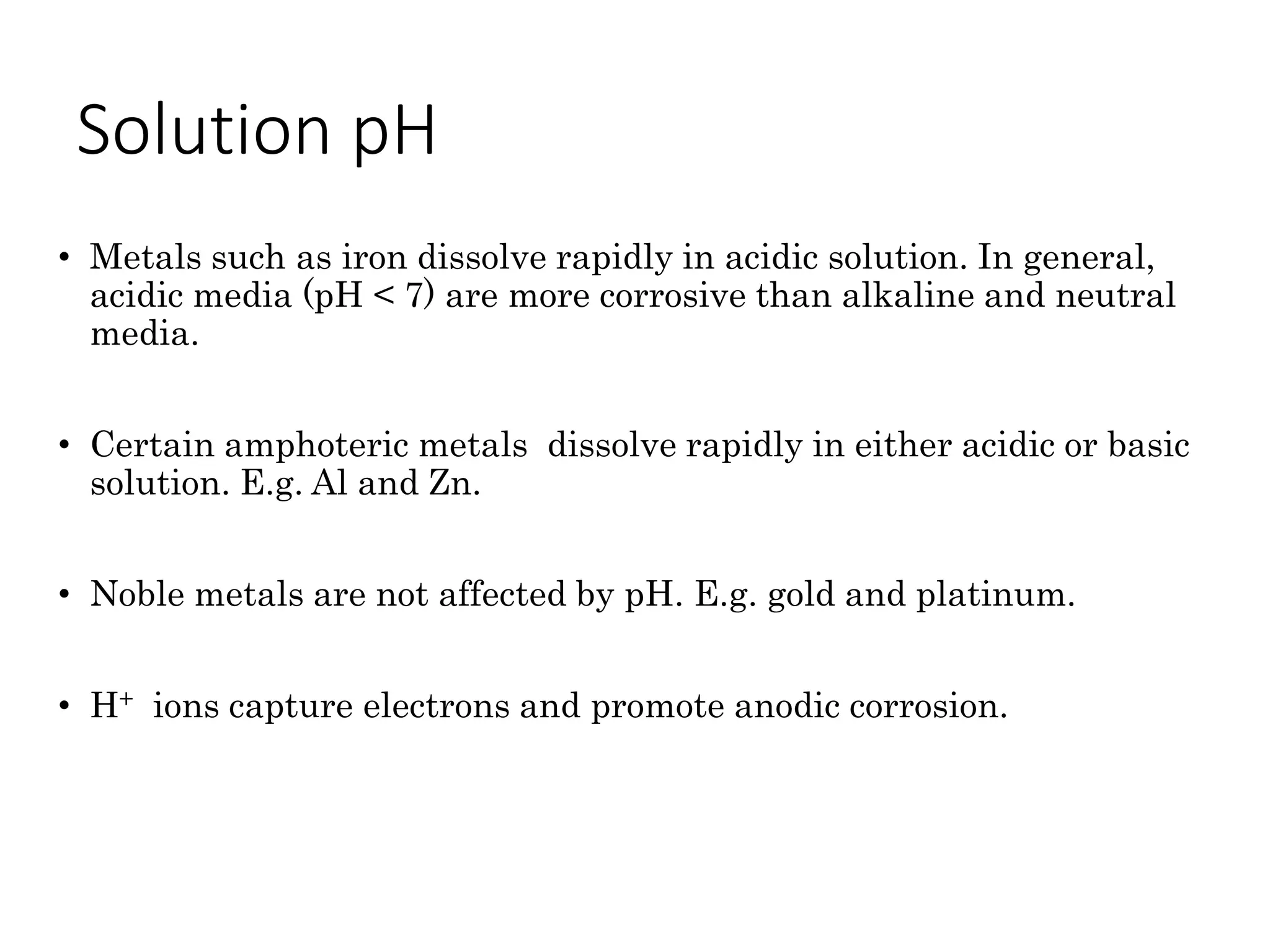
Solution pH
• Metals such as iron dissolve rapidly in acidic solution. In general,
acidic media (pH < 7) are more corrosive than alkaline and neutral
media.
• Certain amphoteric metals dissolve rapidly in either acidic or basic
solution. E.g. Al and Zn.
• Noble metals are not affected by pH. E.g. gold and platinum.
• H+ ions capture electrons and promote anodic corrosion.
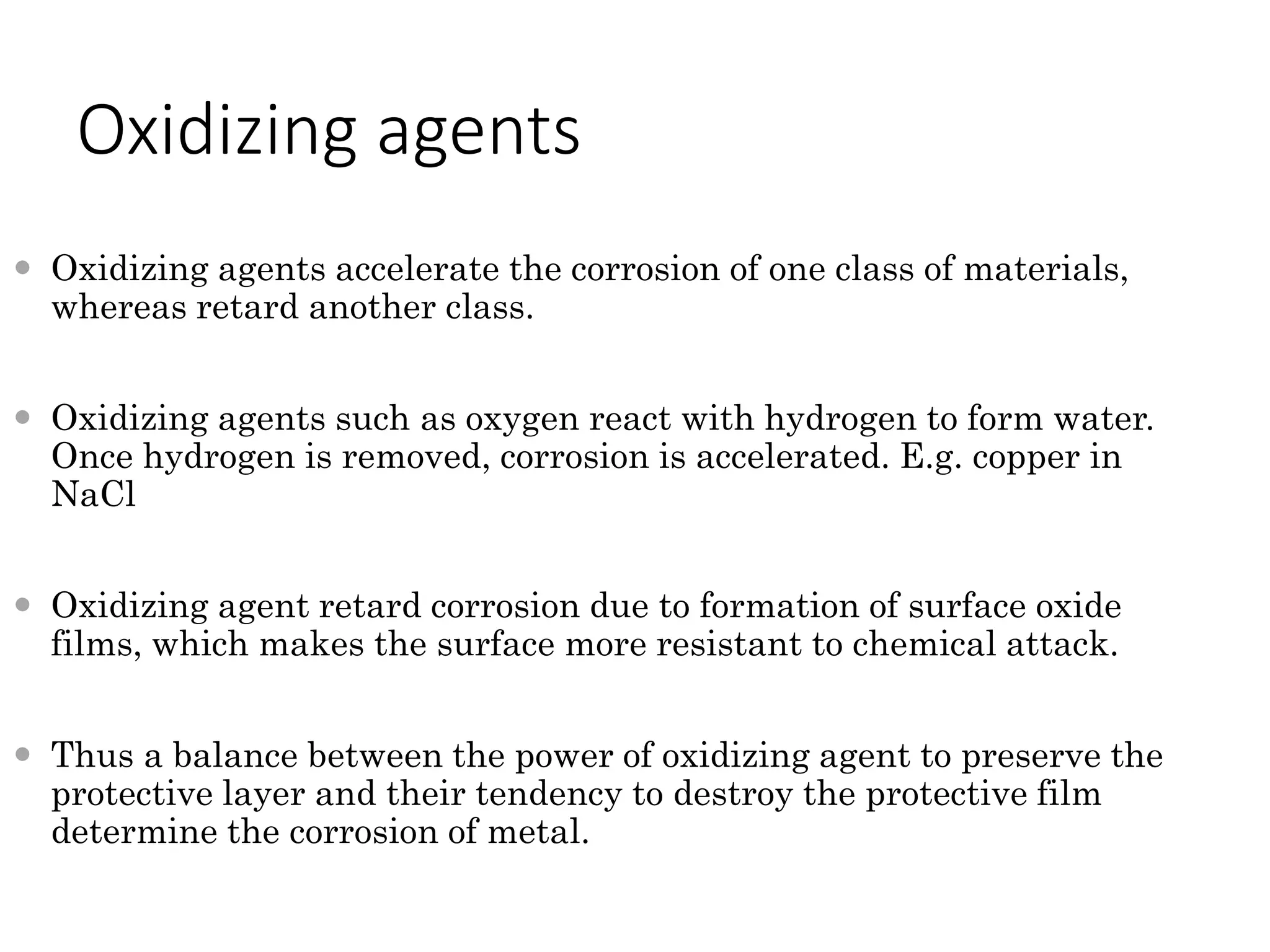
Oxidizing agents
 Oxidizing agents accelerate the corrosion of one class of materials,
whereas retard another class.
 Oxidizing agents such as oxygen react with hydrogen to form water.
Once hydrogen is removed, corrosion is accelerated. E.g. copper in
NaCl
 Oxidizing agent retard corrosion due to formation of surface oxide
films, which makes the surface more resistant to chemical attack.
 Thus a balance between the power of oxidizing agent to preserve the
protective layer and their tendency to destroy the protective film
determine the corrosion of metal.
Temperature
• Rise in temp increase rate of corrosion.
• Increase in temp reduce the solubility of oxygen or air. The released
oxygen enhances the corrosion.
• Increase in temp induces phase change, which enhance the rate of
corrosion.
Corrosion and its Control
Inter-granular Corrosion
1. Materials selection
2. Alteration of the Environment
3. Proper Design of articles – Avoid Crevice and sharp bends
4. Cathodic protection methods:
a) Sacrificial Anodic Protection
b) Impressed Current Cathodic Protection method
5. Anodic protection method:
6. Corrosion Inhibitors:
a) Anodic inhibitors
b) Cathodic inhibitors
c) Vapour phase inhibitors
7. Protective coating:
a) Electroplating and electro-less plating
b) Physical vapour deposition
c) Chemical vapour deposition
Control of corrosion
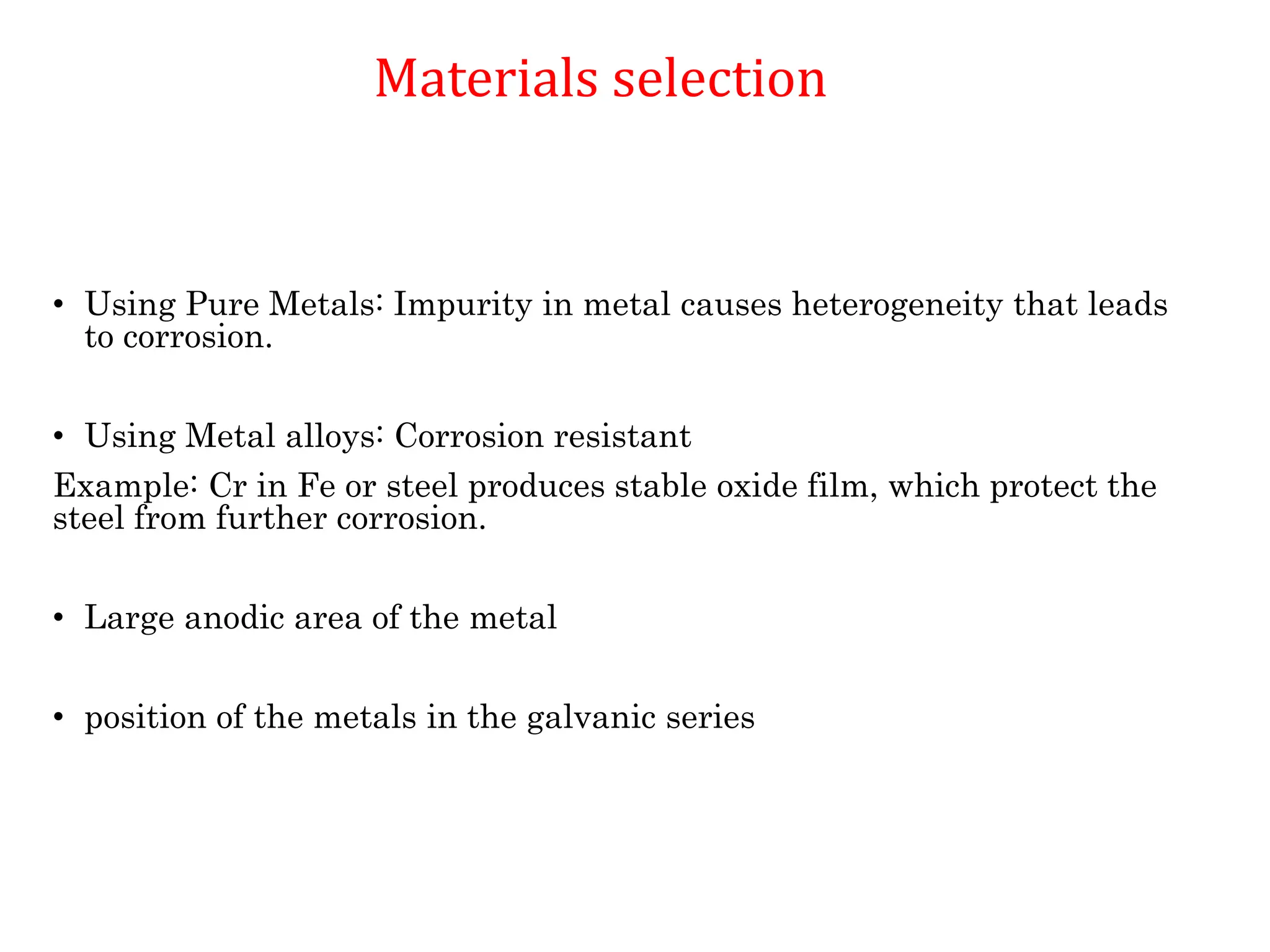
Materials selection
• Using Pure Metals: Impurity in metal causes heterogeneity that leads
to corrosion.
• Using Metal alloys: Corrosion resistant
Example: Cr in Fe or steel produces stable oxide film, which protect the
steel from further corrosion.
• Large anodic area of the metal
• position of the metals in the galvanic series
Materials selection
Typical changes in medium are:
• Lowering temperature –
• Removing oxygen or oxidizers – De-aeration or Hydrazine
• Removing Moisture: Dehumidification by silica gel or Alumina
• Alkaline neutralization– Acidity decrease
Alteration of the Environment
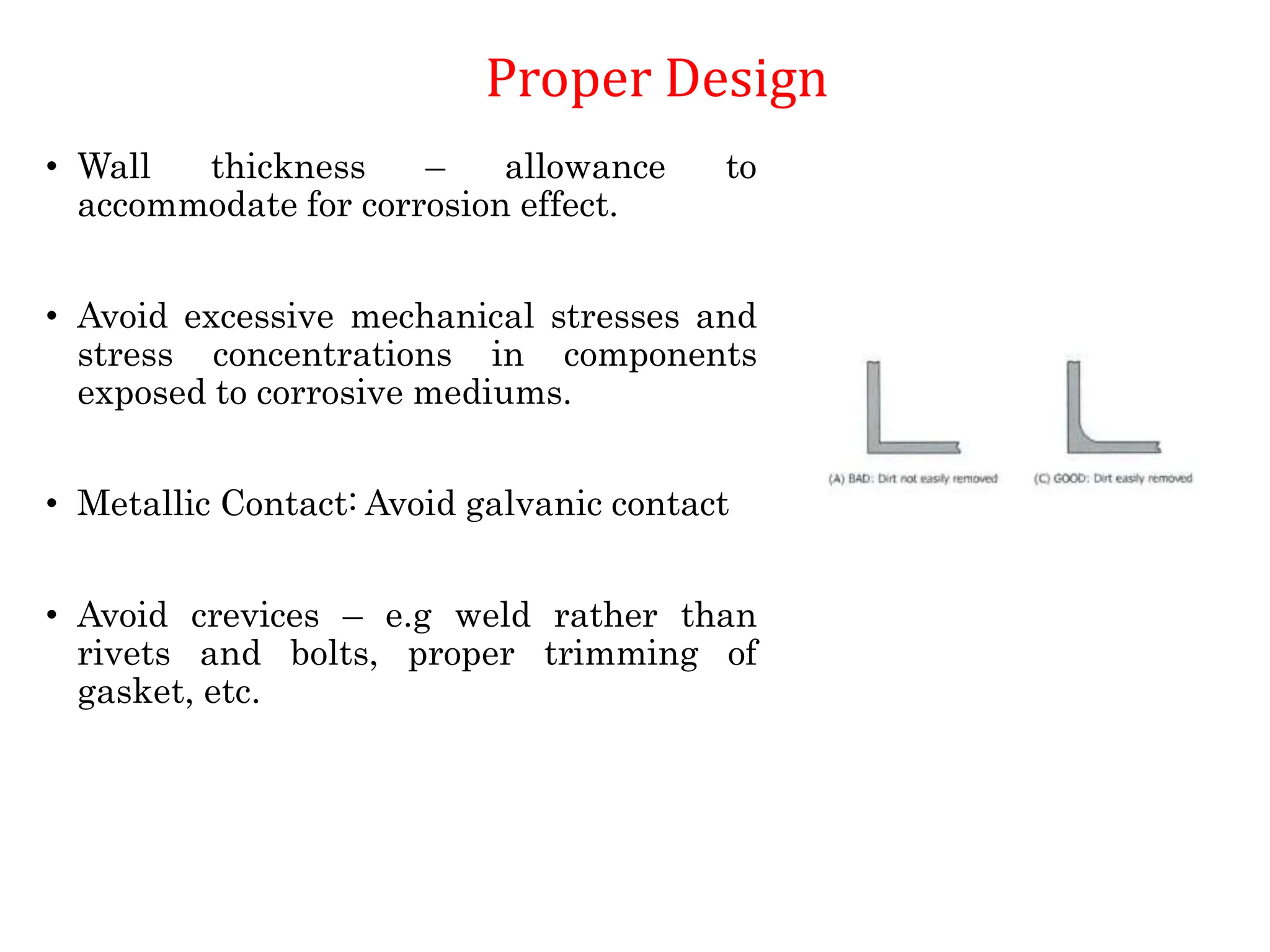
• Wall thickness – allowance to
accommodate for corrosion effect.
• Avoid excessive mechanical stresses and
stress concentrations in components
exposed to corrosive mediums.
• Metallic Contact: Avoid galvanic contact
• Avoid crevices – e.g weld rather than
rivets and bolts, proper trimming of
gasket, etc.
Proper Design
Cathodic Protection methods
• The principle involved in cathodic protection is to force the metal
to be protected to behave like a cathode.
• Since, there will not be any anodic area on the metal, corrosion
will not occur.
There are two types of cathodic protection
• Sacrificial anodic protection method
• Impressed current cathodic protection method
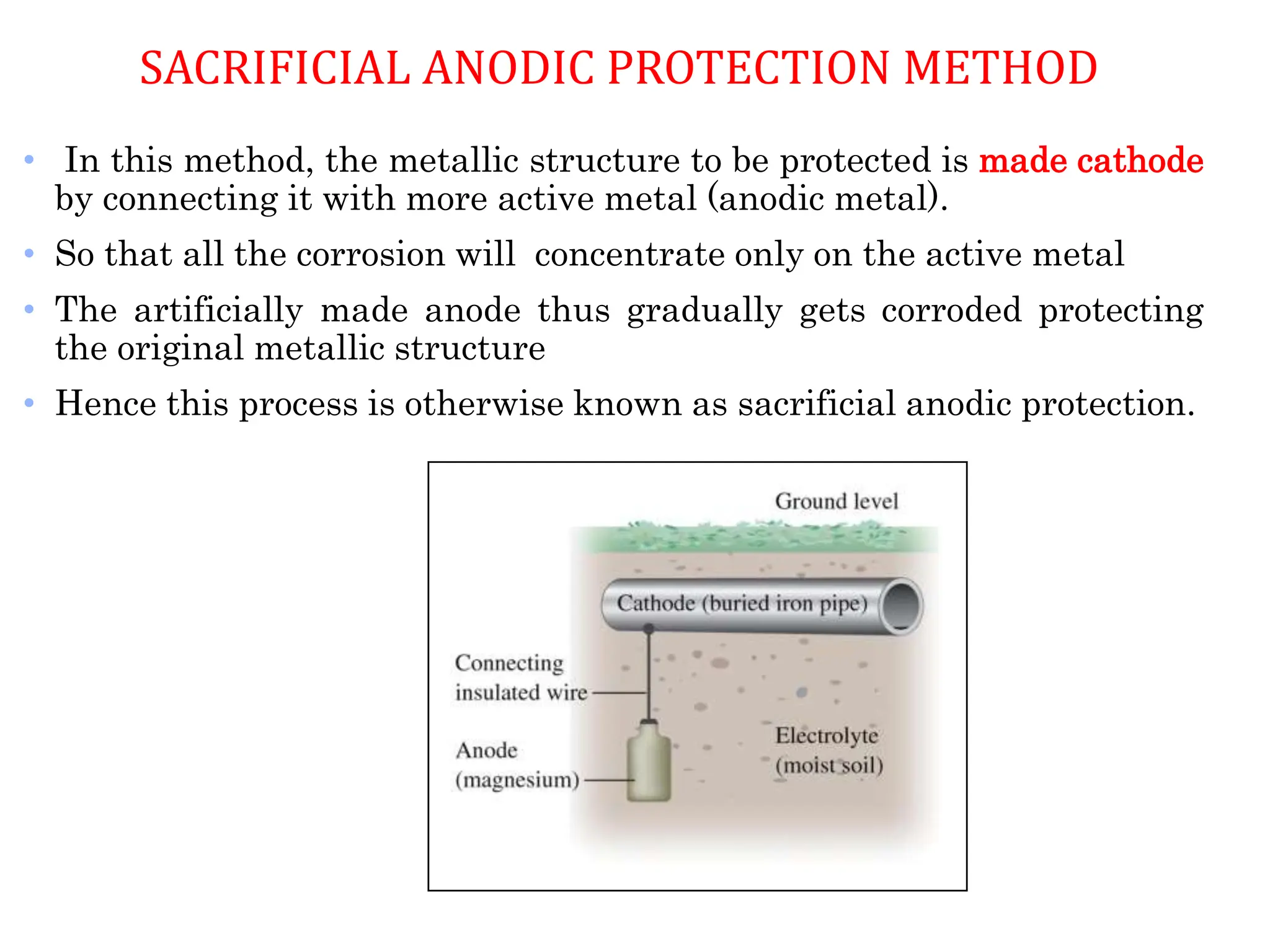
• In this method, the metallic structure to be protected is made cathode
by connecting it with more active metal (anodic metal).
• So that all the corrosion will concentrate only on the active metal
• The artificially made anode thus gradually gets corroded protecting
the original metallic structure
• Hence this process is otherwise known as sacrificial anodic protection.
SACRIFICIAL ANODIC PROTECTION METHOD
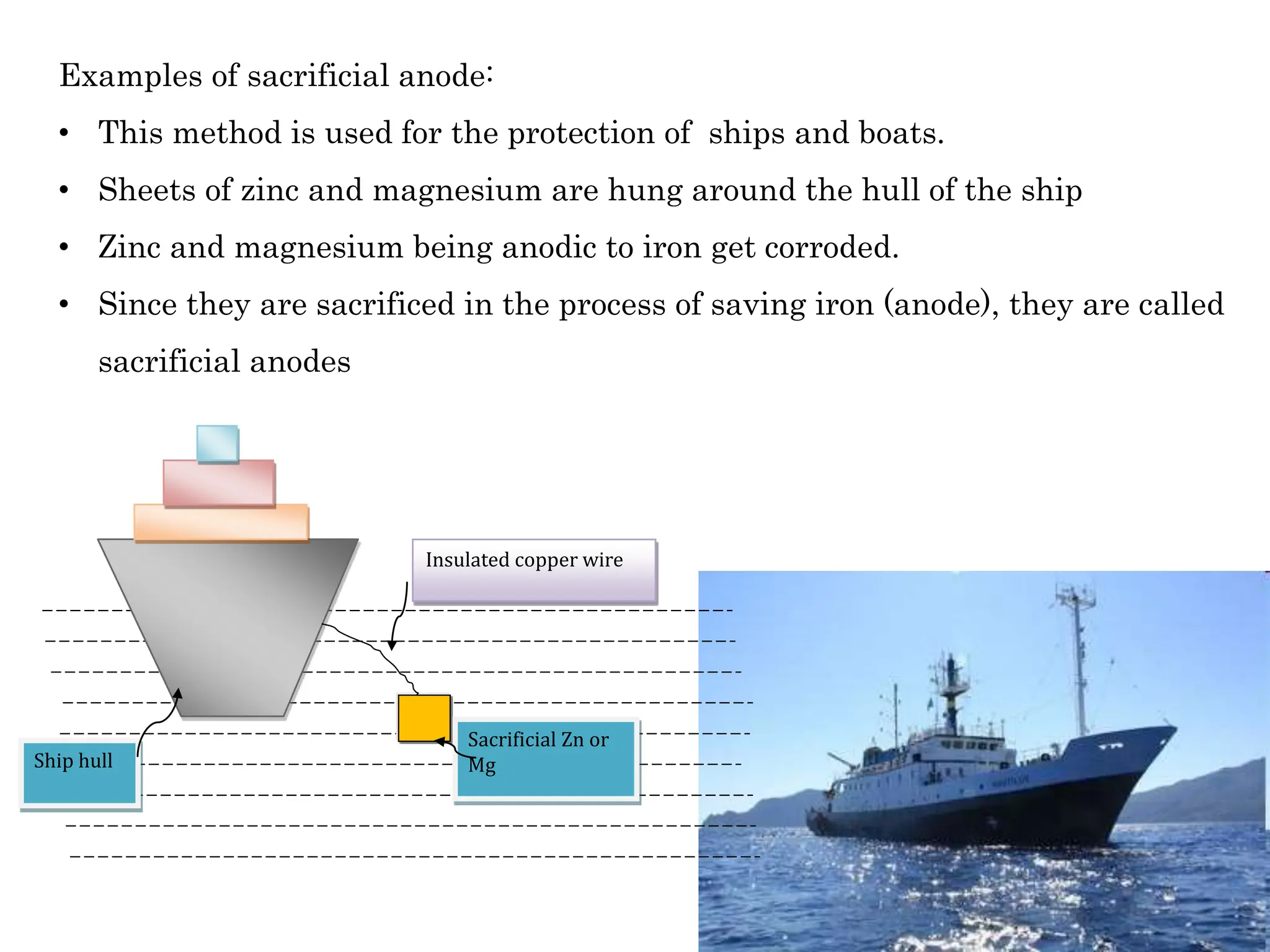
Insulated copper wire
Sacrificial Zn or
Mg
Ship hull
Examples of sacrificial anode:
• This method is used for the protection of ships and boats.
• Sheets of zinc and magnesium are hung around the hull of the ship
• Zinc and magnesium being anodic to iron get corroded.
• Since they are sacrificed in the process of saving iron (anode), they are called
sacrificial anodes
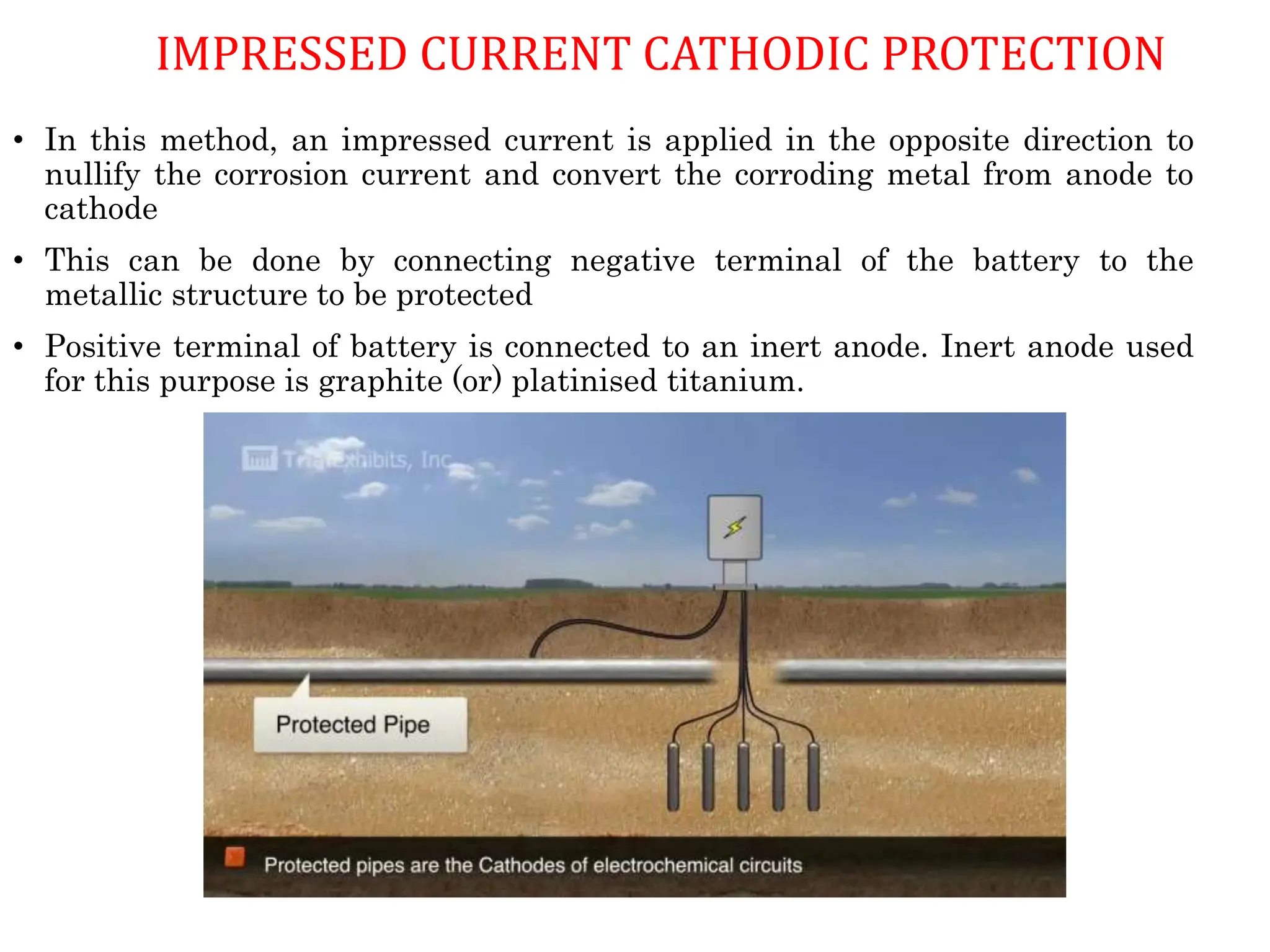
IMPRESSED CURRENT CATHODIC PROTECTION
• In this method, an impressed current is applied in the opposite direction to
nullify the corrosion current and convert the corroding metal from anode to
cathode
• This can be done by connecting negative terminal of the battery to the
metallic structure to be protected
• Positive terminal of battery is connected to an inert anode. Inert anode used
for this purpose is graphite (or) platinised titanium.
Anodic Protection Method
• The principle involved in anodic protection is to force the metal to be
protected to behave like “more anodic”.
• Used for metals which form protective layer, like Al, Cr, Ni etc.
• In this method, a predetermined potential is applied to the metal
specimen and the corresponding current changes are observed.
• During the initial stage, the current increases indicating the dissolution of
the metal.
• When the current reaches a critical point, passivation occur, i.e., the oxide
layers set in suitable oxidizing environment. The potential at the critical
point is called passivating potential.
• Above this passivating potential, the current flows decreases to a very
small value called passivating current, the minimum protective current
density required to maintain passivation.
• At this stage, an increase in potential will not be corrode metal since the
later is in highly passive state.
CORROSION INHIBITORS
Inhibitors are classified in to three types,
1. ANODIC INHIBITORS
2. CATHODIC INHIBITORS
3. VAPOUR PHASE INHIBITORS
A corrosion inhibitors is a substance which when added to in small
quantities to the aqueous corrosive environment effectively decreases
the rate of corrosion of the metal.
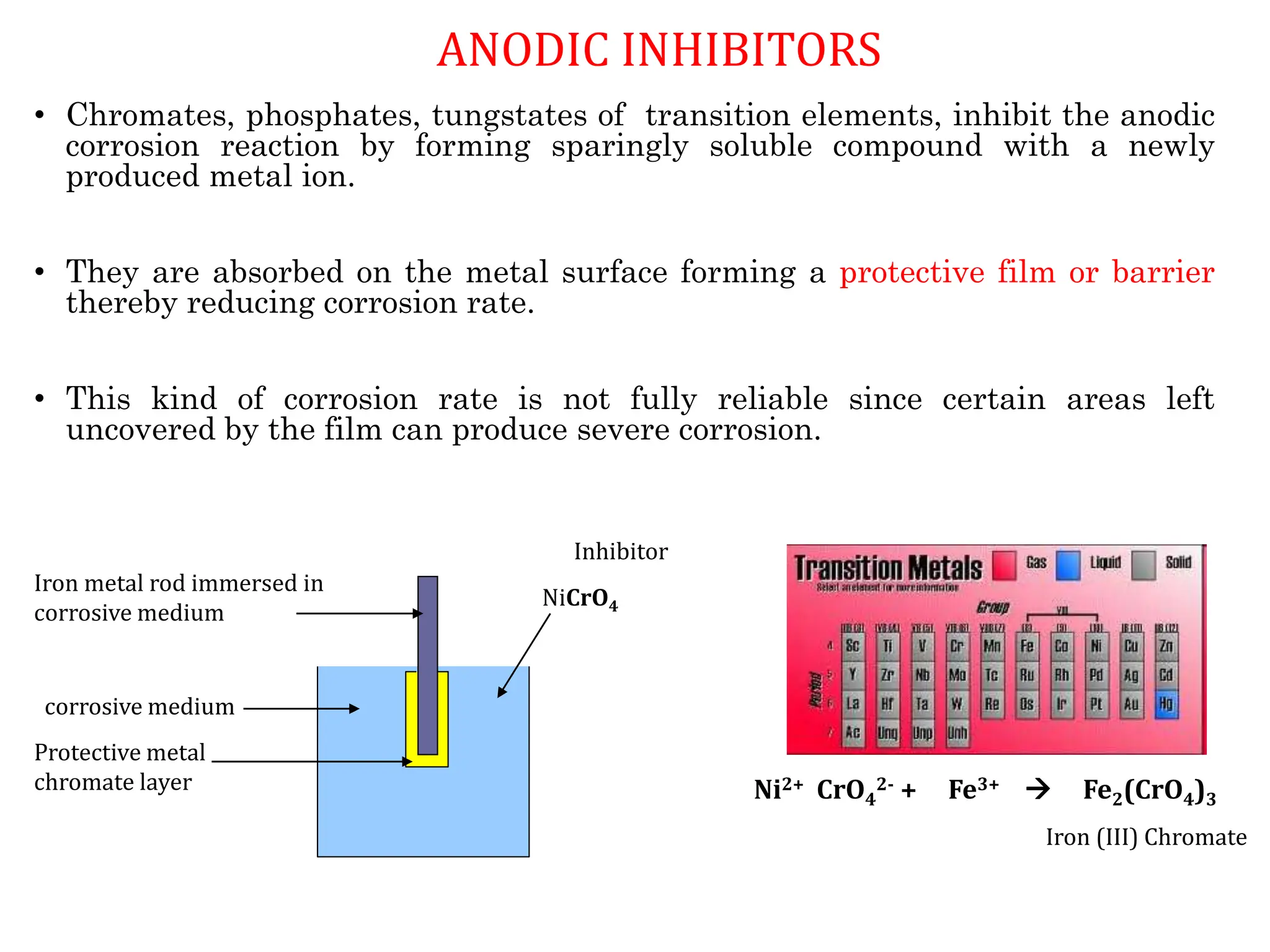
• Chromates, phosphates, tungstates of transition elements, inhibit the anodic
corrosion reaction by forming sparingly soluble compound with a newly
produced metal ion.
• They are absorbed on the metal surface forming a protective film or barrier
thereby reducing corrosion rate.
• This kind of corrosion rate is not fully reliable since certain areas left
uncovered by the film can produce severe corrosion.
ANODIC INHIBITORS
Ni2+ CrO4
2- + Fe3+  Fe2(CrO4)3
Iron metal rod immersed in
corrosive medium
corrosive medium
Protective metal
chromate layer
NiCrO4
Inhibitor
Iron (III) Chromate
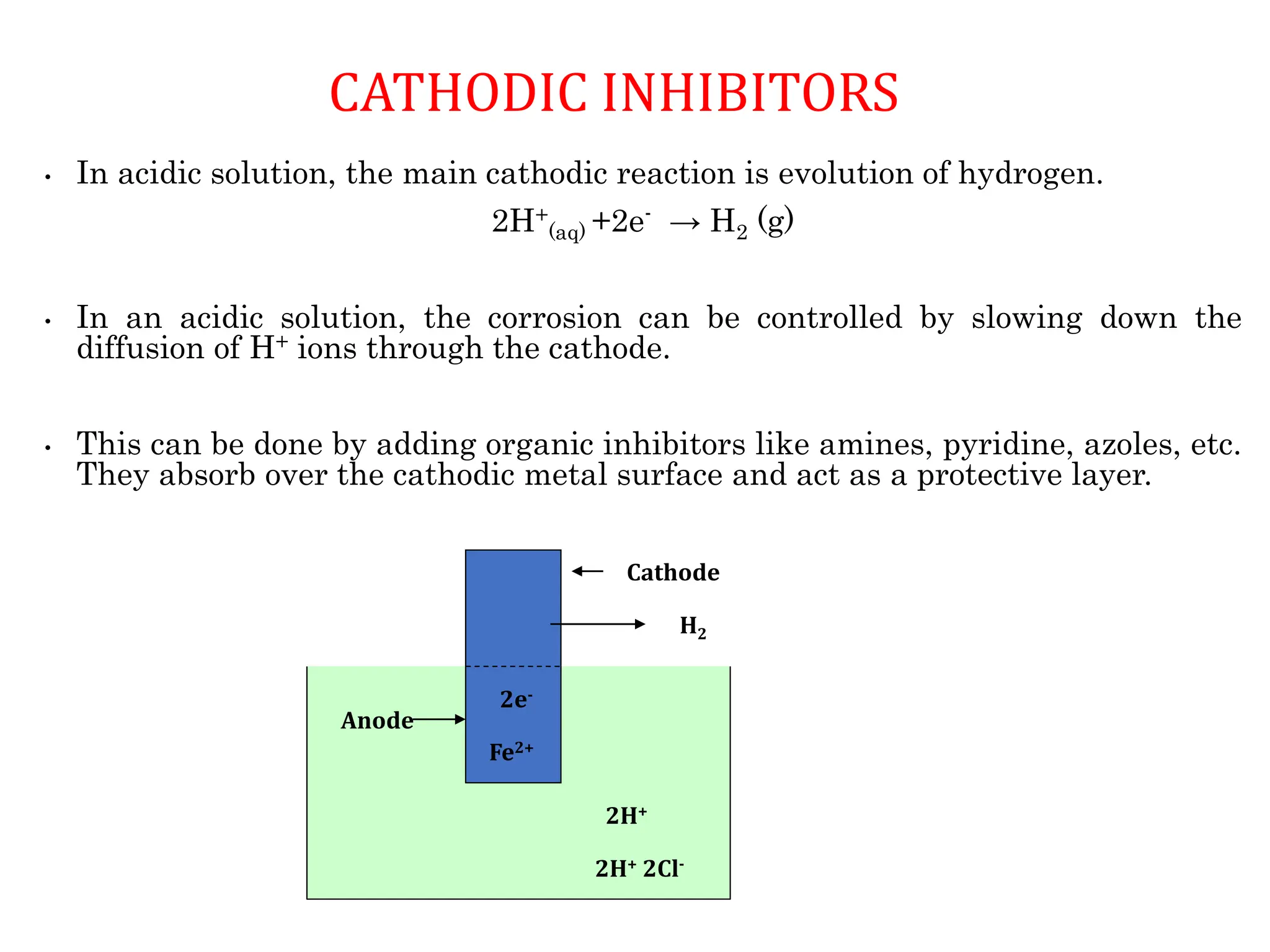
• In acidic solution, the main cathodic reaction is evolution of hydrogen.
2H+
(aq) +2e- → H2 (g)
• In an acidic solution, the corrosion can be controlled by slowing down the
diffusion of H+ ions through the cathode.
• This can be done by adding organic inhibitors like amines, pyridine, azoles, etc.
They absorb over the cathodic metal surface and act as a protective layer.
CATHODIC INHIBITORS
2H+ 2Cl-
Fe2+
2e-
Anode
Cathode
2H+
H2
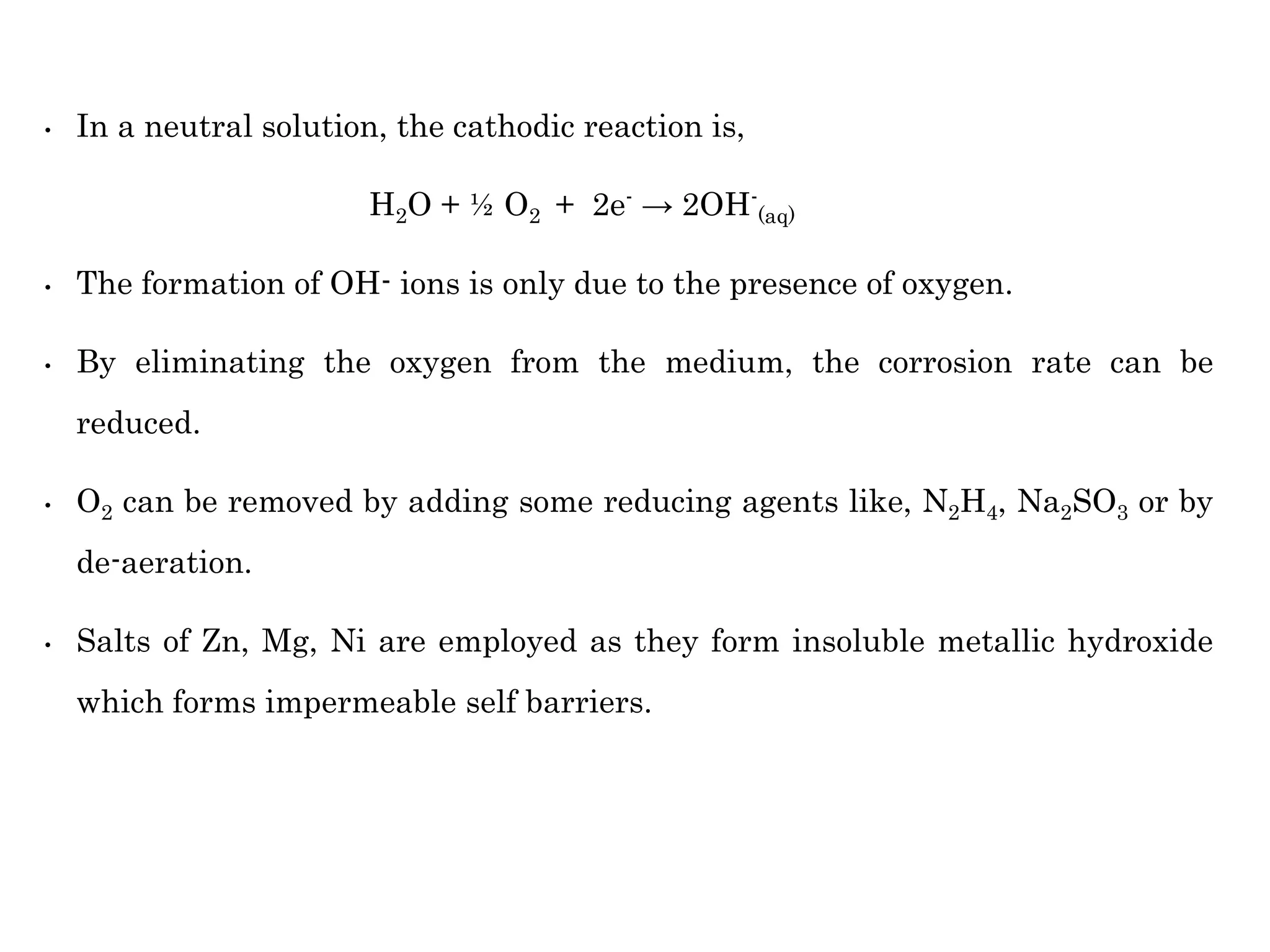
• In a neutral solution, the cathodic reaction is,
H2O + ½ O2 + 2e- → 2OH-
(aq)
• The formation of OH- ions is only due to the presence of oxygen.
• By eliminating the oxygen from the medium, the corrosion rate can be
reduced.
• O2 can be removed by adding some reducing agents like, N2H4, Na2SO3 or by
de-aeration.
• Salts of Zn, Mg, Ni are employed as they form insoluble metallic hydroxide
which forms impermeable self barriers.
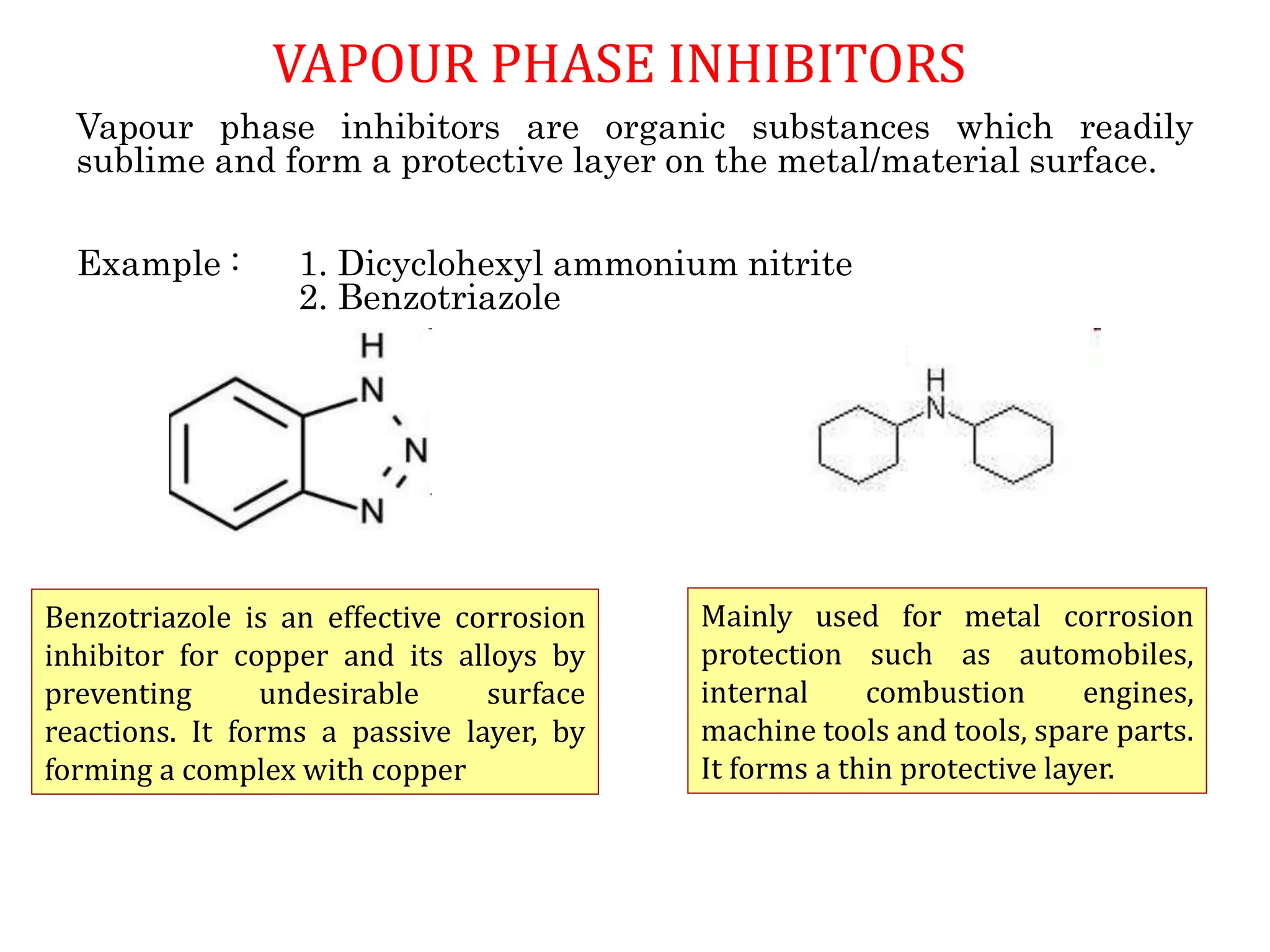
VAPOUR PHASE INHIBITORS
Vapour phase inhibitors are organic substances which readily
sublime and form a protective layer on the metal/material surface.
Example : 1. Dicyclohexyl ammonium nitrite
2. Benzotriazole
Mainly used for metal corrosion
protection such as automobiles,
internal combustion engines,
machine tools and tools, spare parts.
It forms a thin protective layer.
Benzotriazole is an effective corrosion
inhibitor for copper and its alloys by
preventing undesirable surface
reactions. It forms a passive layer, by
forming a complex with copper
58
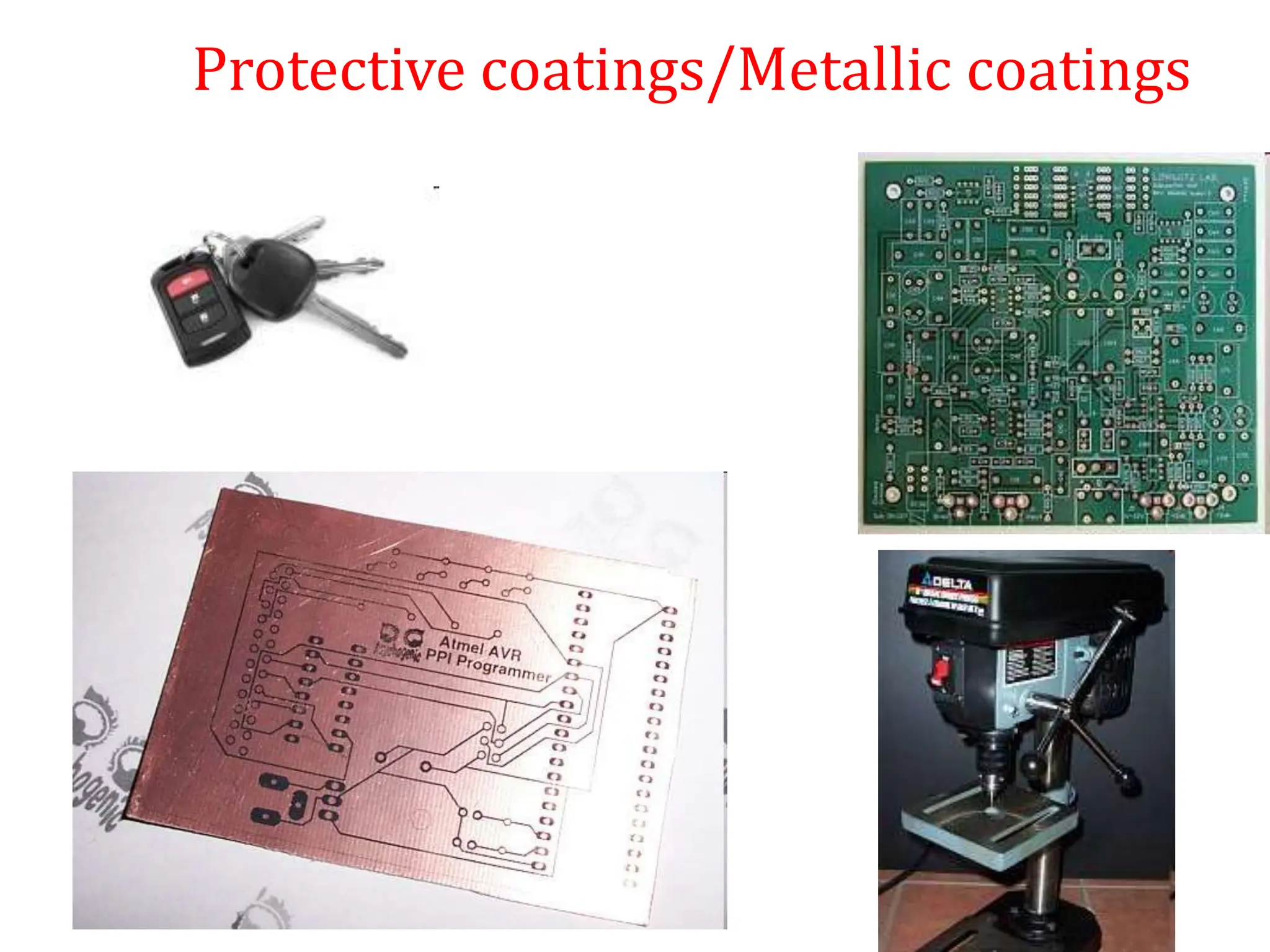
Protective coatings/Metallic coatings
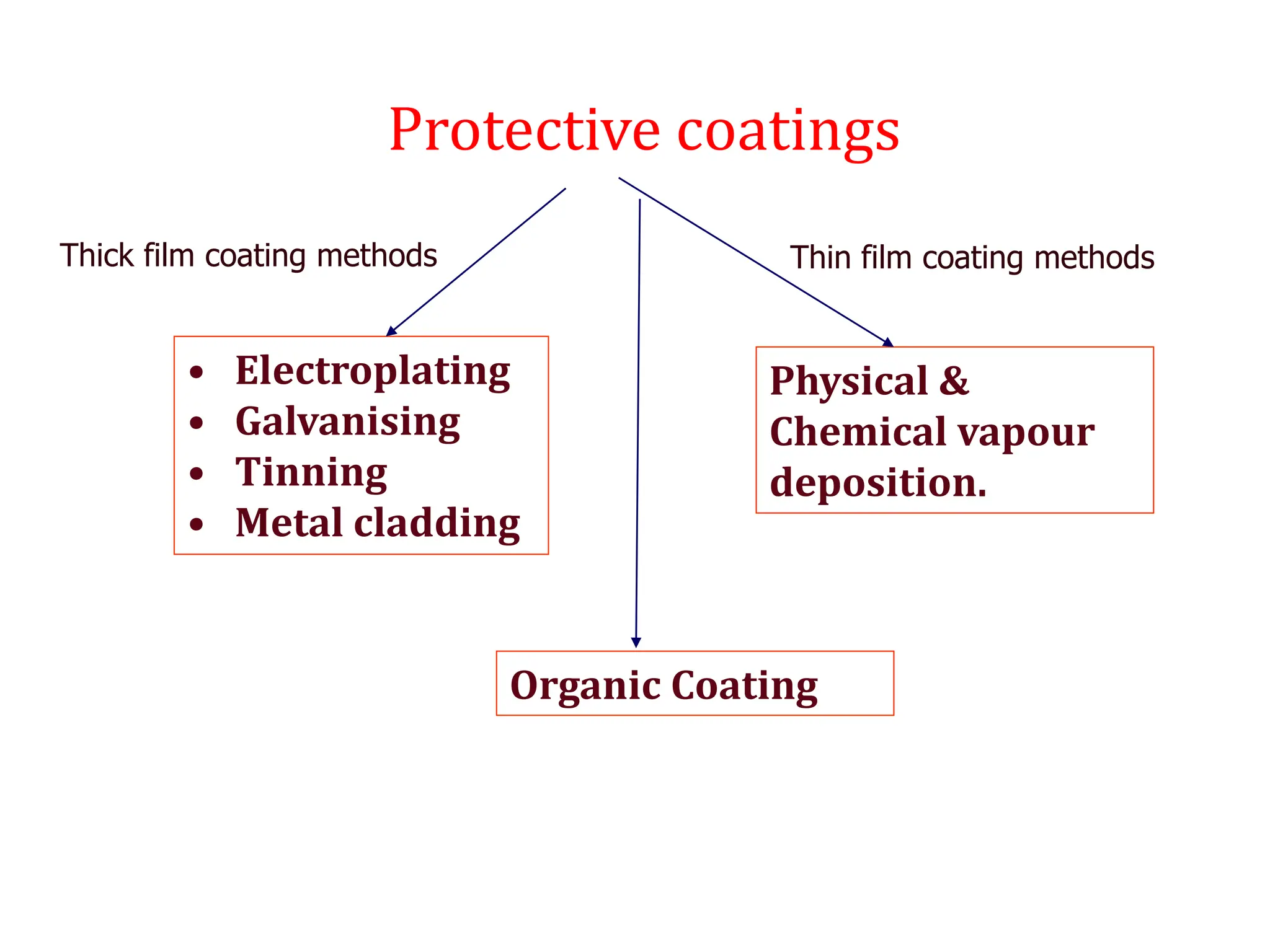
• Electroplating
• Galvanising
• Tinning
• Metal cladding
Physical &
Chemical vapour
deposition.
Thick film coating methods Thin film coating methods
Protective coatings
Organic Coating
Sample (or) substrate Preparation
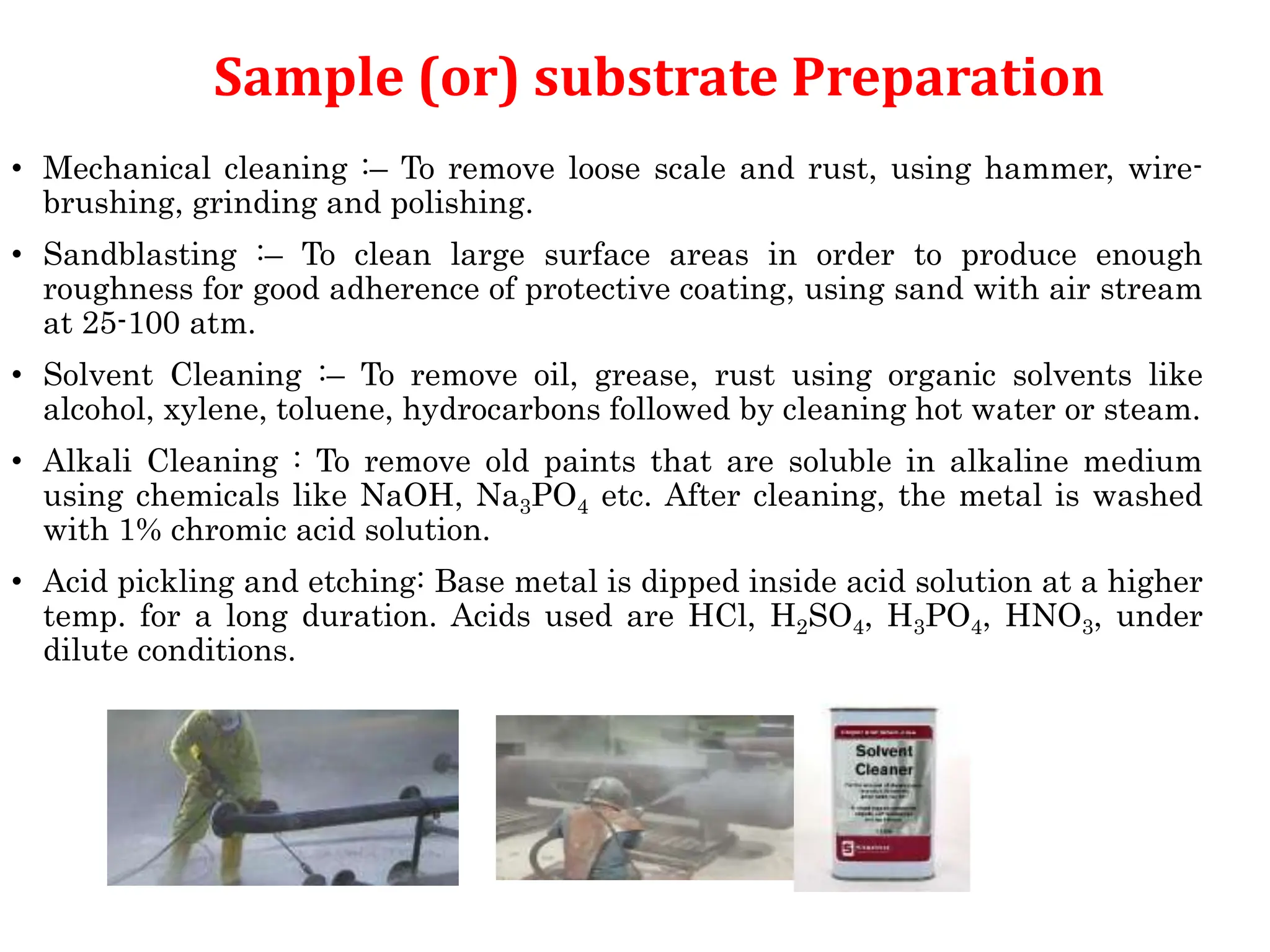
• Mechanical cleaning :– To remove loose scale and rust, using hammer, wire-
brushing, grinding and polishing.
• Sandblasting :– To clean large surface areas in order to produce enough
roughness for good adherence of protective coating, using sand with air stream
at 25-100 atm.
• Solvent Cleaning :– To remove oil, grease, rust using organic solvents like
alcohol, xylene, toluene, hydrocarbons followed by cleaning hot water or steam.
• Alkali Cleaning : To remove old paints that are soluble in alkaline medium
using chemicals like NaOH, Na3PO4 etc. After cleaning, the metal is washed
with 1% chromic acid solution.
• Acid pickling and etching: Base metal is dipped inside acid solution at a higher
temp. for a long duration. Acids used are HCl, H2SO4, H3PO4, HNO3, under
dilute conditions.
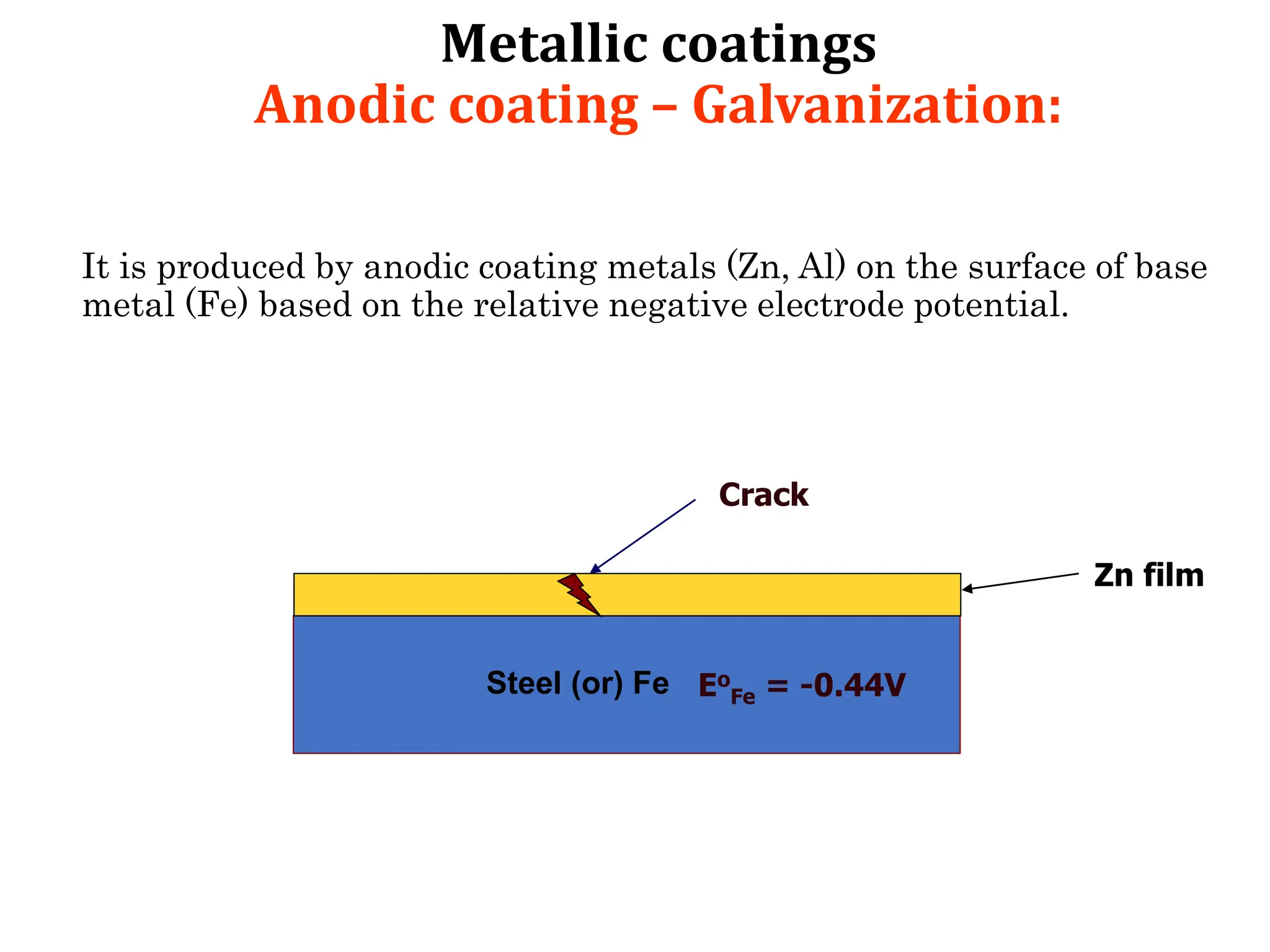
Metallic coatings
Anodic coating – Galvanization:
It is produced by anodic coating metals (Zn, Al) on the surface of base
metal (Fe) based on the relative negative electrode potential.
Steel (or) Fe
Zn film
Crack
Eo
Fe = -0.44V
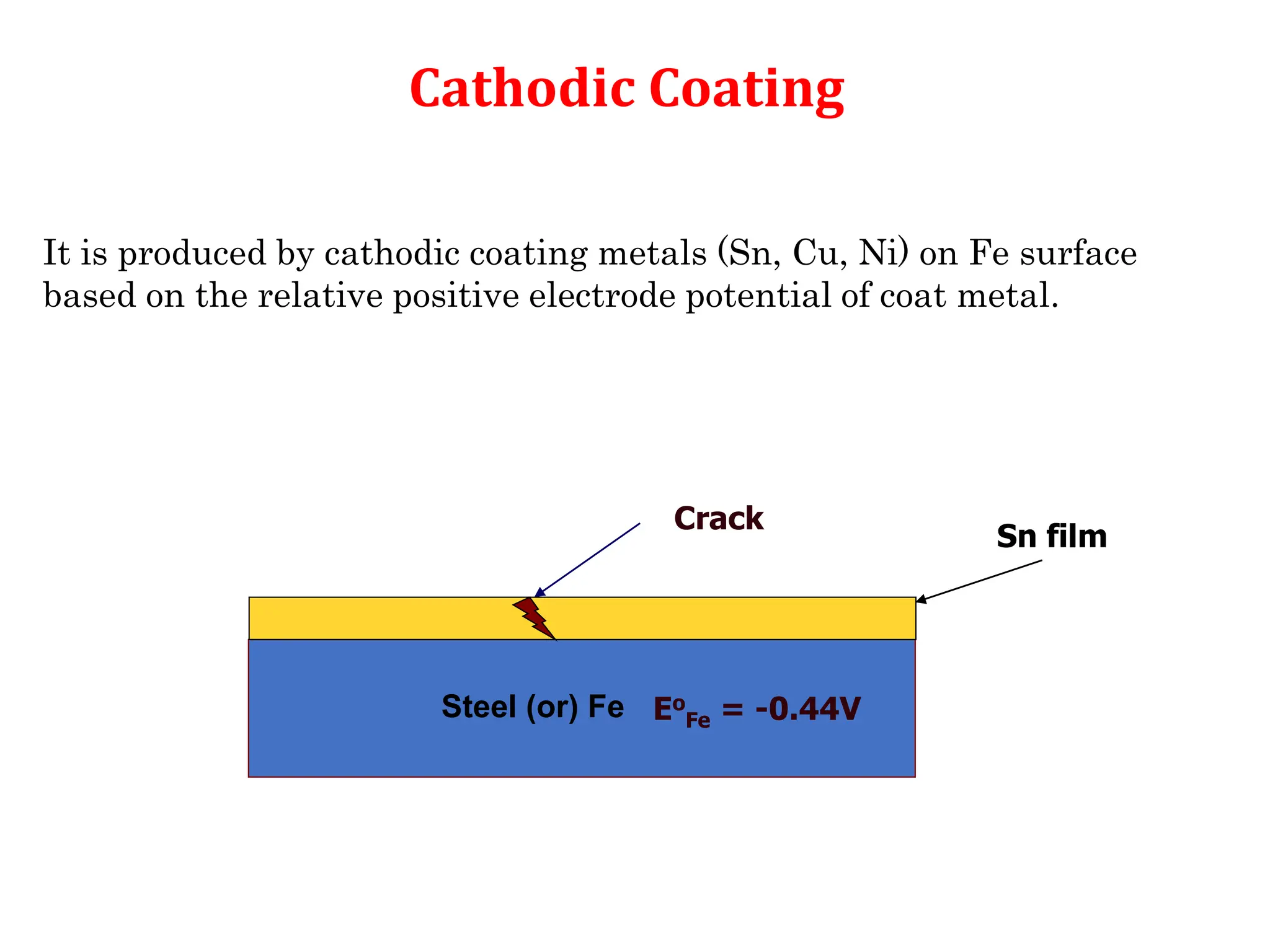
It is produced by cathodic coating metals (Sn, Cu, Ni) on Fe surface
based on the relative positive electrode potential of coat metal.
Steel (or) Fe
Sn film
Crack
Eo
Fe = -0.44V
Cathodic Coating
Methods for Metallic Coating
1. Hot dipping
2. Metal cladding
3. Electroplating
4. Cementation
5. Vacuum metalizing
6. Metal spraying
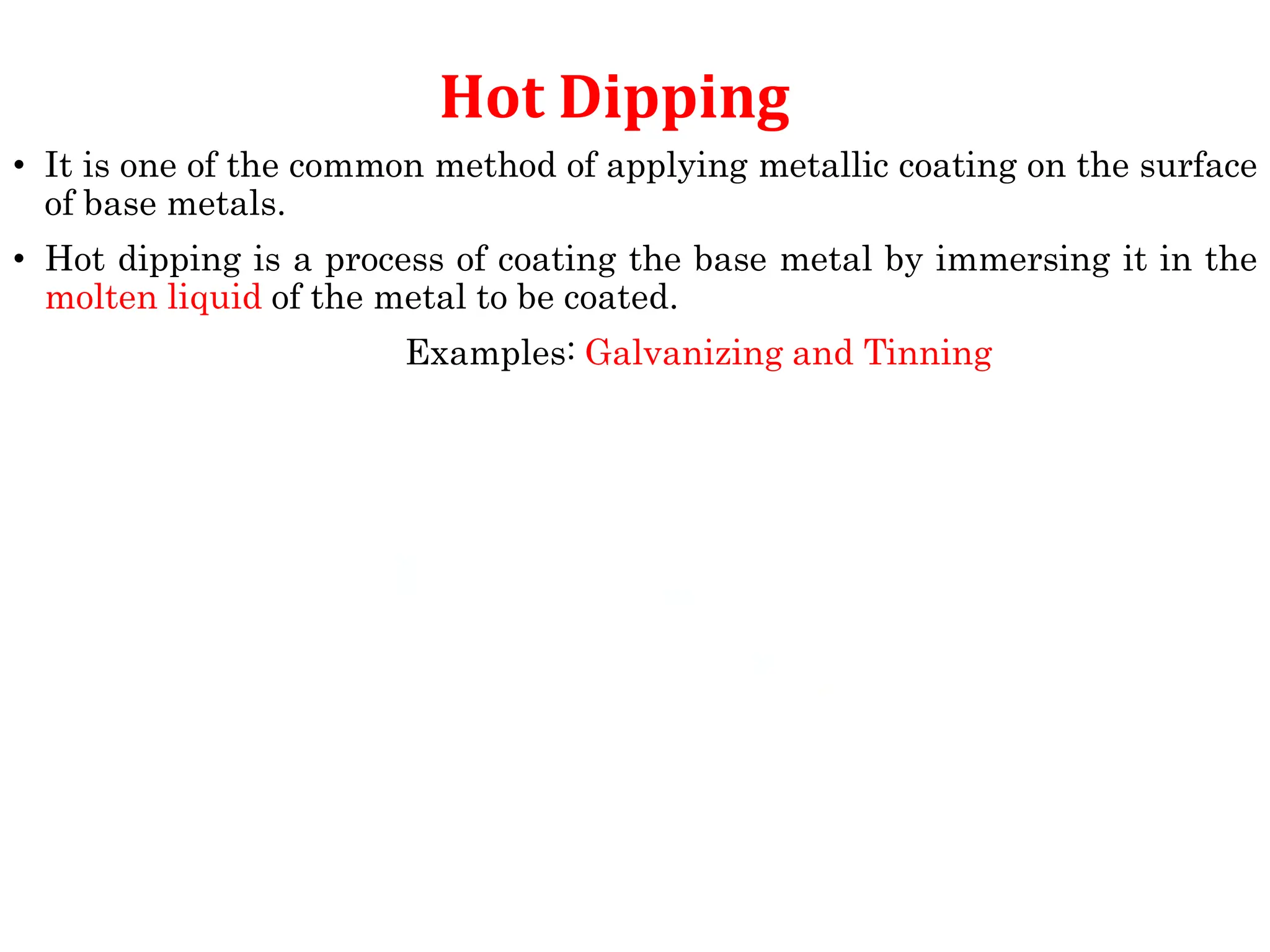
Hot Dipping
• It is one of the common method of applying metallic coating on the surface
of base metals.
• Hot dipping is a process of coating the base metal by immersing it in the
molten liquid of the metal to be coated.
Examples: Galvanizing and Tinning
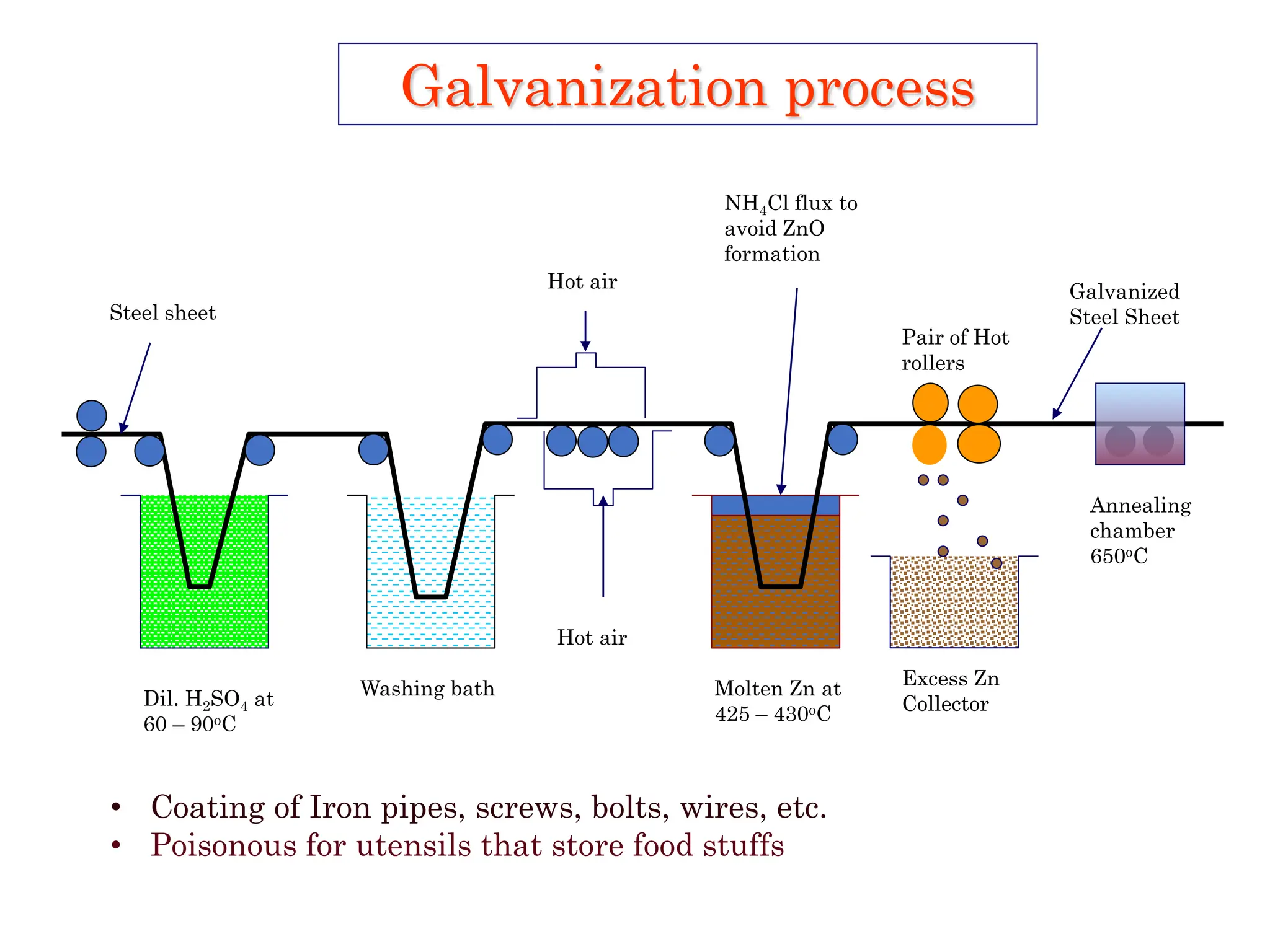
Hot air
Hot air
Pair of Hot
rollers
Annealing
chamber
650oC
Galvanized
Steel Sheet
Excess Zn
Collector
Molten Zn at
425 – 430oC
Washing bath
Dil. H2SO4 at
60 – 90oC
Steel sheet
NH4Cl flux to
avoid ZnO
formation
Galvanization process
• Coating of Iron pipes, screws, bolts, wires, etc.
• Poisonous for utensils that store food stuffs
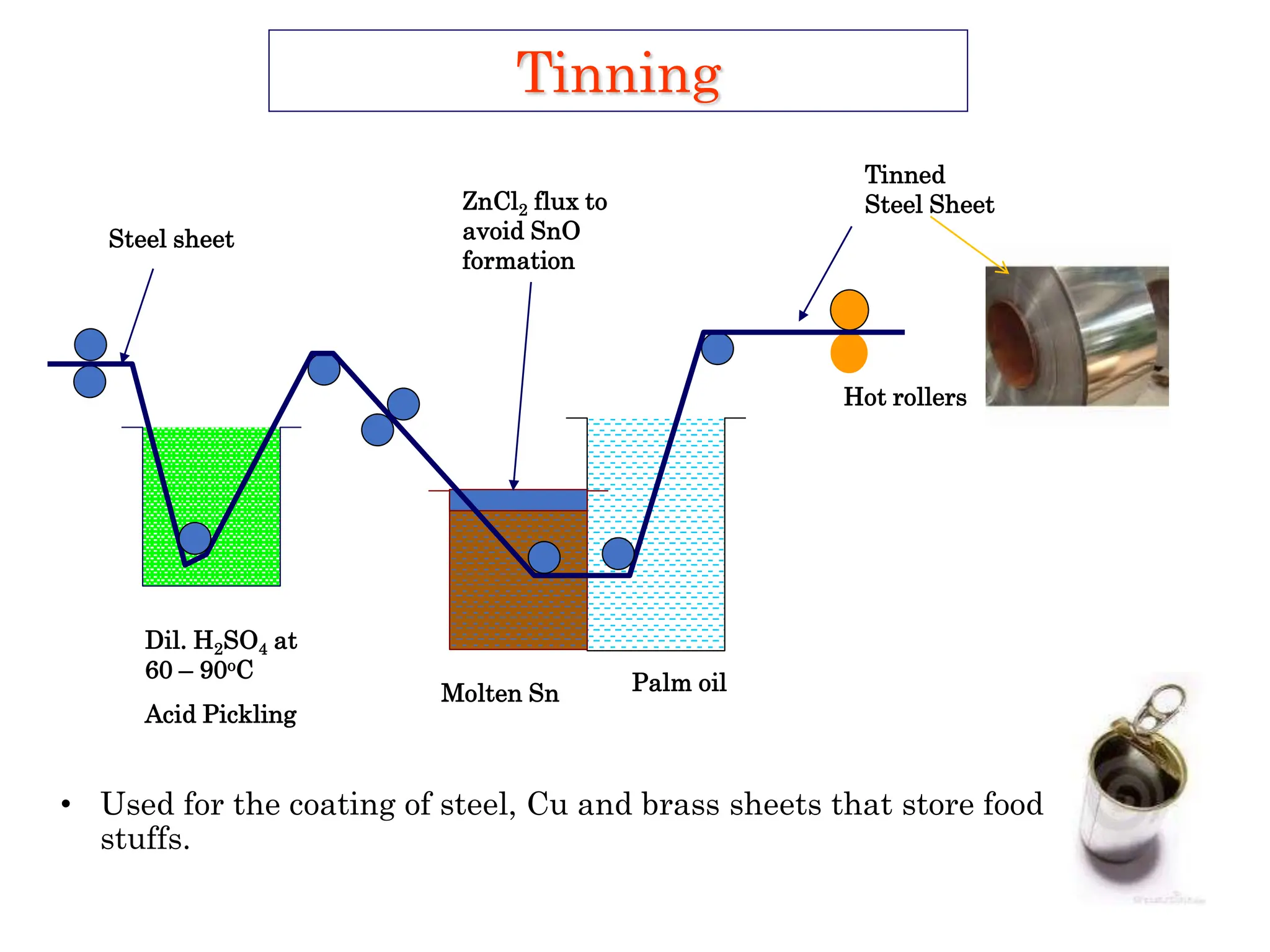
Hot rollers
Tinned
Steel Sheet
Molten Sn
Dil. H2SO4 at
60 – 90oC
Acid Pickling
Steel sheet
ZnCl2 flux to
avoid SnO
formation
Palm oil
• Used for the coating of steel, Cu and brass sheets that store food
stuffs.
Tinning
67
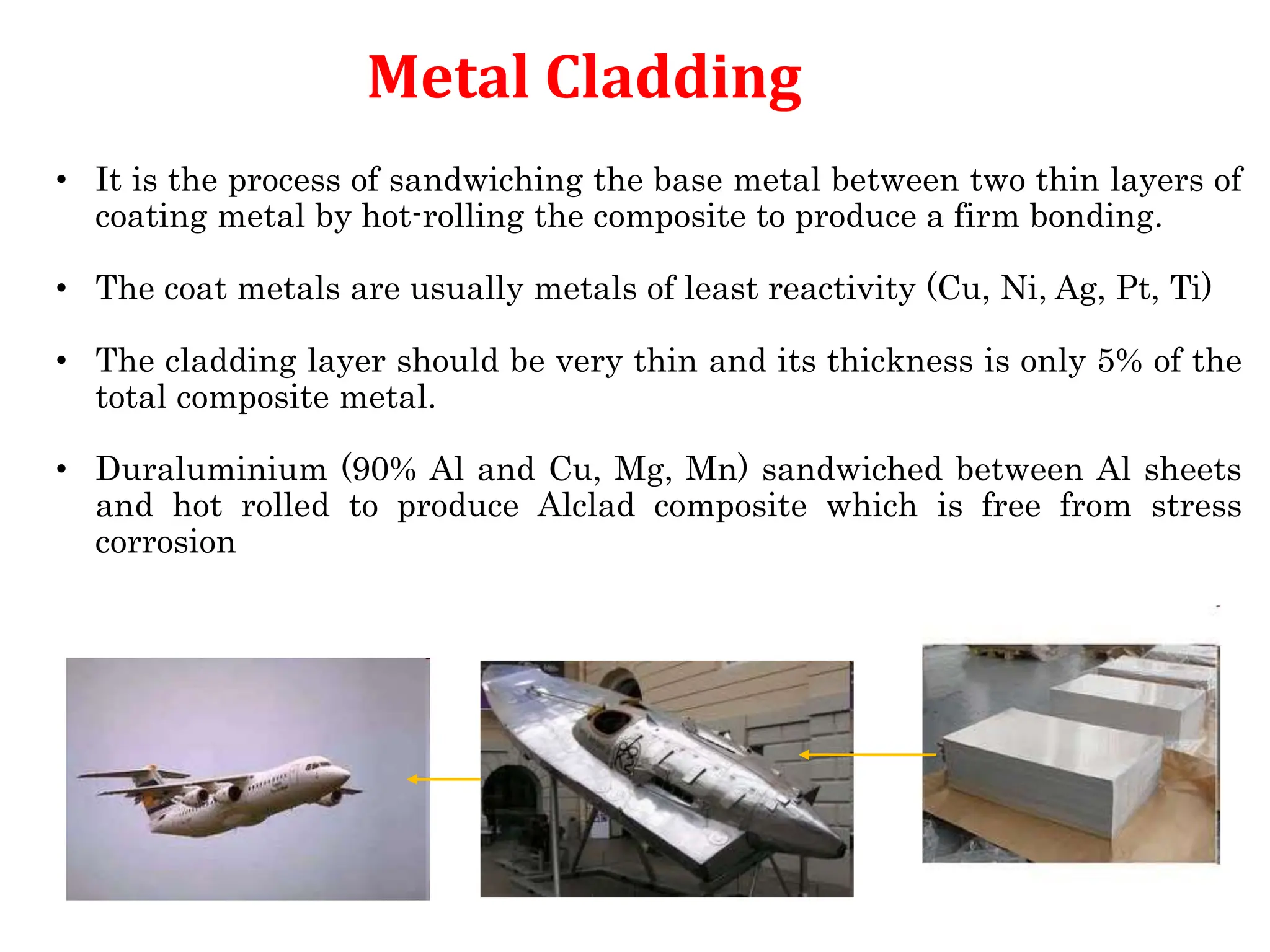
Metal Cladding
• It is the process of sandwiching the base metal between two thin layers of
coating metal by hot-rolling the composite to produce a firm bonding.
• The coat metals are usually metals of least reactivity (Cu, Ni, Ag, Pt, Ti)
• The cladding layer should be very thin and its thickness is only 5% of the
total composite metal.
• Duraluminium (90% Al and Cu, Mg, Mn) sandwiched between Al sheets
and hot rolled to produce Alclad composite which is free from stress
corrosion
Electroplating is the process in which the metal to be coated is deposited
on the base metal (substrate) by passing a direct current in the presence
of electrolytic solution containing the soluble salt of the metal to be
coated.
Objectives of electroplating:
(i) To increase the resistance to corrosion and chemical attack of the
plated metal.
(ii) To obtain a polished surface
(iii) To improve hardness and wear resistance
Uses :
(i) It is often used in electronic industries for making printed circuit
boards, edge connectors, semiconductor lead-out connection
(ii) It is also used in the manufacture of jewelry, refrigerator, electric
iron etc.
Electroplating
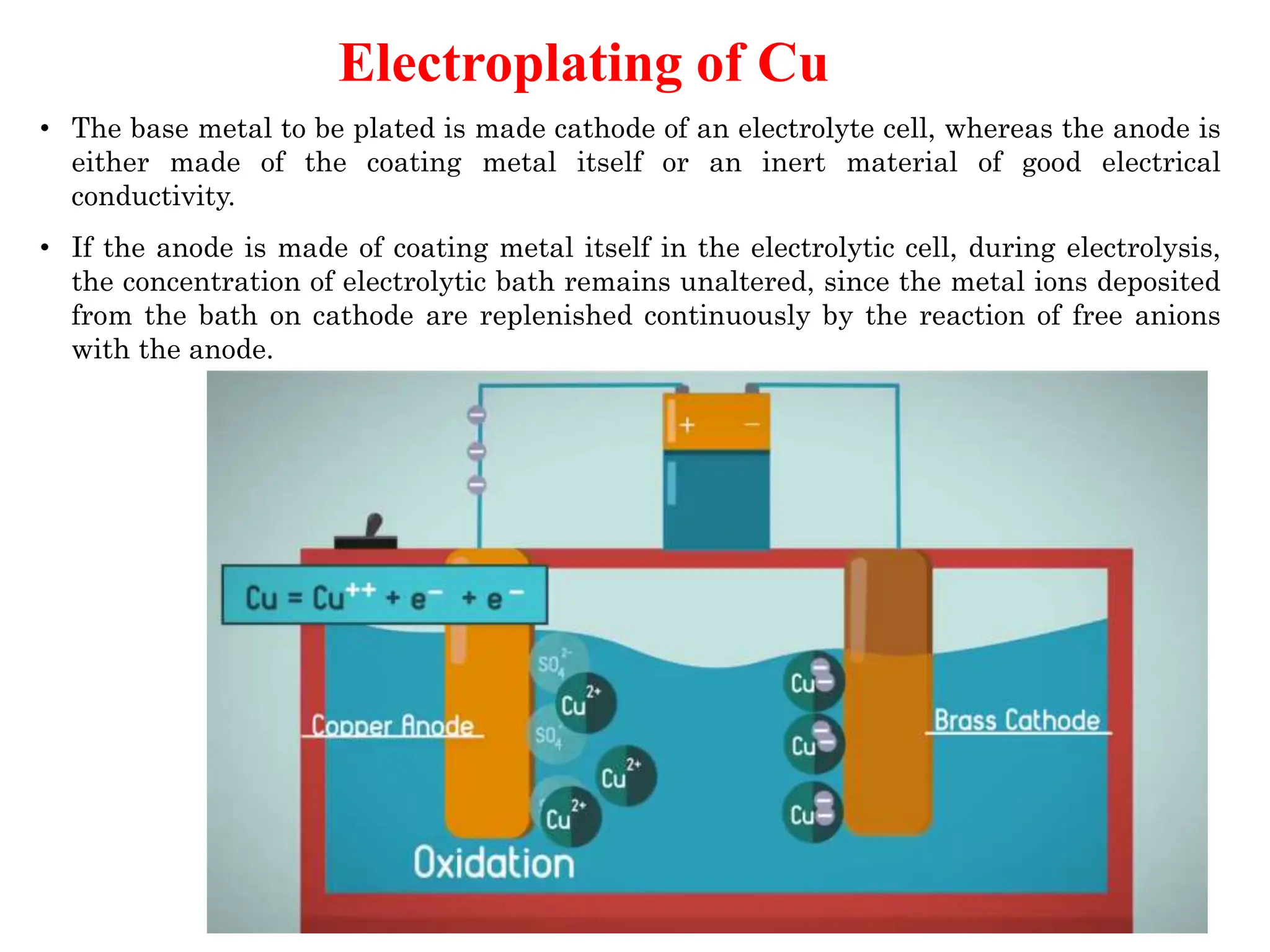
Electroplating of Cu
• The base metal to be plated is made cathode of an electrolyte cell, whereas the anode is
either made of the coating metal itself or an inert material of good electrical
conductivity.
• If the anode is made of coating metal itself in the electrolytic cell, during electrolysis,
the concentration of electrolytic bath remains unaltered, since the metal ions deposited
from the bath on cathode are replenished continuously by the reaction of free anions
with the anode.
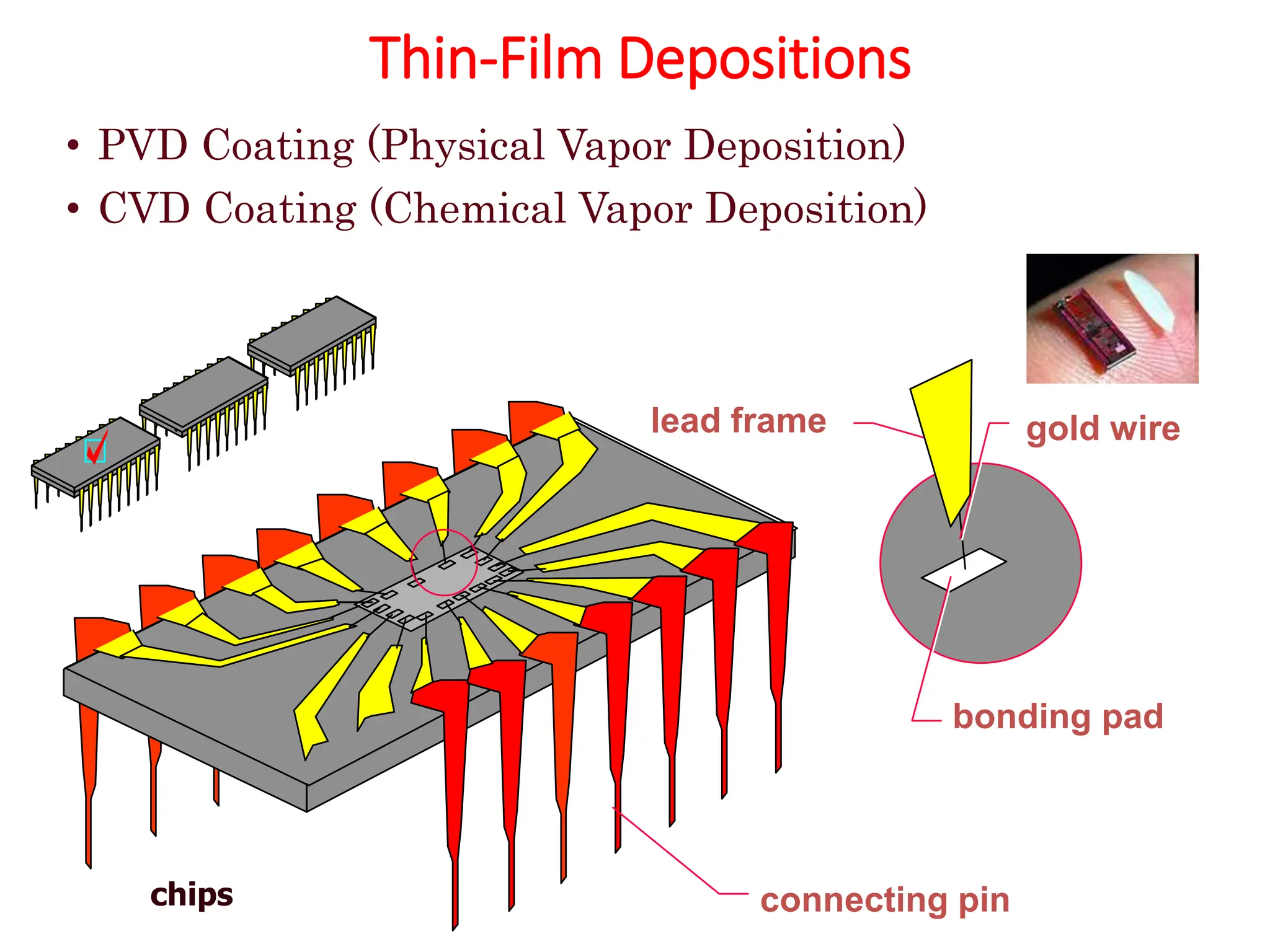
Thin-Film Depositions
• PVD Coating (Physical Vapor Deposition)
• CVD Coating (Chemical Vapor Deposition)
lead frame gold wire
bonding pad
connecting pin
chips
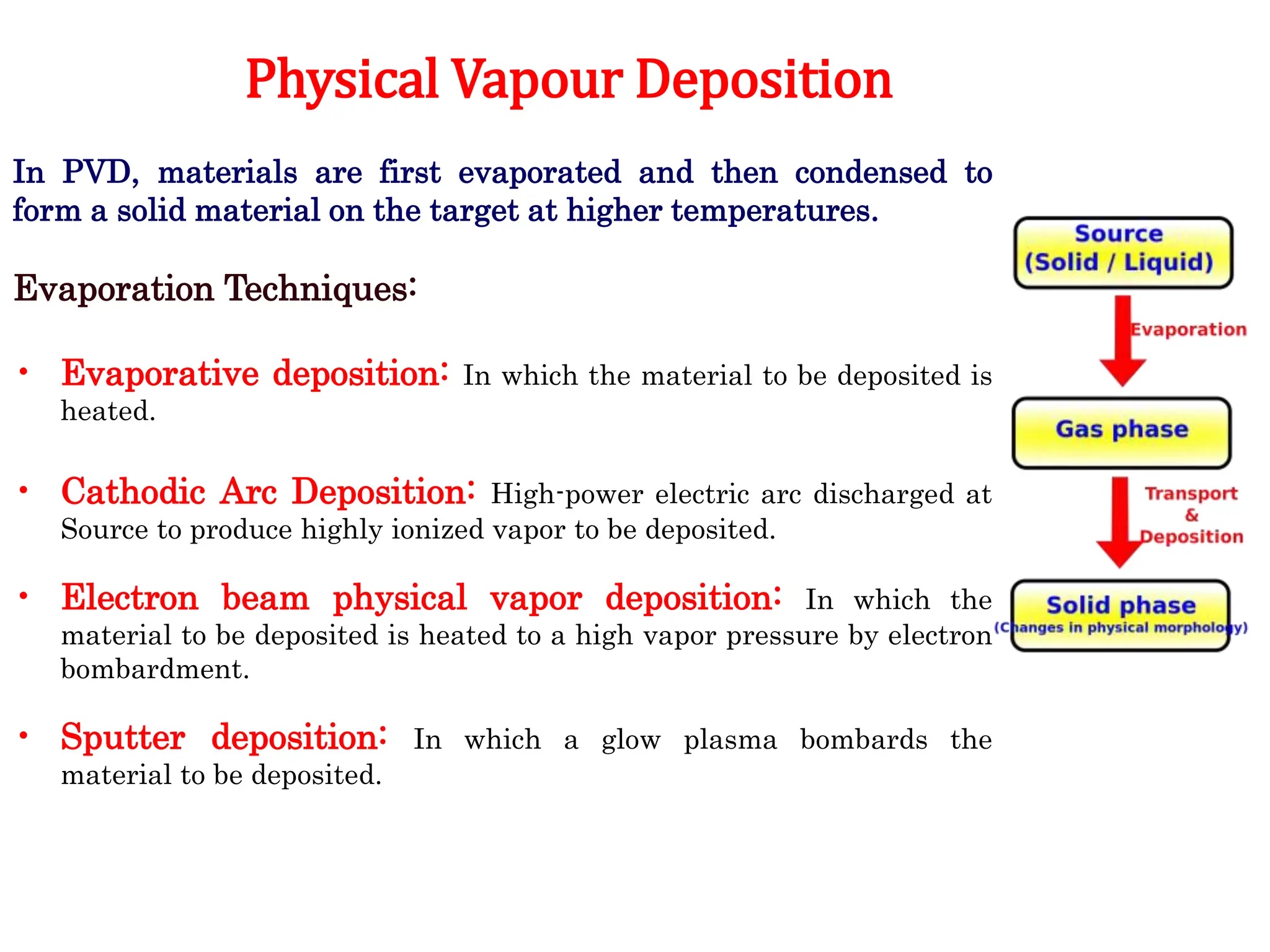
Physical Vapour Deposition
In PVD, materials are first evaporated and then condensed to
form a solid material on the target at higher temperatures.
Evaporation Techniques:
• Evaporative deposition: In which the material to be deposited is
heated.
• Cathodic Arc Deposition: High-power electric arc discharged at
Source to produce highly ionized vapor to be deposited.
• Electron beam physical vapor deposition: In which the
material to be deposited is heated to a high vapor pressure by electron
bombardment.
• Sputter deposition: In which a glow plasma bombards the
material to be deposited.
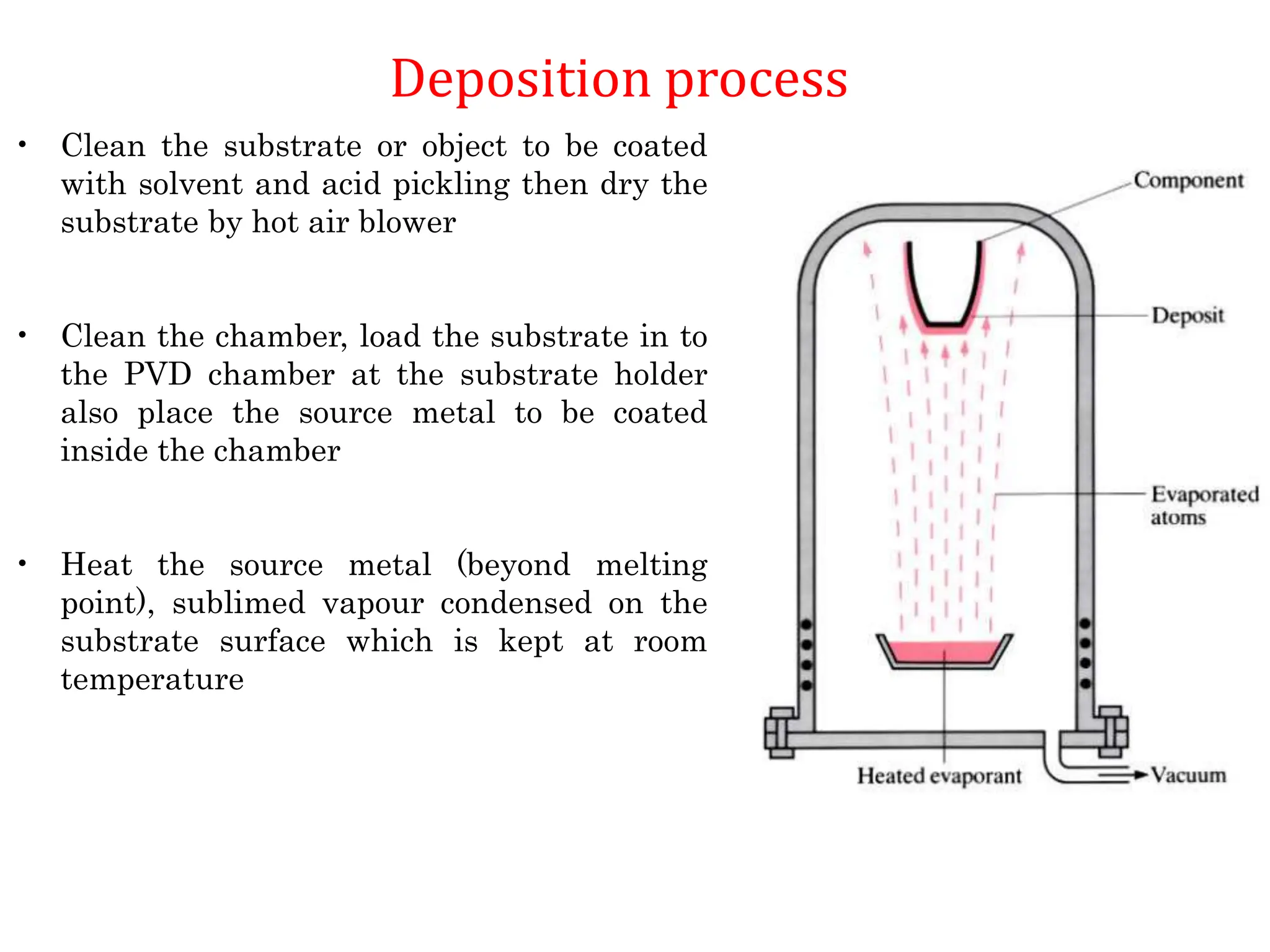
Deposition process
• Clean the substrate or object to be coated
with solvent and acid pickling then dry the
substrate by hot air blower
• Clean the chamber, load the substrate in to
the PVD chamber at the substrate holder
also place the source metal to be coated
inside the chamber
• Heat the source metal (beyond melting
point), sublimed vapour condensed on the
substrate surface which is kept at room
temperature
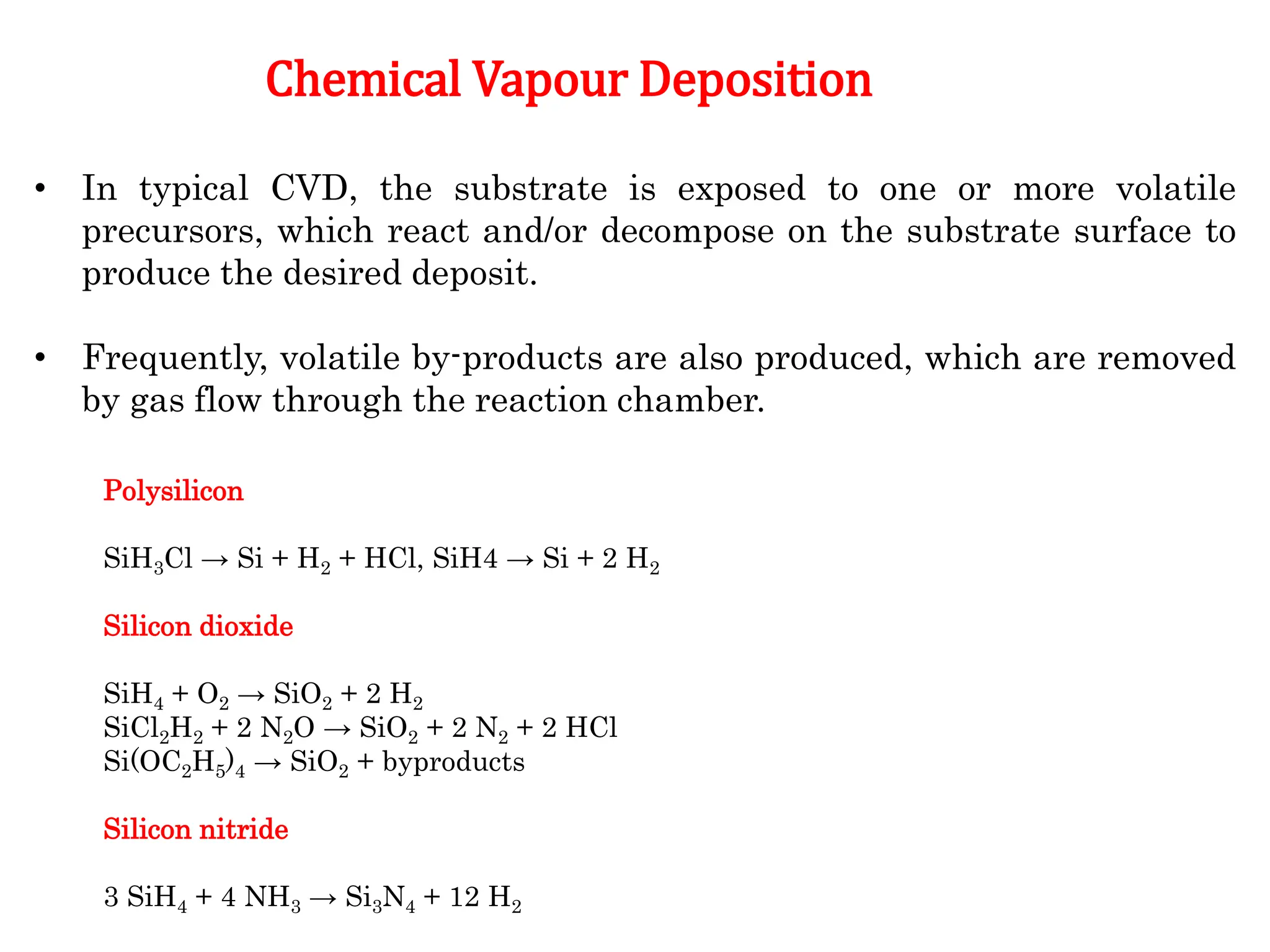
• In typical CVD, the substrate is exposed to one or more volatile
precursors, which react and/or decompose on the substrate surface to
produce the desired deposit.
• Frequently, volatile by-products are also produced, which are removed
by gas flow through the reaction chamber.
Chemical Vapour Deposition
Polysilicon
SiH3Cl → Si + H2 + HCl, SiH4 → Si + 2 H2
Silicon dioxide
SiH4 + O2 → SiO2 + 2 H2
SiCl2H2 + 2 N2O → SiO2 + 2 N2 + 2 HCl
Si(OC2H5)4 → SiO2 + byproducts
Silicon nitride
3 SiH4 + 4 NH3 → Si3N4 + 12 H2
• Organic coatings act as a protective barrier against corrosion and
oxidation.
• These are durable coatings applied to a substrate for their decorative
or specific technical properties.
• Organic coatings depend primarily on their chemical inertness and
impermeability.
• Various types of organic coatings are available for industrial purposes
including primers, adhesive cements and topcoats (enamel, varnish
and paints).
• Organic coatings are easy to apply with the help of brushes, sprays,
rollers, dips, or by electrostatic means.
• The coating cures or dries by evaporation or loss of solvent,
polymerization and oxidation.
Organic Coating
Thank you!

Corrosion, its causes and consequences and different control strategies

  • 1.
  • 2.
    Corrosion • Corrosion isthe deterioration or destruction and consequent loss of a solid metallic material due to chemical, electrochemical and other reactions of the exposed material surface with the surrounding environment. • Corrosion represents a return of metals to their more natural state as minerals (oxides). • Deterioration of metals through oxidation- usually but not always- to their oxides. • For example, when exposed to air, iron rusts, silver tarnishes, and copper and brass acquire a bluish-green surface called a patina.
  • 3.
    Corrosion Why are metalsnot found in their free state? Element Element Ore Formula Aluminium •Bauxite •Cryolite •Corundum •Al2O3.2H2O •Na3AlF6 •Al2O3 Zinc •Zinc blende •Calamine •Zincite •ZnS •ZnCO3 •ZnO Iron •Haematite •Magnetite •Iron Pyrites •Spathic Iron Ore •FeO3 •Fe3O4 •FeS2 •FeCO3 Copper •Malachite •Chalcopyrite •Copper Glance •CuCO3•Cu(OH)2 •CuFeS2 •Cu2S Tin •Tin Pyrites •Cassiterite •Cu2FeSnS4 •SnO2 Silver Silver Glance •Ag2S ENERGY METAL ORE
  • 4.
    Why do metalsundergo corrosion? Why most metals undergo corrosion but not Au and Pt.
  • 5.
    Consequences of Corrosion Due to formation of corrosion product over the machinery, the efficiency of the machine gets lost.  The products are contaminated due to corrosion.  The corroded equipment must be replaced frequently.  Plant failure due to corrosion.  Corrosion releases toxic products, health hazard, etc.
  • 6.
    Basics of Corrosion Need: 1.An Anode (where oxidation is taking place) 2. A Cathode (where reduction is taking place) 3. Conductive electrolyte 4. Electrical contact between the Anode and Cathode
  • 8.
    Basics of Corrosion Corrosionis essentially the oxidation of metal
  • 9.
    Different Theories ofCorrosion 9 Chemical or Dry Corrosion Electrochemical or Galvanic or Wet Corrosion Corrosion
  • 10.
    Dry or Chemicalcorrosion Dry corrosion is due to the attack of metal surfaces by the atmospheric gases such as oxygen, hydrogen sulphide, sulphur dioxide, nitrogen, inorganic liquids etc. There are three (sub-classification) main types of dry corrosion; 1. Oxidation corrosion (or) corrosion by oxygen 2. Corrosion by other gases 3. Liquid – Metal corrosion.
  • 11.
    Oxidation Corrosion • Oxidationcorrosion is brought about by the direct attack of oxygen at low or high temperatures on metal surface in the absence of moisture. • Alkali metals like (Li, Na, K, etc) and alkaline-earth metals (Mg, Ca, Sr, etc) are rapidly oxidized at low temperature. • At high temperature, almost all metals (expect Ag, Au and Pt) are oxidized.              2 2 2 2 O 2M O 2 2M O e 2 O 2 e 2 2M 2M n n n n n n n n M2+ M2+ Mn+ O2- O2- O2- Metal Atmosphere MO (Metal oxide)
  • 12.
    Oxidation Corrosion The natureof oxide film formed on the metal surface plays in important role in oxidation corrosion. • Stable oxide layer: a protective coating and no further corrosion can occur. Example: Al, Sn, Pb etc. • Unstable oxide layer: mainly produced on the surface of noble metals, which decomposes back to the metal and oxygen. Example: Pt, Ag, etc. • Volatile oxide layer: The oxide layer volatilizes as soon as it is formed, leaving the metal surface for further corrosion. Example: Molybdenum oxide. • Porous oxide layer: Metal oxides having pores and cracks allow penetration of oxygen to the underlying metal, resulting in the complete conversion of metal into its oxide. Example: Alkali, Alkaline Earth Metals
  • 13.
    The ratio ofthe volume of the oxide formed to the volume of the metal consumed is called “Pilling-Bedworth ratio”.
  • 14.
    • Corrosion byother gases such as Cl2, SO2, H2S, CO2, F2 or NOx • The extent of corrosion depends upon the chemical affinity between metal and the gas. • In dry atmosphere, these gases react with metal and form corrosion products which may be protective or non-protective. • Protective: Intensity or extent of attack decreases after layer formed. Dry Cl2 reacts with Ag and forms AgCl • Non-protective: Continuous Attack SnCl4 is volatile Corrosion by Other Gases
  • 15.
  • 16.
    This is dueto the chemical action of flowing liquid metal at high temperature on the surface of another metal. The corrosion reaction involves • Dissolution of a solid metal by a liquid metal • Liquid metal may penetrate in to the solid metal. Al Ga Gallium is corrosive to Aluminium Liquid metal Solid metal base Liquid– Metal Corrosion
  • 17.
    Wet corrosion occursunder the following conditions, • When two dissimilar metals are in contact with each other in the presence of an aqueous solution or moisture. • When conducting liquid is in contact with metal. Zn, Anode Eo Zn = -0.76V Fe, cathode Eo Fe = -0.44V Electrolyte Zn undergoes corrosion Electrolyte Fe undergoes corrosion Anodic Cathodic Wet or Electrochemical Corrosion
  • 18.
    At anode: oxidationor dissolution of metal takes place at this electrode releasing electrons M  M2++ 2e- At cathode: Reduction takes place using the electrons released at the anode. When one part of the metal acts as anode and the other as cathode and corrosion occurs and the following electrochemical reactions occur. Depends on the nature of the corrosive environment. • Hydrogen evolution type corrosion (Acidic solutions) • Hydroxide ion formation corrosion (Neutral/alkaline medium) Wet or Electrochemical Corrosion
  • 19.
    If the corrosiveenvironment in acidic in nature, hydrogen gas is evolved Fe metal: Anodic part Fe Fe2+ + 2e- Acidic environment: Cathodic part 2H+ + 2e- H2 H+Cl- H+Cl- As per the following reaction occurring at the cathode 2H+ + 2e- H2 H2 evolution corrosion
  • 20.
    Formation of OH-Type Corrosion • Anode: Fe undergoes dissolution to Fe2+ with the liberation of electrons. • Cathode: Liberated electrons follow from anode to cathode, where dissolved O2 is consumed to form OH- ions. ½ O2 + H2O + 2e-  2 OH- Fe2+ + 2 OH-  Fe(OH)2 Fe(OH)2 + 2 H2O + O2  4 Fe(OH)3 Or Fe2O3 Iron oxide film Fe metal (cathodic) )part) Crack (anodic part) Fe Fe2+ +2e- Corrosion occurs Atmosphere: Neutral electrolyte H2O O2 H2O O2 H2O O2 Fe2+ 2e- Fe(OH)3
  • 21.
    21 Examples for Wetcorrosion – Types/Forms Electrochemical Corrosion Concentration cell or Differential Aeration: Localized Differential Metallic or Bimetallic • Pitting • Stress Corrosion • Waterline Corrosion/ Concentration Corrosion • Inter-granular Corrosion Galvanic More negative electrode potential act as an anode Different conc of electrolyte or air? Low aerated act as an anode
  • 22.
    Inter-granular corrosion • Metalsand alloys have micro-structures that are made up of grains, and these grains have boundaries. Intergranular corrosion is an attack along or near the boundaries of several grains while the rest of the grain remains unaffected. This type of attack is caused by local differences in composition. • When it is severe it causes loss of strength and ductility.
  • 23.
    Pitting corrosion • Pittingoccur when there is break in protective oxide layer and imperfections on the underlying metal. • Caused by localized mechanical damage, chemical damage to a metals oxide film, or poor application of protective coating. • ”Pits” or “holes” range from deep cavities of small diameter to shallow depression.
  • 24.
    • Occurs whena metal is exposed to varying concentration of oxygen or any electrolyte on the surface of the base metal. Example • Metals partially immersed in water (or) conducting solution (called water line corrosion). • If a metal is partially immersed in a conducting solution the metal part above the solution is more aerated and hence become cathodic. • On the other hand, the metal part inside the solution is less aerated and thus, become anodic and suffers corrosion. ZnCl2 Zn rod More oxygenated part (Cathodic part) 1/2O2 + H2O + 2e- 2OH- Less oxygenated part (anodic part) Zn Zn2+ +2e- Undergoes corrosion Brine solution Water line Zn2 + Zn2 + Zn2+ + 2OH- Zn(OH)2 Waterline corrosion
  • 25.
    Stress Corrosion • Metaldevelop internal stress during manufacturing process. • Area under stress is high energy---- tend to oxidize--- ANODE • Stress free area---- Cathode
  • 26.
    Fretting Corrosion • Frettingcorrosion occurs when metals slide over each other and cause mechanical damage to one or both. • During relative movement of metals, two process may occur, (i) frictional heat is generated, which oxidize the metal to form oxide films. (ii) removal of the protective films resulting in exposure of fresh surface to corrosion attack. • This can be avoided by using harder materials, minimizing friction by lubrication or by proper designing of the equipment.
  • 27.
    • When twodifferent metals are in contact with each other in the presence of an aqueous solution (or) moisture, galvanic corrosion occurs. • The more active metal (with more negative electrode potential) acts as anode and the less active metal (with less negative potential) acts as cathode. e.g. Steel screw in a brass marine hardware corrodes. • This is due to galvanic corrosion. Iron as anode, is attacked and corroded, while Copper acts as cathodic and is not attacked. Fe, Anode Eo Zn = - 0.44V Cu, cathode Eo Cu = +0.34V Electrolyte Fe undergoes corrosion GALVANIC CORROSION
  • 28.
    Bolt and nutsmade of the same metal is preferred, Why? Rusting of a screw in an door knob It is preferred in practice, because galvanic corrosion is avoided due to homogeneous metals (no anodic and cathodic part).
  • 29.
    Chemical vs Electrochemicalcorrosion Chemical Corrosion Electrochemical Corrosion It occurs only in dry condition It occurs in the presence of moisture or electrolyte It is due to the direct chemical attack on the metal by the environment It is due to the set up of a large number of cathodic and anodic areas Even a homogeneous metal surface gets corroded Hetergeneous surface or bimetallic contact is required for corrosion Corrosion products accumulate in the same place, where corrosion occurs. Corrosion occurs at the anode, while products formed elsewhere Chemical corrosion is self-controlled It is continuous process It follows adsorption mechanism Eg. Formation of mild scale on iron surface It follows electrochemical reaction Eg. Rusting of iron in moist atmosphere
  • 30.
    Factors Affecting theRate of Corrosion 34 Nature of the metal 1. Position of the metal in EMF series More the diff. more the corrosion 2. Purity of the metal Pure less prone 3. Relative area of Anode and Cathode Low anodic area and high cathodic area Steel rivets in Cu plate 4. Physical state (Stress) on the metal 5. Solubility of corrosion product 6. Nature of the metal oxide (corrosion product) formed Like volatile?
  • 31.
    Factors influencing corrosion •Solution pH. • Oxidizing agent. • Temperature. • Surface Films. • Other Factors.
  • 33.
    Solution pH • Metalssuch as iron dissolve rapidly in acidic solution. In general, acidic media (pH < 7) are more corrosive than alkaline and neutral media. • Certain amphoteric metals dissolve rapidly in either acidic or basic solution. E.g. Al and Zn. • Noble metals are not affected by pH. E.g. gold and platinum. • H+ ions capture electrons and promote anodic corrosion.
  • 34.
    Oxidizing agents  Oxidizingagents accelerate the corrosion of one class of materials, whereas retard another class.  Oxidizing agents such as oxygen react with hydrogen to form water. Once hydrogen is removed, corrosion is accelerated. E.g. copper in NaCl  Oxidizing agent retard corrosion due to formation of surface oxide films, which makes the surface more resistant to chemical attack.  Thus a balance between the power of oxidizing agent to preserve the protective layer and their tendency to destroy the protective film determine the corrosion of metal.
  • 35.
    Temperature • Rise intemp increase rate of corrosion. • Increase in temp reduce the solubility of oxygen or air. The released oxygen enhances the corrosion. • Increase in temp induces phase change, which enhance the rate of corrosion.
  • 36.
    Corrosion and itsControl Inter-granular Corrosion
  • 37.
    1. Materials selection 2.Alteration of the Environment 3. Proper Design of articles – Avoid Crevice and sharp bends 4. Cathodic protection methods: a) Sacrificial Anodic Protection b) Impressed Current Cathodic Protection method 5. Anodic protection method: 6. Corrosion Inhibitors: a) Anodic inhibitors b) Cathodic inhibitors c) Vapour phase inhibitors 7. Protective coating: a) Electroplating and electro-less plating b) Physical vapour deposition c) Chemical vapour deposition Control of corrosion
  • 39.
    Materials selection • UsingPure Metals: Impurity in metal causes heterogeneity that leads to corrosion. • Using Metal alloys: Corrosion resistant Example: Cr in Fe or steel produces stable oxide film, which protect the steel from further corrosion. • Large anodic area of the metal • position of the metals in the galvanic series Materials selection
  • 40.
    Typical changes inmedium are: • Lowering temperature – • Removing oxygen or oxidizers – De-aeration or Hydrazine • Removing Moisture: Dehumidification by silica gel or Alumina • Alkaline neutralization– Acidity decrease Alteration of the Environment
  • 41.
    • Wall thickness– allowance to accommodate for corrosion effect. • Avoid excessive mechanical stresses and stress concentrations in components exposed to corrosive mediums. • Metallic Contact: Avoid galvanic contact • Avoid crevices – e.g weld rather than rivets and bolts, proper trimming of gasket, etc. Proper Design
  • 42.
    Cathodic Protection methods •The principle involved in cathodic protection is to force the metal to be protected to behave like a cathode. • Since, there will not be any anodic area on the metal, corrosion will not occur. There are two types of cathodic protection • Sacrificial anodic protection method • Impressed current cathodic protection method
  • 44.
    • In thismethod, the metallic structure to be protected is made cathode by connecting it with more active metal (anodic metal). • So that all the corrosion will concentrate only on the active metal • The artificially made anode thus gradually gets corroded protecting the original metallic structure • Hence this process is otherwise known as sacrificial anodic protection. SACRIFICIAL ANODIC PROTECTION METHOD
  • 45.
    Insulated copper wire SacrificialZn or Mg Ship hull Examples of sacrificial anode: • This method is used for the protection of ships and boats. • Sheets of zinc and magnesium are hung around the hull of the ship • Zinc and magnesium being anodic to iron get corroded. • Since they are sacrificed in the process of saving iron (anode), they are called sacrificial anodes
  • 47.
    IMPRESSED CURRENT CATHODICPROTECTION • In this method, an impressed current is applied in the opposite direction to nullify the corrosion current and convert the corroding metal from anode to cathode • This can be done by connecting negative terminal of the battery to the metallic structure to be protected • Positive terminal of battery is connected to an inert anode. Inert anode used for this purpose is graphite (or) platinised titanium.
  • 48.
    Anodic Protection Method •The principle involved in anodic protection is to force the metal to be protected to behave like “more anodic”. • Used for metals which form protective layer, like Al, Cr, Ni etc. • In this method, a predetermined potential is applied to the metal specimen and the corresponding current changes are observed. • During the initial stage, the current increases indicating the dissolution of the metal. • When the current reaches a critical point, passivation occur, i.e., the oxide layers set in suitable oxidizing environment. The potential at the critical point is called passivating potential. • Above this passivating potential, the current flows decreases to a very small value called passivating current, the minimum protective current density required to maintain passivation. • At this stage, an increase in potential will not be corrode metal since the later is in highly passive state.
  • 49.
    CORROSION INHIBITORS Inhibitors areclassified in to three types, 1. ANODIC INHIBITORS 2. CATHODIC INHIBITORS 3. VAPOUR PHASE INHIBITORS A corrosion inhibitors is a substance which when added to in small quantities to the aqueous corrosive environment effectively decreases the rate of corrosion of the metal.
  • 50.
    • Chromates, phosphates,tungstates of transition elements, inhibit the anodic corrosion reaction by forming sparingly soluble compound with a newly produced metal ion. • They are absorbed on the metal surface forming a protective film or barrier thereby reducing corrosion rate. • This kind of corrosion rate is not fully reliable since certain areas left uncovered by the film can produce severe corrosion. ANODIC INHIBITORS Ni2+ CrO4 2- + Fe3+  Fe2(CrO4)3 Iron metal rod immersed in corrosive medium corrosive medium Protective metal chromate layer NiCrO4 Inhibitor Iron (III) Chromate
  • 51.
    • In acidicsolution, the main cathodic reaction is evolution of hydrogen. 2H+ (aq) +2e- → H2 (g) • In an acidic solution, the corrosion can be controlled by slowing down the diffusion of H+ ions through the cathode. • This can be done by adding organic inhibitors like amines, pyridine, azoles, etc. They absorb over the cathodic metal surface and act as a protective layer. CATHODIC INHIBITORS 2H+ 2Cl- Fe2+ 2e- Anode Cathode 2H+ H2
  • 52.
    • In aneutral solution, the cathodic reaction is, H2O + ½ O2 + 2e- → 2OH- (aq) • The formation of OH- ions is only due to the presence of oxygen. • By eliminating the oxygen from the medium, the corrosion rate can be reduced. • O2 can be removed by adding some reducing agents like, N2H4, Na2SO3 or by de-aeration. • Salts of Zn, Mg, Ni are employed as they form insoluble metallic hydroxide which forms impermeable self barriers.
  • 53.
    VAPOUR PHASE INHIBITORS Vapourphase inhibitors are organic substances which readily sublime and form a protective layer on the metal/material surface. Example : 1. Dicyclohexyl ammonium nitrite 2. Benzotriazole Mainly used for metal corrosion protection such as automobiles, internal combustion engines, machine tools and tools, spare parts. It forms a thin protective layer. Benzotriazole is an effective corrosion inhibitor for copper and its alloys by preventing undesirable surface reactions. It forms a passive layer, by forming a complex with copper
  • 54.
  • 55.
    • Electroplating • Galvanising •Tinning • Metal cladding Physical & Chemical vapour deposition. Thick film coating methods Thin film coating methods Protective coatings Organic Coating
  • 56.
    Sample (or) substratePreparation • Mechanical cleaning :– To remove loose scale and rust, using hammer, wire- brushing, grinding and polishing. • Sandblasting :– To clean large surface areas in order to produce enough roughness for good adherence of protective coating, using sand with air stream at 25-100 atm. • Solvent Cleaning :– To remove oil, grease, rust using organic solvents like alcohol, xylene, toluene, hydrocarbons followed by cleaning hot water or steam. • Alkali Cleaning : To remove old paints that are soluble in alkaline medium using chemicals like NaOH, Na3PO4 etc. After cleaning, the metal is washed with 1% chromic acid solution. • Acid pickling and etching: Base metal is dipped inside acid solution at a higher temp. for a long duration. Acids used are HCl, H2SO4, H3PO4, HNO3, under dilute conditions.
  • 57.
    Metallic coatings Anodic coating– Galvanization: It is produced by anodic coating metals (Zn, Al) on the surface of base metal (Fe) based on the relative negative electrode potential. Steel (or) Fe Zn film Crack Eo Fe = -0.44V
  • 58.
    It is producedby cathodic coating metals (Sn, Cu, Ni) on Fe surface based on the relative positive electrode potential of coat metal. Steel (or) Fe Sn film Crack Eo Fe = -0.44V Cathodic Coating
  • 59.
    Methods for MetallicCoating 1. Hot dipping 2. Metal cladding 3. Electroplating 4. Cementation 5. Vacuum metalizing 6. Metal spraying
  • 60.
    Hot Dipping • Itis one of the common method of applying metallic coating on the surface of base metals. • Hot dipping is a process of coating the base metal by immersing it in the molten liquid of the metal to be coated. Examples: Galvanizing and Tinning
  • 61.
    Hot air Hot air Pairof Hot rollers Annealing chamber 650oC Galvanized Steel Sheet Excess Zn Collector Molten Zn at 425 – 430oC Washing bath Dil. H2SO4 at 60 – 90oC Steel sheet NH4Cl flux to avoid ZnO formation Galvanization process • Coating of Iron pipes, screws, bolts, wires, etc. • Poisonous for utensils that store food stuffs
  • 62.
    Hot rollers Tinned Steel Sheet MoltenSn Dil. H2SO4 at 60 – 90oC Acid Pickling Steel sheet ZnCl2 flux to avoid SnO formation Palm oil • Used for the coating of steel, Cu and brass sheets that store food stuffs. Tinning
  • 63.
    67 Metal Cladding • Itis the process of sandwiching the base metal between two thin layers of coating metal by hot-rolling the composite to produce a firm bonding. • The coat metals are usually metals of least reactivity (Cu, Ni, Ag, Pt, Ti) • The cladding layer should be very thin and its thickness is only 5% of the total composite metal. • Duraluminium (90% Al and Cu, Mg, Mn) sandwiched between Al sheets and hot rolled to produce Alclad composite which is free from stress corrosion
  • 64.
    Electroplating is theprocess in which the metal to be coated is deposited on the base metal (substrate) by passing a direct current in the presence of electrolytic solution containing the soluble salt of the metal to be coated. Objectives of electroplating: (i) To increase the resistance to corrosion and chemical attack of the plated metal. (ii) To obtain a polished surface (iii) To improve hardness and wear resistance Uses : (i) It is often used in electronic industries for making printed circuit boards, edge connectors, semiconductor lead-out connection (ii) It is also used in the manufacture of jewelry, refrigerator, electric iron etc. Electroplating
  • 65.
    Electroplating of Cu •The base metal to be plated is made cathode of an electrolyte cell, whereas the anode is either made of the coating metal itself or an inert material of good electrical conductivity. • If the anode is made of coating metal itself in the electrolytic cell, during electrolysis, the concentration of electrolytic bath remains unaltered, since the metal ions deposited from the bath on cathode are replenished continuously by the reaction of free anions with the anode.
  • 67.
    Thin-Film Depositions • PVDCoating (Physical Vapor Deposition) • CVD Coating (Chemical Vapor Deposition) lead frame gold wire bonding pad connecting pin chips
  • 68.
    Physical Vapour Deposition InPVD, materials are first evaporated and then condensed to form a solid material on the target at higher temperatures. Evaporation Techniques: • Evaporative deposition: In which the material to be deposited is heated. • Cathodic Arc Deposition: High-power electric arc discharged at Source to produce highly ionized vapor to be deposited. • Electron beam physical vapor deposition: In which the material to be deposited is heated to a high vapor pressure by electron bombardment. • Sputter deposition: In which a glow plasma bombards the material to be deposited.
  • 69.
    Deposition process • Cleanthe substrate or object to be coated with solvent and acid pickling then dry the substrate by hot air blower • Clean the chamber, load the substrate in to the PVD chamber at the substrate holder also place the source metal to be coated inside the chamber • Heat the source metal (beyond melting point), sublimed vapour condensed on the substrate surface which is kept at room temperature
  • 71.
    • In typicalCVD, the substrate is exposed to one or more volatile precursors, which react and/or decompose on the substrate surface to produce the desired deposit. • Frequently, volatile by-products are also produced, which are removed by gas flow through the reaction chamber. Chemical Vapour Deposition Polysilicon SiH3Cl → Si + H2 + HCl, SiH4 → Si + 2 H2 Silicon dioxide SiH4 + O2 → SiO2 + 2 H2 SiCl2H2 + 2 N2O → SiO2 + 2 N2 + 2 HCl Si(OC2H5)4 → SiO2 + byproducts Silicon nitride 3 SiH4 + 4 NH3 → Si3N4 + 12 H2
  • 73.
    • Organic coatingsact as a protective barrier against corrosion and oxidation. • These are durable coatings applied to a substrate for their decorative or specific technical properties. • Organic coatings depend primarily on their chemical inertness and impermeability. • Various types of organic coatings are available for industrial purposes including primers, adhesive cements and topcoats (enamel, varnish and paints). • Organic coatings are easy to apply with the help of brushes, sprays, rollers, dips, or by electrostatic means. • The coating cures or dries by evaporation or loss of solvent, polymerization and oxidation. Organic Coating
  • 74.