Corrosion and its control
 Definition of corrosion
 Deterioration or degradation of a metal by chemical or electrochemical reaction with its
environment at its surface is called corrosion
 Corrosion is when a refined metal is naturally converted to a more stable form such as its
oxide, hydroxide or sulphide state this leads to deterioration of the material
 Degradation includes weakening of a material and loss of properties of a metal.
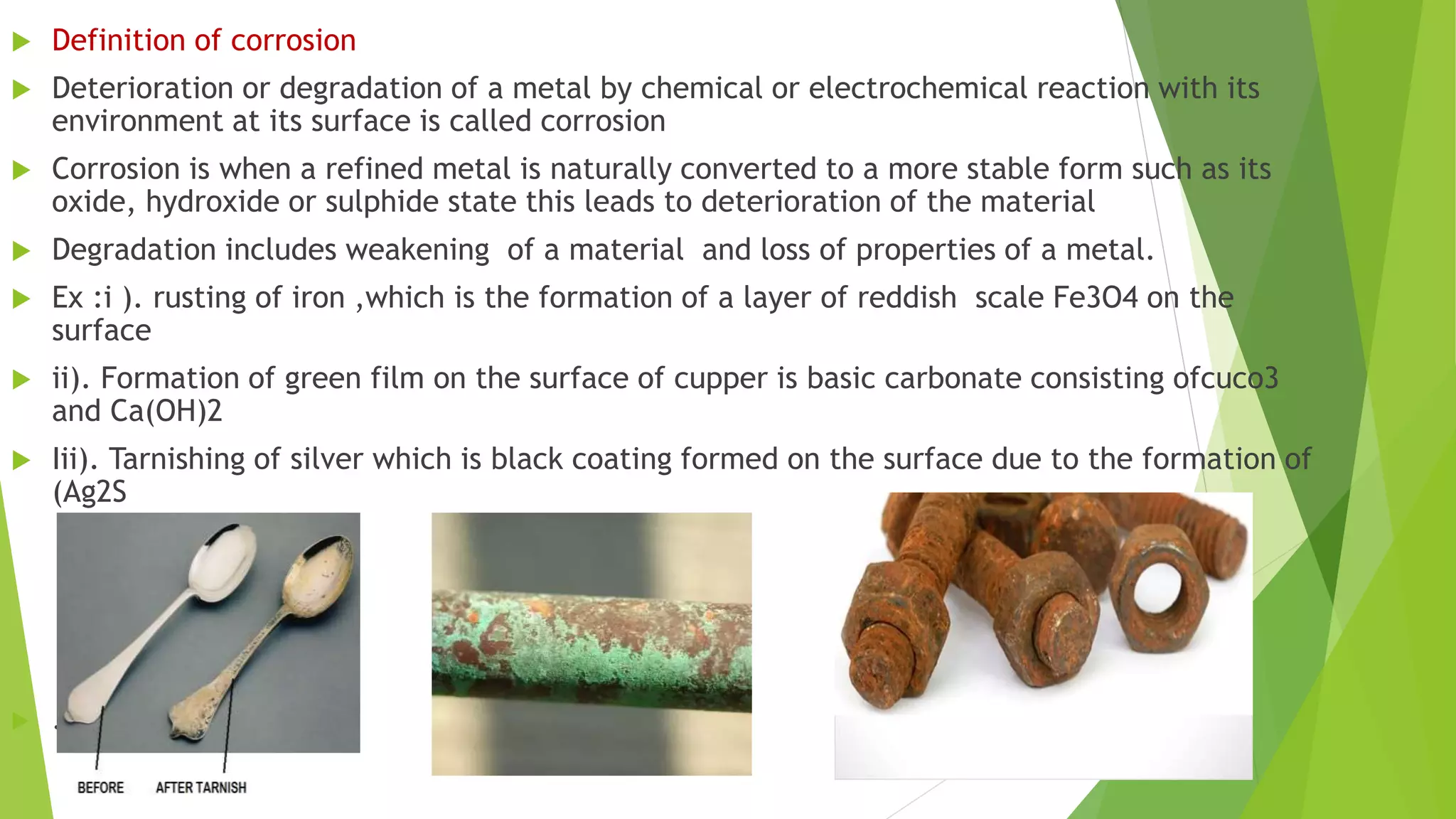
 Ex :i ). rusting of iron ,which is the formation of a layer of reddish scale Fe3O4 on the
surface
 ii). Formation of green film on the surface of cupper is basic carbonate consisting ofcuco3
and Ca(OH)2
 Iii). Tarnishing of silver which is black coating formed on the surface due to the formation of
(Ag2S
 .
 Causes of Corrosion
 metal corrodes when it reacts with another substance such as oxygen,
hydrogen, an electrical current or even dirt and bacteria. Corrosion can also
happen when metals like steel are placed under too much stress causing the
material to crack.
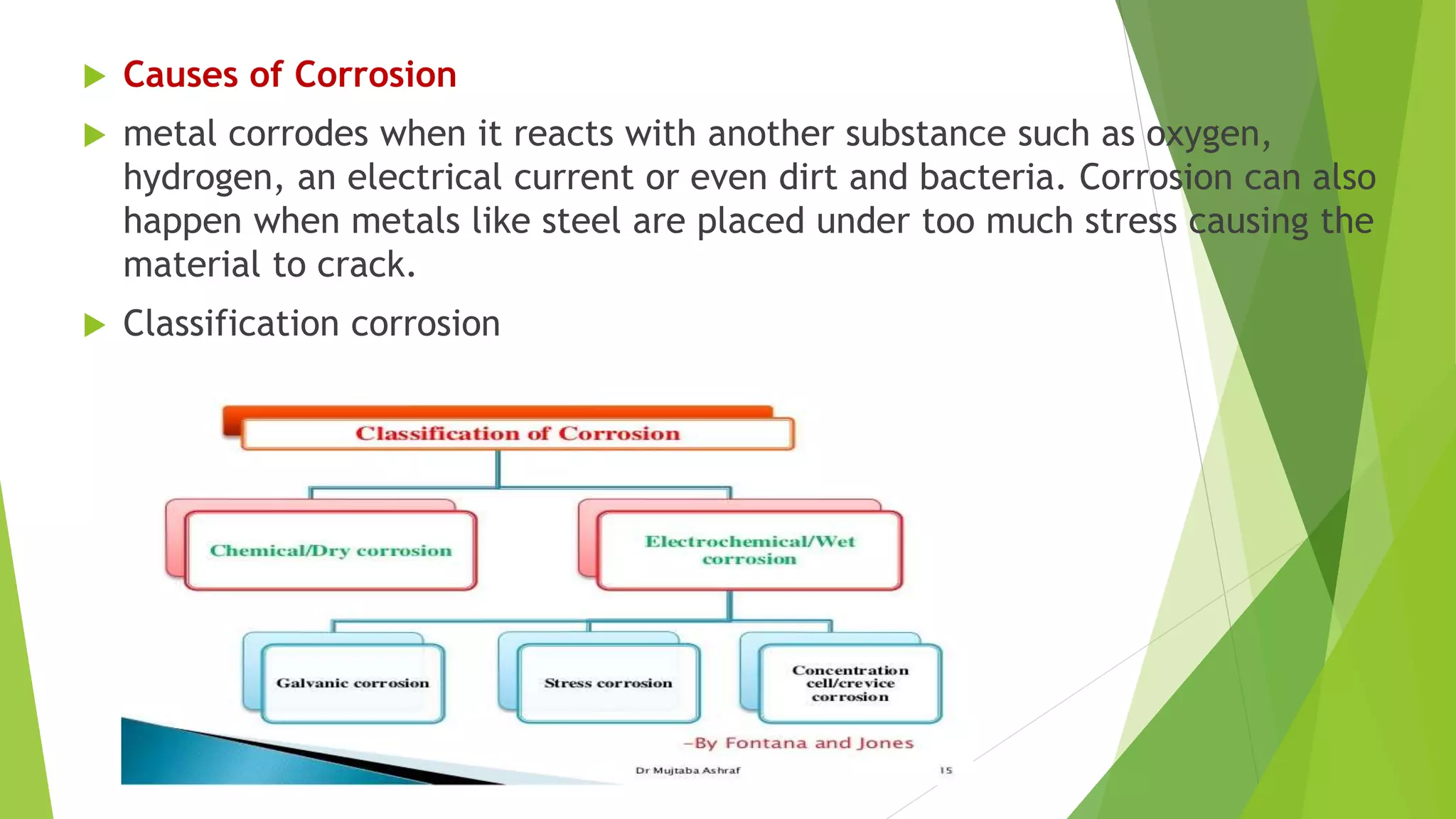
 Classification corrosion
 dry or chemical theory of corrosion
 This type of corrosion occurs by the direct chemical attack of metal with environment in the absence of
moisture. Metal reacts with atmospheric gases such as oxygen, halogens, hydrogen sulphide, nitrogen etc.
Depending on the chemical involved there are three main types of chemical or dry corrosion.
 1. Oxidation corrosion
 2. Corrosion by other gases.
 3. Liquid metal corrosion
 Oxidation corrosion:
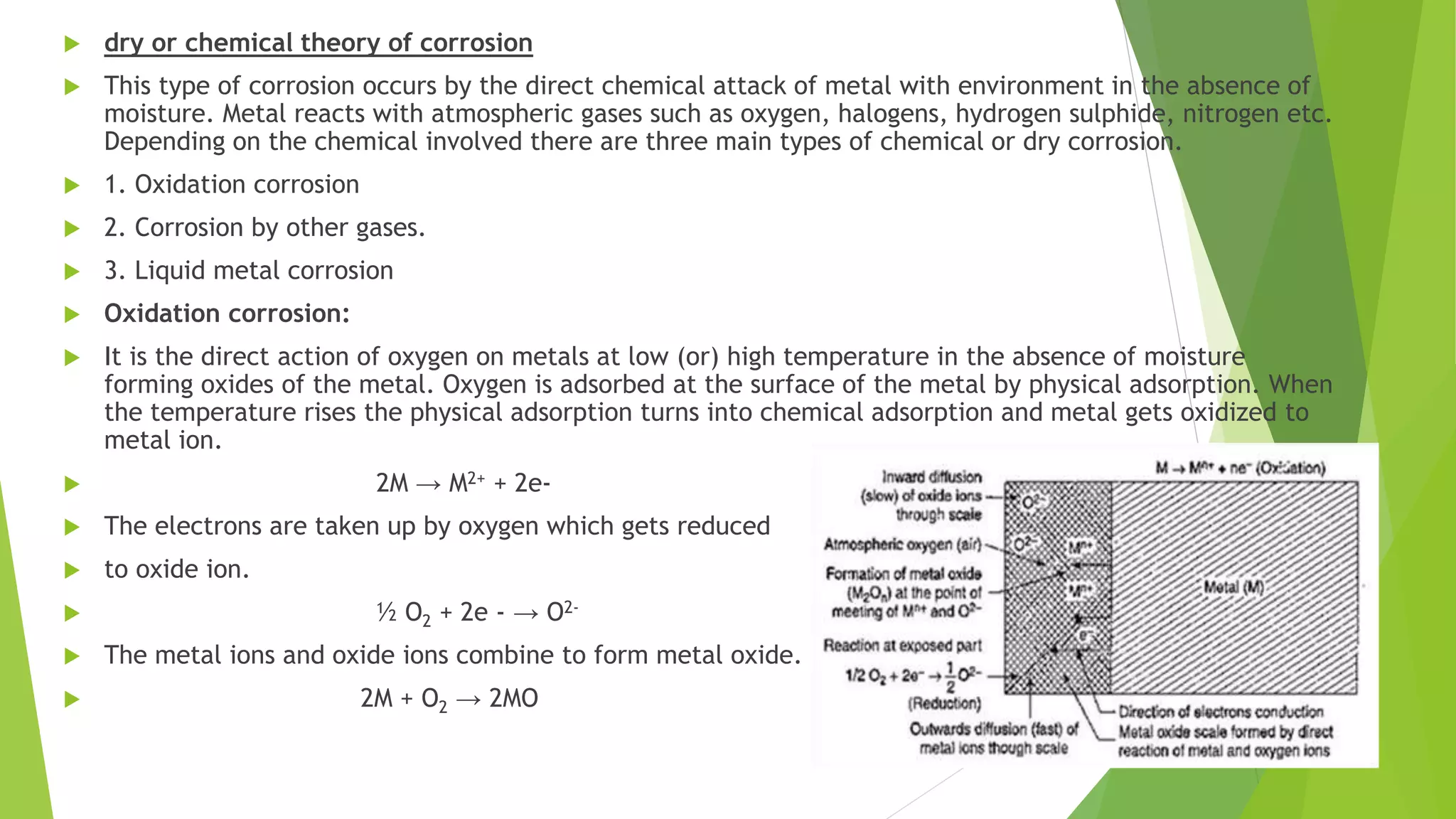
 It is the direct action of oxygen on metals at low (or) high temperature in the absence of moisture
forming oxides of the metal. Oxygen is adsorbed at the surface of the metal by physical adsorption. When
the temperature rises the physical adsorption turns into chemical adsorption and metal gets oxidized to
metal ion.
 2M β†’ M2+ + 2e-
 The electrons are taken up by oxygen which gets reduced
 to oxide ion.
 Β½ O2 + 2e - β†’ O2-
 The metal ions and oxide ions combine to form metal oxide.
 2M + O2 β†’ 2MO
 The metal oxide formed acts as a barrier between the metal and the oxygen and prevents further
oxidation of the metal. If the thickness of the metal oxide is less than 300 A0, it is called film. If
the thickness is greater than 300 A0 it is known as scale. For further oxidation to continue either
metal ions come upward or oxide ions diffuse inwards through the scale to the underlying metal.
Further oxidation of the metal depends on nature of the oxide film formed. There are four
different kinds of metal oxide film. It may be 1) Stable, 2) Unstable, 3) Volatile 4) Porous.
 Stable
 If the oxide film is highly stable it fixes tightly to the metal surface preventing the penetration of
oxygen to the underlying metal. Such film forms a protective coating over the metal and prevents
further oxidation or corrosion. Ex: The oxide films of Al, Cr, Cu, Pb.
 Unstable
 Unstable layer decomposes back to metal and oxygen. Corrosion does not occur even at the
surface. Ex: Oxide films of Ag, Au & Pt.

 Volatile:
If the oxide layer formed is volatile it evaporates as soon as it is formed leaving the
fresh metal surface for further attack leading to continuous corrosion.
Ex: MoO3 is volatile.
Porous:
If the oxide layer is porous or have cracks the oxygen diffuses through these pores
and cracks leading to further oxidation. Corrosion takes place till the metal is
completely converted into oxide. Ex: Oxide films of alkali and alkaline earth metals.
 Pilling – Bed worth Rule:
 Pilling – Bed worth rule was proposed to explain the extent of protection
given by the oxide layer to the metal. It depends upon the ratio of volume of
the metal oxide to the volume of the metal. It explains the resistance of
metal to oxidation. The rule is expressed mathematically as,
 R = Volume of the metal oxide formed / Volume of the metal.
 If the volume of oxide is less than the volume of metal, then R < 1 and the
oxide layer is porous and non-protective. In such cases further corrosion of
metal occurs. Ex: Oxides of alkali & alkaline earth metals.
 If the volume of the oxide film is equal to or greater than volume of the
metal, then R β‰₯ 1 and the oxide film is protective. In such cases oxide film
prevents further corrosion of metal. Ex: oxide films of Al, Cr, W etc.

 CORROSION BY OTHER GASES:
 In addition to oxygen other gases like CO2, SO2, Cl2, H2S etc. also have corrosive effect on metals and it
depends mainly on chemical affinity between metal & gas. The product formed may or may not be
protective in nature.
 Ex: Cl2 attacks Sn and forms volatile SnCl4. The product is non protective and corrosion proceeds
rapidly.
 Whereas a protective film of AgCl is formed on Ag and prevents metal from further attack.
 corrosion by H2S At higher temperature molecular hydrogen undergoes dissociation to atomic
hydrogen. This atomic hydrogen when comes in contact with steel, it combines with carbon of steel
and form methane gas. This gas collects in voids and causes cracks in steel. This is known as
decarburization.
 LIQUID METAL CORROSION:
 It is due to the chemical action of flowing liquid metal at high temperature on solid metal or alloy.
Such corrosion occur in devices used in nuclear power plant. This corrosion involves either dissolution
of solid metal by liquid metal or internal penetration of liquid metal into solid metal.
 Ex: Liquid metal Hg dissolves most of the metals forming amalgams
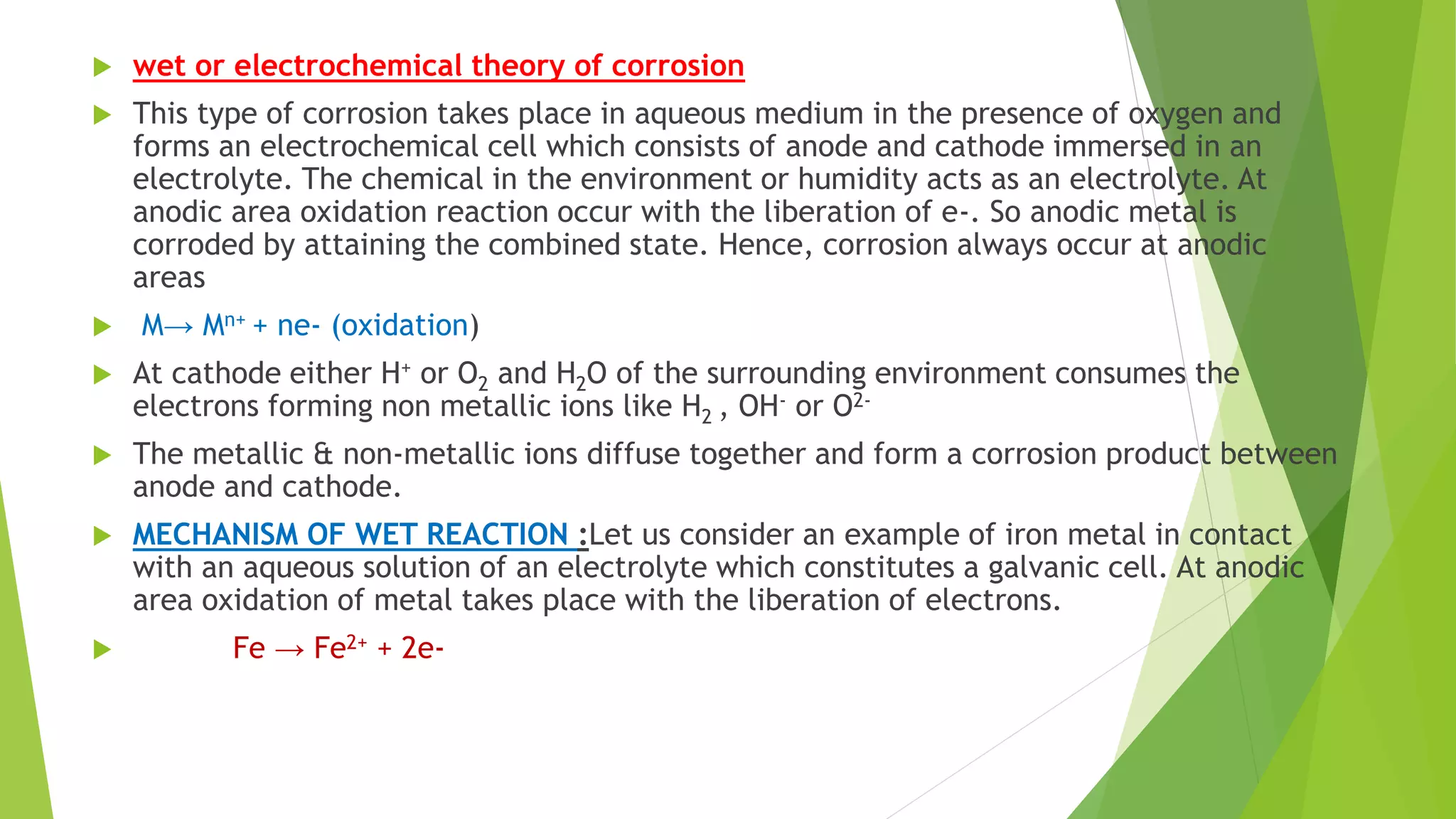
 wet or electrochemical theory of corrosion
 This type of corrosion takes place in aqueous medium in the presence of oxygen and
forms an electrochemical cell which consists of anode and cathode immersed in an
electrolyte. The chemical in the environment or humidity acts as an electrolyte. At
anodic area oxidation reaction occur with the liberation of e-. So anodic metal is
corroded by attaining the combined state. Hence, corrosion always occur at anodic
areas
 Mβ†’ Mn+ + ne- (oxidation)
 At cathode either H+ or O2 and H2O of the surrounding environment consumes the
electrons forming non metallic ions like H2 , OH- or O2-
 The metallic & non-metallic ions diffuse together and form a corrosion product between
anode and cathode.
 MECHANISM OF WET REACTION :Let us consider an example of iron metal in contact
with an aqueous solution of an electrolyte which constitutes a galvanic cell. At anodic
area oxidation of metal takes place with the liberation of electrons.
 Fe β†’ Fe2+ + 2e-
 Thus corrosion takes place at anode.
 At cathodic area electrons are consumed. Depending on the nature of the environment
wet corrosion is of two types:
 1. Evolution of Hydrogen (H2)
 2. Absorption of Oxygen (O2)
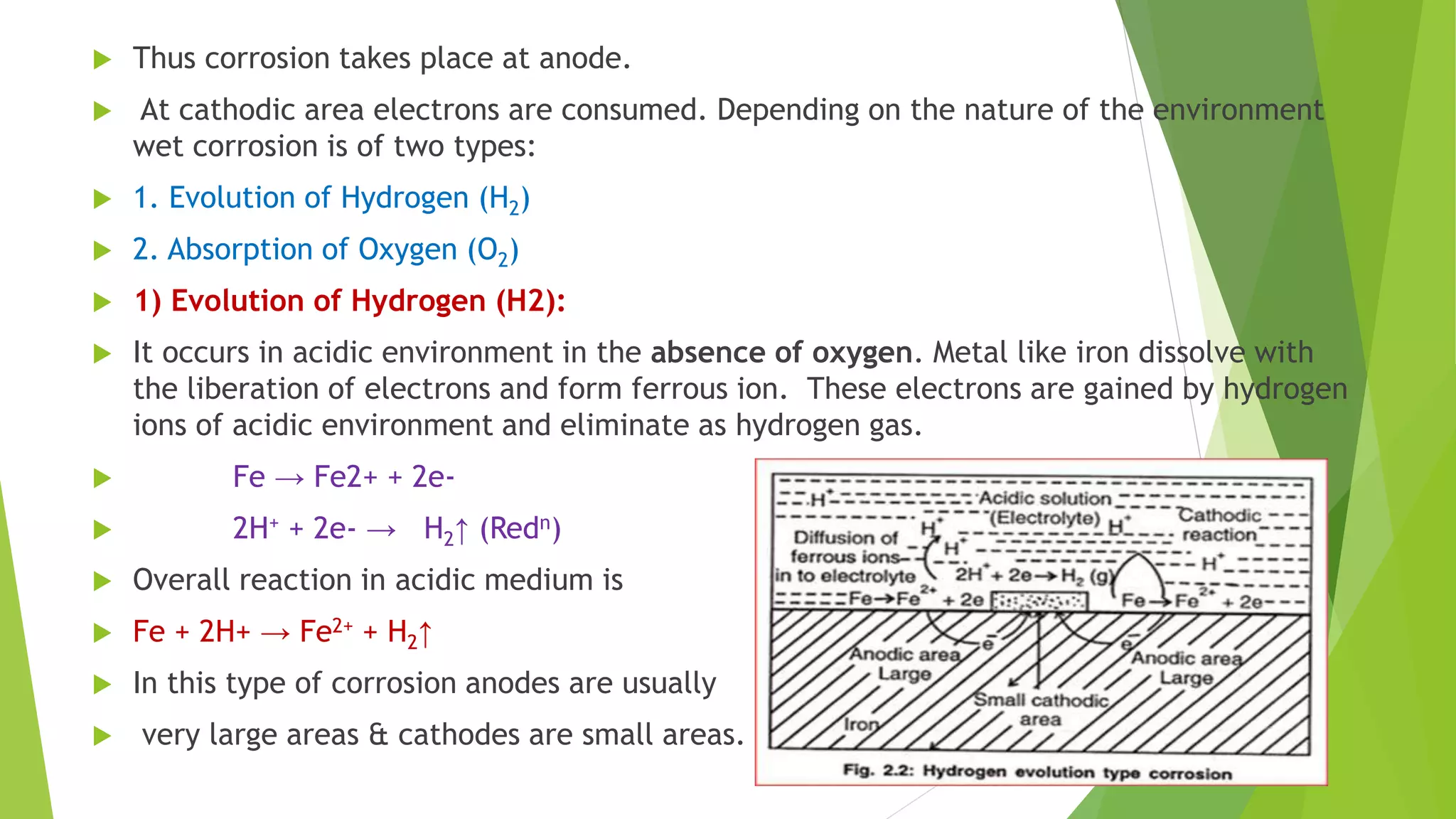
 1) Evolution of Hydrogen (H2):
 It occurs in acidic environment in the absence of oxygen. Metal like iron dissolve with
the liberation of electrons and form ferrous ion. These electrons are gained by hydrogen
ions of acidic environment and eliminate as hydrogen gas.
 Fe β†’ Fe2+ + 2e-
 2H+ + 2e- β†’ H2↑ (Redn)
 Overall reaction in acidic medium is
 Fe + 2H+ β†’ Fe2+ + H2↑
 In this type of corrosion anodes are usually
 very large areas & cathodes are small areas.
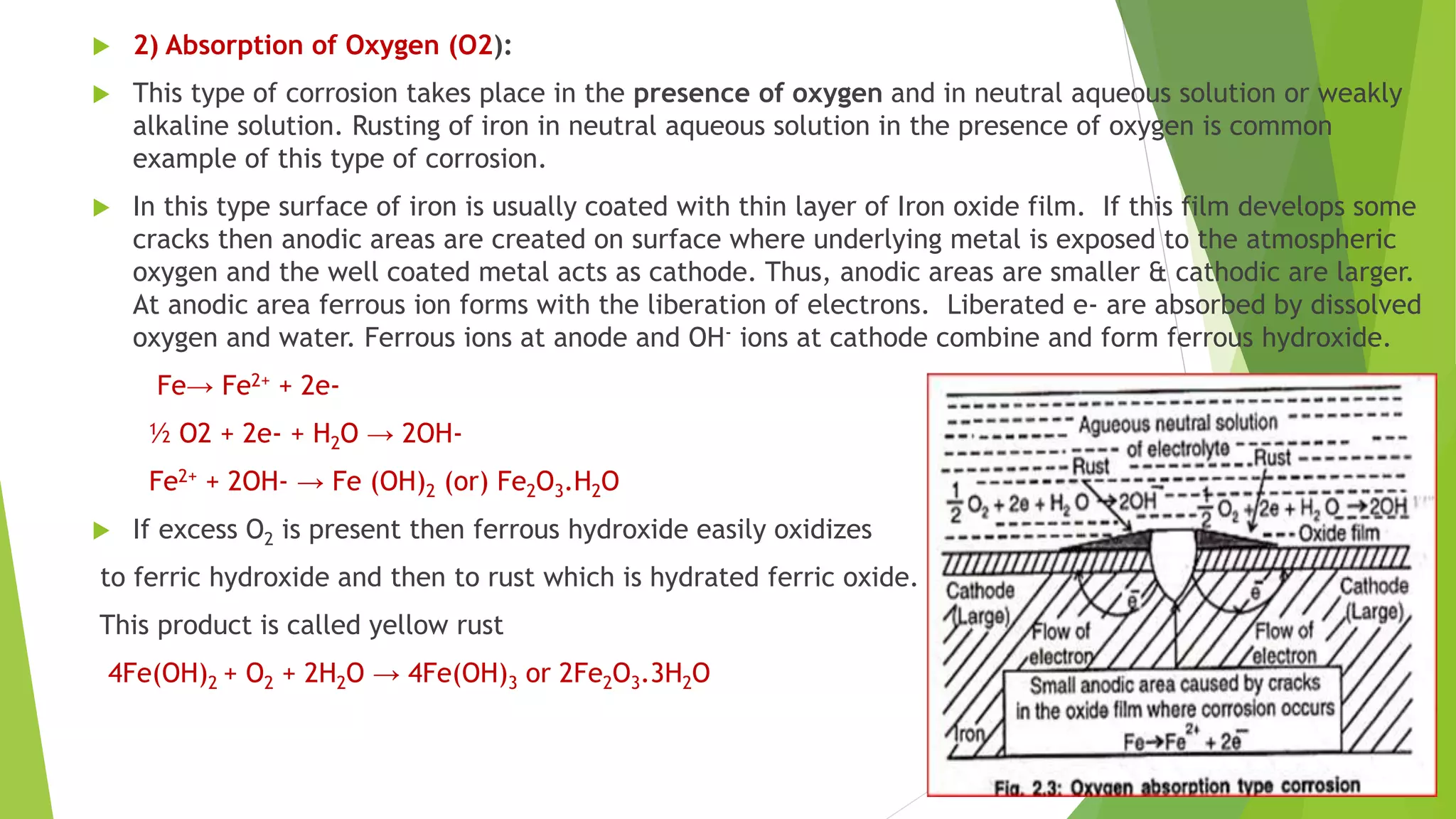
 2) Absorption of Oxygen (O2):
 This type of corrosion takes place in the presence of oxygen and in neutral aqueous solution or weakly
alkaline solution. Rusting of iron in neutral aqueous solution in the presence of oxygen is common
example of this type of corrosion.
 In this type surface of iron is usually coated with thin layer of Iron oxide film. If this film develops some
cracks then anodic areas are created on surface where underlying metal is exposed to the atmospheric
oxygen and the well coated metal acts as cathode. Thus, anodic areas are smaller & cathodic are larger.
At anodic area ferrous ion forms with the liberation of electrons. Liberated e- are absorbed by dissolved
oxygen and water. Ferrous ions at anode and OH- ions at cathode combine and form ferrous hydroxide.
Fe→ Fe2+ + 2e-
Β½ O2 + 2e- + H2O β†’ 2OH-
Fe2+ + 2OH- β†’ Fe (OH)2 (or) Fe2O3.H2O
 If excess O2 is present then ferrous hydroxide easily oxidizes
to ferric hydroxide and then to rust which is hydrated ferric oxide.
This product is called yellow rust
4Fe(OH)2 + O2 + 2H2O β†’ 4Fe(OH)3 or 2Fe2O3.3H2O
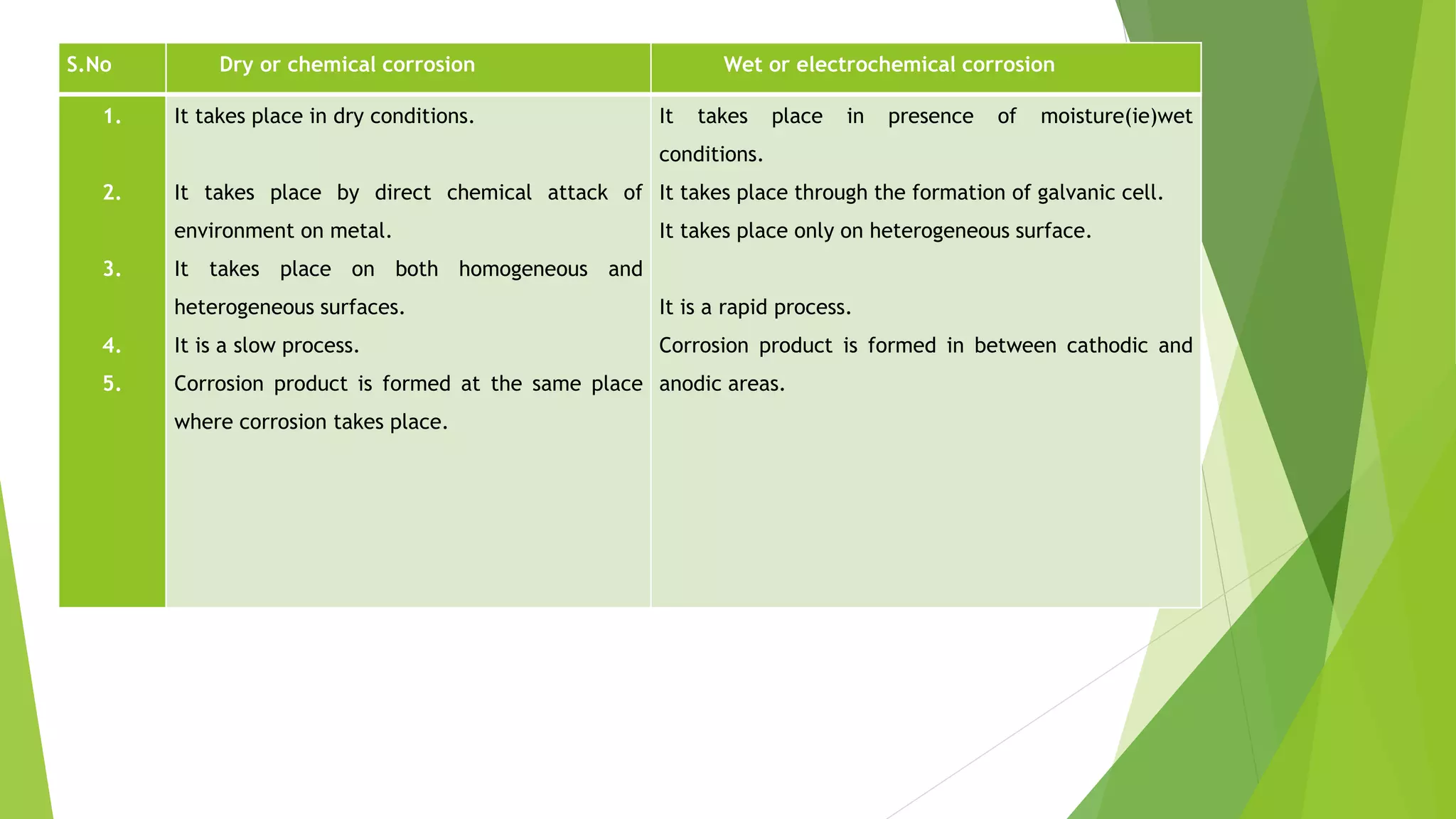
S.No Dry or chemical corrosion Wet or electrochemical corrosion
1.
2.
3.
4.
5.
It takes place in dry conditions.
It takes place by direct chemical attack of
environment on metal.
It takes place on both homogeneous and
heterogeneous surfaces.
It is a slow process.
Corrosion product is formed at the same place
where corrosion takes place.
It takes place in presence of moisture(ie)wet
conditions.
It takes place through the formation of galvanic cell.
It takes place only on heterogeneous surface.
It is a rapid process.
Corrosion product is formed in between cathodic and
anodic areas.
 Types of wet corrosion
 1. Galvanic corrosion
 2. Waterline corrosion
 3. Pitting corrosion
 1. Galvanic corrosion
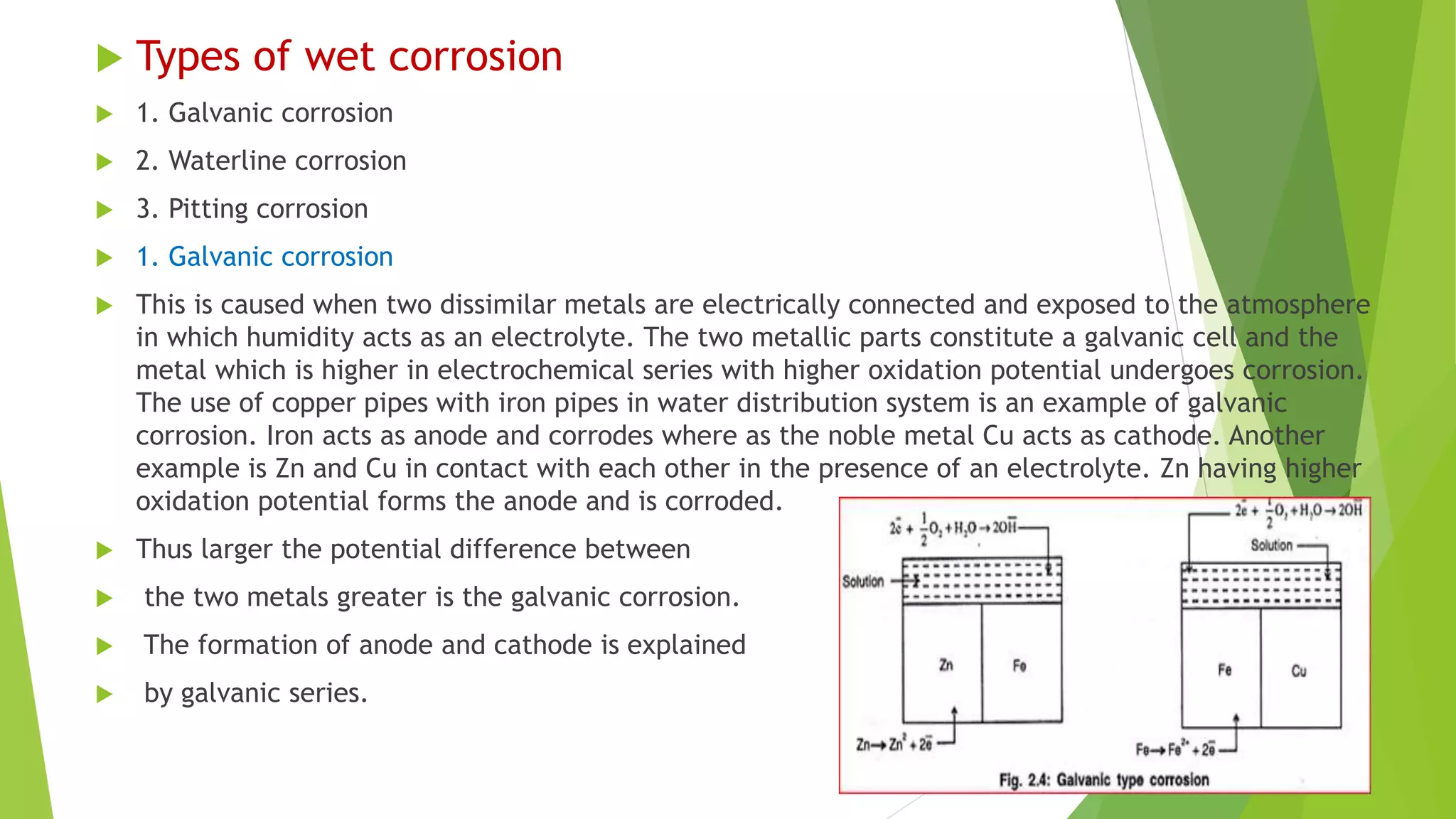
 This is caused when two dissimilar metals are electrically connected and exposed to the atmosphere
in which humidity acts as an electrolyte. The two metallic parts constitute a galvanic cell and the
metal which is higher in electrochemical series with higher oxidation potential undergoes corrosion.
The use of copper pipes with iron pipes in water distribution system is an example of galvanic
corrosion. Iron acts as anode and corrodes where as the noble metal Cu acts as cathode. Another
example is Zn and Cu in contact with each other in the presence of an electrolyte. Zn having higher
oxidation potential forms the anode and is corroded.
 Thus larger the potential difference between
 the two metals greater is the galvanic corrosion.
 The formation of anode and cathode is explained
 by galvanic series.
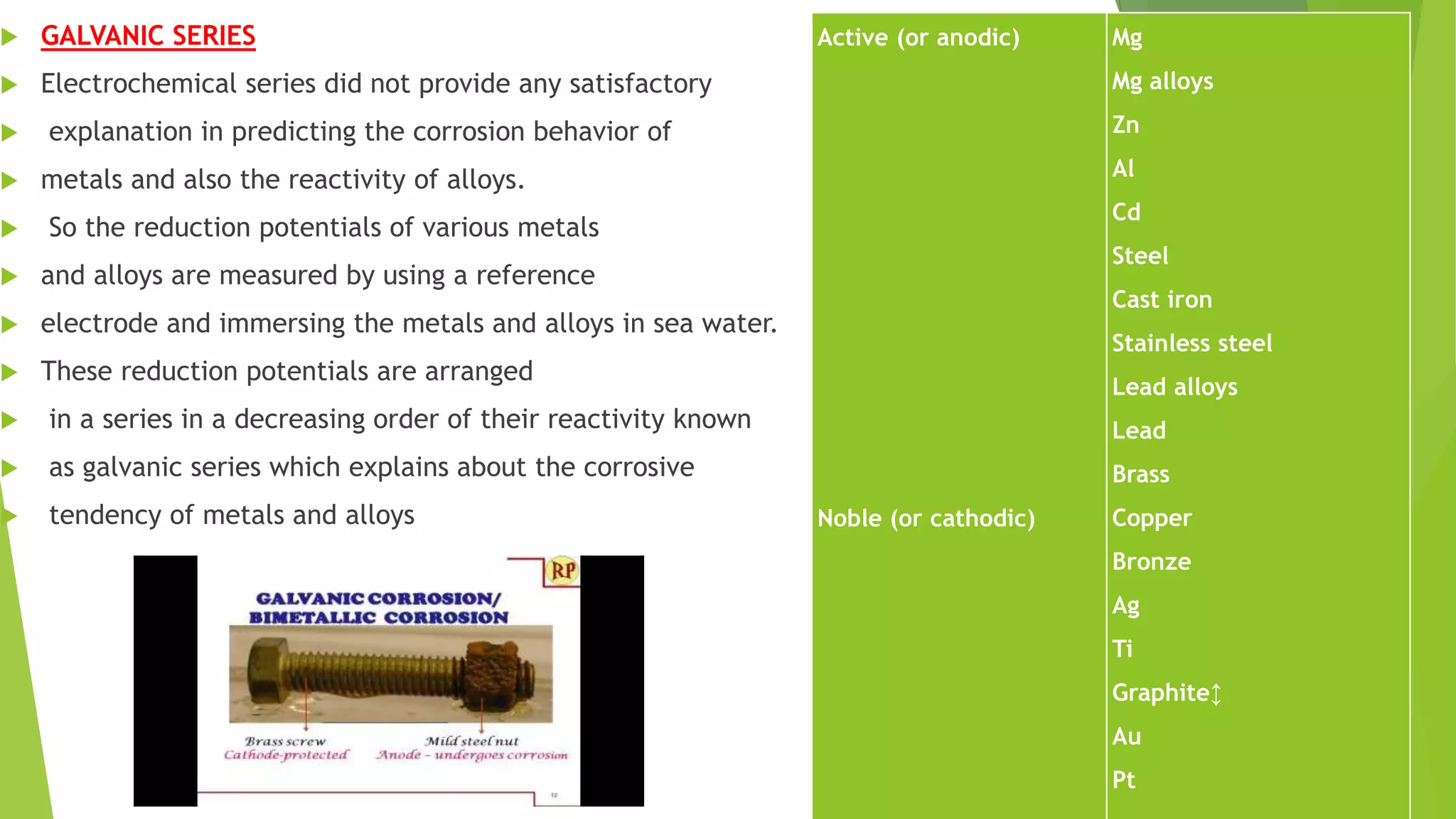
 GALVANIC SERIES
 Electrochemical series did not provide any satisfactory
 explanation in predicting the corrosion behavior of
 metals and also the reactivity of alloys.
 So the reduction potentials of various metals
 and alloys are measured by using a reference
 electrode and immersing the metals and alloys in sea water.
 These reduction potentials are arranged
 in a series in a decreasing order of their reactivity known
 as galvanic series which explains about the corrosive
 tendency of metals and alloys
Active (or anodic)
Noble (or cathodic)
Mg
Mg alloys
Zn
Al
Cd
Steel
Cast iron
Stainless steel
Lead alloys
Lead
Brass
Copper
Bronze
Ag
Ti
Graphite↕
Au
Pt
 II) CONCENTRATION CELL CORROSION
 This corrosion is due to electrochemical attack on the metal surface. This corrosion takes place when
two or more areas of the metal surface are exposed to an electrolyte of different concentration or
different aeration. This corrosion is explained on the basis of electrolyte concentration cell. The area of
the metal exposed to lower concentration of the electrolyte or lower concentration of oxygen acts as
anode and undergoes corrosion. The area of the metal exposed to higher concentration of the electrolyte
or higher concentration of oxygen acts as cathode.
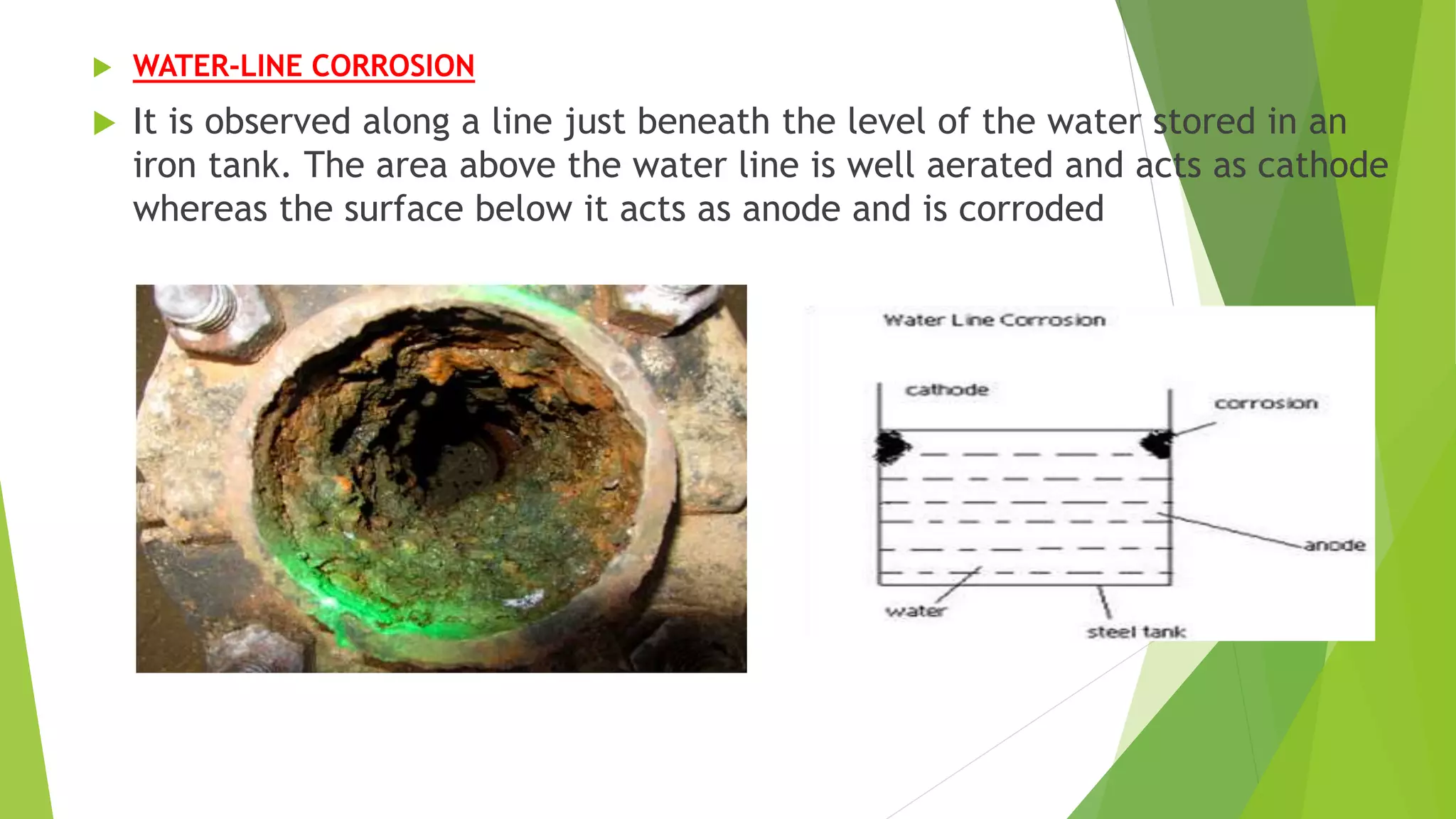
 WATER-LINE CORROSION
 It is observed along a line just beneath the level of the water stored in an
iron tank. The area above the water line is well aerated and acts as cathode
whereas the surface below it acts as anode and is corroded
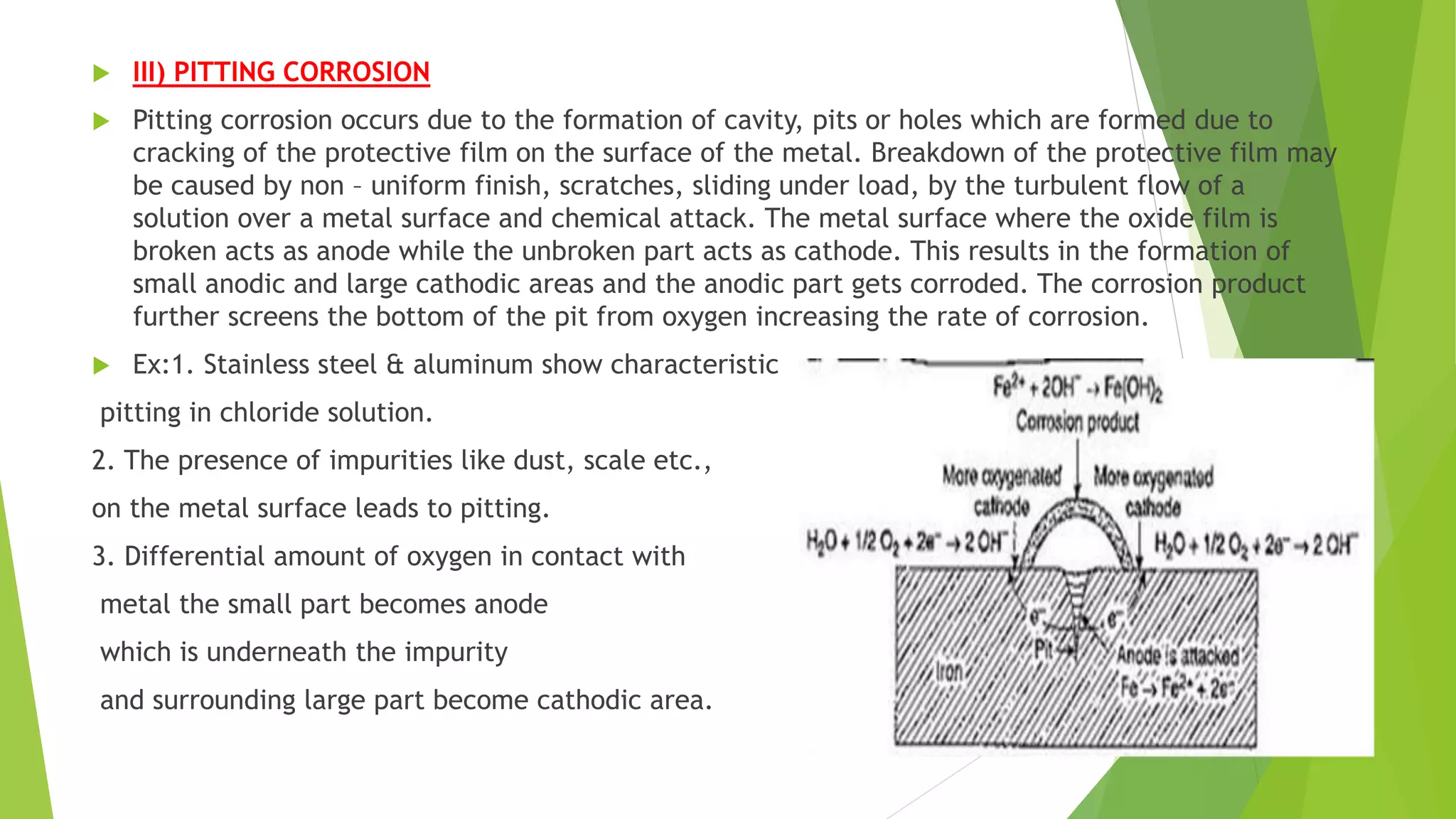
 III) PITTING CORROSION
 Pitting corrosion occurs due to the formation of cavity, pits or holes which are formed due to
cracking of the protective film on the surface of the metal. Breakdown of the protective film may
be caused by non – uniform finish, scratches, sliding under load, by the turbulent flow of a
solution over a metal surface and chemical attack. The metal surface where the oxide film is
broken acts as anode while the unbroken part acts as cathode. This results in the formation of
small anodic and large cathodic areas and the anodic part gets corroded. The corrosion product
further screens the bottom of the pit from oxygen increasing the rate of corrosion.
 Ex:1. Stainless steel & aluminum show characteristic
pitting in chloride solution.
2. The presence of impurities like dust, scale etc.,
on the metal surface leads to pitting.
3. Differential amount of oxygen in contact with
metal the small part becomes anode
which is underneath the impurity
and surrounding large part become cathodic area.
 Factors affecting the rate of corrosion
 Rate of corrosion depends upon:
 1) Nature of metal
 2) Nature of environment
 NATURE OF METAL
 1) Position of metal in Galvanic series:
 The rate of corrosion depends upon the position of metal in galvanic series. When two metals
are in electrical contact in presence of an electrolyte, the metal with higher oxidation
potential undergoes corrosion. And greater the difference in their position in galvanic series
faster and higher is the rate of corrosion.
 For example iron pipe does not rust when it is connected to Zn metal but corrodes faster when
it is connected to copper metal. This is because Fe and Zn are placed above hydrogen in
galvanic series and the difference in potentials of the two metals is 0.32V. Whereas Fe is
placed above hydrogen and copper is placed below hydrogen in the series and also the
difference in potentials of the two metals is 0.77V. As the difference is high Fe undergoes
corrosion.
 2) Relative areas of anode and Cathode:
 The rate of corrosion increases if the anode area is small and cathode area is large. In general
corrosion is more if the electrons liberated at the anode are consumed by cathodic reaction. So
if the cathodic area is large it will demand more electrons which can be supplied by rapid
oxidation or corrosion of anodic area.
 Ex: Small steel pipe fitted in copper tank.
 3) Purity of Metal:
 Impurities in metal cause heterogeneity and galvanic cell is set up with anodic & cathodic area
in the metal. Higher the percentage of impurity faster the corrosion. Corrosion resistance of
metal may be improved increasing the purity.
 4) Nature of surface film or oxide film:
 All metals get covered with a thin surface film of metal oxide. If the oxide film is highly volatile
and porous the rate of corrosion increases. Also rate of corrosion depends on the ratio of volume
of metal oxide and metal. If the volume of the metal oxide is more the rate of corrosion is less.
 5) Nature of corrosion product:
 If corrosion product is soluble and highly volatile in corroding medium then rate of corrosion is
fast. If it is insoluble then it act as a physical barrier between metal and corrosive environment
thereby preventing further corrosion.
 6) Hydrogen overvoltage:
 The excess voltage required for a metal to liberate hydrogen gas at cathode is called hydrogen
overvoltage of that metal. If the overvoltage is less then the rate of corrosion is more. For
example when Zn metal is placed in H2SO4 it undergoes corrosion liberating hydrogen gas. But the
initial rate of corrosion is slow because of high overvoltage of Zn (ie) 0.76V. If a few drops of
CuSO4 are added then some copper gets deposited on the Zn metal forming small cathode which
can deposit H2 gas. The overvoltage of Cu is 0.33V. Thus lesser the overvoltage of the metal higher
is the rate of corrosion.
 NATURE OF ENVIRONMENT:
 1) Effect of Temperature:
 Rate of corrosion increases with increase in temperature. At low temperature solubility of
oxygen is more. It decreases with increase in temperature. So, rate of corrosion will increase
with temperature. At higher temperature noble metals also become active and get corroded.

 2) Humidity:
 Corrosion increases with increase in humidity of the atmosphere. This is because humidity
provides water that can act as an electrolyte. The humidity above which the rate of corrosion
increases rapidly is called critical humidity.
 3) PH of Atmosphere:
 In acidic medium rate of corrosion is more than in alkaline and neutral media. This is because
the anodic reaction is accelerated in acidic medium by the consumption of electrons by H+
ions of the acid. Thus lower the pH of the surrounding medium higher is the corrosion.
 cathodic protection
 The principle involved in this method is to force the metal to be protected to behave like
cathode so that corrosion does not occur. The metal to be protected is called base metal.
There are two types of cathodic protection.
 1) Sacrificial anodic protection
 2) Impressed current cathodic protection
 (1) Sacrificial anodic protection:
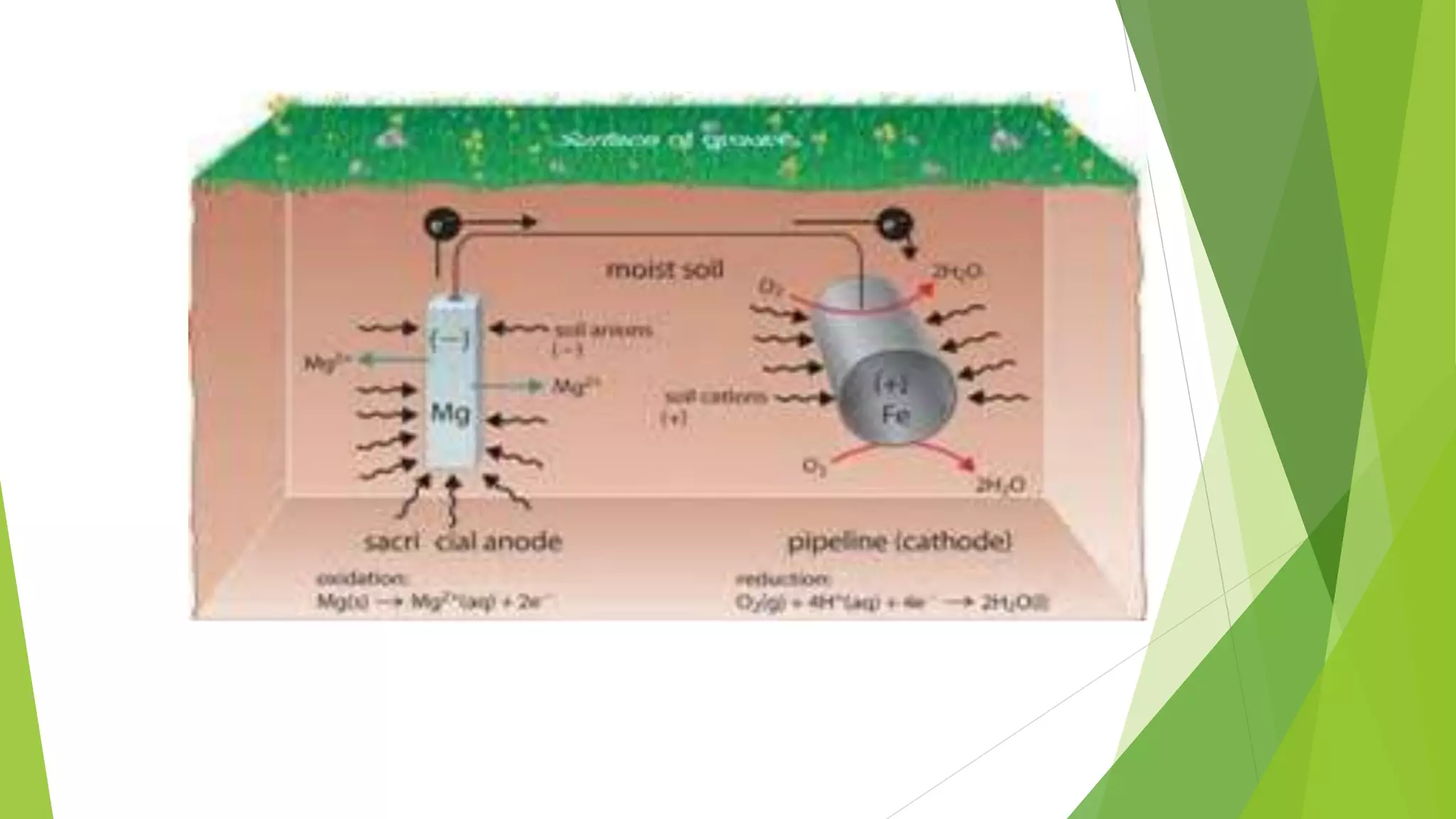
 In this the metallic structure to be protected is connected by a wire to a more anodic metal
so that all the corrosion occurs at more active or anodic metal while the parent structure is
protected. The more active metal used to protect another metal from corrosion is called
sacrificial anode. The corroded sacrificial anode is replaced by a fresh one. The metals
commonly used as sacrificial anodes are Mg, Zn, Al & their alloys. The important applications
of sacrificial anodic method include protecting the buried pipe line, underground cables,
ships and boat hulls from marine corrosion, water tanks, railway tracks etc.

(2) Impressed Current Cathodic Protection :
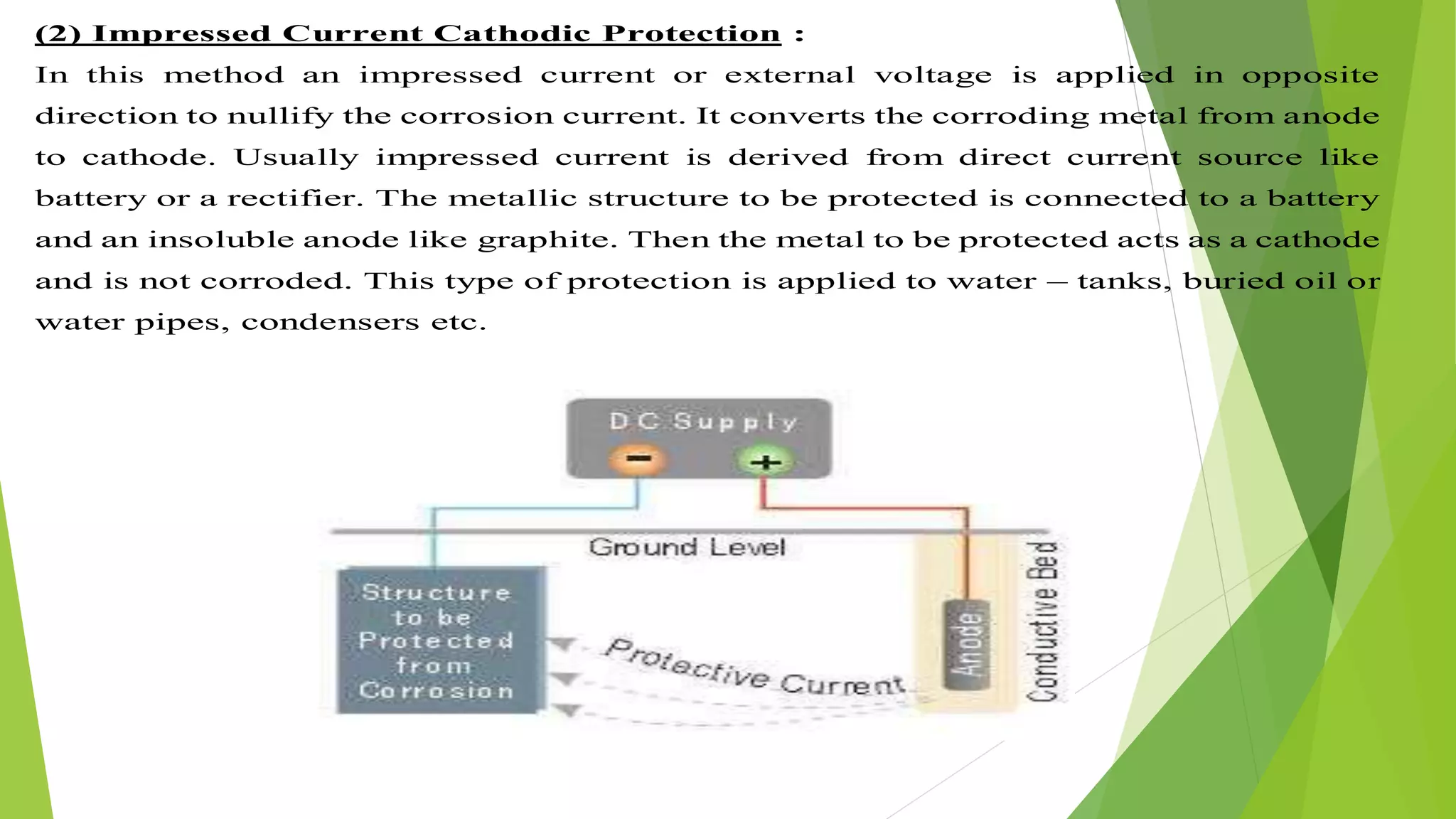
In this method an impressed current or external voltage is applied in opposite
direction to nullify the corrosion current. It converts the corroding metal from anode
to cathode. Usually impressed current is derived from direct current source like
battery or a rectifier. The metallic structure to be protected is connected to a battery
and an insoluble anode like graphite. Then the metal to be protected acts as a cathode
and is not corroded. This type of protection is applied to water – tanks, buried oil or
water pipes, condensers etc.
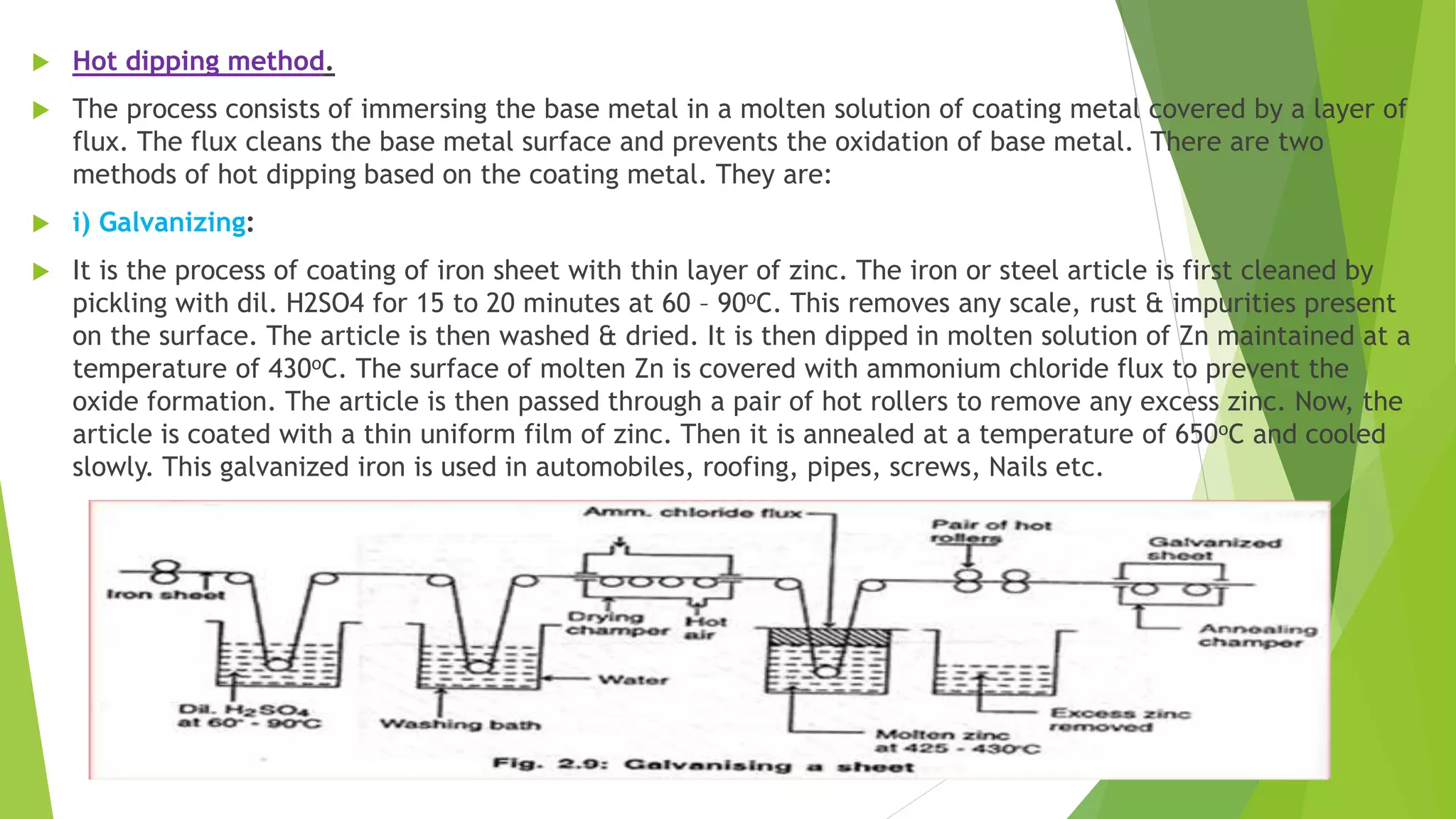
 Hot dipping method.
 The process consists of immersing the base metal in a molten solution of coating metal covered by a layer of
flux. The flux cleans the base metal surface and prevents the oxidation of base metal. There are two
methods of hot dipping based on the coating metal. They are:
 i) Galvanizing:
 It is the process of coating of iron sheet with thin layer of zinc. The iron or steel article is first cleaned by
pickling with dil. H2SO4 for 15 to 20 minutes at 60 – 90oC. This removes any scale, rust & impurities present
on the surface. The article is then washed & dried. It is then dipped in molten solution of Zn maintained at a
temperature of 430oC. The surface of molten Zn is covered with ammonium chloride flux to prevent the
oxide formation. The article is then passed through a pair of hot rollers to remove any excess zinc. Now, the
article is coated with a thin uniform film of zinc. Then it is annealed at a temperature of 650oC and cooled
slowly. This galvanized iron is used in automobiles, roofing, pipes, screws, Nails etc.
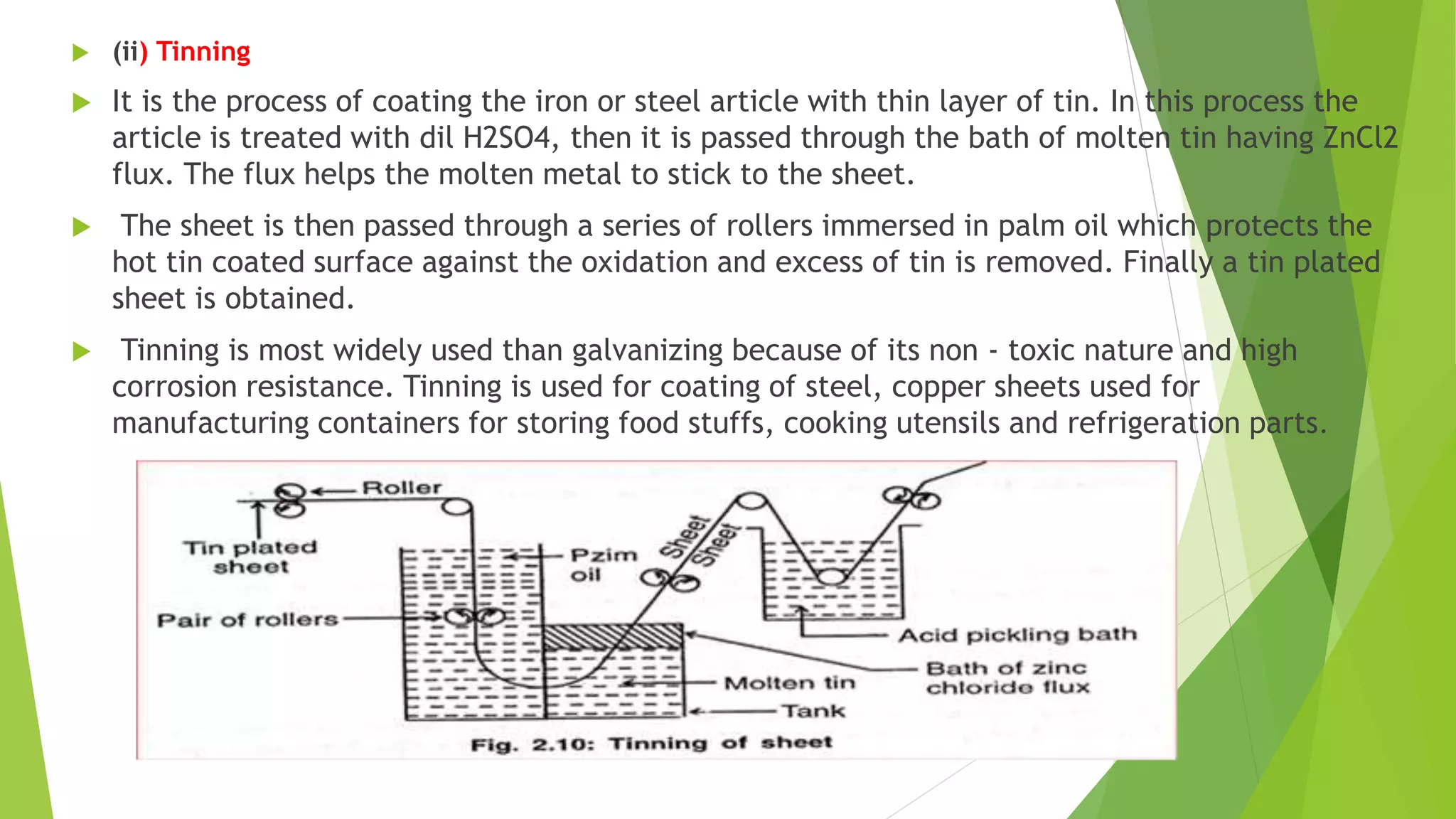
 (ii) Tinning
 It is the process of coating the iron or steel article with thin layer of tin. In this process the
article is treated with dil H2SO4, then it is passed through the bath of molten tin having ZnCl2
flux. The flux helps the molten metal to stick to the sheet.
 The sheet is then passed through a series of rollers immersed in palm oil which protects the
hot tin coated surface against the oxidation and excess of tin is removed. Finally a tin plated
sheet is obtained.
 Tinning is most widely used than galvanizing because of its non - toxic nature and high
corrosion resistance. Tinning is used for coating of steel, copper sheets used for
manufacturing containers for storing food stuffs, cooking utensils and refrigeration parts.
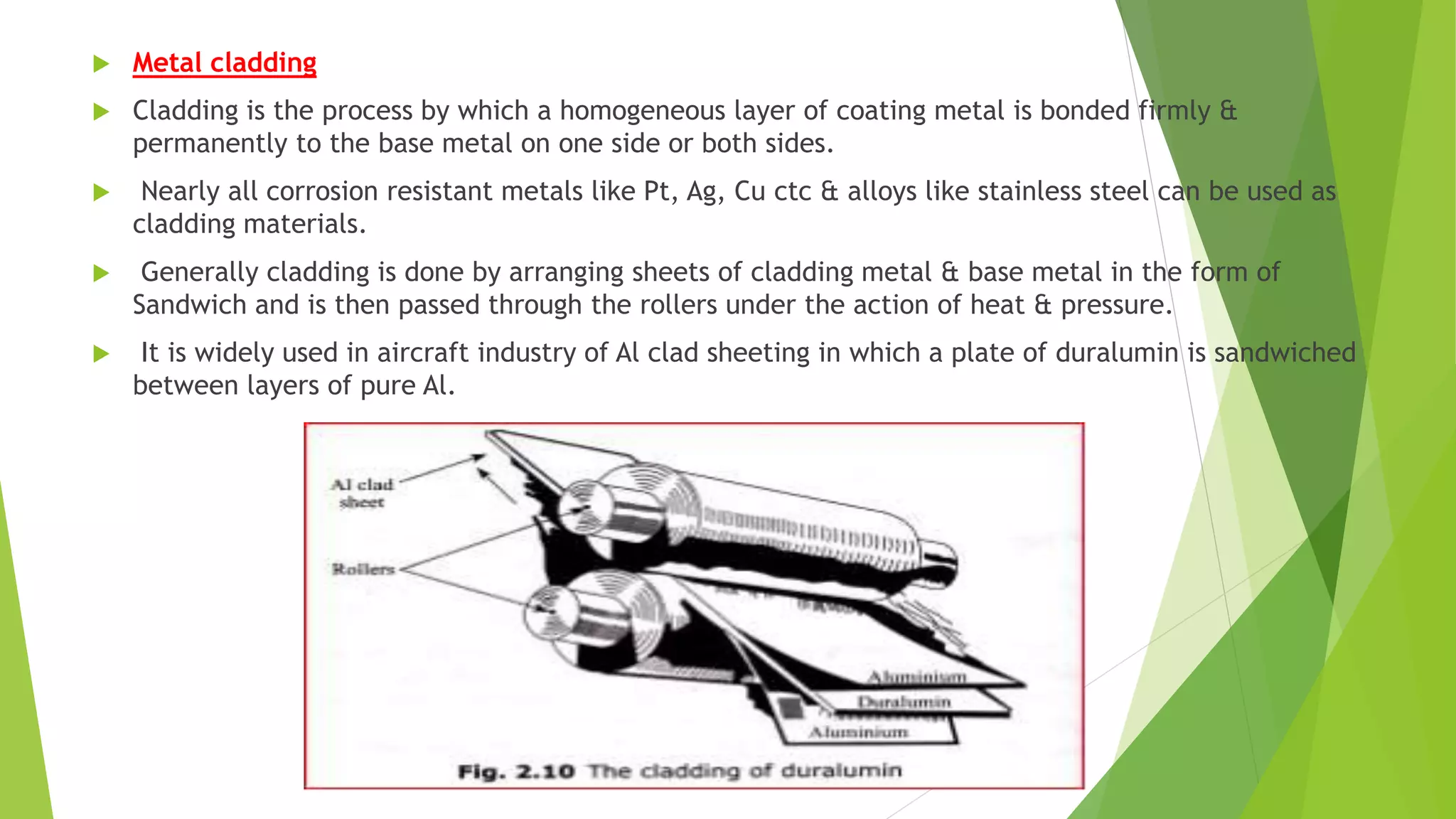
 Metal cladding
 Cladding is the process by which a homogeneous layer of coating metal is bonded firmly &
permanently to the base metal on one side or both sides.
 Nearly all corrosion resistant metals like Pt, Ag, Cu ctc & alloys like stainless steel can be used as
cladding materials.
 Generally cladding is done by arranging sheets of cladding metal & base metal in the form of
Sandwich and is then passed through the rollers under the action of heat & pressure.
 It is widely used in aircraft industry of Al clad sheeting in which a plate of duralumin is sandwiched
between layers of pure Al.
 electroplating method
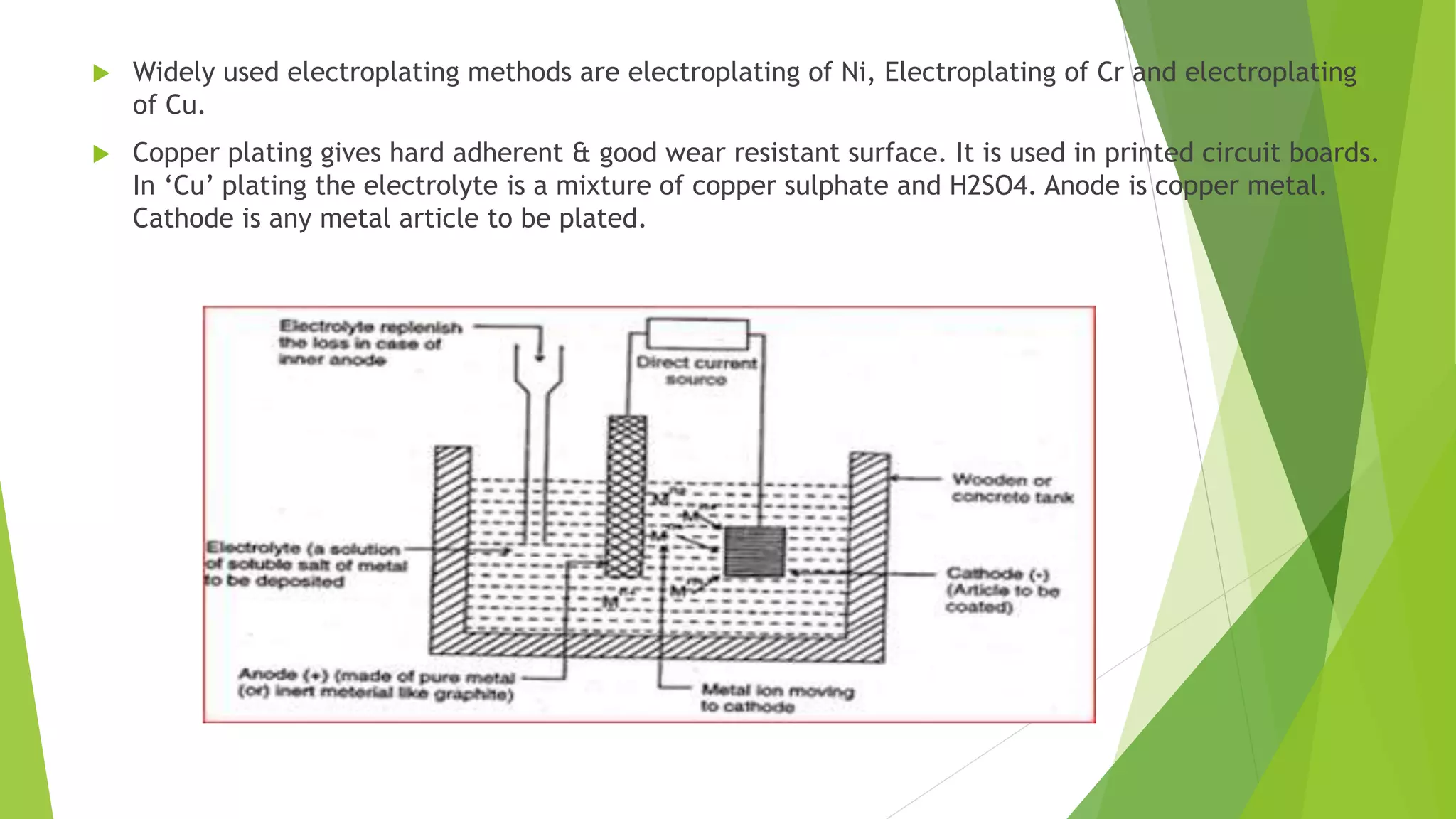
 Electroplating is the process by which a coating metal is deposited on the base metal by passing a
direct current through an electrolyte containing the soluble salt of the coating metal. It is most
widely used industrial method of applying metallic coatings. In this method the base metal to be
plated or coated is usually made the cathode of electrolytic cell where the anode is made up of
coating metal.
 Procedure:
 The article to be electroplated is treated with organic solvent to remove oil and it is treated with
dil. HCl to remove scales & oxides. The cleaned article is made of cathode. The anode is either
coating metal or inert material of good conductivity.
 The electrolyte is a solution of a soluble salt of the coating metal. The electrolytic solution is
taken in an electroplating tank.
 The anode & cathode are dipped in the electrolytic solution and are connected to a DC source.
During electrolysis coating metal ions migrate to the cathode & get deposited.
 Thus a layer of coating metal is obtained on the article.
 Widely used electroplating methods are electroplating of Ni, Electroplating of Cr and electroplating
of Cu.
 Copper plating gives hard adherent & good wear resistant surface. It is used in printed circuit boards.
In β€˜Cu’ plating the electrolyte is a mixture of copper sulphate and H2SO4. Anode is copper metal.
Cathode is any metal article to be plated.
 Electroless plating
 It is a process of depositing a noble metal from its salt solution on the surface of a less noble metal by
using a suitable reducing agent without using any external source. The reducing agent causes
reduction of metallic ions of the electrolyte (noble metal salt solution) to the metal which gets plated
over the surface of the base metal. The reducing agents used are formaldehyde, hypophosphite. The
process consists of cleaning the base etal surface by acid cleaning and then immersing in an
electrolytic solution containing the soluble salt of coating metal. Examples include electroless plating
of Ni, Cu.
 Electroless Ni plating: The process consists of cleaning the base metal surface using organic solvents
followed by acid treatment. Then the base metal is immersed in a coating solution containing NiCl2,
reducing agent sodium hypophosphite, buffer sodium acetate which is used to control pH.
 The reactions taking place are:
 At cathode: Ni2+ + 2e- β†’ Ni
 At anode: H2PO2
- + H2O β†’ H2PO3
- + 2H+ + 2e-
 The overall reaction is: Ni2+ + H2PO2
- + H2O β†’ Ni + H2PO3
- + 2H+

vnd.openxmlformats-officedocument.presentationml.presentation&rendition=1.pptx

  • 1.
  • 2.
     Definition ofcorrosion  Deterioration or degradation of a metal by chemical or electrochemical reaction with its environment at its surface is called corrosion  Corrosion is when a refined metal is naturally converted to a more stable form such as its oxide, hydroxide or sulphide state this leads to deterioration of the material  Degradation includes weakening of a material and loss of properties of a metal.  Ex :i ). rusting of iron ,which is the formation of a layer of reddish scale Fe3O4 on the surface  ii). Formation of green film on the surface of cupper is basic carbonate consisting ofcuco3 and Ca(OH)2  Iii). Tarnishing of silver which is black coating formed on the surface due to the formation of (Ag2S  .
  • 3.
     Causes ofCorrosion  metal corrodes when it reacts with another substance such as oxygen, hydrogen, an electrical current or even dirt and bacteria. Corrosion can also happen when metals like steel are placed under too much stress causing the material to crack.  Classification corrosion
  • 4.
     dry orchemical theory of corrosion  This type of corrosion occurs by the direct chemical attack of metal with environment in the absence of moisture. Metal reacts with atmospheric gases such as oxygen, halogens, hydrogen sulphide, nitrogen etc. Depending on the chemical involved there are three main types of chemical or dry corrosion.  1. Oxidation corrosion  2. Corrosion by other gases.  3. Liquid metal corrosion  Oxidation corrosion:  It is the direct action of oxygen on metals at low (or) high temperature in the absence of moisture forming oxides of the metal. Oxygen is adsorbed at the surface of the metal by physical adsorption. When the temperature rises the physical adsorption turns into chemical adsorption and metal gets oxidized to metal ion.  2M β†’ M2+ + 2e-  The electrons are taken up by oxygen which gets reduced  to oxide ion.  Β½ O2 + 2e - β†’ O2-  The metal ions and oxide ions combine to form metal oxide.  2M + O2 β†’ 2MO
  • 5.
     The metaloxide formed acts as a barrier between the metal and the oxygen and prevents further oxidation of the metal. If the thickness of the metal oxide is less than 300 A0, it is called film. If the thickness is greater than 300 A0 it is known as scale. For further oxidation to continue either metal ions come upward or oxide ions diffuse inwards through the scale to the underlying metal. Further oxidation of the metal depends on nature of the oxide film formed. There are four different kinds of metal oxide film. It may be 1) Stable, 2) Unstable, 3) Volatile 4) Porous.  Stable  If the oxide film is highly stable it fixes tightly to the metal surface preventing the penetration of oxygen to the underlying metal. Such film forms a protective coating over the metal and prevents further oxidation or corrosion. Ex: The oxide films of Al, Cr, Cu, Pb.  Unstable  Unstable layer decomposes back to metal and oxygen. Corrosion does not occur even at the surface. Ex: Oxide films of Ag, Au & Pt. 
  • 6.
     Volatile: If theoxide layer formed is volatile it evaporates as soon as it is formed leaving the fresh metal surface for further attack leading to continuous corrosion. Ex: MoO3 is volatile. Porous: If the oxide layer is porous or have cracks the oxygen diffuses through these pores and cracks leading to further oxidation. Corrosion takes place till the metal is completely converted into oxide. Ex: Oxide films of alkali and alkaline earth metals.
  • 7.
     Pilling –Bed worth Rule:  Pilling – Bed worth rule was proposed to explain the extent of protection given by the oxide layer to the metal. It depends upon the ratio of volume of the metal oxide to the volume of the metal. It explains the resistance of metal to oxidation. The rule is expressed mathematically as,  R = Volume of the metal oxide formed / Volume of the metal.  If the volume of oxide is less than the volume of metal, then R < 1 and the oxide layer is porous and non-protective. In such cases further corrosion of metal occurs. Ex: Oxides of alkali & alkaline earth metals.  If the volume of the oxide film is equal to or greater than volume of the metal, then R β‰₯ 1 and the oxide film is protective. In such cases oxide film prevents further corrosion of metal. Ex: oxide films of Al, Cr, W etc. 
  • 8.
     CORROSION BYOTHER GASES:  In addition to oxygen other gases like CO2, SO2, Cl2, H2S etc. also have corrosive effect on metals and it depends mainly on chemical affinity between metal & gas. The product formed may or may not be protective in nature.  Ex: Cl2 attacks Sn and forms volatile SnCl4. The product is non protective and corrosion proceeds rapidly.  Whereas a protective film of AgCl is formed on Ag and prevents metal from further attack.  corrosion by H2S At higher temperature molecular hydrogen undergoes dissociation to atomic hydrogen. This atomic hydrogen when comes in contact with steel, it combines with carbon of steel and form methane gas. This gas collects in voids and causes cracks in steel. This is known as decarburization.  LIQUID METAL CORROSION:  It is due to the chemical action of flowing liquid metal at high temperature on solid metal or alloy. Such corrosion occur in devices used in nuclear power plant. This corrosion involves either dissolution of solid metal by liquid metal or internal penetration of liquid metal into solid metal.  Ex: Liquid metal Hg dissolves most of the metals forming amalgams
  • 9.
     wet orelectrochemical theory of corrosion  This type of corrosion takes place in aqueous medium in the presence of oxygen and forms an electrochemical cell which consists of anode and cathode immersed in an electrolyte. The chemical in the environment or humidity acts as an electrolyte. At anodic area oxidation reaction occur with the liberation of e-. So anodic metal is corroded by attaining the combined state. Hence, corrosion always occur at anodic areas  Mβ†’ Mn+ + ne- (oxidation)  At cathode either H+ or O2 and H2O of the surrounding environment consumes the electrons forming non metallic ions like H2 , OH- or O2-  The metallic & non-metallic ions diffuse together and form a corrosion product between anode and cathode.  MECHANISM OF WET REACTION :Let us consider an example of iron metal in contact with an aqueous solution of an electrolyte which constitutes a galvanic cell. At anodic area oxidation of metal takes place with the liberation of electrons.  Fe β†’ Fe2+ + 2e-
  • 10.
     Thus corrosiontakes place at anode.  At cathodic area electrons are consumed. Depending on the nature of the environment wet corrosion is of two types:  1. Evolution of Hydrogen (H2)  2. Absorption of Oxygen (O2)  1) Evolution of Hydrogen (H2):  It occurs in acidic environment in the absence of oxygen. Metal like iron dissolve with the liberation of electrons and form ferrous ion. These electrons are gained by hydrogen ions of acidic environment and eliminate as hydrogen gas.  Fe β†’ Fe2+ + 2e-  2H+ + 2e- β†’ H2↑ (Redn)  Overall reaction in acidic medium is  Fe + 2H+ β†’ Fe2+ + H2↑  In this type of corrosion anodes are usually  very large areas & cathodes are small areas.
  • 11.
     2) Absorptionof Oxygen (O2):  This type of corrosion takes place in the presence of oxygen and in neutral aqueous solution or weakly alkaline solution. Rusting of iron in neutral aqueous solution in the presence of oxygen is common example of this type of corrosion.  In this type surface of iron is usually coated with thin layer of Iron oxide film. If this film develops some cracks then anodic areas are created on surface where underlying metal is exposed to the atmospheric oxygen and the well coated metal acts as cathode. Thus, anodic areas are smaller & cathodic are larger. At anodic area ferrous ion forms with the liberation of electrons. Liberated e- are absorbed by dissolved oxygen and water. Ferrous ions at anode and OH- ions at cathode combine and form ferrous hydroxide. Feβ†’ Fe2+ + 2e- Β½ O2 + 2e- + H2O β†’ 2OH- Fe2+ + 2OH- β†’ Fe (OH)2 (or) Fe2O3.H2O  If excess O2 is present then ferrous hydroxide easily oxidizes to ferric hydroxide and then to rust which is hydrated ferric oxide. This product is called yellow rust 4Fe(OH)2 + O2 + 2H2O β†’ 4Fe(OH)3 or 2Fe2O3.3H2O
  • 12.
    S.No Dry orchemical corrosion Wet or electrochemical corrosion 1. 2. 3. 4. 5. It takes place in dry conditions. It takes place by direct chemical attack of environment on metal. It takes place on both homogeneous and heterogeneous surfaces. It is a slow process. Corrosion product is formed at the same place where corrosion takes place. It takes place in presence of moisture(ie)wet conditions. It takes place through the formation of galvanic cell. It takes place only on heterogeneous surface. It is a rapid process. Corrosion product is formed in between cathodic and anodic areas.
  • 13.
     Types ofwet corrosion  1. Galvanic corrosion  2. Waterline corrosion  3. Pitting corrosion  1. Galvanic corrosion  This is caused when two dissimilar metals are electrically connected and exposed to the atmosphere in which humidity acts as an electrolyte. The two metallic parts constitute a galvanic cell and the metal which is higher in electrochemical series with higher oxidation potential undergoes corrosion. The use of copper pipes with iron pipes in water distribution system is an example of galvanic corrosion. Iron acts as anode and corrodes where as the noble metal Cu acts as cathode. Another example is Zn and Cu in contact with each other in the presence of an electrolyte. Zn having higher oxidation potential forms the anode and is corroded.  Thus larger the potential difference between  the two metals greater is the galvanic corrosion.  The formation of anode and cathode is explained  by galvanic series.
  • 14.
     GALVANIC SERIES Electrochemical series did not provide any satisfactory  explanation in predicting the corrosion behavior of  metals and also the reactivity of alloys.  So the reduction potentials of various metals  and alloys are measured by using a reference  electrode and immersing the metals and alloys in sea water.  These reduction potentials are arranged  in a series in a decreasing order of their reactivity known  as galvanic series which explains about the corrosive  tendency of metals and alloys Active (or anodic) Noble (or cathodic) Mg Mg alloys Zn Al Cd Steel Cast iron Stainless steel Lead alloys Lead Brass Copper Bronze Ag Ti Graphite↕ Au Pt
  • 15.
     II) CONCENTRATIONCELL CORROSION  This corrosion is due to electrochemical attack on the metal surface. This corrosion takes place when two or more areas of the metal surface are exposed to an electrolyte of different concentration or different aeration. This corrosion is explained on the basis of electrolyte concentration cell. The area of the metal exposed to lower concentration of the electrolyte or lower concentration of oxygen acts as anode and undergoes corrosion. The area of the metal exposed to higher concentration of the electrolyte or higher concentration of oxygen acts as cathode.
  • 16.
     WATER-LINE CORROSION It is observed along a line just beneath the level of the water stored in an iron tank. The area above the water line is well aerated and acts as cathode whereas the surface below it acts as anode and is corroded
  • 17.
     III) PITTINGCORROSION  Pitting corrosion occurs due to the formation of cavity, pits or holes which are formed due to cracking of the protective film on the surface of the metal. Breakdown of the protective film may be caused by non – uniform finish, scratches, sliding under load, by the turbulent flow of a solution over a metal surface and chemical attack. The metal surface where the oxide film is broken acts as anode while the unbroken part acts as cathode. This results in the formation of small anodic and large cathodic areas and the anodic part gets corroded. The corrosion product further screens the bottom of the pit from oxygen increasing the rate of corrosion.  Ex:1. Stainless steel & aluminum show characteristic pitting in chloride solution. 2. The presence of impurities like dust, scale etc., on the metal surface leads to pitting. 3. Differential amount of oxygen in contact with metal the small part becomes anode which is underneath the impurity and surrounding large part become cathodic area.
  • 18.
     Factors affectingthe rate of corrosion  Rate of corrosion depends upon:  1) Nature of metal  2) Nature of environment  NATURE OF METAL  1) Position of metal in Galvanic series:  The rate of corrosion depends upon the position of metal in galvanic series. When two metals are in electrical contact in presence of an electrolyte, the metal with higher oxidation potential undergoes corrosion. And greater the difference in their position in galvanic series faster and higher is the rate of corrosion.  For example iron pipe does not rust when it is connected to Zn metal but corrodes faster when it is connected to copper metal. This is because Fe and Zn are placed above hydrogen in galvanic series and the difference in potentials of the two metals is 0.32V. Whereas Fe is placed above hydrogen and copper is placed below hydrogen in the series and also the difference in potentials of the two metals is 0.77V. As the difference is high Fe undergoes corrosion.
  • 19.
     2) Relativeareas of anode and Cathode:  The rate of corrosion increases if the anode area is small and cathode area is large. In general corrosion is more if the electrons liberated at the anode are consumed by cathodic reaction. So if the cathodic area is large it will demand more electrons which can be supplied by rapid oxidation or corrosion of anodic area.  Ex: Small steel pipe fitted in copper tank.  3) Purity of Metal:  Impurities in metal cause heterogeneity and galvanic cell is set up with anodic & cathodic area in the metal. Higher the percentage of impurity faster the corrosion. Corrosion resistance of metal may be improved increasing the purity.  4) Nature of surface film or oxide film:  All metals get covered with a thin surface film of metal oxide. If the oxide film is highly volatile and porous the rate of corrosion increases. Also rate of corrosion depends on the ratio of volume of metal oxide and metal. If the volume of the metal oxide is more the rate of corrosion is less.
  • 20.
     5) Natureof corrosion product:  If corrosion product is soluble and highly volatile in corroding medium then rate of corrosion is fast. If it is insoluble then it act as a physical barrier between metal and corrosive environment thereby preventing further corrosion.  6) Hydrogen overvoltage:  The excess voltage required for a metal to liberate hydrogen gas at cathode is called hydrogen overvoltage of that metal. If the overvoltage is less then the rate of corrosion is more. For example when Zn metal is placed in H2SO4 it undergoes corrosion liberating hydrogen gas. But the initial rate of corrosion is slow because of high overvoltage of Zn (ie) 0.76V. If a few drops of CuSO4 are added then some copper gets deposited on the Zn metal forming small cathode which can deposit H2 gas. The overvoltage of Cu is 0.33V. Thus lesser the overvoltage of the metal higher is the rate of corrosion.
  • 21.
     NATURE OFENVIRONMENT:  1) Effect of Temperature:  Rate of corrosion increases with increase in temperature. At low temperature solubility of oxygen is more. It decreases with increase in temperature. So, rate of corrosion will increase with temperature. At higher temperature noble metals also become active and get corroded.   2) Humidity:  Corrosion increases with increase in humidity of the atmosphere. This is because humidity provides water that can act as an electrolyte. The humidity above which the rate of corrosion increases rapidly is called critical humidity.  3) PH of Atmosphere:  In acidic medium rate of corrosion is more than in alkaline and neutral media. This is because the anodic reaction is accelerated in acidic medium by the consumption of electrons by H+ ions of the acid. Thus lower the pH of the surrounding medium higher is the corrosion.
  • 22.
     cathodic protection The principle involved in this method is to force the metal to be protected to behave like cathode so that corrosion does not occur. The metal to be protected is called base metal. There are two types of cathodic protection.  1) Sacrificial anodic protection  2) Impressed current cathodic protection  (1) Sacrificial anodic protection:  In this the metallic structure to be protected is connected by a wire to a more anodic metal so that all the corrosion occurs at more active or anodic metal while the parent structure is protected. The more active metal used to protect another metal from corrosion is called sacrificial anode. The corroded sacrificial anode is replaced by a fresh one. The metals commonly used as sacrificial anodes are Mg, Zn, Al & their alloys. The important applications of sacrificial anodic method include protecting the buried pipe line, underground cables, ships and boat hulls from marine corrosion, water tanks, railway tracks etc. 
  • 24.
    (2) Impressed CurrentCathodic Protection : In this method an impressed current or external voltage is applied in opposite direction to nullify the corrosion current. It converts the corroding metal from anode to cathode. Usually impressed current is derived from direct current source like battery or a rectifier. The metallic structure to be protected is connected to a battery and an insoluble anode like graphite. Then the metal to be protected acts as a cathode and is not corroded. This type of protection is applied to water – tanks, buried oil or water pipes, condensers etc.
  • 25.
     Hot dippingmethod.  The process consists of immersing the base metal in a molten solution of coating metal covered by a layer of flux. The flux cleans the base metal surface and prevents the oxidation of base metal. There are two methods of hot dipping based on the coating metal. They are:  i) Galvanizing:  It is the process of coating of iron sheet with thin layer of zinc. The iron or steel article is first cleaned by pickling with dil. H2SO4 for 15 to 20 minutes at 60 – 90oC. This removes any scale, rust & impurities present on the surface. The article is then washed & dried. It is then dipped in molten solution of Zn maintained at a temperature of 430oC. The surface of molten Zn is covered with ammonium chloride flux to prevent the oxide formation. The article is then passed through a pair of hot rollers to remove any excess zinc. Now, the article is coated with a thin uniform film of zinc. Then it is annealed at a temperature of 650oC and cooled slowly. This galvanized iron is used in automobiles, roofing, pipes, screws, Nails etc.
  • 26.
     (ii) Tinning It is the process of coating the iron or steel article with thin layer of tin. In this process the article is treated with dil H2SO4, then it is passed through the bath of molten tin having ZnCl2 flux. The flux helps the molten metal to stick to the sheet.  The sheet is then passed through a series of rollers immersed in palm oil which protects the hot tin coated surface against the oxidation and excess of tin is removed. Finally a tin plated sheet is obtained.  Tinning is most widely used than galvanizing because of its non - toxic nature and high corrosion resistance. Tinning is used for coating of steel, copper sheets used for manufacturing containers for storing food stuffs, cooking utensils and refrigeration parts.
  • 27.
     Metal cladding Cladding is the process by which a homogeneous layer of coating metal is bonded firmly & permanently to the base metal on one side or both sides.  Nearly all corrosion resistant metals like Pt, Ag, Cu ctc & alloys like stainless steel can be used as cladding materials.  Generally cladding is done by arranging sheets of cladding metal & base metal in the form of Sandwich and is then passed through the rollers under the action of heat & pressure.  It is widely used in aircraft industry of Al clad sheeting in which a plate of duralumin is sandwiched between layers of pure Al.
  • 28.
     electroplating method Electroplating is the process by which a coating metal is deposited on the base metal by passing a direct current through an electrolyte containing the soluble salt of the coating metal. It is most widely used industrial method of applying metallic coatings. In this method the base metal to be plated or coated is usually made the cathode of electrolytic cell where the anode is made up of coating metal.  Procedure:  The article to be electroplated is treated with organic solvent to remove oil and it is treated with dil. HCl to remove scales & oxides. The cleaned article is made of cathode. The anode is either coating metal or inert material of good conductivity.  The electrolyte is a solution of a soluble salt of the coating metal. The electrolytic solution is taken in an electroplating tank.  The anode & cathode are dipped in the electrolytic solution and are connected to a DC source. During electrolysis coating metal ions migrate to the cathode & get deposited.  Thus a layer of coating metal is obtained on the article.
  • 29.
     Widely usedelectroplating methods are electroplating of Ni, Electroplating of Cr and electroplating of Cu.  Copper plating gives hard adherent & good wear resistant surface. It is used in printed circuit boards. In β€˜Cu’ plating the electrolyte is a mixture of copper sulphate and H2SO4. Anode is copper metal. Cathode is any metal article to be plated.
  • 30.
     Electroless plating It is a process of depositing a noble metal from its salt solution on the surface of a less noble metal by using a suitable reducing agent without using any external source. The reducing agent causes reduction of metallic ions of the electrolyte (noble metal salt solution) to the metal which gets plated over the surface of the base metal. The reducing agents used are formaldehyde, hypophosphite. The process consists of cleaning the base etal surface by acid cleaning and then immersing in an electrolytic solution containing the soluble salt of coating metal. Examples include electroless plating of Ni, Cu.  Electroless Ni plating: The process consists of cleaning the base metal surface using organic solvents followed by acid treatment. Then the base metal is immersed in a coating solution containing NiCl2, reducing agent sodium hypophosphite, buffer sodium acetate which is used to control pH.  The reactions taking place are:  At cathode: Ni2+ + 2e- β†’ Ni  At anode: H2PO2 - + H2O β†’ H2PO3 - + 2H+ + 2e-  The overall reaction is: Ni2+ + H2PO2 - + H2O β†’ Ni + H2PO3 - + 2H+