
Corporate Social
Responsibility (CSR)

        Jeannifer B. Villanueva
                MPMG 11-011
             Dean F. Tolentino
CSR: Origin
  The term "corporate social responsibility"
 came into common use in the late 1960s and
      early 1970s after many multinational
  corporations formed the term stakeholder. It
    was used to describe corporate owners
     beyond shareholders as a result of an
          influential book by R. Edward
      Freeman, Strategic Management: A
        Stakeholder Approach in 1984.
CSR: Goal
   To embrace responsibility for the company's
    actions
   Encourage a positive impact through its
    activities on the environment, consumers,
    employees, communities, stakeholders and
    all other members of the public sphere
   To aid an organization's mission as well as a
    guide to what the company stands for and will
    uphold to its consumers
   To manage the business processes to
    produce an overall positive impact on society.
CSR Definitions
Business for Social Responsibility:
 Operating a business in a manner that meets or
  exceeds the ethical, legal, commercial and
  public expectations that society has of business.
The World Business Council for Sustainable
  Development:
 Corporate Social Responsibility is the continuing
  commitment by business to behave ethically
  and contribute to economic development while
  improving the quality of life of the workforce and
  their families as well as of the local community
  and society at large.
CSR as defined by different countries

 In Ghana, CSR is about capacity
  building for sustainable livelihoods. It
  respects cultural differences and finds
  the business opportunities in building
  the skills of employees, the community
  and the government.
 In the Philippines, CSR is about

  business giving back to society.
   In the United States, CSR has been defined
    much more in terms of a philanthropic model.
    Companies make profits, unhindered except
    by fulfilling their duty to pay taxes. Then they
    donate a certain share of the profits to
    charitable causes.
   In Europe, CSR is operating the core business
    in a socially responsible way, complemented
    by investment in communities for solid
    business case reasons.
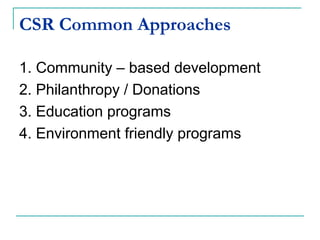
CSR Common Approaches

1. Community – based development
2. Philanthropy / Donations
3. Education programs
4. Environment friendly programs
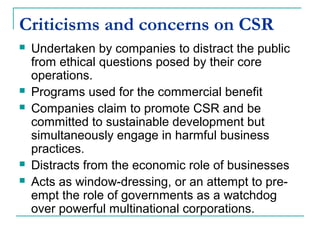
Criticisms and concerns on CSR
   Undertaken by companies to distract the public
    from ethical questions posed by their core
    operations.
   Programs used for the commercial benefit
   Companies claim to promote CSR and be
    committed to sustainable development but
    simultaneously engage in harmful business
    practices.
   Distracts from the economic role of businesses
   Acts as window-dressing, or an attempt to pre-
    empt the role of governments as a watchdog
    over powerful multinational corporations.
Thank You!

Corporate social responsibility

  • 1.
    Corporate Social Responsibility (CSR) Jeannifer B. Villanueva MPMG 11-011 Dean F. Tolentino
  • 2.
    CSR: Origin The term "corporate social responsibility" came into common use in the late 1960s and early 1970s after many multinational corporations formed the term stakeholder. It was used to describe corporate owners beyond shareholders as a result of an influential book by R. Edward Freeman, Strategic Management: A Stakeholder Approach in 1984.
  • 3.
    CSR: Goal  To embrace responsibility for the company's actions  Encourage a positive impact through its activities on the environment, consumers, employees, communities, stakeholders and all other members of the public sphere  To aid an organization's mission as well as a guide to what the company stands for and will uphold to its consumers  To manage the business processes to produce an overall positive impact on society.
  • 4.
    CSR Definitions Business forSocial Responsibility:  Operating a business in a manner that meets or exceeds the ethical, legal, commercial and public expectations that society has of business. The World Business Council for Sustainable Development:  Corporate Social Responsibility is the continuing commitment by business to behave ethically and contribute to economic development while improving the quality of life of the workforce and their families as well as of the local community and society at large.
  • 5.
    CSR as definedby different countries  In Ghana, CSR is about capacity building for sustainable livelihoods. It respects cultural differences and finds the business opportunities in building the skills of employees, the community and the government.  In the Philippines, CSR is about business giving back to society.
  • 6.
    In the United States, CSR has been defined much more in terms of a philanthropic model. Companies make profits, unhindered except by fulfilling their duty to pay taxes. Then they donate a certain share of the profits to charitable causes.  In Europe, CSR is operating the core business in a socially responsible way, complemented by investment in communities for solid business case reasons.
  • 8.
    CSR Common Approaches 1.Community – based development 2. Philanthropy / Donations 3. Education programs 4. Environment friendly programs
  • 9.
    Criticisms and concernson CSR  Undertaken by companies to distract the public from ethical questions posed by their core operations.  Programs used for the commercial benefit  Companies claim to promote CSR and be committed to sustainable development but simultaneously engage in harmful business practices.  Distracts from the economic role of businesses  Acts as window-dressing, or an attempt to pre- empt the role of governments as a watchdog over powerful multinational corporations.
  • 10.