Corporate Social
Responsibility
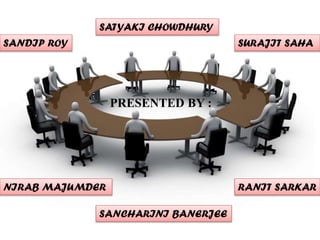
SANDIP ROY
SATYAKI CHOWDHURY
NIRAB MAJUMDER
SURAJIT SAHA
RANIT SARKAR
SANCHARINI BANERJEE
PRESENTED BY :
Objectives of the Session
At the end of this session, you should be able to identify
and describe:
 A definition for CSR
 Brief History & Types of CSR
 Myths Surrounding CSR
 Need & Demonstration of CSR
 Benefits of CSR
 Evolution of CSR In India
 Corporates, India & CSR
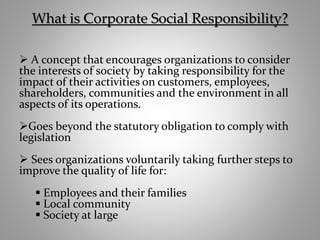
What is Corporate Social Responsibility?
 A concept that encourages organizations to consider
the interests of society by taking responsibility for the
impact of their activities on customers, employees,
shareholders, communities and the environment in all
aspects of its operations.
Goes beyond the statutory obligation to comply with
legislation
 Sees organizations voluntarily taking further steps to
improve the quality of life for:
 Employees and their families
 Local community
 Society at large
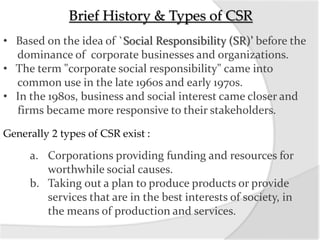
Brief History & Types of CSR
• Based on the idea of `Social Responsibility (SR)’ before the
dominance of corporate businesses and organizations.
• The term "corporate social responsibility" came into
common use in the late 1960s and early 1970s.
• In the 1980s, business and social interest came closer and
firms became more responsive to their stakeholders.
Generally 2 types of CSR exist :
a. Corporations providing funding and resources for
worthwhile social causes.
b. Taking out a plan to produce products or provide
services that are in the best interests of society, in
the means of production and services.
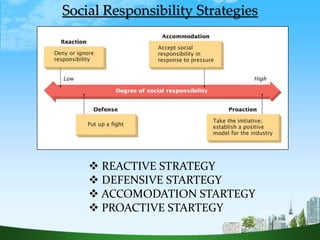
Social Responsibility Strategies
 REACTIVE STRATEGY
 DEFENSIVE STARTEGY
 ACCOMODATION STARTEGY
 PROACTIVE STARTEGY
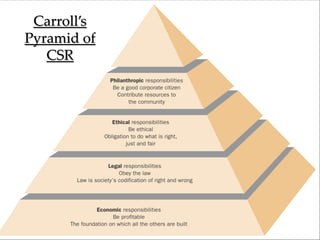
Carroll’s
Pyramid of
CSR
Need For CSR
 Issues such as environmental damage, improper
treatment of workers, and faulty production leading to
customer inconvenience or danger are being highlighted.
Investors and investment fund managers have began
to take account of a firm’s CSR policy in making
investment decisions.
 Some consumers have become
increasingly sensitive to the CSR
program of the firms from which
they buy their goods and
services.
Need Of CSR For Consumers & Society
Important for encouraging businesses
Consumer preference
Consumer opinions
Issues mainly emphasized on by
consumers:
Product quality
Money value
Technological advancements
• Leads to increase in the awareness of the society
• Helps in dealing with societal matters such as:
• Nutrition & health issues
• Human rights & gender
• Labor practices
• Involvement in community issues
Demonstration of CSR
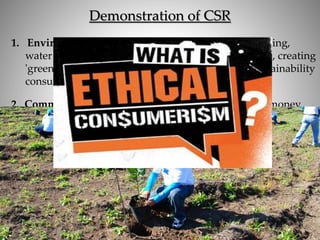
1. Environmental Sustainability: Areas include recycling,
water management, using renewable energy sources, creating
'greener' supply chains, etc. The highest ranked sustainability
consulting firm is Ernst & Young
2. Community Involvement: This can include raising money
for local charities, sponsoring local events, employing people
from a community, etc. Starbucks is an example of a
company that focuses on community involvement.
3. Ethical Marketing Practices: Companies that ethically
market to consumers are placing a higher value on their
customers and respecting them as people who are ends in
themselves.
Potential Business Benefits of CSR
 TRIPLE BOTTOM LINE : People, Planet & Profit.
People - Relates to fair and beneficial business practices
Planet - Refers to sustainable environmental practices
Profit - Is the economic value created by the
organization after deducting the cost of all inputs
HUMAN RESOURCES : A CSR
program can be an aid to recruitment
and retention, particularly within the
competitive graduate student market.
 RISK MANAGEMENT : Building a genuine culture of
'doing the right thing' within a corporation can offset
these risks.
Potential Business Benefits of CSR
 BRAND DIFFERENTIATION : In crowded
marketplaces, companies strive for a unique selling
proposition that can separate them from the competition
in the minds of consumers. CSR can play a role in
building customer loyalty based on distinctive ethical
values.
LICENSE TO OPERATE : To avoid
interference in their business
through taxation or regulations.
 SUPPLIER RELATIONS : Emphasize the importance
of practicing CSR to suppliers & researching on existing
supply chains.
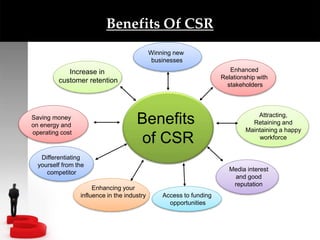
Benefits
of CSR
Winning new
businesses
Enhancing your
influence in the industry
Attracting,
Retaining and
Maintaining a happy
workforce
Increase in
customer retention
Differentiating
yourself from the
competitor
Saving money
on energy and
operating cost
Access to funding
opportunities
Media interest
and good
reputation
Enhanced
Relationship with
stakeholders
Benefits Of CSR
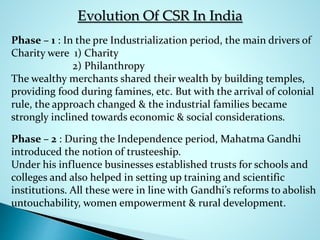
Evolution Of CSR In India
Phase – 1 : In the pre Industrialization period, the main drivers of
Charity were 1) Charity
2) Philanthropy
The wealthy merchants shared their wealth by building temples,
providing food during famines, etc. But with the arrival of colonial
rule, the approach changed & the industrial families became
strongly inclined towards economic & social considerations.
Phase – 2 : During the Independence period, Mahatma Gandhi
introduced the notion of trusteeship.
Under his influence businesses established trusts for schools and
colleges and also helped in setting up training and scientific
institutions. All these were in line with Gandhi’s reforms to abolish
untouchability, women empowerment & rural development.
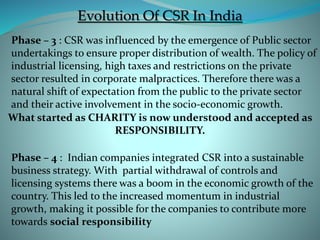
Evolution Of CSR In India
Phase – 3 : CSR was influenced by the emergence of Public sector
undertakings to ensure proper distribution of wealth. The policy of
industrial licensing, high taxes and restrictions on the private
sector resulted in corporate malpractices. Therefore there was a
natural shift of expectation from the public to the private sector
and their active involvement in the socio-economic growth.
Phase – 4 : Indian companies integrated CSR into a sustainable
business strategy. With partial withdrawal of controls and
licensing systems there was a boom in the economic growth of the
country. This led to the increased momentum in industrial
growth, making it possible for the companies to contribute more
towards social responsibility
What started as CHARITY is now understood and accepted as
RESPONSIBILITY.
General Values Statement
ENVIRONMENTAL FOCUS
“While we have always sought to be sensitive to the
environment, we must use our significant resources and
capabilities to provide active leadership on environmental
issues, particularly those relevant to our business. We are
committed to preserving our environment , from the use
of more than $2 billion a year in recycled content &
suppliers & beautification efforts.”
General Values Statement
EMPLOYEE FOCUS
Johnson & Johnson’s Balancing Work & Family program
reflects our credo commitment to help employees manage
work and family life. This effort offers advantages to
employees and to the Company, which is able to attract,
recruit and retain the most talented employees and offer
them a host of benefits.
CORPORATES,
INDIA & CSR
21
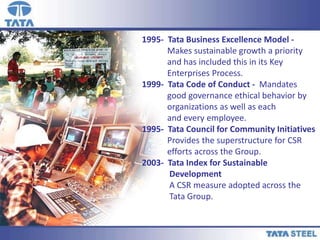
1995- Tata Business Excellence Model -
Makes sustainable growth a priority
and has included this in its Key
Enterprises Process.
1999- Tata Code of Conduct - Mandates
good governance ethical behavior by
organizations as well as each
and every employee.
1995- Tata Council for Community Initiatives
Provides the superstructure for CSR
efforts across the Group.
2003- Tata Index for Sustainable
Development
A CSR measure adopted across the
Tata Group.
22
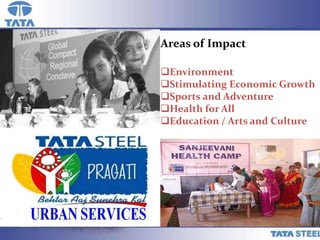
Areas of Impact
Environment
Stimulating Economic Growth
Sports and Adventure
Health for All
Education / Arts and Culture
SOCIAL PERFORMANCE
 The environment policy of the Company promotes
energy conservation, 3Rs (Reduce, Reuse and
Recycle), green procurement, environment friendly
mobility and environment consciousness among its
direct stakeholders.
 Maruti Suzuki became the first automobile
company in India to register a Clean Development
Mechanism (CDM) project with the United Nations
Framework Convention on Climate Change
(UNFCCC).
 Maruti Suzuki runs an in-house volunteer
programme for its employees. The programme runs
in partnership with local NGOs.
Conclusions
A. Corporate had moved ahead to a really new level to
fulfill their Social Responsibility which not only helps
the society but also to these companies to make a
reputation in the society.
B. The expectations from private sector regarding CSR is
very high.
C. Corporate companies should be encouraged and
motivated to contribute more.
So, Companies not doing CSR will not survive.
It’s only the Question of “WHEN”…….
CORPORATE SOCIAL RESPONSIBILITY -  Background & Implications In India

CORPORATE SOCIAL RESPONSIBILITY - Background & Implications In India

  • 2.
  • 3.
    SANDIP ROY SATYAKI CHOWDHURY NIRABMAJUMDER SURAJIT SAHA RANIT SARKAR SANCHARINI BANERJEE PRESENTED BY :
  • 4.
    Objectives of theSession At the end of this session, you should be able to identify and describe:  A definition for CSR  Brief History & Types of CSR  Myths Surrounding CSR  Need & Demonstration of CSR  Benefits of CSR  Evolution of CSR In India  Corporates, India & CSR
  • 5.
    What is CorporateSocial Responsibility?  A concept that encourages organizations to consider the interests of society by taking responsibility for the impact of their activities on customers, employees, shareholders, communities and the environment in all aspects of its operations. Goes beyond the statutory obligation to comply with legislation  Sees organizations voluntarily taking further steps to improve the quality of life for:  Employees and their families  Local community  Society at large
  • 6.
    Brief History &Types of CSR • Based on the idea of `Social Responsibility (SR)’ before the dominance of corporate businesses and organizations. • The term "corporate social responsibility" came into common use in the late 1960s and early 1970s. • In the 1980s, business and social interest came closer and firms became more responsive to their stakeholders. Generally 2 types of CSR exist : a. Corporations providing funding and resources for worthwhile social causes. b. Taking out a plan to produce products or provide services that are in the best interests of society, in the means of production and services.
  • 8.
    Social Responsibility Strategies REACTIVE STRATEGY  DEFENSIVE STARTEGY  ACCOMODATION STARTEGY  PROACTIVE STARTEGY
  • 9.
  • 10.
    Need For CSR Issues such as environmental damage, improper treatment of workers, and faulty production leading to customer inconvenience or danger are being highlighted. Investors and investment fund managers have began to take account of a firm’s CSR policy in making investment decisions.  Some consumers have become increasingly sensitive to the CSR program of the firms from which they buy their goods and services.
  • 11.
    Need Of CSRFor Consumers & Society Important for encouraging businesses Consumer preference Consumer opinions Issues mainly emphasized on by consumers: Product quality Money value Technological advancements • Leads to increase in the awareness of the society • Helps in dealing with societal matters such as: • Nutrition & health issues • Human rights & gender • Labor practices • Involvement in community issues
  • 12.
    Demonstration of CSR 1.Environmental Sustainability: Areas include recycling, water management, using renewable energy sources, creating 'greener' supply chains, etc. The highest ranked sustainability consulting firm is Ernst & Young 2. Community Involvement: This can include raising money for local charities, sponsoring local events, employing people from a community, etc. Starbucks is an example of a company that focuses on community involvement. 3. Ethical Marketing Practices: Companies that ethically market to consumers are placing a higher value on their customers and respecting them as people who are ends in themselves.
  • 13.
    Potential Business Benefitsof CSR  TRIPLE BOTTOM LINE : People, Planet & Profit. People - Relates to fair and beneficial business practices Planet - Refers to sustainable environmental practices Profit - Is the economic value created by the organization after deducting the cost of all inputs HUMAN RESOURCES : A CSR program can be an aid to recruitment and retention, particularly within the competitive graduate student market.  RISK MANAGEMENT : Building a genuine culture of 'doing the right thing' within a corporation can offset these risks.
  • 14.
    Potential Business Benefitsof CSR  BRAND DIFFERENTIATION : In crowded marketplaces, companies strive for a unique selling proposition that can separate them from the competition in the minds of consumers. CSR can play a role in building customer loyalty based on distinctive ethical values. LICENSE TO OPERATE : To avoid interference in their business through taxation or regulations.  SUPPLIER RELATIONS : Emphasize the importance of practicing CSR to suppliers & researching on existing supply chains.
  • 15.
    Benefits of CSR Winning new businesses Enhancingyour influence in the industry Attracting, Retaining and Maintaining a happy workforce Increase in customer retention Differentiating yourself from the competitor Saving money on energy and operating cost Access to funding opportunities Media interest and good reputation Enhanced Relationship with stakeholders Benefits Of CSR
  • 16.
    Evolution Of CSRIn India Phase – 1 : In the pre Industrialization period, the main drivers of Charity were 1) Charity 2) Philanthropy The wealthy merchants shared their wealth by building temples, providing food during famines, etc. But with the arrival of colonial rule, the approach changed & the industrial families became strongly inclined towards economic & social considerations. Phase – 2 : During the Independence period, Mahatma Gandhi introduced the notion of trusteeship. Under his influence businesses established trusts for schools and colleges and also helped in setting up training and scientific institutions. All these were in line with Gandhi’s reforms to abolish untouchability, women empowerment & rural development.
  • 17.
    Evolution Of CSRIn India Phase – 3 : CSR was influenced by the emergence of Public sector undertakings to ensure proper distribution of wealth. The policy of industrial licensing, high taxes and restrictions on the private sector resulted in corporate malpractices. Therefore there was a natural shift of expectation from the public to the private sector and their active involvement in the socio-economic growth. Phase – 4 : Indian companies integrated CSR into a sustainable business strategy. With partial withdrawal of controls and licensing systems there was a boom in the economic growth of the country. This led to the increased momentum in industrial growth, making it possible for the companies to contribute more towards social responsibility What started as CHARITY is now understood and accepted as RESPONSIBILITY.
  • 18.
    General Values Statement ENVIRONMENTALFOCUS “While we have always sought to be sensitive to the environment, we must use our significant resources and capabilities to provide active leadership on environmental issues, particularly those relevant to our business. We are committed to preserving our environment , from the use of more than $2 billion a year in recycled content & suppliers & beautification efforts.”
  • 19.
    General Values Statement EMPLOYEEFOCUS Johnson & Johnson’s Balancing Work & Family program reflects our credo commitment to help employees manage work and family life. This effort offers advantages to employees and to the Company, which is able to attract, recruit and retain the most talented employees and offer them a host of benefits.
  • 20.
  • 21.
    21 1995- Tata BusinessExcellence Model - Makes sustainable growth a priority and has included this in its Key Enterprises Process. 1999- Tata Code of Conduct - Mandates good governance ethical behavior by organizations as well as each and every employee. 1995- Tata Council for Community Initiatives Provides the superstructure for CSR efforts across the Group. 2003- Tata Index for Sustainable Development A CSR measure adopted across the Tata Group.
  • 22.
    22 Areas of Impact Environment StimulatingEconomic Growth Sports and Adventure Health for All Education / Arts and Culture
  • 23.
    SOCIAL PERFORMANCE  Theenvironment policy of the Company promotes energy conservation, 3Rs (Reduce, Reuse and Recycle), green procurement, environment friendly mobility and environment consciousness among its direct stakeholders.  Maruti Suzuki became the first automobile company in India to register a Clean Development Mechanism (CDM) project with the United Nations Framework Convention on Climate Change (UNFCCC).  Maruti Suzuki runs an in-house volunteer programme for its employees. The programme runs in partnership with local NGOs.
  • 24.
    Conclusions A. Corporate hadmoved ahead to a really new level to fulfill their Social Responsibility which not only helps the society but also to these companies to make a reputation in the society. B. The expectations from private sector regarding CSR is very high. C. Corporate companies should be encouraged and motivated to contribute more. So, Companies not doing CSR will not survive. It’s only the Question of “WHEN”…….