Adonis Olukayode HAMBOLU Bolaji  Ibrahim  ABDULLAHI
Introduction This is an academic attempt at making lucid presentation of  the  content  and  process  of the  emerging concept of corporate citizenship  in the contemporary business world  as a subject akin to corporate social responsibility .
Agenda Background Definitions& Theoretical  arguments Focus Overview Corporate Citizenship Model Features  Effects 12 Generic Principles Ripple Effects Conceptualisation Legislation  & Control Benefits  Conclusion References
Background of  Corporate Citizenship Corporate Citizenship;   it is a resultant effect of the global economy  that make business to automatically be open to the challenges of  societal expectations/ responsibilities. Which enhance the legitimating and the liberation of the private commercial enterprises globally in the 1980s/90s occasioned by the exponential manifestation of corporate networking globally via technology. As in the political sense of human individual, a business is assumed to be a citizen of its operational environment and should as a matter of fact owe it some level of active allegiance and commitment. Citizenship according to Drucker (1993) means the legal rights and duties of a member of a country
Background cont’d Corporate identity is the selfness awareness and fundamental of answering the question of who are we by rganisations  (Albert& Whetten ,1985,Benning 1999)
Definition and  Theoretical  Arguments The definitions and conceptions of corporate citizenship are fuzzy, varied and constantly evolving More akin to the concept of CSR and sustainability It involves the act of  proactively addressing business and society issues ,while building stakeholders partnerships  ( Post et al,2002 ) Good corporate citizenship integrates social, ethical, environmental, economic and philanthropic values in the core decision making processes of a business. Corporate citizenship has supporters and detractors from Corporate citizenship is defined as the act of 'business taking greater account of its social, environmental and financial footprints  ( Gianni Zappala, 2003 )
Definition cont’d Corporate  Citizenship is the management of organisations wider influences within the society for the mutual benefit of the company and the society  (Mersden & Andriof, 1998) It is a  philanthropic managerial strategic ideology  evolveed by practitioners  Good corporate citizenship integrates social, ethical, environmental, economic and philanthropic values in the core decision making processes of a business. Corporate citizenship has supporters and detractors from across the political and ideological spectrum, business, non-government organisations (NGOs) and the general public.
Historical Evolution  Edward Mason (1959)of Harvard propound business as the most important economic institution affecting the community much more than  ever thought of  The American firms post World War II era domination of global economy  (Thorne et al (2003) Rice University Management School academic Theoretical  construct in the 1980s Became a common terminology on the 1990s
Evolution Cont’d Ronald Regan /Margaret Thatcher  Era Globalisation Era The Customer/ popular Awareness Era
Focus of Corporate Citizenship Social Impact Economic Impact  Environmental Impact
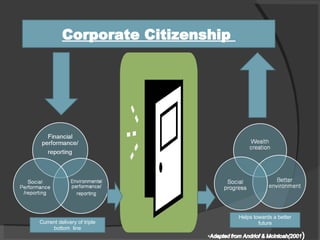
Corporate Citizenship  Helps towards a better future Current delivery of triple bottom  line
Overview Origin   :  1990s Basis   : Evolving a collaborative partnership effort with key  stakeholder groups Focus  : Discovering Genuine business  opportunities via partnership Actions :  Management of Corporate social  and  financial activities .... Post et al(2002)
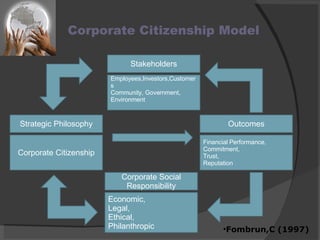
Corporate Citizenship Model  Employees,Investors,Customers Community, Government, Environment Economic, Legal, Ethical, Philanthropic Financial Performance, Commitment, Trust, Reputation Corporate Citizenship Strategic Philosophy Stakeholders Outcomes Corporate Social Responsibility Fombrun,C (1997)
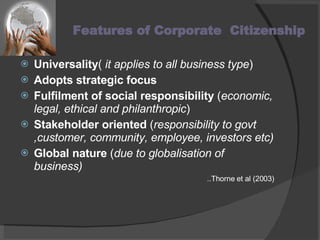
Features of Corporate  Citizenship  Universality (  it applies to all business type ) Adopts strategic focus  Fulfilment of social responsibility  ( economic, legal, ethical and philanthropic ) Stakeholder oriented  ( responsibility to govt ,customer, community, employee, investors etc) Global nature  ( due to globalisation of business) ..Thorne et al (2003)
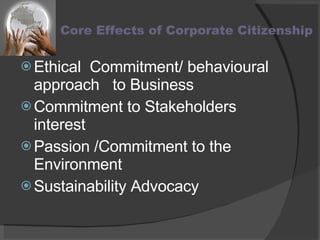
Core Effects of Corporate Citizenship Ethical  Commitment/ behavioural approach  to Business Commitment to Stakeholders interest  Passion /Commitment to the Environment Sustainability Advocacy
12 Generic Principles Making  difference in the wider society Stakeholder empowerment Accountability Transparency Sustainable capitalism (profitability & Prosperity) Sharing responsibility Triple bottom line  Long Term oriented Dialogue Stakeholders Inclusion Communication Engagement
The UN & Corporate Citizenship The United nation in its initiative under the leadership of Kofi  Annan as the Secretary general sees the world business sector as a citizen of the world and indeed a veritable tool / solution to the world problems rather than cause Global Compact published in 2000 providing the requisite information on the principle, code and practice of  good corporate citizenship
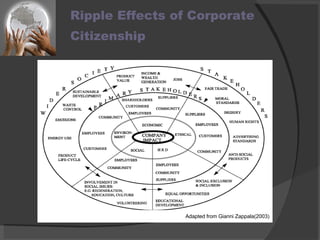
Ripple Effects of Corporate Citizenship                    Adapted from Gianni Zappala(2003)
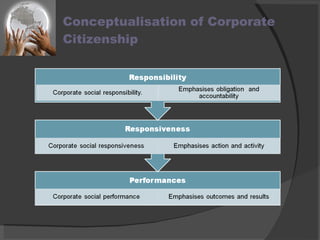
Conceptualisation of Corporate Citizenship
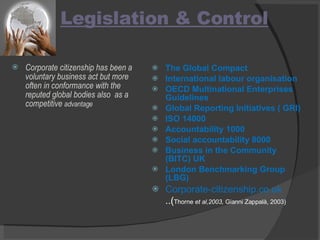
Legislation & Control Corporate citizenship has been a voluntary business act but more often in conformance with the reputed global bodies also  as a competitive  advantage   The Global Compact  International labour organisation OECD Multinational Enterprises Guidelines Global Reporting Initiatives ( GRI) ISO 14000 Accountability 1000 Social accountability 8000 Business in the Community (BITC) UK London Benchmarking Group (LBG) Corporate-citizenship.co.uk ..( Thorne  et al,2003,  Gianni Zappalà, 2003)
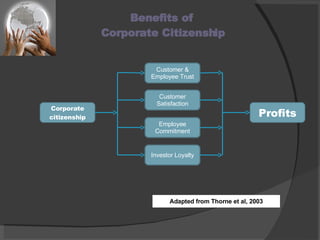
Benefits of  Corporate Citizenship Employee Commitment Corporate citizenship Investor Loyalty Profits Customer Satisfaction Customer & Employee Trust Adapted from Thorne et al, 2003
Conclusion Corporate Citizenship, is another phrase normally used by business executives to describe different rights and responsibility of business activities in the society were they operate or intend to, and with the growing concern of concept of sustainability a lot of companies are aware of the major challenges before them as corporation to carryout business activities
- and responsibility. The long run achievement would be to make the world a better place for us and the incoming generation. Conclusion (cont.)
References   Andriof,j & McIntosh ,M (2001)Perspectives on Corporate  Citizenship, Greenleaf, UK Bush Geoffrey(2005) Corporate Citizenship as part of  The Business Model ( Hancock Ed)  Carroll & Buchholtz (2006) Business & Society: Ethics and Stakeholder Management, Thomson, Australia Fombrun,C  (1997)The three pillars of corporate citizenship (Corporate global  citizenship) Lexington , San Francisco    Gianni Zappala( 2003)Corporate citizenship  :A Brief Overview  John Hancock(2005) Investing in Corporate Social Responsibility, Kogan Page, London Kim Davenport(1999) The Social Auditing Teaching Packet Post,J et al (2002) Business and society: corporate strategy , public policy ,ethics 10 th  Ed, McGraw-Hill, Boston. Thorne  et al (2003) Business and Society : A Strategic Approach to Corporate Citizenship, Houghtom Mifflin, Boston Thorne  et al (2003) Business and Society : A Strategic Approach to Corporate Social Responsibility, 3 rd  Ed ,Houghtom Mifflin, Boston  

Good Corporate Citizenship

  • 1.
    Adonis Olukayode HAMBOLUBolaji Ibrahim ABDULLAHI
  • 2.
    Introduction This isan academic attempt at making lucid presentation of the content and process of the emerging concept of corporate citizenship in the contemporary business world as a subject akin to corporate social responsibility .
  • 3.
    Agenda Background Definitions&Theoretical arguments Focus Overview Corporate Citizenship Model Features Effects 12 Generic Principles Ripple Effects Conceptualisation Legislation & Control Benefits Conclusion References
  • 4.
    Background of Corporate Citizenship Corporate Citizenship; it is a resultant effect of the global economy that make business to automatically be open to the challenges of societal expectations/ responsibilities. Which enhance the legitimating and the liberation of the private commercial enterprises globally in the 1980s/90s occasioned by the exponential manifestation of corporate networking globally via technology. As in the political sense of human individual, a business is assumed to be a citizen of its operational environment and should as a matter of fact owe it some level of active allegiance and commitment. Citizenship according to Drucker (1993) means the legal rights and duties of a member of a country
  • 5.
    Background cont’d Corporateidentity is the selfness awareness and fundamental of answering the question of who are we by rganisations (Albert& Whetten ,1985,Benning 1999)
  • 6.
    Definition and Theoretical Arguments The definitions and conceptions of corporate citizenship are fuzzy, varied and constantly evolving More akin to the concept of CSR and sustainability It involves the act of proactively addressing business and society issues ,while building stakeholders partnerships ( Post et al,2002 ) Good corporate citizenship integrates social, ethical, environmental, economic and philanthropic values in the core decision making processes of a business. Corporate citizenship has supporters and detractors from Corporate citizenship is defined as the act of 'business taking greater account of its social, environmental and financial footprints ( Gianni Zappala, 2003 )
  • 7.
    Definition cont’d Corporate Citizenship is the management of organisations wider influences within the society for the mutual benefit of the company and the society (Mersden & Andriof, 1998) It is a philanthropic managerial strategic ideology evolveed by practitioners Good corporate citizenship integrates social, ethical, environmental, economic and philanthropic values in the core decision making processes of a business. Corporate citizenship has supporters and detractors from across the political and ideological spectrum, business, non-government organisations (NGOs) and the general public.
  • 8.
    Historical Evolution Edward Mason (1959)of Harvard propound business as the most important economic institution affecting the community much more than ever thought of The American firms post World War II era domination of global economy (Thorne et al (2003) Rice University Management School academic Theoretical construct in the 1980s Became a common terminology on the 1990s
  • 9.
    Evolution Cont’d RonaldRegan /Margaret Thatcher Era Globalisation Era The Customer/ popular Awareness Era
  • 10.
    Focus of CorporateCitizenship Social Impact Economic Impact Environmental Impact
  • 11.
    Corporate Citizenship Helps towards a better future Current delivery of triple bottom line
  • 12.
    Overview Origin : 1990s Basis : Evolving a collaborative partnership effort with key stakeholder groups Focus : Discovering Genuine business opportunities via partnership Actions : Management of Corporate social and financial activities .... Post et al(2002)
  • 13.
    Corporate Citizenship Model Employees,Investors,Customers Community, Government, Environment Economic, Legal, Ethical, Philanthropic Financial Performance, Commitment, Trust, Reputation Corporate Citizenship Strategic Philosophy Stakeholders Outcomes Corporate Social Responsibility Fombrun,C (1997)
  • 14.
    Features of Corporate Citizenship Universality ( it applies to all business type ) Adopts strategic focus Fulfilment of social responsibility ( economic, legal, ethical and philanthropic ) Stakeholder oriented ( responsibility to govt ,customer, community, employee, investors etc) Global nature ( due to globalisation of business) ..Thorne et al (2003)
  • 15.
    Core Effects ofCorporate Citizenship Ethical Commitment/ behavioural approach to Business Commitment to Stakeholders interest Passion /Commitment to the Environment Sustainability Advocacy
  • 16.
    12 Generic PrinciplesMaking difference in the wider society Stakeholder empowerment Accountability Transparency Sustainable capitalism (profitability & Prosperity) Sharing responsibility Triple bottom line Long Term oriented Dialogue Stakeholders Inclusion Communication Engagement
  • 17.
    The UN &Corporate Citizenship The United nation in its initiative under the leadership of Kofi Annan as the Secretary general sees the world business sector as a citizen of the world and indeed a veritable tool / solution to the world problems rather than cause Global Compact published in 2000 providing the requisite information on the principle, code and practice of good corporate citizenship
  • 18.
    Ripple Effects ofCorporate Citizenship                 Adapted from Gianni Zappala(2003)
  • 19.
  • 20.
    Legislation & ControlCorporate citizenship has been a voluntary business act but more often in conformance with the reputed global bodies also as a competitive advantage The Global Compact International labour organisation OECD Multinational Enterprises Guidelines Global Reporting Initiatives ( GRI) ISO 14000 Accountability 1000 Social accountability 8000 Business in the Community (BITC) UK London Benchmarking Group (LBG) Corporate-citizenship.co.uk ..( Thorne et al,2003, Gianni Zappalà, 2003)
  • 21.
    Benefits of Corporate Citizenship Employee Commitment Corporate citizenship Investor Loyalty Profits Customer Satisfaction Customer & Employee Trust Adapted from Thorne et al, 2003
  • 22.
    Conclusion Corporate Citizenship,is another phrase normally used by business executives to describe different rights and responsibility of business activities in the society were they operate or intend to, and with the growing concern of concept of sustainability a lot of companies are aware of the major challenges before them as corporation to carryout business activities
  • 23.
    - and responsibility.The long run achievement would be to make the world a better place for us and the incoming generation. Conclusion (cont.)
  • 24.
    References Andriof,j & McIntosh ,M (2001)Perspectives on Corporate Citizenship, Greenleaf, UK Bush Geoffrey(2005) Corporate Citizenship as part of The Business Model ( Hancock Ed) Carroll & Buchholtz (2006) Business & Society: Ethics and Stakeholder Management, Thomson, Australia Fombrun,C (1997)The three pillars of corporate citizenship (Corporate global citizenship) Lexington , San Francisco   Gianni Zappala( 2003)Corporate citizenship :A Brief Overview John Hancock(2005) Investing in Corporate Social Responsibility, Kogan Page, London Kim Davenport(1999) The Social Auditing Teaching Packet Post,J et al (2002) Business and society: corporate strategy , public policy ,ethics 10 th Ed, McGraw-Hill, Boston. Thorne et al (2003) Business and Society : A Strategic Approach to Corporate Citizenship, Houghtom Mifflin, Boston Thorne et al (2003) Business and Society : A Strategic Approach to Corporate Social Responsibility, 3 rd Ed ,Houghtom Mifflin, Boston