





Financial Wellness Enhancement
Program
Welcome to the Program
Pre-Workshop Questionnaire
Expectation from the Program – What we
heard from 3000+ Participants
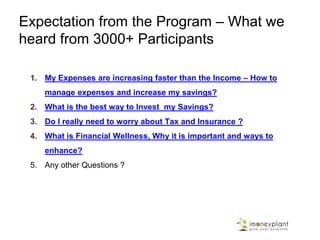
1. My Expenses are increasing faster than the Income – How to
manage expenses and increase my savings?
2. What is the best way to Invest my Savings?
3. Do I really need to worry about Tax and Insurance ?
4. What is Financial Wellness, Why it is important and ways to
enhance?
5. Any other Questions ?
Which is a bigger problem ?
Not enough money to Invest
or
Have Enough Savings, but don’t know where to Invest
Managing Expenses
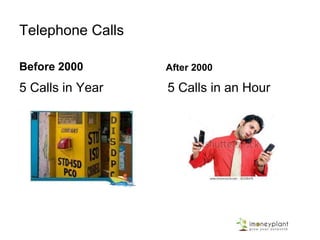
Telephone Calls
Before 2000
5 Calls in Year
After 2000
5 Calls in an Hour
Clothes
Before 2000
Bought only for
After 2000
Bought whenever
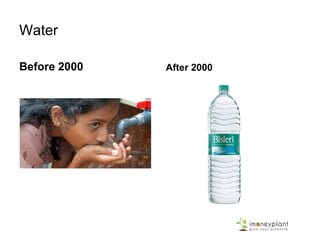
Water
Before 2000 After 2000
How to increase our
savings?
What is our nature?
Marshmallow Test
Research conducted over 40 years
Kids 6-10 years of age are asked to go to a room
where chocolate is kept and asked to wait for 15
minutes
If they resist 15 min without eating chocolate, they
will get 2
Every Kid wanted to have 2 chocolates
Guess how many walked with 2?
Just 1%
10 years later – same kids who walked away with 2
chocolates – got better grades in the exam
Another 10 years later – they had better jobs
Another 10 years later – they had better investments
What prevents us from being in that 1%
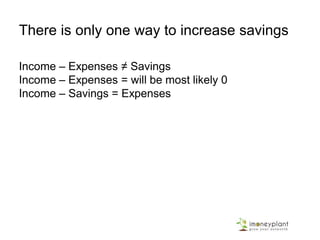
There is only one way to increase savings
Income – Expenses ≠ Savings
Income – Expenses = will be most likely 0
Income – Savings = Expenses
How to increase savings ?
1. Treat Savings as your first Expense
2. Take maximum benefits of Employer sponsored
Retirement benefits (EPF, NPS, Super Annuation
Schemes)
3. Measure Savings as % of Income
4. Improve Savings % by 2-5% every year
5. Aim for 30:30-40:50-50:100 (for Pvt Sector) and
30:30-40:40-50:50-60:100 (for PSU)
Expectation from the Program – What we
heard from 3000+ Participants
1. My Expenses are increasing faster than the Income – How to
manage expenses and increase my savings?
2. What is the best way to Invest my Savings?
3. Do I really need to worry about Tax and Insurance ?
4. What is Financial Wellness, Why it is important and ways to
enhance?
5. Any other Questions ?
Why Invest ?
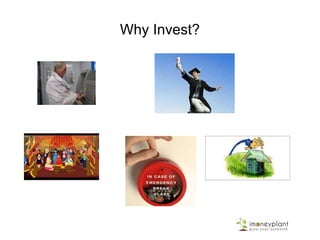
Why Invest?
How much is required for Retirement ?
Let us do a case Study -
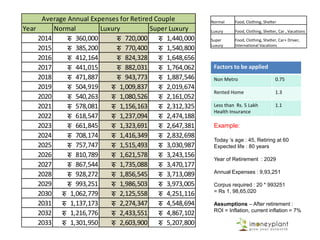
Normal Food, Clothing, Shelter
Luxury Food, Clothing, Shelter, Car , Vacations
Super
Luxury
Food, Clothing, Shelter, Car+ Driver,
International Vacations
Year Normal Luxury Super Luxury
2014 रु 360,000 रु 720,000 रु 1,440,000
2015 रु 385,200 रु 770,400 रु 1,540,800
2016 रु 412,164 रु 824,328 रु 1,648,656
2017 रु 441,015 रु 882,031 रु 1,764,062
2018 रु 471,887 रु 943,773 रु 1,887,546
2019 रु 504,919 रु 1,009,837 रु 2,019,674
2020 रु 540,263 रु 1,080,526 रु 2,161,052
2021 रु 578,081 रु 1,156,163 रु 2,312,325
2022 रु 618,547 रु 1,237,094 रु 2,474,188
2023 रु 661,845 रु 1,323,691 रु 2,647,381
2024 रु 708,174 रु 1,416,349 रु 2,832,698
2025 रु 757,747 रु 1,515,493 रु 3,030,987
2026 रु 810,789 रु 1,621,578 रु 3,243,156
2027 रु 867,544 रु 1,735,088 रु 3,470,177
2028 रु 928,272 रु 1,856,545 रु 3,713,089
2029 रु 993,251 रु 1,986,503 रु 3,973,005
2030 रु 1,062,779 रु 2,125,558 रु 4,251,116
2031 रु 1,137,173 रु 2,274,347 रु 4,548,694
2032 रु 1,216,776 रु 2,433,551 रु 4,867,102
2033 रु 1,301,950 रु 2,603,900 रु 5,207,800
Average Annual Expenses for Retired Couple
Factors to be applied
Non Metro 0.75
Rented Home 1.3
Less than Rs. 5 Lakh
Health Insurance
1.1
Example:
Today ‘s age : 45, Retiring at 60
Expected life : 80 years
Year of Retirement : 2029
Annual Expenses : 9,93,251
Corpus required : 20 * 993251
= Rs 1, 98,65,020
Assumptions – After retirement :
ROI = Inflation, current inflation = 7%
Normal Food, Clothing, Shelter
Luxury Food, Clothing, Shelter, Car , Vacations
Super
Luxury
Food, Clothing, Shelter, Car+ Driver,
International Vacations
Year Normal Luxury Super Luxury
2034 रु 1,393,087 रु 2,786,173 रु 5,572,346
2035 रु 1,490,603 रु 2,981,205 रु 5,962,410
2036 रु 1,594,945 रु 3,189,889 रु 6,379,779
2037 रु 1,706,591 रु 3,413,182 रु 6,826,363
2038 रु 1,826,052 रु 3,652,104 रु 7,304,209
2039 रु 1,953,876 रु 3,907,752 रु 7,815,504
2040 रु 2,090,647 रु 4,181,294 रु 8,362,589
2041 रु 2,236,992 रु 4,473,985 रु 8,947,970
2042 रु 2,393,582 रु 4,787,164 रु 9,574,328
2043 रु 2,561,133 रु 5,122,265 रु 10,244,531
2044 रु 2,740,412 रु 5,480,824 रु 10,961,648
2045 रु 2,932,241 रु 5,864,482 रु 11,728,963
2046 रु 3,137,498 रु 6,274,995 रु 12,549,991
2047 रु 3,357,123 रु 6,714,245 रु 13,428,490
2048 रु 3,592,121 रु 7,184,242 रु 14,368,484
2049 रु 3,843,570 रु 7,687,139 रु 15,374,278
2050 रु 4,112,619 रु 8,225,239 रु 16,450,478
2051 रु 4,400,503 रु 8,801,006 रु 17,602,011
2052 रु 4,708,538 रु 9,417,076 रु 18,834,152
2053 रु 5,038,136 रु 10,076,271 रु 20,152,543
Average Annual Expenses for Retired Couple
Factors to be applied
Non Metro 0.75
Rented Home 1.3
Less than Rs. 5 Lakh
Health Insurance
1.1
Example:
Today ‘s age : 24, Retiring at 58
Expected life : 80 years
Year of Retirement : 2048
Annual Expenses : Rs.35,92,121
Corpus required : 22 * 35,92,121
= Rs 7,90,26,662
Assumptions – After retirement :
ROI = Inflation, current inflation = 7%
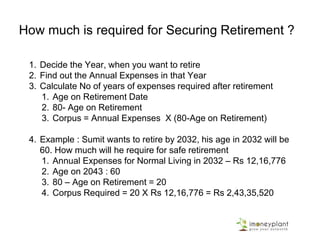
How much is required for Securing Retirement ?
1. Decide the Year, when you want to retire
2. Find out the Annual Expenses in that Year
3. Calculate No of years of expenses required after retirement
1. Age on Retirement Date
2. 80- Age on Retirement
3. Corpus = Annual Expenses X (80-Age on Retirement)
4. Example : Sumit wants to retire by 2032, his age in 2032 will be
60. How much will he require for safe retirement
1. Annual Expenses for Normal Living in 2032 – Rs 12,16,776
2. Age on 2043 : 60
3. 80 – Age on Retirement = 20
4. Corpus Required = 20 X Rs 12,16,776 = Rs 2,43,35,520
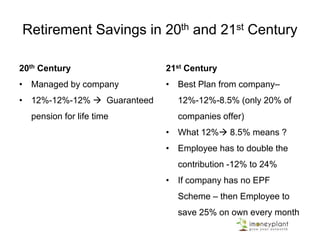
Retirement Savings in 20th and 21st Century
20th Century
• Managed by company
• 12%-12%-12%  Guaranteed
pension for life time
21st Century
• Best Plan from company–
12%-12%-8.5% (only 20% of
companies offer)
• What 12% 8.5% means ?
• Employee has to double the
contribution -12% to 24%
• If company has no EPF
Scheme – then Employee to
save 25% on own every month
Retirement Savings - T 20 Match
Only 2 Strategies will work
1. Sanath Jaysuriya or Virender Shewag (Slog in
the first 5 overs)
2. Virat Kohli (Consistent Scoring in all overs)
Treat Every month like an over
Don’t allow maiden overs – They increase the run rate
Keeping it for last 5 overs (years) is sure way to loose
the match
What if I want to start saving for retirement from tomorrow and
not today ?
In a recent consumer study, 21 percent of
individuals surveyed – including 38 percent of
those with income below $25,000 – reported that
winning the lottery was "the most practical
strategy for accumulating several hundred
thousand dollars" of wealth for their own
retirement. In addition, 16 percent thought that
winning the lottery was the best retirement
strategy for all Americans, not just themselves
– Consumer Federation of America and The
Financial Planning Association, 2006
Two Most Important Savings – So you will never
have to borrow (or even if you want to borrow
may not be able to borrow)
1. Short Term Expenses (About 5 Lakhs)
2. Retirement
Our Nature
• Investment
– Will do it tomorrow
• Consumption
– I want it today
This attitude and behavior leads to consume more and Invest less
To over come our Nature
1.Automate Investments – use SIP
2. Set up SIP on the day your salary is credited
Successful Investing
Invest with a Purpose and end goal in mind
Purpose/Goals
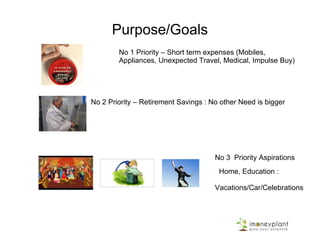
No 1 Priority – Short term expenses (Mobiles,
Appliances, Unexpected Travel, Medical, Impulse Buy)
No 2 Priority – Retirement Savings : No other Need is bigger
No 3 Priority Aspirations
Home, Education :
Vacations/Car/Celebrations
Short term needs
• Take “0” Risk  “0” Return is OK
• Protect the Capital
• “0” Risk Investment – Only FD or RD
Retirement Purpose
• Take Advantage of Tax Free Returns
• Tax Free Return Products - EPF, PPF, ELSS
Funds, INDEX Funds
• Keep reinvesting and withdraw only on the
day of retirement
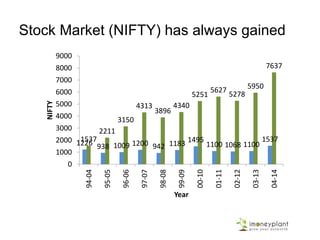
Stock Market (NIFTY) has always gained
1226 938 1009 1200 942 1183 1495
1100 1068 1100
15371537
2211
3150
4313
3896
4340
5251
5627
5278
5950
7637
0
1000
2000
3000
4000
5000
6000
7000
8000
9000
94-04
95-05
96-06
97-07
98-08
99-09
00-10
01-11
02-12
03-13
04-14
NIFTY
Year
It does not matter when you invest,
10 years later Stock Market was
always higher
Buy, Stock Market – Not Stock
Stock Market will be there after 10 years, Stock may not
be there after 10 years
How to buy Stock Market ?
• ABC –Index Fund – Sensex ––
Growth
• ABC –Index Fund – NIFTY –- Growth
• Through Monthly SIP
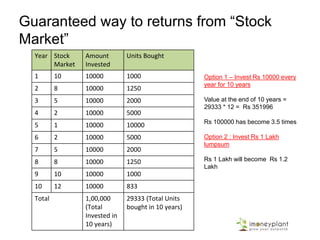
Guaranteed way to returns from “Stock
Market”
Year Stock
Market
Amount
Invested
Units Bought
1 10 10000 1000
2 8 10000 1250
3 5 10000 2000
4 2 10000 5000
5 1 10000 10000
6 2 10000 5000
7 5 10000 2000
8 8 10000 1250
9 10 10000 1000
10 12 10000 833
Total 1,00,000
(Total
Invested in
10 years)
29333 (Total Units
bought in 10 years)
Option 1 – Invest Rs 10000 every
year for 10 years
Value at the end of 10 years =
29333 * 12 = Rs 351996
Rs 100000 has become 3.5 times
Option 2 : Invest Rs 1 Lakh
lumpsum
Rs 1 Lakh will become Rs 1.2
Lakh
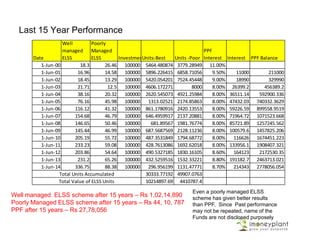
Last 15 Year Performance
Date
Well
managed
ELSS
Poorly
Managed
ELSS InvestmentUnits-Best Units -Poor
PPF
Interest Interest PPF Balance
1-Jun-00 18.3 26.46 100000 5464.480874 3779.28949 11.00%
1-Jun-01 16.96 14.58 100000 5896.226415 6858.71056 9.50% 11000 211000
1-Jun-02 18.45 13.29 100000 5420.054201 7524.45448 9.00% 18990 329990
1-Jun-03 21.71 12.5 100000 4606.172271 8000 8.00% 26399.2 456389.2
1-Jun-04 38.16 20.32 100000 2620.545073 4921.25984 8.00% 36511.14 592900.336
1-Jun-05 76.16 45.98 100000 1313.02521 2174.85863 8.00% 47432.03 740332.3629
1-Jun-06 116.12 41.32 100000 861.1780916 2420.13553 8.00% 59226.59 899558.9519
1-Jun-07 154.68 46.79 100000 646.4959917 2137.20881 8.00% 71964.72 1071523.668
1-Jun-08 146.65 50.46 100000 681.89567 1981.76774 8.00% 85721.89 1257245.562
1-Jun-09 145.44 46.99 100000 687.5687569 2128.11236 8.00% 100579.6 1457825.206
1-Jun-10 205.19 55.72 100000 487.3531849 1794.68772 8.00% 116626 1674451.223
1-Jun-11 233.23 59.08 100000 428.7613086 1692.62018 8.00% 133956.1 1908407.321
1-Jun-12 203.86 54.64 100000 490.5327185 1830.16105 8.60% 164123 2172530.35
1-Jun-13 231.2 65.26 100000 432.5259516 1532.33221 8.80% 191182.7 2463713.021
1-Jun-14 336.75 88.38 100000 296.956199 1131.47771 8.70% 214343 2778056.054
30333.77192 49907.0763
10214897.69 4410787.4
Total Units Accumulated
Total Value of ELSS Units
Well managed ELSS scheme after 15 years – Rs 1,02,14,890
Poorly Managed ELSS scheme after 15 years – Rs 44, 10, 787
PPF after 15 years – Rs 27,78,056
Even a poorly managed ELSS
scheme has given better results
than PPF, Since Past performance
may not be repeated, name of the
Funds are not disclosed purposely
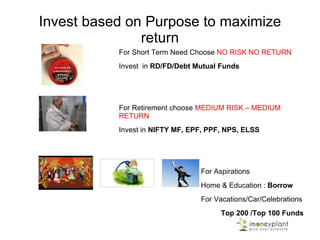
Invest based on Purpose to maximize
return
For Short Term Need Choose NO RISK NO RETURN
Invest in RD/FD/Debt Mutual Funds
For Retirement choose MEDIUM RISK – MEDIUM
RETURN
Invest in NIFTY MF, EPF, PPF, NPS, ELSS
For Aspirations
Home & Education : Borrow
For Vacations/Car/Celebrations
Top 200 /Top 100 Funds
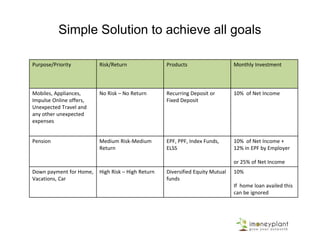
Simple Solution to achieve all goals
Purpose/Priority Risk/Return Products Monthly Investment
Mobiles, Appliances,
Impulse Online offers,
Unexpected Travel and
any other unexpected
expenses
No Risk – No Return Recurring Deposit or
Fixed Deposit
10% of Net Income
Pension Medium Risk-Medium
Return
EPF, PPF, Index Funds,
ELSS
10% of Net Income +
12% in EPF by Employer
or 25% of Net Income
Down payment for Home,
Vacations, Car
High Risk – High Return Diversified Equity Mutual
funds
10%
If home loan availed this
can be ignored
Basics of Finance
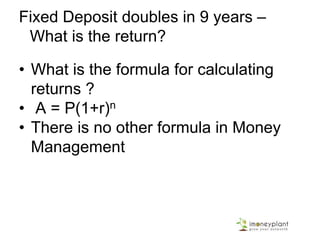
Fixed Deposit doubles in 9 years –
What is the return?
• What is the formula for calculating
returns ?
• A = P(1+r)n
• There is no other formula in Money
Management
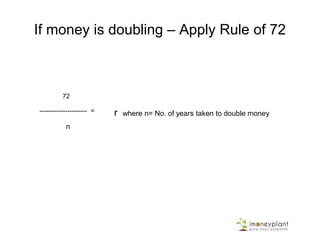
If money is doubling – Apply Rule of 72
72
---------------------- = r where n= No. of years taken to double money
n
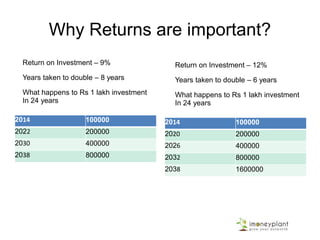
Why Returns are important?
2014 100000
2022 200000
2030 400000
2038 800000
2014 100000
2020 200000
2026 400000
2032 800000
2038 1600000
Return on Investment – 9%
Years taken to double – 8 years
What happens to Rs 1 lakh investment
In 24 years
Return on Investment – 12%
Years taken to double – 6 years
What happens to Rs 1 lakh investment
In 24 years
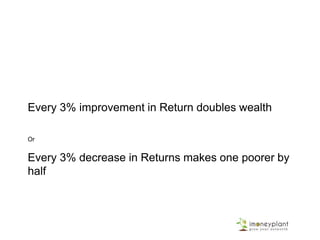
Or
Every 3% decrease in Returns makes one poorer by
half
Every 3% improvement in Return doubles wealth
Same rule applies to borrowing
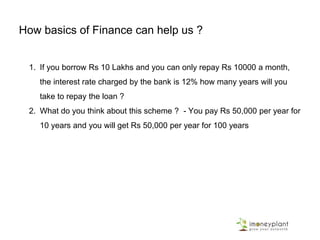
How basics of Finance can help us ?
1. If you borrow Rs 10 Lakhs and you can only repay Rs 10000 a month,
the interest rate charged by the bank is 12% how many years will you
take to repay the loan ?
2. What do you think about this scheme ? - You pay Rs 50,000 per year for
10 years and you will get Rs 50,000 per year for 100 years
Expectation from the Program – What we
heard from 3000+ Participants
1. My Expenses are increasing faster than the Income – How to
manage expenses and increase my savings?
2. What is the best way to Invest my Savings?
3. Do I really need to worry about Tax and Insurance ?
4. What is Financial Wellness, Why it is important and ways to
enhance?
5. Any other Questions ?
Save Tax or Increase Net Income
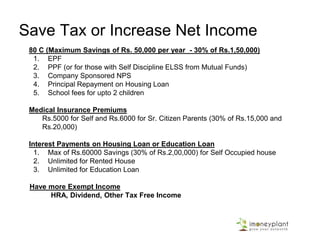
80 C
1. EPF
2. PPF (or for those with Self Discipline
ELSS from Mutual Funds)
3. Company Sponsored NPS
4. Principal Repayment on Housing
Loan
5. School fees for upto 2 children
Medical Insurance Premiums
Rs.15000 for Self and Rs.20000 for Sr.
Citizen Parents
Interest Payments on Housing Loan or
Education Loan
1. Rs.2,00,000 for Self Occupied house
2. Unlimited for Rented House
3. Unlimited for Education Loan
Have more Exempt Income
HRA, Dividend, Other Tax Free
Income
Tax Benefits
80 C 80 D Set off
Limit Rs
1,50,000
Rs 15,000
for Self,
Rs 20,000
for Sr
Citizen
Parents
Rs
2,00,000
Interest
paid on
self
occupied
house,
Unlimited
interest
on house
given on
rent and
education
loan
10% Rs 15,000 Rs 3500 Rs 20,000
20% Rs 30,000 Rs 7000 Rs 40,000
30% Rs 45,000 Rs 10,500 Rs 60,000
Home and Education Loans – A Must have
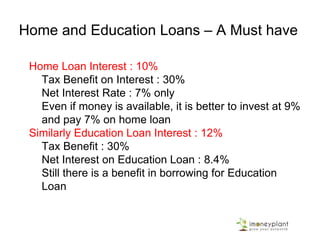
Home Loan Interest : 10%
Tax Benefit on Interest : 30%
Net Interest Rate : 7% only
Even if money is available, it is better to invest at 9%
and pay 7% on home loan
Similarly Education Loan Interest : 12%
Tax Benefit : 30%
Net Interest on Education Loan : 8.4%
Still there is a benefit in borrowing for Education
Loan
Insurance – Purpose : Covers any
Financial Loss (not emotional loss)
Cover for Life Risk – Loss of
Income
Cover for Accident Risk – Loss
of Income
Cover for Illness –
Hospitalization Expenses
Cover for Critical illness –
Prolonged Treatment
Cover for Vehicle – Third Party
Loss
Thumb rules
Life + accident : 10 times Net Annual Income
Hospitalization : Rs 5 Lakhs for Family
Critical Illness : Rs 20 Lakhs (may be
considered after 35 years of age)
Expectation from the Program – What we
heard from 3000+ Participants
1. My Expenses are increasing faster than the Income – How to
manage expenses and increase my savings?
2. What is the best way to Invest my Savings?
3. Do I really need to worry about Tax and Insurance ?
4. What is Financial Wellness, Why it is important and ways to
enhance?
5. Any other Questions ?
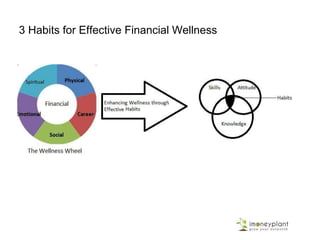
3 Habits for Effective Financial Wellness
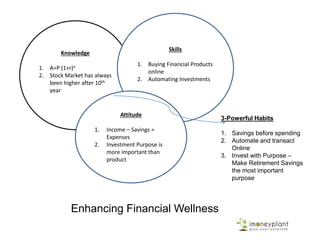
Knowledge
1. A=P (1+r)n
2. Stock Market has always
been higher after 10th
year
Skills
1. Buying Financial Products
online
2. Automating Investments
Attitude
1. Income – Savings =
Expenses
2. Investment Purpose is
more important than
product
3-Powerful Habits
1. Savings before spending
2. Automate and transact
Online
3. Invest with Purpose –
Make Retirement Savings
the most important
purpose
Enhancing Financial Wellness
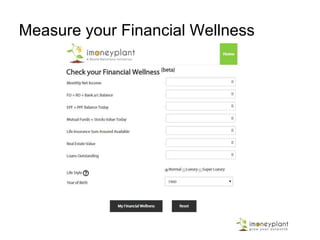
Measure your Financial Wellness
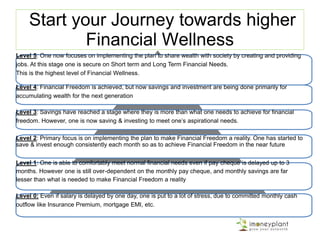
Start your Journey towards higher
Financial Wellness
Level 5: One now focuses on implementing the plan to share wealth with society by creating and providing
jobs. At this stage one is secure on Short term and Long Term Financial Needs.
This is the highest level of Financial Wellness.
Level 4: Financial Freedom is achieved, but now savings and investment are being done primarily for
accumulating wealth for the next generation
Level 3: Savings have reached a stage where they is more than what one needs to achieve for financial
freedom. However, one is now saving & investing to meet one’s aspirational needs.
Level 2: Primary focus is on implementing the plan to make Financial Freedom a reality. One has started to
save & invest enough consistently each month so as to achieve Financial Freedom in the near future
Level 1: One is able to comfortably meet normal financial needs even if pay cheque is delayed up to 3
months. However one is still over-dependent on the monthly pay cheque, and monthly savings are far
lesser than what is needed to make Financial Freedom a reality
Level 0: Even if salary is delayed by one day, one is put to a lot of stress, due to committed monthly cash
outflow like Insurance Premium, mortgage EMI, etc.
What Next?
Keen to Enhance your Financial Wellness of Self and others
Activities you must do today
1. To download ppt visit www.slideshare.net/imoneyplant/ifw
2. Automate your Savings – 10%-10%-10% - All Participants
who succeeded did it on the same day of presentation
3. Be part of PM’s Jan Dhan Yojana – Make it mandatory for
your servant maid’s to have JDY bank A/c (benefits : Free
Insurance cover) – Credit your maid salary directly to their
Bank to make Financial Inclusion a success and Financial
Wellness for all
Your Valuable Feedback
Please fill in the feedback forms to help us improve the program
Disclaimer
The information provided here is intended to provide helpful
and informative material on the subject matter covered. It
is given with the understanding that
owner/author/publishers of this material are not engaged
in rendering professional services through this material. If
the reader requires personal assistance or advice a
competent professional should be consulted. The
owners/authors/publishers specifically disclaim any
responsibility for any Loss, Liability, or Risk, personal or
otherwise, which is incurred as a consequence, directly or
indirectly, of the use and application of any of the
contents. The contents are general information that is
intended, but not guaranteed, to be correct or updated.
The information is not presented as a source of
Investment, Tax, Insurance or Legal Advice. You should
not rely on statements or representations made here or by
any externally referenced sources. If you need investment
or tax advice upon which you intend to rely in the course of
your financial or business affairs, consult a competent,
independent financial adviser. The contents should not be
taken as financial advice or as an offer to buy or sell
securities/insurance/fund or any financial product. It should
not be taken as endorsement or recommendation of any
particular company or individual and no responsibility can
be taken for inaccuracies, omissions or errors. The
Information presented is not to be considered as
investment advice.
The owners/authors/publishers do not assume any
responsibility for actions or non-actions taken by people
who have read the content and no one shall be entitled to
claim for detrimental reliance based upon any information
provided or expressed herein. Your use of any information
provided herein does not constitute any type of contractual
relationship between yourself and the providers of this
information. The owners/authors/publishers hereby
disclaim all responsibility and liability for all use of any
information in this material.
Contact
www.imoneyplant.com
+91 22 25298454
admin@imoneyplant.com
An Investor Education Initiative

Ifw2

  • 1.
  • 2.
    Welcome to theProgram Pre-Workshop Questionnaire
  • 3.
    Expectation from theProgram – What we heard from 3000+ Participants 1. My Expenses are increasing faster than the Income – How to manage expenses and increase my savings? 2. What is the best way to Invest my Savings? 3. Do I really need to worry about Tax and Insurance ? 4. What is Financial Wellness, Why it is important and ways to enhance? 5. Any other Questions ? Which is a bigger problem ? Not enough money to Invest or Have Enough Savings, but don’t know where to Invest
  • 4.
  • 5.
    Telephone Calls Before 2000 5Calls in Year After 2000 5 Calls in an Hour
  • 6.
    Clothes Before 2000 Bought onlyfor After 2000 Bought whenever
  • 7.
  • 8.
    How to increaseour savings?
  • 9.
    What is ournature? Marshmallow Test Research conducted over 40 years Kids 6-10 years of age are asked to go to a room where chocolate is kept and asked to wait for 15 minutes If they resist 15 min without eating chocolate, they will get 2 Every Kid wanted to have 2 chocolates Guess how many walked with 2? Just 1% 10 years later – same kids who walked away with 2 chocolates – got better grades in the exam Another 10 years later – they had better jobs Another 10 years later – they had better investments What prevents us from being in that 1%
  • 10.
    There is onlyone way to increase savings Income – Expenses ≠ Savings Income – Expenses = will be most likely 0 Income – Savings = Expenses
  • 11.
    How to increasesavings ? 1. Treat Savings as your first Expense 2. Take maximum benefits of Employer sponsored Retirement benefits (EPF, NPS, Super Annuation Schemes) 3. Measure Savings as % of Income 4. Improve Savings % by 2-5% every year 5. Aim for 30:30-40:50-50:100 (for Pvt Sector) and 30:30-40:40-50:50-60:100 (for PSU)
  • 12.
    Expectation from theProgram – What we heard from 3000+ Participants 1. My Expenses are increasing faster than the Income – How to manage expenses and increase my savings? 2. What is the best way to Invest my Savings? 3. Do I really need to worry about Tax and Insurance ? 4. What is Financial Wellness, Why it is important and ways to enhance? 5. Any other Questions ?
  • 13.
  • 14.
  • 15.
    How much isrequired for Retirement ? Let us do a case Study -
  • 16.
    Normal Food, Clothing,Shelter Luxury Food, Clothing, Shelter, Car , Vacations Super Luxury Food, Clothing, Shelter, Car+ Driver, International Vacations Year Normal Luxury Super Luxury 2014 रु 360,000 रु 720,000 रु 1,440,000 2015 रु 385,200 रु 770,400 रु 1,540,800 2016 रु 412,164 रु 824,328 रु 1,648,656 2017 रु 441,015 रु 882,031 रु 1,764,062 2018 रु 471,887 रु 943,773 रु 1,887,546 2019 रु 504,919 रु 1,009,837 रु 2,019,674 2020 रु 540,263 रु 1,080,526 रु 2,161,052 2021 रु 578,081 रु 1,156,163 रु 2,312,325 2022 रु 618,547 रु 1,237,094 रु 2,474,188 2023 रु 661,845 रु 1,323,691 रु 2,647,381 2024 रु 708,174 रु 1,416,349 रु 2,832,698 2025 रु 757,747 रु 1,515,493 रु 3,030,987 2026 रु 810,789 रु 1,621,578 रु 3,243,156 2027 रु 867,544 रु 1,735,088 रु 3,470,177 2028 रु 928,272 रु 1,856,545 रु 3,713,089 2029 रु 993,251 रु 1,986,503 रु 3,973,005 2030 रु 1,062,779 रु 2,125,558 रु 4,251,116 2031 रु 1,137,173 रु 2,274,347 रु 4,548,694 2032 रु 1,216,776 रु 2,433,551 रु 4,867,102 2033 रु 1,301,950 रु 2,603,900 रु 5,207,800 Average Annual Expenses for Retired Couple Factors to be applied Non Metro 0.75 Rented Home 1.3 Less than Rs. 5 Lakh Health Insurance 1.1 Example: Today ‘s age : 45, Retiring at 60 Expected life : 80 years Year of Retirement : 2029 Annual Expenses : 9,93,251 Corpus required : 20 * 993251 = Rs 1, 98,65,020 Assumptions – After retirement : ROI = Inflation, current inflation = 7%
  • 17.
    Normal Food, Clothing,Shelter Luxury Food, Clothing, Shelter, Car , Vacations Super Luxury Food, Clothing, Shelter, Car+ Driver, International Vacations Year Normal Luxury Super Luxury 2034 रु 1,393,087 रु 2,786,173 रु 5,572,346 2035 रु 1,490,603 रु 2,981,205 रु 5,962,410 2036 रु 1,594,945 रु 3,189,889 रु 6,379,779 2037 रु 1,706,591 रु 3,413,182 रु 6,826,363 2038 रु 1,826,052 रु 3,652,104 रु 7,304,209 2039 रु 1,953,876 रु 3,907,752 रु 7,815,504 2040 रु 2,090,647 रु 4,181,294 रु 8,362,589 2041 रु 2,236,992 रु 4,473,985 रु 8,947,970 2042 रु 2,393,582 रु 4,787,164 रु 9,574,328 2043 रु 2,561,133 रु 5,122,265 रु 10,244,531 2044 रु 2,740,412 रु 5,480,824 रु 10,961,648 2045 रु 2,932,241 रु 5,864,482 रु 11,728,963 2046 रु 3,137,498 रु 6,274,995 रु 12,549,991 2047 रु 3,357,123 रु 6,714,245 रु 13,428,490 2048 रु 3,592,121 रु 7,184,242 रु 14,368,484 2049 रु 3,843,570 रु 7,687,139 रु 15,374,278 2050 रु 4,112,619 रु 8,225,239 रु 16,450,478 2051 रु 4,400,503 रु 8,801,006 रु 17,602,011 2052 रु 4,708,538 रु 9,417,076 रु 18,834,152 2053 रु 5,038,136 रु 10,076,271 रु 20,152,543 Average Annual Expenses for Retired Couple Factors to be applied Non Metro 0.75 Rented Home 1.3 Less than Rs. 5 Lakh Health Insurance 1.1 Example: Today ‘s age : 24, Retiring at 58 Expected life : 80 years Year of Retirement : 2048 Annual Expenses : Rs.35,92,121 Corpus required : 22 * 35,92,121 = Rs 7,90,26,662 Assumptions – After retirement : ROI = Inflation, current inflation = 7%
  • 18.
    How much isrequired for Securing Retirement ? 1. Decide the Year, when you want to retire 2. Find out the Annual Expenses in that Year 3. Calculate No of years of expenses required after retirement 1. Age on Retirement Date 2. 80- Age on Retirement 3. Corpus = Annual Expenses X (80-Age on Retirement) 4. Example : Sumit wants to retire by 2032, his age in 2032 will be 60. How much will he require for safe retirement 1. Annual Expenses for Normal Living in 2032 – Rs 12,16,776 2. Age on 2043 : 60 3. 80 – Age on Retirement = 20 4. Corpus Required = 20 X Rs 12,16,776 = Rs 2,43,35,520
  • 19.
    Retirement Savings in20th and 21st Century 20th Century • Managed by company • 12%-12%-12%  Guaranteed pension for life time 21st Century • Best Plan from company– 12%-12%-8.5% (only 20% of companies offer) • What 12% 8.5% means ? • Employee has to double the contribution -12% to 24% • If company has no EPF Scheme – then Employee to save 25% on own every month
  • 20.
    Retirement Savings -T 20 Match Only 2 Strategies will work 1. Sanath Jaysuriya or Virender Shewag (Slog in the first 5 overs) 2. Virat Kohli (Consistent Scoring in all overs) Treat Every month like an over Don’t allow maiden overs – They increase the run rate Keeping it for last 5 overs (years) is sure way to loose the match
  • 21.
    What if Iwant to start saving for retirement from tomorrow and not today ? In a recent consumer study, 21 percent of individuals surveyed – including 38 percent of those with income below $25,000 – reported that winning the lottery was "the most practical strategy for accumulating several hundred thousand dollars" of wealth for their own retirement. In addition, 16 percent thought that winning the lottery was the best retirement strategy for all Americans, not just themselves – Consumer Federation of America and The Financial Planning Association, 2006
  • 22.
    Two Most ImportantSavings – So you will never have to borrow (or even if you want to borrow may not be able to borrow) 1. Short Term Expenses (About 5 Lakhs) 2. Retirement
  • 23.
    Our Nature • Investment –Will do it tomorrow • Consumption – I want it today This attitude and behavior leads to consume more and Invest less
  • 24.
    To over comeour Nature 1.Automate Investments – use SIP 2. Set up SIP on the day your salary is credited
  • 25.
  • 27.
    Invest with aPurpose and end goal in mind
  • 28.
    Purpose/Goals No 1 Priority– Short term expenses (Mobiles, Appliances, Unexpected Travel, Medical, Impulse Buy) No 2 Priority – Retirement Savings : No other Need is bigger No 3 Priority Aspirations Home, Education : Vacations/Car/Celebrations
  • 29.
    Short term needs •Take “0” Risk  “0” Return is OK • Protect the Capital • “0” Risk Investment – Only FD or RD
  • 30.
    Retirement Purpose • TakeAdvantage of Tax Free Returns • Tax Free Return Products - EPF, PPF, ELSS Funds, INDEX Funds • Keep reinvesting and withdraw only on the day of retirement
  • 31.
    Stock Market (NIFTY)has always gained 1226 938 1009 1200 942 1183 1495 1100 1068 1100 15371537 2211 3150 4313 3896 4340 5251 5627 5278 5950 7637 0 1000 2000 3000 4000 5000 6000 7000 8000 9000 94-04 95-05 96-06 97-07 98-08 99-09 00-10 01-11 02-12 03-13 04-14 NIFTY Year
  • 32.
    It does notmatter when you invest, 10 years later Stock Market was always higher Buy, Stock Market – Not Stock Stock Market will be there after 10 years, Stock may not be there after 10 years
  • 33.
    How to buyStock Market ? • ABC –Index Fund – Sensex –– Growth • ABC –Index Fund – NIFTY –- Growth • Through Monthly SIP
  • 34.
    Guaranteed way toreturns from “Stock Market” Year Stock Market Amount Invested Units Bought 1 10 10000 1000 2 8 10000 1250 3 5 10000 2000 4 2 10000 5000 5 1 10000 10000 6 2 10000 5000 7 5 10000 2000 8 8 10000 1250 9 10 10000 1000 10 12 10000 833 Total 1,00,000 (Total Invested in 10 years) 29333 (Total Units bought in 10 years) Option 1 – Invest Rs 10000 every year for 10 years Value at the end of 10 years = 29333 * 12 = Rs 351996 Rs 100000 has become 3.5 times Option 2 : Invest Rs 1 Lakh lumpsum Rs 1 Lakh will become Rs 1.2 Lakh
  • 35.
    Last 15 YearPerformance Date Well managed ELSS Poorly Managed ELSS InvestmentUnits-Best Units -Poor PPF Interest Interest PPF Balance 1-Jun-00 18.3 26.46 100000 5464.480874 3779.28949 11.00% 1-Jun-01 16.96 14.58 100000 5896.226415 6858.71056 9.50% 11000 211000 1-Jun-02 18.45 13.29 100000 5420.054201 7524.45448 9.00% 18990 329990 1-Jun-03 21.71 12.5 100000 4606.172271 8000 8.00% 26399.2 456389.2 1-Jun-04 38.16 20.32 100000 2620.545073 4921.25984 8.00% 36511.14 592900.336 1-Jun-05 76.16 45.98 100000 1313.02521 2174.85863 8.00% 47432.03 740332.3629 1-Jun-06 116.12 41.32 100000 861.1780916 2420.13553 8.00% 59226.59 899558.9519 1-Jun-07 154.68 46.79 100000 646.4959917 2137.20881 8.00% 71964.72 1071523.668 1-Jun-08 146.65 50.46 100000 681.89567 1981.76774 8.00% 85721.89 1257245.562 1-Jun-09 145.44 46.99 100000 687.5687569 2128.11236 8.00% 100579.6 1457825.206 1-Jun-10 205.19 55.72 100000 487.3531849 1794.68772 8.00% 116626 1674451.223 1-Jun-11 233.23 59.08 100000 428.7613086 1692.62018 8.00% 133956.1 1908407.321 1-Jun-12 203.86 54.64 100000 490.5327185 1830.16105 8.60% 164123 2172530.35 1-Jun-13 231.2 65.26 100000 432.5259516 1532.33221 8.80% 191182.7 2463713.021 1-Jun-14 336.75 88.38 100000 296.956199 1131.47771 8.70% 214343 2778056.054 30333.77192 49907.0763 10214897.69 4410787.4 Total Units Accumulated Total Value of ELSS Units Well managed ELSS scheme after 15 years – Rs 1,02,14,890 Poorly Managed ELSS scheme after 15 years – Rs 44, 10, 787 PPF after 15 years – Rs 27,78,056 Even a poorly managed ELSS scheme has given better results than PPF, Since Past performance may not be repeated, name of the Funds are not disclosed purposely
  • 36.
    Invest based onPurpose to maximize return For Short Term Need Choose NO RISK NO RETURN Invest in RD/FD/Debt Mutual Funds For Retirement choose MEDIUM RISK – MEDIUM RETURN Invest in NIFTY MF, EPF, PPF, NPS, ELSS For Aspirations Home & Education : Borrow For Vacations/Car/Celebrations Top 200 /Top 100 Funds
  • 37.
    Simple Solution toachieve all goals Purpose/Priority Risk/Return Products Monthly Investment Mobiles, Appliances, Impulse Online offers, Unexpected Travel and any other unexpected expenses No Risk – No Return Recurring Deposit or Fixed Deposit 10% of Net Income Pension Medium Risk-Medium Return EPF, PPF, Index Funds, ELSS 10% of Net Income + 12% in EPF by Employer or 25% of Net Income Down payment for Home, Vacations, Car High Risk – High Return Diversified Equity Mutual funds 10% If home loan availed this can be ignored
  • 38.
  • 39.
    Fixed Deposit doublesin 9 years – What is the return? • What is the formula for calculating returns ? • A = P(1+r)n • There is no other formula in Money Management
  • 40.
    If money isdoubling – Apply Rule of 72 72 ---------------------- = r where n= No. of years taken to double money n
  • 41.
    Why Returns areimportant? 2014 100000 2022 200000 2030 400000 2038 800000 2014 100000 2020 200000 2026 400000 2032 800000 2038 1600000 Return on Investment – 9% Years taken to double – 8 years What happens to Rs 1 lakh investment In 24 years Return on Investment – 12% Years taken to double – 6 years What happens to Rs 1 lakh investment In 24 years
  • 42.
    Or Every 3% decreasein Returns makes one poorer by half Every 3% improvement in Return doubles wealth
  • 43.
    Same rule appliesto borrowing
  • 44.
    How basics ofFinance can help us ? 1. If you borrow Rs 10 Lakhs and you can only repay Rs 10000 a month, the interest rate charged by the bank is 12% how many years will you take to repay the loan ? 2. What do you think about this scheme ? - You pay Rs 50,000 per year for 10 years and you will get Rs 50,000 per year for 100 years
  • 46.
    Expectation from theProgram – What we heard from 3000+ Participants 1. My Expenses are increasing faster than the Income – How to manage expenses and increase my savings? 2. What is the best way to Invest my Savings? 3. Do I really need to worry about Tax and Insurance ? 4. What is Financial Wellness, Why it is important and ways to enhance? 5. Any other Questions ?
  • 47.
    Save Tax orIncrease Net Income 80 C 1. EPF 2. PPF (or for those with Self Discipline ELSS from Mutual Funds) 3. Company Sponsored NPS 4. Principal Repayment on Housing Loan 5. School fees for upto 2 children Medical Insurance Premiums Rs.15000 for Self and Rs.20000 for Sr. Citizen Parents Interest Payments on Housing Loan or Education Loan 1. Rs.2,00,000 for Self Occupied house 2. Unlimited for Rented House 3. Unlimited for Education Loan Have more Exempt Income HRA, Dividend, Other Tax Free Income Tax Benefits 80 C 80 D Set off Limit Rs 1,50,000 Rs 15,000 for Self, Rs 20,000 for Sr Citizen Parents Rs 2,00,000 Interest paid on self occupied house, Unlimited interest on house given on rent and education loan 10% Rs 15,000 Rs 3500 Rs 20,000 20% Rs 30,000 Rs 7000 Rs 40,000 30% Rs 45,000 Rs 10,500 Rs 60,000
  • 48.
    Home and EducationLoans – A Must have Home Loan Interest : 10% Tax Benefit on Interest : 30% Net Interest Rate : 7% only Even if money is available, it is better to invest at 9% and pay 7% on home loan Similarly Education Loan Interest : 12% Tax Benefit : 30% Net Interest on Education Loan : 8.4% Still there is a benefit in borrowing for Education Loan
  • 49.
    Insurance – Purpose: Covers any Financial Loss (not emotional loss) Cover for Life Risk – Loss of Income Cover for Accident Risk – Loss of Income Cover for Illness – Hospitalization Expenses Cover for Critical illness – Prolonged Treatment Cover for Vehicle – Third Party Loss Thumb rules Life + accident : 10 times Net Annual Income Hospitalization : Rs 5 Lakhs for Family Critical Illness : Rs 20 Lakhs (may be considered after 35 years of age)
  • 50.
    Expectation from theProgram – What we heard from 3000+ Participants 1. My Expenses are increasing faster than the Income – How to manage expenses and increase my savings? 2. What is the best way to Invest my Savings? 3. Do I really need to worry about Tax and Insurance ? 4. What is Financial Wellness, Why it is important and ways to enhance? 5. Any other Questions ?
  • 51.
    3 Habits forEffective Financial Wellness
  • 52.
    Knowledge 1. A=P (1+r)n 2.Stock Market has always been higher after 10th year Skills 1. Buying Financial Products online 2. Automating Investments Attitude 1. Income – Savings = Expenses 2. Investment Purpose is more important than product 3-Powerful Habits 1. Savings before spending 2. Automate and transact Online 3. Invest with Purpose – Make Retirement Savings the most important purpose Enhancing Financial Wellness
  • 53.
  • 54.
    Start your Journeytowards higher Financial Wellness Level 5: One now focuses on implementing the plan to share wealth with society by creating and providing jobs. At this stage one is secure on Short term and Long Term Financial Needs. This is the highest level of Financial Wellness. Level 4: Financial Freedom is achieved, but now savings and investment are being done primarily for accumulating wealth for the next generation Level 3: Savings have reached a stage where they is more than what one needs to achieve for financial freedom. However, one is now saving & investing to meet one’s aspirational needs. Level 2: Primary focus is on implementing the plan to make Financial Freedom a reality. One has started to save & invest enough consistently each month so as to achieve Financial Freedom in the near future Level 1: One is able to comfortably meet normal financial needs even if pay cheque is delayed up to 3 months. However one is still over-dependent on the monthly pay cheque, and monthly savings are far lesser than what is needed to make Financial Freedom a reality Level 0: Even if salary is delayed by one day, one is put to a lot of stress, due to committed monthly cash outflow like Insurance Premium, mortgage EMI, etc.
  • 55.
    What Next? Keen toEnhance your Financial Wellness of Self and others Activities you must do today 1. To download ppt visit www.slideshare.net/imoneyplant/ifw 2. Automate your Savings – 10%-10%-10% - All Participants who succeeded did it on the same day of presentation 3. Be part of PM’s Jan Dhan Yojana – Make it mandatory for your servant maid’s to have JDY bank A/c (benefits : Free Insurance cover) – Credit your maid salary directly to their Bank to make Financial Inclusion a success and Financial Wellness for all
  • 56.
    Your Valuable Feedback Pleasefill in the feedback forms to help us improve the program
  • 57.
    Disclaimer The information providedhere is intended to provide helpful and informative material on the subject matter covered. It is given with the understanding that owner/author/publishers of this material are not engaged in rendering professional services through this material. If the reader requires personal assistance or advice a competent professional should be consulted. The owners/authors/publishers specifically disclaim any responsibility for any Loss, Liability, or Risk, personal or otherwise, which is incurred as a consequence, directly or indirectly, of the use and application of any of the contents. The contents are general information that is intended, but not guaranteed, to be correct or updated. The information is not presented as a source of Investment, Tax, Insurance or Legal Advice. You should not rely on statements or representations made here or by any externally referenced sources. If you need investment or tax advice upon which you intend to rely in the course of your financial or business affairs, consult a competent, independent financial adviser. The contents should not be taken as financial advice or as an offer to buy or sell securities/insurance/fund or any financial product. It should not be taken as endorsement or recommendation of any particular company or individual and no responsibility can be taken for inaccuracies, omissions or errors. The Information presented is not to be considered as investment advice. The owners/authors/publishers do not assume any responsibility for actions or non-actions taken by people who have read the content and no one shall be entitled to claim for detrimental reliance based upon any information provided or expressed herein. Your use of any information provided herein does not constitute any type of contractual relationship between yourself and the providers of this information. The owners/authors/publishers hereby disclaim all responsibility and liability for all use of any information in this material. Contact www.imoneyplant.com +91 22 25298454 admin@imoneyplant.com An Investor Education Initiative