DEFINITION OF CSR
“Corporate Social Responsibility is the continuing
commitment by business to behave ethically and
contribute to economic development while
improving the quality of life of the workplace and
their families as well as of the local community and
society at large”.
WHY SOCIAL RESPONSIBILITY OF BUSINESS?
• ‘The Business of business is Business’ was the motto of
businesspersons in early times.
• To economists like Adam Smith and Milton Friedman, in
a capitalist society profit maximization by the continued
increase of efficiency is the most socially responsible
way of conducting business. This implies making quick
money, with utter disregard for the responsibility of business
towards society.
• The ethical and social behavior of corporations is essential
for the generation of profit, owing its source to the reputation
the corporation would acquire in view of its social behavior.
ACCOUNTABILITY TO SOCIETY
• In a democratic society, any kind of enterprise
exists for the sake of society.
• Industries are allowed to exist because they are
perceived by the public to be useful in the attainment of
the personal, social, and material goals of the people.
• So, corporations exist for the sake the public, they are
accountable to the public and have a social
responsibility.
CORPORATION’S DEBT TO SOCIETY
• Corporations, whether public or private, draw much from
society.
• It depends on society for a developed infrastructure such
as roads, water supply, electricity and an educated
workforce.
• It also depends on society for the maintenance of law and
order, public health, transport facilities and for reaching out
to its customers through the mass media.
• Finally, all consumers of its finished products are drawn
from society.
If a corporation draws so much from society it has to
make its own contribution to society.
CSR may be classified into:-
• Classical economic model
• Socioeconomic model
THE CLASSICAL ECONOMIC MODEL
Adam Smith, father of the classical economic
model, believed that an ‘invisible hand’ promoted
the public welfare
Smith believed that the public interest was served
best by individuals pursuing their own self-interests.
THE SOCIOECONOMIC MODEL
• Business is seen as one sub-system among many in a
highly interdependent society.
• Recognizes that companies have stakeholders other than
their stockholders .
• A stakeholder audit allows companies to systematically
identify all parties that could possibly be impacted by the
company’s performance.
• Business has an obligation to respond to the needs of all
stakeholders while pursuing its profit
Some of the driving forces behind the evolution
of CSR are: -
• Concerns and expectations from citizens,
consumers, public authorities and investors,
• Concerns about the impact of economic
activity on the environment, and
• Increased transparency of business activities
because of the development in IT
IMPLEMENTATON OF CSR
The systematic implementation of CSR means:
• Adoption of strong organizational values and
norms depicting behaviors that are
appropriate towards a variety of stakeholders.
• The continuous generation of intelligence
about stakeholders issues, along with positive
responses to these issues.
THEORETICAL
JUSTIFICATION FOR CSR
1) TRUSTEESHIP MODEL
2) SOCIAL ENTITY THEORY
3) PLURALISTIC MODEL
What are corporations expected
to do?
Some economists argue that corporations depend
on society for a number of facilities they enjoy such
as
• Developed infrastructure,
• Peace and tranquility in the work place
• A trained workforce
• Maintenance of law and order
• Mass media through which they reach their
customers
• Above all, consumers of products, without whom
they have no reason for existence, are all drawn
from the society.
Corporations have a moral responsibility to take a
long and hard look at their values, practices and
assumptions. They have to ensure that
• The country’s name is not compromised during
their deals abroad, either as exporters or
importers,
• Maintenance of quality of their products,
• Create employment opportunities for the
disadvantaged persons by directly setting up
ancillaries,
• Provide financial resources,
• Make available marketing support by purchasing
from disadvantaged communities,
• Donate.
Private sector needs goodwill of the
society
• Historical reasons
• Need for goodwill
• Economic goals and social responsibility
objectives need not contradict each other
Models for implementation
of CSR
1) Ethical Model
2) Statist Model
3) Liberal Model
4) Stakeholder Model
CSR as a business strategy for
sustainable development
• “CSR is about capacity building for sustainable livelihoods”
• Manifold benefits to corporations both internally and externally.
Socially Responsible Investing is gaining importance because :-
• Socially responsible companies offer long term value
• Evaluating a company’s social impact on top of its financial
performance provides an additional hedge against the risk
• SRI blunts adverse sentiments against the company
“CSR is an outcome for business models, which goes just
beyond financial viability.”
Evaluation of CSR activity
3 basic principles: -
• Sustainability
• Accountability
• Transparency
Advantages of CSR
• Improved financial performance
• Enhanced brand image and reputation
• Increased sales and customer loyalty
• Increased ability to attract and retain employees
• Reduced regulatory oversight
• Innovation and learning
• Risk management
• Easier access to capital
• Reduced operating costs
Scope of CSR
Three levels of social responsibility can be identified: -
• Market forces
• Mandated actions
• Voluntary actions
CSR addresses the following
issues:
• Community, assistance in solving community problems
• Health and welfare
• Education
• Human rights
• Natural environment
• Culture
Corporate social responsibilities to different
group of stakeholders: -
1. To consumers and community
• Quality
• Reasonable prices
• After-sales services
• Free competition
• Ethical advertising policy
• Support for educational, charitable and other programs
• Honest trade policies
• Impartiality towards political affairs
• Social accountability
• Progressive outlook
2. To employees
• Promote espirit de corps
• Pay fair wages
• Provide reasonable work conditions
• Help development of proper leadership
• Guarantee religious, social and political freedom to
workers to take part in civic activities
3. To owners and inter-business establishments
• Provide fair return
• Develop healthy cooperative business relationship
• Check the advance of unfair practices
• Help in control of monopoly and promotion of
healthy competition.

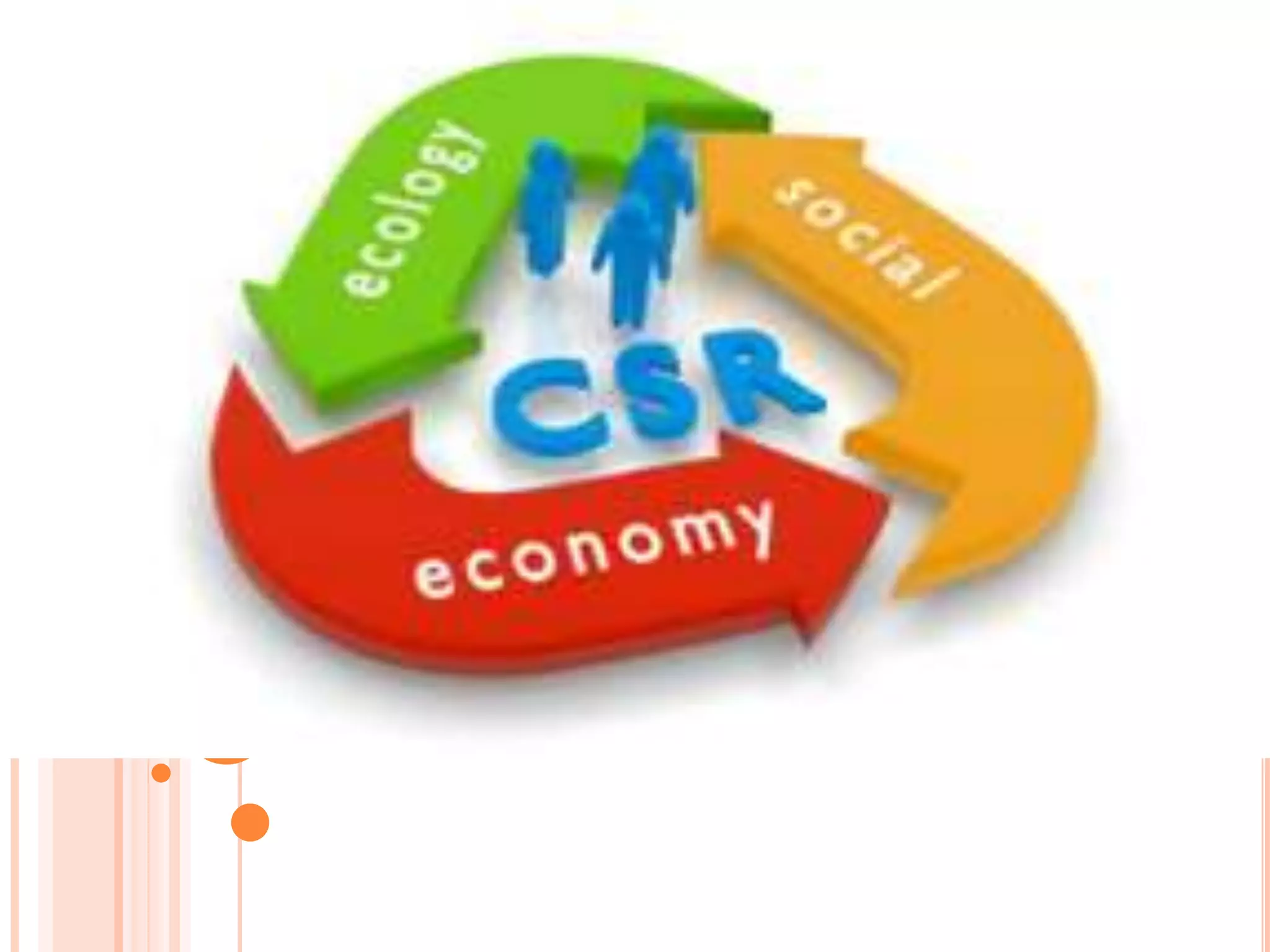
Corporate Social Responsibility(CSR)

  • 2.
    DEFINITION OF CSR “CorporateSocial Responsibility is the continuing commitment by business to behave ethically and contribute to economic development while improving the quality of life of the workplace and their families as well as of the local community and society at large”.
  • 3.
    WHY SOCIAL RESPONSIBILITYOF BUSINESS? • ‘The Business of business is Business’ was the motto of businesspersons in early times. • To economists like Adam Smith and Milton Friedman, in a capitalist society profit maximization by the continued increase of efficiency is the most socially responsible way of conducting business. This implies making quick money, with utter disregard for the responsibility of business towards society. • The ethical and social behavior of corporations is essential for the generation of profit, owing its source to the reputation the corporation would acquire in view of its social behavior.
  • 4.
    ACCOUNTABILITY TO SOCIETY •In a democratic society, any kind of enterprise exists for the sake of society. • Industries are allowed to exist because they are perceived by the public to be useful in the attainment of the personal, social, and material goals of the people. • So, corporations exist for the sake the public, they are accountable to the public and have a social responsibility.
  • 5.
    CORPORATION’S DEBT TOSOCIETY • Corporations, whether public or private, draw much from society. • It depends on society for a developed infrastructure such as roads, water supply, electricity and an educated workforce. • It also depends on society for the maintenance of law and order, public health, transport facilities and for reaching out to its customers through the mass media. • Finally, all consumers of its finished products are drawn from society. If a corporation draws so much from society it has to make its own contribution to society.
  • 6.
    CSR may beclassified into:- • Classical economic model • Socioeconomic model
  • 7.
    THE CLASSICAL ECONOMICMODEL Adam Smith, father of the classical economic model, believed that an ‘invisible hand’ promoted the public welfare Smith believed that the public interest was served best by individuals pursuing their own self-interests.
  • 8.
    THE SOCIOECONOMIC MODEL •Business is seen as one sub-system among many in a highly interdependent society. • Recognizes that companies have stakeholders other than their stockholders . • A stakeholder audit allows companies to systematically identify all parties that could possibly be impacted by the company’s performance. • Business has an obligation to respond to the needs of all stakeholders while pursuing its profit
  • 9.
    Some of thedriving forces behind the evolution of CSR are: - • Concerns and expectations from citizens, consumers, public authorities and investors, • Concerns about the impact of economic activity on the environment, and • Increased transparency of business activities because of the development in IT
  • 10.
    IMPLEMENTATON OF CSR Thesystematic implementation of CSR means: • Adoption of strong organizational values and norms depicting behaviors that are appropriate towards a variety of stakeholders. • The continuous generation of intelligence about stakeholders issues, along with positive responses to these issues.
  • 11.
    THEORETICAL JUSTIFICATION FOR CSR 1)TRUSTEESHIP MODEL 2) SOCIAL ENTITY THEORY 3) PLURALISTIC MODEL
  • 12.
    What are corporationsexpected to do? Some economists argue that corporations depend on society for a number of facilities they enjoy such as • Developed infrastructure, • Peace and tranquility in the work place • A trained workforce • Maintenance of law and order • Mass media through which they reach their customers • Above all, consumers of products, without whom they have no reason for existence, are all drawn from the society.
  • 13.
    Corporations have amoral responsibility to take a long and hard look at their values, practices and assumptions. They have to ensure that • The country’s name is not compromised during their deals abroad, either as exporters or importers, • Maintenance of quality of their products, • Create employment opportunities for the disadvantaged persons by directly setting up ancillaries, • Provide financial resources, • Make available marketing support by purchasing from disadvantaged communities, • Donate.
  • 14.
    Private sector needsgoodwill of the society • Historical reasons • Need for goodwill • Economic goals and social responsibility objectives need not contradict each other
  • 15.
    Models for implementation ofCSR 1) Ethical Model 2) Statist Model 3) Liberal Model 4) Stakeholder Model
  • 16.
    CSR as abusiness strategy for sustainable development • “CSR is about capacity building for sustainable livelihoods” • Manifold benefits to corporations both internally and externally. Socially Responsible Investing is gaining importance because :- • Socially responsible companies offer long term value • Evaluating a company’s social impact on top of its financial performance provides an additional hedge against the risk • SRI blunts adverse sentiments against the company “CSR is an outcome for business models, which goes just beyond financial viability.”
  • 17.
    Evaluation of CSRactivity 3 basic principles: - • Sustainability • Accountability • Transparency
  • 18.
    Advantages of CSR •Improved financial performance • Enhanced brand image and reputation • Increased sales and customer loyalty • Increased ability to attract and retain employees • Reduced regulatory oversight • Innovation and learning • Risk management • Easier access to capital • Reduced operating costs
  • 19.
    Scope of CSR Threelevels of social responsibility can be identified: - • Market forces • Mandated actions • Voluntary actions CSR addresses the following issues: • Community, assistance in solving community problems • Health and welfare • Education • Human rights • Natural environment • Culture
  • 20.
    Corporate social responsibilitiesto different group of stakeholders: - 1. To consumers and community • Quality • Reasonable prices • After-sales services • Free competition • Ethical advertising policy • Support for educational, charitable and other programs • Honest trade policies • Impartiality towards political affairs • Social accountability • Progressive outlook
  • 21.
    2. To employees •Promote espirit de corps • Pay fair wages • Provide reasonable work conditions • Help development of proper leadership • Guarantee religious, social and political freedom to workers to take part in civic activities 3. To owners and inter-business establishments • Provide fair return • Develop healthy cooperative business relationship • Check the advance of unfair practices • Help in control of monopoly and promotion of healthy competition.