Global Corporate Citizenship   Saurabh Kumar  Kumar Ravi Meghana Swati  Rajnikant George  09/28/09 XIDAS Jabalpur
Global Corporate Citizenship 09/28/09 XIDAS Jabalpur  “ Global corporate citizenship means that companies must not only be engaged with stakeholders but be stakeholders themselves alongside governments and civil society.”  Klaus Schwab, Executive Chairman, World Economic Forum, 2008
Corporate Citizenship  From a management perspective the defines corporate citizenship as the way in which the company understands, considers, and accounts for economic, social and environmental impacts in the design of its products and services, the management of its operations and its contribution to communities.  Corporate citizenship encompasses the values, policies, practices and performance targets that guide a company's business strategy so as to ensure minimum negative impact on society while maximizing positive value and returns to both shareholders and society. 09/28/09 XIDAS Jabalpur
Global corporate citizenship   Corporate citizenship in the 21st century is driving a major transition from a model that allowed unconnected activities — such as compliance with governance and laws, endorsing global standards promoting strong philanthropic and volunteer activities — to serve as surrogates for citizenship. The current global challenges of transparency, stakeholder expectations, accountability, trust and reputation require a strategic approach endorsed at the highest levels of the company and integrated and aligned throughout the business operation.  09/28/09 XIDAS Jabalpur
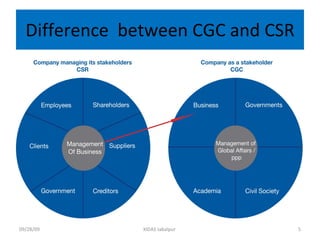
Difference  between CGC and CSR 09/28/09 XIDAS Jabalpur
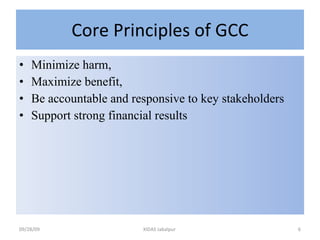
Core Principles of GCC Minimize harm, Maximize benefit, Be accountable and responsive to key stakeholders Support strong financial results 09/28/09 XIDAS Jabalpur
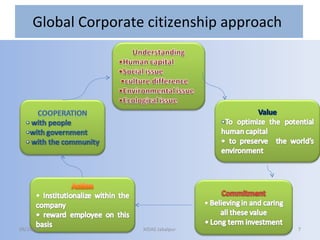
Global Corporate citizenship approach  09/28/09 XIDAS Jabalpur
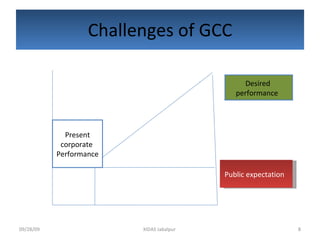
Challenges of GCC Public expectation  Present corporate  Performance  Desired  performance  09/28/09 XIDAS Jabalpur
A global view : GCC India  CSR measure should focus on benefiting “people and communities other than those whom they are contractually obliged to”, namely those “who are socially and economically disadvantaged” - Shrivastava & Venkateswaran 2000  09/28/09 XIDAS Jabalpur
The objective was to ensure that UK business  take into account their economic, social and environment impact and address the key sustainable development challenge based on their core competencies wherever they operate- locally, regionally and internationally.  09/28/09 XIDAS Jabalpur  UK
GCC Vision and strategy 09/28/09 XIDAS Jabalpur  Promote business activates that bring economic, social and environmental benefits, Work in partnership with the private sector, community bodies, and other stakeholders, Encourage continuing development and application of best practice and  Ensure decent minimum levels of performance in area such as health& safety the environment and equal opportunities.
09/28/09 XIDAS Jabalpur  Latin America  A move from philanthropy to strategic social investment by developing information and analysis for benchmarking system, and leadership and capacity progammes to improve management processes.  Primary object  network of civil society and institution, Evolving intermediary structure and  institution & Providing links and partnership with established business network.
USA In the united states, CSR trend involved in large part though the efforts of a few visionary leaders like Carnegie, ford, Hewlett and Packard. However CSR owes its growth to regulation. Beginning in the late 1960s and early 1970s the US govt. established regulatory agencies that shaped much of internal CSR benchmarking. Osha (occupational safety and health admistration)  CPSC (consumer product safety commission) EPA (environmental protection agency)  etc  09/28/09 XIDAS Jabalpur
Europe  09/28/09 XIDAS Jabalpur  An increasing number of European companies are promoting their corporate social responsibility strategies as responses to a variety of social, environmental and economic pressures. They aim to send a signal to various stakeholder with whom they interact employees, shareholder, investors, consumers, public authorizes and NGO.
Japan  In December 2001 the council of better corporate citizenship (CBCC) established a study group on the CSR required of multinational corporation.  In October 2002 nippon Keidnren (japan business federation) introduced certain measures in its charter of corporate behavior (established in 1991, revised in 1996 and 2002) revised the charter of corporate behavior and its implementation guideline; Establishing a system for promoting ethical conduct within corporations; Announced support for companies in the prevention of corporate misconduct; clarified and strengthened the measure Nippon Keidanren takes against companies involved in unethical behavior. 09/28/09 XIDAS Jabalpur
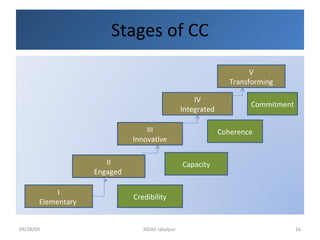
Stages of CC I Elementary  IV Integrated III Innovative II Engaged  V Transforming Capacity Commitment Coherence Credibility 09/28/09 XIDAS Jabalpur
Drivers of GCC The increasing number of multinational corporations , Complexity and interrelatedness of social, environmental and economic challenges; Emerging regulations in some markets  09/28/09 XIDAS Jabalpur
References  Baxi C.V, Corporate social responsibility, 2005, Excel Book, New Delhi. www.bostoncollege .com  www.internationalcsr.org   09/28/09 XIDAS Jabalpur
09/28/09 XIDAS Jabalpur

Global Corporate Citizenship

  • 1.
    Global Corporate Citizenship Saurabh Kumar Kumar Ravi Meghana Swati Rajnikant George 09/28/09 XIDAS Jabalpur
  • 2.
    Global Corporate Citizenship09/28/09 XIDAS Jabalpur “ Global corporate citizenship means that companies must not only be engaged with stakeholders but be stakeholders themselves alongside governments and civil society.” Klaus Schwab, Executive Chairman, World Economic Forum, 2008
  • 3.
    Corporate Citizenship From a management perspective the defines corporate citizenship as the way in which the company understands, considers, and accounts for economic, social and environmental impacts in the design of its products and services, the management of its operations and its contribution to communities.  Corporate citizenship encompasses the values, policies, practices and performance targets that guide a company's business strategy so as to ensure minimum negative impact on society while maximizing positive value and returns to both shareholders and society. 09/28/09 XIDAS Jabalpur
  • 4.
    Global corporate citizenship Corporate citizenship in the 21st century is driving a major transition from a model that allowed unconnected activities — such as compliance with governance and laws, endorsing global standards promoting strong philanthropic and volunteer activities — to serve as surrogates for citizenship. The current global challenges of transparency, stakeholder expectations, accountability, trust and reputation require a strategic approach endorsed at the highest levels of the company and integrated and aligned throughout the business operation. 09/28/09 XIDAS Jabalpur
  • 5.
    Difference betweenCGC and CSR 09/28/09 XIDAS Jabalpur
  • 6.
    Core Principles ofGCC Minimize harm, Maximize benefit, Be accountable and responsive to key stakeholders Support strong financial results 09/28/09 XIDAS Jabalpur
  • 7.
    Global Corporate citizenshipapproach 09/28/09 XIDAS Jabalpur
  • 8.
    Challenges of GCCPublic expectation Present corporate Performance Desired performance 09/28/09 XIDAS Jabalpur
  • 9.
    A global view: GCC India CSR measure should focus on benefiting “people and communities other than those whom they are contractually obliged to”, namely those “who are socially and economically disadvantaged” - Shrivastava & Venkateswaran 2000 09/28/09 XIDAS Jabalpur
  • 10.
    The objective wasto ensure that UK business take into account their economic, social and environment impact and address the key sustainable development challenge based on their core competencies wherever they operate- locally, regionally and internationally. 09/28/09 XIDAS Jabalpur UK
  • 11.
    GCC Vision andstrategy 09/28/09 XIDAS Jabalpur Promote business activates that bring economic, social and environmental benefits, Work in partnership with the private sector, community bodies, and other stakeholders, Encourage continuing development and application of best practice and Ensure decent minimum levels of performance in area such as health& safety the environment and equal opportunities.
  • 12.
    09/28/09 XIDAS Jabalpur Latin America A move from philanthropy to strategic social investment by developing information and analysis for benchmarking system, and leadership and capacity progammes to improve management processes. Primary object network of civil society and institution, Evolving intermediary structure and institution & Providing links and partnership with established business network.
  • 13.
    USA In theunited states, CSR trend involved in large part though the efforts of a few visionary leaders like Carnegie, ford, Hewlett and Packard. However CSR owes its growth to regulation. Beginning in the late 1960s and early 1970s the US govt. established regulatory agencies that shaped much of internal CSR benchmarking. Osha (occupational safety and health admistration) CPSC (consumer product safety commission) EPA (environmental protection agency) etc 09/28/09 XIDAS Jabalpur
  • 14.
    Europe 09/28/09XIDAS Jabalpur An increasing number of European companies are promoting their corporate social responsibility strategies as responses to a variety of social, environmental and economic pressures. They aim to send a signal to various stakeholder with whom they interact employees, shareholder, investors, consumers, public authorizes and NGO.
  • 15.
    Japan InDecember 2001 the council of better corporate citizenship (CBCC) established a study group on the CSR required of multinational corporation. In October 2002 nippon Keidnren (japan business federation) introduced certain measures in its charter of corporate behavior (established in 1991, revised in 1996 and 2002) revised the charter of corporate behavior and its implementation guideline; Establishing a system for promoting ethical conduct within corporations; Announced support for companies in the prevention of corporate misconduct; clarified and strengthened the measure Nippon Keidanren takes against companies involved in unethical behavior. 09/28/09 XIDAS Jabalpur
  • 16.
    Stages of CCI Elementary IV Integrated III Innovative II Engaged V Transforming Capacity Commitment Coherence Credibility 09/28/09 XIDAS Jabalpur
  • 17.
    Drivers of GCCThe increasing number of multinational corporations , Complexity and interrelatedness of social, environmental and economic challenges; Emerging regulations in some markets 09/28/09 XIDAS Jabalpur
  • 18.
    References BaxiC.V, Corporate social responsibility, 2005, Excel Book, New Delhi. www.bostoncollege .com www.internationalcsr.org 09/28/09 XIDAS Jabalpur
  • 19.