URBAN PLANNING IN
PHILIPPINE DEVELOPMENT
        SETTING
         Topic:
  EXTERNAL SOURCES OF
     LOCAL REVENUE

      Jeannifer B. Villanueva
         11-MPMG-011
        Dean C. Laurente
Funding Sources for the Local
             Government Units
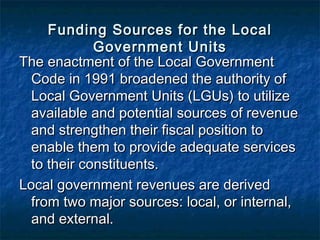
The enactment of the Local Government
  Code in 1991 broadened the authority of
  Local Government Units (LGUs) to utilize
  available and potential sources of revenue
  and strengthen their fiscal position to
  enable them to provide adequate services
  to their constituents.
Local government revenues are derived
  from two major sources: local, or internal,
  and external.
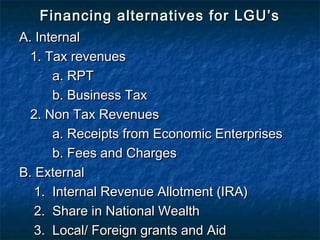
Financing alternatives for LGU’s
A. Internal
  1. Tax revenues
      a. RPT
      b. Business Tax
  2. Non Tax Revenues
      a. Receipts from Economic Enterprises
      b. Fees and Charges
B. External
   1. Internal Revenue Allotment (IRA)
   2. Share in National Wealth
   3. Local/ Foreign grants and Aid
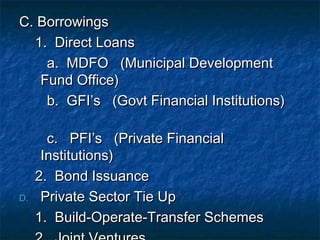
C. Borrowings
  1. Direct Loans
    a. MDFO (Municipal Development
   Fund Office)
    b. GFI’s (Govt Financial Institutions)

       c. PFI’s (Private Financial
      Institutions)
     2. Bond Issuance
D.    Private Sector Tie Up
     1. Build-Operate-Transfer Schemes
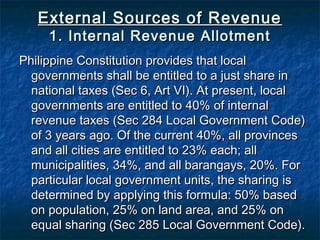
External Sources of Revenue
     1. Internal Revenue Allotment
Philippine Constitution provides that local
  governments shall be entitled to a just share in
  national taxes (Sec 6, Art VI). At present, local
  governments are entitled to 40% of internal
  revenue taxes (Sec 284 Local Government Code)
  of 3 years ago. Of the current 40%, all provinces
  and all cities are entitled to 23% each; all
  municipalities, 34%, and all barangays, 20%. For
  particular local government units, the sharing is
  determined by applying this formula: 50% based
  on population, 25% on land area, and 25% on
  equal sharing (Sec 285 Local Government Code).
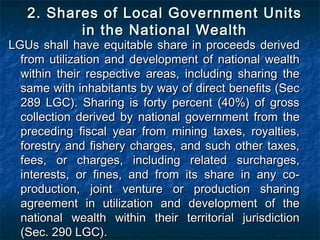
2. Shares of Local Government Units
          in the National Wealth
LGUs shall have equitable share in proceeds derived
  from utilization and development of national wealth
  within their respective areas, including sharing the
  same with inhabitants by way of direct benefits (Sec
  289 LGC). Sharing is forty percent (40%) of gross
  collection derived by national government from the
  preceding fiscal year from mining taxes, royalties,
  forestry and fishery charges, and such other taxes,
  fees, or charges, including related surcharges,
  interests, or fines, and from its share in any co-
  production, joint venture or production sharing
  agreement in utilization and development of the
  national wealth within their territorial jurisdiction
  (Sec. 290 LGC).
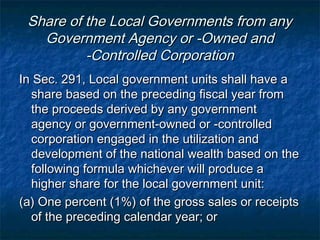
Share of the Local Governments from any
   Government Agency or -Owned and
          -Controlled Corporation
In Sec. 291, Local government units shall have a
  share based on the preceding fiscal year from
  the proceeds derived by any government
  agency or government-owned or -controlled
  corporation engaged in the utilization and
  development of the national wealth based on the
  following formula whichever will produce a
  higher share for the local government unit:
(a) One percent (1%) of the gross sales or receipts
  of the preceding calendar year; or
(b) Forty percent (40%) of the mining taxes,
  royalties, forestry and fishery charges and such
  other taxes, fees or charges, including related
  surcharges, interests, or fines the government
  agency or government -owned or -controlled
  corporation would have paid if it were not
  otherwise exempt.
The share shall be distributed in the following
  manner:
 province -20%, Component municipality / city -45;
  and barangay -35%.
Credit Financing
As a general policy, any local government
 unit may create indebtedness, and avail of
 credit facilities to finance local
 infrastructure and other socio-economic
 development projects in accordance with
 the approved local development plan and
 public investment program. A local
 government unit may also avail of credit
 lines from government or private banks
 and lending institutions for the purpose of
 stabilizing local finances. (Section 296)
Sec 297. LGUs may contract loans, credits, and
  other forms of indebtedness w/ any government
  or domestic private bank and other lending
  institutions to finance the construction,
  installation, improvement, expansion, operation,
  or maintenance of public facilities, infrastructure
  facilities, housing projects, the acquisition of real
  property, and the implementation of other capital
  investment projects, subject to terms and
  conditions as may be agreed upon by LGU and
  the lender. Proceeds from such transactions
  shall accrue directly to the LGU concerned.
An LGU may secure from any government
 bank and lending institution short, medium
 and long-term loans and advances against
 security of real estate or other acceptable
 assets for establishment, development, or
 expansion of agricultural, industrial,
 commercial, house financing projects,
 livelihood projects, and other economic
 enterprises.
 Government financial and other lending
 institutions are authorized to grant loans,
 credits, and other forms of indebtedness
 out of their loanable funds to LGUs for
 purposes specified above.
   SEC. 298. Deferred-Payment and other
    Financial Schemes. - Provincial, city and
    municipal governments may likewise
    acquire property, plant, machinery,
    equipment, and such necessary
    accessories under a supplier's credit,
    deferred payment plan, or other financial
    scheme.
Sec. 299.  Bonds and Other Long-Term
Securities.  
Subject to the rules and regulations of the Central
  Bank and Securities and Exchange Commission,
  provinces, cities, and municipalities are hereby
  authorized to issue bonds, debentures, securities,
  collaterals, notes and other obligations to finance
  self-liquidating, income-producing development or
  livelihood projects pursuant to the priorities
  established in the approved local development plan
  or the public investment program. The sanggunian
  concerned shall, through an ordinance approved by
  a majority of all its members, declare and state the
  terms and conditions of the bonds and the purpose
  for which proposed indebtedness is to be incurred.
SEC. 300. Inter-Local Government
     Loans, Grants, and Subsidies
Provinces, cities and municipalities may, upon
  approval of the majority of all members of
  the sanggunian concerned and in amounts not
  exceeding their surplus funds, extend loans,
  grants, or subsidies to other local government
  units under such terms and conditions as may
  be agreed upon by the contracting parties. Local
  government units may, upon approval of their
  respective sanggunian, jointly or severally
  contract loans, credits, and other forms of
  indebtedness for purposes mutually beneficial to
SEC. 301. Loans from Funds Secured by the
   National Government from Foreign Sources
The President, or his duly authorized representative,
  may, through any government financial or other
  lending institution, relend to any province, city,
  municipality, or barangay, the proceeds of loans
  contracted with foreign financial institutions or other
  international funding agencies for the purpose of
  financing construction, installation, improvement,
  expansion, operation, or maintenance of public
  utilities and facilities, infrastructure facilities, or
  housing projects, acquisition of real property, and
  implementation of other capital investment projects,
  subject to terms and conditions as may be agreed
  upon by the President and LGU.
Proceeds from such loans shall accrue
  directly to the local government
  concerned.
(b) The President may likewise authorize the
  relending to local government units the
  proceeds of grants secured from foreign
  sources, subject to the provisions of
  existing laws and the applicable grant
  agreements

Urban planning in philippine development setting

  • 1.
    URBAN PLANNING IN PHILIPPINEDEVELOPMENT SETTING Topic: EXTERNAL SOURCES OF LOCAL REVENUE Jeannifer B. Villanueva 11-MPMG-011 Dean C. Laurente
  • 2.
    Funding Sources forthe Local Government Units The enactment of the Local Government Code in 1991 broadened the authority of Local Government Units (LGUs) to utilize available and potential sources of revenue and strengthen their fiscal position to enable them to provide adequate services to their constituents. Local government revenues are derived from two major sources: local, or internal, and external.
  • 3.
    Financing alternatives forLGU’s A. Internal 1. Tax revenues a. RPT b. Business Tax 2. Non Tax Revenues a. Receipts from Economic Enterprises b. Fees and Charges B. External 1. Internal Revenue Allotment (IRA) 2. Share in National Wealth 3. Local/ Foreign grants and Aid
  • 4.
    C. Borrowings 1. Direct Loans a. MDFO (Municipal Development Fund Office) b. GFI’s (Govt Financial Institutions) c. PFI’s (Private Financial Institutions) 2. Bond Issuance D. Private Sector Tie Up 1. Build-Operate-Transfer Schemes
  • 5.
    External Sources ofRevenue 1. Internal Revenue Allotment Philippine Constitution provides that local governments shall be entitled to a just share in national taxes (Sec 6, Art VI). At present, local governments are entitled to 40% of internal revenue taxes (Sec 284 Local Government Code) of 3 years ago. Of the current 40%, all provinces and all cities are entitled to 23% each; all municipalities, 34%, and all barangays, 20%. For particular local government units, the sharing is determined by applying this formula: 50% based on population, 25% on land area, and 25% on equal sharing (Sec 285 Local Government Code).
  • 6.
    2. Shares ofLocal Government Units in the National Wealth LGUs shall have equitable share in proceeds derived from utilization and development of national wealth within their respective areas, including sharing the same with inhabitants by way of direct benefits (Sec 289 LGC). Sharing is forty percent (40%) of gross collection derived by national government from the preceding fiscal year from mining taxes, royalties, forestry and fishery charges, and such other taxes, fees, or charges, including related surcharges, interests, or fines, and from its share in any co- production, joint venture or production sharing agreement in utilization and development of the national wealth within their territorial jurisdiction (Sec. 290 LGC).
  • 7.
    Share of theLocal Governments from any Government Agency or -Owned and -Controlled Corporation In Sec. 291, Local government units shall have a share based on the preceding fiscal year from the proceeds derived by any government agency or government-owned or -controlled corporation engaged in the utilization and development of the national wealth based on the following formula whichever will produce a higher share for the local government unit: (a) One percent (1%) of the gross sales or receipts of the preceding calendar year; or
  • 8.
    (b) Forty percent(40%) of the mining taxes, royalties, forestry and fishery charges and such other taxes, fees or charges, including related surcharges, interests, or fines the government agency or government -owned or -controlled corporation would have paid if it were not otherwise exempt. The share shall be distributed in the following manner: province -20%, Component municipality / city -45; and barangay -35%.
  • 9.
    Credit Financing As ageneral policy, any local government As a general policy, any local government unit may create indebtedness, and avail of credit facilities to finance local infrastructure and other socio-economic development projects in accordance with the approved local development plan and public investment program. A local government unit may also avail of credit lines from government or private banks and lending institutions for the purpose of stabilizing local finances. (Section 296)
  • 10.
    Sec 297. LGUsmay contract loans, credits, and other forms of indebtedness w/ any government or domestic private bank and other lending institutions to finance the construction, installation, improvement, expansion, operation, or maintenance of public facilities, infrastructure facilities, housing projects, the acquisition of real property, and the implementation of other capital investment projects, subject to terms and conditions as may be agreed upon by LGU and the lender. Proceeds from such transactions shall accrue directly to the LGU concerned.
  • 11.
    An LGU maysecure from any government bank and lending institution short, medium and long-term loans and advances against security of real estate or other acceptable assets for establishment, development, or expansion of agricultural, industrial, commercial, house financing projects, livelihood projects, and other economic enterprises. Government financial and other lending institutions are authorized to grant loans, credits, and other forms of indebtedness out of their loanable funds to LGUs for purposes specified above.
  • 12.
    SEC. 298. Deferred-Payment and other Financial Schemes. - Provincial, city and municipal governments may likewise acquire property, plant, machinery, equipment, and such necessary accessories under a supplier's credit, deferred payment plan, or other financial scheme.
  • 13.
    Sec. 299.  Bondsand Other Long-Term Securities.   Subject to the rules and regulations of the Central Bank and Securities and Exchange Commission, provinces, cities, and municipalities are hereby authorized to issue bonds, debentures, securities, collaterals, notes and other obligations to finance self-liquidating, income-producing development or livelihood projects pursuant to the priorities established in the approved local development plan or the public investment program. The sanggunian concerned shall, through an ordinance approved by a majority of all its members, declare and state the terms and conditions of the bonds and the purpose for which proposed indebtedness is to be incurred.
  • 14.
    SEC. 300. Inter-Local Government Loans, Grants, and Subsidies Provinces, cities and municipalities may, upon approval of the majority of all members of the sanggunian concerned and in amounts not exceeding their surplus funds, extend loans, grants, or subsidies to other local government units under such terms and conditions as may be agreed upon by the contracting parties. Local government units may, upon approval of their respective sanggunian, jointly or severally contract loans, credits, and other forms of indebtedness for purposes mutually beneficial to
  • 15.
    SEC. 301. Loans fromFunds Secured by the National Government from Foreign Sources The President, or his duly authorized representative, may, through any government financial or other lending institution, relend to any province, city, municipality, or barangay, the proceeds of loans contracted with foreign financial institutions or other international funding agencies for the purpose of financing construction, installation, improvement, expansion, operation, or maintenance of public utilities and facilities, infrastructure facilities, or housing projects, acquisition of real property, and implementation of other capital investment projects, subject to terms and conditions as may be agreed upon by the President and LGU.
  • 16.
    Proceeds from suchloans shall accrue directly to the local government concerned. (b) The President may likewise authorize the relending to local government units the proceeds of grants secured from foreign sources, subject to the provisions of existing laws and the applicable grant agreements