

PRESENTED BY:   MAR ICAR CALILIW
                 JOHNNY R AFOLS JR.
                      JEANNIFER VILLANUEVA
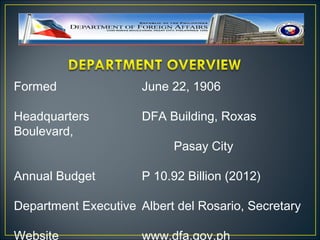
Formed                June 22, 1906

Headquarters          DFA Building, Roxas
Boulevard,
                           Pasay City

Annual Budget         P 10.92 Billion (2012)

Department Executive Albert del Rosario, Secretary

Website               www.dfa.gov.ph
The Philippines Department of Foreign Affairs (DFA)
(Filipino: Ka g a wa ra n ng Ug na y a ng Pa nla ba s ) is the executive
department of the Philippine government tasked to contribute
to the enhancement of national security and the protection of
the territorial integrity and national sovereignty, to participate
in the national endeavour of sustaining development and
enhancing the Philippines' competitive edge, to protect the
rights and promote the welfare of Filipinos overseas and to
mobilize them as partners in national development, to project
a positive image of the Philippines, and to increase
international understanding of Philippine culture for mutually-
beneficial relations with other countries.
Beginnings

The Department of Foreign Affairs was created on June
23, 1898 through a decree of Emilio Aguinaldo, who
appointed Apolinario Mabini as the Philippines’s first
Secretary of Foreign Affairs. In effect, the DFA became the
first government department to be established following the
proclamation of the First Philippine Republic in
Malolos City in Bulacan. Realizing the need for
international recognition to support the legitimacy of his
government.
Post-W Philippines
      ar

The country regained full control of foreign affairs and
diplomatic matters on July 4, 1946, when Commonwealth
Act No. 732 was passed creating the Department of
Foreign     Affairs.   On     September      16,     President
Manuel Roxas issued Executive Order No. 18, which
provided for the organization and operation of the DFA and
the Foreign Service. The main tasks of the DFA then were
to assist in postwar rehabilitation, formulate policies for the
promotion of investment, and re-establish diplomatic
relations with neighboring countries.
Under Marcos
President Ferdinand Marcos redefined foreign policy as the
protection of Philippine independence, territorial integrity and
national dignity, and emphasized increased regional
cooperation and collaboration. He placed great stress on
being Asian and pursued a policy of constructive unity and
co-existence with other Asian states, regardless of ideological
persuasion.

Throughout the 1970s, the DFA pursued the promotion of
trade and investment, played an active role in hosting
international meetings, and participated in the meetings of the
Non-Aligned Movement. The Foreign Service Institute was
Post-EDSA 1986
The 1986 EDSA Revolution saw the re-establishment of a
democratic government under President Corazon Aquino.
During this period, the DFA once again pursued development
policy, in the active pursuit of opportunities abroad in the vital
areas of trade, investment, finance, technology and aid.

During this period, the Philippines became one of the founding
members of the Asia-Pacific Economic Cooperation or APEC in
November 1989, and an active player in regional efforts to
establish the ASEAN Free Trade Area. In 1990, the DFA
proposed the establishment of more diplomatic missions to the
Middle East to improve existing ties with Arab states and to
respond to the growing needs of Overseas Filipino Workers in
Under Fidel V. R  amos
The Ramos administration from July 1992 to June 1998
defined four core areas of Philippine foreign policy: the
enhancement of national security, promotion of economic
diplomacy, protecting Overseas Filipino Workers and
Filipino nationals abroad, the projection of a good image of
the country abroad.

The Migrant Workers and Overseas Filipinos Act of 1995
provided the framework for stronger protection of Filipino
workers abroad, with the creation of the Legal Assistance
Fund and the Assistance-to-Nationals Fund, and the
designation in the DFA of a Legal Assistant for Migrant
Estrada Administration
The Estrada administration upheld the foreign policy
thrusts of the previous administration, focusing on national
security, economic diplomacy, assistance to nationals, and
image-building. The Philippines continued to be at the
forefront of the regional and multilateral arena. It
successfully hosted the ASEAN Ministerial Meeting in July
1998 and undertook confidence-building measures with
China over South China Sea issue through a meeting in
March 1999.

The DFA also played a major role in the forging of a
Visiting Forces Agreement with the United States, which
To advance the interests of the
Philippines and the Filipino people in
the world community.
THE DEPARTMENT OF FOR         EIGN AFFAIRS is the prime
agency of government responsible for the pursuit of the
State's foreign policy and the nerve center for a Foreign
Service worthy of the trust and pride of every Filipino.

We are an organization of competent, dedicated and highly
motivated personnel, who devote their energies to the
benefit of the Filipino people.
We implement foreign policy with the highest
standards of professionalism and commitment.

We pursue bilateral, regional and multilateral relations
to advance the interest of the Philippines and the
Filipinos.

 We build partnerships with national security and
development agencies, think-tanks and the academe,
the private sector, the media and civil society in the
We endeavor to promote regional and global cooperation in
order to achieve peace, prosperity and stability.

 In the global arena, we work for social justice especially for
the poor, human rights and fundamental freedoms, and a
democratic way of life.

We are committed to secure a world free from serious
environmental degradation, transnational crime and
proliferation of nuclear weapons.
Our missions abroad are the partners of Filipinos
overseas in the pursuit of the national interest and
in the promotion and protection of their rights and
well-being.

We have highly responsive system, which ensures
effective delivery of services.

Our personnel are our greatest asset.
We are committed to the personal, professional
and career development of each employee.

In pursuit of our goals, we strive for and live by the
principles of excellence, integrity and patriotism.
 To contribute to the enhancement of
  national security and the protection of the
  territorial integrity and national sovereignty.
 To participate in the national endeavour to
  sustain development and to enhance the
  Philippines' competitive edge in a global
  milieu.
 To project a positive image of the
  Philippines;
 To increase international understanding of
  Philippine culture for mutually-beneficial
  relations with other countries; and,

 To increase and maximize human, financial,
  technological and other resources to
  optimize    the  performance    of    the
  Department.
The m o s t im p o rta nt p ro vis io ns o f the 1 9 8 7 Philip p ine
Co ns titutio n whic h p e rta in to the fra m ing o f Philip p ine fo re ig n
p o lic y a re a s fo llo ws :

           Article II, Section 2: "The Philippines
    renounces war as an instrument of national policy,
    adopts the generally accepted principles of
    international law as part of the law of the land and
    adheres to the policy of peace, equality, justice."
 Article II, Section 7: "The State shall pursue an
  independent foreign policy. In its relations with other
  states the paramount consideration shall be national
  sovereignty, territorial integrity, national interest, and the
  right to self-determination

 Republic Act No. 7157, otherwise known as "Philippine
  Foreign Service Act of 1991", gives mandate to the
  Department of Foreign Affairs to implement the three (3)
  pillars of the Philippine Foreign Policy.
The three (3) pillars of the Philippine Foreign Policy
   1.    Preservation and enhancement of national
security
   2. Promotion and attainment of economic security
   3. Protection of the rights and promotion of the
welfare         and interest of Filipinos overseas.

These pillars overlap and cannot be considered apart
from each other. Together with the eight (8) foreign
policy realities outlined by the President, they reinforce
each other and must be addressed as one whole.
These eight foreign policy realities are:

1.China, Japan and the United States and their
 relationship will be a determining influence in the
security situation and economic evolution of East
    Asia.

2.Philippine foreign policy decisions have to be
made in the context of ASEAN.
3. The international Islamic community will
    continue to be important for the Philippines.

      4. The coming years will see the growing
      importance of multilateral and     inter-
regional organizations to promote        common
interests.
7. The Philippines can benefit most quickly from
      international tourism.

     8. Overseas Filipinos will continue to be
recognized for their critical role in the country's
economic and      social          stability.
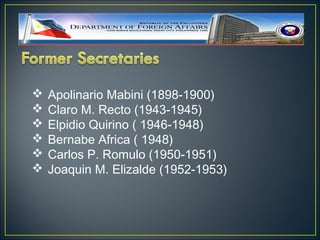
   Apolinario Mabini (1898-1900)
   Claro M. Recto (1943-1945)
   Elpidio Quirino ( 1946-1948)
   Bernabe Africa ( 1948)
   Carlos P. Romulo (1950-1951)
   Joaquin M. Elizalde (1952-1953)
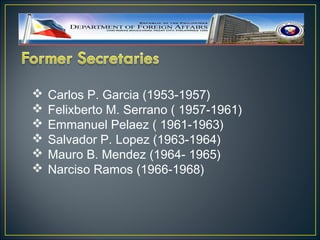
   Carlos P. Garcia (1953-1957)
   Felixberto M. Serrano ( 1957-1961)
   Emmanuel Pelaez ( 1961-1963)
   Salvador P. Lopez (1963-1964)
   Mauro B. Mendez (1964- 1965)
   Narciso Ramos (1966-1968)
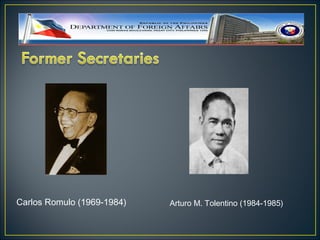
Carlos Romulo (1969-1984)   Arturo M. Tolentino (1984-1985)
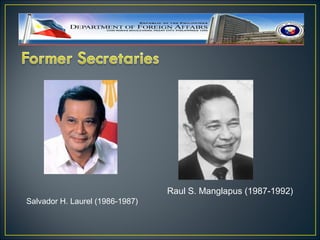
Raul S. Manglapus (1987-1992)
Salvador H. Laurel (1986-1987)
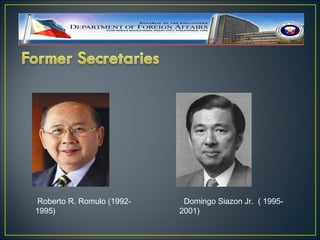
Roberto R. Romulo (1992-    Domingo Siazon Jr. ( 1995-
1995)                       2001)
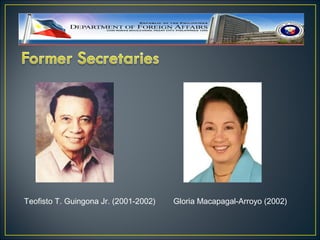
Teofisto T. Guingona Jr. (2001-2002)   Gloria Macapagal-Arroyo (2002)
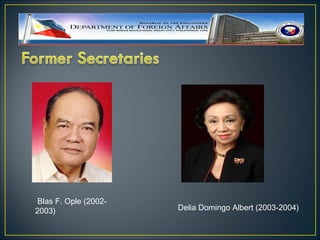
Blas F. Ople (2002-
2003)                  Delia Domingo Albert (2003-2004)
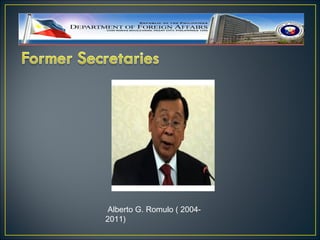
Alberto G. Romulo ( 2004-
2011)
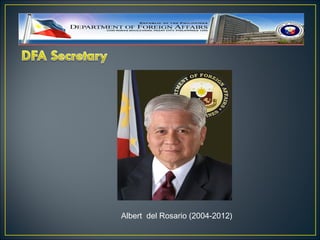
Albert del Rosario (2004-2012)
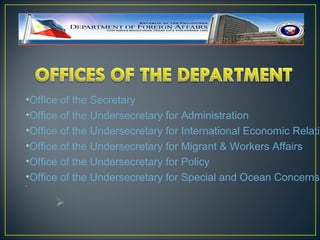
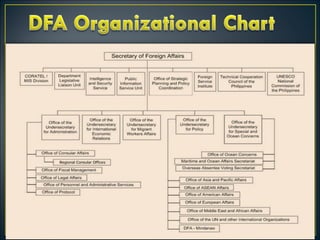
•Office of the Secretary
•Office of the Undersecretary for Administration
•Office of the Undersecretary for International Economic Relatio
•Office of the Undersecretary for Migrant & Workers Affairs
•Office of the Undersecretary for Policy
•Office of the Undersecretary for Special and Ocean Concerns
•


      
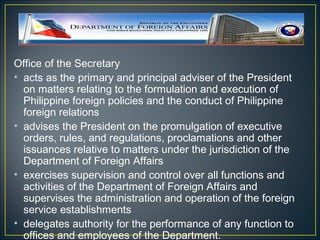
Office of the Secretary
• acts as the primary and principal adviser of the President
  on matters relating to the formulation and execution of
  Philippine foreign policies and the conduct of Philippine
  foreign relations
• advises the President on the promulgation of executive
  orders, rules, and regulations, proclamations and other
  issuances relative to matters under the jurisdiction of the
  Department of Foreign Affairs
• exercises supervision and control over all functions and
  activities of the Department of Foreign Affairs and
  supervises the administration and operation of the foreign
  service establishments
• delegates authority for the performance of any function to
  offices and employees of the Department.
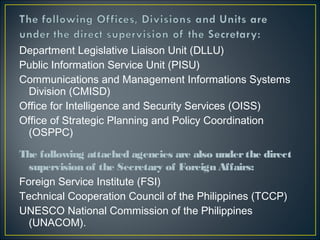
Department Legislative Liaison Unit (DLLU)
Public Information Service Unit (PISU)
Communications and Management Informations Systems
 Division (CMISD)
Office for Intelligence and Security Services (OISS)
Office of Strategic Planning and Policy Coordination
 (OSPPC)

The following attached agencies are also under the direct
  supervision of the Secretary of Foreign Affairs: 
Foreign Service Institute (FSI)
Technical Cooperation Council of the Philippines (TCCP)
UNESCO National Commission of the Philippines
  (UNACOM).
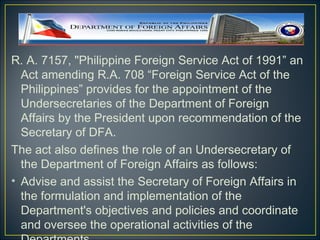
R. A. 7157, "Philippine Foreign Service Act of 1991” an
  Act amending R.A. 708 “Foreign Service Act of the
  Philippines” provides for the appointment of the
  Undersecretaries of the Department of Foreign
  Affairs by the President upon recommendation of the
  Secretary of DFA.
The act also defines the role of an Undersecretary of
  the Department of Foreign Affairs as follows:
• Advise and assist the Secretary of Foreign Affairs in
  the formulation and implementation of the
  Department's objectives and policies and coordinate
  and oversee the operational activities of the
Office of the Undersecretary for
 Administration
The Office of the Undersecretary for
 Administration aids the Secretary of
 Foreign Affairs and provides him advice on
 matters relating to the general operations
 of the DFA, its regional offices and
 Philippine Foreign Service Posts and all
 other administrative matters and concerns.
The Office of the Undersecretary for Administration
  oversees the operations of all administrative related
  offices of the Department including the:
  Office of Legal Affairs (OLA),
  Office of Personnel and Administration Services (OPAS),
  Office of Fiscal Management (OFM),
  Office of Protocol and State Visits (OPSV) and;
  Office of Consular Affairs (OCA).
The Undersecretary for Administration also chairs and
  oversees the:
 Board of Foreign Service Administration (BFSA),
 Board of Foreign Service Examinations (BFSE),
 Bids and Awards Committee (BAC),
 and other related committees of the Department.
Office of the Undersecretary for International Economic
  Relations
The Office of the Undersecretary for International Economic
  Relations is principally in-charge with implementing and
  coordinating the responsibilities and functions of the
  Department of Foreign Affairs relating to:
     trade and investments,
     science and technology,
     environment and sustainable development,
     official development cooperation and,
     other related economic/social concerns, particularly
  those related to issues on women and youth vis-à-vis
  other countries, in cooperation with all Philippine
  government agencies concerned and the private sector.
Office of the Undersecretary for Migrant & Workers Affairs
Created by Republic Act No. 8042, or the Migrant Workers and
  Overseas Filipinos Act of 1995, the Office of the Undersecretary
  for Migrant Workers Affairs
• aids the Secretary of Foreign Affairs and provides advice on
  matters relating to the formulation and execution of Philippine
  foreign policy relating to the protection of the dignity, fundamental
  rights and freedoms of Filipino citizens abroad, while giving
  particular attention to the protection and promotion of the welfare
  and dignity of overseas Filipinos.  It is the third pillar of Philippine
  foreign policy and one of the highest priority concerns of the
  Secretary of Foreign Affairs and the Philippine Foreign Service
  Posts.
OUMWA works in coordination with various sectors - elected
  officials, other government agencies, OFWs and their families,
  mass media, private organizations, international organizations,
  NGOs and religious group - to deliver timely assistance to
Office of the Undersecretary for Policy
The Office of the Undersecretary for Policy
 aids the Secretary of Foreign Affairs and
 provides him advice on matters relating to
 the formulation and execution of Philippine
 foreign policy, particularly on bilateral,
 regional and international political and
 security issues.
Office of the Undersecretary for Special and Ocean Concerns
• aids the Secretary of Foreign Affairs and provides him
  advice on matters relating to identified special issues and
  concerns of the Department including the following:
Maritime and Ocean Concerns Territorial Concerns Counter
  Terrorism
Overseas Absentee Voting          Dual Citizenship     Human
  Rights Issues
Children in Armed Conflict        Bid for Observer Status in the OIC
Peace Processes                    Task Force on the Sabah Issue
Coordination with the Philippine Drug Enforcement Agency
Under this office are the Office of Ocean Concerns, Maritime
 and Ocean Affairs Secretariat, and the Overseas Absentee
 Voting Secretariat.
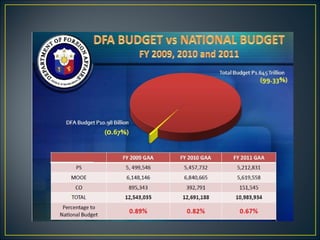
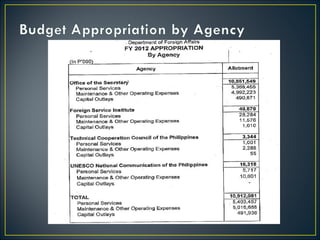
BUDGET
Current budget Y2012 – P10.92B

Proposed budget for Y2013 – P11.64B
  (increase of 6.6 % from Y2012 budget)
 - includes a building fund of P428.29M
Presently, the DFA has 60 embassies, 20
 consulate generals all over the world,
 which mostly are leased in the amount of
 P600 million yearly.
Dfa 2 ppt
Dfa 2 ppt
Dfa 2 ppt

Dfa 2 ppt

  • 1.
    PRESENTED BY: MAR ICAR CALILIW JOHNNY R AFOLS JR. JEANNIFER VILLANUEVA
  • 2.
    Formed June 22, 1906 Headquarters DFA Building, Roxas Boulevard, Pasay City Annual Budget P 10.92 Billion (2012) Department Executive Albert del Rosario, Secretary Website www.dfa.gov.ph
  • 3.
    The Philippines Departmentof Foreign Affairs (DFA) (Filipino: Ka g a wa ra n ng Ug na y a ng Pa nla ba s ) is the executive department of the Philippine government tasked to contribute to the enhancement of national security and the protection of the territorial integrity and national sovereignty, to participate in the national endeavour of sustaining development and enhancing the Philippines' competitive edge, to protect the rights and promote the welfare of Filipinos overseas and to mobilize them as partners in national development, to project a positive image of the Philippines, and to increase international understanding of Philippine culture for mutually- beneficial relations with other countries.
  • 4.
    Beginnings The Department ofForeign Affairs was created on June 23, 1898 through a decree of Emilio Aguinaldo, who appointed Apolinario Mabini as the Philippines’s first Secretary of Foreign Affairs. In effect, the DFA became the first government department to be established following the proclamation of the First Philippine Republic in Malolos City in Bulacan. Realizing the need for international recognition to support the legitimacy of his government.
  • 5.
    Post-W Philippines ar The country regained full control of foreign affairs and diplomatic matters on July 4, 1946, when Commonwealth Act No. 732 was passed creating the Department of Foreign Affairs. On September 16, President Manuel Roxas issued Executive Order No. 18, which provided for the organization and operation of the DFA and the Foreign Service. The main tasks of the DFA then were to assist in postwar rehabilitation, formulate policies for the promotion of investment, and re-establish diplomatic relations with neighboring countries.
  • 6.
    Under Marcos President FerdinandMarcos redefined foreign policy as the protection of Philippine independence, territorial integrity and national dignity, and emphasized increased regional cooperation and collaboration. He placed great stress on being Asian and pursued a policy of constructive unity and co-existence with other Asian states, regardless of ideological persuasion. Throughout the 1970s, the DFA pursued the promotion of trade and investment, played an active role in hosting international meetings, and participated in the meetings of the Non-Aligned Movement. The Foreign Service Institute was
  • 7.
    Post-EDSA 1986 The 1986EDSA Revolution saw the re-establishment of a democratic government under President Corazon Aquino. During this period, the DFA once again pursued development policy, in the active pursuit of opportunities abroad in the vital areas of trade, investment, finance, technology and aid. During this period, the Philippines became one of the founding members of the Asia-Pacific Economic Cooperation or APEC in November 1989, and an active player in regional efforts to establish the ASEAN Free Trade Area. In 1990, the DFA proposed the establishment of more diplomatic missions to the Middle East to improve existing ties with Arab states and to respond to the growing needs of Overseas Filipino Workers in
  • 8.
    Under Fidel V.R amos The Ramos administration from July 1992 to June 1998 defined four core areas of Philippine foreign policy: the enhancement of national security, promotion of economic diplomacy, protecting Overseas Filipino Workers and Filipino nationals abroad, the projection of a good image of the country abroad. The Migrant Workers and Overseas Filipinos Act of 1995 provided the framework for stronger protection of Filipino workers abroad, with the creation of the Legal Assistance Fund and the Assistance-to-Nationals Fund, and the designation in the DFA of a Legal Assistant for Migrant
  • 9.
    Estrada Administration The Estradaadministration upheld the foreign policy thrusts of the previous administration, focusing on national security, economic diplomacy, assistance to nationals, and image-building. The Philippines continued to be at the forefront of the regional and multilateral arena. It successfully hosted the ASEAN Ministerial Meeting in July 1998 and undertook confidence-building measures with China over South China Sea issue through a meeting in March 1999. The DFA also played a major role in the forging of a Visiting Forces Agreement with the United States, which
  • 10.
    To advance theinterests of the Philippines and the Filipino people in the world community.
  • 11.
    THE DEPARTMENT OFFOR EIGN AFFAIRS is the prime agency of government responsible for the pursuit of the State's foreign policy and the nerve center for a Foreign Service worthy of the trust and pride of every Filipino. We are an organization of competent, dedicated and highly motivated personnel, who devote their energies to the benefit of the Filipino people.
  • 12.
    We implement foreignpolicy with the highest standards of professionalism and commitment. We pursue bilateral, regional and multilateral relations to advance the interest of the Philippines and the Filipinos. We build partnerships with national security and development agencies, think-tanks and the academe, the private sector, the media and civil society in the
  • 13.
    We endeavor topromote regional and global cooperation in order to achieve peace, prosperity and stability. In the global arena, we work for social justice especially for the poor, human rights and fundamental freedoms, and a democratic way of life. We are committed to secure a world free from serious environmental degradation, transnational crime and proliferation of nuclear weapons.
  • 14.
    Our missions abroadare the partners of Filipinos overseas in the pursuit of the national interest and in the promotion and protection of their rights and well-being. We have highly responsive system, which ensures effective delivery of services. Our personnel are our greatest asset.
  • 15.
    We are committedto the personal, professional and career development of each employee. In pursuit of our goals, we strive for and live by the principles of excellence, integrity and patriotism.
  • 16.
     To contributeto the enhancement of national security and the protection of the territorial integrity and national sovereignty.  To participate in the national endeavour to sustain development and to enhance the Philippines' competitive edge in a global milieu.  To project a positive image of the Philippines;
  • 17.
     To increaseinternational understanding of Philippine culture for mutually-beneficial relations with other countries; and,  To increase and maximize human, financial, technological and other resources to optimize the performance of the Department.
  • 18.
    The m os t im p o rta nt p ro vis io ns o f the 1 9 8 7 Philip p ine Co ns titutio n whic h p e rta in to the fra m ing o f Philip p ine fo re ig n p o lic y a re a s fo llo ws :  Article II, Section 2: "The Philippines renounces war as an instrument of national policy, adopts the generally accepted principles of international law as part of the law of the land and adheres to the policy of peace, equality, justice."
  • 19.
     Article II,Section 7: "The State shall pursue an independent foreign policy. In its relations with other states the paramount consideration shall be national sovereignty, territorial integrity, national interest, and the right to self-determination  Republic Act No. 7157, otherwise known as "Philippine Foreign Service Act of 1991", gives mandate to the Department of Foreign Affairs to implement the three (3) pillars of the Philippine Foreign Policy.
  • 20.
    The three (3)pillars of the Philippine Foreign Policy 1. Preservation and enhancement of national security 2. Promotion and attainment of economic security 3. Protection of the rights and promotion of the welfare and interest of Filipinos overseas. These pillars overlap and cannot be considered apart from each other. Together with the eight (8) foreign policy realities outlined by the President, they reinforce each other and must be addressed as one whole.
  • 21.
    These eight foreignpolicy realities are: 1.China, Japan and the United States and their relationship will be a determining influence in the security situation and economic evolution of East Asia. 2.Philippine foreign policy decisions have to be made in the context of ASEAN.
  • 22.
    3. The internationalIslamic community will continue to be important for the Philippines. 4. The coming years will see the growing importance of multilateral and inter- regional organizations to promote common interests.
  • 23.
    7. The Philippinescan benefit most quickly from international tourism. 8. Overseas Filipinos will continue to be recognized for their critical role in the country's economic and social stability.
  • 24.
    Apolinario Mabini (1898-1900)  Claro M. Recto (1943-1945)  Elpidio Quirino ( 1946-1948)  Bernabe Africa ( 1948)  Carlos P. Romulo (1950-1951)  Joaquin M. Elizalde (1952-1953)
  • 25.
    Carlos P. Garcia (1953-1957)  Felixberto M. Serrano ( 1957-1961)  Emmanuel Pelaez ( 1961-1963)  Salvador P. Lopez (1963-1964)  Mauro B. Mendez (1964- 1965)  Narciso Ramos (1966-1968)
  • 26.
    Carlos Romulo (1969-1984) Arturo M. Tolentino (1984-1985)
  • 27.
    Raul S. Manglapus(1987-1992) Salvador H. Laurel (1986-1987)
  • 28.
    Roberto R. Romulo(1992- Domingo Siazon Jr. ( 1995- 1995) 2001)
  • 29.
    Teofisto T. GuingonaJr. (2001-2002) Gloria Macapagal-Arroyo (2002)
  • 30.
    Blas F. Ople(2002- 2003) Delia Domingo Albert (2003-2004)
  • 31.
    Alberto G. Romulo( 2004- 2011)
  • 32.
    Albert del Rosario(2004-2012)
  • 33.
    •Office of theSecretary •Office of the Undersecretary for Administration •Office of the Undersecretary for International Economic Relatio •Office of the Undersecretary for Migrant & Workers Affairs •Office of the Undersecretary for Policy •Office of the Undersecretary for Special and Ocean Concerns • 
  • 34.
    Office of theSecretary • acts as the primary and principal adviser of the President on matters relating to the formulation and execution of Philippine foreign policies and the conduct of Philippine foreign relations • advises the President on the promulgation of executive orders, rules, and regulations, proclamations and other issuances relative to matters under the jurisdiction of the Department of Foreign Affairs • exercises supervision and control over all functions and activities of the Department of Foreign Affairs and supervises the administration and operation of the foreign service establishments • delegates authority for the performance of any function to offices and employees of the Department.
  • 35.
    Department Legislative LiaisonUnit (DLLU) Public Information Service Unit (PISU) Communications and Management Informations Systems Division (CMISD) Office for Intelligence and Security Services (OISS) Office of Strategic Planning and Policy Coordination (OSPPC) The following attached agencies are also under the direct supervision of the Secretary of Foreign Affairs:  Foreign Service Institute (FSI) Technical Cooperation Council of the Philippines (TCCP) UNESCO National Commission of the Philippines (UNACOM).
  • 36.
    R. A. 7157,"Philippine Foreign Service Act of 1991” an Act amending R.A. 708 “Foreign Service Act of the Philippines” provides for the appointment of the Undersecretaries of the Department of Foreign Affairs by the President upon recommendation of the Secretary of DFA. The act also defines the role of an Undersecretary of the Department of Foreign Affairs as follows: • Advise and assist the Secretary of Foreign Affairs in the formulation and implementation of the Department's objectives and policies and coordinate and oversee the operational activities of the
  • 37.
    Office of theUndersecretary for Administration The Office of the Undersecretary for Administration aids the Secretary of Foreign Affairs and provides him advice on matters relating to the general operations of the DFA, its regional offices and Philippine Foreign Service Posts and all other administrative matters and concerns.
  • 38.
    The Office ofthe Undersecretary for Administration oversees the operations of all administrative related offices of the Department including the: Office of Legal Affairs (OLA), Office of Personnel and Administration Services (OPAS), Office of Fiscal Management (OFM), Office of Protocol and State Visits (OPSV) and; Office of Consular Affairs (OCA). The Undersecretary for Administration also chairs and oversees the: Board of Foreign Service Administration (BFSA), Board of Foreign Service Examinations (BFSE), Bids and Awards Committee (BAC), and other related committees of the Department.
  • 39.
    Office of theUndersecretary for International Economic Relations The Office of the Undersecretary for International Economic Relations is principally in-charge with implementing and coordinating the responsibilities and functions of the Department of Foreign Affairs relating to: trade and investments, science and technology, environment and sustainable development, official development cooperation and, other related economic/social concerns, particularly those related to issues on women and youth vis-à-vis other countries, in cooperation with all Philippine government agencies concerned and the private sector.
  • 40.
    Office of theUndersecretary for Migrant & Workers Affairs Created by Republic Act No. 8042, or the Migrant Workers and Overseas Filipinos Act of 1995, the Office of the Undersecretary for Migrant Workers Affairs • aids the Secretary of Foreign Affairs and provides advice on matters relating to the formulation and execution of Philippine foreign policy relating to the protection of the dignity, fundamental rights and freedoms of Filipino citizens abroad, while giving particular attention to the protection and promotion of the welfare and dignity of overseas Filipinos.  It is the third pillar of Philippine foreign policy and one of the highest priority concerns of the Secretary of Foreign Affairs and the Philippine Foreign Service Posts. OUMWA works in coordination with various sectors - elected officials, other government agencies, OFWs and their families, mass media, private organizations, international organizations, NGOs and religious group - to deliver timely assistance to
  • 41.
    Office of theUndersecretary for Policy The Office of the Undersecretary for Policy aids the Secretary of Foreign Affairs and provides him advice on matters relating to the formulation and execution of Philippine foreign policy, particularly on bilateral, regional and international political and security issues.
  • 42.
    Office of theUndersecretary for Special and Ocean Concerns • aids the Secretary of Foreign Affairs and provides him advice on matters relating to identified special issues and concerns of the Department including the following: Maritime and Ocean Concerns Territorial Concerns Counter Terrorism Overseas Absentee Voting Dual Citizenship Human Rights Issues Children in Armed Conflict Bid for Observer Status in the OIC Peace Processes Task Force on the Sabah Issue Coordination with the Philippine Drug Enforcement Agency Under this office are the Office of Ocean Concerns, Maritime and Ocean Affairs Secretariat, and the Overseas Absentee Voting Secretariat.
  • 44.
    BUDGET Current budget Y2012– P10.92B Proposed budget for Y2013 – P11.64B (increase of 6.6 % from Y2012 budget) - includes a building fund of P428.29M Presently, the DFA has 60 embassies, 20 consulate generals all over the world, which mostly are leased in the amount of P600 million yearly.