Corporate Social
Responsibility (CSR)
HEJERA M. LAGUTIN, CPA
Three Foundational Assumptions
The CSR Debate
2.
1. What is CSR?
CSR and Value Creation
3. 4.
Contents
5. The future of CSR Summary
6.
7.
Videos on some companies
Sustainability efforts.
What is CSR?
01
.
Corporate social responsibility (CSR) is part of the reality of doing business in the twenty-first century.
Regardless of how one feels about it, CSR is here to stay. As one feels about it, CSR is “the movement for
corporate social responsibility has won the battle of ideas.” Most Fortune 500 companies now include a
senior level position in their organizational structure dedicated to CSR and/ or sustainability issues.
Reporting standards are beginning to solidify and diffuse. The Global Reporting Initiative, for example, a
non-profit organization dedicated to promoting economic, environmental and social sustainability,
produces a comprehensive sustainability reporting framework that is being rapidly adopted by
organizations around the world, and third parties, like KPMG, are beginning to audit corporate
responsibility reports and issue assurance statements. In 2009, Bloomberg added environmental, social
and governance (or ESG) indicators to its terminal date stream.
CSR is not about pressuring firms into engaging in philanthropy or obligating them to shoulder additional
responsibility for different social problems. Considered broadly, CSR is about establishing and
perpetuating social norms that make economic markets more transparent and effective in serving
societal interests. As we move further into the twenty-first century, CSR is likely to become an increasingly
essential framework for reconciling individual interests and the social good. Because of this, CSR is likely
to play an influential role in every aspect of business, from corporate strategy to marketing and human
resource management.
CSR, considered broadly, is ABOUT HOW OUR ECONOMIC SYSTEM SHOULD
BE STRUCTURED AND THE REPONSIBILITY OF THE PARTICIPANTS IN IT TO
What is CSR?
The five definitions included below are arranged in chronological order
and illustrate a few of the different ways CSR has been conceptualized
and defined.
The term social responsibilities of businessmen will be used frequently. It
refers to the obligations of businessmen (and businesswomen) to pursue
those policies, to make those decisions, or to follow those lines of action
which are desirable in terms of the objectives and values of our society.
This definition does not imply that businessmen as members of society
lack the rights to criticize the values. It is assumed, however, that as
servants of society, they must not disregard socially accepted values or
place their own values above those of society.
-Howard R. Bowen, 1953
Definition
What is CSR?
All of this suggests that when we invoke the phrase “the social
responsibilities of the businessman (or businesswoman),” we
mean that businessmen (or businesswomen) should oversee
the operation of an economic system that fulfills the
expectations of the public. And this means in turn that the
economy’s means of production should be employed in such
way that the production and distribution should enhance total
socio-economic welfare. Social responsibility in the final
analysis implies a public posture toward society’s economic
and human resource and a willingness to see that those
resources are utilized for broad social ends and not simply for
the narrowly circumscribed interests of private persons and
firms. -William C.
Definition
What is CSR?
What does it mean to say that the corporate executive has a
“social responsibility” in his capacity as businessman? If this
statement is not pure rhetoric, it must mean that he is to act
in some way that is not in the interest of his employers… That
is why, my book Capitalism and Freedom, I have called it a
“fundamentally subversive doctrine” in a free society, there is
one and only one social responsibility of business---to use its
resources and engage in activities designed to increase its
profits so long as it stays within the rules of the game, which
is to say, engages in open and free competition without
deception or fraud.
--Milton Friedman, 1970
Definition
What is CSR?
With so many conflicting goals and objectives, the definition
of CSR is not always clear. Here we define CSR as actions that
appear to further some social good, beyond the interests of
the firm and that which is required by law. This definition
underscores that, to us, CSR means going beyond obeying the
law.
-Abagail McWilliams & Donald Siegel,
2001
Definition
What is CSR?
CSR is about how business align their values and behavior
with the expectations and needs of stakeholders—not just
customers and investors but also employees, suppliers,
communities, regulators, special interest groups and society
as a whole. CSR describes a company’s commitment to be
accountable to its stakeholders. CSR demands that businesses
manage economic, social and environmental impacts of their
operations to maximize the benefits and minimize the
downsides. Key CSR issues include governance, environmental
management, stakeholder engagement, labour standards,
employee and community relations, social equity, responsible
sourcing and human rights.
--Two Tomorrows, 2013
Definition
What is CSR?
CSR, broadly defined, is the moral and practical
obligation of market participants to consider
the effect of their actions on collective or
system-level outcomes and to then regulate
their behavior in order to contribute to bringing
those outcomes into congruence with societal
expectations.
Definition
What is CSR?
An early textbook on business society, originally
published in 1966, listed the following areas of
potential social involvement: ecology and
environmental quality (e.g., pollution,
aesthetics, noise control), consumerism (e.g.,
product safety), community needs (e.g., urban
renewal), business giving, minorities and
disadvantaged persons (e.g. training, utilization
in supply chain), and labor relations, among
others.
Definition
What is CSR?
Global Reporting Initiative (GRI) guidelines
identify four subcategories:
Labor practices
Human rights
Society
Product responsibility
Definition
THREE FOUNDATIONAL ASSUMPTIONS
02
If business focus on earning an honest profit—where
“honest” reflects a sincere commitment to “play by
the rules”—isn’t that enough? Why should businesses,
in addition to striving to maximize profits, be
expected to commit resources to addressing social
and environmental issues, and then spend time and
energy preparing both traditional financial
statements and detailed corporate responsibility
reports?
The short answer to the opening question is this: “No,
in many cases, an honest profit isn’t enough.”
Three Foundational Assumptions
In this part, we lay the groundwork for an explanation of why this is the
case by examining three important assumptions often made by CSR
advocates:
Business and society overlap in important ways and are mutually
dependent.
Economic markets are social institutions. In order for markets to
function properly, a number of supporting and certain conditions must
be met.
Societies expect certain outcomes from economic systems. If these
outcomes aren’t realized, then it’s responsible for societies to attempt to
modify or change their economic systems so that these outcomes are
obtained.
Three Foundational Assumptions
MUTUAL DEPENDENCE
Successful corporations need a healthy society. Education , health care,
and equal opportunity are essential to a productive workforce. Safe
products and working conditions not only attract customers but lower
the internal cost of accidents. Efficient utilization of land, water, energy,
and other natural resources makes business more productive. Good
governance, the rule of law, and property rights are essential for
efficiency and innovation. Strong regulatory standards protect both
consumers and competitive companies from exploitation. Ultimately, a
healthy society creates expanding demand for business, as more human
needs are met and aspiration grow. Any business that pursues its ends
at the expense of the society in which it operates will find its success to
be illusory and ultimately temporary.
Three Foundational Assumptions
MUTUAL DEPENDENCE
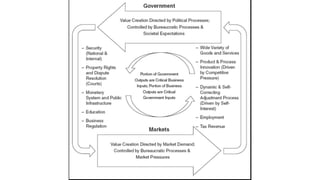
At the same time, a healthy society needs successful companies. No social program can rival the
business sector when it comes to creating the jobs, wealth, and innovation that improve standards of
living and social conditions over time. If governments, NGOs, and other participants in civil society
weaken the ability of business to operate productively, they may win battles but will lose the war, as
corporate and regional competitiveness fade, wages stagnate, jobs disappear, and the wealth that
pays taxes and supports nonprofit contributions evaporates.
Without the critical inputs generated by collective or government efforts, including public goods such
as national security, internal law and order, a system of property rights, access to courts, a monetary
system, roads, airports, and other public infrastructure, public education, and regulatory efforts
designed to constrain negative externalities and improve market functioning, economic markets
would fade away and value-creation efforts of business would become increasingly difficult. A simple
thought experiment underscores this point: Look around you and subtract everything that was
produced through governmental or social effort. Could business function without monetary system,
roads, and educated workforce, and so on? Or another example: What is the difference between the
poorest nations and the wealthiest nations? Is it not primarily the degree of law and order, safety and
security, public infrastructure, and other public goods that make an efficient economic system
possible?
Three Foundational Assumptions
MARKET AS SOCIAL INSTITUTION
In addition to the idea that business and society are mutually dependent, CSR advocates
view economic markets as social institutions. From this perspective, markets are complex
systems of social interaction that must be carefully structured and maintained. To operate
efficiently, markets require a mix of shared norms, enforceable rules, and supporting
institutions. In almost all cases, public goods are necessary.
Because of the emergence of supporting social institutions and the necessary conditions for
efficient market functioning are unlikely to occur spontaneously, market systems should not
be thought of as naturally-occurring social phenomena. Barter based exchanges may
emerge in the course of ongoing social interaction, but such exchanges are as far removed
from market systems as playing catch with a football in one’s backyard is from the National
Football League. Bridging the gap between barter-based economic systems requires
intentional societal intervention. Learning to establish and maintain efficient economic
markets, in many ways, is one of the most impressive social achievements of modern
civilization.
Three Foundational Assumptions
MARKET AS SOCIAL INSTITUTION
Although business and society may be mutually dependent in the sense that each
produces key inputs required by the other, in systemic terms, there is a clear
hierarchy: Markets are defined and structured by society. As ongoing work in
economic sociology—a field that focuses on the social causes and effects of different
economic phenomena—demonstrates, the most efficient markets are often the most
structured in terms of norms, codes of conduct, policies, and enforcement protocols.
For example, the New York Stock Exchange is a carefully structured exchange
environment with a long history of norms, precedents, policies, and rules.
Although markets are a versatile, robust, and effective form of economic organization,
there are situations in which the necessary conditions for efficient markets cannot be
met. In some cases, for example, product characteristics or the structure of the
market itself may prevent proper market functioning. In these cases, society may take
steps to constrain or direct business behavior in order to improve outcomes. Here it is
sufficient to observe that societal intervention in these situations illustrates the
hierarchical relationship between business and society, it is society that defines and
structures the economic space in which business operate—not the other way around.
Three Foundational Assumptions
SOCIAL CONTROL
From a CSR perspective, economic systems are a means to an end. In other words,
societies sep up economic systems with the expectation of achieving certain
outcomes. If these outcomes are not realized, societies may elect to alter or change
their economic systems. Although CSR advocates may acknowledge the mutual
dependence of business and society, they do not view it as an equal partnership.
Business is a part of society and therefore subject to societal control. There is often
open hostility to the notion that society should be correspondingly subject to
corporate control.
Although the social control of economic activity is important to a broad understanding
of CSR, it is, nonetheless, an abstraction that can be difficult for firms to incorporate
into their day-to-day decision making. Two concepts help bridge this gap—license to
operate, and the iron law of responsibility.
Three Foundational Assumptions
SOCIAL CONTROL
-LICENSE TO OPERATE
Historically, the term “license to operate” has referred to situations in which firms or
industries operated in areas controlled by indigenous people. In these cases, it is
important that indigenous communities or populations be consulted and give their
informed consent.
The term “license to operate” is now used to refer, in general way, to the notion that
firms should be cognizant of the level of support they enjoy in the communities and
societies in which they operate. In practical terms, the greater the level of trust and
support firms enjoy, the less likely they will be subjected to burdensome regulation. In
this sense, “license to operate” is often used to refer to the idea that businesses should
voluntarily comply with societal expectations in order to preserve their ability (or
license) to direct their own affairs. In cases in which firms fail to comply with societal
expectations, this freedom (or license) may be suspended or revoked. In other words,
failure to voluntarily comply with societal expectations may result in firms being
forced through regulatory and/or legal means to do so. In general, businesses are
likely to prefer the former arrangement to the latter.
Three Foundational Assumptions
SOCIAL CONTROL
-LICENSE TO OPERATE
PEZA - attached to the Department of Trade and Industry - is the Philippine
government agency tasked to promote investments, extend assistance, register, grant
incentives to and facilitate the business operations of investors in export-oriented
manufacturing and service facilities inside selected areas throughout the country
proclaimed by the President of the Philippines as PEZA Special Economic Zones.
The Philippine Board of Investments (BOI), an attached agency of the Department of
Trade and Industry, is the government agency responsible for promoting in the
Philippines. The BOI is tasked with assisting Filipino and foreign investors to venture
and prosper economically.
Tax holiday
Three Foundational Assumptions
SOCIAL CONTROL
-IRON LAW OF RESPONSIBILITY
The Iron Law of Responsibility, although similar to the notion of a license to operate,
focuses more on the link between power and responsibility than the threat of
regulation. This law can be expressed as follows: “In the long run, those who do not
use power in a manner in which society considers responsible will tend to lose it.
The Iron Law of Responsibility is often reference as one of the primary reasons why
businesses should be careful to respond to changing societal norms and expectations.
If businesses do not respond to changes in societal expectations, then the Iron Law of
Responsibility suggests that over time, the responsibility and power now enjoyed by
the business community will diminish. Keith Davis, is an influential article published in
1960, explained it this way:
But what are the consequences of responsibility avoidance? If power and responsibility are to be
relatively equal, then the avoidance of social responsibility leads to gradual erosion of social power.
To the extent that the businessmen (or businesswomen) do not accept social responsibility
opportunities as they arise, other groups will step in to assume these responsibilities. Historically,
government and labor have been most active in the role of diluting business power, and probably
they will continue to be the principal challenging groups. I am not proposing that this should happen,
but on the basis of the evidence, it appears that this will tend to happen to the extent that
Three Foundational Assumptions
MUTUAL DEPENDENCE
MARKET AS SOCIAL INSTITUTION
SOCIAL CONTROL
The mutual dependence of business and government, the fact that markets are
social institutions, and the legitimacy of societal control of economic activity
are often assumed in CSR contexts. Understanding these assumptions is
important groundwork for understanding why, in many cases, a focus on profit
is not enough to ensure that the actions of market participants will promote
societal interests.
Three Foundational Assumptions
CSR AND VALUE CREATION
03
HOW DO WE GET THERE?
Even though there may be general consensus about what we want from our economic
system, there is still significant debate over the means of getting there. This is because
it is often difficult to determine what participants in our economic system should do in
order to produce the outcomes we want. The following scenario illustrates why making
this determination can often be difficult.
Economic markets working to promote one’s own interest is often the most effective
way to contribute to collective or societal interests. It is important to note, however
that although the links between individual behavior and group or system outcomes are
counterintuitive in both instances, in the case of economic markets, there is an
alignment of individual and group interests (i.e., what is in the best interest of the
individual is also in the best interest of the group).
From CSR perspective, establishing a clear link between individual behavior and group
or system outcomes is essential. In contrast to the invisible hand of economic markets,
CSR asks businesses to explicitly consider societal expectations with regard to specific
macroeconomic outcomes, and to then regulate their behavior in order to satisfy these
expectations. Unless businesses are able to establish a reliable link between their
behavior and these outcomes, businesses cannot be expected to effectively contribute
CSR AND VALUE CREATION
HOW DO WE GET THERE?
The question “How do we get there? Was posed at the start of this section. Stated more
formally: Assuming we know what we want from our economic system, what should
system participants do to contribute to the outcomes we want? Even though there
may be broad consensus regarding the macroeconomic outcomes we want, there is
still likely to be considerable debate about the most effective means of realizing these
outcomes.
Societies expect certain outcomes from their economic systems. Because market
participants have an obligation to contribute to outcomes that satisfy societal
expectations anchor the concept of CSR.
THE PERFECT COMPETATION MARKET MODEL
The perfect competition market model (or PCMM) is a good representation of
commonly held beliefs about how market work. It is often used to link business
behavior to macroeconomic outcomes. In order for the PCMM to function properly,
however, a number of conditions must be met, including a large number of conditions
must be met, including a large number of independent buyers and seller, no
CSR AND VALUE CREATION
If these conditions are met, the most effective way for business to contribute to
productive and allocative efficiency, and maximization of social surplus, may be to
seek to maximize profit. This approach to CSR has become known as the Friedman
Doctrine.
In 1970, Milton Friedman, an economist and recipient of the Nobel Prize in Economics,
authored a short article in the New York Times in which he articulated a view of CSR
that has become known as the “Friedman Doctrine”. This doctrine asserts that the
primary social responsibility of a business is to increase its profits. The following
paragraphs are excerpted from Friedman’s New York Times article:
What does it mean to say that corporate executive has a “social responsibility” in his capacity as businessman? If
this statement is not pure rhetoric, it must mean that he is to act in some way that is not in the interest of his
employers. For example, that he is to refrain from increasing the price of the product in order to contribute to the
social objective of preventing inflation, even though a price increase would be in the best interests of the
corporation. Or that he is to make expenditures on reducing pollution beyond the amount that is in the best
interest of the corporation or that is required by the law in order to contribute to the social objective of improving
the environment. Or that, at the expense of corporate profits, he is to hire “hardcore” unemployed instead of
better qualified available workmen to contribute to the social objective of reducing poverty. In each of these cases,
the corporate executive would be spending someone else’s money for a general social interest. Insofar as his
actions in accord with his “social responsibility” reduce returns to stockholders, he is spending their money.
Insofar as his actions raise the price to customers, he is spending the customers’ money. Insofar as his actions
CSR AND VALUE CREATION
MARKET FAILURE
Although the PCMM reflects a common understanding of economic markets, it is not
the only way of connecting business behavior to macroeconomic outcomes. The term
“market failure” describes situations in which markets fail to function properly. There
are a number of different causes of market failure, including externalities, public
goods, monopolies and oligopolies, natural monopolies, network externalities,
information problems, and other structural idiosyncrasies. In cases of market failures,
profit measures will be poor indicators of whether or not businesses have created
economic value, and attempts to maximize profits can lead to inefficient, suboptimal,
or even catastrophic outcome.
SOCIAL DILEMMAS
Social dilemmas—defined as “interaction situations in which national individual
behavior produces irrational group or collective outcomes”—represent another
approach to linking individual behavior and group or system outcomes. In social
dilemmas, participant behavior is not independent, and the incentives or payoffs to
participants vary based on the behavior of other participants. One of the
representative stories or scenarios generally used to illustrate how these dilemmas
work. In contrast to properly functioning economic markets, in social dilemmas
CSR AND VALUE CREATION
SOCIAL DILEMMAS
Social dilemmas—defined as “interaction situations in which national individual
behavior produces irrational group or collective outcomes”—represent another
approach to linking individual behavior and group or system outcomes. In social
dilemmas, participant behavior is not independent, and the incentives or payoffs to
participants vary based on the behavior of other participants. One of the
representative stories or scenarios generally used to illustrate how these dilemmas
work. In contrast to properly functioning economic markets, in social dilemmas
individual interest conflict with collective interests, and in order to realize the best
possible outcome, participants may be required to act in a manner that is inconsistent
with their immediate self-interest.
VALUE CREATION
We want out economic system to create value in the sense that we want it to use
resources to create products and services that we value more than we value the
resources used to produce them. CSR demands that businesses be committed to
creating economic value, given that that is what society expects from its economic
system. The PCMM, market failure, and social dilemmas should be viewed as different
frameworks for linking individual behavior to group or system outcomes. CSR
CSR AND VALUE CREATION
CSR DEBATE
04
CSR is unique because it is still in the process of being defined and because, as a
normative concept, its existence depends on what you—and others—think about it.
It is important to differentiate between different kinds of CSR. Positioning
different CSR activities along two dimensions—exchange type and level orientation—
yields three different types of CSR: strategic, philanthropic, and systemic. Attempts to
legitimize or justify CSR by linking it to firm profitability—sometimes referred to as the
business case for CSR—often do so from a strategic CSR perspective. These arguments
can be grouped into four categories based on how CSR is assumed to create value for
the firm: cost and risk reduction, profit maximization and competitive advantage,
reputation and legitimacy, and synergistic value creation. Research on the link
between CSR and firm performance is inconclusive. Because of problems with the way
this research has been conducted, conclusions should be viewed skeptically.
Arguments for CSR include an appeal to enlightened self-interest and the desire
to avoid societal interference. It has also been argued that businesses should engage
in CSR to promote the long-run viability of business as an institution, to comply with
societal norms and expectations, and because businesses possess the required
resources, capabilities, and innovative capacity to address difficult social problems,
among others. Michael E. Porter argues that there are four prevailing justifications for
CSR: moral obligation, sustainability (i.e., environmental and community stewardship),
CSR DEBATE
Arguments against CSR include the assertion that society should maintain a
clear dividing line with business and government, and claims that businesses do not
have the right skill set or the right motivation to address social issues, CSR efforts may
distract firms from their core economic functions, and that allowing businesses to
address social problems may upset the pluralistic balance between different societal
institutions. One critic recently claimed that CSR will be ineffective in convincing
businesses to act against their own interests, and is therefore dangerous, given that a
focus on CSR may undermine societal commitment to effective regulation.
Much of this criticism becomes less relevant when CSR is defined in systemic
terms. The most effective rebuttal to CSR critics is often the argument that CSR,
properly implemented, has the potential to increase the efficiency of economic
markets, reduce the need for centralized regulations, and, in the case of market
failure, serve as a framework for resolving social dilemmas, thereby decreasing the
likelihood of collective irrationality.
CSR DEBATE
THE FUTURE OF CSR
05
NEW DEVELOPMENTS
CSR REPORTING
One of the most pronounced trends in CSR in the last few years is the dramatic increase
in social responsibility reporting. For example, according to a recent report by KPMG, in 2011,
95% of the 250 largest global companies issued CSR or sustainability reports.
CONSCIOUS CAPITALISM
At least two new variants of CSR have emerged. The first, called conscious capitalism, is
associated with John Mackey, the co-founder and co-CEO of Whole Foods Market. In conscious
capitalism, six major stakeholders are recognized (customers, employees, suppliers, investors,
society, and the environment), and the challenge of leadership is to create value for all
stakeholders in harmonious and synergistic ways.
CREATING SHARED VALUE
The second CSR variant, championed by Michael E. Porter, is referred to as creating
shared value (CSV). From CSV perspective, firms can simultaneously create economic and social
value in three ways: by creating new products and restructuring existing markets, by increasing
productivity in their own value chains, and by working to establish supportive industry clusters.
Not all profit is equal: profit that is associated with activities that contribute to the social good
“represent a higher form of capitalism.”
THE FUTURE OF CSR
CONCEPTUAL FRAMES
Different conceptual frames can be useful for thinking about the nature and
function of CSR. For example, CSR an be viewed as a mechanism for making sure that all
relevant costs are reflected in the price of a given product or service (and an analogy can be
drawn between this function and the Lorax, a character in the Dr. Seuss book, The Lorax,
who “speaks for the trees”). CSR can also be conceptualized as a normative regulatory
framework that serves the same function as competitive pressure, a form of efficient
regulation that is able to explicit local or embedded knowledge, and as a framework for
collectively resolving broad social dilemmas or situations involving collective irrationality.
Accurate prices are essential to proper market functioning. In this context, price
accuracy refers to whether or not a given price is an accurate reflection of the relative value
of the associated item. Think of the Lorax when he “speaks for the trees” as representation
of everything that is “missing” from a given market price. For example, if a firm generates
negative spillovers in the process of manufacturing basketballs, and the harm caused by
these spillovers is not reflected in the price, then what impact does this have? What does
that mean for a Walmart shopper standing in the sporting goods aisle confronted by a
choice of three different companies, one of which is the company that generates negative
spillovers? What about industries that require complimentary public goods (e.g., the
automobile industry and the national highway system)? Should these industries bear some
of the cost of the public infranstructure required to use their products? Why or why not?
THE FUTURE OF CSR
Can CSR be viewed as an attempt to account for value that isn’t captured in
market prices? Is this an interesting or useful way to view CSR?
A CONTINGENCY MODEL
The practical significance of CSR depends—or is contingent on—the level of
competitive pressure and other constraints that are likely to drive firms towards
efficiency and value creation. The stronger the competition, the less need for CSR. On
the other hand, the weaker the competition, the greater the need for CSR.
Viewing CSR from this perspective has a number of implications. For example, it
make sense to promote CSR more heavily in industries in which market failure is more
likely, or in context characterized by social dilemmas.
THE FUTURE OF CSR
EFFICIENT REGULATION
Think of a network of interacting economic agents. Where is the knowledge
located necessary to enforce effective regulation? Can this knowledge be easily
centralized? For example, if the objective is to prevent negative spillovers in order to
improve market functioning, what needs to be known? By whom?
Does regulation need to be “centrally-planned” in order to be effective? What
are the challenges and costs associated with attempting to codify and centralize
enough information in order to make such regulation effective? On the other hand,
can CSR be viewed as a decentralized regulatory framework capable of exploiting
embedded knowledge in the same way that Hayek argues that economic markets are
capable of doing? If this is the case, then what advantages might CSR, conceptualize as
a normative regulatory framework, have over a centralized regulatory approach.
THE FUTURE OF CSR
IT’S UP TO YOU
It was argued that CSR is unique in the sense that it is a set of ideas and norms
about the relationship between business and society that only exist to the extent that
us that believe it they exist. In other words, CSR is only real to the degree that it is
reflected in your expectation and actions. If managers and key stakeholders expect
firms to focus on the larger challenge of creating economic value in situations in which
a narrow focus on profit is unlikely to contribute to the social good, then firms will do
so. Firms will do so because the cost of failing to live up to social expectations will
make the pursuit of narrow interests an unattractive option. The power of CSR does
not lie in its ability to cajole firms into behaving in ways that are counter to their
interests; the power of CSR lies in its ability to alter the incentives confronted by
organizations so that it no longer makes sense to pursue courses of action that detract
from public good.
CSR is not about obligating firms to go against their interest in order to
contribute to economic and social outcomes that society demands, its about
establishing and perpetuating social norms that create incentives that point firms in
the right direction. CSR, properly implemented, will make economic markets more
transparent, efficient, and effective in serving societal interests.
THE FUTURE OF CSR
SUMMARY
06
Benefits of CSR for Businesses
Implementing CSR can lead to improved brand loyalty,
enhanced employee morale, and increased competitiveness
by fostering positive relationships with communities and
consumers.
What is CSR?
Corporate Social Responsibility (CSR) refers to business
practices that contribute positively to society while
balancing stakeholder interests and enhancing company
reputation.
Global Trends in CSR
Recent trends indicate that businesses are increasingly focusing
on sustainability, social equity, and transparency, reflecting a
shift in consumer expectations and regulatory frameworks
globally.
Ethical Considerations
Ethical considerations in CSR encompass corporate
accountability, moral obligations to stakeholders, and the
alignment of business practices with societal values and norms.
Definition and Importance
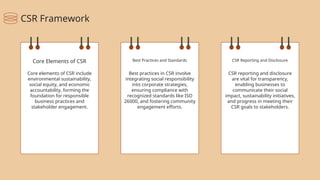
Core elements of CSR include
environmental sustainability,
social equity, and economic
accountability, forming the
foundation for responsible
business practices and
stakeholder engagement.
Core Elements of CSR
Best practices in CSR involve
integrating social responsibility
into corporate strategies,
ensuring compliance with
recognized standards like ISO
26000, and fostering community
engagement efforts.
Best Practices and Standards
CSR reporting and disclosure
are vital for transparency,
enabling businesses to
communicate their social
impact, sustainability initiatives,
and progress in meeting their
CSR goals to stakeholders.
CSR Reporting and Disclosure
CSR Framework
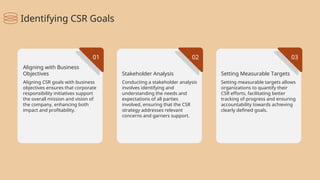
02 03
01
Aligning with Business
Objectives
Aligning CSR goals with business
objectives ensures that corporate
responsibility initiatives support
the overall mission and vision of
the company, enhancing both
impact and profitability.
Stakeholder Analysis
Conducting a stakeholder analysis
involves identifying and
understanding the needs and
expectations of all parties
involved, ensuring that the CSR
strategy addresses relevant
concerns and garners support.
Setting Measurable Targets
Setting measurable targets allows
organizations to quantify their
CSR efforts, facilitating better
tracking of progress and ensuring
accountability towards achieving
clearly defined goals.
Identifying CSR Goals
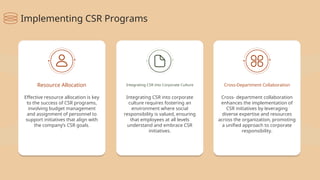
Effective resource allocation is key
to the success of CSR programs,
involving budget management
and assignment of personnel to
support initiatives that align with
the company’s CSR goals.
Resource Allocation Integrating CSR into Corporate Culture Cross-Department Collaboration
Integrating CSR into corporate
culture requires fostering an
environment where social
responsibility is valued, ensuring
that employees at all levels
understand and embrace CSR
initiatives.
Cross- department collaboration
enhances the implementation of
CSR initiatives by leveraging
diverse expertise and resources
across the organization, promoting
a unified approach to corporate
responsibility.
Implementing CSR Programs
01
02
KPIs and Metrics
Establishing Key Performance Indicators (KPIs) and metrics is crucial for
evaluating the success of CSR initiatives, helping organizations assess
impact and make informed adjustments when necessary.
Regular Reporting Mechanisms
Implementing regular reporting mechanisms ensures transparency and
accountability in CSR activities, allowing stakeholders to understand
progress and challenges while reinforcing the importance of corporate
responsibility.
Monitoring and Evaluation
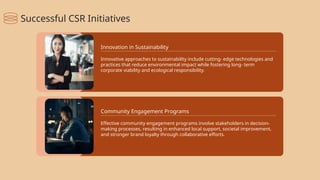
Innovative approaches to sustainability include cutting- edge technologies and
practices that reduce environmental impact while fostering long- term
corporate viability and ecological responsibility.
Innovation in Sustainability
Effective community engagement programs involve stakeholders in decision-
making processes, resulting in enhanced local support, societal improvement,
and stronger brand loyalty through collaborative efforts.
Community Engagement Programs
Successful CSR Initiatives
01
Organizations frequently face
obstacles such as limited
resources, lack of stakeholder
buy- in, and insufficient data to
measure CSR initiatives'
effectiveness, hindering their
progress.
Common Obstacles in CSR
Implementation
02
Key strategies include
establishing clear objectives,
investing in stakeholder
education, and utilizing best
practices from successful case
studies to effectively navigate
CSR complexities.
Strategies for Overcoming CSR
Challenges
03
Examining failures in CSR initiatives
reveals critical insights about the
importance of aligning corporate
practices with genuine stakeholder
interests and ensuring transparent
communication throughout the
process.
Lessons Learned from CSR
Failures
Challenges and Solutions
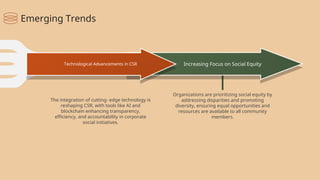
Increasing Focus on Social Equity
Organizations are prioritizing social equity by
addressing disparities and promoting
diversity, ensuring equal opportunities and
resources are available to all community
members.
Technological Advancements in CSR
The integration of cutting- edge technology is
reshaping CSR, with tools like AI and
blockchain enhancing transparency,
efficiency, and accountability in corporate
social initiatives.
Emerging Trends
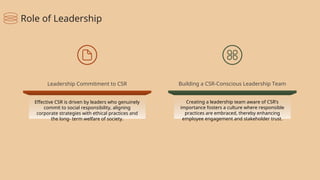
Effective CSR is driven by leaders who genuinely
commit to social responsibility, aligning
corporate strategies with ethical practices and
the long- term welfare of society.
Leadership Commitment to CSR
Creating a leadership team aware of CSR’s
importance fosters a culture where responsible
practices are embraced, thereby enhancing
employee engagement and stakeholder trust.
Building a CSR-Conscious Leadership Team
Role of Leadership
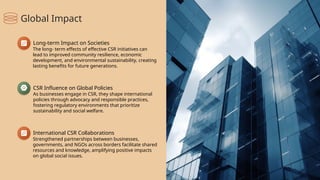
International CSR Collaborations
Strengthened partnerships between businesses,
governments, and NGOs across borders facilitate shared
resources and knowledge, amplifying positive impacts
on global social issues.
CSR Influence on Global Policies
As businesses engage in CSR, they shape international
policies through advocacy and responsible practices,
fostering regulatory environments that prioritize
sustainability and social welfare.
Long-term Impact on Societies
The long- term effects of effective CSR initiatives can
lead to improved community resilience, economic
development, and environmental sustainability, creating
lasting benefits for future generations.
Global Impact
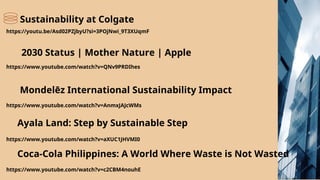
Sustainability at Colgate
https://youtu.be/Asd02PZjbyU?si=3POjNwi_9T3XUqmF
2030 Status | Mother Nature | Apple
https://www.youtube.com/watch?v=QNv9PRDIhes
Mondelēz International Sustainability Impact
https://www.youtube.com/watch?v=AnmxJAJcWMs
Ayala Land: Step by Sustainable Step
https://www.youtube.com/watch?v=aXUC1JHVMI0
Coca-Cola Philippines: A World Where Waste is Not Wasted
https://www.youtube.com/watch?v=c2CBM4nouhE
DESIGN
DESIGN
Thanks
REFERENCE
Corporate Social Responsibility by Brent D. Beal
https://www.aippt.com/editor?
id=1680709&source=workspace

Corporate Social Responsibility (CSR).ppt

  • 1.
  • 2.
    Three Foundational Assumptions TheCSR Debate 2. 1. What is CSR? CSR and Value Creation 3. 4. Contents 5. The future of CSR Summary 6. 7. Videos on some companies Sustainability efforts.
  • 3.
  • 4.
    . Corporate social responsibility(CSR) is part of the reality of doing business in the twenty-first century. Regardless of how one feels about it, CSR is here to stay. As one feels about it, CSR is “the movement for corporate social responsibility has won the battle of ideas.” Most Fortune 500 companies now include a senior level position in their organizational structure dedicated to CSR and/ or sustainability issues. Reporting standards are beginning to solidify and diffuse. The Global Reporting Initiative, for example, a non-profit organization dedicated to promoting economic, environmental and social sustainability, produces a comprehensive sustainability reporting framework that is being rapidly adopted by organizations around the world, and third parties, like KPMG, are beginning to audit corporate responsibility reports and issue assurance statements. In 2009, Bloomberg added environmental, social and governance (or ESG) indicators to its terminal date stream. CSR is not about pressuring firms into engaging in philanthropy or obligating them to shoulder additional responsibility for different social problems. Considered broadly, CSR is about establishing and perpetuating social norms that make economic markets more transparent and effective in serving societal interests. As we move further into the twenty-first century, CSR is likely to become an increasingly essential framework for reconciling individual interests and the social good. Because of this, CSR is likely to play an influential role in every aspect of business, from corporate strategy to marketing and human resource management. CSR, considered broadly, is ABOUT HOW OUR ECONOMIC SYSTEM SHOULD BE STRUCTURED AND THE REPONSIBILITY OF THE PARTICIPANTS IN IT TO
  • 5.
    What is CSR? Thefive definitions included below are arranged in chronological order and illustrate a few of the different ways CSR has been conceptualized and defined. The term social responsibilities of businessmen will be used frequently. It refers to the obligations of businessmen (and businesswomen) to pursue those policies, to make those decisions, or to follow those lines of action which are desirable in terms of the objectives and values of our society. This definition does not imply that businessmen as members of society lack the rights to criticize the values. It is assumed, however, that as servants of society, they must not disregard socially accepted values or place their own values above those of society. -Howard R. Bowen, 1953 Definition
  • 6.
    What is CSR? Allof this suggests that when we invoke the phrase “the social responsibilities of the businessman (or businesswoman),” we mean that businessmen (or businesswomen) should oversee the operation of an economic system that fulfills the expectations of the public. And this means in turn that the economy’s means of production should be employed in such way that the production and distribution should enhance total socio-economic welfare. Social responsibility in the final analysis implies a public posture toward society’s economic and human resource and a willingness to see that those resources are utilized for broad social ends and not simply for the narrowly circumscribed interests of private persons and firms. -William C. Definition
  • 7.
    What is CSR? Whatdoes it mean to say that the corporate executive has a “social responsibility” in his capacity as businessman? If this statement is not pure rhetoric, it must mean that he is to act in some way that is not in the interest of his employers… That is why, my book Capitalism and Freedom, I have called it a “fundamentally subversive doctrine” in a free society, there is one and only one social responsibility of business---to use its resources and engage in activities designed to increase its profits so long as it stays within the rules of the game, which is to say, engages in open and free competition without deception or fraud. --Milton Friedman, 1970 Definition
  • 8.
    What is CSR? Withso many conflicting goals and objectives, the definition of CSR is not always clear. Here we define CSR as actions that appear to further some social good, beyond the interests of the firm and that which is required by law. This definition underscores that, to us, CSR means going beyond obeying the law. -Abagail McWilliams & Donald Siegel, 2001 Definition
  • 9.
    What is CSR? CSRis about how business align their values and behavior with the expectations and needs of stakeholders—not just customers and investors but also employees, suppliers, communities, regulators, special interest groups and society as a whole. CSR describes a company’s commitment to be accountable to its stakeholders. CSR demands that businesses manage economic, social and environmental impacts of their operations to maximize the benefits and minimize the downsides. Key CSR issues include governance, environmental management, stakeholder engagement, labour standards, employee and community relations, social equity, responsible sourcing and human rights. --Two Tomorrows, 2013 Definition
  • 10.
    What is CSR? CSR,broadly defined, is the moral and practical obligation of market participants to consider the effect of their actions on collective or system-level outcomes and to then regulate their behavior in order to contribute to bringing those outcomes into congruence with societal expectations. Definition
  • 11.
    What is CSR? Anearly textbook on business society, originally published in 1966, listed the following areas of potential social involvement: ecology and environmental quality (e.g., pollution, aesthetics, noise control), consumerism (e.g., product safety), community needs (e.g., urban renewal), business giving, minorities and disadvantaged persons (e.g. training, utilization in supply chain), and labor relations, among others. Definition
  • 12.
    What is CSR? GlobalReporting Initiative (GRI) guidelines identify four subcategories: Labor practices Human rights Society Product responsibility Definition
  • 13.
  • 14.
    If business focuson earning an honest profit—where “honest” reflects a sincere commitment to “play by the rules”—isn’t that enough? Why should businesses, in addition to striving to maximize profits, be expected to commit resources to addressing social and environmental issues, and then spend time and energy preparing both traditional financial statements and detailed corporate responsibility reports? The short answer to the opening question is this: “No, in many cases, an honest profit isn’t enough.” Three Foundational Assumptions
  • 15.
    In this part,we lay the groundwork for an explanation of why this is the case by examining three important assumptions often made by CSR advocates: Business and society overlap in important ways and are mutually dependent. Economic markets are social institutions. In order for markets to function properly, a number of supporting and certain conditions must be met. Societies expect certain outcomes from economic systems. If these outcomes aren’t realized, then it’s responsible for societies to attempt to modify or change their economic systems so that these outcomes are obtained. Three Foundational Assumptions
  • 16.
    MUTUAL DEPENDENCE Successful corporationsneed a healthy society. Education , health care, and equal opportunity are essential to a productive workforce. Safe products and working conditions not only attract customers but lower the internal cost of accidents. Efficient utilization of land, water, energy, and other natural resources makes business more productive. Good governance, the rule of law, and property rights are essential for efficiency and innovation. Strong regulatory standards protect both consumers and competitive companies from exploitation. Ultimately, a healthy society creates expanding demand for business, as more human needs are met and aspiration grow. Any business that pursues its ends at the expense of the society in which it operates will find its success to be illusory and ultimately temporary. Three Foundational Assumptions
  • 18.
    MUTUAL DEPENDENCE At thesame time, a healthy society needs successful companies. No social program can rival the business sector when it comes to creating the jobs, wealth, and innovation that improve standards of living and social conditions over time. If governments, NGOs, and other participants in civil society weaken the ability of business to operate productively, they may win battles but will lose the war, as corporate and regional competitiveness fade, wages stagnate, jobs disappear, and the wealth that pays taxes and supports nonprofit contributions evaporates. Without the critical inputs generated by collective or government efforts, including public goods such as national security, internal law and order, a system of property rights, access to courts, a monetary system, roads, airports, and other public infrastructure, public education, and regulatory efforts designed to constrain negative externalities and improve market functioning, economic markets would fade away and value-creation efforts of business would become increasingly difficult. A simple thought experiment underscores this point: Look around you and subtract everything that was produced through governmental or social effort. Could business function without monetary system, roads, and educated workforce, and so on? Or another example: What is the difference between the poorest nations and the wealthiest nations? Is it not primarily the degree of law and order, safety and security, public infrastructure, and other public goods that make an efficient economic system possible? Three Foundational Assumptions
  • 19.
    MARKET AS SOCIALINSTITUTION In addition to the idea that business and society are mutually dependent, CSR advocates view economic markets as social institutions. From this perspective, markets are complex systems of social interaction that must be carefully structured and maintained. To operate efficiently, markets require a mix of shared norms, enforceable rules, and supporting institutions. In almost all cases, public goods are necessary. Because of the emergence of supporting social institutions and the necessary conditions for efficient market functioning are unlikely to occur spontaneously, market systems should not be thought of as naturally-occurring social phenomena. Barter based exchanges may emerge in the course of ongoing social interaction, but such exchanges are as far removed from market systems as playing catch with a football in one’s backyard is from the National Football League. Bridging the gap between barter-based economic systems requires intentional societal intervention. Learning to establish and maintain efficient economic markets, in many ways, is one of the most impressive social achievements of modern civilization. Three Foundational Assumptions
  • 20.
    MARKET AS SOCIALINSTITUTION Although business and society may be mutually dependent in the sense that each produces key inputs required by the other, in systemic terms, there is a clear hierarchy: Markets are defined and structured by society. As ongoing work in economic sociology—a field that focuses on the social causes and effects of different economic phenomena—demonstrates, the most efficient markets are often the most structured in terms of norms, codes of conduct, policies, and enforcement protocols. For example, the New York Stock Exchange is a carefully structured exchange environment with a long history of norms, precedents, policies, and rules. Although markets are a versatile, robust, and effective form of economic organization, there are situations in which the necessary conditions for efficient markets cannot be met. In some cases, for example, product characteristics or the structure of the market itself may prevent proper market functioning. In these cases, society may take steps to constrain or direct business behavior in order to improve outcomes. Here it is sufficient to observe that societal intervention in these situations illustrates the hierarchical relationship between business and society, it is society that defines and structures the economic space in which business operate—not the other way around. Three Foundational Assumptions
  • 21.
    SOCIAL CONTROL From aCSR perspective, economic systems are a means to an end. In other words, societies sep up economic systems with the expectation of achieving certain outcomes. If these outcomes are not realized, societies may elect to alter or change their economic systems. Although CSR advocates may acknowledge the mutual dependence of business and society, they do not view it as an equal partnership. Business is a part of society and therefore subject to societal control. There is often open hostility to the notion that society should be correspondingly subject to corporate control. Although the social control of economic activity is important to a broad understanding of CSR, it is, nonetheless, an abstraction that can be difficult for firms to incorporate into their day-to-day decision making. Two concepts help bridge this gap—license to operate, and the iron law of responsibility. Three Foundational Assumptions
  • 22.
    SOCIAL CONTROL -LICENSE TOOPERATE Historically, the term “license to operate” has referred to situations in which firms or industries operated in areas controlled by indigenous people. In these cases, it is important that indigenous communities or populations be consulted and give their informed consent. The term “license to operate” is now used to refer, in general way, to the notion that firms should be cognizant of the level of support they enjoy in the communities and societies in which they operate. In practical terms, the greater the level of trust and support firms enjoy, the less likely they will be subjected to burdensome regulation. In this sense, “license to operate” is often used to refer to the idea that businesses should voluntarily comply with societal expectations in order to preserve their ability (or license) to direct their own affairs. In cases in which firms fail to comply with societal expectations, this freedom (or license) may be suspended or revoked. In other words, failure to voluntarily comply with societal expectations may result in firms being forced through regulatory and/or legal means to do so. In general, businesses are likely to prefer the former arrangement to the latter. Three Foundational Assumptions
  • 23.
    SOCIAL CONTROL -LICENSE TOOPERATE PEZA - attached to the Department of Trade and Industry - is the Philippine government agency tasked to promote investments, extend assistance, register, grant incentives to and facilitate the business operations of investors in export-oriented manufacturing and service facilities inside selected areas throughout the country proclaimed by the President of the Philippines as PEZA Special Economic Zones. The Philippine Board of Investments (BOI), an attached agency of the Department of Trade and Industry, is the government agency responsible for promoting in the Philippines. The BOI is tasked with assisting Filipino and foreign investors to venture and prosper economically. Tax holiday Three Foundational Assumptions
  • 24.
    SOCIAL CONTROL -IRON LAWOF RESPONSIBILITY The Iron Law of Responsibility, although similar to the notion of a license to operate, focuses more on the link between power and responsibility than the threat of regulation. This law can be expressed as follows: “In the long run, those who do not use power in a manner in which society considers responsible will tend to lose it. The Iron Law of Responsibility is often reference as one of the primary reasons why businesses should be careful to respond to changing societal norms and expectations. If businesses do not respond to changes in societal expectations, then the Iron Law of Responsibility suggests that over time, the responsibility and power now enjoyed by the business community will diminish. Keith Davis, is an influential article published in 1960, explained it this way: But what are the consequences of responsibility avoidance? If power and responsibility are to be relatively equal, then the avoidance of social responsibility leads to gradual erosion of social power. To the extent that the businessmen (or businesswomen) do not accept social responsibility opportunities as they arise, other groups will step in to assume these responsibilities. Historically, government and labor have been most active in the role of diluting business power, and probably they will continue to be the principal challenging groups. I am not proposing that this should happen, but on the basis of the evidence, it appears that this will tend to happen to the extent that Three Foundational Assumptions
  • 25.
    MUTUAL DEPENDENCE MARKET ASSOCIAL INSTITUTION SOCIAL CONTROL The mutual dependence of business and government, the fact that markets are social institutions, and the legitimacy of societal control of economic activity are often assumed in CSR contexts. Understanding these assumptions is important groundwork for understanding why, in many cases, a focus on profit is not enough to ensure that the actions of market participants will promote societal interests. Three Foundational Assumptions
  • 26.
    CSR AND VALUECREATION 03
  • 27.
    HOW DO WEGET THERE? Even though there may be general consensus about what we want from our economic system, there is still significant debate over the means of getting there. This is because it is often difficult to determine what participants in our economic system should do in order to produce the outcomes we want. The following scenario illustrates why making this determination can often be difficult. Economic markets working to promote one’s own interest is often the most effective way to contribute to collective or societal interests. It is important to note, however that although the links between individual behavior and group or system outcomes are counterintuitive in both instances, in the case of economic markets, there is an alignment of individual and group interests (i.e., what is in the best interest of the individual is also in the best interest of the group). From CSR perspective, establishing a clear link between individual behavior and group or system outcomes is essential. In contrast to the invisible hand of economic markets, CSR asks businesses to explicitly consider societal expectations with regard to specific macroeconomic outcomes, and to then regulate their behavior in order to satisfy these expectations. Unless businesses are able to establish a reliable link between their behavior and these outcomes, businesses cannot be expected to effectively contribute CSR AND VALUE CREATION
  • 28.
    HOW DO WEGET THERE? The question “How do we get there? Was posed at the start of this section. Stated more formally: Assuming we know what we want from our economic system, what should system participants do to contribute to the outcomes we want? Even though there may be broad consensus regarding the macroeconomic outcomes we want, there is still likely to be considerable debate about the most effective means of realizing these outcomes. Societies expect certain outcomes from their economic systems. Because market participants have an obligation to contribute to outcomes that satisfy societal expectations anchor the concept of CSR. THE PERFECT COMPETATION MARKET MODEL The perfect competition market model (or PCMM) is a good representation of commonly held beliefs about how market work. It is often used to link business behavior to macroeconomic outcomes. In order for the PCMM to function properly, however, a number of conditions must be met, including a large number of conditions must be met, including a large number of independent buyers and seller, no CSR AND VALUE CREATION
  • 29.
    If these conditionsare met, the most effective way for business to contribute to productive and allocative efficiency, and maximization of social surplus, may be to seek to maximize profit. This approach to CSR has become known as the Friedman Doctrine. In 1970, Milton Friedman, an economist and recipient of the Nobel Prize in Economics, authored a short article in the New York Times in which he articulated a view of CSR that has become known as the “Friedman Doctrine”. This doctrine asserts that the primary social responsibility of a business is to increase its profits. The following paragraphs are excerpted from Friedman’s New York Times article: What does it mean to say that corporate executive has a “social responsibility” in his capacity as businessman? If this statement is not pure rhetoric, it must mean that he is to act in some way that is not in the interest of his employers. For example, that he is to refrain from increasing the price of the product in order to contribute to the social objective of preventing inflation, even though a price increase would be in the best interests of the corporation. Or that he is to make expenditures on reducing pollution beyond the amount that is in the best interest of the corporation or that is required by the law in order to contribute to the social objective of improving the environment. Or that, at the expense of corporate profits, he is to hire “hardcore” unemployed instead of better qualified available workmen to contribute to the social objective of reducing poverty. In each of these cases, the corporate executive would be spending someone else’s money for a general social interest. Insofar as his actions in accord with his “social responsibility” reduce returns to stockholders, he is spending their money. Insofar as his actions raise the price to customers, he is spending the customers’ money. Insofar as his actions CSR AND VALUE CREATION
  • 30.
    MARKET FAILURE Although thePCMM reflects a common understanding of economic markets, it is not the only way of connecting business behavior to macroeconomic outcomes. The term “market failure” describes situations in which markets fail to function properly. There are a number of different causes of market failure, including externalities, public goods, monopolies and oligopolies, natural monopolies, network externalities, information problems, and other structural idiosyncrasies. In cases of market failures, profit measures will be poor indicators of whether or not businesses have created economic value, and attempts to maximize profits can lead to inefficient, suboptimal, or even catastrophic outcome. SOCIAL DILEMMAS Social dilemmas—defined as “interaction situations in which national individual behavior produces irrational group or collective outcomes”—represent another approach to linking individual behavior and group or system outcomes. In social dilemmas, participant behavior is not independent, and the incentives or payoffs to participants vary based on the behavior of other participants. One of the representative stories or scenarios generally used to illustrate how these dilemmas work. In contrast to properly functioning economic markets, in social dilemmas CSR AND VALUE CREATION
  • 31.
    SOCIAL DILEMMAS Social dilemmas—definedas “interaction situations in which national individual behavior produces irrational group or collective outcomes”—represent another approach to linking individual behavior and group or system outcomes. In social dilemmas, participant behavior is not independent, and the incentives or payoffs to participants vary based on the behavior of other participants. One of the representative stories or scenarios generally used to illustrate how these dilemmas work. In contrast to properly functioning economic markets, in social dilemmas individual interest conflict with collective interests, and in order to realize the best possible outcome, participants may be required to act in a manner that is inconsistent with their immediate self-interest. VALUE CREATION We want out economic system to create value in the sense that we want it to use resources to create products and services that we value more than we value the resources used to produce them. CSR demands that businesses be committed to creating economic value, given that that is what society expects from its economic system. The PCMM, market failure, and social dilemmas should be viewed as different frameworks for linking individual behavior to group or system outcomes. CSR CSR AND VALUE CREATION
  • 32.
  • 33.
    CSR is uniquebecause it is still in the process of being defined and because, as a normative concept, its existence depends on what you—and others—think about it. It is important to differentiate between different kinds of CSR. Positioning different CSR activities along two dimensions—exchange type and level orientation— yields three different types of CSR: strategic, philanthropic, and systemic. Attempts to legitimize or justify CSR by linking it to firm profitability—sometimes referred to as the business case for CSR—often do so from a strategic CSR perspective. These arguments can be grouped into four categories based on how CSR is assumed to create value for the firm: cost and risk reduction, profit maximization and competitive advantage, reputation and legitimacy, and synergistic value creation. Research on the link between CSR and firm performance is inconclusive. Because of problems with the way this research has been conducted, conclusions should be viewed skeptically. Arguments for CSR include an appeal to enlightened self-interest and the desire to avoid societal interference. It has also been argued that businesses should engage in CSR to promote the long-run viability of business as an institution, to comply with societal norms and expectations, and because businesses possess the required resources, capabilities, and innovative capacity to address difficult social problems, among others. Michael E. Porter argues that there are four prevailing justifications for CSR: moral obligation, sustainability (i.e., environmental and community stewardship), CSR DEBATE
  • 34.
    Arguments against CSRinclude the assertion that society should maintain a clear dividing line with business and government, and claims that businesses do not have the right skill set or the right motivation to address social issues, CSR efforts may distract firms from their core economic functions, and that allowing businesses to address social problems may upset the pluralistic balance between different societal institutions. One critic recently claimed that CSR will be ineffective in convincing businesses to act against their own interests, and is therefore dangerous, given that a focus on CSR may undermine societal commitment to effective regulation. Much of this criticism becomes less relevant when CSR is defined in systemic terms. The most effective rebuttal to CSR critics is often the argument that CSR, properly implemented, has the potential to increase the efficiency of economic markets, reduce the need for centralized regulations, and, in the case of market failure, serve as a framework for resolving social dilemmas, thereby decreasing the likelihood of collective irrationality. CSR DEBATE
  • 35.
  • 36.
    NEW DEVELOPMENTS CSR REPORTING Oneof the most pronounced trends in CSR in the last few years is the dramatic increase in social responsibility reporting. For example, according to a recent report by KPMG, in 2011, 95% of the 250 largest global companies issued CSR or sustainability reports. CONSCIOUS CAPITALISM At least two new variants of CSR have emerged. The first, called conscious capitalism, is associated with John Mackey, the co-founder and co-CEO of Whole Foods Market. In conscious capitalism, six major stakeholders are recognized (customers, employees, suppliers, investors, society, and the environment), and the challenge of leadership is to create value for all stakeholders in harmonious and synergistic ways. CREATING SHARED VALUE The second CSR variant, championed by Michael E. Porter, is referred to as creating shared value (CSV). From CSV perspective, firms can simultaneously create economic and social value in three ways: by creating new products and restructuring existing markets, by increasing productivity in their own value chains, and by working to establish supportive industry clusters. Not all profit is equal: profit that is associated with activities that contribute to the social good “represent a higher form of capitalism.” THE FUTURE OF CSR
  • 37.
    CONCEPTUAL FRAMES Different conceptualframes can be useful for thinking about the nature and function of CSR. For example, CSR an be viewed as a mechanism for making sure that all relevant costs are reflected in the price of a given product or service (and an analogy can be drawn between this function and the Lorax, a character in the Dr. Seuss book, The Lorax, who “speaks for the trees”). CSR can also be conceptualized as a normative regulatory framework that serves the same function as competitive pressure, a form of efficient regulation that is able to explicit local or embedded knowledge, and as a framework for collectively resolving broad social dilemmas or situations involving collective irrationality. Accurate prices are essential to proper market functioning. In this context, price accuracy refers to whether or not a given price is an accurate reflection of the relative value of the associated item. Think of the Lorax when he “speaks for the trees” as representation of everything that is “missing” from a given market price. For example, if a firm generates negative spillovers in the process of manufacturing basketballs, and the harm caused by these spillovers is not reflected in the price, then what impact does this have? What does that mean for a Walmart shopper standing in the sporting goods aisle confronted by a choice of three different companies, one of which is the company that generates negative spillovers? What about industries that require complimentary public goods (e.g., the automobile industry and the national highway system)? Should these industries bear some of the cost of the public infranstructure required to use their products? Why or why not? THE FUTURE OF CSR
  • 38.
    Can CSR beviewed as an attempt to account for value that isn’t captured in market prices? Is this an interesting or useful way to view CSR? A CONTINGENCY MODEL The practical significance of CSR depends—or is contingent on—the level of competitive pressure and other constraints that are likely to drive firms towards efficiency and value creation. The stronger the competition, the less need for CSR. On the other hand, the weaker the competition, the greater the need for CSR. Viewing CSR from this perspective has a number of implications. For example, it make sense to promote CSR more heavily in industries in which market failure is more likely, or in context characterized by social dilemmas. THE FUTURE OF CSR
  • 39.
    EFFICIENT REGULATION Think ofa network of interacting economic agents. Where is the knowledge located necessary to enforce effective regulation? Can this knowledge be easily centralized? For example, if the objective is to prevent negative spillovers in order to improve market functioning, what needs to be known? By whom? Does regulation need to be “centrally-planned” in order to be effective? What are the challenges and costs associated with attempting to codify and centralize enough information in order to make such regulation effective? On the other hand, can CSR be viewed as a decentralized regulatory framework capable of exploiting embedded knowledge in the same way that Hayek argues that economic markets are capable of doing? If this is the case, then what advantages might CSR, conceptualize as a normative regulatory framework, have over a centralized regulatory approach. THE FUTURE OF CSR
  • 40.
    IT’S UP TOYOU It was argued that CSR is unique in the sense that it is a set of ideas and norms about the relationship between business and society that only exist to the extent that us that believe it they exist. In other words, CSR is only real to the degree that it is reflected in your expectation and actions. If managers and key stakeholders expect firms to focus on the larger challenge of creating economic value in situations in which a narrow focus on profit is unlikely to contribute to the social good, then firms will do so. Firms will do so because the cost of failing to live up to social expectations will make the pursuit of narrow interests an unattractive option. The power of CSR does not lie in its ability to cajole firms into behaving in ways that are counter to their interests; the power of CSR lies in its ability to alter the incentives confronted by organizations so that it no longer makes sense to pursue courses of action that detract from public good. CSR is not about obligating firms to go against their interest in order to contribute to economic and social outcomes that society demands, its about establishing and perpetuating social norms that create incentives that point firms in the right direction. CSR, properly implemented, will make economic markets more transparent, efficient, and effective in serving societal interests. THE FUTURE OF CSR
  • 41.
  • 42.
    Benefits of CSRfor Businesses Implementing CSR can lead to improved brand loyalty, enhanced employee morale, and increased competitiveness by fostering positive relationships with communities and consumers. What is CSR? Corporate Social Responsibility (CSR) refers to business practices that contribute positively to society while balancing stakeholder interests and enhancing company reputation. Global Trends in CSR Recent trends indicate that businesses are increasingly focusing on sustainability, social equity, and transparency, reflecting a shift in consumer expectations and regulatory frameworks globally. Ethical Considerations Ethical considerations in CSR encompass corporate accountability, moral obligations to stakeholders, and the alignment of business practices with societal values and norms. Definition and Importance
  • 43.
    Core elements ofCSR include environmental sustainability, social equity, and economic accountability, forming the foundation for responsible business practices and stakeholder engagement. Core Elements of CSR Best practices in CSR involve integrating social responsibility into corporate strategies, ensuring compliance with recognized standards like ISO 26000, and fostering community engagement efforts. Best Practices and Standards CSR reporting and disclosure are vital for transparency, enabling businesses to communicate their social impact, sustainability initiatives, and progress in meeting their CSR goals to stakeholders. CSR Reporting and Disclosure CSR Framework
  • 44.
    02 03 01 Aligning withBusiness Objectives Aligning CSR goals with business objectives ensures that corporate responsibility initiatives support the overall mission and vision of the company, enhancing both impact and profitability. Stakeholder Analysis Conducting a stakeholder analysis involves identifying and understanding the needs and expectations of all parties involved, ensuring that the CSR strategy addresses relevant concerns and garners support. Setting Measurable Targets Setting measurable targets allows organizations to quantify their CSR efforts, facilitating better tracking of progress and ensuring accountability towards achieving clearly defined goals. Identifying CSR Goals
  • 45.
    Effective resource allocationis key to the success of CSR programs, involving budget management and assignment of personnel to support initiatives that align with the company’s CSR goals. Resource Allocation Integrating CSR into Corporate Culture Cross-Department Collaboration Integrating CSR into corporate culture requires fostering an environment where social responsibility is valued, ensuring that employees at all levels understand and embrace CSR initiatives. Cross- department collaboration enhances the implementation of CSR initiatives by leveraging diverse expertise and resources across the organization, promoting a unified approach to corporate responsibility. Implementing CSR Programs
  • 46.
    01 02 KPIs and Metrics EstablishingKey Performance Indicators (KPIs) and metrics is crucial for evaluating the success of CSR initiatives, helping organizations assess impact and make informed adjustments when necessary. Regular Reporting Mechanisms Implementing regular reporting mechanisms ensures transparency and accountability in CSR activities, allowing stakeholders to understand progress and challenges while reinforcing the importance of corporate responsibility. Monitoring and Evaluation
  • 47.
    Innovative approaches tosustainability include cutting- edge technologies and practices that reduce environmental impact while fostering long- term corporate viability and ecological responsibility. Innovation in Sustainability Effective community engagement programs involve stakeholders in decision- making processes, resulting in enhanced local support, societal improvement, and stronger brand loyalty through collaborative efforts. Community Engagement Programs Successful CSR Initiatives
  • 48.
    01 Organizations frequently face obstaclessuch as limited resources, lack of stakeholder buy- in, and insufficient data to measure CSR initiatives' effectiveness, hindering their progress. Common Obstacles in CSR Implementation 02 Key strategies include establishing clear objectives, investing in stakeholder education, and utilizing best practices from successful case studies to effectively navigate CSR complexities. Strategies for Overcoming CSR Challenges 03 Examining failures in CSR initiatives reveals critical insights about the importance of aligning corporate practices with genuine stakeholder interests and ensuring transparent communication throughout the process. Lessons Learned from CSR Failures Challenges and Solutions
  • 49.
    Increasing Focus onSocial Equity Organizations are prioritizing social equity by addressing disparities and promoting diversity, ensuring equal opportunities and resources are available to all community members. Technological Advancements in CSR The integration of cutting- edge technology is reshaping CSR, with tools like AI and blockchain enhancing transparency, efficiency, and accountability in corporate social initiatives. Emerging Trends
  • 50.
    Effective CSR isdriven by leaders who genuinely commit to social responsibility, aligning corporate strategies with ethical practices and the long- term welfare of society. Leadership Commitment to CSR Creating a leadership team aware of CSR’s importance fosters a culture where responsible practices are embraced, thereby enhancing employee engagement and stakeholder trust. Building a CSR-Conscious Leadership Team Role of Leadership
  • 51.
    International CSR Collaborations Strengthenedpartnerships between businesses, governments, and NGOs across borders facilitate shared resources and knowledge, amplifying positive impacts on global social issues. CSR Influence on Global Policies As businesses engage in CSR, they shape international policies through advocacy and responsible practices, fostering regulatory environments that prioritize sustainability and social welfare. Long-term Impact on Societies The long- term effects of effective CSR initiatives can lead to improved community resilience, economic development, and environmental sustainability, creating lasting benefits for future generations. Global Impact
  • 52.
    Sustainability at Colgate https://youtu.be/Asd02PZjbyU?si=3POjNwi_9T3XUqmF 2030Status | Mother Nature | Apple https://www.youtube.com/watch?v=QNv9PRDIhes Mondelēz International Sustainability Impact https://www.youtube.com/watch?v=AnmxJAJcWMs Ayala Land: Step by Sustainable Step https://www.youtube.com/watch?v=aXUC1JHVMI0 Coca-Cola Philippines: A World Where Waste is Not Wasted https://www.youtube.com/watch?v=c2CBM4nouhE
  • 53.
    DESIGN DESIGN Thanks REFERENCE Corporate Social Responsibilityby Brent D. Beal https://www.aippt.com/editor? id=1680709&source=workspace
Editor's Notes