1
CHAPTER - I
INTRODUCTION
2
INTRODUCTION
MEANING OF CORPORATE SOCIAL RESPONSIBILITY (CSR)
Corporate social responsibility (CSR) is a self-regulating business model that helps a company
be socially accountable to itself, its stakeholders. Companies that adopt CSR programs have
often grown their business to the point where they can give back to society. Thus, CSR is
typically a strategy that's implemented by large corporations. After all, the more visible and
successful a corporation is, the more responsibility it has to set standards of ethical behavior for
its peers, competition and industry.
DEFINITION OF CORPORATE SOCIAL RESPONSIBILITY (CSR)
In Green Paper - Corporate Social Responsibility was defined as: “The voluntary integration of
company’s social and ecological concerns into their business activities and their relationships
with their stakeholders. Being socially responsible means not only fully satisfying the applicable
legal obligations but also going beyond and investing ‘more’ in human capital, environment, and
stakeholder relations” (European Union, 2001).
CSR evolved from the voluntary choices of individual companies to mandatory regulations at
regional, national and international levels. However, many companies choose to go beyond the
legal requirements and embed the idea of "doing good" into their business models. To ensure
CSR authenticity, a company should look at its values, business mission and core issues and
determine which initiatives best align with the business's goals and culture. The business can do
this internally or hire a third party to conduct an assessment.
OBJECTIVES OF CSR
 CSR aim to embrace responsibility for the company's actions.
 Its basic objective of these days is to maximise the company's overall impact on the
society and stakeholder.
 To give back to the community in the best possible way in return to the resources.
 To create awareness about the company & build its public profile.
 To maintain long run success of the business & achieve customer loyalty.
3
CONCEPT OF CSR
CSR strategies encourage the company to make a positive impact on the environment and
stakeholders, i.e. all the parties who have a stake in the performance and output of the
corporation. Stakeholders include the company’s employees, unions, investors, suppliers,
consumers, local and national governments, and communities that may be affected by corporate
activities such as construction, manufacturing etc. Not all companies approach CSR in the same
way. Their approach depends upon their resources, available assets, and corporate culture. In
addition, some companies perceive more benefit from one type of CSR than another. The
personal beliefs and priorities of senior management/ownership can also influence the
company’s approach to social responsibility.
There are many reasons for a company to embrace CSR practices. It improves customers'
perception of the brand. It's important for companies to have a socially conscious image.
Consumers, employees, and stakeholders prioritize CSR when choosing a brand or company, and
they hold corporations accountable for effecting social change with their beliefs, practices, and
profits. "What the public thinks of your company is critical to its success," said Katie Schmidt,
founder and lead designer of Passion Lilie. "By building a positive image that you believe in,
you can make a name for your company as being socially conscious."
Sustainability has become such an important concept that it is frequently used
interchangeably with CSR. Indeed, for some companies it seems that CSR is sustainability.
Sustainability is a concept derived from environmentalism; it originally referred to the ability of
a society or company to continue to operate without compromising the planet’s environmental
condition in the future. In other words, a sustainable corporation is one that can sustain its
current activities without adding to the world’s environmental problems.
The Kantar Purpose 2020 study demonstrated a direct correlation between perceived positive
impact and brand value growth. Companies that the public considers highly impactful
demonstrated a brand value growth of 175% over 12 years, while businesses with a low positive
impact showed only 70% growth. Schmidt also said that sustainable development could help a
business financially. For example, using less packaging and less energy can reduce production
costs.
4
HISTORY OF CSR
The idea that companies do CSR and play an active role in the sustainable development fight has
its roots in the work of some American managers in the 1950s. They thought that if companies
no longer focused only on their profits but also on the impact they have on society and the
environment, they’d have other kinds of benefits. For example, if a company pays its employees
better, it may spend more on paying for salaries but on the other hand its workers purchasing
power increases and so do the chances that they buy the company’s products. As well, if a
company better manages its environmental impacts, it will save money in the short term by
avoiding fines and in the long term by passing the necessity to manage natural disasters.
“The Social Responsibility of the Businessman” in which (Howard Bowen, 1953) explains why
companies should be interested in being more socially and environmentally accountable and
gave the first “recognized” definition of CSR. Moreover, with the development of environmental
concerns in addition to economic and social issues in the second half of the 20th century,
corporate (social) responsibility became a growing issue. More and more consumers started
becoming critical of companies and wanted them to be more respectful of the laws, the
environment, and more responsible in general.
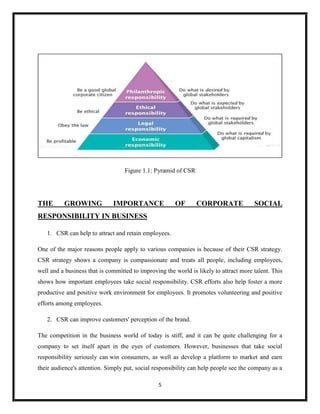
(Carroll, 1979) was one of the first researchers who debated and had a big influence on the CSR
concept. He claimed that the economic category was the most important within social
responsibility, and the other three were ranked in the following decreasing order of importance:
legal, ethical and philanthropic. Carroll’s paradigm remains the most known within business.
Carroll with this view, offering CSR definition as “the social responsibility of business
encompasses the economic, legal, ethical, and discretionary expectations that society has of
organizations at a given point in time.
5
Figure 1.1: Pyramid of CSR
THE GROWING IMPORTANCE OF CORPORATE SOCIAL
RESPONSIBILITY IN BUSINESS
1. CSR can help to attract and retain employees.
One of the major reasons people apply to various companies is because of their CSR strategy.
CSR strategy shows a company is compassionate and treats all people, including employees,
well and a business that is committed to improving the world is likely to attract more talent. This
shows how important employees take social responsibility. CSR efforts also help foster a more
productive and positive work environment for employees. It promotes volunteering and positive
efforts among employees.
2. CSR can improve customers' perception of the brand.
The competition in the business world of today is stiff, and it can be quite challenging for a
company to set itself apart in the eyes of customers. However, businesses that take social
responsibility seriously can win consumers, as well as develop a platform to market and earn
their audience's attention. Simply put, social responsibility can help people see the company as a
6
positive force in society. The projects that company and their team take on can help raise
awareness for important causes and keep the business top of mind. CSR is also important when it
comes to branding. To have a successful brand and retain customers, businesses must create trust
with their target audience, and having a CSR strategy can help build a good reputation and in
turn, earn trust and loyalty among clients.
3. CSR shows a sign of accountability to investors.
Businesses that are socially responsible can also appear more attractive to investors. Investors in
a business have one common goal to have greater returns than invested funds. Most of them view
businesses that are able to manage finances while still helping their communities as accountable
and transparent in their dealings. According to a 2016 report by Aflac, investments in CSR are
not typically viewed by investors as a waste of money, but rather an "indicator of a corporate
culture less likely to produce expensive missteps like financial fraud." The study said 61% of
investors consider CSR a sign of "ethical corporate behavior, which reduces investment risk."
4. CSR can enable the better engagement with customers.
CSR can help the business better engage with customers. Many forms of CSR involve
businesses interacting directly with members of society, who may also be customers or potential
customers. Company can get direct feedback on what they are doing is right or wrong and what
the company needs to be improve on. Word-of-mouth is still an effective form of advertising,
and customers who have been part of the social responsibility created by a company are able to
tell other potential customers about the business (Chastity Heyward, 2020).
7
BENEFITS OF CORPORATE SOCIAL RESPONSIBILITY FOR
BUSINESS
1. CSR increases employee engagement.
Extensive research proves that CSR and a strong sense of employee purpose actively contribute
to increased employee engagement. Employee engagement is not just a KPI to measure CSR
effectiveness; it’s a positive metric to further other business performance statistics. Engaged
employees have a 17% increase in productivity, are 21% more profitable, and can
have 41% lower absenteeism. Giving back to the community is a virtuous circle in which
engaged employees are enriched by volunteering opportunities that further engage and encourage
them.
2. Presents press opportunities
Impactful CSR can get excellent press. If the organization is ever struggling to gain online
popularity and interest, CSR initiative could be the route to market. CSR program will help to
create fantastic boost in the brand awareness of the company and overall online brand affinity.
However, company should be cautious about their CSR efforts. CSR that’s not authentic has
been called Greenwashing; if the company CSR initiative seems too out of line with their
mission and values, people can question its purpose, even though it comes with good intent.
3. CSR supports local and global communities.
For all of the fantastic benefits the business gets from showcasing their CSR initiatives, it can be
easy to overlook its reason for being in the first place. CSR gives people the leverage and the
platform they need to make a difference in local and global communities. Companies are often
collections of like-minded, talented people working towards a broader vision. If company had
find a CSR program is in line with the company’s values, then the business truly has the
opportunity to create a substantial positive impact. TOMS is a fantastic example of how a
product-led CSR initiative can support global communities.
8
4. Increases customer retention and loyalty.
Excellent CSR gives a company a chance to showcase consistency and win loyalty, which
ultimately converts into customer retention and increased sales. Company should have faith in
their CSR initiative, and ensure that they are aligning with their customers’ values. In doing so,
their customers will place their trust in their business and remain loyal to their shared mission.
According to Cialdini’s six principles of persuasion and proves to be a fantastic way for
businesses to showcase they’re trustworthy. Research shows that 87% of Americans are more
likely to buy a product from a company that they can align their values with (Alaya by benevity,
2020).
Figure 2.1: Six Principles of Persuasion
9
DEMERITS IN CSR
Despite its growth and popularity in the past years, corporate social responsibility has severe
limitations and challenges, profoundly affecting its ability to reduce the negative social and
environmental impacts corporations generate as they pursue their financial bottom line. One of
the most controversial CSR issues today is that it’s making the business case for corporate virtue.
Although most of the research has found a significant positive relationship between responsible
corporate behavior and its financial performance, conflicting outcomes do exist. Following are
the demerits faced by the Company:
1. Impact on Reputation of the Corporate
These days, corporate uses practices that appear on the face of it very ethical and responsible but
are not. This is the concept of green-washing in the world of corporate. In terms of CSR
limitations, these companies adopt practices that appear socially and environmentally
responsible, but there is no change in the way they carelessly conduct their business. It’s a fact
that CSR activities, if followed quietly, will reap negligible benefits and will deteriorate the
interests of communities and the environment. However, if a corporation conducts its CSR
activities in a public place, it is open to more significant customer’s scrutiny. Therefore, if there
is a mistake of any hint of irresponsible behavior from the company’s side, it is bound to face the
public’s wrath, eventually hurting its reputation.
2. Competitive Disadvantage
CSR practice can prove harmful for corporations in the long run. As companies have to
accommodate CSR practices in their operations necessarily, it can increase production costs and
other ancillary costs and pressure. It has a cascading effect on the company’s stakeholders and
customers who have to bear this corporate mechanism’s brunt. With the increase in production
cost, there will increase in the products’ prices, which will make the customers less inclined to
purchase products from such a company. Therefore, CSR practices in the company’s operation
can lead to a disadvantageous position and extra pressure for the companies who follow it.
10
3. Lack of concrete clarity on the CSR concept
CSR is not the coherent, homogenous concept that it is often presented as being. One of the main
concerns is that the term CSR has become so broad that people interpret it differently and adapt
it for different purposes. This vagueness of the concept restricts its effectiveness both as an
analytical tool and as a guide for decision-makers. That’s the reason CSR is interpreted in
different ways by different people. For example, CSR practices are a different thing for
practitioners to implement in the company and to researchers trying to establish it as a structured
discipline; it can also mean different to NGOs and corporate entities. These differences in the
CSR mechanism implementation can cause frustration, especially for managers who require a
clear and concise concept.
4. Limitations of Social Reporting and Social Auditing
In India and many countries worldwide, the importance of social responsibility and reporting is
being recognized by many corporations. However, the progress and performance of this social
reporting and auditing are hindered due to the below-outlined reasons.
5. Lack of Standard Format
There is a lack of well-established concepts, postulates, conventions, and axioms to guide and
govern the social accountants in drafting their reporting and audit. There is no clear cut definition
of social reporting. In India we don’t have a settled definition and procedure for social reporting,
every enterprise tends to follow different methods for measuring, reporting, and evaluating social
responsibility behavior. There is often the case that the company’s general operations auditors
are doing social auditing for the firm. There is no separate cadre of social auditors in many
companies, and even if there are some, it’s not clear how the social auditing has to be conducted
(Deepshikha).
11
NEW AMENDMENTS TO THE CSR ACT
The amendments to the CSR Rules have officially been passed by the Government of India.
Here's a comprehensive list of their implications on corporates and nonprofits. The Government
of India notified amendments to the Companies (Corporate Social Responsibility) Rules,
2014 and Section 135 of the Companies Act, 2013 on January 22nd, 2021, which means that
these are now effective (Sanheeta Rao, 2021).
IMPACT ON CORPORATES
I. Eligible CSR spends
1. The following activities cannot be included as parts of a company’s eligible CSR spend:
 Activities which are undertaken in the normal course of business of a company, or those
benefitting only its employees.
 Political contributions.
 Sponsorship activities.
 Fulfillment of statutory obligations and activities undertaken outside India (except for
training of sports personnel representing a state or country at the national or international
level).
2. Activities that can now be included as CSR:
 COVID-19-related activity in the normal course of business: This covers companies
undertaking research and development into vaccines, medical devices, and drugs related
to COVID-19, even if such activity is in their normal course of business. This exemption
is allowed up to the financial year 2022-2023.
 Acquisition or creation of a capital asset provided that it is not owned by the
company: The asset created using CSR funds must be owned either by the organization
supported, or the people served or by a public authority.
 While the term administrative overheads has not been listed exhaustively, the amendment
defines it as expenses incurred for ‘general management and administration’ of CSR
functions in a company.
12
II. Treatment of unspent, excess, or surplus CSR amounts.
1. Unspent CSR funds - Any unspent CSR funds remaining at the end of a financial year
should be transferred in any of the following ways:
 Transfer to an Unspent CSR Account: Any unspent amount from an ongoing project
should be transferred within 30 days of the end of the financial year, to the specifically
designated ‘Unspent Corporate Social Responsibility Account’ to be opened by the
company. These amounts should be spent within the next three financial years, in
accordance with the company’s CSR policy. If these amounts remain unspent even after
the three-year period, then they should be transferred, within 30 days of the end of the
third financial year, to any fund specified in Schedule VII of the act (such as the PM
National Relief Fund, PM CARES Fund, Disaster Management Fund, Clean Ganga Fund,
and so on).
 Transfer to a Schedule VII fund: If the funds are unallocated to any CSR project, then
such unspent amount shall be transferred, within six months of the end of the financial
year, to any fund specified in Schedule VII of the act.
2. Surplus CSR funds - If any surplus arises out of the CSR activities, it must be:
 Spent on the same project which gave rise to the surplus, or
 Transferred to the Unspent CSR Account of the company, or
 Transferred to a fund as specified in Schedule VII of the act.
3. Excess CSR spends- If a company has spent amounts more than the mandatory two
percent on CSR, the company can set off such excess amounts against the CSR spends in
the next three financial years. The board of directors however, needs to pass a resolution
for this. It’s important to note that such excess amounts cannot include the surplus arising
out of CSR activities. For instance, if any interest is earned out of the assets acquired
through the CSR funds, such interest would be treated as a surplus, but cannot be set off
from the CSR budget of the following year.
13
III. Impact assessment
There is a new requirement for mandatory impact assessment of CSR projects.
 This requirement applies to companies that have an average CSR spend of INR 10 crore
or more in the past three financial years.
 It must be conducted for all CSR projects that have budgets of INR 1 crore and more; and
have been completed one year prior to undertaking the impact assessment.
 An ‘independent’ agency must be appointed to undertake the impact assessment. The
costs of such an agency cannot exceed INR 50 lakh or five percent of the total CSR spend
for that financial year (whichever is lower).
IV. Governance and transparency
 Mandatory disclosures on the website: If a company has a website, it is mandatorily
required to disclose the composition of the CSR committee, its CSR policy, and the
projects approved by the board.
 CSR committee: This committee must formulate an annual action plan for CSR spends,
which lists the CSR projects, implementation and monitoring schedules, and details of
impact assessment (if applicable). However, if a company’s CSR spend is less than INR
50 lakh it is not required to create a CSR committee. The board of directors will perform
the functions of the committee in such a case.
 CSR policy: A company’s CSR policy must include further details of its CSR philosophy,
its guiding principles for selecting projects, implementation and monitoring of activities,
as well as the formulation of the annual action plan.
 Monetary penalties for non-compliance: Departing from the previous philosophy of
‘name and shame’, the amendments have introduced monetary penalties for the company
and every officer in default for non-compliance. A defaulting company is now liable for
the lesser of INR 1 crore or twice the amount that should have been transferred to the
Unspent CSR Account or the Schedule VII specified fund. Additionally, a defaulting
officer is now liable for the lesser of INR 2 lakh, or one-tenth the amount that should
have been transferred to the ‘Unspent CSR Account’ or the Schedule VII specified fund.
14
CSR PRACTICES IN SMALL AND MEDIUM ENTERPRISES (SMES)
DEFINITION OF MICRO, SMALL AND MEDIUM ENTERPRISES
The Government of India has enacted the Micro, Small and Medium Enterprises Development
(MSMED) Act, 2006 in terms of which the definition of micro, small and medium enterprises is
as - Enterprises engaged in the manufacture or production, processing or preservation of goods
as specified below:
 A micro enterprise is an enterprise where investment in plant and machinery does not
exceed Rs. 25 lakh;
 A small enterprise is an enterprise where the investment in plant and machinery is more
than Rs. 25 lakh but does not exceed Rs. 5 crore;
 A medium enterprise is an enterprise where the investment in plant and machinery is
more than Rs.5 crore but does not exceed Rs.10 crore.
Small & Medium Enterprises (SMEs) play a major role in global economic growth in terms of
their contribution to industrial employment, output and exports. This sector has emerged as a
dynamic and vibrant sector of the economy (Vadera and Kulshreshtha, 2010) and occupies a
place of strategic importance in the Indian economy as well. Over 8,000 large companies
complying with Corporate Social Responsibility (CSR) has been a remarkable policy adoption
by the Indian Government. India is a country of SMEs. Schumacher said, “Small is Beautiful”.
We need to make the small beautiful in India too. It is imperative that India works towards
making the smaller enterprises CSR compliant. Employing close to 40% of India’s workforce
and contributing 45% to India’s manufacturing output, SMEs play a critical role in generating
millions of jobs, especially at the low-skill level. The country’s 1.3 million SMEs account for
40% of India’s total exports. SMEs have a much wider spread, hence a wider reach across
communities. We can extrapolate and comfortably say, that the geographical reach through
SMEs is vastly higher than through the larger enterprises. The smaller enterprises need to not
always spend in rupee terms for CSR. They have to first educate themselves on CSR. CSR
initiatives will begin to result in higher motivation and loyalty among employees. This in turn
15
will lead to better production efficiencies, lower employee turnover, and eventually lower costs
for companies.
Very soon, organisations will see an increased sales turnover due to the competitive advantage
derived from a good CSR policy. Compliance to CSR will ensure that the bulk of SMEs
undertake the following to help produce quality products and derive customer satisfaction,
thereby improving the overall environmental and social surrounding of each one of them Hence,
it is imperative that SMEs take on this responsibility. It is the government’s responsibility to
enable such a revolution, by bringing in the SMEs into the CSR act in a careful and responsible
manner. The rules have to be enablers and not irritants for the SMEs. Small and Medium
Enterprises contribute largely to the country’s economic growth by employing nearly 40% of the
nation’s workforce and by contributing about 45% to the manufacturing output pool. That is
because these enterprises not only serve independently but are also ancillary to those larger units
and hence generate employment and help industrialize the rural and backward regions of India.
The activities done by these enterprises are done with the awareness of community needs and
expectations. Hence, doing such business activities in proximity of locals will help them develop
appropriate CSR programmes.
PROGRESS OF CSR
In India there are an existent but small number of companies which practice CSR. This
engagement of the Indian economy concentrates mainly on a few old family owned companies,
and corporate giants such as the Tata and Birla group companies which have led the way in
making corporate social responsibility an intrinsic part of their business plans. These companies
have been deeply involved with social development initiatives in the communities surrounding
their facilities. Jamshedpur, one of the prominent cities in the northeastern state of Bihar in India,
is also known as Tata Nagar and stands out at a beacon for other companies to follow.
Jamshedpur was carved out from the jungle a century ago. Tata's CSR activities in Jamshedpur
include provision of full health and education expenses for all employees and the management of
schools and hospitals. In spite of having such life size successful examples, CSR in India is in a
very nascent stage.
16
In recent years, Corporate Social Responsibility has taken center stage in society. More and more
consumers are interested in CSR. Corporate social responsibility can be defined as the sense of
responsibility of the organization towards social environment and community. It helps to
understand that what actually company is doing with their profits and how they are affecting the
society. According to a study by the European Commission in 2007 (‘Corporate Social
Responsibility in SMEs - SMEs Good practice’), CSR can positively influence SMEs’
competitiveness in numerous ways. SMEs can provide with improved products, high customer
loyalty, motivated employee, cost savings, increased profitability due to optimum resource
utilization, enhanced networking with business partners and improved company image. Though
profit making is one of the main objectives of business but it has to satisfy its employees,
consumers, government, community, and shareholders. Awareness of the impact of business on
society and environment has grown along with the increasing socioregulatory pressures. The
other findings suggest that the Italian businesses are using various social media networks for
corporate communication purposes. Most of them are utilizing Facebook, LinkedIn and
YouTube, among others, to communicate commercial information and to promote their business.
It implies that marketers need to carefully coordinate the use of different digital tools to ensure
that they reach their target audiences in an effective manner. The increasing relevance of CSR in
India has stemmed from the fact that a business cannot succeed by ignoring the human and social
needs of our society. The Small and Medium Enterprises alone contribute to 7% of India’s GDP
and contribution to Indian GDP is expected to increase to 22 per cent by 2020 (Indian express,
2011) and can become the second largest in the world, ahead of the United States, by 2050,and
the third largest after China and the United States by 2032. For Small and Medium Enterprises it
may seem like it is hard or near impossible to do them because of time, money, and other
expenses. However, doing CSR work does not really mean that company need to shell out a huge
amount of money. Then can collaborate with various other NGOs, Trusts, Societies, Section 8
companies, DST certified incubation centers or through collaborative projects with other
corporate.
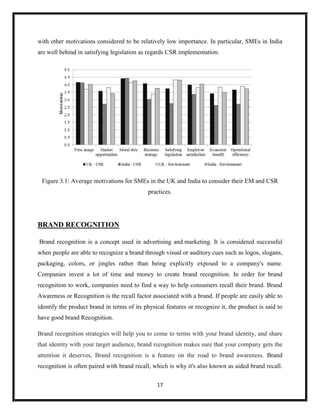
The majority of SMEs in the UK and India believe that they consider CSR. The survey (by
Chrisovalantis Malesios) indicates that companies in the UK implement CSR for a range of
reasons. Whereas SMEs in India consider moral duty and firm image to be the main reasons,
17
with other motivations considered to be relatively low importance. In particular, SMEs in India
are well behind in satisfying legislation as regards CSR implementation.
Figure 3.1: Average motivations for SMEs in the UK and India to consider their EM and CSR
practices.
BRAND RECOGNITION
Brand recognition is a concept used in advertising and marketing. It is considered successful
when people are able to recognize a brand through visual or auditory cues such as logos, slogans,
packaging, colors, or jingles rather than being explicitly exposed to a company's name.
Companies invest a lot of time and money to create brand recognition. In order for brand
recognition to work, companies need to find a way to help consumers recall their brand. Brand
Awareness or Recognition is the recall factor associated with a brand. If people are easily able to
identify the product brand in terms of its physical features or recognize it, the product is said to
have good brand Recognition.
Brand recognition strategies will help you to come to terms with your brand identity, and share
that identity with your target audience, brand recognition makes sure that your company gets the
attention it deserves, Brand recognition is a feature on the road to brand awareness. Brand
recognition is often paired with brand recall, which is why it's also known as aided brand recall.
18
Aided brand recall is the ability of customers to think of a brand name from their memory when
told to think of a category of products.
THE DIFFERENCE BETWEEN BRAND RECOGNITION AND BRAND
AWARENESS
Brand recognition makes sure that the customers and other members of the public can pick the
company out of a line-up. Far more than just the business name, brand recognition are all the
elements that come together to define the brand, from the company logo, to company title, and
even the tone of voice. A great brand recognition strategy can even help the name of the product
or company to become synonymous with whatever it represents. Brand recognition focuses on
making sure that the company stays in the eyes and minds of the customers.
Brand awareness, on the other hand, is a little bit more refined. It means that the customers won’t
just be able to remember the company logo and name, but identify what the company product is,
what makes company special, and why their product is the best solution to their problem. While
recognition helps the company to become more “familiar” to the customers, brand awareness is
the element that gradually leads to company loyalty, and brand affinity. While brand recognition
makes sure that the company gets the attention it deserves, brand awareness will help to cultivate
loyalty in customers that helps the firm to reap all the benefits associated with employee
advocates, repeat customers, and word of mouth marketing.
19
CHAPTER - II
REVIEW OF LITERATURE
20
A literature review is a search and evaluation of the available literature in your given subject or
chosen topic area. It documents the state of the art with respect to the subject or topic you are
writing about. It critically analyses the information gathered by identifying gaps in current
knowledge; by showing limitations of theories and points of view.
(Wu Jiajun & Huang Wanying, 2020)1 analysed in their paper titled “Impact of CSR on Brand
Equity: The Moderating Role of Consumer Involvement in CSR". The results indicate that the
degree of a firm’s CSR positively impacts brand awareness, perceived quality, and brand loyalty
through empirical analysis. Meanwhile, as a moderator, consumer involvement in CSR positively
moderates the relationship between the degree of a firm’s CSR and perceived quality but shows
no significant moderating effects on the other two associations. By uncovering the relationship
between CSR and consumer-based brand equity through the signaling theory and by introducing
the variable of consumer involvement in CSR, this study advances CSR research. It extends the
application of signaling theory in a new research area as well.
( Ho Thi Hai Thuy & Ha Hien Minh , 2020)2 analysed in their paper titled “The study
conducted to examine the Impact of CSR on Brand Image: A Survey amongst Gen Z
Consumers’ Perception toward a Supermarket Chain in Viet Nam”. The authors have learned,
about supermarket chain in Viet Nam and their findings demonstrated that ethical and
philanthropic responsibilities are cues for companies to developing brand image toward Gen Z
consumers. This research results about CSR, brand image and Gen Z by exploring the influence
of CSR on Gen Z’s perception of brand image. That CSR practices enhance brand image
encourages managers of the supermarket to continue investing in CSR because customers tend to
favor companies that are more socially responsible.
1
Wu Jiajun, & Huang Wanying. (2020). The impact of CSR on Brand equity: The moderating role of
consumer involvement in CSR. DiVA.
2
Ho Thi Hai Thuy, & Ha Hien Minh . (2020). The Impact Of CSR On Brand Image: A Survey Amongst
Gen Z Consumers’ Perception Toward A Supermarket Chain In Viet Nam. Research gate
21
(Abdul Waheed & Qingyu Zhang , 2020)3
analyzed in their paper titled “The effect of CSR
and Ethical Practices on Sustainable Competitive Performance: A Case of Emerging Markets
from Stakeholder Theory Perspective”. The study conducted to reveal that CSR have positive
relationships with ECL (Ethical cultural practices). These researches also shows positive
influence of ethical cultural practices between corporate social responsibilities and sustainable
competitive performance respectively and the findings revealed the positive mediating influence
of ECL between CSRPs and SACP, respectively. This study furnishes insightful information for
management on how firms may achieve sustainable performance by incorporating ethical
cultural practices and corporate social responsibility practices as the strategic tools.
( Dr Anjali Bhatnagar & Dr Anjali Arora , 2020)4 studied in their paper titled “Corporate
Social Responsibility during Covid-19 Pandemic: Response of Select Indian Companies”. After
Covid-19, there have been significant changes and expansion in the realm of CSR. The aim of
this study was examine current practices of Corporate Social Responsibility (CSR) by well-
known Indian enterprises, especially during the pandemic. In the current era of Covid-19, many
enterprises have been participating in CSR activities by encouraging community awareness for
physical distancing. The main findings of the study are that CSR is now presented as a
comprehensive business strategy, arising mainly from performance considerations and
stakeholder pressure. It has become apparent that the focus has been somewhat one-sided in
nature, with the bulk of attention going to the corporate processes, motives and outcomes of such
efforts
3
Abdul Waheed , & Qingyu Zhang . (2020). Effect Of CSR And Ethical Practices On Sustainable
Competitive Performance: A Case Of Emerging Markets From Stakeholder Theory Perspective.
Journal of Business Ethics.
4
Dr Anjali Bhatnagar, & Dr Anjali Arora . (2020). Corporate Social Responsibility During Covid-19
Pandemic: Response Of Select Indian Companies. International Journal of Creative Research
Thoughts, | Volume 9, Issue 8 .
22
(Gautam Srivastava , 2019)5
examined in their paper titled “Impact of CSR on Company’s
Reputation and Brand Image”. The author analyzed that for having a sturdy future the company
needs to get indulge in some kind of charitable work so that people get aware of the company’s
work and the image and reputation can be build up which in return help the company to make the
maximum profits which is the ultimate goal of an organization. This research resulted that when
the company’s reputation and brand image enhances it will increase the image of corporate social
responsibility. The researcher concluded that corporate social responsibilities have a positive
impact on company's reputation and brand image. This research shows that when the company's
reputation enhances it will increase the image of corporate social responsibility.
(Kirk Plangger, Douglas West, Hector Menendez , & Shintaro Okazaki, 2019)6
analyzed in
their paper titled “Exploring Digital Corporate Social Responsibility Communications on
Twitter”. Author have analyzed that many brands utilize social media to communicate with
consumers. Author has examined eight brands' digital CSR communications on Twitter and
suggests these dialogs are present but are rarely part of the process with most interactions
between their consumers and also assesses the brands' CSR relevant tweets' content and finds
that most are not relevant to CSR and, moreover, are predominantly one-way. Therefore, the
studies reveal that brands are not tapping into the potential for co-creation that is inherent in
social media. Thus, author recommends that social media communications should include
individual consumers, audience specification, relevant message content, and opportunities for
consumers to co-create value with the relevant brands. Hence, communication of CSR activities
through social media helps the company to increase its brand recognition.
5
Gautam Srivastava . (2019). Impact Of CSR On Company’s Reputation And Brand Image. Global
Journal of Enterprise Information System.
6
Kirk Plangger, Douglas West, Hector Menendez , & Shintaro Okazaki. (2019). Exploring Digital
Corporate Social Responsibility Communications On Twitter. Journal of Business Research,
Volume 117, 675-682.
23
( Hadjer Bouakkaz & Houari Maaradj , 2017)7
examined in their paper titled “Building Brand
Image through Corporate Social Responsibility Case Study on Mobilis Telecommunication
Company”. This research investigates the impact of corporate social responsibility on building
brand image in the telecommunication sector. Firms are using CSR to build brand image and to
establish long lasting relations with its stakeholders. However, the relationship between brand
image and corporate social responsibility is not been explored adequately and it resulted that
social responsible activities of a firm enhance the brand image. This research resulted that when
the company’s reputation and brand image enhances it will increase the image of corporate social
responsibility.
(Hoi Wan Liu, Xiaoming Lu, & Mizan Rahman, 2017)8 examined in their paper title “Impact
of corporate social responsibility on customer loyalty: A case for two global corporations in
China”. The authors explored that corporate social responsibility initiatives have different impact
on developing customer loyalty in the context of two leading international sportswear companies
operating in China. Academic interest in CSR in China has grown over the years. The findings
suggest a relatively strong impact of CSR dimensions and other related attributes on developing
customer loyalty in China. There are topical differences in China in relation to customers’ CSR
perceptions and have a probability of being influenced by a company’s CSR initiatives.
7
Hadjer Bouakkaz, & Houari Maaradj . (2017). Building Brand Image Through Corporate Social
Responsibility Case Study On Mobilis Telecommunication Company. Journal Economic Issue,
Vol 8., 343-357.
8
Hoi Wan Liu, Xiaoming Lu, & Mizan Rahman. (2017). The Impact Of Corporate Social Responsibility
On Customer Loyalty: A Case For Two Global Corporations In China. Scholars Portal Jornals ,
251-260.
24
( Abhisekh Shah, Kaushik PS , & Priya Malebennurc , 2017)9
examined in their paper titled
“The scope of Corporate Social Responsibility”. The study shows that the government has no
role in monitoring CSR activities, and there are certain activities such as contribution to Prime
Minister’s National Relief Fund, scientific research, rural development projects, skill
development projects, agricultural extension projects etc, are aligned to Schedule VII which has
exemptions under different sections as indicated under the Income Tax Act, 1961. Author reveal
that Corporate Social Responsibility (CSR) is when a company operates in an ethical and
sustainable way and deals with its environmental and social impacts. This means a careful
consideration of human rights, the community, environment, and society in which it operates.
Objective of the CSR Law is to promote innovative ideas and corporate’s enhanced management
skills in discharging social responsibility that results in greater efficiency and better outcomes.
(Sandhya Mishra , 2016)10 examined in their paper titled “Corporate Social Responsibility in
Infosys Foundation”. The present study reveals that the company is actively engaged in different
areas of social responsibility. The study makes it clear that in the period of recession; most of the
companies are still going for corporate social initiatives as goodwill and transparency are crucial
for a company to keep blooming especially in the times of economic downturn. Companies do
such activities as internal projects or in association with some government bodies or NGOs. A
number of companies in India are engaged in and are demonstrating their CSR initiatives. In a
survey conducted by Centre for Social Markets in 2001, the respondents mentioned the name of
certain Indian and International companies as their role models in CSR sector. Therefore, the
companies irrespective of their size should try to get advantage from CSR activities rather than
focusing on immediate cost cutting or forgoing their responsibility towards the society at large.
9
Abhisekh Shah, Kaushik PS , & Priya Malebennurc . (2017). The Scope Of Corporate Social
Responsibility.
10
Sandhya Mishra . (2016). Corporate Social Responsibility In Infosys Foundation.
25
( Won-Moo Hur, Hanna Kim, & Joon Hyo Jang , 2015)11 analyzed in their paper titled “Role
of Gender Differences in the Impact of CSR Perceptions on Corporate Marketing Outcomes”.
The purpose of this study was to investigate gender differences in corporate social responsibility
(CSR) perceptions regarding business sustainability. Another important objective of this study
was to explore the moderating role of gender on the relationship between CSR perception and
three corporate marketing outcomes. The results of this study resulted that and there is the
positive alliance between CSR perception and corporate brand equity was stronger among men
than women and female consumers have more high perception toward CSR than male
consumers. In addition, there is also the negative alliance between CSR perception and corporate
distrust and between CSR sagacity and corporate dishonesty were both stronger among men than
women.
( Imran Ali, Ana Isabel , Jiménez-Zarco, & Marta Bicho, 2015)12 examined in their paper
titled “Using Social Media for CSR Communication and Engaging Stakeholders”. Study
examines the role of social media for designing effective corporate social responsibility (CSR)
communication strategy for modern business organisation to engage their stakeholders. The
results indicate that the majority of respondents think that social media is very important
platform to communicate CSR activities. Customers believe that communication of CSR
activities through social media influence their buying behavior positively. Author also found
strong intentions among employees to work for socially responsible corporations who are
successful in communicating their CSR initiatives to their employees through social media.
11
Won-Moo Hur, Hanna Kim, & Joon Hyo Jang . (2015). The Role Of Gender Differences In The Impact
Of CSR Perceptions On Corporate Marketing Outcomes. Corporate Social Responsibility and
Environmental Management, vol. 23(6), 345-357.
12
Imran Ali, Ana Isabel , Jiménez-Zarco, & Marta Bicho. (2015). Using Social Media For CSR
Communication And Engaging Stakeholders. Corporate Social Responsibility in the Digital Age.
26
(Ruchi Tewari & Taral Pathak , 2014)13
analyzed in their paper titled “Sustainable CSR for
Micro, Small and Medium Enterprises”. Corporate Social Responsibility (CSR) is used as a
competitive tool in developing economies. Small enterprises need to compete with the large
companies, CSR adoption is not a choice and therefore this research paper findings says that
small or medium enterprises should follow ‘collective corporate social responsibilities, (CCSR)
through which a group of MSMEs with similar sustainability needs support and take up socially
responsible activities, as a unit. The clusters provide a beneficial opportunity to MSME’s to
adopt social responsibilities collectively, which will serve the needs of the various stakeholders
like workers, community, environment, customers etc and practice of CSR should be socio-
culturally framed.
(Shaista Siddiq & Sara Javed, 2014)14 examined in their paper titled “Impact of CSR on
Organizational Performance”. The main objective of this study is to determine the CSR
disclosure and to find out the association between CSR and FP by the public companies of
Maldives. The result of this research shows a highly positive relation between Return on asset
and turnover of a company. Companies should follow CSR which give extra benefits of
customer loyalty which ultimately improve the profit margin of the firm and also help to increase
the good will; the organizations get high reputation in the eye of stakeholder and help to beat
competitors. One of the main consequences of this study is the CSR framework adopted in this
study which is not a custom-tailored instrument specific to the Maldives instead chose from
another research paper. The analysis of the research shows that better CSP may not influence
CFP so it is difficult to anticipate CSR from a firm. The overall study is a guiding force for the
managers and a helpful tool for future researchers.
13
Ruchi Tewari , & Taral Pathak . (2014). Sustainable CSR For Micro, Small And Medium Enterprises.
Journal of Management & Public Policy, Vol. 6, No. 1, , 34-44.
14
Shaista Siddiq, & Sara Javed. (2014). Impact of CSR on Organizational Performance. European
Journal of Business and Management, Vol.6, No.27.
27
(Parveen Maan, 2014)15 examined in their paper titled “CSR- Key Issues and Challenges in
India”. The purpose of this article is to provide a general summary of the value propositions
evident in the research on the business case for Corporate Social Responsibility (CSR). This
study brings out that over a last 30 to 40 years, there has been a steady increase in concern
expressed about, and the information produced by small and large organisational set ups in
relation to their social and environmental impacts. It is not only government responsibility to
uplift the downtrodden society myth that the ultimate goal is not profit making, rather trust
building is viable and assert able with societal relationship and only long term survival mantra
for any organization. This article tries to analyze the study of Corporate Social Responsibility
(CSR) status in India, and it further provide an insight to what extent companies can follow the
Corporate Social Responsibility (CSR).
(Richa Gautam & Anju Singh , 2013)16
analysed in their paper titled “Corporate Social
Responsibility Practices in India: A Study of Top 500 Companies”. This research found that
there are several companies in India involved in activities such as healthcare, education, rural
development, sanitation, microcredit, and women empowerment etc. CSR seem to be in a
confused state in India. Individual companies define CSR in their own ways. The end result
show that CSR activities are mainly philanthropy and it seems that CSR in India has been
evolving mainly in domain of profit distribution. There is a need to increase the understanding,
knowledge and active participation of business in social development as an integral part of good
business practice. The study suggests that business and CSR strategy appear to be on a
convergent path, towards business and CSR integration across the company. This paper will be
useful to any Indian company in understanding more about its shortcomings and opportunities.
15
Parveen Maan. (2014). CSR- Key Issues And Challenges In India. nternational Journal of Science,
Environment and Technolog,Vol. 3, No 6, 2038 – 2045.
16
Richa Gautam , & Anju Singh . (2013). Corporate Social Responsibility Practices In India: A Study Of
Top 500 Companies. National Institute of Industrial Engineering, Volume: 2, 41-56.
28
(Abhishek Tripathi & Dr. Anupama Bains , 2013)17
examined in their paper titled A Study of
Indian CSR Practices in Small and Medium Enterprises”. This study says that CSR act as a
strategic mechanism for Small and Medium Enterprises which help them to create corporate
image, brand building, increase sales, better relationship with stake holders. There are no
mandatory regulations to contribute in CSR because for some small and medium enterprises it
will not improve the situation of companies, but simply may add to burden faced by them. It is
suggested that SMEs can take help from other organizations by making cluster or a group, which
are ready to support responsible business objectives and also help to achieve the social
responsibility.
( Campopiano Giovannaa, De Massis Alfredoa, & Cassia Lucio , 2012)18 analysed in their
paper titled “Corporate Social Responsibility: A Survey among SME's in Bergamo”. This study
provides some insights on the topic of CSR in small- and medium-sized family vs. non-family
firms. Though preliminary, the results show that they are generally unaware of the concept of
CSR, do not report their initiatives, but are still engaged in social actions towards their closest
stakeholders. Family business owners are especially found to be in charge of social activities
towards employees and the local community. Author discusses this behavior in light of the social
capital theory, according to which relationships and the interrelation with environment and
communities are relevant for the sustainability of these businesses.
17
Abhishek Tripathi, & Dr. Anupama Bains . (2013). A Study Of Indian CSR Practices In Small And
Medium Enterprises. International Journal of Advanced Research in Management and Social
Sciences .
18
Campopiano Giovannaa, De Massis Alfredoa, & Cassia Lucio . (2012). Corporate Social
Responsibility: A Survey Among SME's In Bergamo. Procedia - Social and Behavioral Sciences,
325 – 341.
29
(Suresh Chandra Bihari & Sudeepta Pradhan, 2011)19 “CSR and Performance: The Story of
Banks in India". This study is done to map the corporate social responsibility (CSR) practices of
major players in the Indian banking sector and to find out the impact of such practices on their
performance and image. The findings of the study suggest that banks in India have increased
their CSR activities, which also have a positive impact on performance of the business, apart
from improving their image and goodwill. It also reflects the fact that work done for society may
pass on the advantages to the corporate sector and enhance their value and goodwill. This also
sets a good example for other service sectors as well. The social responsible attitude is integral
part of the identity of financial institutions like banks, and it is one of their distinctive features.
The Reserve Bank of India has asked the banks to pay special attention toward integration of
social and environmental concerns in their business operations.
(Xueming Luo & C.B Bhattacharya, 2006)20 analysed in their paper titled “Corporate Social
Responsibility, Customer Satisfaction, and Market Value”. The study conducted to understand
the most of the research addressed the influence of corporate social responsibility (CSR) on
customer responses; it is not clear whether CSR affects market value of the firm. This study
predicts that customer satisfaction partially intervene the relationship between CSR and firm
market value and these moderated relationships are mediated by customer satisfaction. The
authors found that the firm with low innovativeness capability, CSR actually reduces customer
satisfaction levels and, through the lowered satisfaction, harms market value. The uncovered
mediated and asymmetrically moderated results offer important implications for marketing
theory and practice.
.
19
Suresh Chandra Bihari, & Sudeepta Pradhan. (2011). CSR And Performance: The Story Of Banks In
India. Journal of Transnational Management, 20-35.
20
Xueming Luo , & C.B Bhattacharya. (2006). Corporate Social Responsibility, Customer Satisfaction,
And Market Value. Journal of Marketing.
30
CHAPTER - III
RESEARCH DESIGN
31
RESEARCH
Research is a systematic process of answering to the questions about events and phenomena
through the application of scientific methods. It is an act of objective, impartial, empirical and
logical analysis and recording of controlled observations, principles or theories. According to
John W. Creswell, “Research is a process of steps used to collect and analyze information to
increase our understanding of a topic or issue”.
RESEARCH DESIGN
A research design is a plan, structure and strategy of investigation so conceived as to obtain
answers to the research questions or problems. A research design is a map developed to guide the
research. It is a part of the planning stage of research, a blueprint for the collection, measurement
and analysis of data. A research design is a framework of research methods and techniques
chosen by a researcher.
STATEMENT OF PROBLEM
The main research problem of this study is to understand the impact of Corporate Social
Responsibility on the Brand recognition of the company. The purpose of this study is to examine
how CSR help the company to do marketing and increase the brand recognition and also
contribute to the society and the factors that affect the buying preference of the customer. The
main focus of this study is to analyze the awareness of the brand to the customer through
Corporate Social Responsibility.
OBJECTIVES OF THE STUDY
 To ascertain the impact of CSR activities on brand recognition.
 To analyze an effect of CSR on the sales of the company.
 To access the relationship between CSR activities and customer trust.
 To analyze the customer preference towards Enokopp Pvt Ltd.
32
SCOPE OF THE STUDY
Corporate Social Responsibility (CSR) is an essential part of every organisation, whether small
or large, profit or non-profit oriented organisation. CSR activities are mostly practiced by large
scale firms with large amount of contribution. This study focus on the CSR activities practiced
by Small and Medium Scale Enterprises (SME’s). This study represents comprehensive review
about the CSR activities practiced by Enokopp Pvt Ltd and its effects on the brand recognition of
the company and it also study the effect of CSR on the sales of the company.
RESEARCH METHODOLOGY
This research aimed to determine awareness level of customer through CSR activities and also
determine the customer preference and factors that influence customers to buy the products of
Enokopp Pvt Ltd.
Survey questionnaire was used to collect data from the customers of the organisation because
questionnaire can cover large population with lower cost and shorter time. Self-adjusted
questionnaire was adopted from past studies and questions are formed keeping in mind the
objectives to be achieved.
SAMPLE SIZE
Sample is a group of people, object or items that are taken from a large population for
measurement. The sample should be representative of the population to ensure that we can
generalize the finding from the research sample to the population. The size of the sample is
always less than the total size of the population.
For the purpose of collecting data to support the research, the sample size chosen was 100
respondents.
POPULATION
The total element of the universe from which the sample is selected for the purpose of research is
known as Population.
The population selected for the research is the customers of the Enokopp Pvt Ltd.
33
SAMPLE DESIGN
A sample design is the framework, which serves as the basis for the selection of a survey sample
and affects many other important aspects of a survey as well. The sample design provides the
basic plan by which a sample is selected for the purpose of research.
Simple Random sampling was used to collect data. Simple Random Sampling is a data collection
technique where each individual is chosen entirely by chance and each individual of the
population has an equal opportunity of getting selected, or probability of being selected.
The universe selected is Enokopp Pvt Ltd.
SOURCE OF DATA
There are basically two sources of data collection: Primary and secondary sources
Primary data: Is the data collected by a researcher from first-hand sources, using methods like
survey, interviews, or experiments. The data used for this study is basically collected from
primary source and as well as secondary data. Here Primary data is collected through structured
questionnaire survey through Google forms sent to respondents for filling out the details.
Secondary Data: This refers to data that is collected by means of data collected by some other
than the user. Common sources of secondary data are census, research papers etc. Secondary
source is also used like others research papers related to CSR to get an in-depth knowledge about
the CSR.
TOOLS FOR DATA COLLECTION
The research instrument used for this study is a structures questionnaire. The questionnaire was
formulated keeping in mind the following points:
1) Giving the respondent clear comprehension of the questions.
2) Giving clear instruction about what is needed.
3) Framed detailed and comprehensive questions.
4) Keeping objectives as a base while framing the questionnaire.
34
Online questionnaires were formed using Google forms for the survey and were sent to the
respondents for their response.
A questionnaire is a research instrument that consists of a series of questions related to a
particular topic for the purpose of gathering information from the respondents. The questionnaire
should be clear and simple to understand. It can be done physically or digitally. The mode used
in my research is online Google form. Personal observation is also used so as to interpret the
question and come to a conclusion.
PLAN OF ANALYSIS
The analysis of the data collected by issuing the questionnaire is going to be analysed with the
help of charts and bar diagrams. The presentation of these tools will clearly help in the analysis.
OPERATIONAL DEFINITION
An operational definition is a result of the process of operationalization and is used to define
something (e.g. - a variable, term, or object) in terms of a process or set of valuation test needed
to determine its existence, duration, and quantity. Since the degree of operationalization can vary
itself, it can result in a more or less operational definition. The procedure included in definition
should be repeatable by anyone or at least by peers.
In this study, definition of Corporate Social Responsibility (CSR) by European Union is used in
this research.
LIMITATION
 The period is very short.
 The size of the sample is low when compared to the total population.
 The study was limited to extent of the abilities and willingness of the respondents to
answer appropriately to the questions.
35
OVERVIEW OF CHAPTER SCHEME
• Chapter 1: Introduction
This chapter includes a brief introduction to the topic Corporate Social Responsibility.
• Chapter 2: Literature Review
This Chapter includes the brief description of the research done by the authors of the topics
closely related to my research to get an idea of the Topic and Research.
• Chapter 3: Research Design
This chapter gives the plan of study, which includes the objectives, need of the study, statement
of problem and source of data.
• Chapter 4: Profile of the company
This chapter contains the profile of Enokopp Pvt Ltd. where the research was conducted.
• Chapter 5: Analysis and Data Interpretation
In this chapter, the data collected through the primary source is analysed using charts and tables
and inferences are drawn on the same.
• Chapter 6: Summary of Findings, Suggestions and Conclusion
This chapter basically contains the results of the study, so that one can get an overall picture of
the findings obtained on the basis of which suggestions are made.
36
CHAPTER - IV
PROFILE OF THE
COMPANY
37
ENOKOPP PVT LTD is a small scale enterprise. It has its headquarters in Bangalore, Karnataka
and it was incorporated in the year 2017. It deals in manufacturing of MCB box, Plugs and
Sockets, Cables etc and also pioneer in providing high-quality products tailored to the Indian
market. They have their manufacturing facilities in India; their mission is to provide more for
less in terms of design and monetary value. Enokopp prioritizes energy management to control
and conserve electrical energy for a brighter tomorrow for all.
Enokopp is trying to build specialist in electrical and digital building infrastructure. They focus
on leverage knowledge to customize offerings locally, delivering end-to-end solutions across
categories and sectors, from residential and commercial, to hospitality and industrial. Enokopp
has progressively developed product ranges for wiring devices, home automation, lighting
management systems, cable management and structured cabling to add to the core offerings of
circuit breakers and distribution boards. An employee base of over 100 in 3 offices spread across
the country, 3 manufacturing facilities, and an extensive network of over 20-25 distributions
partners and more than 100 retailers consolidated Enokopp network, enabling quickly penetrate
new market and product segments, and generate economies of scale.
38
They follow the principle of ‘Frugal Engineering,’ and it shifts our focus from “how to improve
this product” to “how to make this product more accessible” so that all our customers can say,
“This makes sense’. We continuously strive to deliver high-quality products suited to the Indian
market.
JOURNEY OF THE FIRM
From last 6 years, firm has developed the name in their market. In 2017, Enokopp product was
launched in the market with 6-7 varieties of the products. Firm did not perform as it was
accepted to perform in the market. So, firm has circulated the feedback form so that they can
meet the needs and expectation of the customers. They found that the customers are not satisfied
with the quality of the products which launched by them. So their sales were low in the year
2017. In 2018, firm worked on their product quality and pricing strategy. During the year under
review, Enokopp was accepted by the public, it was over the expectation. In the same year they
developed the product and bought the new varieties of the product in the market. Still they were
receiving the complaints related to pricing. They were working on the pricing strategy, they were
facing problem to reduce their cost. So they started to make products, which were essential for
the production of the product rather than purchasing it from other manufactures. In 2019, Firm
started to grow and also had a good amount of sales in that year. They also got award to capture
the market in limited time. They also entered e-commerce sector by starting their operations
through e-commerce platform. They started selling their product through their website and other
business website. They also started their marketing through social media marketing. In 2020,
firm had to face lot of crisis due to covid-19, because of that their sales went down in that year.
Then to they took care of their workers who were working in their firm. They were taking care of
all their essentials and also realized the importance of helping people. In covid-19 they started
helping people who were in need and slowly they started their CSR activities. In 2021, they have
a capture good amount of audience through their marketing in sales and also through their CSR
activities. Due to which they had a good amount of sales in that year.
39
GENERAL INFORMATION
Name of the firm – ENOKOPP PVT LTD
Status – Sole Proprietorship
Founded – 2017
Headquarters – Bangalore, Karnataka, India
Owner – Mahendra Ratadiya, Vipul Ratadiya
Website - www.enokopp.com
Vision
 We will take steps to understand how we can most effectively support the needs of the
local community and implement initiatives accordingly.
 We recognize that our social, economic and environmental responsibilities to these
stakeholders are integral to our business.
 We aim to demonstrate these responsibilities through our actions and within our
corporate policies.
 We take seriously all feedback that we receive from our stakeholders and, where
possible, maintain open dialogue to ensure that we fulfill the requirements outlined
within this policy.
 We are Maintaining quality of life by ensuring safe, efficient and convenient and
affordable use of electricity
Mission
 We shall ensure a high level of business performance while minimizing and effectively
managing risk ensuring that we uphold the values of honesty, partnership and fairness in
our relationships with all our stakeholders.
 We shall encourage suppliers and contractors to adopt responsible business policies and
practices.
 We shall encourage dialogue with local communities for mutual benefit.
40
 We shall maintain a clear and fair employee remuneration policy.
 We shall provide, and strive to maintain, a clean, healthy and safe working environment
of work.
 We shall develop Environmental policies and objectives as part of the business planning
cycle.
 Providing good quality of product with affordable price.
Tagline - “Safety is our Priority”
PRODUCTS CATEGORIES
 RCCB's
RCCB stands for Residual Current Circuit Breaker. RCCB is an electrical wiring device
that disconnects the circuit as soon as it detects a current leak to the earth wire. It also
protects against electric electrocution or shock caused by direct contact. Range: RCCB’s
are available in 2 Pole (DP) and 4 pole (FP) options.
 SINGLE AND DOUBLE DOOR DB's
a. SPN
The term SPN stands for ‘single phase and neutral’. This means that the circuit
has only one single phase input, with several single-phase outputs. The main
single phase supply cable comes into the board and the current is then distributed
to the different circuits like lights and plugs. Before the current passes to the
circuits, it first goes through circuit breakers. These circuit breakers keep you safe
by preventing the flow of current to the circuit in case of current overload or
voltage fluctuation. Range: SPN distribution boards are available in 4-Way, 8-
Way, 10-Way, 12-Way options.
b. TPN
TPN means a 4 Pole device with 4th Pole as Neutral. In TPN opening & closing
will open & close the Neutral. For TPN, protection applies to the current flows
through only 3 poles (Three Phase) only; there is no protection for the current
41
flow through the neutral pole. Neutral is just an isolating pole. Range: TPN
distribution boards are available in 4-Way, 6-Way, and 8-Way options.
c. There are more varieties in Distribution Box (DB), rest of the them are -
PLATIMUM DB, P-GOLD DB, OSSUM DB, ROYAL DB, PEARL DB,
DELUXE DB, WHITELINE DB etc. Each product is different from each other
based on the prices and the quality. Each product available ranges are – 4 Way, 6
Way, 8 Way, 10 Way, 12 Way and 16 Way.
 MCB BOX AND MINI MCB's
MCB stands for Miniature Circuit Breakers. The MCB is an electromechanical device
that switches off the circuit automatically if an abnormality is detected. The MCB easily
senses the overcurrent caused by the short circuit. The miniature circuit has a very
straightforward working principle. Additionally, it has two contacts; one fixed and the
other movable. If the current increases, the movable contacts are disconnected from the
fixed contacts, making the circuit open and disconnects them from the main supply.
Range: MCB Box is available in 2 Pole (DP) and 4 pole (FP) options.
 METAL CLAD PLUG & SOCKET
A plug is the movable connector attached to an electrically operated device, and the
socket is fixed on equipment or a building structure and connected to an energized
electrical circuit. Ranges available from - 20A/2P – PLUG, 20A/3P – PLUG, 30A/3P –
PLUG, 20A/2P – SOCKET, 20A/3P – SOCKET, 30A/3P – SOCKET.
 A.C BOX
This unit functions as the central location for circuit breakers within the AC system. The
safe supply from multiple sources such as shore power, generator and inverter to each of
the electrical consumers is controlled and the unit functions as the central location for
circuit breakers within the AC system. Ranges available from - 20/2 EMPTY, 20/3
EMPTY, 30/3 EMPTY, 20/2 FULL SET, 20/3 FULL SET, 30/3 FULL SET.
42
 CABLES
Power cables are used for bulk transmission of alternating and direct current power,
especially using high-voltage cable. Electrical cables are extensively used in building
wiring for lighting, power and control circuits permanently installed in buildings.
 ISOLATOR
An isolator is a device used for isolating a circuit or equipment from a source of power.
An isolator is a mechanical switching device that, in the open position, allows for
isolation of the input and output of a device. Range: Isolator is available in 2 Pole (DP)
and 4 pole (FP) options.
 CHANGE OVER AND BUSBAR
A changeover switch is designed to transfer a house (or business) electricity from the
commercial power grid to a local generator when an outage occurs. Also known as
“transfer switches,” they connect directly to the generator, commercial power supply or
line, and the house. Busbars, also known as busbar trunking systems, distribute electricity
with greater ease and flexibility than some other more permanent forms of installation
and distribution.
43
CSR ACTIVITIES OF THE FIRM
ENOKOPP has been adopted Corporate Social Responsibility in 2020 and also focused in
sustained economic performance, environmental and social stewardship which is also a key
factor for holistic business growth. Following are the activities which they have performed:
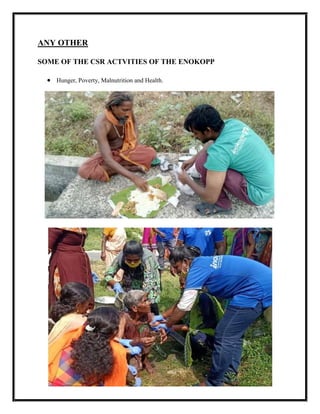
 Hunger, Poverty, Malnutrition and Health: promoting preventive healthcare and
sanitation and making available safe drinking water. In covid-19 many were suffering
from hunger, so firm took the small initiative to and helped the poor people by giving
them the food and also helped the orphanages by providing the basic essentials to them,
they visited Akkamahadevi orphanage in akkipete and also helped the poor people by
giving them a bath who were disable to walk.
 Rural Development Projects: Strengthening rural areas by improving accessibility,
housing, drinking water, sanitation, power and livelihoods, thereby creating sustainable
villages. Firm has joined the champs, to help the rural people by providing them proper
drinking water. They also spread awareness of hygiene among the people of the rural
areas.
 Gender Equality and Empowerment of Women: setting up homes, hostels and day care
centers for women and orphans; setting up old age homes and such other facilities for
senior citizens; and adopting measures for reducing inequalities faced by socially and
economically backward groups. Firm also visited the old age homes and contributed to
the old age home based on their capacities.
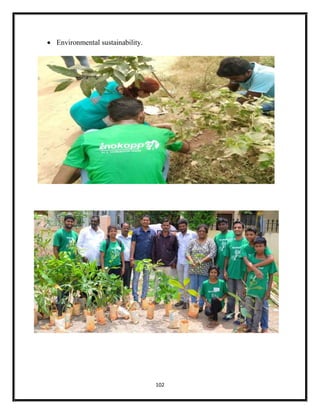
 Environmental Sustainability: Ensuring environmental sustainability, ecological balance,
protection of flora and fauna, animal welfare, agro-forestry, conservation of natural
resources and maintaining the quality of soil, air and water. Firm mainly focused in this
area, they planted the trees in different area of the Bengaluru.
44
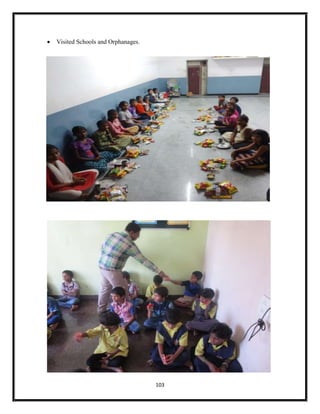
 Visited Schools: Providing the essentials to the children, entertaining them and spread
awareness among the children. Firm also took initiative to distribute the basic essentials
to the children, they even played games with them. Also spread awareness about the good
habits, provided education of good touch and bad touch, and many more.
45
CHAPTER - V
ANALYSIS AND DATA
INTERPRETATION
46
DATA ANALYSIS AND INTERPRETATION
Data analysis and interpretation is the process of assigning meaning to the collected information
and determining the conclusions, significance, and implications of the findings. Data analysis is
the process of cleaning, transforming and modeling data to discover useful information. The
purpose of data analysis is to extract useful information from the data collected and taking the
decision based upon the data analysis.
The collected data is to be edited, coded, classified and then analysed to extract meaningful
information from the observed data. A number of tables are prepared to bring out the main
characteristics of the data.
From the analysis, interpretation can be drawn on the observation of the study. Based on the
findings of the study, the researcher is able to conclude on the research problem used.
The questions in the questionnaire are asked in three different parts in accordance with the
objectives of the study:
 To ascertain the impact of CSR activities on brand recognition.
 To analyze an effect of CSR on the sales of the company.
 To access the relationship between CSR activities and customer trust.
 To analyze the customer preference towards ENOKOPP PVT LTD.
47
I. To ascertain the impact of CSR activities on brand recognition.
Question 1
Gender
a. Male
b. Female
c. Prefer not to say
Table 5.1: Table showing gender group of respondents.
Options No. of respondents Percentages
Male 75 75%
Female 25 25%
Prefer not to say - -
Total 100 100%
ANALYSIS
According to the survey, we can see that out of 100 respondents, 75% of the respondents are
male customers and 25 % of the respondents are female customers. Whereas no customer i.e. 0
respondents chose the option called Prefer not to say.
48
Graph 5.1: Graph showing gender group of respondents.
INTERPRETATION
This question was asked to know the majority of the customer and according to this analysis it is
seen that as per the response 75% of the customer are male and only 25% of the customer is
female. It may be due to large no. of male customers in the market as compare to the female
customers.
75%
25%
No. of Respondets
Male
Female
Prefer not to say
49
QUESTION 2
What is your level of knowledge relating to Corporate Social Responsibility (CSR)?
a. I don't know about it.
b. I have a basic understanding of the concept.
c. I am familiar with the concept.
Table 5.2: Table showing level of knowledge relating to Corporate Social
Responsibility.
Options No. of respondents Percentages
I don't know about it.
14 14%
I have a basic understanding of the concept
40 40%
I am familiar with the concept
46 46%
Total
100 100%
ANALYSIS
According to this survey, we can see that 46% of the respondents are properly familiar with the
concept of Corporate Social Responsibility, 40% of respondents have just a basic understanding
about the concept and 14% of the respondents are not even aware of the concept of CSR.
50
14%
40%
46%
0%
5%
10%
15%
20%
25%
30%
35%
40%
45%
50%
I don't know about it. I have a basic understanding of
the concept
I am familiar with the concept.
No. of Respondets
Graph 5.2: Graph showing level of knowledge relating to Corporate Social
Responsibility.
INTERPRETATION
This particular question was asked to understand the level of knowledge of the customer relating
to Corporate Social Responsibility, and from the above analysis we can see that less than half of
the respondents are actually aware of the concept and 14% of the respondents are not even have
a knowledge relating to CSR, this may be due to lack of awareness about the concept of CSR
among the customers.
51
QUESTION 3
Are you aware of the brand Enokopp?
a. Yes
b. No
Table 5.3: Table showing awareness of the Brand Enokopp.
Options No. of respondents Percentages
Yes 63 63%
No 37 37%
Total 100 100%
ANALYSIS
According to this survey, we can see that out of 100 respondents 63% of the respondents are
aware of the brand Enokopp and only 37% of the respondents aren’t aware of the brand
Enokopp, it may be due to lack of proper marketing.
52
Graph 5.3: Graph showing awareness of the Brand Enokopp.
INTERPRETATION
This question was asked to understand the awareness of the brand and this analysis shows the
positive response, more than 50% of the respondents i.e. 63% of the respondents are aware of the
brand Enokopp and co. need to focus on 37% also and make them aware of the brand and
products of the Enokopp.
63%
37%
No. of Respondets
YES NO
53
QUESTION 4
How are you aware of brand Enokopp?
a. As a customer
b. Through Corporate Social Responsibility
c. Word of mouth
d. None of the above
Table 5.4: Table showing how people are aware of the brand Enokopp.
Options No. of respondents Percentages
As a customer 56 56%
Through Corporate Social Responsibility 20 20%
Word of mouth 14 14%
None of the above 10 10%
Total 100 100%
ANALYSIS
According to this survey we can see that 56% of the respondents know the brand because they
are the customer of the brand, 20% and 14% know the brand through CSR activity of the
company and Word of mouth respectively. 10% of the respondents are not sure of how they got
aware of the brand Enokopp.
54
Graph 5.4: Graph showing how people are aware of the brand Enokopp.
INTERPRETATION
This question was asked to understand how respondents got aware of the brand Enokopp. The
above analysis shows that more that 50% of respondents are aware of the brand because they are
the customer, but only 20% of the respondents know the brand through CSR activity, it may be
due to lack of marketing. Company need to focus on marketing element and make aware of the
brand to the public.
56%
20%
14%
10%
No. of Respondents
As a customer
Through Corporate Social
Responsibility
Word of mouth
None of the above
55
QUESTION 5
Are you aware of the CSR activities of ENOKOPP?
a. Yes
b. No
Table 5.5: Table showing how many people are aware of the CSR activities of
Enokopp.
Options No. of respondents Percentages
Yes 67 67%
No 33 33%
Total 100 100%
ANALYSIS
According to this survey, we can see that 67% of the respondents are aware of the CSR activities
of the company and 33% of the respondents are not aware of the CSR activities of the Enokopp.
This may due to lack of productive marketing among the customers.
56
Graph 5.5: Graph showing how many people are aware of the CSR activities
of Enokopp
INTERPRETATION
This question was asked to understand the awareness of the CSR activities of the brand Enokopp.
Above analysis shows that more than 50% of the respondents are aware of the CSR activities of
the company and yet 33% of the respondents are not aware, it may be because of lack of
marketing and awareness among the customers. So company needs to focus on the marketing
element and they need to market their CSR activities, so that people get aware of the activities.
67%
33%
No. of respondents
Yes
No
57
QUESTION 6
If yes, you came across through
a. Social media
b. Word of mouth
Table 5.6: Table showing how people came across CSR activities of Enokopp.
Options No. of respondents Percentages
Social media 27 40%
Word of mouth 40 60%
Total 67 100%
ANALYSIS
According to this survey, we can see that the people out of 100 respondents, 67% of them are
aware of the CSR activities among them 60% of the respondents got aware through word of
mouth and 40% of the respondents got aware through social media.
58
Graph 5.6: Graph showing how people came across CSR activities of
Enokopp.
INTERPRETATION
This question was asked to understand from which source respondents got aware of the CSR
activities of the Enokopp. Above analysis shows that 40% of the respondents got aware through
social media. Company needs to focus on social media marketing, so that they can cover larger
audience with lower cost and should also focus on the other half, who are not aware of the
activities, Company can use social media marketing to create awareness among the customers.
40%
60%
0%
10%
20%
30%
40%
50%
60%
70%
Social Media Word of mouth
No. of Respondents
59
QUESTION 7
Are you interested to know about CSR activities of Enokopp?
a. Yes
b. Maybe
c. No
Table 5.7: Table showing People’s interest to know CSR activities of Enokopp.
Options No. of respondents Percentages
Yes 57 57%
Maybe 38 38%
No 05 05%
Total 100 100%
ANALYSIS
According to this survey, we can see that 57% of the respondents are interested to know the CSR
activities and 38% of the respondents chose maybe option and 5 % of the respondents are not
interested to know the CSR activities of Enokopp.
60
Graph 5.7: Graph showing People’s interest to know CSR activities of
Enokopp.
INTERPRETATION
This question was asked to understand if people are interested to know CSR activities of
Enokopp. Above analysis shows that more than 50% of the respondents are interested to know
the CSR activities. Company should make awareness about the CSR activities and should build
the importance of CSR activities in the mind of the customers.
57%
38%
5%
No. of Respondents
Yes
May be
No
61
II. To access the relationship between CSR activities and customer trust
QUESTION 8
If you get to know about CSR activities of the company, will it affect your buying preference?
a. Yes
b. Maybe
c. No
Table 5.8: Table showing effect of CSR activities of the company, on the
buying preference of the customer.
Options No. of respondents Percentages
Yes 37 37%
Maybe 44 44%
No 19 19%
Total 100 100%
ANALYSIS
According to this survey, we can see that 37% of the respondents chose option yes which means
CSR do affect their buying preference and 19% of the respondents CSR does not affect their
buying preference. 44% of the respondents chose option maybe which suggest CSR may affect
may not affect their buying preference.
62
Graph 5.8: Graph showing effect of CSR activities of the company, on the
buying preference of the customer.
INTERPRETATION
This question was asked to understand relationship of CSR with customer preferences. Above
analysis shows that less than 50% of the population shows interest to know and understand the
CSR activities of the company. Only 37% of the respondent’s preference gets affected by CSR
and 19% of the respondents do not give so importance to the CSR activities of the company.
0
5
10
15
20
25
30
35
40
45
Yes May be No
37%
44%
19%
No. of Respondents
63
QUESTION 9
How relevant is it for you that companies operate with socially responsibility level?
a. Extremely important
b. Somewhat important
c. Not important
Table 5.9: Table showing how relevant is for people that companies operate
on a socially responsibility level.
Options No. of respondents Percentages
Extremely important 55 55%
Somewhat important 21 21%
Not important 24 24%
Total 100 100%
ANALYSIS
According to this survey, we can see that 55% of the respondents think CSR is extremely
important for the 24% of the respondents does not think that CSR is important and 21% of
respondents think it is somewhat important which indicates that CSR activities may or may not
affect the customers.
64
Graph 5.9: Graph showing how relevant is for people that companies operate
on a socially responsibility level.
INTERPRETATION
This question was asked to understand the relevancy of CSR activities with respect to the
customers. Above analysis shows that more than 50% of the respondents think CSR is important
of the society. This analysis shows positive sign, but 24% of respondents do not feel that CSR is
important for the society. Company should make aware about the concept of CSR and then they
so publish or do the marketing about their CSR activities.
55%
21%
24%
0% 10% 20% 30% 40% 50% 60%
Extremely important
Somewhat important
Not important
Percentages
No. of Respondents
65
QUESTION 10
If company had a proven track record of poor CSR, would you be still purchasing their product?
a. Yes
b. Maybe
c. No
Table 5.10: Table showing if company had a proven track record of poor
CSR, would people be still purchasing that company product.
Options No. of respondents Percentages
Yes 34 34%
Maybe 38 38%
No 28 28%
Total 100 100%
ANALYSIS
According to this survey, we can see that 34% of respondents say that poor CSR will affect their
buying preference, 28% of respondents chose no option which means that poor CSR will not
affect their buying preference and 38% of respondents chose maybe option which says it may,
may not affect their buying preference.
66
Graph 5.10: Graph showing if company had a proven track record of poor
CSR, would people be still purchasing that company product.
INTERPRETATION
This question was asked to understand the effect of poor CSR on the buying preference of the
customer. Above analysis shows that more than 50% of the respondents (considering may be
option) will get affected by the poor track record of CSR activities of the company. Company
should focus on maintaining good track record of CSR activities because it will affect their brand
image and it will also affect their sales.
34%
38%
28%
No. of Respondnets
Yes
Maybe
No
67
QUESTION 11
If the quality and price of products are similar, will you preferably consider the brand which
performed more CSR activities?
a. Agree
b. Neither Agree Nor Disagree
c. Disagree
Table 5.11: Table showing preference of the customer, if co. performs CSR
activities.
Options No. of respondents Percentages
Agree 44 44%
Neither Agree Nor Disagree 40 40%
Disagree 16 16%
Total 100 100%
ANALYSIS
According to this survey we can analyze that 44% of the respondents will consider the brand
which performed more CSR activities even if the quality and price of products are similar with
the other brand. 40% of the respondents had neither agreed nor disagreed and 16% of the
respondents didn’t agree with the following question asked.
68
Graph 5.11: Graph showing preference of the customer, if co. performs CSR
activities.
INTERPRETATION
This question was asked to understand if customer will prefer the brand which is performing the
CSR activities as compare to the brand which is not performing even if their quality and price are
similar. Above analysis show that less than 50% of the respondent has agreed with following
question asked. Company should spread awareness about their CSR activities among their
customers.
44%
40%
16%
0%
5%
10%
15%
20%
25%
30%
35%
40%
45%
50%
Agree Neither agree nor disagree Disagree
No. of Respondents
69
III. To analyze the customer preference towards ENOKOPP.
QUESTION 12
How satisfy are you with the current feature of product of the Enokopp? Rate your satisfaction
level.
Not satisfied Satisfied
1 2 3 4 5
Table 5.12: Table showing customer satisfaction in relation with Enokopp
product.
Options No. of respondents Percentages
1 5 5%
2 13 13%
3 25 25%
4 39 39%
5 18 18%
Total 100 100%
ANALYSIS
According to this survey, we can see that more responses received are for rating 4 that is 39% of
the respondents are almost satisfied and 18% of respondents are full satisfied and 25% of
respondents are neither satisfies nor dissatisfied. Leftover 18% are not satisfied by the product.
70
Graph 5.12: Graph showing customer satisfaction in relation with Enokopp
product
INTERPRETATION
This question was asked to analysis the satisfaction of the customers with regard to Enokopp
products. Above analysis shows that more than 50% of the respondents are satisfied. Firm has to
focus on other half of the respondents who are not satisfied by the product or services of the
Enokopp.
5%
13%
25%
39%
18%
0 5 10 15 20 25 30 35 40 45
1
2
3
4
5
Percentages
Ratings
from
Not
satisfied
to
Satisfied
No. of Respondents
71
QUESTION 13
Which factors affect your buying decision of the products of Enokopp?
a. Price
b. Brand
c. Quality
Table 5.13: Table showing factors that affect the buying decision of the
customer.
Options No. of respondents Percentages
Price 26 26%
Brand 31 31%
Quality 43 43%
Total 100 100%
ANALYSIS
According to this survey, we can analyze that 43% of the respondent buy the product based on
the quality, 26% of the respondents buy based on the price and 31% of respondents buy based on
the brand name of the company.
72
Graph 5.13: Graph showing factors that affect the buying decision of the
customer.
INTERPRETATION
This question was asked to understand the factors which affect the buying decision of the
customers. Above analysis show that more responses received are for the quality, which is a
positive sign because quality of the product will help the firm to retain their customers. Company
should make awareness about CSR activities of their firm, so that it will also help the firm to
retain their brand name.
26%
31%
43%
No. of Respondents
Price
Brand
Quality
73
QUESTION 14
Which factors discourage you to buy the product of Enokopp?
a. Price
b. Quality
c. Services
d. None of the above
Table 5.14: Table showing factors that discourage customer to buy the
product of Enokopp.
Options No. of respondents Percentages
Price 13 13%
Quality 21 21%
Services 41 41%
None of the above 25 25%
Total 100 100%
ANALYSIS
According to this survey, we can see that 41% of the respondents are discourage to buy the
product of the company because of their services rendered, 13% and 21% of the respondents are
discourage due to price and quality of the product respectively.
74
Graph 5.14: Graph showing factors that discourage customer to buy the
product of Enokopp.
INTERPRETATION
This question was asked to understand the discouraging factors which stop the customer to buy
the product of the company. Above analysis shows the highest discouraging factors which affect
the customers preference to buy the product is the services rendered by the company. Company
need to focus on improving their services to their customer because service is one of the factors
which affect the customer to retained in the company.
0%
5%
10%
15%
20%
25%
30%
35%
40%
45%
Price Quality Services None of the above
13%
21%
41%
25%
No. of Respondents
75
QUESTION 15
How do you feel about this brand?
a. Positive
b. Neutral
c. Negative
Table 5.15: Table showing customer feeling with respect to the brand
Enokopp.
Options No. of respondents Percentages
Positive 37 37%
Neutral 58 58%
Negative 05 05%
Total 100 100%
ANALYSIS
According to this survey, we can see that 58% of the respondents feel positive about the
company, 37% of the respondents feel neutral and 5% of the respondents feel negative about the
company.
76
Graph 5.15: Graph showing customer feeling with respect to the brand
Enokopp.
INTERPRETATION
This question was asked to understand the customer feeling with respect to the brand Enokopp.
Above analysis shows that more than 50% of the respondents feel positive about the brand and
that is a positive sign. There are a 5% of the respondents which feel negative about the brand;
company can try to make the positive impact about the brand in the mind of the customers.
37%
58%
5%
No. of Respondents
Positive
Neutral
Negative
77
QUESTION 16
What do you feel about the pricing strategy of products of Enokopp?
a. High
b. Moderate
c. Low
Table 5.16: Table showing pricing strategy of products of Enokopp.
Options No. of respondents Percentages
High 35 35%
Moderate 49 49%
Low 16 16%
Total 100 100%
ANALYSIS
According to this survey, we can analysis that highest responses are for the moderate that is 49%.
35% of the respondents say that the prices of the products are high and 16% of the respondents
say that the prices of the product are low.
78
Graph 5.16: Graph showing pricing strategy of products of Enokopp.
INTERPRETATION
This question was asked to understand the pricing strategy of the firm; almost 50% of the
respondents feel the prices of the product are moderate. More than 3/4th
of the respondents feel
the prices of the product are high; this may affect the customer to buy the product from this
company. Firm should educate the customers about the quality of the product, so that they can
analysis and make an effective decision.
0%
5%
10%
15%
20%
25%
30%
35%
40%
45%
50%
High Moderate Low
35%
49%
16%
No. of Respondents
79
QUESTION 17
How well do Enokopp brand products meet your needs?
a. Extremely well
b. Somewhat well
c. Not so well
Table 5.17: Table showing how well company meets the customer needs.
Options No. of respondents Percentages
Extremely well 35 35%
Somewhat well 53 53%
Not so well 12 12%
Total 100 100%
ANALYSIS
According to this survey, we can see that 35% of the respondents needs are extremely well
satisfied, 53% of the respondents needs are somewhat met and 12% of the respondents needs and
not satisfied.
80
Graph 5.17: Graph showing how well company meets the customer needs.
INTERPRETATION
This question was asked to understand that how well company meets the customer needs. More
than 50% of the respondents needs are averagely met and there are still 12% of the respondents
whose needs are not met. Company primary focus should be to meet the needs of the customer,
then only the customer will retain in the firm.
35%
53%
12%
No. of Respondets
Extremely well
Somewhat well
Not so well
81
QUESTION 18
How often do you buy Enokopp brand products per month?
a. 1 - 8 times
b. 9 - 16 times
c. 17 or more times
d. No
Table 5.18: Table showing purchasing power of the customer.
Options No. of respondents Percentages
1-8 times 41 41%
9-16 times 30 30%
17 or more times 11 11%
No 18 18%
Total 100 100%
ANALYSIS
According to this survey, we can see that highest responses is 41% which means 41% of the
respondents buy the product 1-8 times in a month, second highest is 30% which says 30% of the
respondents have a purchasing power of 9-16 times in a month. 11% of the respondents have a
purchasing power of 17 or more times in a month. 18% of the respondents did not buy the
product of the firm.
82
Graph 5.18: Graph showing purchasing power of the customer.
INTERPRETATION
This question was asked to understand the purchasing power of the customers. Above analysis
showed the positive sign, highest percentage is 41% i.e. customers buy 1-8 times in a month and
there is still 18% of the customers haven’t purchased the product of the Enokopp. Company need
to encourage the customers to buy the product of the company make them aware about the price,
quality and others factors of the product.
0% 10% 20% 30% 40% 50%
1-8 times
9-16 times
17 or more times
No
41%
30%
11%
18%
No. of Respondents
83
QUESTION 19
What improvement would you prefer in the product of Enokopp?
a. Quality
b. Pricing
c. Services
Table 5.19: Table showing Improvement needed in the product of Enokopp.
Options No. of respondents Percentages
Quality 22 22%
Pricing 15 15%
Services 63 63%
Total 100 100%
ANALYSIS
According to this survey, we can see that 63% of the respondents want an improvement in the
services which is rendered by the company. 22% of the respondents want improvement in the
quality of the product and 15% of the respondents want an improvement in the pricing strategy
of the firm.
84
Graph 5.19: Graph showing Improvement needed in the product of Enokopp.
INTERPRETATION
This question was asked to understand the factors which must be improved and above analysis
showed that more than 50% of the respondents want improvement in the services which is render
by the company. Firm should improve their quality of services because it is one of the factors
which may affect the customer not to buy the product of the Enokopp.
22%
15%
63%
No. of Respondents
Quality
Pricing
Services
85
QUESTION 20
Will you recommend others to buy the products of Enokopp?
a. Yes
b. May be
c. No
Table 5.20: Table showing customers recommendation to others with respect
of the product of the Enokopp.
Options No. of respondents Percentages
Yes 64 64%
Maybe 27 27%
No 09 09%
Total 100 100%
ANALYSIS
According to this survey, we can see that 64% of the respondents will recommend others to buy
the product of the Enokopp, 27% of the respondents may or may not recommend others to buy
the product and 9% of the respondents will not recommend others to buy the product of the
Enokopp.
86
Graph 5.20: Graph showing customers recommendation to others with
respect of the product of the Enokopp.
INTERPRETATION
This question was asked to understand weather the customers will recommend others to buy the
product of the Enokopp. Above analysis showed a positive sign i.e. more than 50% of the
respondents will recommend the products of the Enokopp to others. Upon this company should
also focus on the marketing segment and make aware about the CSR activities to the customers.
64%
27%
9%
No. of Respondents
Yes
Maybe
No
87
IV. To analyze an effect of CSR on the sales of the company.
Graph 5.21: Graph showing the effect of CSR on the sales of the company.
ANALYSIS
According to company data, we can see that from 2017 – 2019 there is the positive increase in
the sales of the company. In the year 2020 we can see that there is fall in the sales it may be
because of the covid -19, many firm had to face lockdown due to which their sales have gone
down. From 2021 firm has started with their CSR activities and we can clearly see that there is
good impact on the sales and there is good amount of increment in the sales of the company.
0
500000
1000000
1500000
2000000
2500000
3000000
3500000
4000000
2017 2018 2019 2020 2021 2022
Sales
revenue
in
rupees
Years
Sales of the company
88
INTERPRETATION
This analysis is done to understand the impact of CSR on the sales of the company. Above
analysis shows that there is an impact of CSR on the sales of the company and firm have to
spread awareness about the CSR activities among their customers, which may further have a
positive impact on the sales of the company and it will also help them to retain the brand name
and brand recognition in the mind of the customers.
89
CHAPTER - VI
SUMMARY OF FINDINGS,
CONCLUSION AND
SUGGESTIONS
90
SUMMARY OF FINDINGS
The study was carried out to find out if there is impact of corporate social responsibility on brand
recognition of the company and effect of CSR on the customer preference. The summaries of
findings of all the section of the questions are as follows:
 First section of the study was conducted to determine if there is any impact of CSR
activities on the brand recognition. The study indicates that CSR do have an impact on
the brand recognition and survey also shows that there is a positive impact on the brand
recognition and it is also beneficiary to firm to some extent.
 Second section of the study was to determine relationship between CSR activities and
customer trust and preference. The study indicates that there is an indirect relationship of
CSR with the customers. Survey shows that CSR does influence some customers to buy
the product.
 Third section of the study was to determine the customer preference towards Enokopp.
This study helped to determine the different preferences of the customers, their needs and
their expectation with respect to the product of Enokopp and survey also clearly showed
the preference of customers , their wants and their expectations with respect to the
product of Enokopp.
 Forth section of the study was to determine the effect of CSR on the sales of the
company. The study indicates that there is positive impact of CSR on the sales of the
company. Survey indicates there was averagely increment in the sales irrespective of the
year 2020, because there was a fall in sales due to covid-19.
91
CONCLUSIONS
In conclusion, businesses can no longer operate with the sole aim of making profits at the
expense of the environment, society, economy, consumers and employees. Companies need to
consider how they can give back to society, and this can help them to attract customers and keep
their best employees. Customer satisfaction and employee retention are the keys to any
successful business, after all. Corporate social responsibility (CSR) has been the subject of
increasing public scrutiny, and consumers have become more concerned about whether
enterprises are contributing to the betterment of society.
 From this study conducted we can conclude that Corporate Social Responsibilities have a
positive impact on company’s reputation and brand recognition. This research shows that
when the company’s reputation enhances it will increase the image of corporate social
responsibility. Similarly when the brand image of the company’s increases than the
image of company’s corporate social responsibility also enhances.
 From this study conducted we can conclude that CSR did increase the sales of the
company, we can see positive increment in the sales of the company irrespective of the
year 2020, because there was a downfall in the sale due the lockdown in the country.
CSR does also affect the profit of the company because it is a small scale enterprise.
According to law there are no mandatory regulations to contribute in CSR. The findings
of the research resulted that CSR policies differ with turnover and profit.
 From this study conducted we can conclude that there is indirect effect of CSR on the
customer trust. More than 50% of the respondents get emotionally affected by the
companies who are practicing CSR activities. CSR affect their purchasing behavior and
also help to build the trust among the customers.
 From this study we can conclude that different customers have different preference,
needs, expectation with respect to the product of Enokopp. This study examined customer
preference with respect of price, quantity and services. Most of the respondents are not
satisfied by the services rendered by the firm.
92
SUGGESTION
 Firm should look after the customer expectations and their needs. They should promote
their product and make aware of CSR activities of the firm to their customers. Firm have
to do more marketing because some people are not aware of the brand yet, they can use
the social media platform like Instagram, Facebook etc and so that they can market about
their product as well as also spread awareness about the CSR activities of the firm among
their customers.
 Firm should also focus on the improving their services, most of the customer are
dissatisfied by the services rendered by the firm. Firm should focus on the service factors
because it is one of the factors which retain the customers.
 Doing CSR activities not only it helps to build the brand but it also affect the turnover
and the profit of the firm, which may further affect the production of the small scale
enterprise. There are no mandatory regulations to contribute in CSR because for some
small and medium enterprises it will not improve the situation of companies, but simply
may add to burden faced by them. Small or medium enterprises should follow ‘collective
corporate social responsibilities, (CCSR) through which a group of SMEs with similar
sustainability needs support and take up socially responsible activities, as a unit. SMEs
can take help from other organizations by making cluster or a group, which are ready to
support responsible business objectives and also help to achieve the social responsibility.
The clusters provide a beneficial opportunity to SME’s to adopt social responsibilities
collectively, which will serve the needs of the various stakeholders like workers,
community, environment, customers etc and practice of CSR should be socio-culturally
framed.
93
ANNEXURES
94
BIBLIOGRAPHY
Abhisekh Shah, Kaushik PS , & Priya Malebennurc . (2017). The Scope Of Corporate Social
Responsibility.
Campopiano Giovannaa, De Massis Alfredoa, & Cassia Lucio . (2012). Corporate Social
Responsibility: A Survey Among SME's In Bergamo. Procedia - Social and Behavioral
Sciences, 325 – 341.
Dr Anjali Bhatnagar, & Dr Anjali Arora . (2020). Corporate Social Responsibility During Covid-
19 Pandemic: Response Of Select Indian Companies. International Journal of Creative
Research Thoughts, | Volume 9, Issue 8 .
Hadjer Bouakkaz, & Houari Maaradj . (2017). Building Brand Image Through Corporate Social
Responsibility Case Study On Mobilis Telecommunication Company. Journal Economic
Issue, Vol 8., 343-357.
Ho Thi Hai Thuy, & Ha Hien Minh . (2020). The Impact Of CSR On Brand Image: A Survey
Amongst Gen Z Consumers’ Perception Toward A Supermarket Chain In Viet Nam.
Research gate.
Imran Ali, Ana Isabel , Jiménez-Zarco, & Marta Bicho. (2015). Using Social Media For CSR
Communication And Engaging Stakeholders. Corporate Social Responsibility in the
Digital Age.
Won-Moo Hur, Hanna Kim, & Joon Hyo Jang . (2015). The Role Of Gender Differences In The
Impact Of CSR Perceptions On Corporate Marketing Outcomes. Corporate Social
Responsibility and Environmental Management, vol. 23(6), 345-357.
Abdul Waheed , & Qingyu Zhang . (2020). Effect Of CSR And Ethical Practices On Sustainable
Competitive Performance: A Case Of Emerging Markets From Stakeholder Theory
Perspective. Journal of Business Ethics.
Abhishek Tripathi, & Dr. Anupama Bains . (2013). A Study Of Indian CSR Practices In Small
And Medium Enterprises. International Journal of Advanced Research in Management
and Social Sciences .
95
Alaya by benevity. (2020). BENEFITS OF CORPORATE SOCIAL RESPONSIBILITY FOR
BUSINESS.
Carroll. (1979). Carrol Paradigm.
Chastity Heyward. (2020). The Growing Importance Of Social Responsibility In Business.
Deepshikha. (n.d.). What are the limitations of CSR? The Company Ninja.
European Union. (2001). Corporate Social Responsibility. Green Paper.
Gautam Srivastava . (2019). Impact Of CSR On Company’s Reputation And Brand Image.
Global Journal of Enterprise Information System.
Hoi Wan Liu, Xiaoming Lu, & Mizan Rahman. (2017). The Impact Of Corporate Social
Responsibility On Customer Loyalty: A Case For Two Global Corporations In China.
Scholars Portal Jornals , 251-260.
Howard Bowen. (1953). Corporate Social Responsibility. The Social Responsibility of the
Businessman.
Indian express. (2011). Contribution of SME's to Indian GDP. Indian express.
Kirk Plangger, Douglas West, Hector Menendez , & Shintaro Okazaki. (2019). Exploring Digital
Corporate Social Responsibility Communications On Twitter. Journal of Business
Research, Volume 117, 675-682.
Parveen Maan. (2014). CSR- Key Issues And Challenges In India. nternational Journal of
Science, Environment and Technolog,Vol. 3, No 6, 2038 – 2045.
Richa Gautam , & Anju Singh . (2013). Corporate Social Responsibility Practices In India: A
Study Of Top 500 Companies. National Institute of Industrial Engineering, Volume: 2,
41-56.
Ruchi Tewari , & Taral Pathak . (2014). Sustainable CSR For Micro, Small And Medium
Enterprises. Journal of Management & Public Policy, Vol. 6, No. 1, , 34-44.
Sandhya Mishra . (2016). Corporate Social Responsibility In Infosys Foundation.
96
Sanheeta Rao. (2021). New amendments to the CSR Act. idr.
Shaista Siddiq, & Sara Javed. (2014). Impact of CSR on Organizational Performance. European
Journal of Business and Management, Vol.6, No.27.
Shwu-Ing Wu, & Wen-Hsuan Wang. (2014). Impact of CSR Perception on Brand Image, Brand
Attitude and Buying Willingness: A Study of a Global Café.
Suresh Chandra Bihari, & Sudeepta Pradhan. (2011). CSR And Performance: The Story Of
Banks In India. Journal of Transnational Management, 20-35.
Wu Jiajun, & Huang Wanying. (2020). The impact of CSR on Brand equity: The moderating role
of consumer involvement in CSR. DiVA.
Xueming Luo , & C.B Bhattacharya. (2006). Corporate Social Responsibility, Customer
Satisfaction, And Market Value. Journal of Marketing .
97
I. QUESTIONNAIRE
1. Gender
a. Male
b. Female
c. Prefer not to say
2. What is your level of knowledge relating to Corporate Social Responsibility (CSR)?
a. I don’t know about it.
b. I have a basic understanding of the concept
c. I am familiar with the concept.
3. Are you aware of the brand Enokopp?
a. Yes
b. No
4. How you are aware of brand Enokopp?
a. As a customer.
b. Through Corporate Social Responsibility.
c. Word of mouth.
d. None of the above.
5. Are you aware of the CSR activities of Enokopp?
a. Yes
b. No
6. If yes, you came across through
a. Social Media
b. Word of mouth
98
7. Are you interested to know about CSR activities of Enokopp?
a. Yes
b. Maybe
c. No
8. If you get to know about CSR activities of the company, will it affect your buying
preference?
a. Yes
b. Maybe
c. No
9. How relevant is it for you that companies operate on a socially responsibility level?
a. Extremely important
b. Somewhat important
c. Not important
10. If company had a proven track record of poor CSR, would you be still purchasing their
product?
a. Yes
b. Maybe
c. No
11. If the quality and price of products are similar, will you preferably consider the brand
which performed more CSR activities?
a. Agree
b. Neither Agree Nor Disagree
c. Disagree
99
12. How satisfy are you with the current feature of product of the Enokopp? Rank your
satisfaction level
Not satisfied. Satisfied
1 2 3 4 5
13. Which factors that affect your buying decision of the products of Enokopp?
a. Price
b. Brand
c. Quality
14. Which factors discourage you to buy the product of Enokopp?
a. Price
b. Quality
c. Services
d. None of the above
15. How do you feel about this brand?
a. Positive
b. Neutral
c. Negative
16. What do you feel about the pricing strategy of products of Enokopp?
a. High
b. Moderate
c. Low
17. How well do Enokopp brand products meet your needs?
a. Extremely well
b. Somewhat well
c. Not so well
100
18. How often do you buy Enokopp brand products per month?
a. 1 - 8 times
b. 9 - 16 times
c. 17 or more times
d. No
19. What improvement would you prefer in the product of Enokopp?
a. Quality
b. Pricing
c. Services
20. Will you recommend others to buy the products of Enokopp?
a. Yes
b. May be
c. No
101
ANY OTHER
SOME OF THE CSR ACTVITIES OF THE ENOKOPP
 Hunger, Poverty, Malnutrition and Health.
102
 Environmental sustainability.
103
 Visited Schools and Orphanages.

Research Project on CSR.docx

  • 1.
  • 2.
    2 INTRODUCTION MEANING OF CORPORATESOCIAL RESPONSIBILITY (CSR) Corporate social responsibility (CSR) is a self-regulating business model that helps a company be socially accountable to itself, its stakeholders. Companies that adopt CSR programs have often grown their business to the point where they can give back to society. Thus, CSR is typically a strategy that's implemented by large corporations. After all, the more visible and successful a corporation is, the more responsibility it has to set standards of ethical behavior for its peers, competition and industry. DEFINITION OF CORPORATE SOCIAL RESPONSIBILITY (CSR) In Green Paper - Corporate Social Responsibility was defined as: “The voluntary integration of company’s social and ecological concerns into their business activities and their relationships with their stakeholders. Being socially responsible means not only fully satisfying the applicable legal obligations but also going beyond and investing ‘more’ in human capital, environment, and stakeholder relations” (European Union, 2001). CSR evolved from the voluntary choices of individual companies to mandatory regulations at regional, national and international levels. However, many companies choose to go beyond the legal requirements and embed the idea of "doing good" into their business models. To ensure CSR authenticity, a company should look at its values, business mission and core issues and determine which initiatives best align with the business's goals and culture. The business can do this internally or hire a third party to conduct an assessment. OBJECTIVES OF CSR  CSR aim to embrace responsibility for the company's actions.  Its basic objective of these days is to maximise the company's overall impact on the society and stakeholder.  To give back to the community in the best possible way in return to the resources.  To create awareness about the company & build its public profile.  To maintain long run success of the business & achieve customer loyalty.
  • 3.
    3 CONCEPT OF CSR CSRstrategies encourage the company to make a positive impact on the environment and stakeholders, i.e. all the parties who have a stake in the performance and output of the corporation. Stakeholders include the company’s employees, unions, investors, suppliers, consumers, local and national governments, and communities that may be affected by corporate activities such as construction, manufacturing etc. Not all companies approach CSR in the same way. Their approach depends upon their resources, available assets, and corporate culture. In addition, some companies perceive more benefit from one type of CSR than another. The personal beliefs and priorities of senior management/ownership can also influence the company’s approach to social responsibility. There are many reasons for a company to embrace CSR practices. It improves customers' perception of the brand. It's important for companies to have a socially conscious image. Consumers, employees, and stakeholders prioritize CSR when choosing a brand or company, and they hold corporations accountable for effecting social change with their beliefs, practices, and profits. "What the public thinks of your company is critical to its success," said Katie Schmidt, founder and lead designer of Passion Lilie. "By building a positive image that you believe in, you can make a name for your company as being socially conscious." Sustainability has become such an important concept that it is frequently used interchangeably with CSR. Indeed, for some companies it seems that CSR is sustainability. Sustainability is a concept derived from environmentalism; it originally referred to the ability of a society or company to continue to operate without compromising the planet’s environmental condition in the future. In other words, a sustainable corporation is one that can sustain its current activities without adding to the world’s environmental problems. The Kantar Purpose 2020 study demonstrated a direct correlation between perceived positive impact and brand value growth. Companies that the public considers highly impactful demonstrated a brand value growth of 175% over 12 years, while businesses with a low positive impact showed only 70% growth. Schmidt also said that sustainable development could help a business financially. For example, using less packaging and less energy can reduce production costs.
  • 4.
    4 HISTORY OF CSR Theidea that companies do CSR and play an active role in the sustainable development fight has its roots in the work of some American managers in the 1950s. They thought that if companies no longer focused only on their profits but also on the impact they have on society and the environment, they’d have other kinds of benefits. For example, if a company pays its employees better, it may spend more on paying for salaries but on the other hand its workers purchasing power increases and so do the chances that they buy the company’s products. As well, if a company better manages its environmental impacts, it will save money in the short term by avoiding fines and in the long term by passing the necessity to manage natural disasters. “The Social Responsibility of the Businessman” in which (Howard Bowen, 1953) explains why companies should be interested in being more socially and environmentally accountable and gave the first “recognized” definition of CSR. Moreover, with the development of environmental concerns in addition to economic and social issues in the second half of the 20th century, corporate (social) responsibility became a growing issue. More and more consumers started becoming critical of companies and wanted them to be more respectful of the laws, the environment, and more responsible in general. (Carroll, 1979) was one of the first researchers who debated and had a big influence on the CSR concept. He claimed that the economic category was the most important within social responsibility, and the other three were ranked in the following decreasing order of importance: legal, ethical and philanthropic. Carroll’s paradigm remains the most known within business. Carroll with this view, offering CSR definition as “the social responsibility of business encompasses the economic, legal, ethical, and discretionary expectations that society has of organizations at a given point in time.
  • 5.
    5 Figure 1.1: Pyramidof CSR THE GROWING IMPORTANCE OF CORPORATE SOCIAL RESPONSIBILITY IN BUSINESS 1. CSR can help to attract and retain employees. One of the major reasons people apply to various companies is because of their CSR strategy. CSR strategy shows a company is compassionate and treats all people, including employees, well and a business that is committed to improving the world is likely to attract more talent. This shows how important employees take social responsibility. CSR efforts also help foster a more productive and positive work environment for employees. It promotes volunteering and positive efforts among employees. 2. CSR can improve customers' perception of the brand. The competition in the business world of today is stiff, and it can be quite challenging for a company to set itself apart in the eyes of customers. However, businesses that take social responsibility seriously can win consumers, as well as develop a platform to market and earn their audience's attention. Simply put, social responsibility can help people see the company as a
  • 6.
    6 positive force insociety. The projects that company and their team take on can help raise awareness for important causes and keep the business top of mind. CSR is also important when it comes to branding. To have a successful brand and retain customers, businesses must create trust with their target audience, and having a CSR strategy can help build a good reputation and in turn, earn trust and loyalty among clients. 3. CSR shows a sign of accountability to investors. Businesses that are socially responsible can also appear more attractive to investors. Investors in a business have one common goal to have greater returns than invested funds. Most of them view businesses that are able to manage finances while still helping their communities as accountable and transparent in their dealings. According to a 2016 report by Aflac, investments in CSR are not typically viewed by investors as a waste of money, but rather an "indicator of a corporate culture less likely to produce expensive missteps like financial fraud." The study said 61% of investors consider CSR a sign of "ethical corporate behavior, which reduces investment risk." 4. CSR can enable the better engagement with customers. CSR can help the business better engage with customers. Many forms of CSR involve businesses interacting directly with members of society, who may also be customers or potential customers. Company can get direct feedback on what they are doing is right or wrong and what the company needs to be improve on. Word-of-mouth is still an effective form of advertising, and customers who have been part of the social responsibility created by a company are able to tell other potential customers about the business (Chastity Heyward, 2020).
  • 7.
    7 BENEFITS OF CORPORATESOCIAL RESPONSIBILITY FOR BUSINESS 1. CSR increases employee engagement. Extensive research proves that CSR and a strong sense of employee purpose actively contribute to increased employee engagement. Employee engagement is not just a KPI to measure CSR effectiveness; it’s a positive metric to further other business performance statistics. Engaged employees have a 17% increase in productivity, are 21% more profitable, and can have 41% lower absenteeism. Giving back to the community is a virtuous circle in which engaged employees are enriched by volunteering opportunities that further engage and encourage them. 2. Presents press opportunities Impactful CSR can get excellent press. If the organization is ever struggling to gain online popularity and interest, CSR initiative could be the route to market. CSR program will help to create fantastic boost in the brand awareness of the company and overall online brand affinity. However, company should be cautious about their CSR efforts. CSR that’s not authentic has been called Greenwashing; if the company CSR initiative seems too out of line with their mission and values, people can question its purpose, even though it comes with good intent. 3. CSR supports local and global communities. For all of the fantastic benefits the business gets from showcasing their CSR initiatives, it can be easy to overlook its reason for being in the first place. CSR gives people the leverage and the platform they need to make a difference in local and global communities. Companies are often collections of like-minded, talented people working towards a broader vision. If company had find a CSR program is in line with the company’s values, then the business truly has the opportunity to create a substantial positive impact. TOMS is a fantastic example of how a product-led CSR initiative can support global communities.
  • 8.
    8 4. Increases customerretention and loyalty. Excellent CSR gives a company a chance to showcase consistency and win loyalty, which ultimately converts into customer retention and increased sales. Company should have faith in their CSR initiative, and ensure that they are aligning with their customers’ values. In doing so, their customers will place their trust in their business and remain loyal to their shared mission. According to Cialdini’s six principles of persuasion and proves to be a fantastic way for businesses to showcase they’re trustworthy. Research shows that 87% of Americans are more likely to buy a product from a company that they can align their values with (Alaya by benevity, 2020). Figure 2.1: Six Principles of Persuasion
  • 9.
    9 DEMERITS IN CSR Despiteits growth and popularity in the past years, corporate social responsibility has severe limitations and challenges, profoundly affecting its ability to reduce the negative social and environmental impacts corporations generate as they pursue their financial bottom line. One of the most controversial CSR issues today is that it’s making the business case for corporate virtue. Although most of the research has found a significant positive relationship between responsible corporate behavior and its financial performance, conflicting outcomes do exist. Following are the demerits faced by the Company: 1. Impact on Reputation of the Corporate These days, corporate uses practices that appear on the face of it very ethical and responsible but are not. This is the concept of green-washing in the world of corporate. In terms of CSR limitations, these companies adopt practices that appear socially and environmentally responsible, but there is no change in the way they carelessly conduct their business. It’s a fact that CSR activities, if followed quietly, will reap negligible benefits and will deteriorate the interests of communities and the environment. However, if a corporation conducts its CSR activities in a public place, it is open to more significant customer’s scrutiny. Therefore, if there is a mistake of any hint of irresponsible behavior from the company’s side, it is bound to face the public’s wrath, eventually hurting its reputation. 2. Competitive Disadvantage CSR practice can prove harmful for corporations in the long run. As companies have to accommodate CSR practices in their operations necessarily, it can increase production costs and other ancillary costs and pressure. It has a cascading effect on the company’s stakeholders and customers who have to bear this corporate mechanism’s brunt. With the increase in production cost, there will increase in the products’ prices, which will make the customers less inclined to purchase products from such a company. Therefore, CSR practices in the company’s operation can lead to a disadvantageous position and extra pressure for the companies who follow it.
  • 10.
    10 3. Lack ofconcrete clarity on the CSR concept CSR is not the coherent, homogenous concept that it is often presented as being. One of the main concerns is that the term CSR has become so broad that people interpret it differently and adapt it for different purposes. This vagueness of the concept restricts its effectiveness both as an analytical tool and as a guide for decision-makers. That’s the reason CSR is interpreted in different ways by different people. For example, CSR practices are a different thing for practitioners to implement in the company and to researchers trying to establish it as a structured discipline; it can also mean different to NGOs and corporate entities. These differences in the CSR mechanism implementation can cause frustration, especially for managers who require a clear and concise concept. 4. Limitations of Social Reporting and Social Auditing In India and many countries worldwide, the importance of social responsibility and reporting is being recognized by many corporations. However, the progress and performance of this social reporting and auditing are hindered due to the below-outlined reasons. 5. Lack of Standard Format There is a lack of well-established concepts, postulates, conventions, and axioms to guide and govern the social accountants in drafting their reporting and audit. There is no clear cut definition of social reporting. In India we don’t have a settled definition and procedure for social reporting, every enterprise tends to follow different methods for measuring, reporting, and evaluating social responsibility behavior. There is often the case that the company’s general operations auditors are doing social auditing for the firm. There is no separate cadre of social auditors in many companies, and even if there are some, it’s not clear how the social auditing has to be conducted (Deepshikha).
  • 11.
    11 NEW AMENDMENTS TOTHE CSR ACT The amendments to the CSR Rules have officially been passed by the Government of India. Here's a comprehensive list of their implications on corporates and nonprofits. The Government of India notified amendments to the Companies (Corporate Social Responsibility) Rules, 2014 and Section 135 of the Companies Act, 2013 on January 22nd, 2021, which means that these are now effective (Sanheeta Rao, 2021). IMPACT ON CORPORATES I. Eligible CSR spends 1. The following activities cannot be included as parts of a company’s eligible CSR spend:  Activities which are undertaken in the normal course of business of a company, or those benefitting only its employees.  Political contributions.  Sponsorship activities.  Fulfillment of statutory obligations and activities undertaken outside India (except for training of sports personnel representing a state or country at the national or international level). 2. Activities that can now be included as CSR:  COVID-19-related activity in the normal course of business: This covers companies undertaking research and development into vaccines, medical devices, and drugs related to COVID-19, even if such activity is in their normal course of business. This exemption is allowed up to the financial year 2022-2023.  Acquisition or creation of a capital asset provided that it is not owned by the company: The asset created using CSR funds must be owned either by the organization supported, or the people served or by a public authority.  While the term administrative overheads has not been listed exhaustively, the amendment defines it as expenses incurred for ‘general management and administration’ of CSR functions in a company.
  • 12.
    12 II. Treatment ofunspent, excess, or surplus CSR amounts. 1. Unspent CSR funds - Any unspent CSR funds remaining at the end of a financial year should be transferred in any of the following ways:  Transfer to an Unspent CSR Account: Any unspent amount from an ongoing project should be transferred within 30 days of the end of the financial year, to the specifically designated ‘Unspent Corporate Social Responsibility Account’ to be opened by the company. These amounts should be spent within the next three financial years, in accordance with the company’s CSR policy. If these amounts remain unspent even after the three-year period, then they should be transferred, within 30 days of the end of the third financial year, to any fund specified in Schedule VII of the act (such as the PM National Relief Fund, PM CARES Fund, Disaster Management Fund, Clean Ganga Fund, and so on).  Transfer to a Schedule VII fund: If the funds are unallocated to any CSR project, then such unspent amount shall be transferred, within six months of the end of the financial year, to any fund specified in Schedule VII of the act. 2. Surplus CSR funds - If any surplus arises out of the CSR activities, it must be:  Spent on the same project which gave rise to the surplus, or  Transferred to the Unspent CSR Account of the company, or  Transferred to a fund as specified in Schedule VII of the act. 3. Excess CSR spends- If a company has spent amounts more than the mandatory two percent on CSR, the company can set off such excess amounts against the CSR spends in the next three financial years. The board of directors however, needs to pass a resolution for this. It’s important to note that such excess amounts cannot include the surplus arising out of CSR activities. For instance, if any interest is earned out of the assets acquired through the CSR funds, such interest would be treated as a surplus, but cannot be set off from the CSR budget of the following year.
  • 13.
    13 III. Impact assessment Thereis a new requirement for mandatory impact assessment of CSR projects.  This requirement applies to companies that have an average CSR spend of INR 10 crore or more in the past three financial years.  It must be conducted for all CSR projects that have budgets of INR 1 crore and more; and have been completed one year prior to undertaking the impact assessment.  An ‘independent’ agency must be appointed to undertake the impact assessment. The costs of such an agency cannot exceed INR 50 lakh or five percent of the total CSR spend for that financial year (whichever is lower). IV. Governance and transparency  Mandatory disclosures on the website: If a company has a website, it is mandatorily required to disclose the composition of the CSR committee, its CSR policy, and the projects approved by the board.  CSR committee: This committee must formulate an annual action plan for CSR spends, which lists the CSR projects, implementation and monitoring schedules, and details of impact assessment (if applicable). However, if a company’s CSR spend is less than INR 50 lakh it is not required to create a CSR committee. The board of directors will perform the functions of the committee in such a case.  CSR policy: A company’s CSR policy must include further details of its CSR philosophy, its guiding principles for selecting projects, implementation and monitoring of activities, as well as the formulation of the annual action plan.  Monetary penalties for non-compliance: Departing from the previous philosophy of ‘name and shame’, the amendments have introduced monetary penalties for the company and every officer in default for non-compliance. A defaulting company is now liable for the lesser of INR 1 crore or twice the amount that should have been transferred to the Unspent CSR Account or the Schedule VII specified fund. Additionally, a defaulting officer is now liable for the lesser of INR 2 lakh, or one-tenth the amount that should have been transferred to the ‘Unspent CSR Account’ or the Schedule VII specified fund.
  • 14.
    14 CSR PRACTICES INSMALL AND MEDIUM ENTERPRISES (SMES) DEFINITION OF MICRO, SMALL AND MEDIUM ENTERPRISES The Government of India has enacted the Micro, Small and Medium Enterprises Development (MSMED) Act, 2006 in terms of which the definition of micro, small and medium enterprises is as - Enterprises engaged in the manufacture or production, processing or preservation of goods as specified below:  A micro enterprise is an enterprise where investment in plant and machinery does not exceed Rs. 25 lakh;  A small enterprise is an enterprise where the investment in plant and machinery is more than Rs. 25 lakh but does not exceed Rs. 5 crore;  A medium enterprise is an enterprise where the investment in plant and machinery is more than Rs.5 crore but does not exceed Rs.10 crore. Small & Medium Enterprises (SMEs) play a major role in global economic growth in terms of their contribution to industrial employment, output and exports. This sector has emerged as a dynamic and vibrant sector of the economy (Vadera and Kulshreshtha, 2010) and occupies a place of strategic importance in the Indian economy as well. Over 8,000 large companies complying with Corporate Social Responsibility (CSR) has been a remarkable policy adoption by the Indian Government. India is a country of SMEs. Schumacher said, “Small is Beautiful”. We need to make the small beautiful in India too. It is imperative that India works towards making the smaller enterprises CSR compliant. Employing close to 40% of India’s workforce and contributing 45% to India’s manufacturing output, SMEs play a critical role in generating millions of jobs, especially at the low-skill level. The country’s 1.3 million SMEs account for 40% of India’s total exports. SMEs have a much wider spread, hence a wider reach across communities. We can extrapolate and comfortably say, that the geographical reach through SMEs is vastly higher than through the larger enterprises. The smaller enterprises need to not always spend in rupee terms for CSR. They have to first educate themselves on CSR. CSR initiatives will begin to result in higher motivation and loyalty among employees. This in turn
  • 15.
    15 will lead tobetter production efficiencies, lower employee turnover, and eventually lower costs for companies. Very soon, organisations will see an increased sales turnover due to the competitive advantage derived from a good CSR policy. Compliance to CSR will ensure that the bulk of SMEs undertake the following to help produce quality products and derive customer satisfaction, thereby improving the overall environmental and social surrounding of each one of them Hence, it is imperative that SMEs take on this responsibility. It is the government’s responsibility to enable such a revolution, by bringing in the SMEs into the CSR act in a careful and responsible manner. The rules have to be enablers and not irritants for the SMEs. Small and Medium Enterprises contribute largely to the country’s economic growth by employing nearly 40% of the nation’s workforce and by contributing about 45% to the manufacturing output pool. That is because these enterprises not only serve independently but are also ancillary to those larger units and hence generate employment and help industrialize the rural and backward regions of India. The activities done by these enterprises are done with the awareness of community needs and expectations. Hence, doing such business activities in proximity of locals will help them develop appropriate CSR programmes. PROGRESS OF CSR In India there are an existent but small number of companies which practice CSR. This engagement of the Indian economy concentrates mainly on a few old family owned companies, and corporate giants such as the Tata and Birla group companies which have led the way in making corporate social responsibility an intrinsic part of their business plans. These companies have been deeply involved with social development initiatives in the communities surrounding their facilities. Jamshedpur, one of the prominent cities in the northeastern state of Bihar in India, is also known as Tata Nagar and stands out at a beacon for other companies to follow. Jamshedpur was carved out from the jungle a century ago. Tata's CSR activities in Jamshedpur include provision of full health and education expenses for all employees and the management of schools and hospitals. In spite of having such life size successful examples, CSR in India is in a very nascent stage.
  • 16.
    16 In recent years,Corporate Social Responsibility has taken center stage in society. More and more consumers are interested in CSR. Corporate social responsibility can be defined as the sense of responsibility of the organization towards social environment and community. It helps to understand that what actually company is doing with their profits and how they are affecting the society. According to a study by the European Commission in 2007 (‘Corporate Social Responsibility in SMEs - SMEs Good practice’), CSR can positively influence SMEs’ competitiveness in numerous ways. SMEs can provide with improved products, high customer loyalty, motivated employee, cost savings, increased profitability due to optimum resource utilization, enhanced networking with business partners and improved company image. Though profit making is one of the main objectives of business but it has to satisfy its employees, consumers, government, community, and shareholders. Awareness of the impact of business on society and environment has grown along with the increasing socioregulatory pressures. The other findings suggest that the Italian businesses are using various social media networks for corporate communication purposes. Most of them are utilizing Facebook, LinkedIn and YouTube, among others, to communicate commercial information and to promote their business. It implies that marketers need to carefully coordinate the use of different digital tools to ensure that they reach their target audiences in an effective manner. The increasing relevance of CSR in India has stemmed from the fact that a business cannot succeed by ignoring the human and social needs of our society. The Small and Medium Enterprises alone contribute to 7% of India’s GDP and contribution to Indian GDP is expected to increase to 22 per cent by 2020 (Indian express, 2011) and can become the second largest in the world, ahead of the United States, by 2050,and the third largest after China and the United States by 2032. For Small and Medium Enterprises it may seem like it is hard or near impossible to do them because of time, money, and other expenses. However, doing CSR work does not really mean that company need to shell out a huge amount of money. Then can collaborate with various other NGOs, Trusts, Societies, Section 8 companies, DST certified incubation centers or through collaborative projects with other corporate. The majority of SMEs in the UK and India believe that they consider CSR. The survey (by Chrisovalantis Malesios) indicates that companies in the UK implement CSR for a range of reasons. Whereas SMEs in India consider moral duty and firm image to be the main reasons,
  • 17.
    17 with other motivationsconsidered to be relatively low importance. In particular, SMEs in India are well behind in satisfying legislation as regards CSR implementation. Figure 3.1: Average motivations for SMEs in the UK and India to consider their EM and CSR practices. BRAND RECOGNITION Brand recognition is a concept used in advertising and marketing. It is considered successful when people are able to recognize a brand through visual or auditory cues such as logos, slogans, packaging, colors, or jingles rather than being explicitly exposed to a company's name. Companies invest a lot of time and money to create brand recognition. In order for brand recognition to work, companies need to find a way to help consumers recall their brand. Brand Awareness or Recognition is the recall factor associated with a brand. If people are easily able to identify the product brand in terms of its physical features or recognize it, the product is said to have good brand Recognition. Brand recognition strategies will help you to come to terms with your brand identity, and share that identity with your target audience, brand recognition makes sure that your company gets the attention it deserves, Brand recognition is a feature on the road to brand awareness. Brand recognition is often paired with brand recall, which is why it's also known as aided brand recall.
  • 18.
    18 Aided brand recallis the ability of customers to think of a brand name from their memory when told to think of a category of products. THE DIFFERENCE BETWEEN BRAND RECOGNITION AND BRAND AWARENESS Brand recognition makes sure that the customers and other members of the public can pick the company out of a line-up. Far more than just the business name, brand recognition are all the elements that come together to define the brand, from the company logo, to company title, and even the tone of voice. A great brand recognition strategy can even help the name of the product or company to become synonymous with whatever it represents. Brand recognition focuses on making sure that the company stays in the eyes and minds of the customers. Brand awareness, on the other hand, is a little bit more refined. It means that the customers won’t just be able to remember the company logo and name, but identify what the company product is, what makes company special, and why their product is the best solution to their problem. While recognition helps the company to become more “familiar” to the customers, brand awareness is the element that gradually leads to company loyalty, and brand affinity. While brand recognition makes sure that the company gets the attention it deserves, brand awareness will help to cultivate loyalty in customers that helps the firm to reap all the benefits associated with employee advocates, repeat customers, and word of mouth marketing.
  • 19.
  • 20.
    20 A literature reviewis a search and evaluation of the available literature in your given subject or chosen topic area. It documents the state of the art with respect to the subject or topic you are writing about. It critically analyses the information gathered by identifying gaps in current knowledge; by showing limitations of theories and points of view. (Wu Jiajun & Huang Wanying, 2020)1 analysed in their paper titled “Impact of CSR on Brand Equity: The Moderating Role of Consumer Involvement in CSR". The results indicate that the degree of a firm’s CSR positively impacts brand awareness, perceived quality, and brand loyalty through empirical analysis. Meanwhile, as a moderator, consumer involvement in CSR positively moderates the relationship between the degree of a firm’s CSR and perceived quality but shows no significant moderating effects on the other two associations. By uncovering the relationship between CSR and consumer-based brand equity through the signaling theory and by introducing the variable of consumer involvement in CSR, this study advances CSR research. It extends the application of signaling theory in a new research area as well. ( Ho Thi Hai Thuy & Ha Hien Minh , 2020)2 analysed in their paper titled “The study conducted to examine the Impact of CSR on Brand Image: A Survey amongst Gen Z Consumers’ Perception toward a Supermarket Chain in Viet Nam”. The authors have learned, about supermarket chain in Viet Nam and their findings demonstrated that ethical and philanthropic responsibilities are cues for companies to developing brand image toward Gen Z consumers. This research results about CSR, brand image and Gen Z by exploring the influence of CSR on Gen Z’s perception of brand image. That CSR practices enhance brand image encourages managers of the supermarket to continue investing in CSR because customers tend to favor companies that are more socially responsible. 1 Wu Jiajun, & Huang Wanying. (2020). The impact of CSR on Brand equity: The moderating role of consumer involvement in CSR. DiVA. 2 Ho Thi Hai Thuy, & Ha Hien Minh . (2020). The Impact Of CSR On Brand Image: A Survey Amongst Gen Z Consumers’ Perception Toward A Supermarket Chain In Viet Nam. Research gate
  • 21.
    21 (Abdul Waheed &Qingyu Zhang , 2020)3 analyzed in their paper titled “The effect of CSR and Ethical Practices on Sustainable Competitive Performance: A Case of Emerging Markets from Stakeholder Theory Perspective”. The study conducted to reveal that CSR have positive relationships with ECL (Ethical cultural practices). These researches also shows positive influence of ethical cultural practices between corporate social responsibilities and sustainable competitive performance respectively and the findings revealed the positive mediating influence of ECL between CSRPs and SACP, respectively. This study furnishes insightful information for management on how firms may achieve sustainable performance by incorporating ethical cultural practices and corporate social responsibility practices as the strategic tools. ( Dr Anjali Bhatnagar & Dr Anjali Arora , 2020)4 studied in their paper titled “Corporate Social Responsibility during Covid-19 Pandemic: Response of Select Indian Companies”. After Covid-19, there have been significant changes and expansion in the realm of CSR. The aim of this study was examine current practices of Corporate Social Responsibility (CSR) by well- known Indian enterprises, especially during the pandemic. In the current era of Covid-19, many enterprises have been participating in CSR activities by encouraging community awareness for physical distancing. The main findings of the study are that CSR is now presented as a comprehensive business strategy, arising mainly from performance considerations and stakeholder pressure. It has become apparent that the focus has been somewhat one-sided in nature, with the bulk of attention going to the corporate processes, motives and outcomes of such efforts 3 Abdul Waheed , & Qingyu Zhang . (2020). Effect Of CSR And Ethical Practices On Sustainable Competitive Performance: A Case Of Emerging Markets From Stakeholder Theory Perspective. Journal of Business Ethics. 4 Dr Anjali Bhatnagar, & Dr Anjali Arora . (2020). Corporate Social Responsibility During Covid-19 Pandemic: Response Of Select Indian Companies. International Journal of Creative Research Thoughts, | Volume 9, Issue 8 .
  • 22.
    22 (Gautam Srivastava ,2019)5 examined in their paper titled “Impact of CSR on Company’s Reputation and Brand Image”. The author analyzed that for having a sturdy future the company needs to get indulge in some kind of charitable work so that people get aware of the company’s work and the image and reputation can be build up which in return help the company to make the maximum profits which is the ultimate goal of an organization. This research resulted that when the company’s reputation and brand image enhances it will increase the image of corporate social responsibility. The researcher concluded that corporate social responsibilities have a positive impact on company's reputation and brand image. This research shows that when the company's reputation enhances it will increase the image of corporate social responsibility. (Kirk Plangger, Douglas West, Hector Menendez , & Shintaro Okazaki, 2019)6 analyzed in their paper titled “Exploring Digital Corporate Social Responsibility Communications on Twitter”. Author have analyzed that many brands utilize social media to communicate with consumers. Author has examined eight brands' digital CSR communications on Twitter and suggests these dialogs are present but are rarely part of the process with most interactions between their consumers and also assesses the brands' CSR relevant tweets' content and finds that most are not relevant to CSR and, moreover, are predominantly one-way. Therefore, the studies reveal that brands are not tapping into the potential for co-creation that is inherent in social media. Thus, author recommends that social media communications should include individual consumers, audience specification, relevant message content, and opportunities for consumers to co-create value with the relevant brands. Hence, communication of CSR activities through social media helps the company to increase its brand recognition. 5 Gautam Srivastava . (2019). Impact Of CSR On Company’s Reputation And Brand Image. Global Journal of Enterprise Information System. 6 Kirk Plangger, Douglas West, Hector Menendez , & Shintaro Okazaki. (2019). Exploring Digital Corporate Social Responsibility Communications On Twitter. Journal of Business Research, Volume 117, 675-682.
  • 23.
    23 ( Hadjer Bouakkaz& Houari Maaradj , 2017)7 examined in their paper titled “Building Brand Image through Corporate Social Responsibility Case Study on Mobilis Telecommunication Company”. This research investigates the impact of corporate social responsibility on building brand image in the telecommunication sector. Firms are using CSR to build brand image and to establish long lasting relations with its stakeholders. However, the relationship between brand image and corporate social responsibility is not been explored adequately and it resulted that social responsible activities of a firm enhance the brand image. This research resulted that when the company’s reputation and brand image enhances it will increase the image of corporate social responsibility. (Hoi Wan Liu, Xiaoming Lu, & Mizan Rahman, 2017)8 examined in their paper title “Impact of corporate social responsibility on customer loyalty: A case for two global corporations in China”. The authors explored that corporate social responsibility initiatives have different impact on developing customer loyalty in the context of two leading international sportswear companies operating in China. Academic interest in CSR in China has grown over the years. The findings suggest a relatively strong impact of CSR dimensions and other related attributes on developing customer loyalty in China. There are topical differences in China in relation to customers’ CSR perceptions and have a probability of being influenced by a company’s CSR initiatives. 7 Hadjer Bouakkaz, & Houari Maaradj . (2017). Building Brand Image Through Corporate Social Responsibility Case Study On Mobilis Telecommunication Company. Journal Economic Issue, Vol 8., 343-357. 8 Hoi Wan Liu, Xiaoming Lu, & Mizan Rahman. (2017). The Impact Of Corporate Social Responsibility On Customer Loyalty: A Case For Two Global Corporations In China. Scholars Portal Jornals , 251-260.
  • 24.
    24 ( Abhisekh Shah,Kaushik PS , & Priya Malebennurc , 2017)9 examined in their paper titled “The scope of Corporate Social Responsibility”. The study shows that the government has no role in monitoring CSR activities, and there are certain activities such as contribution to Prime Minister’s National Relief Fund, scientific research, rural development projects, skill development projects, agricultural extension projects etc, are aligned to Schedule VII which has exemptions under different sections as indicated under the Income Tax Act, 1961. Author reveal that Corporate Social Responsibility (CSR) is when a company operates in an ethical and sustainable way and deals with its environmental and social impacts. This means a careful consideration of human rights, the community, environment, and society in which it operates. Objective of the CSR Law is to promote innovative ideas and corporate’s enhanced management skills in discharging social responsibility that results in greater efficiency and better outcomes. (Sandhya Mishra , 2016)10 examined in their paper titled “Corporate Social Responsibility in Infosys Foundation”. The present study reveals that the company is actively engaged in different areas of social responsibility. The study makes it clear that in the period of recession; most of the companies are still going for corporate social initiatives as goodwill and transparency are crucial for a company to keep blooming especially in the times of economic downturn. Companies do such activities as internal projects or in association with some government bodies or NGOs. A number of companies in India are engaged in and are demonstrating their CSR initiatives. In a survey conducted by Centre for Social Markets in 2001, the respondents mentioned the name of certain Indian and International companies as their role models in CSR sector. Therefore, the companies irrespective of their size should try to get advantage from CSR activities rather than focusing on immediate cost cutting or forgoing their responsibility towards the society at large. 9 Abhisekh Shah, Kaushik PS , & Priya Malebennurc . (2017). The Scope Of Corporate Social Responsibility. 10 Sandhya Mishra . (2016). Corporate Social Responsibility In Infosys Foundation.
  • 25.
    25 ( Won-Moo Hur,Hanna Kim, & Joon Hyo Jang , 2015)11 analyzed in their paper titled “Role of Gender Differences in the Impact of CSR Perceptions on Corporate Marketing Outcomes”. The purpose of this study was to investigate gender differences in corporate social responsibility (CSR) perceptions regarding business sustainability. Another important objective of this study was to explore the moderating role of gender on the relationship between CSR perception and three corporate marketing outcomes. The results of this study resulted that and there is the positive alliance between CSR perception and corporate brand equity was stronger among men than women and female consumers have more high perception toward CSR than male consumers. In addition, there is also the negative alliance between CSR perception and corporate distrust and between CSR sagacity and corporate dishonesty were both stronger among men than women. ( Imran Ali, Ana Isabel , Jiménez-Zarco, & Marta Bicho, 2015)12 examined in their paper titled “Using Social Media for CSR Communication and Engaging Stakeholders”. Study examines the role of social media for designing effective corporate social responsibility (CSR) communication strategy for modern business organisation to engage their stakeholders. The results indicate that the majority of respondents think that social media is very important platform to communicate CSR activities. Customers believe that communication of CSR activities through social media influence their buying behavior positively. Author also found strong intentions among employees to work for socially responsible corporations who are successful in communicating their CSR initiatives to their employees through social media. 11 Won-Moo Hur, Hanna Kim, & Joon Hyo Jang . (2015). The Role Of Gender Differences In The Impact Of CSR Perceptions On Corporate Marketing Outcomes. Corporate Social Responsibility and Environmental Management, vol. 23(6), 345-357. 12 Imran Ali, Ana Isabel , Jiménez-Zarco, & Marta Bicho. (2015). Using Social Media For CSR Communication And Engaging Stakeholders. Corporate Social Responsibility in the Digital Age.
  • 26.
    26 (Ruchi Tewari &Taral Pathak , 2014)13 analyzed in their paper titled “Sustainable CSR for Micro, Small and Medium Enterprises”. Corporate Social Responsibility (CSR) is used as a competitive tool in developing economies. Small enterprises need to compete with the large companies, CSR adoption is not a choice and therefore this research paper findings says that small or medium enterprises should follow ‘collective corporate social responsibilities, (CCSR) through which a group of MSMEs with similar sustainability needs support and take up socially responsible activities, as a unit. The clusters provide a beneficial opportunity to MSME’s to adopt social responsibilities collectively, which will serve the needs of the various stakeholders like workers, community, environment, customers etc and practice of CSR should be socio- culturally framed. (Shaista Siddiq & Sara Javed, 2014)14 examined in their paper titled “Impact of CSR on Organizational Performance”. The main objective of this study is to determine the CSR disclosure and to find out the association between CSR and FP by the public companies of Maldives. The result of this research shows a highly positive relation between Return on asset and turnover of a company. Companies should follow CSR which give extra benefits of customer loyalty which ultimately improve the profit margin of the firm and also help to increase the good will; the organizations get high reputation in the eye of stakeholder and help to beat competitors. One of the main consequences of this study is the CSR framework adopted in this study which is not a custom-tailored instrument specific to the Maldives instead chose from another research paper. The analysis of the research shows that better CSP may not influence CFP so it is difficult to anticipate CSR from a firm. The overall study is a guiding force for the managers and a helpful tool for future researchers. 13 Ruchi Tewari , & Taral Pathak . (2014). Sustainable CSR For Micro, Small And Medium Enterprises. Journal of Management & Public Policy, Vol. 6, No. 1, , 34-44. 14 Shaista Siddiq, & Sara Javed. (2014). Impact of CSR on Organizational Performance. European Journal of Business and Management, Vol.6, No.27.
  • 27.
    27 (Parveen Maan, 2014)15examined in their paper titled “CSR- Key Issues and Challenges in India”. The purpose of this article is to provide a general summary of the value propositions evident in the research on the business case for Corporate Social Responsibility (CSR). This study brings out that over a last 30 to 40 years, there has been a steady increase in concern expressed about, and the information produced by small and large organisational set ups in relation to their social and environmental impacts. It is not only government responsibility to uplift the downtrodden society myth that the ultimate goal is not profit making, rather trust building is viable and assert able with societal relationship and only long term survival mantra for any organization. This article tries to analyze the study of Corporate Social Responsibility (CSR) status in India, and it further provide an insight to what extent companies can follow the Corporate Social Responsibility (CSR). (Richa Gautam & Anju Singh , 2013)16 analysed in their paper titled “Corporate Social Responsibility Practices in India: A Study of Top 500 Companies”. This research found that there are several companies in India involved in activities such as healthcare, education, rural development, sanitation, microcredit, and women empowerment etc. CSR seem to be in a confused state in India. Individual companies define CSR in their own ways. The end result show that CSR activities are mainly philanthropy and it seems that CSR in India has been evolving mainly in domain of profit distribution. There is a need to increase the understanding, knowledge and active participation of business in social development as an integral part of good business practice. The study suggests that business and CSR strategy appear to be on a convergent path, towards business and CSR integration across the company. This paper will be useful to any Indian company in understanding more about its shortcomings and opportunities. 15 Parveen Maan. (2014). CSR- Key Issues And Challenges In India. nternational Journal of Science, Environment and Technolog,Vol. 3, No 6, 2038 – 2045. 16 Richa Gautam , & Anju Singh . (2013). Corporate Social Responsibility Practices In India: A Study Of Top 500 Companies. National Institute of Industrial Engineering, Volume: 2, 41-56.
  • 28.
    28 (Abhishek Tripathi &Dr. Anupama Bains , 2013)17 examined in their paper titled A Study of Indian CSR Practices in Small and Medium Enterprises”. This study says that CSR act as a strategic mechanism for Small and Medium Enterprises which help them to create corporate image, brand building, increase sales, better relationship with stake holders. There are no mandatory regulations to contribute in CSR because for some small and medium enterprises it will not improve the situation of companies, but simply may add to burden faced by them. It is suggested that SMEs can take help from other organizations by making cluster or a group, which are ready to support responsible business objectives and also help to achieve the social responsibility. ( Campopiano Giovannaa, De Massis Alfredoa, & Cassia Lucio , 2012)18 analysed in their paper titled “Corporate Social Responsibility: A Survey among SME's in Bergamo”. This study provides some insights on the topic of CSR in small- and medium-sized family vs. non-family firms. Though preliminary, the results show that they are generally unaware of the concept of CSR, do not report their initiatives, but are still engaged in social actions towards their closest stakeholders. Family business owners are especially found to be in charge of social activities towards employees and the local community. Author discusses this behavior in light of the social capital theory, according to which relationships and the interrelation with environment and communities are relevant for the sustainability of these businesses. 17 Abhishek Tripathi, & Dr. Anupama Bains . (2013). A Study Of Indian CSR Practices In Small And Medium Enterprises. International Journal of Advanced Research in Management and Social Sciences . 18 Campopiano Giovannaa, De Massis Alfredoa, & Cassia Lucio . (2012). Corporate Social Responsibility: A Survey Among SME's In Bergamo. Procedia - Social and Behavioral Sciences, 325 – 341.
  • 29.
    29 (Suresh Chandra Bihari& Sudeepta Pradhan, 2011)19 “CSR and Performance: The Story of Banks in India". This study is done to map the corporate social responsibility (CSR) practices of major players in the Indian banking sector and to find out the impact of such practices on their performance and image. The findings of the study suggest that banks in India have increased their CSR activities, which also have a positive impact on performance of the business, apart from improving their image and goodwill. It also reflects the fact that work done for society may pass on the advantages to the corporate sector and enhance their value and goodwill. This also sets a good example for other service sectors as well. The social responsible attitude is integral part of the identity of financial institutions like banks, and it is one of their distinctive features. The Reserve Bank of India has asked the banks to pay special attention toward integration of social and environmental concerns in their business operations. (Xueming Luo & C.B Bhattacharya, 2006)20 analysed in their paper titled “Corporate Social Responsibility, Customer Satisfaction, and Market Value”. The study conducted to understand the most of the research addressed the influence of corporate social responsibility (CSR) on customer responses; it is not clear whether CSR affects market value of the firm. This study predicts that customer satisfaction partially intervene the relationship between CSR and firm market value and these moderated relationships are mediated by customer satisfaction. The authors found that the firm with low innovativeness capability, CSR actually reduces customer satisfaction levels and, through the lowered satisfaction, harms market value. The uncovered mediated and asymmetrically moderated results offer important implications for marketing theory and practice. . 19 Suresh Chandra Bihari, & Sudeepta Pradhan. (2011). CSR And Performance: The Story Of Banks In India. Journal of Transnational Management, 20-35. 20 Xueming Luo , & C.B Bhattacharya. (2006). Corporate Social Responsibility, Customer Satisfaction, And Market Value. Journal of Marketing.
  • 30.
  • 31.
    31 RESEARCH Research is asystematic process of answering to the questions about events and phenomena through the application of scientific methods. It is an act of objective, impartial, empirical and logical analysis and recording of controlled observations, principles or theories. According to John W. Creswell, “Research is a process of steps used to collect and analyze information to increase our understanding of a topic or issue”. RESEARCH DESIGN A research design is a plan, structure and strategy of investigation so conceived as to obtain answers to the research questions or problems. A research design is a map developed to guide the research. It is a part of the planning stage of research, a blueprint for the collection, measurement and analysis of data. A research design is a framework of research methods and techniques chosen by a researcher. STATEMENT OF PROBLEM The main research problem of this study is to understand the impact of Corporate Social Responsibility on the Brand recognition of the company. The purpose of this study is to examine how CSR help the company to do marketing and increase the brand recognition and also contribute to the society and the factors that affect the buying preference of the customer. The main focus of this study is to analyze the awareness of the brand to the customer through Corporate Social Responsibility. OBJECTIVES OF THE STUDY  To ascertain the impact of CSR activities on brand recognition.  To analyze an effect of CSR on the sales of the company.  To access the relationship between CSR activities and customer trust.  To analyze the customer preference towards Enokopp Pvt Ltd.
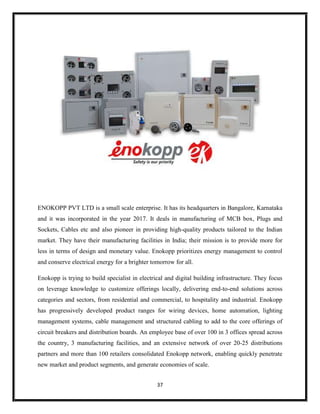
  • 32.
    32 SCOPE OF THESTUDY Corporate Social Responsibility (CSR) is an essential part of every organisation, whether small or large, profit or non-profit oriented organisation. CSR activities are mostly practiced by large scale firms with large amount of contribution. This study focus on the CSR activities practiced by Small and Medium Scale Enterprises (SME’s). This study represents comprehensive review about the CSR activities practiced by Enokopp Pvt Ltd and its effects on the brand recognition of the company and it also study the effect of CSR on the sales of the company. RESEARCH METHODOLOGY This research aimed to determine awareness level of customer through CSR activities and also determine the customer preference and factors that influence customers to buy the products of Enokopp Pvt Ltd. Survey questionnaire was used to collect data from the customers of the organisation because questionnaire can cover large population with lower cost and shorter time. Self-adjusted questionnaire was adopted from past studies and questions are formed keeping in mind the objectives to be achieved. SAMPLE SIZE Sample is a group of people, object or items that are taken from a large population for measurement. The sample should be representative of the population to ensure that we can generalize the finding from the research sample to the population. The size of the sample is always less than the total size of the population. For the purpose of collecting data to support the research, the sample size chosen was 100 respondents. POPULATION The total element of the universe from which the sample is selected for the purpose of research is known as Population. The population selected for the research is the customers of the Enokopp Pvt Ltd.
  • 33.
    33 SAMPLE DESIGN A sampledesign is the framework, which serves as the basis for the selection of a survey sample and affects many other important aspects of a survey as well. The sample design provides the basic plan by which a sample is selected for the purpose of research. Simple Random sampling was used to collect data. Simple Random Sampling is a data collection technique where each individual is chosen entirely by chance and each individual of the population has an equal opportunity of getting selected, or probability of being selected. The universe selected is Enokopp Pvt Ltd. SOURCE OF DATA There are basically two sources of data collection: Primary and secondary sources Primary data: Is the data collected by a researcher from first-hand sources, using methods like survey, interviews, or experiments. The data used for this study is basically collected from primary source and as well as secondary data. Here Primary data is collected through structured questionnaire survey through Google forms sent to respondents for filling out the details. Secondary Data: This refers to data that is collected by means of data collected by some other than the user. Common sources of secondary data are census, research papers etc. Secondary source is also used like others research papers related to CSR to get an in-depth knowledge about the CSR. TOOLS FOR DATA COLLECTION The research instrument used for this study is a structures questionnaire. The questionnaire was formulated keeping in mind the following points: 1) Giving the respondent clear comprehension of the questions. 2) Giving clear instruction about what is needed. 3) Framed detailed and comprehensive questions. 4) Keeping objectives as a base while framing the questionnaire.
  • 34.
    34 Online questionnaires wereformed using Google forms for the survey and were sent to the respondents for their response. A questionnaire is a research instrument that consists of a series of questions related to a particular topic for the purpose of gathering information from the respondents. The questionnaire should be clear and simple to understand. It can be done physically or digitally. The mode used in my research is online Google form. Personal observation is also used so as to interpret the question and come to a conclusion. PLAN OF ANALYSIS The analysis of the data collected by issuing the questionnaire is going to be analysed with the help of charts and bar diagrams. The presentation of these tools will clearly help in the analysis. OPERATIONAL DEFINITION An operational definition is a result of the process of operationalization and is used to define something (e.g. - a variable, term, or object) in terms of a process or set of valuation test needed to determine its existence, duration, and quantity. Since the degree of operationalization can vary itself, it can result in a more or less operational definition. The procedure included in definition should be repeatable by anyone or at least by peers. In this study, definition of Corporate Social Responsibility (CSR) by European Union is used in this research. LIMITATION  The period is very short.  The size of the sample is low when compared to the total population.  The study was limited to extent of the abilities and willingness of the respondents to answer appropriately to the questions.
  • 35.
    35 OVERVIEW OF CHAPTERSCHEME • Chapter 1: Introduction This chapter includes a brief introduction to the topic Corporate Social Responsibility. • Chapter 2: Literature Review This Chapter includes the brief description of the research done by the authors of the topics closely related to my research to get an idea of the Topic and Research. • Chapter 3: Research Design This chapter gives the plan of study, which includes the objectives, need of the study, statement of problem and source of data. • Chapter 4: Profile of the company This chapter contains the profile of Enokopp Pvt Ltd. where the research was conducted. • Chapter 5: Analysis and Data Interpretation In this chapter, the data collected through the primary source is analysed using charts and tables and inferences are drawn on the same. • Chapter 6: Summary of Findings, Suggestions and Conclusion This chapter basically contains the results of the study, so that one can get an overall picture of the findings obtained on the basis of which suggestions are made.
  • 36.
  • 37.
    37 ENOKOPP PVT LTDis a small scale enterprise. It has its headquarters in Bangalore, Karnataka and it was incorporated in the year 2017. It deals in manufacturing of MCB box, Plugs and Sockets, Cables etc and also pioneer in providing high-quality products tailored to the Indian market. They have their manufacturing facilities in India; their mission is to provide more for less in terms of design and monetary value. Enokopp prioritizes energy management to control and conserve electrical energy for a brighter tomorrow for all. Enokopp is trying to build specialist in electrical and digital building infrastructure. They focus on leverage knowledge to customize offerings locally, delivering end-to-end solutions across categories and sectors, from residential and commercial, to hospitality and industrial. Enokopp has progressively developed product ranges for wiring devices, home automation, lighting management systems, cable management and structured cabling to add to the core offerings of circuit breakers and distribution boards. An employee base of over 100 in 3 offices spread across the country, 3 manufacturing facilities, and an extensive network of over 20-25 distributions partners and more than 100 retailers consolidated Enokopp network, enabling quickly penetrate new market and product segments, and generate economies of scale.
  • 38.
    38 They follow theprinciple of ‘Frugal Engineering,’ and it shifts our focus from “how to improve this product” to “how to make this product more accessible” so that all our customers can say, “This makes sense’. We continuously strive to deliver high-quality products suited to the Indian market. JOURNEY OF THE FIRM From last 6 years, firm has developed the name in their market. In 2017, Enokopp product was launched in the market with 6-7 varieties of the products. Firm did not perform as it was accepted to perform in the market. So, firm has circulated the feedback form so that they can meet the needs and expectation of the customers. They found that the customers are not satisfied with the quality of the products which launched by them. So their sales were low in the year 2017. In 2018, firm worked on their product quality and pricing strategy. During the year under review, Enokopp was accepted by the public, it was over the expectation. In the same year they developed the product and bought the new varieties of the product in the market. Still they were receiving the complaints related to pricing. They were working on the pricing strategy, they were facing problem to reduce their cost. So they started to make products, which were essential for the production of the product rather than purchasing it from other manufactures. In 2019, Firm started to grow and also had a good amount of sales in that year. They also got award to capture the market in limited time. They also entered e-commerce sector by starting their operations through e-commerce platform. They started selling their product through their website and other business website. They also started their marketing through social media marketing. In 2020, firm had to face lot of crisis due to covid-19, because of that their sales went down in that year. Then to they took care of their workers who were working in their firm. They were taking care of all their essentials and also realized the importance of helping people. In covid-19 they started helping people who were in need and slowly they started their CSR activities. In 2021, they have a capture good amount of audience through their marketing in sales and also through their CSR activities. Due to which they had a good amount of sales in that year.
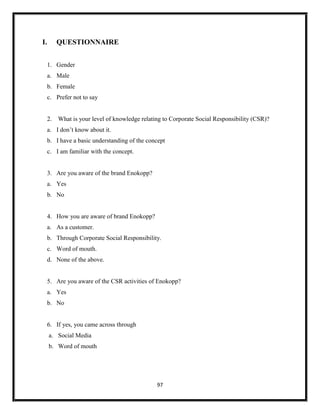
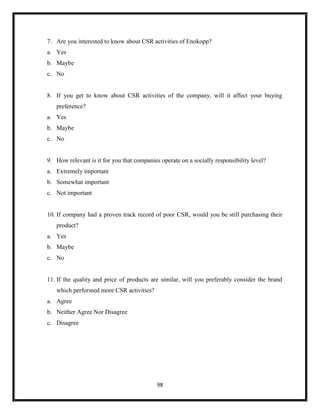
  • 39.
    39 GENERAL INFORMATION Name ofthe firm – ENOKOPP PVT LTD Status – Sole Proprietorship Founded – 2017 Headquarters – Bangalore, Karnataka, India Owner – Mahendra Ratadiya, Vipul Ratadiya Website - www.enokopp.com Vision  We will take steps to understand how we can most effectively support the needs of the local community and implement initiatives accordingly.  We recognize that our social, economic and environmental responsibilities to these stakeholders are integral to our business.  We aim to demonstrate these responsibilities through our actions and within our corporate policies.  We take seriously all feedback that we receive from our stakeholders and, where possible, maintain open dialogue to ensure that we fulfill the requirements outlined within this policy.  We are Maintaining quality of life by ensuring safe, efficient and convenient and affordable use of electricity Mission  We shall ensure a high level of business performance while minimizing and effectively managing risk ensuring that we uphold the values of honesty, partnership and fairness in our relationships with all our stakeholders.  We shall encourage suppliers and contractors to adopt responsible business policies and practices.  We shall encourage dialogue with local communities for mutual benefit.
  • 40.
    40  We shallmaintain a clear and fair employee remuneration policy.  We shall provide, and strive to maintain, a clean, healthy and safe working environment of work.  We shall develop Environmental policies and objectives as part of the business planning cycle.  Providing good quality of product with affordable price. Tagline - “Safety is our Priority” PRODUCTS CATEGORIES  RCCB's RCCB stands for Residual Current Circuit Breaker. RCCB is an electrical wiring device that disconnects the circuit as soon as it detects a current leak to the earth wire. It also protects against electric electrocution or shock caused by direct contact. Range: RCCB’s are available in 2 Pole (DP) and 4 pole (FP) options.  SINGLE AND DOUBLE DOOR DB's a. SPN The term SPN stands for ‘single phase and neutral’. This means that the circuit has only one single phase input, with several single-phase outputs. The main single phase supply cable comes into the board and the current is then distributed to the different circuits like lights and plugs. Before the current passes to the circuits, it first goes through circuit breakers. These circuit breakers keep you safe by preventing the flow of current to the circuit in case of current overload or voltage fluctuation. Range: SPN distribution boards are available in 4-Way, 8- Way, 10-Way, 12-Way options. b. TPN TPN means a 4 Pole device with 4th Pole as Neutral. In TPN opening & closing will open & close the Neutral. For TPN, protection applies to the current flows through only 3 poles (Three Phase) only; there is no protection for the current
  • 41.
    41 flow through theneutral pole. Neutral is just an isolating pole. Range: TPN distribution boards are available in 4-Way, 6-Way, and 8-Way options. c. There are more varieties in Distribution Box (DB), rest of the them are - PLATIMUM DB, P-GOLD DB, OSSUM DB, ROYAL DB, PEARL DB, DELUXE DB, WHITELINE DB etc. Each product is different from each other based on the prices and the quality. Each product available ranges are – 4 Way, 6 Way, 8 Way, 10 Way, 12 Way and 16 Way.  MCB BOX AND MINI MCB's MCB stands for Miniature Circuit Breakers. The MCB is an electromechanical device that switches off the circuit automatically if an abnormality is detected. The MCB easily senses the overcurrent caused by the short circuit. The miniature circuit has a very straightforward working principle. Additionally, it has two contacts; one fixed and the other movable. If the current increases, the movable contacts are disconnected from the fixed contacts, making the circuit open and disconnects them from the main supply. Range: MCB Box is available in 2 Pole (DP) and 4 pole (FP) options.  METAL CLAD PLUG & SOCKET A plug is the movable connector attached to an electrically operated device, and the socket is fixed on equipment or a building structure and connected to an energized electrical circuit. Ranges available from - 20A/2P – PLUG, 20A/3P – PLUG, 30A/3P – PLUG, 20A/2P – SOCKET, 20A/3P – SOCKET, 30A/3P – SOCKET.  A.C BOX This unit functions as the central location for circuit breakers within the AC system. The safe supply from multiple sources such as shore power, generator and inverter to each of the electrical consumers is controlled and the unit functions as the central location for circuit breakers within the AC system. Ranges available from - 20/2 EMPTY, 20/3 EMPTY, 30/3 EMPTY, 20/2 FULL SET, 20/3 FULL SET, 30/3 FULL SET.
  • 42.
    42  CABLES Power cablesare used for bulk transmission of alternating and direct current power, especially using high-voltage cable. Electrical cables are extensively used in building wiring for lighting, power and control circuits permanently installed in buildings.  ISOLATOR An isolator is a device used for isolating a circuit or equipment from a source of power. An isolator is a mechanical switching device that, in the open position, allows for isolation of the input and output of a device. Range: Isolator is available in 2 Pole (DP) and 4 pole (FP) options.  CHANGE OVER AND BUSBAR A changeover switch is designed to transfer a house (or business) electricity from the commercial power grid to a local generator when an outage occurs. Also known as “transfer switches,” they connect directly to the generator, commercial power supply or line, and the house. Busbars, also known as busbar trunking systems, distribute electricity with greater ease and flexibility than some other more permanent forms of installation and distribution.
  • 43.
    43 CSR ACTIVITIES OFTHE FIRM ENOKOPP has been adopted Corporate Social Responsibility in 2020 and also focused in sustained economic performance, environmental and social stewardship which is also a key factor for holistic business growth. Following are the activities which they have performed:  Hunger, Poverty, Malnutrition and Health: promoting preventive healthcare and sanitation and making available safe drinking water. In covid-19 many were suffering from hunger, so firm took the small initiative to and helped the poor people by giving them the food and also helped the orphanages by providing the basic essentials to them, they visited Akkamahadevi orphanage in akkipete and also helped the poor people by giving them a bath who were disable to walk.  Rural Development Projects: Strengthening rural areas by improving accessibility, housing, drinking water, sanitation, power and livelihoods, thereby creating sustainable villages. Firm has joined the champs, to help the rural people by providing them proper drinking water. They also spread awareness of hygiene among the people of the rural areas.  Gender Equality and Empowerment of Women: setting up homes, hostels and day care centers for women and orphans; setting up old age homes and such other facilities for senior citizens; and adopting measures for reducing inequalities faced by socially and economically backward groups. Firm also visited the old age homes and contributed to the old age home based on their capacities.  Environmental Sustainability: Ensuring environmental sustainability, ecological balance, protection of flora and fauna, animal welfare, agro-forestry, conservation of natural resources and maintaining the quality of soil, air and water. Firm mainly focused in this area, they planted the trees in different area of the Bengaluru.
  • 44.
    44  Visited Schools:Providing the essentials to the children, entertaining them and spread awareness among the children. Firm also took initiative to distribute the basic essentials to the children, they even played games with them. Also spread awareness about the good habits, provided education of good touch and bad touch, and many more.
  • 45.
    45 CHAPTER - V ANALYSISAND DATA INTERPRETATION
  • 46.
    46 DATA ANALYSIS ANDINTERPRETATION Data analysis and interpretation is the process of assigning meaning to the collected information and determining the conclusions, significance, and implications of the findings. Data analysis is the process of cleaning, transforming and modeling data to discover useful information. The purpose of data analysis is to extract useful information from the data collected and taking the decision based upon the data analysis. The collected data is to be edited, coded, classified and then analysed to extract meaningful information from the observed data. A number of tables are prepared to bring out the main characteristics of the data. From the analysis, interpretation can be drawn on the observation of the study. Based on the findings of the study, the researcher is able to conclude on the research problem used. The questions in the questionnaire are asked in three different parts in accordance with the objectives of the study:  To ascertain the impact of CSR activities on brand recognition.  To analyze an effect of CSR on the sales of the company.  To access the relationship between CSR activities and customer trust.  To analyze the customer preference towards ENOKOPP PVT LTD.
  • 47.
    47 I. To ascertainthe impact of CSR activities on brand recognition. Question 1 Gender a. Male b. Female c. Prefer not to say Table 5.1: Table showing gender group of respondents. Options No. of respondents Percentages Male 75 75% Female 25 25% Prefer not to say - - Total 100 100% ANALYSIS According to the survey, we can see that out of 100 respondents, 75% of the respondents are male customers and 25 % of the respondents are female customers. Whereas no customer i.e. 0 respondents chose the option called Prefer not to say.
  • 48.
    48 Graph 5.1: Graphshowing gender group of respondents. INTERPRETATION This question was asked to know the majority of the customer and according to this analysis it is seen that as per the response 75% of the customer are male and only 25% of the customer is female. It may be due to large no. of male customers in the market as compare to the female customers. 75% 25% No. of Respondets Male Female Prefer not to say
  • 49.
    49 QUESTION 2 What isyour level of knowledge relating to Corporate Social Responsibility (CSR)? a. I don't know about it. b. I have a basic understanding of the concept. c. I am familiar with the concept. Table 5.2: Table showing level of knowledge relating to Corporate Social Responsibility. Options No. of respondents Percentages I don't know about it. 14 14% I have a basic understanding of the concept 40 40% I am familiar with the concept 46 46% Total 100 100% ANALYSIS According to this survey, we can see that 46% of the respondents are properly familiar with the concept of Corporate Social Responsibility, 40% of respondents have just a basic understanding about the concept and 14% of the respondents are not even aware of the concept of CSR.
  • 50.
    50 14% 40% 46% 0% 5% 10% 15% 20% 25% 30% 35% 40% 45% 50% I don't knowabout it. I have a basic understanding of the concept I am familiar with the concept. No. of Respondets Graph 5.2: Graph showing level of knowledge relating to Corporate Social Responsibility. INTERPRETATION This particular question was asked to understand the level of knowledge of the customer relating to Corporate Social Responsibility, and from the above analysis we can see that less than half of the respondents are actually aware of the concept and 14% of the respondents are not even have a knowledge relating to CSR, this may be due to lack of awareness about the concept of CSR among the customers.
  • 51.
    51 QUESTION 3 Are youaware of the brand Enokopp? a. Yes b. No Table 5.3: Table showing awareness of the Brand Enokopp. Options No. of respondents Percentages Yes 63 63% No 37 37% Total 100 100% ANALYSIS According to this survey, we can see that out of 100 respondents 63% of the respondents are aware of the brand Enokopp and only 37% of the respondents aren’t aware of the brand Enokopp, it may be due to lack of proper marketing.
  • 52.
    52 Graph 5.3: Graphshowing awareness of the Brand Enokopp. INTERPRETATION This question was asked to understand the awareness of the brand and this analysis shows the positive response, more than 50% of the respondents i.e. 63% of the respondents are aware of the brand Enokopp and co. need to focus on 37% also and make them aware of the brand and products of the Enokopp. 63% 37% No. of Respondets YES NO
  • 53.
    53 QUESTION 4 How areyou aware of brand Enokopp? a. As a customer b. Through Corporate Social Responsibility c. Word of mouth d. None of the above Table 5.4: Table showing how people are aware of the brand Enokopp. Options No. of respondents Percentages As a customer 56 56% Through Corporate Social Responsibility 20 20% Word of mouth 14 14% None of the above 10 10% Total 100 100% ANALYSIS According to this survey we can see that 56% of the respondents know the brand because they are the customer of the brand, 20% and 14% know the brand through CSR activity of the company and Word of mouth respectively. 10% of the respondents are not sure of how they got aware of the brand Enokopp.
  • 54.
    54 Graph 5.4: Graphshowing how people are aware of the brand Enokopp. INTERPRETATION This question was asked to understand how respondents got aware of the brand Enokopp. The above analysis shows that more that 50% of respondents are aware of the brand because they are the customer, but only 20% of the respondents know the brand through CSR activity, it may be due to lack of marketing. Company need to focus on marketing element and make aware of the brand to the public. 56% 20% 14% 10% No. of Respondents As a customer Through Corporate Social Responsibility Word of mouth None of the above
  • 55.
    55 QUESTION 5 Are youaware of the CSR activities of ENOKOPP? a. Yes b. No Table 5.5: Table showing how many people are aware of the CSR activities of Enokopp. Options No. of respondents Percentages Yes 67 67% No 33 33% Total 100 100% ANALYSIS According to this survey, we can see that 67% of the respondents are aware of the CSR activities of the company and 33% of the respondents are not aware of the CSR activities of the Enokopp. This may due to lack of productive marketing among the customers.
  • 56.
    56 Graph 5.5: Graphshowing how many people are aware of the CSR activities of Enokopp INTERPRETATION This question was asked to understand the awareness of the CSR activities of the brand Enokopp. Above analysis shows that more than 50% of the respondents are aware of the CSR activities of the company and yet 33% of the respondents are not aware, it may be because of lack of marketing and awareness among the customers. So company needs to focus on the marketing element and they need to market their CSR activities, so that people get aware of the activities. 67% 33% No. of respondents Yes No
  • 57.
    57 QUESTION 6 If yes,you came across through a. Social media b. Word of mouth Table 5.6: Table showing how people came across CSR activities of Enokopp. Options No. of respondents Percentages Social media 27 40% Word of mouth 40 60% Total 67 100% ANALYSIS According to this survey, we can see that the people out of 100 respondents, 67% of them are aware of the CSR activities among them 60% of the respondents got aware through word of mouth and 40% of the respondents got aware through social media.
  • 58.
    58 Graph 5.6: Graphshowing how people came across CSR activities of Enokopp. INTERPRETATION This question was asked to understand from which source respondents got aware of the CSR activities of the Enokopp. Above analysis shows that 40% of the respondents got aware through social media. Company needs to focus on social media marketing, so that they can cover larger audience with lower cost and should also focus on the other half, who are not aware of the activities, Company can use social media marketing to create awareness among the customers. 40% 60% 0% 10% 20% 30% 40% 50% 60% 70% Social Media Word of mouth No. of Respondents
  • 59.
    59 QUESTION 7 Are youinterested to know about CSR activities of Enokopp? a. Yes b. Maybe c. No Table 5.7: Table showing People’s interest to know CSR activities of Enokopp. Options No. of respondents Percentages Yes 57 57% Maybe 38 38% No 05 05% Total 100 100% ANALYSIS According to this survey, we can see that 57% of the respondents are interested to know the CSR activities and 38% of the respondents chose maybe option and 5 % of the respondents are not interested to know the CSR activities of Enokopp.
  • 60.
    60 Graph 5.7: Graphshowing People’s interest to know CSR activities of Enokopp. INTERPRETATION This question was asked to understand if people are interested to know CSR activities of Enokopp. Above analysis shows that more than 50% of the respondents are interested to know the CSR activities. Company should make awareness about the CSR activities and should build the importance of CSR activities in the mind of the customers. 57% 38% 5% No. of Respondents Yes May be No
  • 61.
    61 II. To accessthe relationship between CSR activities and customer trust QUESTION 8 If you get to know about CSR activities of the company, will it affect your buying preference? a. Yes b. Maybe c. No Table 5.8: Table showing effect of CSR activities of the company, on the buying preference of the customer. Options No. of respondents Percentages Yes 37 37% Maybe 44 44% No 19 19% Total 100 100% ANALYSIS According to this survey, we can see that 37% of the respondents chose option yes which means CSR do affect their buying preference and 19% of the respondents CSR does not affect their buying preference. 44% of the respondents chose option maybe which suggest CSR may affect may not affect their buying preference.
  • 62.
    62 Graph 5.8: Graphshowing effect of CSR activities of the company, on the buying preference of the customer. INTERPRETATION This question was asked to understand relationship of CSR with customer preferences. Above analysis shows that less than 50% of the population shows interest to know and understand the CSR activities of the company. Only 37% of the respondent’s preference gets affected by CSR and 19% of the respondents do not give so importance to the CSR activities of the company. 0 5 10 15 20 25 30 35 40 45 Yes May be No 37% 44% 19% No. of Respondents
  • 63.
    63 QUESTION 9 How relevantis it for you that companies operate with socially responsibility level? a. Extremely important b. Somewhat important c. Not important Table 5.9: Table showing how relevant is for people that companies operate on a socially responsibility level. Options No. of respondents Percentages Extremely important 55 55% Somewhat important 21 21% Not important 24 24% Total 100 100% ANALYSIS According to this survey, we can see that 55% of the respondents think CSR is extremely important for the 24% of the respondents does not think that CSR is important and 21% of respondents think it is somewhat important which indicates that CSR activities may or may not affect the customers.
  • 64.
    64 Graph 5.9: Graphshowing how relevant is for people that companies operate on a socially responsibility level. INTERPRETATION This question was asked to understand the relevancy of CSR activities with respect to the customers. Above analysis shows that more than 50% of the respondents think CSR is important of the society. This analysis shows positive sign, but 24% of respondents do not feel that CSR is important for the society. Company should make aware about the concept of CSR and then they so publish or do the marketing about their CSR activities. 55% 21% 24% 0% 10% 20% 30% 40% 50% 60% Extremely important Somewhat important Not important Percentages No. of Respondents
  • 65.
    65 QUESTION 10 If companyhad a proven track record of poor CSR, would you be still purchasing their product? a. Yes b. Maybe c. No Table 5.10: Table showing if company had a proven track record of poor CSR, would people be still purchasing that company product. Options No. of respondents Percentages Yes 34 34% Maybe 38 38% No 28 28% Total 100 100% ANALYSIS According to this survey, we can see that 34% of respondents say that poor CSR will affect their buying preference, 28% of respondents chose no option which means that poor CSR will not affect their buying preference and 38% of respondents chose maybe option which says it may, may not affect their buying preference.
  • 66.
    66 Graph 5.10: Graphshowing if company had a proven track record of poor CSR, would people be still purchasing that company product. INTERPRETATION This question was asked to understand the effect of poor CSR on the buying preference of the customer. Above analysis shows that more than 50% of the respondents (considering may be option) will get affected by the poor track record of CSR activities of the company. Company should focus on maintaining good track record of CSR activities because it will affect their brand image and it will also affect their sales. 34% 38% 28% No. of Respondnets Yes Maybe No
  • 67.
    67 QUESTION 11 If thequality and price of products are similar, will you preferably consider the brand which performed more CSR activities? a. Agree b. Neither Agree Nor Disagree c. Disagree Table 5.11: Table showing preference of the customer, if co. performs CSR activities. Options No. of respondents Percentages Agree 44 44% Neither Agree Nor Disagree 40 40% Disagree 16 16% Total 100 100% ANALYSIS According to this survey we can analyze that 44% of the respondents will consider the brand which performed more CSR activities even if the quality and price of products are similar with the other brand. 40% of the respondents had neither agreed nor disagreed and 16% of the respondents didn’t agree with the following question asked.
  • 68.
    68 Graph 5.11: Graphshowing preference of the customer, if co. performs CSR activities. INTERPRETATION This question was asked to understand if customer will prefer the brand which is performing the CSR activities as compare to the brand which is not performing even if their quality and price are similar. Above analysis show that less than 50% of the respondent has agreed with following question asked. Company should spread awareness about their CSR activities among their customers. 44% 40% 16% 0% 5% 10% 15% 20% 25% 30% 35% 40% 45% 50% Agree Neither agree nor disagree Disagree No. of Respondents
  • 69.
    69 III. To analyzethe customer preference towards ENOKOPP. QUESTION 12 How satisfy are you with the current feature of product of the Enokopp? Rate your satisfaction level. Not satisfied Satisfied 1 2 3 4 5 Table 5.12: Table showing customer satisfaction in relation with Enokopp product. Options No. of respondents Percentages 1 5 5% 2 13 13% 3 25 25% 4 39 39% 5 18 18% Total 100 100% ANALYSIS According to this survey, we can see that more responses received are for rating 4 that is 39% of the respondents are almost satisfied and 18% of respondents are full satisfied and 25% of respondents are neither satisfies nor dissatisfied. Leftover 18% are not satisfied by the product.
  • 70.
    70 Graph 5.12: Graphshowing customer satisfaction in relation with Enokopp product INTERPRETATION This question was asked to analysis the satisfaction of the customers with regard to Enokopp products. Above analysis shows that more than 50% of the respondents are satisfied. Firm has to focus on other half of the respondents who are not satisfied by the product or services of the Enokopp. 5% 13% 25% 39% 18% 0 5 10 15 20 25 30 35 40 45 1 2 3 4 5 Percentages Ratings from Not satisfied to Satisfied No. of Respondents
  • 71.
    71 QUESTION 13 Which factorsaffect your buying decision of the products of Enokopp? a. Price b. Brand c. Quality Table 5.13: Table showing factors that affect the buying decision of the customer. Options No. of respondents Percentages Price 26 26% Brand 31 31% Quality 43 43% Total 100 100% ANALYSIS According to this survey, we can analyze that 43% of the respondent buy the product based on the quality, 26% of the respondents buy based on the price and 31% of respondents buy based on the brand name of the company.
  • 72.
    72 Graph 5.13: Graphshowing factors that affect the buying decision of the customer. INTERPRETATION This question was asked to understand the factors which affect the buying decision of the customers. Above analysis show that more responses received are for the quality, which is a positive sign because quality of the product will help the firm to retain their customers. Company should make awareness about CSR activities of their firm, so that it will also help the firm to retain their brand name. 26% 31% 43% No. of Respondents Price Brand Quality
  • 73.
    73 QUESTION 14 Which factorsdiscourage you to buy the product of Enokopp? a. Price b. Quality c. Services d. None of the above Table 5.14: Table showing factors that discourage customer to buy the product of Enokopp. Options No. of respondents Percentages Price 13 13% Quality 21 21% Services 41 41% None of the above 25 25% Total 100 100% ANALYSIS According to this survey, we can see that 41% of the respondents are discourage to buy the product of the company because of their services rendered, 13% and 21% of the respondents are discourage due to price and quality of the product respectively.
  • 74.
    74 Graph 5.14: Graphshowing factors that discourage customer to buy the product of Enokopp. INTERPRETATION This question was asked to understand the discouraging factors which stop the customer to buy the product of the company. Above analysis shows the highest discouraging factors which affect the customers preference to buy the product is the services rendered by the company. Company need to focus on improving their services to their customer because service is one of the factors which affect the customer to retained in the company. 0% 5% 10% 15% 20% 25% 30% 35% 40% 45% Price Quality Services None of the above 13% 21% 41% 25% No. of Respondents
  • 75.
    75 QUESTION 15 How doyou feel about this brand? a. Positive b. Neutral c. Negative Table 5.15: Table showing customer feeling with respect to the brand Enokopp. Options No. of respondents Percentages Positive 37 37% Neutral 58 58% Negative 05 05% Total 100 100% ANALYSIS According to this survey, we can see that 58% of the respondents feel positive about the company, 37% of the respondents feel neutral and 5% of the respondents feel negative about the company.
  • 76.
    76 Graph 5.15: Graphshowing customer feeling with respect to the brand Enokopp. INTERPRETATION This question was asked to understand the customer feeling with respect to the brand Enokopp. Above analysis shows that more than 50% of the respondents feel positive about the brand and that is a positive sign. There are a 5% of the respondents which feel negative about the brand; company can try to make the positive impact about the brand in the mind of the customers. 37% 58% 5% No. of Respondents Positive Neutral Negative
  • 77.
    77 QUESTION 16 What doyou feel about the pricing strategy of products of Enokopp? a. High b. Moderate c. Low Table 5.16: Table showing pricing strategy of products of Enokopp. Options No. of respondents Percentages High 35 35% Moderate 49 49% Low 16 16% Total 100 100% ANALYSIS According to this survey, we can analysis that highest responses are for the moderate that is 49%. 35% of the respondents say that the prices of the products are high and 16% of the respondents say that the prices of the product are low.
  • 78.
    78 Graph 5.16: Graphshowing pricing strategy of products of Enokopp. INTERPRETATION This question was asked to understand the pricing strategy of the firm; almost 50% of the respondents feel the prices of the product are moderate. More than 3/4th of the respondents feel the prices of the product are high; this may affect the customer to buy the product from this company. Firm should educate the customers about the quality of the product, so that they can analysis and make an effective decision. 0% 5% 10% 15% 20% 25% 30% 35% 40% 45% 50% High Moderate Low 35% 49% 16% No. of Respondents
  • 79.
    79 QUESTION 17 How welldo Enokopp brand products meet your needs? a. Extremely well b. Somewhat well c. Not so well Table 5.17: Table showing how well company meets the customer needs. Options No. of respondents Percentages Extremely well 35 35% Somewhat well 53 53% Not so well 12 12% Total 100 100% ANALYSIS According to this survey, we can see that 35% of the respondents needs are extremely well satisfied, 53% of the respondents needs are somewhat met and 12% of the respondents needs and not satisfied.
  • 80.
    80 Graph 5.17: Graphshowing how well company meets the customer needs. INTERPRETATION This question was asked to understand that how well company meets the customer needs. More than 50% of the respondents needs are averagely met and there are still 12% of the respondents whose needs are not met. Company primary focus should be to meet the needs of the customer, then only the customer will retain in the firm. 35% 53% 12% No. of Respondets Extremely well Somewhat well Not so well
  • 81.
    81 QUESTION 18 How oftendo you buy Enokopp brand products per month? a. 1 - 8 times b. 9 - 16 times c. 17 or more times d. No Table 5.18: Table showing purchasing power of the customer. Options No. of respondents Percentages 1-8 times 41 41% 9-16 times 30 30% 17 or more times 11 11% No 18 18% Total 100 100% ANALYSIS According to this survey, we can see that highest responses is 41% which means 41% of the respondents buy the product 1-8 times in a month, second highest is 30% which says 30% of the respondents have a purchasing power of 9-16 times in a month. 11% of the respondents have a purchasing power of 17 or more times in a month. 18% of the respondents did not buy the product of the firm.
  • 82.
    82 Graph 5.18: Graphshowing purchasing power of the customer. INTERPRETATION This question was asked to understand the purchasing power of the customers. Above analysis showed the positive sign, highest percentage is 41% i.e. customers buy 1-8 times in a month and there is still 18% of the customers haven’t purchased the product of the Enokopp. Company need to encourage the customers to buy the product of the company make them aware about the price, quality and others factors of the product. 0% 10% 20% 30% 40% 50% 1-8 times 9-16 times 17 or more times No 41% 30% 11% 18% No. of Respondents
  • 83.
    83 QUESTION 19 What improvementwould you prefer in the product of Enokopp? a. Quality b. Pricing c. Services Table 5.19: Table showing Improvement needed in the product of Enokopp. Options No. of respondents Percentages Quality 22 22% Pricing 15 15% Services 63 63% Total 100 100% ANALYSIS According to this survey, we can see that 63% of the respondents want an improvement in the services which is rendered by the company. 22% of the respondents want improvement in the quality of the product and 15% of the respondents want an improvement in the pricing strategy of the firm.
  • 84.
    84 Graph 5.19: Graphshowing Improvement needed in the product of Enokopp. INTERPRETATION This question was asked to understand the factors which must be improved and above analysis showed that more than 50% of the respondents want improvement in the services which is render by the company. Firm should improve their quality of services because it is one of the factors which may affect the customer not to buy the product of the Enokopp. 22% 15% 63% No. of Respondents Quality Pricing Services
  • 85.
    85 QUESTION 20 Will yourecommend others to buy the products of Enokopp? a. Yes b. May be c. No Table 5.20: Table showing customers recommendation to others with respect of the product of the Enokopp. Options No. of respondents Percentages Yes 64 64% Maybe 27 27% No 09 09% Total 100 100% ANALYSIS According to this survey, we can see that 64% of the respondents will recommend others to buy the product of the Enokopp, 27% of the respondents may or may not recommend others to buy the product and 9% of the respondents will not recommend others to buy the product of the Enokopp.
  • 86.
    86 Graph 5.20: Graphshowing customers recommendation to others with respect of the product of the Enokopp. INTERPRETATION This question was asked to understand weather the customers will recommend others to buy the product of the Enokopp. Above analysis showed a positive sign i.e. more than 50% of the respondents will recommend the products of the Enokopp to others. Upon this company should also focus on the marketing segment and make aware about the CSR activities to the customers. 64% 27% 9% No. of Respondents Yes Maybe No
  • 87.
    87 IV. To analyzean effect of CSR on the sales of the company. Graph 5.21: Graph showing the effect of CSR on the sales of the company. ANALYSIS According to company data, we can see that from 2017 – 2019 there is the positive increase in the sales of the company. In the year 2020 we can see that there is fall in the sales it may be because of the covid -19, many firm had to face lockdown due to which their sales have gone down. From 2021 firm has started with their CSR activities and we can clearly see that there is good impact on the sales and there is good amount of increment in the sales of the company. 0 500000 1000000 1500000 2000000 2500000 3000000 3500000 4000000 2017 2018 2019 2020 2021 2022 Sales revenue in rupees Years Sales of the company
  • 88.
    88 INTERPRETATION This analysis isdone to understand the impact of CSR on the sales of the company. Above analysis shows that there is an impact of CSR on the sales of the company and firm have to spread awareness about the CSR activities among their customers, which may further have a positive impact on the sales of the company and it will also help them to retain the brand name and brand recognition in the mind of the customers.
  • 89.
    89 CHAPTER - VI SUMMARYOF FINDINGS, CONCLUSION AND SUGGESTIONS
  • 90.
    90 SUMMARY OF FINDINGS Thestudy was carried out to find out if there is impact of corporate social responsibility on brand recognition of the company and effect of CSR on the customer preference. The summaries of findings of all the section of the questions are as follows:  First section of the study was conducted to determine if there is any impact of CSR activities on the brand recognition. The study indicates that CSR do have an impact on the brand recognition and survey also shows that there is a positive impact on the brand recognition and it is also beneficiary to firm to some extent.  Second section of the study was to determine relationship between CSR activities and customer trust and preference. The study indicates that there is an indirect relationship of CSR with the customers. Survey shows that CSR does influence some customers to buy the product.  Third section of the study was to determine the customer preference towards Enokopp. This study helped to determine the different preferences of the customers, their needs and their expectation with respect to the product of Enokopp and survey also clearly showed the preference of customers , their wants and their expectations with respect to the product of Enokopp.  Forth section of the study was to determine the effect of CSR on the sales of the company. The study indicates that there is positive impact of CSR on the sales of the company. Survey indicates there was averagely increment in the sales irrespective of the year 2020, because there was a fall in sales due to covid-19.
  • 91.
    91 CONCLUSIONS In conclusion, businessescan no longer operate with the sole aim of making profits at the expense of the environment, society, economy, consumers and employees. Companies need to consider how they can give back to society, and this can help them to attract customers and keep their best employees. Customer satisfaction and employee retention are the keys to any successful business, after all. Corporate social responsibility (CSR) has been the subject of increasing public scrutiny, and consumers have become more concerned about whether enterprises are contributing to the betterment of society.  From this study conducted we can conclude that Corporate Social Responsibilities have a positive impact on company’s reputation and brand recognition. This research shows that when the company’s reputation enhances it will increase the image of corporate social responsibility. Similarly when the brand image of the company’s increases than the image of company’s corporate social responsibility also enhances.  From this study conducted we can conclude that CSR did increase the sales of the company, we can see positive increment in the sales of the company irrespective of the year 2020, because there was a downfall in the sale due the lockdown in the country. CSR does also affect the profit of the company because it is a small scale enterprise. According to law there are no mandatory regulations to contribute in CSR. The findings of the research resulted that CSR policies differ with turnover and profit.  From this study conducted we can conclude that there is indirect effect of CSR on the customer trust. More than 50% of the respondents get emotionally affected by the companies who are practicing CSR activities. CSR affect their purchasing behavior and also help to build the trust among the customers.  From this study we can conclude that different customers have different preference, needs, expectation with respect to the product of Enokopp. This study examined customer preference with respect of price, quantity and services. Most of the respondents are not satisfied by the services rendered by the firm.
  • 92.
    92 SUGGESTION  Firm shouldlook after the customer expectations and their needs. They should promote their product and make aware of CSR activities of the firm to their customers. Firm have to do more marketing because some people are not aware of the brand yet, they can use the social media platform like Instagram, Facebook etc and so that they can market about their product as well as also spread awareness about the CSR activities of the firm among their customers.  Firm should also focus on the improving their services, most of the customer are dissatisfied by the services rendered by the firm. Firm should focus on the service factors because it is one of the factors which retain the customers.  Doing CSR activities not only it helps to build the brand but it also affect the turnover and the profit of the firm, which may further affect the production of the small scale enterprise. There are no mandatory regulations to contribute in CSR because for some small and medium enterprises it will not improve the situation of companies, but simply may add to burden faced by them. Small or medium enterprises should follow ‘collective corporate social responsibilities, (CCSR) through which a group of SMEs with similar sustainability needs support and take up socially responsible activities, as a unit. SMEs can take help from other organizations by making cluster or a group, which are ready to support responsible business objectives and also help to achieve the social responsibility. The clusters provide a beneficial opportunity to SME’s to adopt social responsibilities collectively, which will serve the needs of the various stakeholders like workers, community, environment, customers etc and practice of CSR should be socio-culturally framed.
  • 93.
  • 94.
    94 BIBLIOGRAPHY Abhisekh Shah, KaushikPS , & Priya Malebennurc . (2017). The Scope Of Corporate Social Responsibility. Campopiano Giovannaa, De Massis Alfredoa, & Cassia Lucio . (2012). Corporate Social Responsibility: A Survey Among SME's In Bergamo. Procedia - Social and Behavioral Sciences, 325 – 341. Dr Anjali Bhatnagar, & Dr Anjali Arora . (2020). Corporate Social Responsibility During Covid- 19 Pandemic: Response Of Select Indian Companies. International Journal of Creative Research Thoughts, | Volume 9, Issue 8 . Hadjer Bouakkaz, & Houari Maaradj . (2017). Building Brand Image Through Corporate Social Responsibility Case Study On Mobilis Telecommunication Company. Journal Economic Issue, Vol 8., 343-357. Ho Thi Hai Thuy, & Ha Hien Minh . (2020). The Impact Of CSR On Brand Image: A Survey Amongst Gen Z Consumers’ Perception Toward A Supermarket Chain In Viet Nam. Research gate. Imran Ali, Ana Isabel , Jiménez-Zarco, & Marta Bicho. (2015). Using Social Media For CSR Communication And Engaging Stakeholders. Corporate Social Responsibility in the Digital Age. Won-Moo Hur, Hanna Kim, & Joon Hyo Jang . (2015). The Role Of Gender Differences In The Impact Of CSR Perceptions On Corporate Marketing Outcomes. Corporate Social Responsibility and Environmental Management, vol. 23(6), 345-357. Abdul Waheed , & Qingyu Zhang . (2020). Effect Of CSR And Ethical Practices On Sustainable Competitive Performance: A Case Of Emerging Markets From Stakeholder Theory Perspective. Journal of Business Ethics. Abhishek Tripathi, & Dr. Anupama Bains . (2013). A Study Of Indian CSR Practices In Small And Medium Enterprises. International Journal of Advanced Research in Management and Social Sciences .
  • 95.
    95 Alaya by benevity.(2020). BENEFITS OF CORPORATE SOCIAL RESPONSIBILITY FOR BUSINESS. Carroll. (1979). Carrol Paradigm. Chastity Heyward. (2020). The Growing Importance Of Social Responsibility In Business. Deepshikha. (n.d.). What are the limitations of CSR? The Company Ninja. European Union. (2001). Corporate Social Responsibility. Green Paper. Gautam Srivastava . (2019). Impact Of CSR On Company’s Reputation And Brand Image. Global Journal of Enterprise Information System. Hoi Wan Liu, Xiaoming Lu, & Mizan Rahman. (2017). The Impact Of Corporate Social Responsibility On Customer Loyalty: A Case For Two Global Corporations In China. Scholars Portal Jornals , 251-260. Howard Bowen. (1953). Corporate Social Responsibility. The Social Responsibility of the Businessman. Indian express. (2011). Contribution of SME's to Indian GDP. Indian express. Kirk Plangger, Douglas West, Hector Menendez , & Shintaro Okazaki. (2019). Exploring Digital Corporate Social Responsibility Communications On Twitter. Journal of Business Research, Volume 117, 675-682. Parveen Maan. (2014). CSR- Key Issues And Challenges In India. nternational Journal of Science, Environment and Technolog,Vol. 3, No 6, 2038 – 2045. Richa Gautam , & Anju Singh . (2013). Corporate Social Responsibility Practices In India: A Study Of Top 500 Companies. National Institute of Industrial Engineering, Volume: 2, 41-56. Ruchi Tewari , & Taral Pathak . (2014). Sustainable CSR For Micro, Small And Medium Enterprises. Journal of Management & Public Policy, Vol. 6, No. 1, , 34-44. Sandhya Mishra . (2016). Corporate Social Responsibility In Infosys Foundation.
  • 96.
    96 Sanheeta Rao. (2021).New amendments to the CSR Act. idr. Shaista Siddiq, & Sara Javed. (2014). Impact of CSR on Organizational Performance. European Journal of Business and Management, Vol.6, No.27. Shwu-Ing Wu, & Wen-Hsuan Wang. (2014). Impact of CSR Perception on Brand Image, Brand Attitude and Buying Willingness: A Study of a Global Café. Suresh Chandra Bihari, & Sudeepta Pradhan. (2011). CSR And Performance: The Story Of Banks In India. Journal of Transnational Management, 20-35. Wu Jiajun, & Huang Wanying. (2020). The impact of CSR on Brand equity: The moderating role of consumer involvement in CSR. DiVA. Xueming Luo , & C.B Bhattacharya. (2006). Corporate Social Responsibility, Customer Satisfaction, And Market Value. Journal of Marketing .
  • 97.
    97 I. QUESTIONNAIRE 1. Gender a.Male b. Female c. Prefer not to say 2. What is your level of knowledge relating to Corporate Social Responsibility (CSR)? a. I don’t know about it. b. I have a basic understanding of the concept c. I am familiar with the concept. 3. Are you aware of the brand Enokopp? a. Yes b. No 4. How you are aware of brand Enokopp? a. As a customer. b. Through Corporate Social Responsibility. c. Word of mouth. d. None of the above. 5. Are you aware of the CSR activities of Enokopp? a. Yes b. No 6. If yes, you came across through a. Social Media b. Word of mouth
  • 98.
    98 7. Are youinterested to know about CSR activities of Enokopp? a. Yes b. Maybe c. No 8. If you get to know about CSR activities of the company, will it affect your buying preference? a. Yes b. Maybe c. No 9. How relevant is it for you that companies operate on a socially responsibility level? a. Extremely important b. Somewhat important c. Not important 10. If company had a proven track record of poor CSR, would you be still purchasing their product? a. Yes b. Maybe c. No 11. If the quality and price of products are similar, will you preferably consider the brand which performed more CSR activities? a. Agree b. Neither Agree Nor Disagree c. Disagree
  • 99.
    99 12. How satisfyare you with the current feature of product of the Enokopp? Rank your satisfaction level Not satisfied. Satisfied 1 2 3 4 5 13. Which factors that affect your buying decision of the products of Enokopp? a. Price b. Brand c. Quality 14. Which factors discourage you to buy the product of Enokopp? a. Price b. Quality c. Services d. None of the above 15. How do you feel about this brand? a. Positive b. Neutral c. Negative 16. What do you feel about the pricing strategy of products of Enokopp? a. High b. Moderate c. Low 17. How well do Enokopp brand products meet your needs? a. Extremely well b. Somewhat well c. Not so well
  • 100.
    100 18. How oftendo you buy Enokopp brand products per month? a. 1 - 8 times b. 9 - 16 times c. 17 or more times d. No 19. What improvement would you prefer in the product of Enokopp? a. Quality b. Pricing c. Services 20. Will you recommend others to buy the products of Enokopp? a. Yes b. May be c. No
  • 101.
    101 ANY OTHER SOME OFTHE CSR ACTVITIES OF THE ENOKOPP  Hunger, Poverty, Malnutrition and Health.
  • 102.
  • 103.
    103  Visited Schoolsand Orphanages.