
COPD
Natural history- Clinical Manifestation
Where to start?
o History
o Examination
Natural history
 The often-quoted statistic that only 15-20 % of
smokers develop clinically significant COPD
is misleading and greatly underestimates
the toll of COPD.
 COPD has a variable natural history and not
all individuals follow the same course.
5
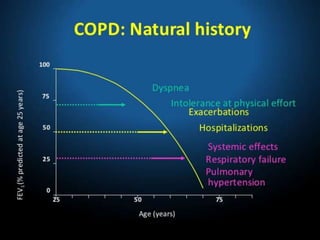
 COPD is generally a progressive disease,
especially if a patient's exposure to noxious
agents , most often tobacco smoking,
continues.
 An accelerated decline in lung function is
still the single most important feature of
COPD.
6
Natural history
 If exposure is stopped, the disease may still
progress, mainly due to the decline in lung
function that normally occurs with ageing.
 Nevertheless, stopping exposure to noxious
agents, even when significant airflow limitation
is present, can result in some improvement in
function and will slow or even hold the
progression of the disease.
7
Natural history
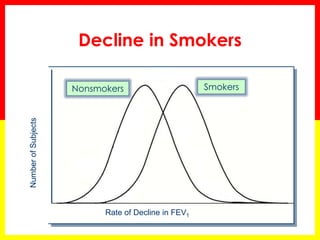
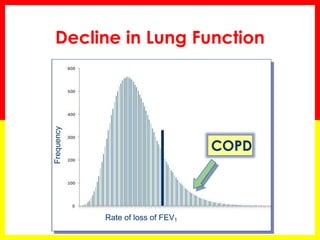
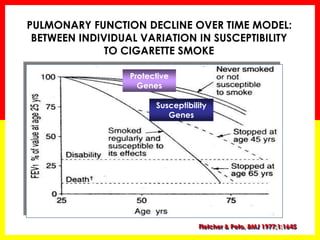
 Susceptible subjects have an accelerated
rate of decline of lung function (50-90ml of
FEV1/yr compared with 20-30ml of FEV1/yr
after the age of 30 in non-smokers).
 Subjects with COPD who stop smoking slow
down the progression of disease and may
return to normal levels of FEV1 decline.
8
 Not all people who smoke, however, develop
COPD; and not all patients with COPD are
smokers or have smoked in the past.
 There seems to be a varying susceptibility to
lung damage due to cigarette smoke within
the general population.
9
Natural history
 Not all smokers develop clinically significant
COPD, which suggests that additional factors
are involved in determining each individual's
susceptibility.
10
11
12
Fletcher and Peto
Charles Fletcher Richard Peto
Decline in Smokers
SmokersNonsmokers
Rate of Decline in FEV1
NumberofSubjects
Two Populations of Smokers?
NumberofSubjects
Rate of decline in FEV1
Normal
COPD
Decline in Lung Function
Frequency
Rate of loss of FEV1
COPD
Fletcher-Peto Diagram: 1977
18
Adapted from Fletcher CM, Peto R. Brit Med J. 1977;1:1645-1648.
Accelerated Lung-Function Decline
in COPD
0
20
40
60
80
100
20 30 40 50 60 70 80 90
Age (years)
Death
Disability
Symptoms
Nonsmoker
COPD
Fletcher & Peto, BMJ 1977;1:1645
Susceptibility
Genes
Protective
Genes
PULMONARY FUNCTION DECLINE OVER TIME MODEL:
BETWEEN INDIVIDUAL VARIATION IN SUSCEPTIBILITY
TO CIGARETTE SMOKE
Bucket and Spoon?
Maximum at age 25:
start with a bucketful
Lose FEV1 at a spoonful
(about 25 ml) per year:
natural ageing process
~ 1 litre over 40 years
Average Decrease in FEV1 / year
Males Females
Former
smokers
30 ml/year 22 ml/year
Current
smokers
66 ml/year 54 ml/year
Anthonisen NR, et.al. Am J Respir Crit Care Med 166:675-9, 2002.
Age 40-50 50-55 55-60 60-70
Age (years)
Death
Disability
Symptoms
Not SusceptibleSusceptible
Smokers
Stopped smoking
at 45 (mild COPD)
Stopped smoking
at 65 (severe COPD)
30 40 50 60 70 80 90
0
20
40
60
80
20
100
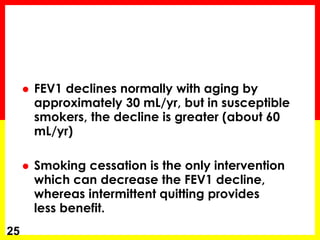
 "The normal rate of decline of FEV1 with age
is approximately 25-30 ml per year but it is
more rapid in those destined to develop
COPD
 Cigarette smokers have an average annual
loss of FEV1 which is 10-20 ml greater than
that of non-smokers.. . .
24
25
 FEV1 declines normally with aging by
approximately 30 mL/yr, but in susceptible
smokers, the decline is greater (about 60
mL/yr)
 Smoking cessation is the only intervention
which can decrease the FEV1 decline,
whereas intermittent quitting provides
less benefit.
26
COPD Disease Progression
28
29
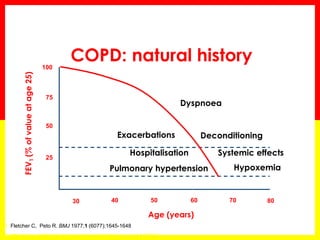
COPD: natural history100
5030 40 60 70 80
Age (years)
25
50
75
Dyspnoea
Exacerbations Deconditioning
Hospitalisation
Pulmonary hypertension Hypoxemia
Systemic effects
1. Fletcher C, Peto R. BMJ 1977;1 (6077):1645-1648
2. http://www.goldcopd.com/workshop/ch1.html (accessed 29605)
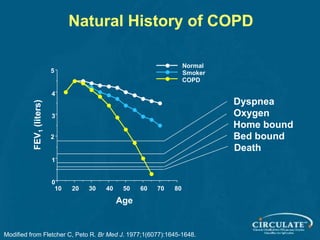
Natural History of COPD
8070605040302010
0
1
2
3
4
5
Normal
Smoker
COPD
Age
FEV1(liters)
Dyspnea
Oxygen
Home bound
Bed bound
Death
Modified from Fletcher C, Peto R. Br Med J. 1977;1(6077):1645-1648.
Sir William Osler
Listen to the
patient; he is
telling you
the diagnosis.
Diagnosis of COPD
Exposure History
 The history of exposure to risk factors, such as
smoking, or occupational or environmental
noxious agents, should be noted.
 A detailed smoking history is essential (pack-
years).
 Pack-years are calculated by multiplying the
number of pack equivalent smoked every day
by the total number of years.
35
 The most important risk factor for COPD is cigarette
smoking and the amount and duration of smoking
contribute to disease severity.
 Thus, a key step in the evaluation of patients with
suspected COPD is to ascertain the number of
pack years smoked (packs of cigarettes per day
multiplied by the number of years), as the majority
(about 80 percent) of patients with COPD in the
Unites States have a history of cigarette smoking
36
37
Smoking History
No. of Packs/day
X
No. of Years smoked
…………………………
COPD patients
~ 20 pack-years
20
 While studies have shown an overall “dose-
response curve” for smoking and lung
function, some individuals develop severe
disease with fewer pack years and others
have minimal to no symptoms despite
many pack years .
39
 The exact threshold for the duration/intensity
of cigarette smoking that will result in COPD
varies from one individual to another.
 On the other hand, the single best variable
for predicting which adults will have airflow
obstruction on spirometry is a history of more
than 40 pack years of smoking .
40
 A smoking history should include the age of
starting and the age of quitting, as patients
may underestimate the number of years
they smoked.
 With enough smoking, almost all smokers
will develop measurably reduced lung
function .
41
 The environmental/occupational history may disclose
other important risk factors for COPD, such as
exposure to fumes or organic or inorganic dusts.
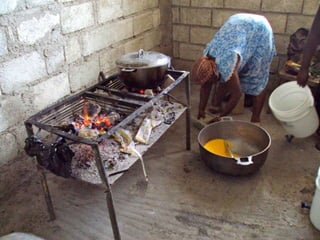
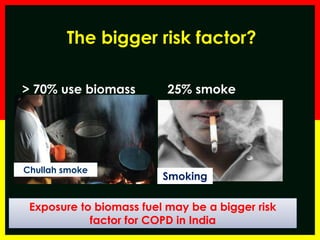
 In the developing world, however, other exposures,
particularly biomass fuel use, play major roles .
 These exposures help to explain the 20 percent of
patients with COPD and the 20 percent of patients
who die from COPD who never smoked .
42
43
The bigger risk factor?
> 70% use biomass
fuel for cooking
25% smoke
Exposure to biomass fuel may be a bigger risk
factor for COPD in India
Smoking
Chullah smoke
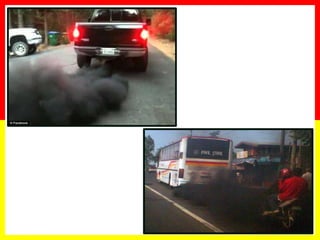
Not only smoking but smoke
Air pollution resulting from the burning of wood
and other biomass fuels is estimated to kill two
million women and children each year.
46
47
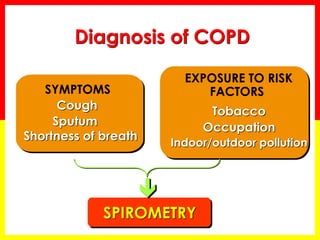
SYMPTOMS
Cough
Sputum
Shortness of breath
EXPOSURE TO RISK
FACTORS
Tobacco
Occupation
Indoor/outdoor pollution
SPIROMETRY
Diagnosis of COPD

 COPD runs an insidious course, measured over
years, with an often undiagnosed initial phase.
 Its presence can be suspected after a directed
clinical evaluation and then confirmed with a
simple spirometry.
 Clinical assessment is based on medical history
and physical examination
49
 Symptoms and pattern of onset — The three cardinal
symptoms of COPD are dyspnea, chronic cough,
and sputum production and the most common early
symptom is exertional dyspnea.
 Less common symptoms include wheezing and
chest tightness .
 However, any of these symptoms may develop
independently and with variable intensity
50
52
Clinical Manifestation
Symptoms:
Dyspnea that is:
 Progressive (worsens over time)
 Persistent (present every day)
 Usually worse with exercise
 Worse during respiratory infections
 Described by the patient as an “increased
effort to breathe,”“heaviness,” “air hunger,”
or “gasping.”
 Gradually progressive dyspnea is the most
common presenting symptoms for patients
with COPD
 Dyspnea is the most common and distressing
symptoms for patients with COPD, and the
reason most patients seek medical attention.
54
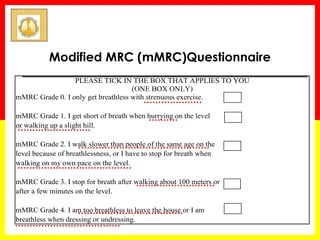
 A quantification of dyspnoea using the
Modified Medical Research Council scale
(mMRC)Questionnaire is indicated since it
predicts quality of life and survival.
55
Modified MRC Dyspnea Scale
PLEASE TICK IN THE BOX THAT APPLIES TO YOU
(ONE BOX ONLY)
mMRC Grade 0. I only get breathless with strenuous exercise.
mMRC Grade 1. I get short of breath when hurrying on the level
or walking up a slight hill.
mMRC Grade 2. I walk slower than people of the same age on the
level because of breathlessness, or I have to stop for breath when
walking on my own pace on the level.
mMRC Grade 3. I stop for breath after walking about 100 meters or
after a few minutes on the level.
mMRC Grade 4. I am too breathless to leave the house or I am
breathless when dressing or undressing.
Modified MRC (mMRC)Questionnaire
 The dyspnea may initially be noticed only
during exertion.
 However, it eventually becomes noticeable
with progressively less exertion or even at
rest.
58
 Dyspnoea is usually progressive and over time it
becomes persistent.
 At the onset it occurs during exercise (climbing
up stairs, walking up hills) and may by avoided
entirely by appropriate behavioural changes
(e.g. using an elevator).
 However, as the disease progresses, dyspnoea is
elicited even during minimal exertion or at rest.
59
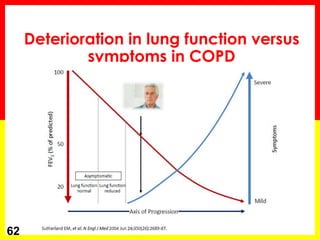
 Breathlessness is the most significant symptom,
but it usually does not occur until the sixth
decade of life (although it may occur much
earlier).
 By the time the FEV1 has fallen to 50% of
predicted, the patient is usually breathless
upon minimal exertion.
60
 In fact, the FEV1 is the most common
variable used to grade the severity of
COPD, although it is not the best
predictor of mortality.
61
Deterioration in lung function versus
symptoms in COPD
62
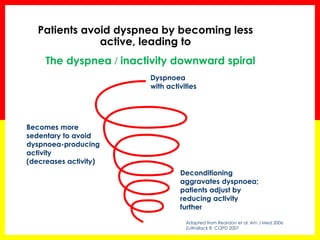
Patients avoid dyspnea by becoming less
active, leading to
Adapted from Reardon et al. Am J Med 2006
ZuWallack R. COPD 2007
Becomes more
sedentary to avoid
dyspnoea-producing
activity
(decreases activity)
Dyspnoea
with activities
Deconditioning
aggravates dyspnoea;
patients adjust by
reducing activity
further
The dyspnea / inactivity downward spiral
64
Chronic cough
 Present intermittently or every day
 Often present throughout the day
 Seldom only nocturnal
65
 The chronic cough is characterized by the
insidious onset of sputum production, which
occurs in the morning initially, but may
progress to occur throughout the day.
 The daily volume rarely exceeds 60 mL, The
sputum is usually mucoid, but becomes
purulent during exacerbations
66
 Cough may be intermittent (early morning) at
the beginning, progressively becoming present
throughout the day, but is seldom entirely
nocturnal .
 Chronic cough is usually productive and is very
often discounted as it is considered an expected
consequence of smoking.
 Cough syncope or cough rib fractures may
occur.
67
Chronic sputum production:
– Present for many years, worst in winters.
Initially mucoid – becomes purulent with
exacerbation
– Any pattern of chronic sputum production
may indicate COPD
68
 Sputum initially occurs in the morning but
later will be present all day long.
 It is usually tenacious and mucoid and in
small quantities .
 A change in sputum colour (purulent) or
volume suggests an infectious exacerbation.
69
 Most patients with COPD seek medical
attention late in the course of their disease.
 Patients often ignore the symptoms because
they start gradually and progress over the
course of years.
70
 Patients often modify their lifestyle to minimize
dyspnea and ignore cough and sputum
production.
 With retroactive questioning, a multiyear
history can be elicited.
71
The 4 typical ways of case presentation
1. With one or more of the characteristic respiratory
symptoms of chronic progressive breathlessness, cough,
sputum production, wheezing, and/or chest tightness
2. Without respiratory symptoms like breathlessness,
because patients might have reduced their physical
activity unknowingly to very low levels. They might just
complain of fatigue
3. With symptoms attributed to complications of the disease
like weight loss (COPD related cachexia) or leg swelling
(due to cor pulmonale)
4. With an exacerbation
With respiratory
symptoms
Without resp.
symptoms, just
fatigue
Symptoms due to
complications
Exacerbation
 Patients who have an extremely sedentary lifestyle
but few complaints require careful questioning to
elicit a history that is suggestive of COPD.
 Some patients unknowingly avoid exertional dyspnea
by shifting their expectations and limiting their
activity.
 They may be unaware of the extent of their limitations
or that their limitations are due to respiratory
symptoms, although they may complain of fatigue .
73
 Some patients present with episodes of increased
cough, purulent sputum, wheezing, fatigue, and
dyspnea that occur intermittently, with or without
fever.
 Diagnosis can be problematic in such patients The
combination of wheezing plus dyspnea may lead
to an incorrect diagnosis of asthma.
74
 Other illnesses with similar manifestations are often
incorrectly diagnosed as a COPD exacerbation (eg,
heart failure, bronchiectasis, bronchiolitis) .
 The interval between exacerbations decreases as the
severity of the COPD increases.
75
 Any history of unexplained weight loss is
important because, if caused by COPD, it
heralds a poor prognosis.
 Weight loss generally reflects more advanced
disease and is associated with a worse
prognosis.
 However, the majority of COPD patients are
overweight or obese
76
Malnutrition in COPD
79
Assessing Comorbidities in
COPD
Agusti A and Jardim J, personal communication.
Look for
Look for
COPD Comorbidities
If Smoker
Past medical history
Any of the following should be noted.
1. Any history of asthma, allergy, respiratory
infections in childhood or any other respiratory
diseases such as tuberculosis.
2. Any family history of COPD or other respiratory
disease.
3. Any history of exacerbations of COPD or
hospitalisations.
82
 A history of asthma should also be sought,
as COPD is often misdiagnosed as asthma.
 In addition, asthma may progress to fixed
airflow limitation and COPD .
83
Medical History
1. Patient’s exposure to risk factors
2. Past medical history (asthma, allergy, sinusitis or nasal
polyps; respiratory infections in childhood; other respiratory
diseases)
3. Family history of COPD or other chronic respiratory
disease
4. Pattern of symptom development: COPD typically
develops in adult life and most patients are conscious of
increased breathlessness, more frequent “winter colds,” and
some social restriction for a number of years before seeking
medical help.
5. History of exacerbations or previous hospitalizations
6. Presence of comorbidities
7. Impact of disease on patient’s life
 It is important to make a timely diagnosis of COPD to
ensure proper triage and appropriate treatment.
 The most pressing requirement is to be aware of
COPD.
 A focused patient history is always a good beginning.
 Although a physical examination is an essential part
of patient assessment, it is a crude and insensitive
means of detecting airflow limitation
85
Physical Examination
 Crude and insensitive means of detecting
airflow obstruction
 P.E. findings may be entirely normal until
FEV1 is reduced to less than 50% predicted
Stubbing,Am Rev Respir Dis, 1989
Useful indicators of airflow limitation:
1. Wheezing during tidal breathing
2. Prolonged expiratory time
 Wheezing may occur in some patients,
particularly during exertion and
exacerbations.
87
 A normal physical examination is frequent in
early COPD . As the disease progresses some
signs become apparent and in the advanced
stages many are almost pathonogmonic.
 As part of the vital signs, all patients should have
their respiratory rate measured, weight and
height determined, and their body mass index
calculated
88
Physical examination
 The findings on physical examination of the chest
vary with the severity of the COPD .
 Early in the disease, the physical examination may be
normal, or may show only prolonged expiration or
wheezes on forced exhalation.
 As the severity of the airway obstruction increases,
physical examination may reveal hyperinflation (eg,
increased resonance to percussion), decreased
breath sounds, wheezes, crackles at the lung bases,
and/or distant heart sounds .
89
 Features of severe disease include an
increased anteroposterior diameter of the
chest (“barrel-shaped” chest) and a
depressed diaphragm with limited movement
based on chest percussion
90
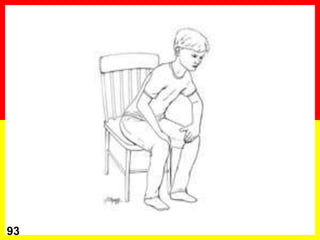
Tripod position
 Patients with end-stage COPD may adopt
positions that relieve dyspnea, such as leaning
forward with arms outstretched and weight
supported on the palms or elbows.
 This posture may be evident during the
examination or may be suggested by the
presence of callouses or swollen bursae on the
extensor surfaces of forearms.
91
 The goal of positioning is to improve the surface area
of the thoracic cavity to allow more gas flow and
therefore gas exchange.
 Have you ever noticed how a patient with dyspnoea
needs to lean over an object to improve their lung
expansion?
 This technique is known as the tripod position and
usually is performed subconsciously in any patient
with dyspnoea. This position should be encouraged in
patients with dyspnoea
92
93
 The tripod position facilitates a more effective influx of
air into the lungs because when the person leans
forward they take unnecessary weight from the chest
and diaphragm onto the knees allowing the chest
walls to rise and fall with less effort.
 This position does not seem to be a learned technique
as anyone who has just finished a long race will
automatically adopt this position finding it to be the
most comfortable and most expedient method for fast
oxygenation.
94
Pursed Lip Breathing
95
 As the name suggests, pursed lip breathing involves
exhaling through partially closed or pursed lips
 The concept of pursed lip breathing is to slow
respiration and increase the length of time to exhale
CO2.
 The patient inhales through pursed lips for the count of
two seconds, and exhales through pursed lips for the
count of four seconds.
96
Pursed Lip Breathing
 People often unconsciously practice this technique
when short of breath after exercise, for example
climbing a flight of stairs; however the patient with
COPD will often use this technique for many tasks
 Pursed lip breathing significantly improved
oxygenation and exercise tolerance when employed
against normal respiration.
 In an acute exacerbation of COPD where dyspnoea
is present, encouraging your patient to use pursed lip
breathing may assist them to reduce their feelings of
dyspnoea and improve their recovery time97
Pursed-Lips Breathing
 Many patients with chronic obstructive lung
disease instinctively learn that pursing the lips
during expiration reduces dyspnea.
 Pursed-lips breathing significantly reduces the
respiratory rate (from about 20 breaths/min to 12
to 15 breaths/min), increases tidal volume (by
about 250 to 800 mL), decreases the PaCO2 (by
5%), and increases oxygen saturation (by 3%).
98
 Dyspnea may diminish because there is less work
of breathing (from a slower rate), less expiratory
airway collapse (the pressure drop across the
lips, 2 to 4 cm of water, provides continuous
expiratory positive pressure), or recruitment of
respiratory muscles in a way that is less fatiguing
to the diaphragm
99
Accessory Muscle Use
 The only muscle used in normal breathing is the
diaphragm, which contracts during inspiration.
 Normal expiration is a passive process that relies on
the elastic recoil of the lungs.
 The term accessory muscle use, therefore, refers to
the contraction of muscles other than the diaphragm
during inspiration (usually, the sternocleidomastoid
and scalene muscles) or to the contraction of any
muscle during expiration (primarily, the abdominal
oblique muscles).
10
0
 Accessory muscle use is a common finding in
patients with chronic obstructive lung disease or
respiratory muscle fatigue
 Contraction of the sternocleidomastoid and scalene
muscles lifts the clavicles and first ribs, which helps
expand the thorax of distressed patients, especially
those with chronic obstructive lung disease whose
flattened diaphragm generates only meager
inspiratory movements.
10
1
 Contraction of the abdominal oblique muscles assists
ventilation in two ways.
1. In patients with obstructed airways, the abdominal
muscles help expel air across the obstructed airways.
2. In patients with respiratory muscle fatigue (e.g.,
amyotrophic lateral sclerosis), the abdominal
muscles characteristically contract right at the
moment that expiration ends, to compress the
respiratory system so that the early part of the
subsequent inspiration can occur passively10
2
 Other physical examination findings include use of
the accessory respiratory muscles of the neck and
shoulder girdle
 Expiration through pursed lips
 paradoxical retraction of the lower interspaces during
inspiration (ie, Hoover's sign)
 Cyanosis, asterixis due to severe hypercapnia
 Enlarged, tender liver due to right heart failure.
 Neck vein distention may also be observed because
of increased intrathoracic pressure, especially during
expiration
10
3
 Yellow stains on the fingers due to nicotine and
tar from burning tobacco are a clue to ongoing
and heavy cigarette smoking .
Clubbing of the digits is not typical in COPD
(even with associated hypoxemia) and
suggests comorbidities such as lung cancer,
interstitial lung disease, or bronchiectasis.
10
4
NCI
Clubbing is not a feature of COPD alone.
If clubbing is found, search for lung cancer.
PE in COPD
Rarely diagnostic
Signs of airflow limitation are usually
not present until significant impairment of lung
function has occurred
May be present:
Pursed lip breathing, RR > 20
Barrel-chested, distant heart sounds
Wheezing Crackles
Cachexia
Signs of cor pulmonale
Useful physical signs in the diagnosis of
COPD
Percussion
Palpation
Auscultation
Inspection
Special
maneuver
Pursed-lip
breathing
Use of accessory
muscles of
respiration
Jugular venous
distension during
expiration
Retraction of
suprasternal,
supraclavicular
and intercostal
spaces during
inspiration
Short trachea
Pulsus paradoxus
Increased
anteroposterior
diameter of the
chest
(barrel-shaped
chest)
Reduced chest
movements
Peripheral edema
Dyspnea-relieving
posture
Muscle wasting
Restricted
chest
expansion
Subxiphoid
shift of
maximum
impulse of
the heart
Chest
hyperreson
ance
Obliteration
of cardiac
dullness
Lower level
of liver
dullness
Lower
diaphragm
atic levels
Diminished
breath
sounds
Early
inspiratory
crackles
Loud
pulmonic
component
of second
heart sound
Forced
expiratory
time
Snider’s
match test
FET: Forced expiratory time
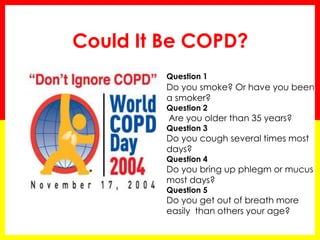
Could It Be COPD?
Question 1
Do you smoke? Or have you been
a smoker?
Question 2
Are you older than 35 years?
Question 3
Do you cough several times most
days?
Question 4
Do you bring up phlegm or mucus
most days?
Question 5
Do you get out of breath more
easily than others your age?
Do you know what COPD is? This chronic lung disease is a major cause of illness, yet
many people have it and don’t know it.
If you answer these questions, it will help you find out if you could have COPD.
1. Do you cough several times most days? Yes ___ No ___
2. Do you bring up phlegm or mucus most days? Yes ___ No ___
3. Do you get out of breath more easily than others your age? Yes ___ No ___
4. Are you older than 40 years? Yes ___ No ___
5. Are you a current smoker or an ex-smoker? Yes ___ No ___
If you answered yes to three or more of these questions, ask your doctor if you might have
COPD and should have a simple breathing test. If COPD is found early, there are steps you
can take to prevent further lung damage and make you feel better.
Take time to think about your lungs……Learn about COPD!
Could it be COPD?
If you test one smoker
with cough every day
You will diagnose
one patient
With COPD
a week
114
Thank you

COPD

  • 2.
  • 4.
    Where to start? oHistory o Examination
  • 5.
    Natural history  Theoften-quoted statistic that only 15-20 % of smokers develop clinically significant COPD is misleading and greatly underestimates the toll of COPD.  COPD has a variable natural history and not all individuals follow the same course. 5
  • 6.
     COPD isgenerally a progressive disease, especially if a patient's exposure to noxious agents , most often tobacco smoking, continues.  An accelerated decline in lung function is still the single most important feature of COPD. 6 Natural history
  • 7.
     If exposureis stopped, the disease may still progress, mainly due to the decline in lung function that normally occurs with ageing.  Nevertheless, stopping exposure to noxious agents, even when significant airflow limitation is present, can result in some improvement in function and will slow or even hold the progression of the disease. 7 Natural history
  • 8.
     Susceptible subjectshave an accelerated rate of decline of lung function (50-90ml of FEV1/yr compared with 20-30ml of FEV1/yr after the age of 30 in non-smokers).  Subjects with COPD who stop smoking slow down the progression of disease and may return to normal levels of FEV1 decline. 8
  • 9.
     Not allpeople who smoke, however, develop COPD; and not all patients with COPD are smokers or have smoked in the past.  There seems to be a varying susceptibility to lung damage due to cigarette smoke within the general population. 9 Natural history
  • 10.
     Not allsmokers develop clinically significant COPD, which suggests that additional factors are involved in determining each individual's susceptibility. 10
  • 11.
  • 12.
  • 13.
    Fletcher and Peto CharlesFletcher Richard Peto
  • 14.
    Decline in Smokers SmokersNonsmokers Rateof Decline in FEV1 NumberofSubjects
  • 15.
    Two Populations ofSmokers? NumberofSubjects Rate of decline in FEV1 Normal COPD
  • 16.
    Decline in LungFunction Frequency Rate of loss of FEV1 COPD
  • 17.
  • 18.
  • 19.
    Adapted from FletcherCM, Peto R. Brit Med J. 1977;1:1645-1648. Accelerated Lung-Function Decline in COPD 0 20 40 60 80 100 20 30 40 50 60 70 80 90 Age (years) Death Disability Symptoms Nonsmoker COPD
  • 20.
    Fletcher & Peto,BMJ 1977;1:1645 Susceptibility Genes Protective Genes PULMONARY FUNCTION DECLINE OVER TIME MODEL: BETWEEN INDIVIDUAL VARIATION IN SUSCEPTIBILITY TO CIGARETTE SMOKE
  • 21.
    Bucket and Spoon? Maximumat age 25: start with a bucketful Lose FEV1 at a spoonful (about 25 ml) per year: natural ageing process ~ 1 litre over 40 years
  • 22.
    Average Decrease inFEV1 / year Males Females Former smokers 30 ml/year 22 ml/year Current smokers 66 ml/year 54 ml/year Anthonisen NR, et.al. Am J Respir Crit Care Med 166:675-9, 2002.
  • 23.
    Age 40-50 50-5555-60 60-70 Age (years) Death Disability Symptoms Not SusceptibleSusceptible Smokers Stopped smoking at 45 (mild COPD) Stopped smoking at 65 (severe COPD) 30 40 50 60 70 80 90 0 20 40 60 80 20 100
  • 24.
     "The normalrate of decline of FEV1 with age is approximately 25-30 ml per year but it is more rapid in those destined to develop COPD  Cigarette smokers have an average annual loss of FEV1 which is 10-20 ml greater than that of non-smokers.. . . 24
  • 25.
    25  FEV1 declinesnormally with aging by approximately 30 mL/yr, but in susceptible smokers, the decline is greater (about 60 mL/yr)  Smoking cessation is the only intervention which can decrease the FEV1 decline, whereas intermittent quitting provides less benefit.
  • 26.
  • 27.
  • 28.
  • 29.
  • 31.
    COPD: natural history100 503040 60 70 80 Age (years) 25 50 75 Dyspnoea Exacerbations Deconditioning Hospitalisation Pulmonary hypertension Hypoxemia Systemic effects 1. Fletcher C, Peto R. BMJ 1977;1 (6077):1645-1648 2. http://www.goldcopd.com/workshop/ch1.html (accessed 29605)
  • 32.
    Natural History ofCOPD 8070605040302010 0 1 2 3 4 5 Normal Smoker COPD Age FEV1(liters) Dyspnea Oxygen Home bound Bed bound Death Modified from Fletcher C, Peto R. Br Med J. 1977;1(6077):1645-1648.
  • 33.
    Sir William Osler Listento the patient; he is telling you the diagnosis.
  • 34.
  • 35.
    Exposure History  Thehistory of exposure to risk factors, such as smoking, or occupational or environmental noxious agents, should be noted.  A detailed smoking history is essential (pack- years).  Pack-years are calculated by multiplying the number of pack equivalent smoked every day by the total number of years. 35
  • 36.
     The mostimportant risk factor for COPD is cigarette smoking and the amount and duration of smoking contribute to disease severity.  Thus, a key step in the evaluation of patients with suspected COPD is to ascertain the number of pack years smoked (packs of cigarettes per day multiplied by the number of years), as the majority (about 80 percent) of patients with COPD in the Unites States have a history of cigarette smoking 36
  • 37.
  • 38.
    Smoking History No. ofPacks/day X No. of Years smoked ………………………… COPD patients ~ 20 pack-years 20
  • 39.
     While studieshave shown an overall “dose- response curve” for smoking and lung function, some individuals develop severe disease with fewer pack years and others have minimal to no symptoms despite many pack years . 39
  • 40.
     The exactthreshold for the duration/intensity of cigarette smoking that will result in COPD varies from one individual to another.  On the other hand, the single best variable for predicting which adults will have airflow obstruction on spirometry is a history of more than 40 pack years of smoking . 40
  • 41.
     A smokinghistory should include the age of starting and the age of quitting, as patients may underestimate the number of years they smoked.  With enough smoking, almost all smokers will develop measurably reduced lung function . 41
  • 42.
     The environmental/occupationalhistory may disclose other important risk factors for COPD, such as exposure to fumes or organic or inorganic dusts.  In the developing world, however, other exposures, particularly biomass fuel use, play major roles .  These exposures help to explain the 20 percent of patients with COPD and the 20 percent of patients who die from COPD who never smoked . 42
  • 43.
  • 44.
    The bigger riskfactor? > 70% use biomass fuel for cooking 25% smoke Exposure to biomass fuel may be a bigger risk factor for COPD in India Smoking Chullah smoke
  • 45.
    Not only smokingbut smoke Air pollution resulting from the burning of wood and other biomass fuels is estimated to kill two million women and children each year.
  • 46.
  • 47.
  • 48.
    SYMPTOMS Cough Sputum Shortness of breath EXPOSURETO RISK FACTORS Tobacco Occupation Indoor/outdoor pollution SPIROMETRY Diagnosis of COPD 
  • 49.
     COPD runsan insidious course, measured over years, with an often undiagnosed initial phase.  Its presence can be suspected after a directed clinical evaluation and then confirmed with a simple spirometry.  Clinical assessment is based on medical history and physical examination 49
  • 50.
     Symptoms andpattern of onset — The three cardinal symptoms of COPD are dyspnea, chronic cough, and sputum production and the most common early symptom is exertional dyspnea.  Less common symptoms include wheezing and chest tightness .  However, any of these symptoms may develop independently and with variable intensity 50
  • 52.
  • 53.
    Clinical Manifestation Symptoms: Dyspnea thatis:  Progressive (worsens over time)  Persistent (present every day)  Usually worse with exercise  Worse during respiratory infections  Described by the patient as an “increased effort to breathe,”“heaviness,” “air hunger,” or “gasping.”
  • 54.
     Gradually progressivedyspnea is the most common presenting symptoms for patients with COPD  Dyspnea is the most common and distressing symptoms for patients with COPD, and the reason most patients seek medical attention. 54
  • 55.
     A quantificationof dyspnoea using the Modified Medical Research Council scale (mMRC)Questionnaire is indicated since it predicts quality of life and survival. 55 Modified MRC Dyspnea Scale
  • 56.
  • 57.
    PLEASE TICK INTHE BOX THAT APPLIES TO YOU (ONE BOX ONLY) mMRC Grade 0. I only get breathless with strenuous exercise. mMRC Grade 1. I get short of breath when hurrying on the level or walking up a slight hill. mMRC Grade 2. I walk slower than people of the same age on the level because of breathlessness, or I have to stop for breath when walking on my own pace on the level. mMRC Grade 3. I stop for breath after walking about 100 meters or after a few minutes on the level. mMRC Grade 4. I am too breathless to leave the house or I am breathless when dressing or undressing. Modified MRC (mMRC)Questionnaire
  • 58.
     The dyspneamay initially be noticed only during exertion.  However, it eventually becomes noticeable with progressively less exertion or even at rest. 58
  • 59.
     Dyspnoea isusually progressive and over time it becomes persistent.  At the onset it occurs during exercise (climbing up stairs, walking up hills) and may by avoided entirely by appropriate behavioural changes (e.g. using an elevator).  However, as the disease progresses, dyspnoea is elicited even during minimal exertion or at rest. 59
  • 60.
     Breathlessness isthe most significant symptom, but it usually does not occur until the sixth decade of life (although it may occur much earlier).  By the time the FEV1 has fallen to 50% of predicted, the patient is usually breathless upon minimal exertion. 60
  • 61.
     In fact,the FEV1 is the most common variable used to grade the severity of COPD, although it is not the best predictor of mortality. 61
  • 62.
    Deterioration in lungfunction versus symptoms in COPD 62
  • 63.
    Patients avoid dyspneaby becoming less active, leading to Adapted from Reardon et al. Am J Med 2006 ZuWallack R. COPD 2007 Becomes more sedentary to avoid dyspnoea-producing activity (decreases activity) Dyspnoea with activities Deconditioning aggravates dyspnoea; patients adjust by reducing activity further The dyspnea / inactivity downward spiral
  • 64.
  • 65.
    Chronic cough  Presentintermittently or every day  Often present throughout the day  Seldom only nocturnal 65
  • 66.
     The chroniccough is characterized by the insidious onset of sputum production, which occurs in the morning initially, but may progress to occur throughout the day.  The daily volume rarely exceeds 60 mL, The sputum is usually mucoid, but becomes purulent during exacerbations 66
  • 67.
     Cough maybe intermittent (early morning) at the beginning, progressively becoming present throughout the day, but is seldom entirely nocturnal .  Chronic cough is usually productive and is very often discounted as it is considered an expected consequence of smoking.  Cough syncope or cough rib fractures may occur. 67
  • 68.
    Chronic sputum production: –Present for many years, worst in winters. Initially mucoid – becomes purulent with exacerbation – Any pattern of chronic sputum production may indicate COPD 68
  • 69.
     Sputum initiallyoccurs in the morning but later will be present all day long.  It is usually tenacious and mucoid and in small quantities .  A change in sputum colour (purulent) or volume suggests an infectious exacerbation. 69
  • 70.
     Most patientswith COPD seek medical attention late in the course of their disease.  Patients often ignore the symptoms because they start gradually and progress over the course of years. 70
  • 71.
     Patients oftenmodify their lifestyle to minimize dyspnea and ignore cough and sputum production.  With retroactive questioning, a multiyear history can be elicited. 71
  • 72.
    The 4 typicalways of case presentation 1. With one or more of the characteristic respiratory symptoms of chronic progressive breathlessness, cough, sputum production, wheezing, and/or chest tightness 2. Without respiratory symptoms like breathlessness, because patients might have reduced their physical activity unknowingly to very low levels. They might just complain of fatigue 3. With symptoms attributed to complications of the disease like weight loss (COPD related cachexia) or leg swelling (due to cor pulmonale) 4. With an exacerbation With respiratory symptoms Without resp. symptoms, just fatigue Symptoms due to complications Exacerbation
  • 73.
     Patients whohave an extremely sedentary lifestyle but few complaints require careful questioning to elicit a history that is suggestive of COPD.  Some patients unknowingly avoid exertional dyspnea by shifting their expectations and limiting their activity.  They may be unaware of the extent of their limitations or that their limitations are due to respiratory symptoms, although they may complain of fatigue . 73
  • 74.
     Some patientspresent with episodes of increased cough, purulent sputum, wheezing, fatigue, and dyspnea that occur intermittently, with or without fever.  Diagnosis can be problematic in such patients The combination of wheezing plus dyspnea may lead to an incorrect diagnosis of asthma. 74
  • 75.
     Other illnesseswith similar manifestations are often incorrectly diagnosed as a COPD exacerbation (eg, heart failure, bronchiectasis, bronchiolitis) .  The interval between exacerbations decreases as the severity of the COPD increases. 75
  • 76.
     Any historyof unexplained weight loss is important because, if caused by COPD, it heralds a poor prognosis.  Weight loss generally reflects more advanced disease and is associated with a worse prognosis.  However, the majority of COPD patients are overweight or obese 76
  • 78.
  • 79.
  • 81.
    Assessing Comorbidities in COPD AgustiA and Jardim J, personal communication. Look for Look for COPD Comorbidities If Smoker
  • 82.
    Past medical history Anyof the following should be noted. 1. Any history of asthma, allergy, respiratory infections in childhood or any other respiratory diseases such as tuberculosis. 2. Any family history of COPD or other respiratory disease. 3. Any history of exacerbations of COPD or hospitalisations. 82
  • 83.
     A historyof asthma should also be sought, as COPD is often misdiagnosed as asthma.  In addition, asthma may progress to fixed airflow limitation and COPD . 83
  • 84.
    Medical History 1. Patient’sexposure to risk factors 2. Past medical history (asthma, allergy, sinusitis or nasal polyps; respiratory infections in childhood; other respiratory diseases) 3. Family history of COPD or other chronic respiratory disease 4. Pattern of symptom development: COPD typically develops in adult life and most patients are conscious of increased breathlessness, more frequent “winter colds,” and some social restriction for a number of years before seeking medical help. 5. History of exacerbations or previous hospitalizations 6. Presence of comorbidities 7. Impact of disease on patient’s life
  • 85.
     It isimportant to make a timely diagnosis of COPD to ensure proper triage and appropriate treatment.  The most pressing requirement is to be aware of COPD.  A focused patient history is always a good beginning.  Although a physical examination is an essential part of patient assessment, it is a crude and insensitive means of detecting airflow limitation 85
  • 86.
    Physical Examination  Crudeand insensitive means of detecting airflow obstruction  P.E. findings may be entirely normal until FEV1 is reduced to less than 50% predicted Stubbing,Am Rev Respir Dis, 1989
  • 87.
    Useful indicators ofairflow limitation: 1. Wheezing during tidal breathing 2. Prolonged expiratory time  Wheezing may occur in some patients, particularly during exertion and exacerbations. 87
  • 88.
     A normalphysical examination is frequent in early COPD . As the disease progresses some signs become apparent and in the advanced stages many are almost pathonogmonic.  As part of the vital signs, all patients should have their respiratory rate measured, weight and height determined, and their body mass index calculated 88
  • 89.
    Physical examination  Thefindings on physical examination of the chest vary with the severity of the COPD .  Early in the disease, the physical examination may be normal, or may show only prolonged expiration or wheezes on forced exhalation.  As the severity of the airway obstruction increases, physical examination may reveal hyperinflation (eg, increased resonance to percussion), decreased breath sounds, wheezes, crackles at the lung bases, and/or distant heart sounds . 89
  • 90.
     Features ofsevere disease include an increased anteroposterior diameter of the chest (“barrel-shaped” chest) and a depressed diaphragm with limited movement based on chest percussion 90
  • 91.
    Tripod position  Patientswith end-stage COPD may adopt positions that relieve dyspnea, such as leaning forward with arms outstretched and weight supported on the palms or elbows.  This posture may be evident during the examination or may be suggested by the presence of callouses or swollen bursae on the extensor surfaces of forearms. 91
  • 92.
     The goalof positioning is to improve the surface area of the thoracic cavity to allow more gas flow and therefore gas exchange.  Have you ever noticed how a patient with dyspnoea needs to lean over an object to improve their lung expansion?  This technique is known as the tripod position and usually is performed subconsciously in any patient with dyspnoea. This position should be encouraged in patients with dyspnoea 92
  • 93.
  • 94.
     The tripodposition facilitates a more effective influx of air into the lungs because when the person leans forward they take unnecessary weight from the chest and diaphragm onto the knees allowing the chest walls to rise and fall with less effort.  This position does not seem to be a learned technique as anyone who has just finished a long race will automatically adopt this position finding it to be the most comfortable and most expedient method for fast oxygenation. 94
  • 95.
  • 96.
     As thename suggests, pursed lip breathing involves exhaling through partially closed or pursed lips  The concept of pursed lip breathing is to slow respiration and increase the length of time to exhale CO2.  The patient inhales through pursed lips for the count of two seconds, and exhales through pursed lips for the count of four seconds. 96 Pursed Lip Breathing
  • 97.
     People oftenunconsciously practice this technique when short of breath after exercise, for example climbing a flight of stairs; however the patient with COPD will often use this technique for many tasks  Pursed lip breathing significantly improved oxygenation and exercise tolerance when employed against normal respiration.  In an acute exacerbation of COPD where dyspnoea is present, encouraging your patient to use pursed lip breathing may assist them to reduce their feelings of dyspnoea and improve their recovery time97
  • 98.
    Pursed-Lips Breathing  Manypatients with chronic obstructive lung disease instinctively learn that pursing the lips during expiration reduces dyspnea.  Pursed-lips breathing significantly reduces the respiratory rate (from about 20 breaths/min to 12 to 15 breaths/min), increases tidal volume (by about 250 to 800 mL), decreases the PaCO2 (by 5%), and increases oxygen saturation (by 3%). 98
  • 99.
     Dyspnea maydiminish because there is less work of breathing (from a slower rate), less expiratory airway collapse (the pressure drop across the lips, 2 to 4 cm of water, provides continuous expiratory positive pressure), or recruitment of respiratory muscles in a way that is less fatiguing to the diaphragm 99
  • 100.
    Accessory Muscle Use The only muscle used in normal breathing is the diaphragm, which contracts during inspiration.  Normal expiration is a passive process that relies on the elastic recoil of the lungs.  The term accessory muscle use, therefore, refers to the contraction of muscles other than the diaphragm during inspiration (usually, the sternocleidomastoid and scalene muscles) or to the contraction of any muscle during expiration (primarily, the abdominal oblique muscles). 10 0
  • 101.
     Accessory muscleuse is a common finding in patients with chronic obstructive lung disease or respiratory muscle fatigue  Contraction of the sternocleidomastoid and scalene muscles lifts the clavicles and first ribs, which helps expand the thorax of distressed patients, especially those with chronic obstructive lung disease whose flattened diaphragm generates only meager inspiratory movements. 10 1
  • 102.
     Contraction ofthe abdominal oblique muscles assists ventilation in two ways. 1. In patients with obstructed airways, the abdominal muscles help expel air across the obstructed airways. 2. In patients with respiratory muscle fatigue (e.g., amyotrophic lateral sclerosis), the abdominal muscles characteristically contract right at the moment that expiration ends, to compress the respiratory system so that the early part of the subsequent inspiration can occur passively10 2
  • 103.
     Other physicalexamination findings include use of the accessory respiratory muscles of the neck and shoulder girdle  Expiration through pursed lips  paradoxical retraction of the lower interspaces during inspiration (ie, Hoover's sign)  Cyanosis, asterixis due to severe hypercapnia  Enlarged, tender liver due to right heart failure.  Neck vein distention may also be observed because of increased intrathoracic pressure, especially during expiration 10 3
  • 104.
     Yellow stainson the fingers due to nicotine and tar from burning tobacco are a clue to ongoing and heavy cigarette smoking . Clubbing of the digits is not typical in COPD (even with associated hypoxemia) and suggests comorbidities such as lung cancer, interstitial lung disease, or bronchiectasis. 10 4
  • 105.
    NCI Clubbing is nota feature of COPD alone. If clubbing is found, search for lung cancer.
  • 106.
    PE in COPD Rarelydiagnostic Signs of airflow limitation are usually not present until significant impairment of lung function has occurred May be present: Pursed lip breathing, RR > 20 Barrel-chested, distant heart sounds Wheezing Crackles Cachexia Signs of cor pulmonale
  • 107.
    Useful physical signsin the diagnosis of COPD Percussion Palpation Auscultation Inspection Special maneuver Pursed-lip breathing Use of accessory muscles of respiration Jugular venous distension during expiration Retraction of suprasternal, supraclavicular and intercostal spaces during inspiration Short trachea Pulsus paradoxus Increased anteroposterior diameter of the chest (barrel-shaped chest) Reduced chest movements Peripheral edema Dyspnea-relieving posture Muscle wasting Restricted chest expansion Subxiphoid shift of maximum impulse of the heart Chest hyperreson ance Obliteration of cardiac dullness Lower level of liver dullness Lower diaphragm atic levels Diminished breath sounds Early inspiratory crackles Loud pulmonic component of second heart sound Forced expiratory time Snider’s match test FET: Forced expiratory time
  • 108.
    Could It BeCOPD? Question 1 Do you smoke? Or have you been a smoker? Question 2 Are you older than 35 years? Question 3 Do you cough several times most days? Question 4 Do you bring up phlegm or mucus most days? Question 5 Do you get out of breath more easily than others your age?
  • 109.
    Do you knowwhat COPD is? This chronic lung disease is a major cause of illness, yet many people have it and don’t know it. If you answer these questions, it will help you find out if you could have COPD. 1. Do you cough several times most days? Yes ___ No ___ 2. Do you bring up phlegm or mucus most days? Yes ___ No ___ 3. Do you get out of breath more easily than others your age? Yes ___ No ___ 4. Are you older than 40 years? Yes ___ No ___ 5. Are you a current smoker or an ex-smoker? Yes ___ No ___ If you answered yes to three or more of these questions, ask your doctor if you might have COPD and should have a simple breathing test. If COPD is found early, there are steps you can take to prevent further lung damage and make you feel better. Take time to think about your lungs……Learn about COPD! Could it be COPD?
  • 113.
    If you testone smoker with cough every day You will diagnose one patient With COPD a week
  • 114.