AEROSOL THERAPY
BY;KAPOOR SINGH
AEROSOL
A suspension of very fine liquid or solid
particles in a gas.
; Only 10% drugs deposited in LUNGS
• Size of Particle
• <5 MICRONS -- BEST TO NEGOTIATE
<1 MICRONS -- DON’T HAVE
ENOUGH TIME TO SETTLE
AEROSOL THERAPY
• Deliver a therapeutic dose of the selected
agents to the desired site of action.
• In clinical settings, medical aerosols are
generated with atomizer, nebulizer or inhalers
devices that physically disperse matter into
small particles & suspend them into a gas.
MECHANISM OF AEROSOL
DEPOSITION
AEROSOL DELIVERY SYSTEMS
The three principle types of devices widely
used are :
1.MDI-metered dose inhalers
2.DPI-dry powder inhalers
3.Nebulizers
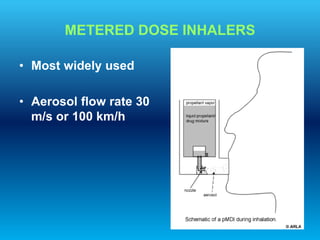
METERED DOSE INHALERS
• Most widely used
• Aerosol flow rate 30
m/s or 100 km/h
ADVANTAGES OF MDI
• Inexpensive
• Light, compact
• Quick delivery of drugs
• Precise and consistent doses
DISADVANTAGES OF MDI
• Difficulty in coordination of activation &
inspiration
• Time consuming to teach
• Contains CFC
• Cannot be used in children & elderly
• Cannot be used in seriously ill patients
• Cannot be used in mechanically ventilated
patients
SPACERS
SPACERS
• Holding chambers or reservoirs
• Attachment to a MDI
• Advantages :
1.No need to activate coordination
With inspiration
2.Increases drug deposition in lung
3.Reduces drug deposition in mouth
4.Used in children with face mask
5.Decreases incidence of oral
thrush
DRY POWDER INHALERS
• Introduced in 1960’s
• No propellants
• Requires patient’s own Inspiratory effort
to form aerosol
• Powder is delivered only when patient
inhales
ADVANTAGES OF DryPowder Inhaler
• Light weight
• No hand breath coordination
• Quick delivery of drugs
• Useful in children above 5 yrs of age
Disadvantages of DPI
• Require high inspiration flow >28 l/min
COMPARISION BETWEEN MDI &DPI
• High velocity aerosols
• Requires coordination
• Time consuming to
teach
• Requires slow & deep
breathing only
• Aerosol velocity
depends on inspiratory
flow rate
• No coordination
needed
• Easy to teach
• Requires high insp
flow >28 l/min
CHARACTERISTICS OF THERAPEUTIC
AEROSOLS
• Effective use of aerosols requires an
understanding of characteristics of the
aerosols.
• Aerosol output (wt /minute)
• Emitted dose
This tells little about the amount of
drug reaching the targeted site of action.
• A substantial proportion of particles that leave
a nebulizer may never reach the lungs.
• Effectiveness of medical aerosols depends on
amount of aerosol particles deposition to the
lower respiratory tract & deposition of aerosol
influenced by many other factors.
PATIENT DEPOSITION FACTORS
Age
Inspiratory flow rate,volume
Breathing pattern
Breath holding
Nasal vs mouth breathing
Upper and lower airway pathology
FACTORS INFLUENCING DEPOSITION
• Physical & chemical properties of
aerosols
• Anatomy of the respiratory tract
• Physiological factors
PHYSICAL & CHEMICAL PROPERTIES
OF AEROSOLS
GRAVITY
• Aerosol size must be >1 microns because at this
mass gravity loses its influence on particles.
• Gravity influence is in direct relation with particle
mass
• Greater mass—tendency to undergo proximal
airway deposition
INERTIAL IMPACTION
Water particles
Gas molecules
PARTICLE SIZE
• Aerosol particle size depends upon :
-- nebulizer chosen
--Method used to generate aerosol
• It is not possible to visually determine whether a
nebulizer is producing an optimal size
particles…
• Aerosols traverse tubular strs in which turbulent
flow is the rule…
• >Particle size---- gravity influence
TONICITY OF THE FLUID
• Hypertonic fluid tend to absorb water.
• Hypotonic aerosols may evaporate
• Normally, mucous membrane is neutral in
relation to electrical charges
ANATOMY OF THE RESPIRATORY TRACT
• Diameter
Infants and children have small diameter of an
airway suggest that having low level of drug
deposition , even that is adequate when
considered in terms of body weight (mg of
drug deposited per kg of BW ).
• Length
• Branching angles of airway segments
PHYSIOLOGICAL FACTORS
• Airflow
Increasing flow 6,8,10 L / min increased the
mass output of particles in the respirable
range of 1-5 microns.
• Breathing pattern
Deposition of particles are directly related
to inhaled volume & inversely related to
ventilatory rate.
• Inspiratory hold
NEBULIZER
Nebulizer as an adjunct to chest
physiotherapy
• Nebulized NS enhances mucociliary clearance ,
given thrice in a day before chest
physiotherapy & also salbutamol before NS to
prevent bronchoconstriction
; With the patient resting in an upright position;
chest physiotherapy, by the forced expiration
technique with postural drainage; and chest
physiotherapy following five minutes' inhalation
of either nebulized normal saline or nebulized
terbutaline 5 mg
• Use of both nebulized saline and nebulized
terbutaline immediately before chest
physiotherapy gave a significantly greater yield
of sputum than did physiotherapy alone, and
terbutaline.
• In mechanically ventilated patients , those
having low lung volume chest PNF technique
should be used to improve lung volume & thus
maximum aerosols can be administered.
• Lung segment which is to be drained out
require to positioned up so that aerosols reach
to upper area.
INDICATIONS FOR NEBULIZER
• Useful in children ,
Handicapped person ,
Seriously ill patients
• Ventilated patients
• Elderly individuals
• High doses can be given
• Combination drugs can be given
• Enhancement of secretion clearance
• Sputum induction
• Humidification of respired gases
• Prevent dehydration
• Prevent or relieve bronchospasm
HAZARDS OF NEBULIZER
• Bronchospasm
• Over hydration
• Delivery of contaminated aerosols
• Tubing condensation
• Swelling of retained secretions
JET NEBULIZER
ULTRASONIC NEBULIZER
DRUGS FOR NEBULIZATION
• Distilled water or normal saline
• Mucolytics : mesna , acetylcysteine
• Beta 2 agonists : salbutamol , terbutalin ,
fometerol , salmeterol
• Antimuscarinic : ipratropium bromide
• Steroids : budesonide
• Antibiotics
• Antifungal
Distilled water/NS
• Cheapest / very economical
• Easily available
• Effective Mucolytic
• Free of ions (distilled water)
• Routinely used in practice
Mucolytic agents
• Mucomyst
• Drug action
• Side effects
• How to counteract
Beta-2 agonists
• Mechanism of action
beta receptor stimulation
adenylcyclase
IC ATP
IC cAMP
smooth muscle relaxation
salbutamol
• Short acting
• Selective beta 2 agonist
• Peak of action
• Long term use effects
• Side effects
Epinephrine
• Classic catecholamine
• Strong alpha & beta-1 beta-2 action
• Available 1:100 solution
• 0.25 to 0.5 ml in 4ml NS
• Lasting effect , side effects
Anticholinergic agent
• Ipratropium bromide
• Site of action
• Usually given through mouthpiece
Thank YOU

Aerosol therapy presentation

  • 1.
  • 2.
    AEROSOL A suspension ofvery fine liquid or solid particles in a gas. ; Only 10% drugs deposited in LUNGS • Size of Particle • <5 MICRONS -- BEST TO NEGOTIATE <1 MICRONS -- DON’T HAVE ENOUGH TIME TO SETTLE
  • 3.
    AEROSOL THERAPY • Delivera therapeutic dose of the selected agents to the desired site of action. • In clinical settings, medical aerosols are generated with atomizer, nebulizer or inhalers devices that physically disperse matter into small particles & suspend them into a gas.
  • 4.
  • 6.
    AEROSOL DELIVERY SYSTEMS Thethree principle types of devices widely used are : 1.MDI-metered dose inhalers 2.DPI-dry powder inhalers 3.Nebulizers
  • 7.
    METERED DOSE INHALERS •Most widely used • Aerosol flow rate 30 m/s or 100 km/h
  • 8.
    ADVANTAGES OF MDI •Inexpensive • Light, compact • Quick delivery of drugs • Precise and consistent doses
  • 9.
    DISADVANTAGES OF MDI •Difficulty in coordination of activation & inspiration • Time consuming to teach • Contains CFC • Cannot be used in children & elderly • Cannot be used in seriously ill patients • Cannot be used in mechanically ventilated patients
  • 11.
  • 12.
    SPACERS • Holding chambersor reservoirs • Attachment to a MDI • Advantages : 1.No need to activate coordination With inspiration 2.Increases drug deposition in lung 3.Reduces drug deposition in mouth 4.Used in children with face mask 5.Decreases incidence of oral thrush
  • 13.
    DRY POWDER INHALERS •Introduced in 1960’s • No propellants • Requires patient’s own Inspiratory effort to form aerosol • Powder is delivered only when patient inhales
  • 14.
    ADVANTAGES OF DryPowderInhaler • Light weight • No hand breath coordination • Quick delivery of drugs • Useful in children above 5 yrs of age Disadvantages of DPI • Require high inspiration flow >28 l/min
  • 15.
    COMPARISION BETWEEN MDI&DPI • High velocity aerosols • Requires coordination • Time consuming to teach • Requires slow & deep breathing only • Aerosol velocity depends on inspiratory flow rate • No coordination needed • Easy to teach • Requires high insp flow >28 l/min
  • 16.
    CHARACTERISTICS OF THERAPEUTIC AEROSOLS •Effective use of aerosols requires an understanding of characteristics of the aerosols. • Aerosol output (wt /minute) • Emitted dose This tells little about the amount of drug reaching the targeted site of action.
  • 17.
    • A substantialproportion of particles that leave a nebulizer may never reach the lungs. • Effectiveness of medical aerosols depends on amount of aerosol particles deposition to the lower respiratory tract & deposition of aerosol influenced by many other factors.
  • 18.
    PATIENT DEPOSITION FACTORS Age Inspiratoryflow rate,volume Breathing pattern Breath holding Nasal vs mouth breathing Upper and lower airway pathology
  • 19.
    FACTORS INFLUENCING DEPOSITION •Physical & chemical properties of aerosols • Anatomy of the respiratory tract • Physiological factors
  • 20.
    PHYSICAL & CHEMICALPROPERTIES OF AEROSOLS GRAVITY • Aerosol size must be >1 microns because at this mass gravity loses its influence on particles. • Gravity influence is in direct relation with particle mass • Greater mass—tendency to undergo proximal airway deposition
  • 21.
  • 22.
    PARTICLE SIZE • Aerosolparticle size depends upon : -- nebulizer chosen --Method used to generate aerosol • It is not possible to visually determine whether a nebulizer is producing an optimal size particles… • Aerosols traverse tubular strs in which turbulent flow is the rule… • >Particle size---- gravity influence
  • 23.
    TONICITY OF THEFLUID • Hypertonic fluid tend to absorb water. • Hypotonic aerosols may evaporate • Normally, mucous membrane is neutral in relation to electrical charges
  • 24.
    ANATOMY OF THERESPIRATORY TRACT • Diameter Infants and children have small diameter of an airway suggest that having low level of drug deposition , even that is adequate when considered in terms of body weight (mg of drug deposited per kg of BW ). • Length • Branching angles of airway segments
  • 25.
    PHYSIOLOGICAL FACTORS • Airflow Increasingflow 6,8,10 L / min increased the mass output of particles in the respirable range of 1-5 microns. • Breathing pattern Deposition of particles are directly related to inhaled volume & inversely related to ventilatory rate. • Inspiratory hold
  • 26.
  • 27.
    Nebulizer as anadjunct to chest physiotherapy • Nebulized NS enhances mucociliary clearance , given thrice in a day before chest physiotherapy & also salbutamol before NS to prevent bronchoconstriction ; With the patient resting in an upright position; chest physiotherapy, by the forced expiration technique with postural drainage; and chest physiotherapy following five minutes' inhalation of either nebulized normal saline or nebulized terbutaline 5 mg
  • 28.
    • Use ofboth nebulized saline and nebulized terbutaline immediately before chest physiotherapy gave a significantly greater yield of sputum than did physiotherapy alone, and terbutaline. • In mechanically ventilated patients , those having low lung volume chest PNF technique should be used to improve lung volume & thus maximum aerosols can be administered. • Lung segment which is to be drained out require to positioned up so that aerosols reach to upper area.
  • 29.
    INDICATIONS FOR NEBULIZER •Useful in children , Handicapped person , Seriously ill patients • Ventilated patients • Elderly individuals • High doses can be given • Combination drugs can be given
  • 30.
    • Enhancement ofsecretion clearance • Sputum induction • Humidification of respired gases • Prevent dehydration • Prevent or relieve bronchospasm
  • 31.
    HAZARDS OF NEBULIZER •Bronchospasm • Over hydration • Delivery of contaminated aerosols • Tubing condensation • Swelling of retained secretions
  • 32.
  • 34.
  • 37.
    DRUGS FOR NEBULIZATION •Distilled water or normal saline • Mucolytics : mesna , acetylcysteine • Beta 2 agonists : salbutamol , terbutalin , fometerol , salmeterol • Antimuscarinic : ipratropium bromide • Steroids : budesonide • Antibiotics • Antifungal
  • 38.
    Distilled water/NS • Cheapest/ very economical • Easily available • Effective Mucolytic • Free of ions (distilled water) • Routinely used in practice
  • 39.
    Mucolytic agents • Mucomyst •Drug action • Side effects • How to counteract
  • 40.
    Beta-2 agonists • Mechanismof action beta receptor stimulation adenylcyclase IC ATP IC cAMP smooth muscle relaxation
  • 41.
    salbutamol • Short acting •Selective beta 2 agonist • Peak of action • Long term use effects • Side effects
  • 42.
    Epinephrine • Classic catecholamine •Strong alpha & beta-1 beta-2 action • Available 1:100 solution • 0.25 to 0.5 ml in 4ml NS • Lasting effect , side effects
  • 43.
    Anticholinergic agent • Ipratropiumbromide • Site of action • Usually given through mouthpiece
  • 44.