Uzair Javed 1421-315313
Preston University
 A manager is a person responsible for
planning and directing the work of a group of
individual, monitoring their work, and taking
corrective action when necessary. For many
people, this is the first step into a
management career.
 "Managers plays an activating role in
organizations. The success of organization
depend on the successful functioning of
management. the management is responsible
for planning, organizing, integrating and
interrelating organizational activities and
resources for achieving common objectives”.
 Harold Koontz : "Management is the art of
getting things done through and with people
in formally organized groups. It is the art of
creating environment in which people can
perform and individuals could co-operate
towards attaining of group goals. It is the art
of removing block to such performance, a
way of optimizing efficiency.
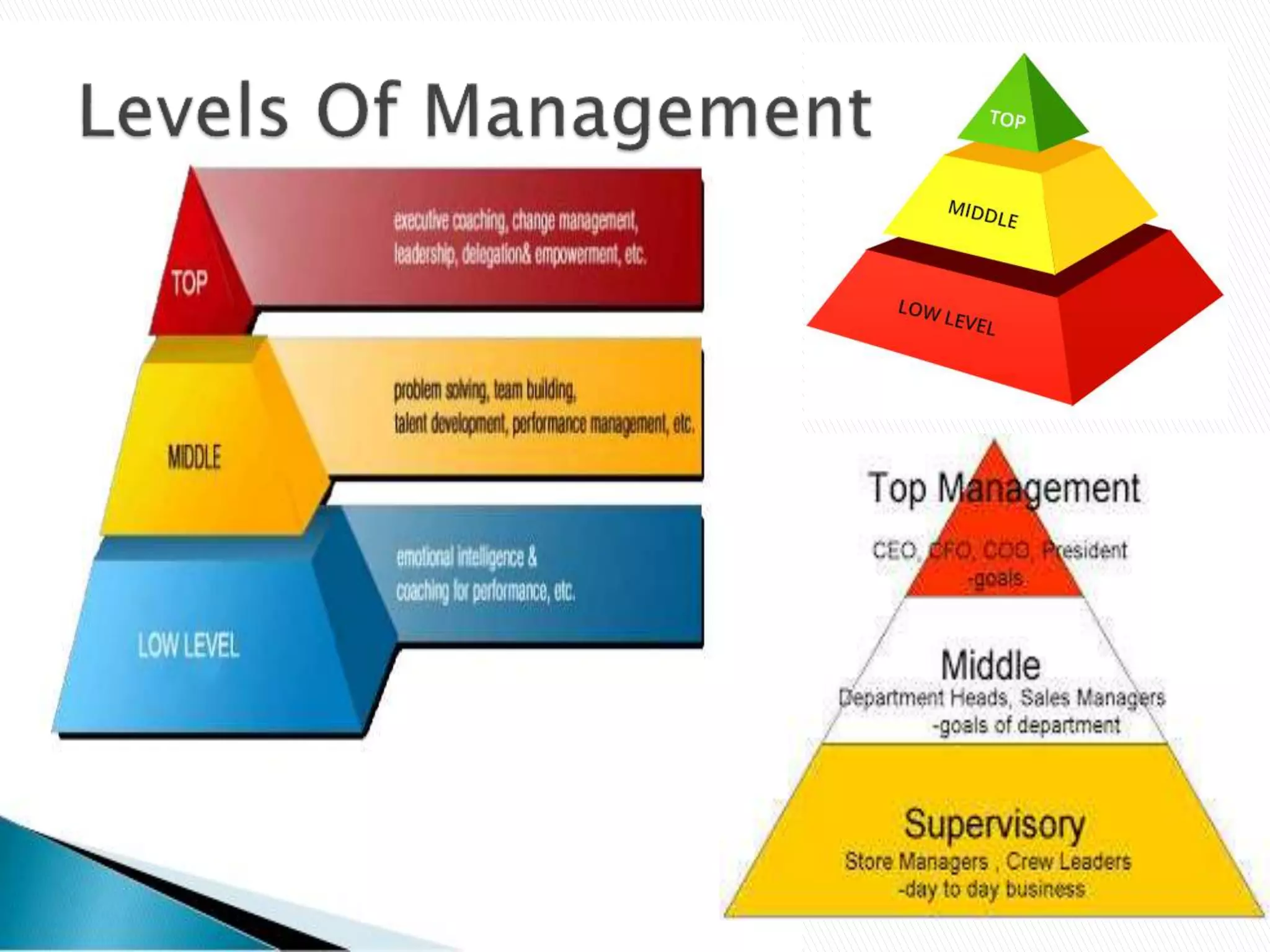
 The management of large organization may
have three levels.
 Senior management (or " top management” or
" upper management”).
 Middle management.
 Low-level management, such as supervisors
or team leaders.
 Require an extensive knowledge of management
roles and skills.
 They have to be very aware of external factors
such as market.
 There decisions are generally of long-term
nature.
 Their decisions are made using analytic,
directive, conceptual and or
behavioral/participative process.
 There are responsible for strategic decisions.
 They have out to chalk out the plan and see the
plan me be effective in future.
 They are executive in nature.
 Develops and reviews long range plans and
strategies.
 Evaluates overall performance of various
departments and ensure cooperation.
 Involved in selection of key personnel.
 Consults subordinate managers on subjects
or problems of general scope.
 Mid-Level Managers have a specialized
understanding of certain managerial tasks.
 They are responsible for carrying out the
decisions made by top-Level Management.
 make plans of intermediate range and
prepares long-range plans for review by top
management.
 Analyzes managerial performance to
determine capability and readiness for
promotion.
 Established department polices.
Reviews daily and weekly
reports on production or
sales.
Counsels subordinate on
production, personnel or
other problems.
Selection and recruitment
of personnel.
Middle
Management
 This level of management ensures that the
decisions and plans are taken by the other
are carried out.
 Low-level managers decision are generally
short-term ones.
 Makes detailed, short-range operating plans.
 Reviews performance of subordinates.
 Supervises day to day operations.
 Makes specific task assignments.
 Maintains close contact with
 operative employees.
 Planning the work
 Decision maker
 Delegating authority
 Problem solver
 Coordinator
 Target setter
 Guiding the subordinates
 Arranging the facilities
 Control the deviations
 Director
 Motivator
 Guide
 Planner
 Supervisor
 Reporter
LEVELS OF MANAGEMENT

LEVELS OF MANAGEMENT

  • 1.
  • 2.
     A manageris a person responsible for planning and directing the work of a group of individual, monitoring their work, and taking corrective action when necessary. For many people, this is the first step into a management career.
  • 3.
     "Managers playsan activating role in organizations. The success of organization depend on the successful functioning of management. the management is responsible for planning, organizing, integrating and interrelating organizational activities and resources for achieving common objectives”.
  • 4.
     Harold Koontz: "Management is the art of getting things done through and with people in formally organized groups. It is the art of creating environment in which people can perform and individuals could co-operate towards attaining of group goals. It is the art of removing block to such performance, a way of optimizing efficiency.
  • 5.
     The managementof large organization may have three levels.  Senior management (or " top management” or " upper management”).  Middle management.  Low-level management, such as supervisors or team leaders.
  • 7.
     Require anextensive knowledge of management roles and skills.  They have to be very aware of external factors such as market.  There decisions are generally of long-term nature.  Their decisions are made using analytic, directive, conceptual and or behavioral/participative process.  There are responsible for strategic decisions.  They have out to chalk out the plan and see the plan me be effective in future.  They are executive in nature.
  • 8.
     Develops andreviews long range plans and strategies.  Evaluates overall performance of various departments and ensure cooperation.  Involved in selection of key personnel.  Consults subordinate managers on subjects or problems of general scope.
  • 9.
     Mid-Level Managershave a specialized understanding of certain managerial tasks.  They are responsible for carrying out the decisions made by top-Level Management.  make plans of intermediate range and prepares long-range plans for review by top management.  Analyzes managerial performance to determine capability and readiness for promotion.  Established department polices.
  • 10.
    Reviews daily andweekly reports on production or sales. Counsels subordinate on production, personnel or other problems. Selection and recruitment of personnel. Middle Management
  • 11.
     This levelof management ensures that the decisions and plans are taken by the other are carried out.  Low-level managers decision are generally short-term ones.  Makes detailed, short-range operating plans.  Reviews performance of subordinates.  Supervises day to day operations.  Makes specific task assignments.  Maintains close contact with  operative employees.
  • 12.
     Planning thework  Decision maker  Delegating authority  Problem solver  Coordinator  Target setter  Guiding the subordinates  Arranging the facilities  Control the deviations
  • 13.
     Director  Motivator Guide  Planner  Supervisor  Reporter