COOLING TOWER 
ASHIF A R 
ashifmsd@gmail.com 
Phone No. - 9745350127 
1
CONTENTS 
• INTRODUCTION 
• COOLING TOWER SYSTEM 
• ASSESSMENT OF COOLING TOWER 
• CONCLUSION 
• REFERENCES 
2
INTRODUCTION 
• Semi-enclosed device for evaporative cooling of water by contact with air 
• Cooling towers vary in size from small roof-top units to very large 
hyperboloid structures 
3
Classification by use 
By use 
• Heating, ventilation and air conditioning (HVAC) 
• Industrial cooling towers 
By build 
• Package type 
• Field erected type 
4
5
COOLING TOWER - BASICS 
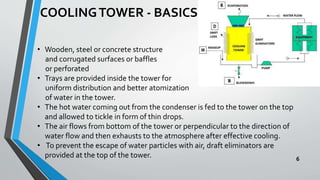
• Wooden, steel or concrete structure 
and corrugated surfaces or baffles 
or perforated 
• Trays are provided inside the tower for 
uniform distribution and better atomization 
of water in the tower. 
• The hot water coming out from the condenser is fed to the tower on the top 
and allowed to tickle in form of thin drops. 
• The air flows from bottom of the tower or perpendicular to the direction of 
water flow and then exhausts to the atmosphere after effective cooling. 
• To prevent the escape of water particles with air, draft eliminators are 
provided at the top of the tower. 
6
COOLING TOWER SYSTEM 
• The water pumped from the tower basin is the 
cooling water routed through the process coolers 
and condensers in an industrial facility. 
• The cool water absorbs heat from the hot process 
streams which need to be cooled or condensed 
and the absorbed heat warms the circulating 
water (C). 
• The warm water returns to the top of the cooling 
tower and trickles downward over the fill material 
inside the tower. 
• It comes in contact with ambient air rising up 
through the tower either by natural draft or by 
forced draft using large fans in the tower. 
Where, 
C = Circulating cooling water 
E = Evaporated water 
W = Windage or Drift loss 
M = Make-up water 
D = Draw-off or Blow down water 
7
COOLING TOWER SYSTEM….... 
• Contact causes a small amount of the water to be lost as 
wind age (W) and some of the water (E) to evaporate. 
• The heat required to evaporate the water is derived from 
the water itself, which cools the water back to the original 
basin water temperature and the water is then ready to 
recirculate. 
• The evaporated water leaves its dissolved salts behind in 
the bulk of the water which has not been evaporated, thus 
raising the salt concentration in the circulating cooling 
water. 
• To prevent the salt concentration of the water from 
becoming too high, a portion of the water is drawn off (D) 
for disposal. 
• Fresh make-up water (M) is supplied to the tower basin to 
compensate for the loss of evaporated water, the wind age 
loss water and the draw-off water. 
Where, 
C = Circulating cooling water 
E = Evaporated water 
W = Windage or Drift loss 
M = Make-up water 
D = Draw-off or Blow down water 
8
ASSESSMENT OF COOLING TOWER 
RANGE 
• This is the difference between the cooling tower water 
inlet and outlet temperature. 
• A high CT Range means that the cooling tower has been 
able to reduce the water temperature effectively, and is 
thus performing well 
APPROACH 
• This is the difference between the cooling tower outlet 
cold water temperature and ambient wet bulb 
temperature. Although, both range and approach should 
be monitored, the `Approach’ is a better indicator of 
cooling tower performance. 
EFFECTIVENESS 
• This is the ratio between the range and the ideal range (in 
percentage), i.e. difference between cooling water inlet 
temperature and ambient wet bulb temperature, or in 
other words it is 
= Range / (Range + Approach). 
Range and Approach of cooling tower 
9
Structural stability 
• Being very large structures, cooling towers are susceptible to wind damage, and several 
spectacular failures have occurred in the past. 
• At Ferry bridge power station on 1 November 1965, the station was the site of a major 
structural failure, when three of the cooling towers collapsed owing to vibrations in 85 mph 
(137 km/h) winds. 
• Although the structures had been built to withstand higher wind speeds, the shape of the 
cooling towers caused westerly winds to be funnelled into the towers themselves, creating 
a vortex. 
• Three out of the original eight cooling towers were destroyed, and the remaining five were 
severely damaged. 
• The towers were later rebuilt and all eight cooling towers were strengthened to tolerate 
adverse weather conditions. 
• Building codes were changed to include improved structural support, and wind tunnel tests 
were introduced to check tower structures and configuration. 10
CONCLUSION 
• The design of cooling tower is closely related to tower Characteristic and 
different types of losses generated in cooling tower. 
• Even though losses are generated in the cooling tower, the cooling is 
achieved due to heat transfer between air and water. 
• In ideal condition, the heat loss by water must be equal to heat gain by air. 
• But in actual practice it is not possible because of some type of losses. 
• Cooling tower performance increases with increase in air flow rate and 
characteristic decreases with increase in water to air mass ratio. 
11
REFERENCES 
1. Kai Wang, Feng - zhong Sun, Yuan-bin Zhao, Ming Gao, Lei Ruan, 
Experimental research of the guiding channels effect on the thermal 
performance of wet cooling towers subjected to crosswinds – Air guiding 
effect on cooling tower, Applied Thermal Engineering 30 (2010) 533–538. 
2. Z. Zhai, S. Fu, Improving cooling efficiency of drycooling towers under 
cross-wind conditions by using wind-break methods, Applied Thermal 
Engineering 26 (2006) 1008–1017. 
3. Jameel - Ur - Rehman Khan, Bilal Ahmed Qureshi, Saiyed M. Zubair, A 
comprehensive design and performance evaluation study of counter flow 
wet cooling towers, Internal Journal of Refrigeration 27 (2004) 914-923. 
4. Wikipedia(Images) 
12

Cooling tower

  • 1.
    COOLING TOWER ASHIFA R ashifmsd@gmail.com Phone No. - 9745350127 1
  • 2.
    CONTENTS • INTRODUCTION • COOLING TOWER SYSTEM • ASSESSMENT OF COOLING TOWER • CONCLUSION • REFERENCES 2
  • 3.
    INTRODUCTION • Semi-encloseddevice for evaporative cooling of water by contact with air • Cooling towers vary in size from small roof-top units to very large hyperboloid structures 3
  • 4.
    Classification by use By use • Heating, ventilation and air conditioning (HVAC) • Industrial cooling towers By build • Package type • Field erected type 4
  • 5.
  • 6.
    COOLING TOWER -BASICS • Wooden, steel or concrete structure and corrugated surfaces or baffles or perforated • Trays are provided inside the tower for uniform distribution and better atomization of water in the tower. • The hot water coming out from the condenser is fed to the tower on the top and allowed to tickle in form of thin drops. • The air flows from bottom of the tower or perpendicular to the direction of water flow and then exhausts to the atmosphere after effective cooling. • To prevent the escape of water particles with air, draft eliminators are provided at the top of the tower. 6
  • 7.
    COOLING TOWER SYSTEM • The water pumped from the tower basin is the cooling water routed through the process coolers and condensers in an industrial facility. • The cool water absorbs heat from the hot process streams which need to be cooled or condensed and the absorbed heat warms the circulating water (C). • The warm water returns to the top of the cooling tower and trickles downward over the fill material inside the tower. • It comes in contact with ambient air rising up through the tower either by natural draft or by forced draft using large fans in the tower. Where, C = Circulating cooling water E = Evaporated water W = Windage or Drift loss M = Make-up water D = Draw-off or Blow down water 7
  • 8.
    COOLING TOWER SYSTEM….... • Contact causes a small amount of the water to be lost as wind age (W) and some of the water (E) to evaporate. • The heat required to evaporate the water is derived from the water itself, which cools the water back to the original basin water temperature and the water is then ready to recirculate. • The evaporated water leaves its dissolved salts behind in the bulk of the water which has not been evaporated, thus raising the salt concentration in the circulating cooling water. • To prevent the salt concentration of the water from becoming too high, a portion of the water is drawn off (D) for disposal. • Fresh make-up water (M) is supplied to the tower basin to compensate for the loss of evaporated water, the wind age loss water and the draw-off water. Where, C = Circulating cooling water E = Evaporated water W = Windage or Drift loss M = Make-up water D = Draw-off or Blow down water 8
  • 9.
    ASSESSMENT OF COOLINGTOWER RANGE • This is the difference between the cooling tower water inlet and outlet temperature. • A high CT Range means that the cooling tower has been able to reduce the water temperature effectively, and is thus performing well APPROACH • This is the difference between the cooling tower outlet cold water temperature and ambient wet bulb temperature. Although, both range and approach should be monitored, the `Approach’ is a better indicator of cooling tower performance. EFFECTIVENESS • This is the ratio between the range and the ideal range (in percentage), i.e. difference between cooling water inlet temperature and ambient wet bulb temperature, or in other words it is = Range / (Range + Approach). Range and Approach of cooling tower 9
  • 10.
    Structural stability •Being very large structures, cooling towers are susceptible to wind damage, and several spectacular failures have occurred in the past. • At Ferry bridge power station on 1 November 1965, the station was the site of a major structural failure, when three of the cooling towers collapsed owing to vibrations in 85 mph (137 km/h) winds. • Although the structures had been built to withstand higher wind speeds, the shape of the cooling towers caused westerly winds to be funnelled into the towers themselves, creating a vortex. • Three out of the original eight cooling towers were destroyed, and the remaining five were severely damaged. • The towers were later rebuilt and all eight cooling towers were strengthened to tolerate adverse weather conditions. • Building codes were changed to include improved structural support, and wind tunnel tests were introduced to check tower structures and configuration. 10
  • 11.
    CONCLUSION • Thedesign of cooling tower is closely related to tower Characteristic and different types of losses generated in cooling tower. • Even though losses are generated in the cooling tower, the cooling is achieved due to heat transfer between air and water. • In ideal condition, the heat loss by water must be equal to heat gain by air. • But in actual practice it is not possible because of some type of losses. • Cooling tower performance increases with increase in air flow rate and characteristic decreases with increase in water to air mass ratio. 11
  • 12.
    REFERENCES 1. KaiWang, Feng - zhong Sun, Yuan-bin Zhao, Ming Gao, Lei Ruan, Experimental research of the guiding channels effect on the thermal performance of wet cooling towers subjected to crosswinds – Air guiding effect on cooling tower, Applied Thermal Engineering 30 (2010) 533–538. 2. Z. Zhai, S. Fu, Improving cooling efficiency of drycooling towers under cross-wind conditions by using wind-break methods, Applied Thermal Engineering 26 (2006) 1008–1017. 3. Jameel - Ur - Rehman Khan, Bilal Ahmed Qureshi, Saiyed M. Zubair, A comprehensive design and performance evaluation study of counter flow wet cooling towers, Internal Journal of Refrigeration 27 (2004) 914-923. 4. Wikipedia(Images) 12