Adiabatic Cooling Tower
Asian Paints Limited
Index
• Cooling tower-Overview
• Cooling towers at APL
• Types of cooling tower
• Working principle of cooling towers
• Adiabatic process in cooling tower
• Vendor consideration
• Technical & Cost comparison
• Reference
• Recommendation
Cooling tower
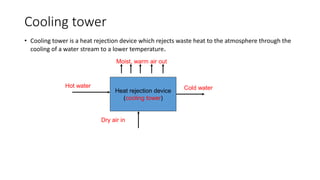
• Cooling tower is a heat rejection device which rejects waste heat to the atmosphere through the
cooling of a water stream to a lower temperature.
Heat rejection device
(cooling tower)
Cold water
Moist, warm air out
Dry air in
Hot water
Cooling towers at APL
• Application
• Cooling of the emulsion process equipment's
• Cooling of the TSD’s
• Cooling of the chiller condenser & air compressors
• Radiator cooling of the Generator set
• We mostly use conventional cooling tower to achieve the desired temperature in the system.
Drawbacks of the existing system:
• Conventional cooling tower evaporates the 1% of the water, flows through cooling tower every hour.
i.e. if water flow through cooling tower is 100 m3/hr than 1 m3 (1KL) water gets evaporates every hour.
• Daily chemical treatment required in the cooling tower to reduce scale formation in cooling lines.
• Due to evaporation of water, TDS of the water increased gradually and that needs to blowdown that
also add in to the loss of water.
• Water required by the cooling tower is either soft water or RO water, that will further add in the loss of
water during the water treatment.
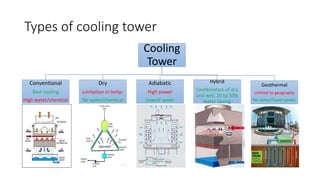
Types of cooling tower
Cooling
Tower
Conventional
Best cooling
High water/chemical
Dry
Limitation in temp.
No water/chemical
Adiabatic
High power
Lowest water
Hybrid
Combination of dry
and wet, 20 to 50%
water saving
Geothermal
Limited to geography
No water/lower power
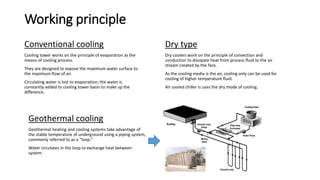
Working principle
Conventional cooling
Cooling tower works on the principle of evaporation as the
means of cooling process.
They are designed to expose the maximum water surface to
the maximum flow of air.
Circulating water is lost to evaporation; the water is
constantly added to cooling tower basin to make up the
difference.
Dry type
Dry coolers work on the principle of convection and
conduction to dissipate heat from process fluid to the air
stream created by the fans.
As the cooling media is the air, cooling only can be used for
cooling of higher temperature fluid.
Air cooled chiller is uses the dry mode of cooling.
Geothermal cooling
Geothermal heating and cooling systems take advantage of
the stable temperature of underground using a piping system,
commonly referred to as a “loop.”
Water circulates in the loop to exchange heat between
system.
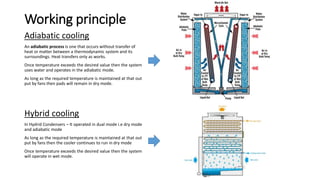
Working principle
Adiabatic cooling
An adiabatic process is one that occurs without transfer of
heat or matter between a thermodynamic system and its
surroundings. Heat transfers only as works.
Once temperature exceeds the desired value then the system
uses water and operates in the adiabatic mode.
As long as the required temperature is maintained at that out
put by fans then pads will remain in dry mode.
Hybrid cooling
In Hydrid Condensers – It operated in dual mode i.e dry mode
and adiabatic mode
As long as the required temperature is maintained at that out
put by fans then the cooler continues to run in dry mode
Once temperature exceeds the desired value then the system
will operate in wet mode.
Adiabatic cooling tower-Principle
• Adiabatic cooling towers is works on the principle of the evaporative cooling ( principles on which desert
cooler works).
• Evaporative cooling is the addition of water vapor into air, which causes a lowering of the temperature of the
air.
• Energy needed to evaporate the water is taken from the air in the form of sensible heat, and latent heat of
evaporation (because of the evaporation of water by getting sensible heat from air) is added in to the air, hence
total internal energy (enthalpy) of the air will remain same.
• As the air remains at constant enthalpy value (no change in internal energy), it is called as Adiabatic process.
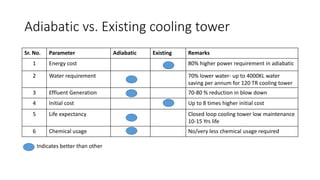
Adiabatic vs. Existing cooling tower
Sr. No. Parameter Adiabatic Existing Remarks
1 Energy cost 80% higher power requirement in adiabatic
2 Water requirement 70% lower water- up to 4000KL water
saving per annum for 120 TR cooling tower
3 Effluent Generation 70-80 % reduction in blow down
4 Initial cost Up to 8 times higher initial cost
5 Life expectancy Closed loop cooling tower low maintenance
10-15 Yrs life
6 Chemical usage No/very less chemical usage required
Indicates better than other
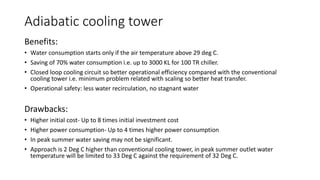
Adiabatic cooling tower
Benefits:
• Water consumption starts only if the air temperature above 29 deg C.
• Saving of 70% water consumption i.e. up to 3000 KL for 100 TR chiller.
• Closed loop cooling circuit so better operational efficiency compared with the conventional
cooling tower i.e. minimum problem related with scaling so better heat transfer.
• Operational safety: less water recirculation, no stagnant water
Drawbacks:
• Higher initial cost- Up to 8 times initial investment cost
• Higher power consumption- Up to 4 times higher power consumption
• In peak summer water saving may not be significant.
• Approach is 2 Deg C higher than conventional cooling tower, in peak summer outlet water
temperature will be limited to 33 Deg C against the requirement of 32 Deg C.
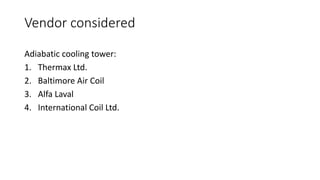
Vendor considered
Adiabatic cooling tower:
1. Thermax Ltd.
2. Baltimore Air Coil
3. Alfa Laval
4. International Coil Ltd.
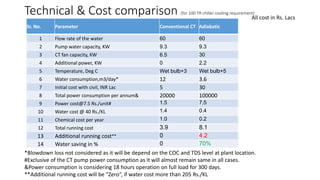
Technical & Cost comparison (for 100 TR chiller cooling requirement)
*Blowdown loss not considered as it will be depend on the COC and TDS level at plant location.
#Exclusive of the CT pump power consumption as it will almost remain same in all cases.
&Power consumption is considering 18 hours operation on full load for 300 days.
**Additional running cost will be “Zero”, if water cost more than 205 Rs./KL
Sr. No. Parameter Conventional CT Adiabatic
1 Flow rate of the water 60 60
2 Pump water capacity, KW 9.3 9.3
3 CT fan capacity, KW 6.5 30
4 Additional power, KW 0 2.2
5 Temperature, Deg C Wet bulb+3 Wet bulb+5
6 Water consumption,m3/day* 12 3.6
7 Initial cost with civil, INR Lac 5 30
8 Total power consumption per annum& 20000 100000
9 Power cost@7.5 Rs./unit# 1.5 7.5
10 Water cost @ 40 Rs./KL 1.4 0.4
11 Chemical cost per year 1.0 0.2
12 Total running cost 3.9 8.1
13 Additional running cost** 0 4.2
14 Water saving in % 0 70%
All cost in Rs. Lacs
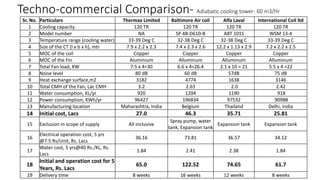
Techno-commercial Comparison- Adiabatic cooling tower- 60 m3/Hr
Sr. No. Particulars Thermax Limited Baltimore Air coil Alfa Laval International Coil ltd
1 Cooling capacity 120 TR 120 TR 120 TR 120 TR
2 Model number NA SP 4B-D610-B ABT 101S WSM 13-4
3 Temperature range (cooling water) 33-39 Deg C 32-38 Deg C 32-38 Deg C 33-39 Deg C
4 Size of the CT (l x b x h), mtr 7.9 x 2.2 x 2.3 7.4 x 2.3 x 2.6 12.2 x 1.13 x 2.9 7.2 x 2.2 x 2.5
5 MOC of the coil Copper Copper Copper Copper
6 MOC of the Fin Aluminium Alluminum Alluminum Alluminum
7 Total Fan load, KW 7.5 x 4=30 6.6 x 4=26.4 2.1 x 10 = 21 5.5 x 4 =22
8 Noise level 80 dB 60 dB 57dB 75 dB
9 Heat exchange surface,m2 3182 4774 1638 3146
10 Total CMH of the Fan, Lac CMH 3.2 2.63 2.0 2.42
11 Water consumption, KL/yr 920 1204 1190 918
12 Power consumption, KWh/yr 96427 196834 97532 90988
13 Manufacturing location Maharashtra, India Belgium Thailand Delhi, India
14 Initial cost, Lacs 27.0 46.3 35.71 25.81
15 Exclusion in scope of supply All inclusive
Spray pump, water
tank, Expansion tank
Expansion tank Expansion tank
16
Electrical operation cost, 5 yrs
@7.5 Rs/Unit, Rs. Lacs
36.16 73.81 36.57 34.12
17
Water cost, 5 yrs@40 Rs./KL, Rs.
Lacs
1.84 2.41 2.38 1.84
18
Initial and operation cost for 5
Years, Rs. Lacs
65.0 122.52 74.65 61.7
19 Delivery time 8 weeks 16 weeks 12 weeks 8 weeks
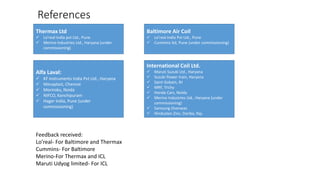
References
Thermax Ltd
 Lo’real India pvt Ltd., Pune
 Merino Industries Ltd., Haryana (under
commissioning)
Baltimore Air Coil
 Lo’real India Pvt Ltd., Pune
 Cummins ltd, Pune (under commissioning)
Alfa Laval:
 KF instruments India Pvt Ltd., Haryana
 Mecaplast, Chennai
 Moriroku, Noida
 NIFCO, Kanchipuram
 Hager India, Pune (under
commissioning)
International Coil Ltd.
 Maruti Suzuki Ltd., Haryana
 Suzuki Power train, Haryana
 Saint Gobain, RJ
 MRF, Trichy
 Honda Cars, Noida
 Merino Industries Ltd., Haryana (under
commissioning)
 Samsung Overseas
 Hindustan Zinc, Dariba, Raj.
Feedback received:
Lo’real- For Baltimore and Thermax
Cummins- For Baltimore
Merino-For Thermax and ICL
Maruti Udyog limited- For ICL
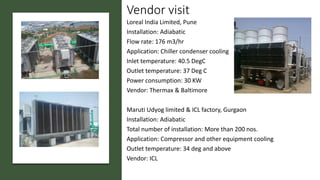
Vendor visit
Loreal India Limited, Pune
Installation: Adiabatic
Flow rate: 176 m3/hr
Application: Chiller condenser cooling
Inlet temperature: 40.5 DegC
Outlet temperature: 37 Deg C
Power consumption: 30 KW
Vendor: Thermax & Baltimore
Maruti Udyog limited & ICL factory, Gurgaon
Installation: Adiabatic
Total number of installation: More than 200 nos.
Application: Compressor and other equipment cooling
Outlet temperature: 34 deg and above
Vendor: ICL
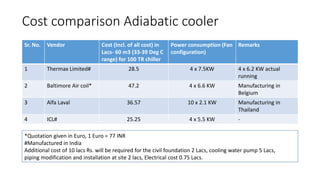
Cost comparison Adiabatic cooler
Sr. No. Vendor Cost (Incl. of all cost) in
Lacs- 60 m3 (33-39 Deg C
range) for 100 TR chiller
Power consumption (Fan
configuration)
Remarks
1 Thermax Limited# 28.5 4 x 7.5KW 4 x 6.2 KW actual
running
2 Baltimore Air coil* 47.2 4 x 6.6 KW Manufacturing in
Belgium
3 Alfa Laval 36.57 10 x 2.1 KW Manufacturing in
Thailand
4 ICL# 25.25 4 x 5.5 KW -
*Quotation given in Euro, 1 Euro = 77 INR
#Manufactured in India
Additional cost of 10 lacs Rs. will be required for the civil foundation 2 Lacs, cooling water pump 5 Lacs,
piping modification and installation at site 2 lacs, Electrical cost 0.75 Lacs.
Recommendation
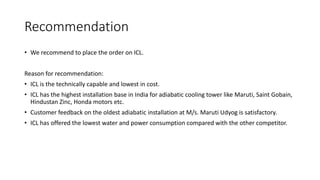
• We recommend to place the order on ICL.
Reason for recommendation:
• ICL is the technically capable and lowest in cost.
• ICL has the highest installation base in India for adiabatic cooling tower like Maruti, Saint Gobain,
Hindustan Zinc, Honda motors etc.
• Customer feedback on the oldest adiabatic installation at M/s. Maruti Udyog is satisfactory.
• ICL has offered the lowest water and power consumption compared with the other competitor.
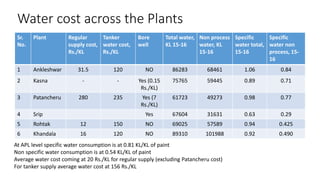
Water cost across the Plants
Sr.
No.
Plant Regular
supply cost,
Rs./KL
Tanker
water cost,
Rs./KL
Bore
well
Total water,
KL 15-16
Non process
water, KL
15-16
Specific
water total,
15-16
Specific
water non
process, 15-
16
1 Ankleshwar 31.5 120 NO 86283 68461 1.06 0.84
2 Kasna - - Yes (0.15
Rs./KL)
75765 59445 0.89 0.71
3 Patancheru 280 235 Yes (7
Rs./KL)
61723 49273 0.98 0.77
4 Srip Yes 67604 31631 0.63 0.29
5 Rohtak 12 150 NO 69025 57589 0.94 0.425
6 Khandala 16 120 NO 89310 101988 0.92 0.490
At APL level specific water consumption is at 0.81 KL/KL of paint
Non specific water consumption is at 0.54 KL/KL of paint
Average water cost coming at 20 Rs./KL for regular supply (excluding Patancheru cost)
For tanker supply average water cost at 156 Rs./KL

Adiabatic cooling tower v3 08.08

  • 1.
  • 2.
    Index • Cooling tower-Overview •Cooling towers at APL • Types of cooling tower • Working principle of cooling towers • Adiabatic process in cooling tower • Vendor consideration • Technical & Cost comparison • Reference • Recommendation
  • 3.
    Cooling tower • Coolingtower is a heat rejection device which rejects waste heat to the atmosphere through the cooling of a water stream to a lower temperature. Heat rejection device (cooling tower) Cold water Moist, warm air out Dry air in Hot water
  • 4.
    Cooling towers atAPL • Application • Cooling of the emulsion process equipment's • Cooling of the TSD’s • Cooling of the chiller condenser & air compressors • Radiator cooling of the Generator set • We mostly use conventional cooling tower to achieve the desired temperature in the system. Drawbacks of the existing system: • Conventional cooling tower evaporates the 1% of the water, flows through cooling tower every hour. i.e. if water flow through cooling tower is 100 m3/hr than 1 m3 (1KL) water gets evaporates every hour. • Daily chemical treatment required in the cooling tower to reduce scale formation in cooling lines. • Due to evaporation of water, TDS of the water increased gradually and that needs to blowdown that also add in to the loss of water. • Water required by the cooling tower is either soft water or RO water, that will further add in the loss of water during the water treatment.
  • 5.
    Types of coolingtower Cooling Tower Conventional Best cooling High water/chemical Dry Limitation in temp. No water/chemical Adiabatic High power Lowest water Hybrid Combination of dry and wet, 20 to 50% water saving Geothermal Limited to geography No water/lower power
  • 6.
    Working principle Conventional cooling Coolingtower works on the principle of evaporation as the means of cooling process. They are designed to expose the maximum water surface to the maximum flow of air. Circulating water is lost to evaporation; the water is constantly added to cooling tower basin to make up the difference. Dry type Dry coolers work on the principle of convection and conduction to dissipate heat from process fluid to the air stream created by the fans. As the cooling media is the air, cooling only can be used for cooling of higher temperature fluid. Air cooled chiller is uses the dry mode of cooling. Geothermal cooling Geothermal heating and cooling systems take advantage of the stable temperature of underground using a piping system, commonly referred to as a “loop.” Water circulates in the loop to exchange heat between system.
  • 7.
    Working principle Adiabatic cooling Anadiabatic process is one that occurs without transfer of heat or matter between a thermodynamic system and its surroundings. Heat transfers only as works. Once temperature exceeds the desired value then the system uses water and operates in the adiabatic mode. As long as the required temperature is maintained at that out put by fans then pads will remain in dry mode. Hybrid cooling In Hydrid Condensers – It operated in dual mode i.e dry mode and adiabatic mode As long as the required temperature is maintained at that out put by fans then the cooler continues to run in dry mode Once temperature exceeds the desired value then the system will operate in wet mode.
  • 8.
    Adiabatic cooling tower-Principle •Adiabatic cooling towers is works on the principle of the evaporative cooling ( principles on which desert cooler works). • Evaporative cooling is the addition of water vapor into air, which causes a lowering of the temperature of the air. • Energy needed to evaporate the water is taken from the air in the form of sensible heat, and latent heat of evaporation (because of the evaporation of water by getting sensible heat from air) is added in to the air, hence total internal energy (enthalpy) of the air will remain same. • As the air remains at constant enthalpy value (no change in internal energy), it is called as Adiabatic process.
  • 9.
    Adiabatic vs. Existingcooling tower Sr. No. Parameter Adiabatic Existing Remarks 1 Energy cost 80% higher power requirement in adiabatic 2 Water requirement 70% lower water- up to 4000KL water saving per annum for 120 TR cooling tower 3 Effluent Generation 70-80 % reduction in blow down 4 Initial cost Up to 8 times higher initial cost 5 Life expectancy Closed loop cooling tower low maintenance 10-15 Yrs life 6 Chemical usage No/very less chemical usage required Indicates better than other
  • 10.
    Adiabatic cooling tower Benefits: •Water consumption starts only if the air temperature above 29 deg C. • Saving of 70% water consumption i.e. up to 3000 KL for 100 TR chiller. • Closed loop cooling circuit so better operational efficiency compared with the conventional cooling tower i.e. minimum problem related with scaling so better heat transfer. • Operational safety: less water recirculation, no stagnant water Drawbacks: • Higher initial cost- Up to 8 times initial investment cost • Higher power consumption- Up to 4 times higher power consumption • In peak summer water saving may not be significant. • Approach is 2 Deg C higher than conventional cooling tower, in peak summer outlet water temperature will be limited to 33 Deg C against the requirement of 32 Deg C.
  • 11.
    Vendor considered Adiabatic coolingtower: 1. Thermax Ltd. 2. Baltimore Air Coil 3. Alfa Laval 4. International Coil Ltd.
  • 12.
    Technical & Costcomparison (for 100 TR chiller cooling requirement) *Blowdown loss not considered as it will be depend on the COC and TDS level at plant location. #Exclusive of the CT pump power consumption as it will almost remain same in all cases. &Power consumption is considering 18 hours operation on full load for 300 days. **Additional running cost will be “Zero”, if water cost more than 205 Rs./KL Sr. No. Parameter Conventional CT Adiabatic 1 Flow rate of the water 60 60 2 Pump water capacity, KW 9.3 9.3 3 CT fan capacity, KW 6.5 30 4 Additional power, KW 0 2.2 5 Temperature, Deg C Wet bulb+3 Wet bulb+5 6 Water consumption,m3/day* 12 3.6 7 Initial cost with civil, INR Lac 5 30 8 Total power consumption per annum& 20000 100000 9 Power cost@7.5 Rs./unit# 1.5 7.5 10 Water cost @ 40 Rs./KL 1.4 0.4 11 Chemical cost per year 1.0 0.2 12 Total running cost 3.9 8.1 13 Additional running cost** 0 4.2 14 Water saving in % 0 70% All cost in Rs. Lacs
  • 13.
    Techno-commercial Comparison- Adiabaticcooling tower- 60 m3/Hr Sr. No. Particulars Thermax Limited Baltimore Air coil Alfa Laval International Coil ltd 1 Cooling capacity 120 TR 120 TR 120 TR 120 TR 2 Model number NA SP 4B-D610-B ABT 101S WSM 13-4 3 Temperature range (cooling water) 33-39 Deg C 32-38 Deg C 32-38 Deg C 33-39 Deg C 4 Size of the CT (l x b x h), mtr 7.9 x 2.2 x 2.3 7.4 x 2.3 x 2.6 12.2 x 1.13 x 2.9 7.2 x 2.2 x 2.5 5 MOC of the coil Copper Copper Copper Copper 6 MOC of the Fin Aluminium Alluminum Alluminum Alluminum 7 Total Fan load, KW 7.5 x 4=30 6.6 x 4=26.4 2.1 x 10 = 21 5.5 x 4 =22 8 Noise level 80 dB 60 dB 57dB 75 dB 9 Heat exchange surface,m2 3182 4774 1638 3146 10 Total CMH of the Fan, Lac CMH 3.2 2.63 2.0 2.42 11 Water consumption, KL/yr 920 1204 1190 918 12 Power consumption, KWh/yr 96427 196834 97532 90988 13 Manufacturing location Maharashtra, India Belgium Thailand Delhi, India 14 Initial cost, Lacs 27.0 46.3 35.71 25.81 15 Exclusion in scope of supply All inclusive Spray pump, water tank, Expansion tank Expansion tank Expansion tank 16 Electrical operation cost, 5 yrs @7.5 Rs/Unit, Rs. Lacs 36.16 73.81 36.57 34.12 17 Water cost, 5 yrs@40 Rs./KL, Rs. Lacs 1.84 2.41 2.38 1.84 18 Initial and operation cost for 5 Years, Rs. Lacs 65.0 122.52 74.65 61.7 19 Delivery time 8 weeks 16 weeks 12 weeks 8 weeks
  • 14.
    References Thermax Ltd  Lo’realIndia pvt Ltd., Pune  Merino Industries Ltd., Haryana (under commissioning) Baltimore Air Coil  Lo’real India Pvt Ltd., Pune  Cummins ltd, Pune (under commissioning) Alfa Laval:  KF instruments India Pvt Ltd., Haryana  Mecaplast, Chennai  Moriroku, Noida  NIFCO, Kanchipuram  Hager India, Pune (under commissioning) International Coil Ltd.  Maruti Suzuki Ltd., Haryana  Suzuki Power train, Haryana  Saint Gobain, RJ  MRF, Trichy  Honda Cars, Noida  Merino Industries Ltd., Haryana (under commissioning)  Samsung Overseas  Hindustan Zinc, Dariba, Raj. Feedback received: Lo’real- For Baltimore and Thermax Cummins- For Baltimore Merino-For Thermax and ICL Maruti Udyog limited- For ICL
  • 15.
    Vendor visit Loreal IndiaLimited, Pune Installation: Adiabatic Flow rate: 176 m3/hr Application: Chiller condenser cooling Inlet temperature: 40.5 DegC Outlet temperature: 37 Deg C Power consumption: 30 KW Vendor: Thermax & Baltimore Maruti Udyog limited & ICL factory, Gurgaon Installation: Adiabatic Total number of installation: More than 200 nos. Application: Compressor and other equipment cooling Outlet temperature: 34 deg and above Vendor: ICL
  • 16.
    Cost comparison Adiabaticcooler Sr. No. Vendor Cost (Incl. of all cost) in Lacs- 60 m3 (33-39 Deg C range) for 100 TR chiller Power consumption (Fan configuration) Remarks 1 Thermax Limited# 28.5 4 x 7.5KW 4 x 6.2 KW actual running 2 Baltimore Air coil* 47.2 4 x 6.6 KW Manufacturing in Belgium 3 Alfa Laval 36.57 10 x 2.1 KW Manufacturing in Thailand 4 ICL# 25.25 4 x 5.5 KW - *Quotation given in Euro, 1 Euro = 77 INR #Manufactured in India Additional cost of 10 lacs Rs. will be required for the civil foundation 2 Lacs, cooling water pump 5 Lacs, piping modification and installation at site 2 lacs, Electrical cost 0.75 Lacs.
  • 17.
    Recommendation • We recommendto place the order on ICL. Reason for recommendation: • ICL is the technically capable and lowest in cost. • ICL has the highest installation base in India for adiabatic cooling tower like Maruti, Saint Gobain, Hindustan Zinc, Honda motors etc. • Customer feedback on the oldest adiabatic installation at M/s. Maruti Udyog is satisfactory. • ICL has offered the lowest water and power consumption compared with the other competitor.
  • 18.
    Water cost acrossthe Plants Sr. No. Plant Regular supply cost, Rs./KL Tanker water cost, Rs./KL Bore well Total water, KL 15-16 Non process water, KL 15-16 Specific water total, 15-16 Specific water non process, 15- 16 1 Ankleshwar 31.5 120 NO 86283 68461 1.06 0.84 2 Kasna - - Yes (0.15 Rs./KL) 75765 59445 0.89 0.71 3 Patancheru 280 235 Yes (7 Rs./KL) 61723 49273 0.98 0.77 4 Srip Yes 67604 31631 0.63 0.29 5 Rohtak 12 150 NO 69025 57589 0.94 0.425 6 Khandala 16 120 NO 89310 101988 0.92 0.490 At APL level specific water consumption is at 0.81 KL/KL of paint Non specific water consumption is at 0.54 KL/KL of paint Average water cost coming at 20 Rs./KL for regular supply (excluding Patancheru cost) For tanker supply average water cost at 156 Rs./KL